• Skip to primary navigation
  • Skip to main content
  • Skip to primary sidebar

Carnegie Museum of Natural History

One of the Four Carnegie Museums of Pittsburgh

  • Visit
    • Buy Tickets
    • Visitor Information
    • Exhibitions
    • Events
    • Dining at the Museum
    • Celebrate at the Museum
    • Powdermill Nature Reserve
    • Event Venue Rental
  • Learn
    • Field Trips
    • Educator Information
    • Programs at the Museum
    • Bring the Museum to You
    • Guided Programs FAQ
    • Programs Online
    • Climate and Rural Systems Partnership
  • Research
    • Scientific Sections
    • Science Stories
    • Science Videos
    • Senior Science & Research Staff
    • Museum Library
    • Science Seminars
    • Scientific Publications
    • Specimen and Artifact Identification
  • About
    • Mission & Commitments
    • Directors Team
    • Museum History
  • Tickets
  • Give
  • Shop

diplodocus carnegii

August 17, 2018 by wpengine

Memoirs of the Carnegie Museum Volume 1, Number 1

By John Wible

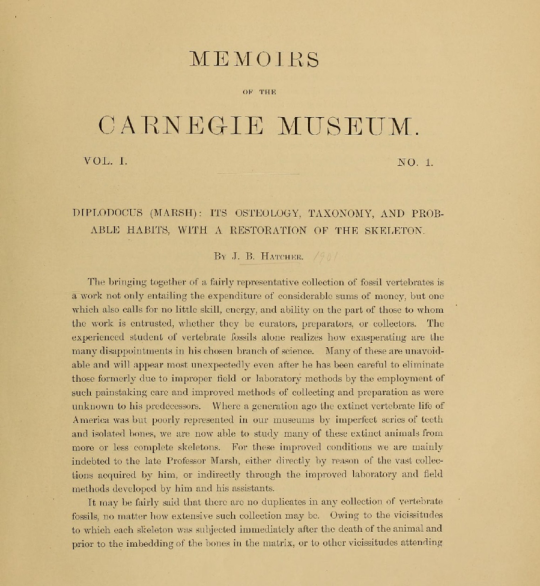
Memoirs of the Carnegie Museum, Volume 1, Number 1

William J. Holland, Director of the Carnegie Museum, announced a new publication series, the Memoirs of the Carnegie Museum, by stating … “To the fame of Pittsburgh as the seat of some of the most Cyclopean industries of the age is being added reputation as a seat of learning. Under the cloud of smoke, which attests the industry of her inhabitants, and is the sign of her material prosperity, live men who find their pleasure in exploring the wonders of the material universe, and the record of their discoveries and researches will be from year to year be found.”

The very first number of this new series was published in July 1901. It announced the discovery of a new species of dinosaur, Diplodocus carnegii, which staff paleontologist John Bell Hatcher named for the museum’s founder, Andrew Carnegie. Hatcher’s 63-page text included a bone-by-bone description of two skeletons collected in 1899 and 1900 from the same quarry in Sheep Creek, Wyoming. Given the number of vertebrae (backbones), most of the text is about them!

Hatcher restored the skeleton in a pose “the animal must have frequently assumed when feeding upon the soft and succulent plants that grew in abundance along the shores of the shallow waters about and in which these Dinosaurs lived” (p. 57).
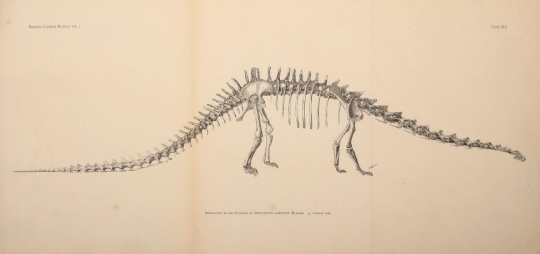
drawing of diplodocus carnegii fossil

This is the pose for Dippy that most Pittsburghers will remember in the old dinosaur hall.
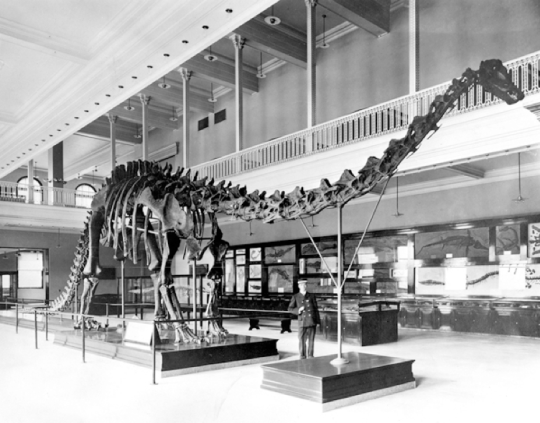
diplodocus carnegii fossil in Dinosaur Hall

In fact, many museum goers around the world know the same pose because Andrew Carnegie donated casts of Diplodocus carnegii to the major museums in Europe, Mexico, and Argentina. The Pittsburgh mount changed in 2007 to bring it up-to-date with current scientific knowledge. To see the updated pose, you will have to come visit the museum.

John Wible, PhD, is the curator of the Section of Mammals at Carnegie Museum of Natural History and editor of Annals of Carnegie Museum. John’s research is focused on the tree of life of mammals, understanding the evolutionary relationships between living and extinct taxa, and how the mammalian fauna on Earth got to be the way it is today. He uses his expertise on the anatomy of living mammals to reconstruct the lifeways of extinct mammals. John lives with his wife and two sons in a house full of cats and rabbits in Ross Township. Museum employees are encouraged to blog about their unique experiences and knowledge gained from working at the museum.
Filed Under: Blog Tagged With: Andrew Carnegie, diplodocus carnegii, Dippy 125, John Bell Hatcher, Mason Heberling

July 11, 2018 by wpengine

The Two-Headed Dinosaur

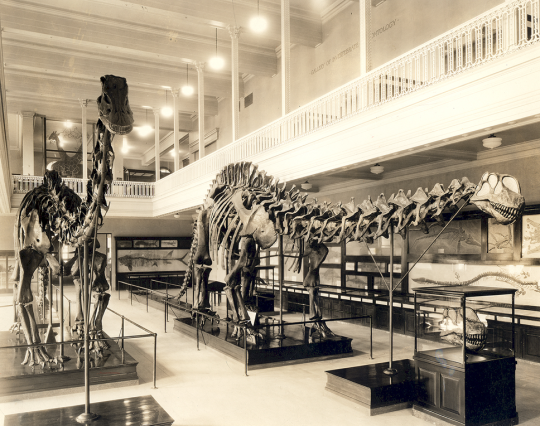
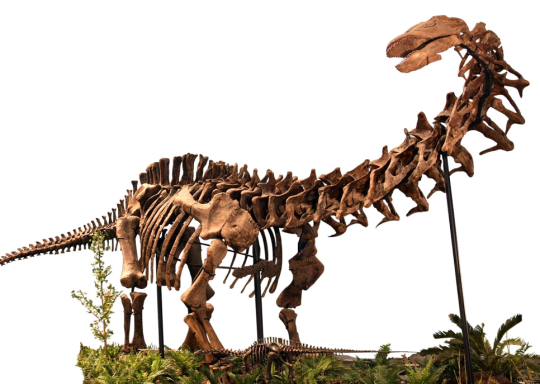
Apatosaurus is a sauropod, or long-necked plant-eating dinosaur, that lived in western North America during the late Jurassic Period roughly 150 million years ago. In the early 20th century, scientists couldn’t agree on what kind of head Apatosaurus had. No skull had ever been found attached to a neck of this dinosaur. So, when Carnegie Museum of Natural History mounted its most complete Apatosaurus skeleton in 1915, it did so without including a skull.

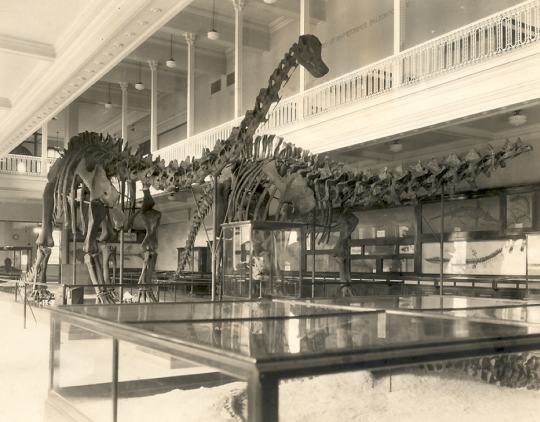
Apatosaurus louisae (right) as it was originally mounted in 1915, without a skull. At left is the skeleton of its relative Diplodocus carnegii.
Carnegie Museum of Natural History’s skeleton of Apatosaurus louisae (right) as it was originally mounted in 1915, without a skull. At left is the skeleton of its relative Diplodocus carnegii, better known as ‘Dippy.’ Credit: Carnegie Museum of Natural History.

The mount stood headless until 1932, when the museum followed prevailing scientific opinion of the day and placed a blunt-snouted, broad-toothed skull on the Apatosaurus. It remained there for another 47 years.

Apatosaurus and Diplodocus skeletons
Apatosaurus (right) and Diplodocus, ca. 1932, after a skull of the blunt-snouted sauropod Camarasaurus lentus had been mounted on the Apatosaurus skeleton. Credit: Carnegie Museum of Natural History.

In 1978, however, Carnegie Museum of Natural History paleontologist Dave Berman and museum research associate Jack McIntosh reasoned that a very different, more Diplodocus-like skull found with the Apatosaurus skeleton back in 1910 was most probably the correct one. A subsequent discovery of a still-connected Apatosaurus skull and neck proved them correct. In 1979, the museum’s Apatosaurus louisae was finally fitted with its proper skull – more than seven decades after its discovery! It remains that way today, on public exhibit in the museum’s dinosaur gallery, Dinosaurs in Their Time.

Apatosaurus Louise
Apatosaurus as it looks today, displayed with its correct skull, which closely resembles that of its relative, Diplodocus. Credit: Melinda McNaugher, Carnegie Museum of Natural History.

Matt Lamanna is a paleontologist and the principal dinosaur researcher at Carnegie Museum of Natural History in Pittsburgh.  Museum employees are encouraged to blog about their unique experiences and knowledge gained from working at the museum.
Related Content

Ask a Scientist: What kind of dinosaur was a megaraptorid?

Mesozoic Monthly: Dreadnoughtus

The Strange Saga of Spinosaurus, the Semiaquatic Dinosaurian Superpredator

Filed Under: Blog Tagged With: dinofest, dinosaur, dinosaurs in their time, diplodocus carnegii, fossils, Matt Lamanna, Vertebrate Paleontology

June 5, 2018 by wpengine

Oh Say Can You Dippy: Andrew Carnegie and His Dinosaurs

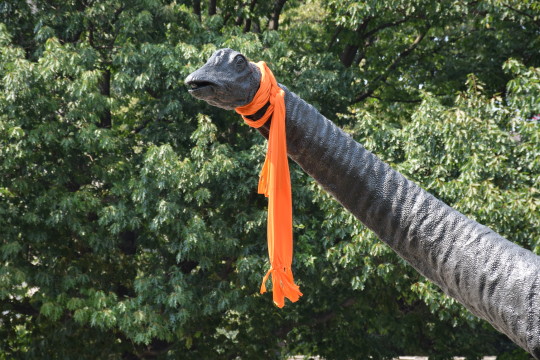
Dippy in an orange scarf

By Anna Weber

Did you know that the ever-popular Dippy the Dinosaur and the American state may or may not share a birthday of sorts? That’s right: though Diplodocus carnegii lived hundreds of millions of years ago, Dippy the fossil was unearthed in Sheep Creek, Wyoming on one of the first days of July 1899. But how did Dippy end up in Pittsburgh, and why was this species named after Andrew Carnegie?

One hundred years ago, if you were a steel magnate, you were also a collector and an investor. You collected or invested in art, real estate and houses, cars, or perhaps even dinosaurs. The expedition that unearthed Dippy was funded by Carnegie, and paleontologist John Bell Hatcher named the new species in honor of the investor himself. When King Edward VII of England expressed an interest to Carnegie in acquiring a replica for what was then called the British Museum of Natural History in London, so launched a business of replicating Dippy the more-than-80-foot dinosaur for museums worldwide.

Why had Carnegie been so interested in getting his hands on his very own dinosaur? Forever interested in evolution and Darwin, Carnegie wanted to continue learning about the natural world and provide this education to the greater Pittsburgh community in order to help all of us better understand our own evolution as humans. In addition, sharing the knowledge derived from the digs, as well as sharing the literal skeletons and fossils, helped foster better diplomacy between the US and other nations.

Carnegie’s dino fervor fueled a facet of the Carnegie Museum of Natural History for which it is still known. Today, Pittsburgh has one of the largest dinosaur collections in the United States, including the holotype of the T. Rex, meaning the first fossil of the world’s most famous dinosaur. As a nod to the museum’s renown, in the movie Silence of the Lambs, Clarice Starling (played by Jodie Foster) walks past a T. Rex skeleton when she visits an etymologist in order to identify the moth.

As you may have noticed, lawns, squares, courtyards, and foyers around the city are graced with statues of T. Rexes, Triceratopses, and Stegosauruses in homage to the Carnegie Museum’s collection. Walk the Burgh and Bike the Burgh’s downtown tours introduce walkers to several of these statues: a T. Rex wearing paintings of excavations, a Stegosaurus made of glass, and a Triceratops in the shape of a Heinz Ketchup bottle. Bike the Burgh also has a tour called “From Oakland to East Liberty: Land of Barons and Bankers,” which explores the “city beautiful” architecture of Oakland, including that of the Carnegie Museum itself. And on Walk the Burgh’s “Discover Oakland” tour, we’ll teach you more about Carnegie, the museums, and Diplodocus carnegii. If you come along, we can wave hello to the Dippy statue near Schenley Plaza as we bike or walk by.

Check out more facts about Dippy and our other dinosaurs on the Carnegie Museum of Natural History’s website, and check out more details about Walk the Burgh and Bike the Burgh’s tours at their sites, too.


Anna Weber is the Marketing and Outreach Coordinator for Bike the Burgh and Walk the Burgh Tours. She is working towards an MFA in creative nonfiction at Pitt. 

Filed Under: Blog Tagged With: diplodocus carnegii, dippy, Dippy 125

May 7, 2018 by wpengine

Dippy’s Looking Good in Our Museum Store

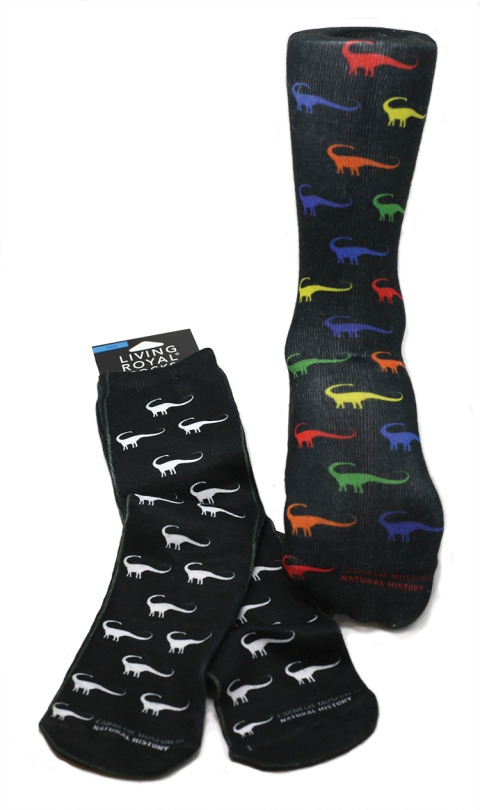
Thanks to our visitors for helping us to rebrand last year! You asked, and we listened: we are featuring Dippy on everything from coffee mugs to socks…

Socks with Dippy logo

We adore the socks and hope you will, too. The multi-colored Dippy’s bring a burst of fun to your wardrobe. The black and white ones are classy enough to pair with your wedding tux!

The Dippy silhouette is truly a community-created design that reflects our most famous (and first!) dino in Dinosaur Hall. Thank you for your role in bringing Diplodocus carnegii to life in a fresh, new way.

Did you get some Dippy swag? Take a selfie and tag us in it on Instagram @carnegiemnh! We’d love to see you loving Dippy.

Filed Under: Blog Tagged With: dinosaurs, diplodocus carnegii, dippy, gift shop

December 18, 2017 by wpengine

Have you tried Dippy Dino Rocks yet?

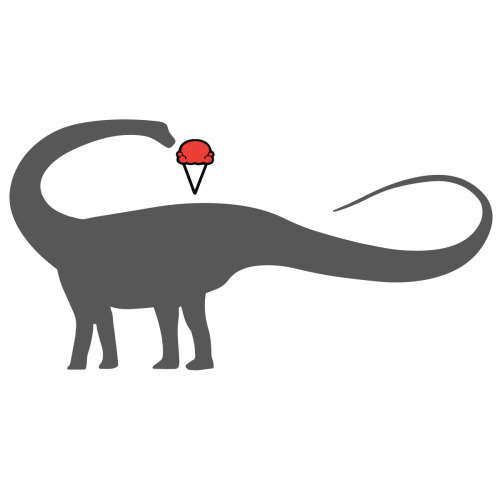
Dippy the dinosaur eating an ice cream coneHave you tried Dippy Dino Rocks yet? It is a new flavor of ice cream inspired by our most famous dinosaur Diplodocus carnegii, and it’s only available at Klavon’s Ice Cream Parlor in the Strip District.

Filed Under: Blog Tagged With: diplodocus carnegii, dippy

October 27, 2017 by wpengine

Dippy Inspires New Ice Cream Flavor

A local ice cream parlor asked that exact question this summer to develop Dippy Dino Rocks—a new flavor inspired by our museum’s most famous dinosaur!  Social media users chose a mint based ice cream with chocolate chip cookie dough, chocolate chips, and fudge ripple to honor Diplodocus carnegii, a giant sauropod discovered by Carnegie scientists. Most people know “Dippy” by the statue of him outside the museum, which sports seasonal scarves throughout the year.

What would an ice cream inspired by a dinosaur taste like?

A local ice cream parlor asked that exact question this summer to develop Dippy Dino Rocks—a new flavor inspired by our museum’s most famous dinosaur!

Social media users chose a mint based ice cream with chocolate chip cookie dough, chocolate chips, and fudge ripple to honor Diplodocus carnegii, a giant sauropod discovered by Carnegie scientists. Most people know “Dippy” by the statue of him outside the museum, which sports seasonal scarves throughout the year.

One user on social media said she voted for mint, because she envisions dinosaurs being green!

Dippy Dino Rocks ice cream is now available at Klavon’s Ice Cream Parlor in the Strip District.

Filed Under: Blog Tagged With: diplodocus carnegii, dippy

  • Page 1
  • Page 2
  • Go to Next Page »

sidebar

About

  • Mission & Commitments
  • Directors Team
  • Museum History

Get Involved

  • Volunteer
  • Membership
  • Carnegie Discoverers
  • Donate
  • Employment
  • Events

Bring a Group

  • Groups of 10 or More
  • Birthday Parties at the Museum
  • Field Trips

Powdermill

  • Powdermill Nature Reserve
  • Powdermill Field Trips
  • Powdermill Staff
  • Research at Powdermill

More Information

  • Image Permission Requests
  • Science Stories
  • Accessibility
  • Shopping Cart
  • Contact
  • Visitor Policies
One of the Four Carnegie Museums | © Carnegie Institute | Privacy Policy | Terms of Use | Accessibility
Rad works here logo