• Skip to primary navigation
  • Skip to main content
  • Skip to primary sidebar

Carnegie Museum of Natural History

One of the Four Carnegie Museums of Pittsburgh

  • Visit
    • Buy Tickets
    • Visitor Information
    • Exhibitions
    • Events
    • Dining at the Museum
    • Celebrate at the Museum
    • Powdermill Nature Reserve
    • Event Venue Rental
    • Gift Cards
  • Learn
    • Field Trips
    • Educator Information
    • Programs at the Museum
    • Bring the Museum to You
    • Guided Programs FAQ
    • Programs Online
    • Climate and Rural Systems Partnership
  • Research
    • Scientific Sections
    • Science Stories
    • Science Videos
    • Senior Science & Research Staff
    • Museum Library
    • Science Seminars
    • Scientific Publications
    • Specimen and Artifact Identification
  • About
    • Mission & Commitments
    • Directors Team
    • Museum History
  • Tickets
  • Give
  • Shop

earth day

April 23, 2018 by wpengine

The Importance of Connections

By Joylette Portlock

Earth Day this year, April 22nd, was the nation’s forty-ninth (though many were calling it the “48th Anniversary”), and my first as Associate Director of Science and Research at Carnegie Museum of Natural History. Even in the short time I’ve been in my role here, this place has afforded me fascinating new ways to think about this very special, extremely wet, rocky ball in space that we, and many millions of other species of mainly surface-and-ocean-dwelling living things call home.

You can’t talk about Earth as a whole without talking about connections. Especially when it comes to the Anthropocene, upon which our museum is newly focused, “connection” is a critically important concept.  We often think of our actions and how they affect Earth as though the planet and nature were somehow separable from us, or we from it. Our option, urgent and essential, is to see ourselves as we are: an integrated part of the world around us. Only then can we imagine and build a responsible future. And, to get to that future, one that fulfills the promise of the first Earth Day, we must connect to each other, ask and answer tough questions, spark conversation, learn and work together.
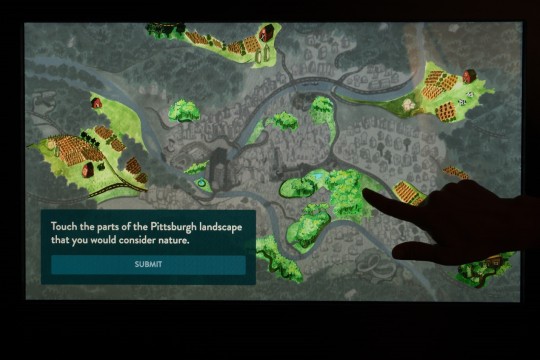
computer screen showing a map of green spaces
Screenshot taken from an interactive in the museum’s temporary exhibit, We Are Nature; Credit Joshua Franzos

Here, we live in a place with a very strong sense of identity and pride; Steeler Country is also a beautiful region of rivers, trees, and hills. And, it is a place inextricably marked, and in some ways defined, by human manipulation of our resources. It’s possible to see the cultural achievements, the sheer natural beauty, and the presence of expansive industry all at once, see the connections between them, and understand how these things exist, in the same place and at the same time, here and around the world.

It’s true that fossil fuel extraction and use has historically led to economic success in the region. (Fun fact, with apologies to Dippy: coal and natural gas, fossil fuels, generally existed long before the dinosaurs.) However, many of our local wild places still bear the scars from our use of these resources in the form of degraded streams, partitioned forests, poor air quality, changing climate, and shifting, sunken land.

“Connection” also means, of course, understanding connections between Earth systems – connecting our actions to global impact. As but one of many examples shown eloquently in the We Are Nature exhibition, rising temperatures and increasing carbon dioxide in the air from burning fossil fuels (atmosphere) are both absorbed by water, leading to warmer, more acidic oceans (hydrosphere), which in turn leads to marine ecosystem damage and danger to coral reefs (biosphere) – a long way away from Pennsylvania.
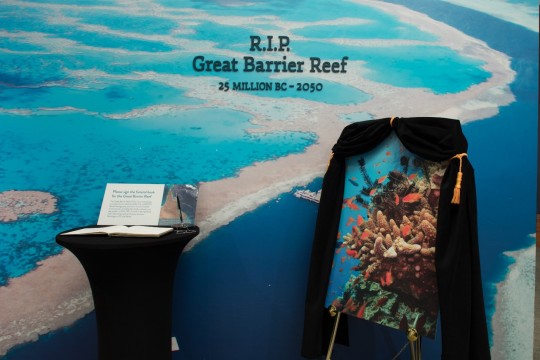
Memorial to the great barrier reef
Photo taken from We Are Nature; Credit Joshua Franzos

There is much to remain hopeful about, however. These are all stories that are still being written. This Earth Day, I’m remembering that this is a beautiful planet… and it’s the only one we’ve got. The systems that govern it are interconnected, complicated, and in some ways, surprisingly delicate. I’m also remembering that the solutions to many of today’s environmental challenges lie in our thoughtful reevaluation and improvement of all the kinds of connections, starting with the first one I mentioned: exploring, learning, and working together.
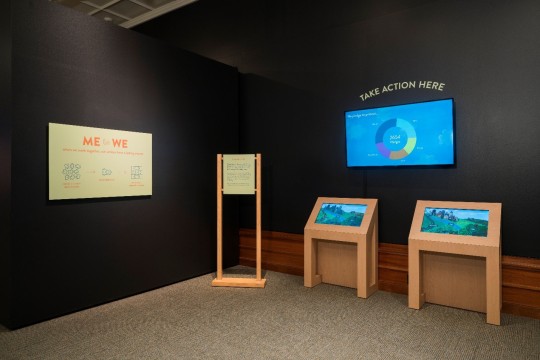
Take action area in We Are Nature
Photo taken from We Are Nature; Credit Joshua Franzos

I invite you to both check out We Are Nature before it leaves this fall and stay tuned for what’s next as more work on the Anthropocene at the museum ramps up.

Or, should I say, stay connected.

–Joylette Portlock, Ph.D., is associate director of science and research at Carnegie Museum of Natural History. She is also executive director of Communitopia, a nonprofit focused on climate change communication, and holds many other roles in the community.
Filed Under: Blog Tagged With: earth day, We Are Nature, We Are Nature: Living in the Anthropocene

March 13, 2018 by wpengine

Think a 400 year old oak tree can be a superhero?

Think a 400 year old oak tree can be a superhero? When you’re not looking they are cleaning the air, re-routing storm water,…and breaking wind so you won’t be blown away! And if a patient can view trees outside their window, they can recover faster and require less painkillers during their stay in the hospital, according to Scientific American. That’s right – trees are the gentle giants protecting our spaces and quality of life.

No wonder Tree Vitalize has become so popular in Pittsburgh’s ground-level revitalization. As a tree-planting partnership through Western Pennsylvania Conservancy (WPC) with Allegheny County, the City of Pittsburgh, Tree Pittsburgh, and Pennsylvania Department of Conservation and Natural Resources, it is a local sustainability effort to increase the number of trees in and around Pittsburgh.

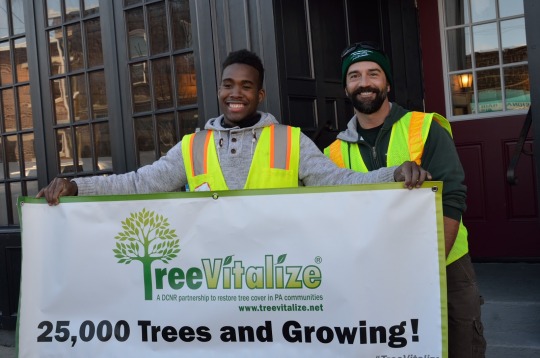
two men holding a sign for Tree Vitalize
TreeVitalize Volunteer left; Jeffrey Bergman right

Lead by Jeffrey Bergman, Director of Community Forestry, and Lauren Fike, Community Forestry Project Coordinator, the organization is responsible for nearly 30,000 trees being planted since 2006, and this is only the beginning.

Bergman said that the quality of life in any urban environment can be improved through mindful conservation practices in and around a city.

“The trees in urban settings serve a specific purpose. A street tree that is shading a street and shading businesses provide benefits that are different than trees in parks and wooded settings.”

For urban landscapes, the benefits of trees are numerous. They can reduce storm runoff and land erosion, decrease energy bills, increase property values, and improve air quality. In the city’s Tree Management Plan, Pittsburgh’s trees were appraised at over $51 million and contributed to nearly $100,000 in energy savings. Despite the advantages, man-made challenges have impeded tree canopies from flourishing.

Rapid construction of roads, housing, and natural gas pipelines contributed to the decline of tree canopies in the county. In a recent study done by Tree Pittsburgh, a little over 10,000 acres was destroyed between 2010 and 2015.

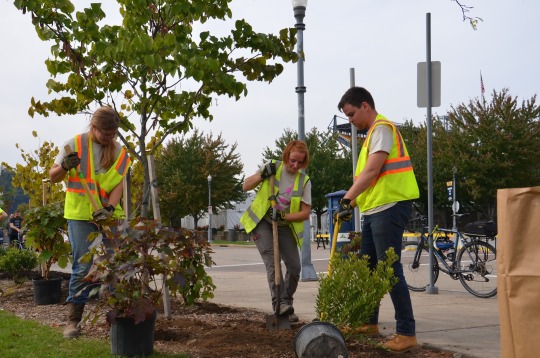
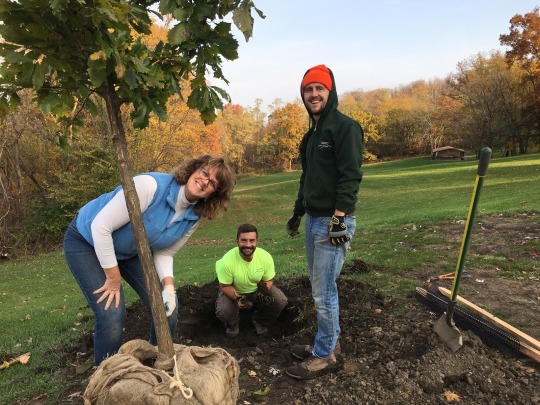
volunteers planting trees

Bergman and Fike’s primary concern is to engage residents and citizens in the work of planting more trees. TreeVitalize provides targeted outreach projects for areas with low tree canopy and in low income communities. The program consistently draws in those who appreciate trees, said Bergman, but planting the tree is only the start. There’s also the long-term maintenance.

“It’s essential there is strong maintenance because we are putting living things in a harsh environment,” Bergman said. “Remember that while trees are infrastructure they are living and they are something that need to be taken care of and respected.”

These projects are critical in not only increasing the number of trees in Pittsburgh, but also connecting people to their community in more significant ways. Fike said that much of her work in managing the field projects and logistics helps prepare volunteers to value the tree-planting experience in meaningful ways.

“It’s really rewarding because if they take the time to plant the tree in 30 degree weather and it’s raining, they are dedicated to that tree. They can say, ‘Oh I planted that tree. I wonder how my tree is doing,’” she said.

Volunteers planting shrubs

Bergman credits the great volunteer ethic in the city of Pittsburgh for TreeVitalize’s success. Residents are able to see physical changes to their community with just a few hours of service. Volunteers hand trees averaging between 10 and 15 feet tall, and the service project stands as  a rewarding experience for those who plant these woody giants.

“People seem to derive a sense of satisfaction from tree planting,” he said. “We also work with colleges and universities but we get feedback that compared to picking up litter on the roadside, people feel like they’ve done something more to help the environment when they do a tree planting.”

Trees are pruned and planted in the early spring and fall while trees are dormant and bear no leaves because they are not able to photosynthesize. TreeVitalize, in partnership with Tree Pittsburgh, offers training for those interested in becoming a “tree tender.”

“You see trees in a different way when you learn about them,” Bergman said. “It’s not just a stop sign or a fire hydrant. People lose sense that these are living things in our environment and you can learn why this work is important.”

Pittsburghers can join the cause to plant more trees and make the city greener by going through TreeVitalize’s intensive training process and coordinating a tree planting project for their neighborhood. Fall 2018 applications are now available and due by March 16. Those interested are also encouraged to contact Bergman directly at 412-586-2396 or jbergman@paconserve.org.


________________________________________________________________

In the spirit of recognizing all we are already doing in Pittsburgh, we have started a new blog series to compliment We Are Nature: Living in the Anthropocene, the exhibition about the complex relationship between humans and nature currently on display at Carnegie Museum of Natural History. We are featuring Pittsburghers who are committed to improving the environment in which we live. Each blog features a new individual and shares some of the ways in which they are helping issues of sustainability, conservation, restoration, climate change, or helping Pittsburgh to be an even more beautiful place to live.

Filed Under: Blog Tagged With: earth day, We Are Nature, We Are Nature: Living in the Anthropocene

sidebar

About

  • Mission & Commitments
  • Directors Team
  • Museum History

Get Involved

  • Volunteer
  • Membership
  • Carnegie Discoverers
  • Donate
  • Employment
  • Events

Bring a Group

  • Groups of 10 or More
  • Birthday Parties at the Museum
  • Field Trips

Powdermill

  • Powdermill Nature Reserve
  • Powdermill Field Trips
  • Powdermill Staff
  • Research at Powdermill

More Information

  • Image Permission Requests
  • Science Stories
  • Accessibility
  • Shopping Cart
  • Contact
  • Visitor Policies
One of the Four Carnegie Museums | © Carnegie Institute | Privacy Policy | Terms of Use | Accessibility
Rad works here logo