• Skip to primary navigation
  • Skip to main content
  • Skip to primary sidebar

Carnegie Museum of Natural History

One of the Four Carnegie Museums of Pittsburgh

  • Visit
    • Buy Tickets
    • Visitor Information
    • Exhibitions
    • Events
    • Dining at the Museum
    • Celebrate at the Museum
    • Powdermill Nature Reserve
    • Event Venue Rental
  • Learn
    • Field Trips
    • Educator Information
    • Programs at the Museum
    • Bring the Museum to You
    • Guided Programs FAQ
    • Programs Online
    • Climate and Rural Systems Partnership
  • Research
    • Scientific Sections
    • Science Stories
    • Science Videos
    • Senior Science & Research Staff
    • Museum Library
    • Science Seminars
    • Scientific Publications
    • Specimen and Artifact Identification
  • About
    • Mission & Commitments
    • Directors Team
    • Museum History
  • Tickets
  • Give
  • Shop

Matt Lamanna

September 11, 2018 by wpengine

Ask A Scientist – What Kind of Dinosaur is a Megaraptorid?

Are megaraptors really raptors? Assistant Curator and Head of Vertebrate Paleontology Dr. Matt Lamanna discusses what paleontologists know about the dinosaur family Megaraptoridae in our latest Ask a Scientist! See a life-sized replica of a megaraptorid thumb claw from Patagonia up close and find out how a claw like that led researchers to give megaraptorids their name.

 Ask a Scientist is a video series where we ask our research staff questions about the millions of amazing objects and specimens stored in our museum collection. Tune in on YouTube, and submit your own questions via Twitter @CarnegieMNH!
Filed Under: Blog Tagged With: Ask a Scientist, dinosaur, dinosaurs, Matt Lamanna, paleontology, Vertebrate Paleontology

July 11, 2018 by wpengine

The Two-Headed Dinosaur

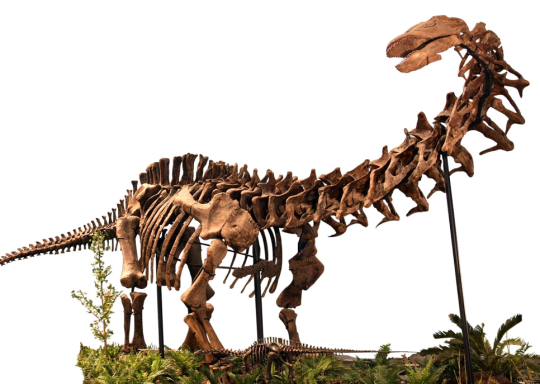
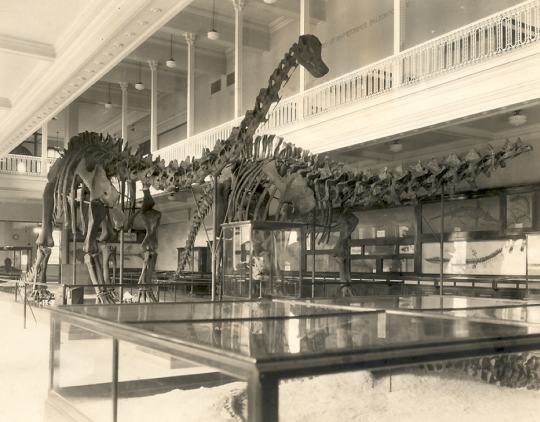
Apatosaurus is a sauropod, or long-necked plant-eating dinosaur, that lived in western North America during the late Jurassic Period roughly 150 million years ago. In the early 20th century, scientists couldn’t agree on what kind of head Apatosaurus had. No skull had ever been found attached to a neck of this dinosaur. So, when Carnegie Museum of Natural History mounted its most complete Apatosaurus skeleton in 1915, it did so without including a skull.

Apatosaurus louisae (right) as it was originally mounted in 1915, without a skull. At left is the skeleton of its relative Diplodocus carnegii.
Carnegie Museum of Natural History’s skeleton of Apatosaurus louisae (right) as it was originally mounted in 1915, without a skull. At left is the skeleton of its relative Diplodocus carnegii, better known as ‘Dippy.’ Credit: Carnegie Museum of Natural History.

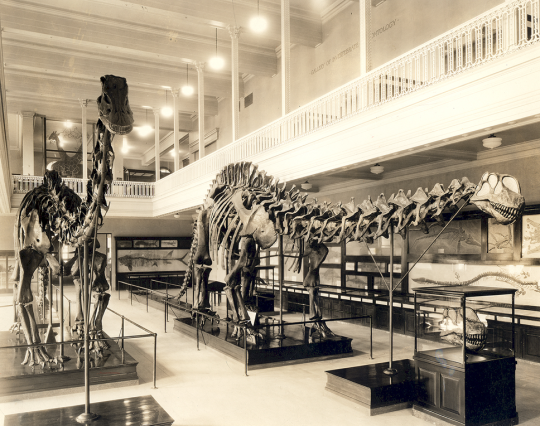
The mount stood headless until 1932, when the museum followed prevailing scientific opinion of the day and placed a blunt-snouted, broad-toothed skull on the Apatosaurus. It remained there for another 47 years.

Apatosaurus and Diplodocus skeletons
Apatosaurus (right) and Diplodocus, ca. 1932, after a skull of the blunt-snouted sauropod Camarasaurus lentus had been mounted on the Apatosaurus skeleton. Credit: Carnegie Museum of Natural History.

In 1978, however, Carnegie Museum of Natural History paleontologist Dave Berman and museum research associate Jack McIntosh reasoned that a very different, more Diplodocus-like skull found with the Apatosaurus skeleton back in 1910 was most probably the correct one. A subsequent discovery of a still-connected Apatosaurus skull and neck proved them correct. In 1979, the museum’s Apatosaurus louisae was finally fitted with its proper skull – more than seven decades after its discovery! It remains that way today, on public exhibit in the museum’s dinosaur gallery, Dinosaurs in Their Time.

Apatosaurus Louise
Apatosaurus as it looks today, displayed with its correct skull, which closely resembles that of its relative, Diplodocus. Credit: Melinda McNaugher, Carnegie Museum of Natural History.

Matt Lamanna is a paleontologist and the principal dinosaur researcher at Carnegie Museum of Natural History in Pittsburgh.  Museum employees are encouraged to blog about their unique experiences and knowledge gained from working at the museum.

Related Content

Ask a Scientist: What kind of dinosaur was a megaraptorid?

Mesozoic Monthly: Dreadnoughtus

The Strange Saga of Spinosaurus, the Semiaquatic Dinosaurian Superpredator

Filed Under: Blog Tagged With: dinofest, dinosaur, dinosaurs in their time, diplodocus carnegii, fossils, Matt Lamanna, Vertebrate Paleontology

July 9, 2018 by wpengine

Revisiting a former expedition: Antarctica Peninsula Paleontology Project (AP3)

The following was taken from a blog series posted by Carnegie Museum of Natural History which documented a paleontology expedition in 2016.

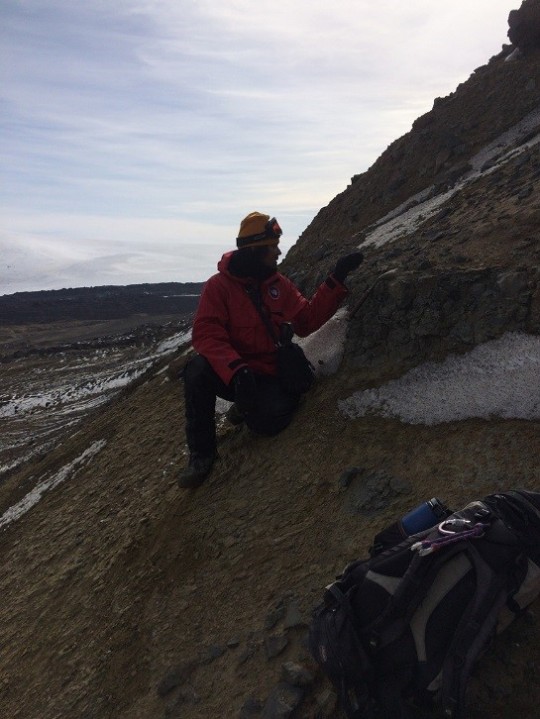
researcher in Antarctica

“February 29–March 6, 2016

Project G-182-N (PI Matt Lamanna)

The team completed several of its research objectives and continued to make progress towards others during week three. At the Sandwich Bluff locality on Vega Island, scientists discovered four new fossil plant sites, found additional Cretaceous fish and bird material, and prepared a plesiosaur (long-necked marine reptile) shoulder girdle for extraction.

All of these specimens were recovered from the Upper Cretaceous Sandwich Bluff Member of the López de Bertodano Formation. At approximately 70 million years in age, this rock unit dates to only a few million years prior to the infamous mass extinction that ended the Mesozoic era, or Age of Dinosaurs.

researchers at work in Antarctica

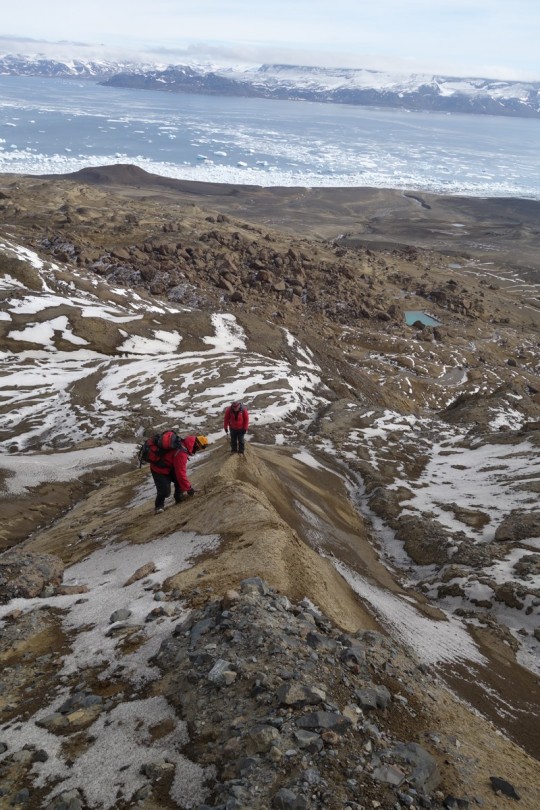
Geologists Eric Roberts and Zubair Jinnah completed their stratigraphic and sedimentological study of the sections of the Snow Hill Island and López de Bertodano formations exposed on the southwestern flank of Sandwich Bluff, an area that, due to its steepness, elevation, and snow cover, has been nicknamed ‘K2’ after that well-known Himalayan peak. They sampled the middle and upper levels of the Sandwich Bluff Member for aragonitic fossil invertebrate shells to be used in strontium isotope geochronological analyses.

Scientists also continued to conduct helicopter-supported reconnaissance visits to other areas of the James Ross Basin, identifying two previously undocumented Cretaceous exposures that were targeted for future investigation.

Inclement weather forced many members of the team to return to their ship, the RVIB Nathaniel B. Palmer, for two days during week three. They spent the time refining strategies for the remainder of the field season, updating the project’s blog and social media pages, and studying fossils that had already been collected.

researchers in Antarctica

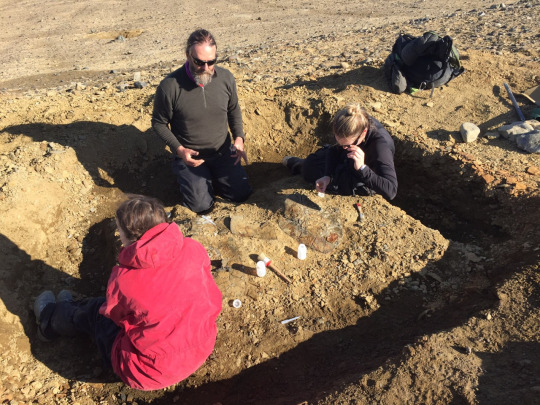
1) G-182-N paleontologists Abby West (left) and Steve Salisbury (center) collect a plesiosaur shoulder girdle co-discovered by Salisbury with ASC Marine Technician Julia Carlton (right). Photo by Matt Lamanna.

2) G-182-N geologists Zubair Jinnah (foreground) and Eric Roberts study the stratigraphy and sedimentology of the ‘K2’ section on Vega Island. Photo by Pat O’Connor.

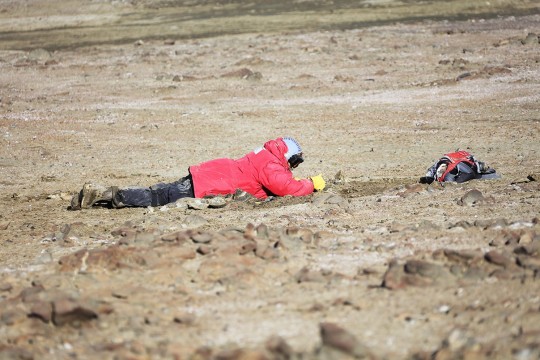
3.) G-182-N paleontologist Kerin Claeson searches for fossils in the ‘Fish Horizon’ near the K–Pg boundary on Seymour Island. Claeson and other G-182-N personnel have collected dozens of partial to nearly complete fish skeletons from the ‘Fish Horizon’ to date, the analysis of which promises to inform understanding of the K–Pg mass extinction in the southern high latitudes. Photo by Meng Jin.”


Matt Lamanna is a paleontologist and the principal dinosaur researcher at Carnegie Museum of Natural History in Pittsburgh. Matt and his team of researchers blogged frequently from Antarctica while on expedition at antarticdinos.org. Detailing his trip in a family-friendly, interactive documentary, Expedition Antarctica, paleontologist Matt Lamanna shares his unique experience. Members are required to preregister for the event. Sign up now.

Filed Under: Blog Tagged With: Antarctic Peninsula Paleontology Project, antarctica, fossils, Matt Lamanna, paleontology

July 9, 2018 by wpengine

Revisiting a former expedition: Antarctica Peninsula Paleontology Project (AP3)

The following blog was taken from a series posted by Carnegie Museum of Natural History which documented a paleontology expedition in February 2016. 

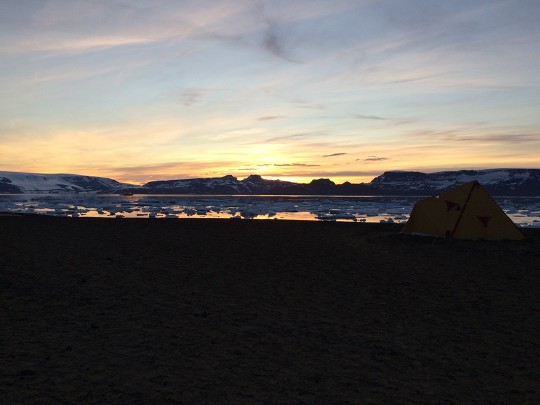
sunset

Sunset over camp on Vega Island. The eastern shore of James Ross Island and the RVIB Nathaniel B. Palmer are visible in the background. Photo by Pat O’Connor.

“February 21–28, 2016

Project G-182-N (PI Matt Lamanna)

Work at the main basecamp on the western shore of Vega Island continued in week two and resulted in the discovery of a wealth of fossils.

Senior project geologist Eric Roberts located a partial plesiosaur. The specimen, which preserves numerous vertebrae, ribs, paddle bones, and gastroliths (stomach stones), appears to be the most complete marine reptile discovered by the project to date. Many of its bones remain articulated (preserved in life position) and are beautifully preserved within sandstone concretions. With time and effort in the laboratory, much of the postcranial skeleton will likely be reassembled and will likely be significant both for scientific study and possible display.

The project made significant progress towards its geological aims as well. Roberts and fellow geologist Zubair Jinnah continued their efforts to decipher the age and depositional environments of the sediments exposed on the uppermost levels of Sandwich Bluff. They collected rock and fossil samples from the uppermost Sandwich Bluff Member and basal Sobral Formation for geochemical and palynological analyses and strontium isotopic dating. They also began to subdivide the Sobral Formation into discrete units, as Roberts and colleagues did for the Sandwich Bluff Member in a 2014 paper.

Helicopter reconnaissance efforts continued with additional trips to Seymour and eastern Vega Island. Considerable effort was expended during week two towards installing a field camp near the Cretaceous–Paleogene boundary horizon in the central area of Seymour Island. Those at the camp are having success in recovering fossils of fishes, putative turtles, and other Cretaceous vertebrates.

Lastly, filmmaker Matt Koshmrl continues to skillfully document all aspects of the project through video and still photography.

geologist Zubair Jinnah doing field work

G-182-N geologist Zubair Jinnah studies an exposure of the Upper Cretaceous upper Cape Lamb Member of the Snow Hill Island Formation on Vega Island. Photo by Pat O’Connor.

Also discovered during week two

– A second plesiosaur partial skeleton. Several partial-to-complete fossil leaves and a conifer branch. Partial skeletons of Cretaceous fishes that may be the most completely-preserved fishes yet found from Cretaceous sediments on Vega Island.

– A partial dorsal rib of a very large-bodied tetrapod, possibly a sauropod (long-necked plant-eating dinosaur)

– Multiple isolated Cretaceous bird bones were also collected, as was a possible avian skull

– An abundance of exceptionally-preserved Eocene penguin bones, including a partial skull of a giant species (possibly Anthropornisnordenskjoeldi or Palaeeudyptes antarcticus). This is exciting as only a handful of cranial elements of fossil penguins have ever been described from Seymour Island.”


Matt Lamanna is a paleontologist and the principal dinosaur researcher at Carnegie Museum of Natural History in Pittsburgh. Matt and his team of researchers blogged frequently from Antarctica while on expedition at antarticdinos.org. Detailing his trip in a family-friendly, interactive documentary, Expedition Antarctica, paleontologist Matt Lamanna shares his unique experience. Members are required to preregister for the event. Sign up now.

Filed Under: Blog Tagged With: Antarctic Peninsula Paleontology Project, antarctica, Matt Lamanna, paleontology

March 29, 2018 by wpengine

Time Travel… No Flux Capacitor Required

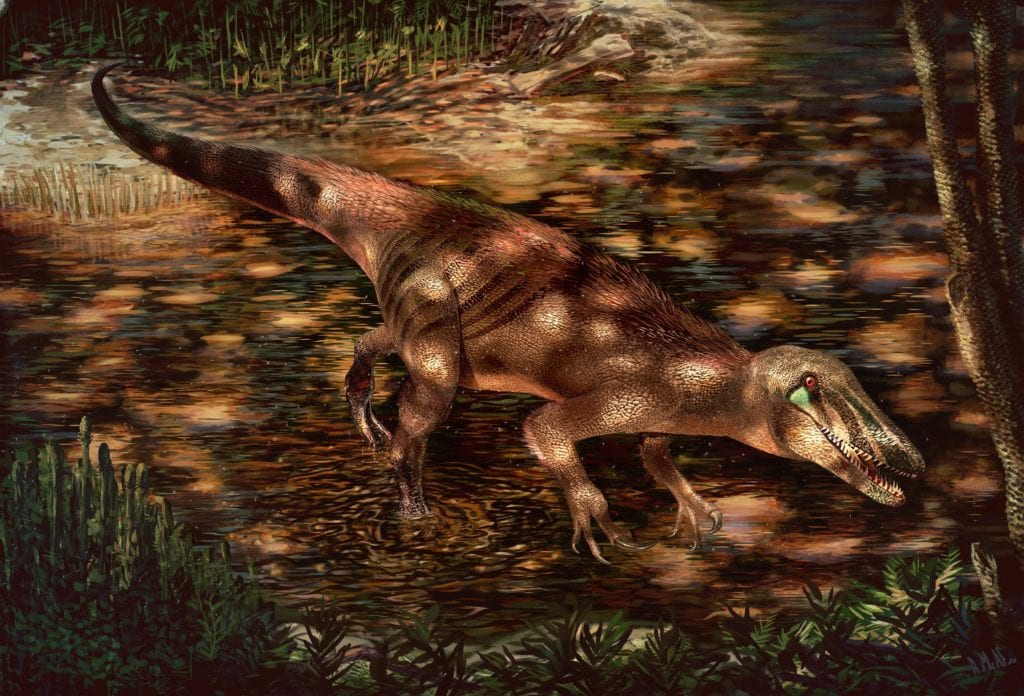
drawing of the dinosaur crossing a stream in its natural habitat
The newly discovered meat-eating dinosaur Tratayenia rosalesi crosses a stream in what is now northern Patagonia, Argentina some 85 million years ago.
Credit: Andrew McAfee, Carnegie Museum of Natural History.

By Matt Lamanna

I’m a child of the 1980s. When I was a kid, one of my favorite movies was Back to the Future, where Doc Brown turns a car into a time machine that sends Marty McFly into the past. I’d watch that movie and think, “How cool would it be if time travel were real?” We could go back in time and, say, hear Abraham Lincoln deliver the Gettysburg Address, or watch Michelangelo paint the ceiling of the Sistine Chapel. We could gaze in wonder at the Great Pyramid under construction, marvel at a herd of passing mammoths, or witness a ‘Lucy’-like creature take humanity’s first steps. We could even go all the way back to the Mesozoic Era – the Age of Dinosaurs.

Sadly—spoiler alert!—time travel is still not possible, at least not in the literal way that the creators of Back to the Future imagined. But there is another way to see dinosaurs in the flesh. One only needs a talented artist.

Over the years, I’ve had the good fortune to have worked with many artists to (virtually) bring dinosaurs and other extinct creatures back to life. From my old buddy the ‘Wookiee’ Jason Poole, to dynamic husband-and-wife duo Bob Walters and Tess Kissinger, to dino-sculptors extraordinaire Dan Pickering, Gary Staab, and Bruce Mohn, to rising stars Taylor Maggiacomo and Lindsay Wright, and others, each of these gifted natural history artists has graciously shared their time and talent to help my scientific collaborators and I breathe life into ancient bones.

Two artists deserve special mention here. For more than a decade, from 2004 to 2015, I was blessed to be able to work with Mark Klingler, the long-time Scientific Illustrator here in Carnegie Museum of Natural History’s Section of Vertebrate Paleontology. Mark and I worked together to give the world its first look at many new fossil discoveries, such as the semi-truck-sized dinosaur Sarmientosaurus, the bizarre ‘Chicken from Hell’ Anzu, and the ~120 million-year-old bird Gansus.

Mark gave the museum and I one final gift prior to his departure in 2015: he hosted an intern, Andrew McAfee, then a newly minted graduate of the Science Illustration program at Cal State University Monterey Bay. Andrew continued to volunteer at the museum after Mark left, and did such a fantastic job that, in 2016, we hired him as Vertebrate Paleontology’s new Scientific Illustrator.

Like Mark before him, Andrew is meticulous when it comes to reconstructing a prehistoric species and its habitat. Case in point: our hot-off-the-presses predatory dinosaur from Patagonia, Tratayenia, which was formally announced by my Argentine collaborators and I yesterday morning. Tratayenia is a fascinating dinosaur, and was undoubtedly a terrifying beast in life, but unfortunately, we paleontologists don’t have very much of it – its fossils are pretty incomplete. So how, you ask, was Andrew able to produce the image above?

Well, he and I first had to build a picture of the dinosaur itself. Tratayenia is a megaraptorid, a group of mysterious hunters that roamed South America, Australia, and probably other Southern Hemisphere continents during the Cretaceous, the third and final time period of the Mesozoic Era. Using the bones of other megaraptorids, we made educated guesses as to what the missing pieces of the Tratayenia skeleton may have looked like. From there, we used our knowledge of the closest living relatives of dinosaurs—birds—to put meat, skin, and feathers back on the bones; in other words, to reconstruct the parts of the body that are rarely found as fossils. Finally, since we have almost no idea what color Tratayenia may have been, I encouraged Andrew to get creative here. The pattern he came up with seems suited to an animal that probably relied on stealth and camouflage to ambush its prey.

After we had Tratayenia to the point where it looked ready to jump off the screen and bite us, it was then time to put the animal back into its 85-million-year-old world. To do so, I scoured the scientific literature on the rock formation that yielded the bones of the new dinosaur, looking for clues as to what its ancient environment was like and what other species called it home. Andrew painted several of these plants and animals into his reconstruction. Look for a thigh bone of the giant herbivorous dinosaur Traukutitan and plants such as ferns, horsetails, flowering herbs, and a conifer belonging to the group Cheirolepidiaceae.

We can’t go back in time to the Age of Dinosaurs, not really at least. But through the skill and vision of natural history artists, working in tandem with paleontologists, we can catch glimpses of what these extraordinary animals and their long-vanished worlds may have been like. Andrew and I are already revving up the DeLorean for our next trip to the Mesozoic.

Matt Lamanna is a paleontologist and the principal dinosaur researcher at Carnegie Museum of Natural History. Museum employees are encouraged to blog about their unique experiences and knowledge gained from working at the museum.

Read more about Tratayenia on Reuters.

Filed Under: Blog Tagged With: Andrew McAfee, dinosaur, Matt Lamanna

February 1, 2018 by wpengine

Antarctic Peninsula Paleontology Project featured by NSF

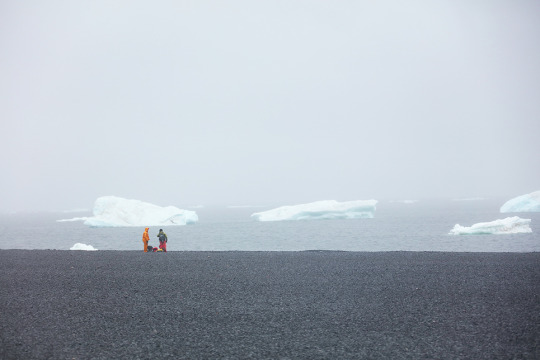
two explorers in the distance on a flat, baren part of antartica
Photo courtesy of AP3 team member Dr. Meng Jin, Curator-in-Charge of the Division of Paleontology at American Museum of Natural History

Dr. Matt Lamanna, Carnegie Museum of Natural History’s Assistant Curator of Vertebrate Paleontology, served as the lead Principal Investigator and Project Director of the Antarctic Peninsula Paleontology Project (AP3). Photos of their expedition were recently featured through The National Science Foundation’s showcase on Discover magazine’s website entitled When Dinosaurs Roamed Antarctica. Check out the link for some of the stunning photos from their trip!

http://discovermagazine.com/galleries/2018/frozen-fossils

Filed Under: Blog Tagged With: Matt Lamanna, Vertebrate Paleontology

  • « Go to Previous Page
  • Page 1
  • Page 2
  • Page 3
  • Page 4
  • Interim pages omitted …
  • Page 6
  • Go to Next Page »

sidebar

About

  • Mission & Commitments
  • Directors Team
  • Museum History

Get Involved

  • Volunteer
  • Membership
  • Carnegie Discoverers
  • Donate
  • Employment
  • Events

Bring a Group

  • Groups of 10 or More
  • Birthday Parties at the Museum
  • Field Trips

Powdermill

  • Powdermill Nature Reserve
  • Powdermill Field Trips
  • Powdermill Staff
  • Research at Powdermill

More Information

  • Image Permission Requests
  • Science Stories
  • Accessibility
  • Shopping Cart
  • Contact
  • Visitor Policies
One of the Four Carnegie Museums | © Carnegie Institute | Privacy Policy | Terms of Use | Accessibility
Rad works here logo