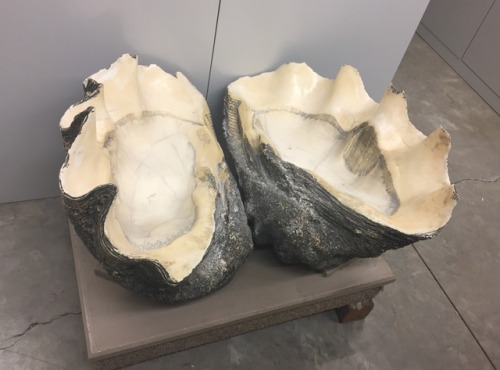
This giant clam is part of the Section of Mollusks’ hidden collection. You can get a special behind-the-scenes tour of the section most second Saturdays of the month at Carnegie Museum of Natural History!
Carnegie Museum of Natural History
One of the Four Carnegie Museums of Pittsburgh
This giant clam is part of the Section of Mollusks’ hidden collection. You can get a special behind-the-scenes tour of the section most second Saturdays of the month at Carnegie Museum of Natural History!
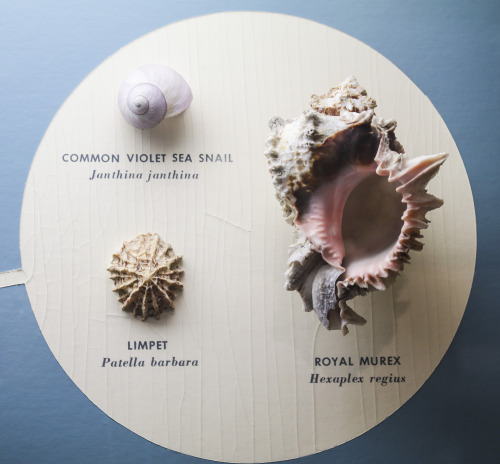
A common violet sea snail, a limpet, and a royal murex in Carnegie Museum of Natural History’s Section of Mollusks.
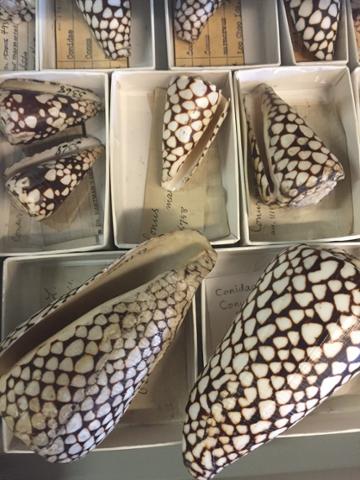
Cone snail shells in the Section of Mollusks’ hidden collection
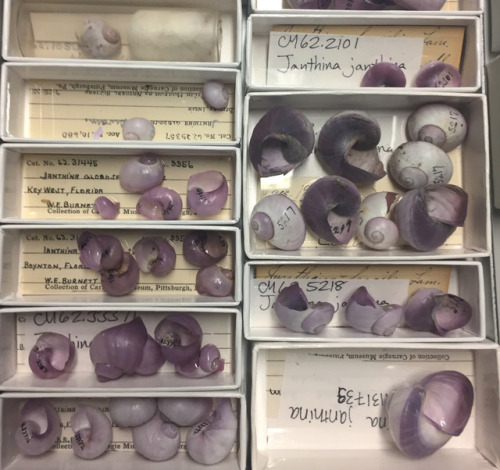
Beautiful purple Janthina specimens in the Section of Mollusks in Carnegie Museum of Natural History’s hidden collection.
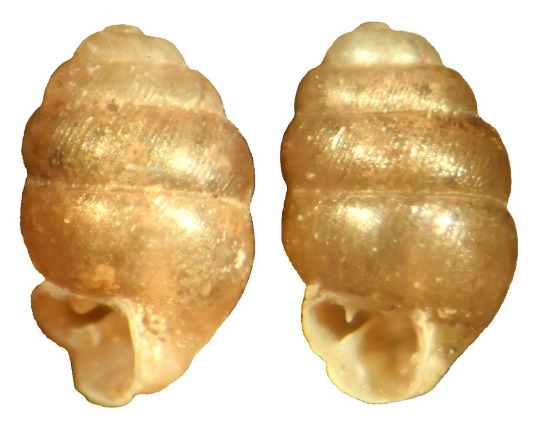
by Timothy A. Pearce
What can stop a wall that the president of the United States wants to build? Snails of course!
At least that was the case on a golf course in Ireland owned by President Donald Trump’s company, Trump International Golf Links.
According to The Washington Post, the company’s plans to build a huge, two-mile sea wall on its Irish golf course were recently withdrawn and replaced with a proposal for two smaller walls.
A tiny, 2 millimeter snail, Vertigo angustior, living in the adjacent Carrowmore Dunes, a special area of conservation, could be harmed if the wall were to change the hydrology of the area. The Carrowmore Dunes site is specially designated for conservation due to its three different dune types and the presence of Vertigo angustior.
Trump’s company submitted an initial wall proposal that cited rising sea levels as a result of climate change as the reason it needed the wall, according to BBC News.
Concerns over the snail and the special dunes delayed a decision about the proposed wall, so Trump International Golf Links resubmitted a proposal for smaller walls just before Christmas 2016, according to the Washington Post. The Clare County Council will carefully consider the revised proposal for its conservation objectives and the impact on the protected snail. A decision is expected in March 2017.
The European snail Vertigo angustior is unusual for coiling the opposite direction of most land snails and occurs in wetlands and low areas among coastal dunes. It is legally protected under the European Union’s Habitats and Species Directive due to declining populations and because wetlands are difficult to protect. According to the International Union for Conservation of Nature, the main threat to this species is the modification of site hydrology, which could occur with the building of sea walls.
Some people feel that business endeavors are more important than species extinctions, while others argue that it is unfair for one species, humans, to cause the complete extinction of another species. Endangered species laws recognize the importance of allowing species to persist.
Timothy A. Pearce, PhD, is the head of the mollusks section at Carnegie Museum of Natural History. Museum employees are encouraged to blog about their unique experiences and knowledge gained from working at the museum.
Discover the science of snails with Scientists Live!
Tim Pearce, assistant curator of the Section of Mollusks, showed off pieces of Carnegie Museum of Natural History’s hidden collection and answered questions in a live broadcast this month on Facebook!
This broadcast is part of the new web series Scientists Live. Check the museum’s Facebook page for more broadcasts featuring different scientists and topics.
