• Skip to primary navigation
  • Skip to main content
  • Skip to primary sidebar

Carnegie Museum of Natural History

One of the Four Carnegie Museums of Pittsburgh

  • Visit
    • Buy Tickets
    • Visitor Information
    • Exhibitions
    • Events
    • Dining at the Museum
    • Celebrate at the Museum
    • Powdermill Nature Reserve
    • Event Venue Rental
  • Learn
    • Field Trips
    • Educator Information
    • Programs at the Museum
    • Bring the Museum to You
    • Guided Programs FAQ
    • Programs Online
    • Climate and Rural Systems Partnership
  • Research
    • Scientific Sections
    • Science Stories
    • Science Videos
    • Senior Science & Research Staff
    • Museum Library
    • Science Seminars
    • Scientific Publications
    • Specimen and Artifact Identification
  • About
    • Mission & Commitments
    • Directors Team
    • Museum History
  • Tickets
  • Give
  • Shop

mollusks

January 12, 2018 by wpengine

Section of Mollusks Tours

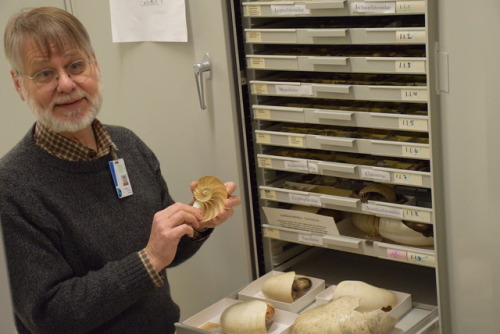
Tim Pearce holding up a shell from the hidden collection

Did you know that the Section of Mollusks Assistant Curator Tim Pearce has been conducting monthly behind-the-scenes tours for the public since 2007?

On these tours, participants often learn for the first time that the museum has huge collections and scientists who conduct
research, and they see crowd pleasers such as the killer sea snail, the giant clam, and they look through the shell to see the beating heart of a live land snail.

Check our Section of Mollusks for tour times!
Filed Under: Blog Tagged With: mollusks, Tim Pearce

January 8, 2018 by wpengine

Ask a Scientist: Why are slugs so slimy?

Ask a Scientist: Why are slugs so slimy?

Assistant Curator and Malacologist Dr. Timothy Pearce explains why slugs are slimy and talks about the incredible and useful properties of slug slime.


Ask a Scientist is a new short video series where we ask our research staff questions about the millions of amazing objects and specimens stored in our collection. Tune in on YouTube, and submit your own questions via Twitter @CarnegieMNH.

Filed Under: Blog Tagged With: Ask a Scientist, mollusks, slugs, Tim Pearce

December 14, 2017 by wpengine

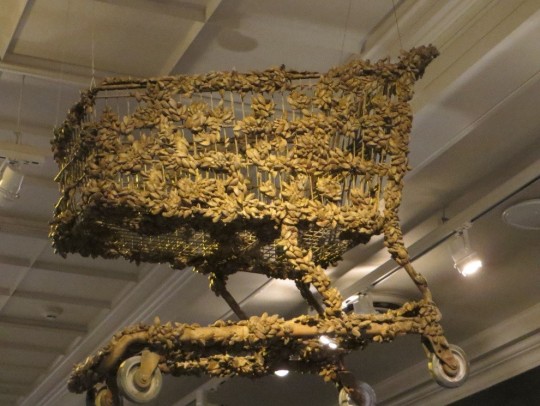
Shopping cart symbol

by Patrick McShea

shopping cart covered in green ocean life

The shell-encrusted shopping cart in We Are Nature would get lots of visitor attention even if it weren’t suspended from the ceiling. Hundreds of zebra mussels coat the familiar contraption, creating an eerily appropriate symbol for human-altered natural systems:  An empty icon of consumer culture armored by hitchhiking organisms of global trade.

Zebra mussels, a freshwater species native to the Caspian Sea and Black Sea, were unwittingly introduced into the Great Lakes during the 1980s via ballast water dumped by ocean-crossing cargo ships. The creature’s rapid dispersal since then has been attributed to the passive drifting of tiny larvae and the ability of mature zebra mussels to attach to boats moving between the lakes and adjacent river systems.

As invaders, zebra mussels have profound effects on ecosystems. They feed by filtering tiny organisms from the water, and by sheer numbers can out-compete fish larvae and native mussel species dependent on the same food source. Zebra mussels attach to any submerged hard surface. Their profusion attracts attention when it results in clogged water in-take pipes, but not necessarily when thousands of the striped fingernail-sized creatures occupy physical positions atop existing beds of native freshwater mussels.

At Carnegie Museum of Natural History, concern for the health of our region’s diverse population of native freshwater mussels has a long history.  In 1909, Arnold Ortmann, then Curator of Invertebrate Zoology, termed the disappearance of mussel species “the first sign of pollution of a dangerous character in a stream.” His observation was based upon biological surveys in rivers and streams throughout Western Pennsylvania, fieldwork performed during a time of rapid industrialization that garnered the museum an irreplaceable collection of local mussel shells.

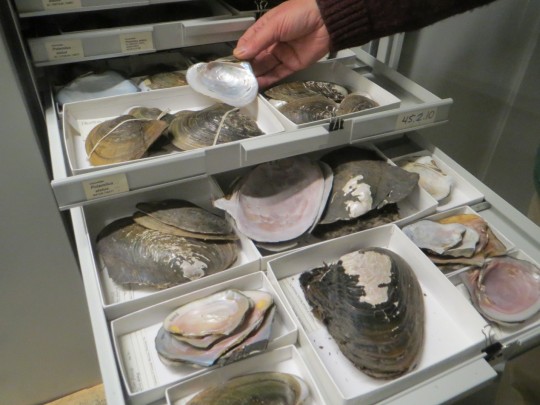
drawer full of mussel shells
Shells of Potamilus alatus, or pink heelsplitter, a native freshwater mussel in the Carnegie Museum of Natural History Section of Mollusks.

Patrick McShea works in the Education and Visitor Experience department of Carnegie Museum of Natural History. Museum employees are encouraged to blog about their unique experiences of working at the museum.


Filed Under: Blog Tagged With: mollusks, We Are Nature, We Are Nature: Living in the Anthropocene

December 11, 2017 by wpengine

How Scallop Eyes Relate to Human Uniqueness

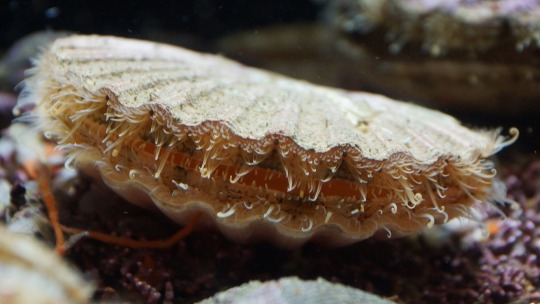
sea scallop resting on the bottom of the ocean

by Timothy A. Pearce

We humans like to think we are special among all creatures. To support that notion, we claim unique traits such as language, tool use, consciousness, etc. Oops, all of those traits have now been shown to occur in other species. Do not fear, though, for I have found a trait that seems to be unique to humans: a fondness for 90 degree angles (aka right angles). You heard it here first! I don’t know where on the evolutionary lineage to modern humans we acquired this fondness for right angles, but evidence of this fondness is all around us in the modern built environment.

What does fondness for right angles have to do with scallop eyes? First let me tell you about the amazing eyes of scallops. They have up to 200 eyes along the mantle margin, and those eyes contain concave mirrors. Instead of being similar to cameras (as our, and most, eyes are), scallop eyes are similar to reflecting telescopes, and each eye has two retinas so they can see clearly in both narrow and peripheral views at the same time.

New research published this week in Science (and described in the New York Times ) demonstrates that the concave mirror of each scallop eye is tiled with more than 100,000 square mirror tiles. Did you get that? They are squares! Outside of the human built environment, right angles are scarce. So to find squares in the eyes of scallops is remarkable. The properties of the tiles making up the mirror has implications for the scallop’s ability to see in the particular wavelengths of light in its surroundings and can inspire improved human optical devices. Future studies will have to examine why a scallop needs to have such amazing vision. But for now, I am amazed to know that scallop eyes contain square mirrors.


Timothy A. Pearce, PhD, is the head of the mollusks section at Carnegie Museum of Natural History. Museum employees are encouraged to blog about their unique experiences and knowledge gained from working at the museum.

Filed Under: Blog Tagged With: mollusks, Tim Pearce

August 18, 2017 by wpengine

83rd Meeting of the American Malacological Society

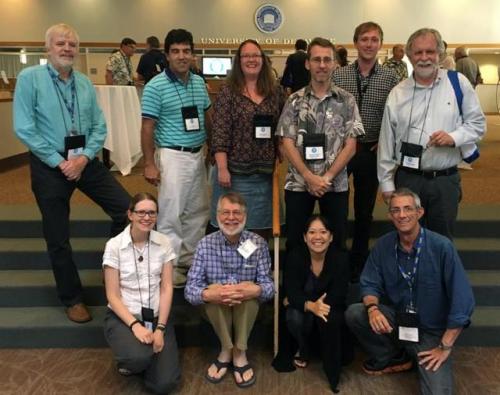
Researchers gathered in a hotel meeting room
Participants of Mollusks in Peril 2017 session at the 83rd Meeting of the American Malacological Society. Top row, from left: Rüdiger Bieler (Field Museum of Natural History), Jay Cordeiro (AMS Conservation Committee), Amanda Haponski (Museum of Zoology, University of Michigan), Ken Hayes (Howard University), Chris Hobbs (Canterbury Christ Church University, UK), Tim Collins (Florida International University); bottom: Megan Paustian (Howard University), Tim Pearce (Carnegie Museum of Natural History), Norine Yeung (Bernice Pauahi Bishop Museum), José H. Leal (Bailey-Matthews National Shell Museum, organizer). Not in photo: Dan Hua (Tennessee Wildlife Resources Agency).

Dr. Tim Pearce, assistant curator and Head of Section of Mollusks, was recently featured in the Curator’s Corner—a newsletter from Dr. José H. Leal, science director and curator at the Bailey-Matthews National Shell Museum—after he participated in the 83rd Meeting of the American Malacological Society at the University of Delaware.

“Some of the highlights of the meeting included a special workshop sponsored by iDigBio (Integrated Digitized Biocollections) on mollusks collections online, Digitizing the 2nd Largest Invertebrate Phylum: Mollusks; the President Symposium, Mollusk research in a digital world: creating, integrating and mining large datasets; and Mollusks in Peril 2017 (MIP 2017, organized by yours truly), a follow-up to the successful Mollusks in Peril 2016 Forum, held in May 2016 at the Shell Museum and sponsored by Smoky and Stephanie Payson.”

-Dr. Leal

Filed Under: Blog Tagged With: mollusks, Tim Pearce

August 3, 2017 by wpengine

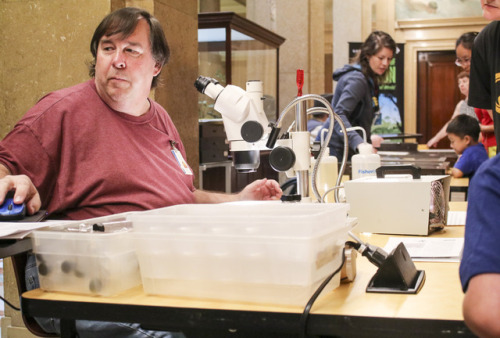
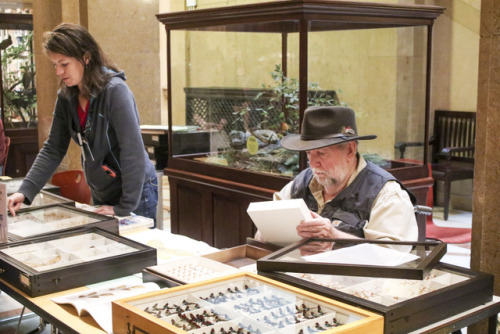
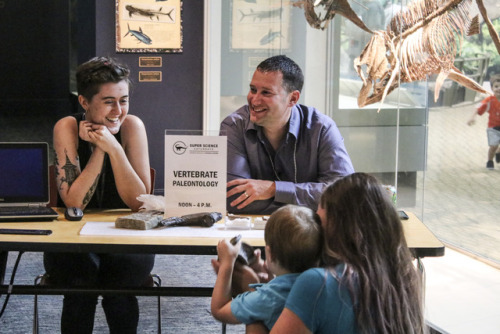
Researchers and scientists at work

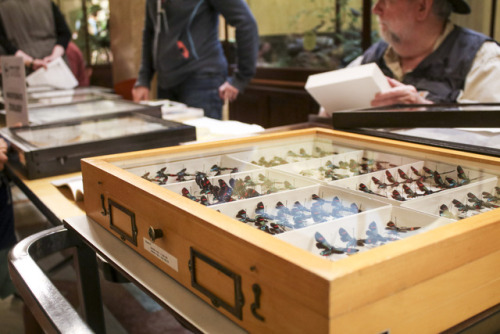
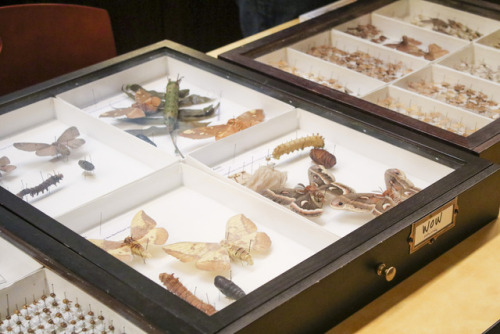
specimens from the section of Invertebrate Zoology

researchers at work

moth and caterpillar specimens

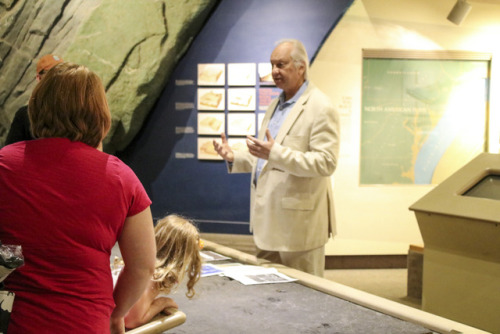
Albert talking to visitors in Benedum Hall of Geology

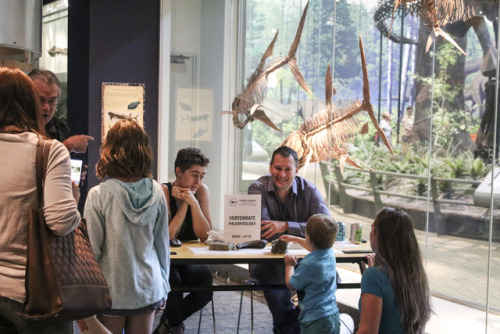
visitors meeting our dinosaur experts

researchers in the section of Invertebrate Zoology

researchers in the section of Vertebrate Palentology

Did you know researchers and scientists are at work in the museum every day?

Visitors got an inside look at the behind-the-scenes science of our museum by interacting with Carnegie scientists at a special Super Science Saturday—Scientist Takeover!

Entomologists, paleontologists, anthropologists, and other scientists spent Saturday, July 22 in the galleries showing off their cool collections, answering questions, and discussing their work with curious museum-goers. Visitors also enjoyed tours and hands-on activities like sifting through soil to find Pennsylvania land snails.

Super Science Saturdays is a program at Carnegie Museum of Natural History that invites visitors of all ages to explore a special theme through hands-on activities, experiments, demonstrations, discussions with museum experts, and more. Events are free with museum admission.

Don’t miss our next event, Whiskers and Woofs, on August 19.

Filed Under: Blog Tagged With: Albert Kollar, invertebrate paleontology, Invertebrate Zoology, John Rawlins, Matt Lamanna, mollusks, Super Science Saturday, Vertebrate Paleontology

  • « Go to Previous Page
  • Page 1
  • Interim pages omitted …
  • Page 6
  • Page 7
  • Page 8
  • Page 9
  • Page 10
  • Go to Next Page »

sidebar

About

  • Mission & Commitments
  • Directors Team
  • Museum History

Get Involved

  • Volunteer
  • Membership
  • Carnegie Discoverers
  • Donate
  • Employment
  • Events

Bring a Group

  • Groups of 10 or More
  • Birthday Parties at the Museum
  • Field Trips

Powdermill

  • Powdermill Nature Reserve
  • Powdermill Field Trips
  • Powdermill Staff
  • Research at Powdermill

More Information

  • Image Permission Requests
  • Science Stories
  • Accessibility
  • Shopping Cart
  • Contact
  • Visitor Policies
One of the Four Carnegie Museums | © Carnegie Institute | Privacy Policy | Terms of Use | Accessibility
Rad works here logo