• Skip to primary navigation
  • Skip to main content
  • Skip to primary sidebar

Carnegie Museum of Natural History

One of the Four Carnegie Museums of Pittsburgh

  • Visit
    • Buy Tickets
    • Visitor Information
    • Exhibitions
    • Events
    • Dining at the Museum
    • Celebrate at the Museum
    • Powdermill Nature Reserve
    • Event Venue Rental
  • Learn
    • Field Trips
    • Educator Information
    • Programs at the Museum
    • Bring the Museum to You
    • Guided Programs FAQ
    • Programs Online
    • Climate and Rural Systems Partnership
  • Research
    • Scientific Sections
    • Science Stories
    • Science Videos
    • Senior Science & Research Staff
    • Museum Library
    • Science Seminars
    • Scientific Publications
    • Specimen and Artifact Identification
  • About
    • Mission & Commitments
    • Directors Team
    • Museum History
  • Tickets
  • Give
  • Shop

Section of Birds

March 11, 2019 by wpengine

A Match Made by Coevolution

Darwin once predicted the existence of a pollinator after examining the star-shaped flower of the orchid Angraecum sesquipedale, a flower whose nectar is at the end of a 30 cm tube. Darwin wrote that “in Madagascar there must be moths with probosces capable of extension to a length of between ten and eleven inches [25.4–27.9cm].” Twenty years after Darwin’s death, his prediction was proven correct with the discovery of a moth, Xanthopan morganii praedicta, which boasted a proboscis 20 cm in length. In 1992, natural history observations of the moth feeding on the extreme flower and transferring pollen provided even more evidence that this plant and insect were tangled in a coevolution that resulted in their extreme morphology.

Coevolution is now a cornerstone of biology and has been well developed through examples of flowering plants and insects, parasites and hosts, predators and prey, and even gut microbiomes and human health. In fact, the influence of closely associated species on each other in their evolution is so ubiquitous one could argue that evolution is coevolution—as the boundary between what is an individual versus a consortia of different species blends as we dive deeper into the units that natural selection is acting upon. The microbiome and human health example helps illustrate the problem of defining an individual, specifically because scientists now think that microbial cells outnumber human cells in your body. Moreover, there is growing evidence this diversity of symbionts on our bodies complete metabolic pathways and serve other physiological functions. Coevolution crisscrosses the natural histories of organisms, creating nuances that sometimes complicate things.

With so much excitement and work surrounding coevolution, it is romantic to stumble across an example of coevolution fit for a kindergarten class. In the collection of birds at the Carnegie Museum of Natural History, we recently finished an analysis of 24 Costa Rican hummingbirds and the pollen types found on their bodies and were reminded of Darwin’s predictions of coevolution over 100 years ago with orchids and moths. The White-tipped Sicklebill (Eutoxeres aquila) is a hummingbird with an extreme bill curve, with an appearance that would remind kindergarteners of Jim Henson’s Gonzo Muppet. Putting this bird next to its favorite food, Centropogon granulosus, illustrates coevolution in an exciting way that doesn’t tangle you up in learning about microbes or imagining other complex ecological relationships. Like Darwin’s orchid and moth, this hummingbird and its preferred flower allow us to see coevolution is all around us.
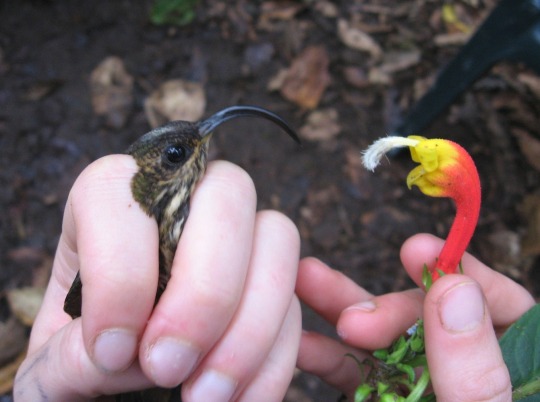
sicklebill hummingbird and its preferred flower

In an ongoing study at the Carnegie Museum of Natural History’s Section of Birds, we were reminded of the natural history observations and predictions that led to an explosion in the field of coevolution. By studying pollen types collected from hummingbirds in Costa Rica we confirmed that the White-tipped Sicklebill (Eutoxeres aquila) feeds mostly on Centropogon granulosus, a match made by coevolution.

Chase Mendenhall is Assistant Curator of Birds, Ecology, and Conservation at Carnegie Museum of Natural History. Museum employees are encouraged to blog about their unique experiences and knowledge gained from working at the museum.
Filed Under: Blog Tagged With: bird hall, Birds, Botany, Chase Mendenhall, evolution, Section of Birds

November 8, 2018 by wpengine

Ask a Scientist – How Are Birds Like Dinosaurs?

How are birds like dinosaurs? Assistant Curator of Birds, Chase Mendenhall, and Urban Bird Conservation Coordinator, Jonathan Rice, introduce the bird collection in the latest Ask a Scientist. Learn how the Section of Birds works with paleontologists to understand dinosaur behavior.

Ask a Scientist is a video series where we ask our research staff questions about the millions of amazing objects and specimens stored in our museum collection. Tune in on YouTube, and submit your own questions via Twitter @CarnegieMNH!

Filed Under: Blog Tagged With: Ask a Scientist, Birds, Chase Mendenhall, dinosaurs, Section of Birds

September 4, 2018 by wpengine

Fire Destroys Brazilian Museum Once Called House of the Birds

by Chase D. Mendenhall

One of Latin America’s most important museums burned Sunday night —destroying up to 20 million scientific and historical artifacts. It is unclear how many of the irreplaceable treasures housed at the National Museum in Rio de Janeiro were lost. The museum was established in 1818 by the King of Portugal and in its early days was known as the “Casa dos Pássaros,” or House of the Birds, for its impressive bird collections.

Today, the museum was best known for its exhibits of the Americas consisting of mammals, birds, reptiles, amphibians, insects, minerals, aboriginal collections of utensils, Egyptian mummies, South American archaeological artifacts, meteorites, fossils and many other findings. Sadly, many of these invaluable objects are permanently lost.

Novelist Paulo Coelho described the reaction to the fire by saying, “the country is in tears.” Others have demonstrated their pain by carrying signs that say “200 years of history, 20 million items, reduced to ashes.”

We find comfort knowing that some pieces of Brazilian history are safely stored in other museums around the world. The Carnegie Museum of Natural History represents Brazil strongly in its collections, especially in the Section of Birds. We house one of the most comprehensive collections of Brazilian birds outside of Rio de Janeiro. We have 885 species of birds from Brazil, represented by 20,292 specimens—4,357 of which are on loan around the world.

Museums generate millions of data points and inform published scientific debates that are shared through networks. Today, these networks of knowledge and sharing define museum collections and exist precisely to safeguard against disasters.

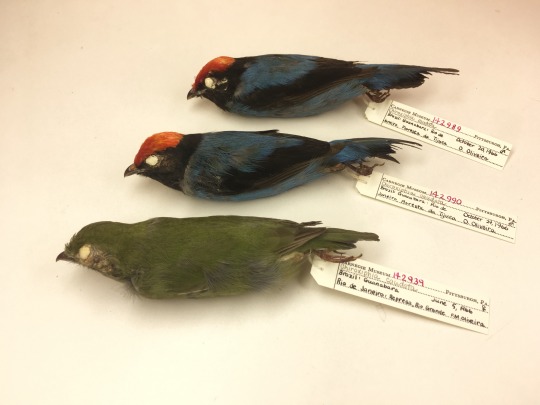
Chiroxiphia caudata study skins

Birds from the Carnegie Museum of Natural History collected from Rio de Janero include Blue Manakins (Chiroxiphia caudata), a species with one of the best examples of a cooperative breeding behavior. Males (red, black, and blue birds in background) meet in groups to dance in a coordinated, circular loop to breed with the solitary females (green bird in foreground) who raise the young on their own.

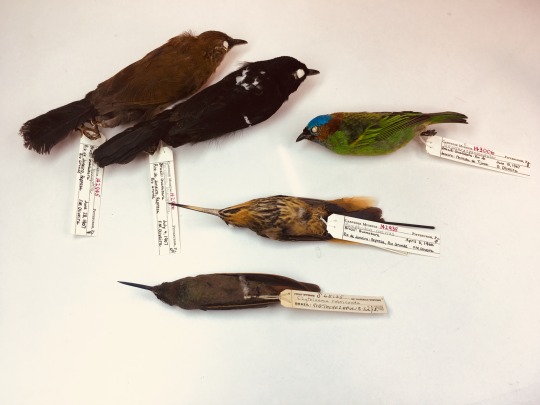
study skins of Brazilian birds

Other birds representing Brazil from the collections at the Carnegie Museum of Natural History include a pair of White-shouldered Fire-eye (Pyriglena leucoptera), a Red-necked Tanager (Tangara cyanocephala), a Saw-billed Hermit (Ramphodon naevius), and a Brazilian Ruby (Clytolaema rubricauda). Specimens are listed in the image from top to bottom.

Chase Mendenhall is Assistant Curator of Birds, Ecology, and Conservation at Carnegie Museum of Natural History. Museum employees are encouraged to blog about their unique experiences and knowledge gained from working at the museum.
Filed Under: Blog Tagged With: bird hall, Birds, Chase Mendenhall, Mason Heberling, Section of Birds

July 20, 2018 by wpengine

Powerlifting Poultry and Mallards that Marathon

By Chase D. Mendenhall

Fried, roasted or barbequed—most of us have a preference for cuts of light or dark meat when chicken is for dinner. But why the striking differences between dark and light meat?

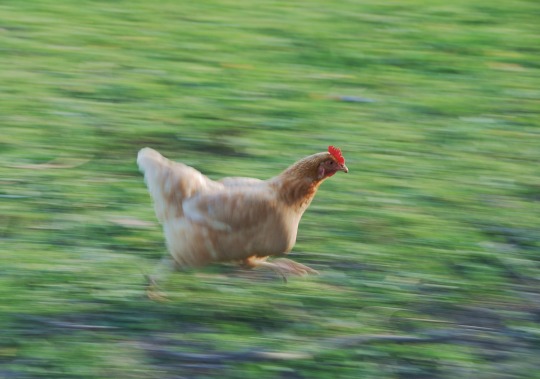
Chickens are gallinaceous birds, meaning they belong to a group of heavy-bodied, ground-feeding birds that generally prefer not to fly. Their leg muscles are used for standing, walking, and running throughout the day. Like a marathon runner, chickens build muscles in their legs that are highly resistant to fatigue and require lots of oxygen for the aerobic exercise being on foot all day. In fact, drumsticks and thighs get their color from the iron held in a special muscle fiber, myoglobin. The myoglobin in the dark muscles breaks down during cooking, giving the cooked meat a brownish color.

chicken running

Chickens build muscles in their wings and breasts for explosive bursts of flight from a resting position, similar to a bodybuilder maxing out their bench press. The flight of a chicken is mostly an anaerobic exercise, meaning that muscles are reacting quickly and doing extremely hard work in the absence of oxygen. Lighter muscle fibers take up sugars to fuel the explosive movement of flight from a standstill, but these muscles fatigue very quickly. When muscles with very little myoglobin muscle fibers are cooked, the proteins in the muscle fibers denature and coagulate, resulting in the white, opaque appearance we associate with a chicken breast.

But what about duck breast, isn’t it dark meat? Duck à l’orange and Pan Roasted Duck only have darker cuts of meat for us to choose from—including the breasts. Because ducks use their flight muscles to sustain long-distance flights, they stock their flight muscles with myoglobin to sustain aerobic flight. The aerobic demands of flight for a duck means that their meat is a darker color when served for supper.

Chase Mendenhall is Assistant Curator of Birds, Ecology, and Conservation at Carnegie Museum of Natural History. Museum employees are encouraged to blog about their unique experiences and knowledge gained from working at the museum.
Filed Under: Blog Tagged With: Birds, Chase Mendenhall, Section of Birds

February 1, 2018 by wpengine

Carnegie Museum of Natural History has an extremely…

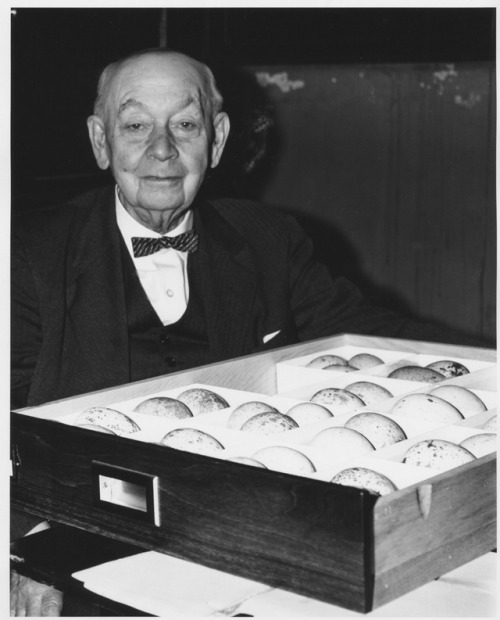
black and white photo of W.E. Clyde Todd with a drawer of large bird eggs

Carnegie Museum of Natural History has an extremely valuable collection of birds from northern South America because W.E. Clyde Todd, curator of ornithology, had an interest in the area and the ability to purchase specimens during the early years of the museum. We hold almost 59,000 specimens from the continent. Todd was curator from 1919–1944, but began at the museum in 1899 and continued to visit the museum as an emeritus until 1969—a full 70 years!

Picture above in 1966, Todd is shown with a drawer of bird eggs.

Filed Under: Blog Tagged With: Birds, museum history, Section of Birds

January 22, 2018 by wpengine

Endemic Birds of Cuba

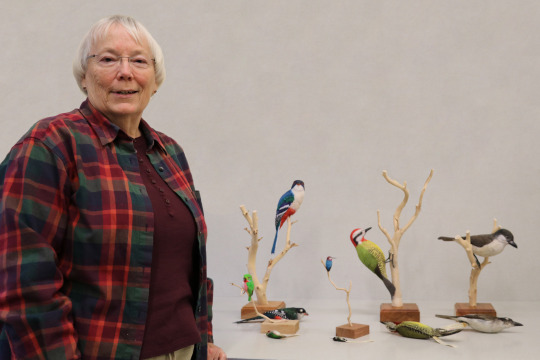
Susan standing in front of three wooden bird carvings
Susan Kraft with specimens at Carnegie Museum of Natural History

We will be highlighting a series of endemic birds from Cuba in correspondence to a new exhibit appearing at Phipps Conservatory, Tropical Forest Cuba set to open Saturday, February, 10. Carvings were created by Susan Kraft (above), for the exhibit, using specimens from Carnegie Museum of Natural History as reference.

An endemic bird can be defined as one that only occurs in a given area, in this case, Cuba and the small islands surrounding this large island. Endemics only live in a specific area unless they are in captivity or became invasive in some way.

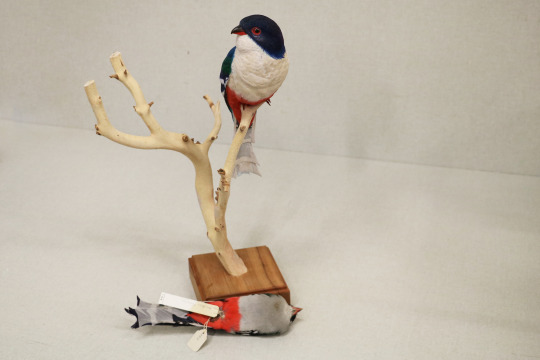
wooden carving of a blue and red bird shown next to the real study skin of the same bird
Cuban Trogon reference specimen

The first highlighted piece is an exquisite carving of a Cuban Trogon. The reference specimen used to create this carving was a specimen in the Carnegie Museum collection collected on March 1941 by W.H. Corning. Artists, sculptors, and carvers benefit by having real specimens to use as reference.


Tropical Forest Cuba is an exhibit opening February 10 at Phipps Conservatory. The exhibit showcases the vibrant ecology and culture of one of the most bio-diverse nations on Earth. Cuba houses more endemic animal and plant species than any other Caribbean island, boasting some of the most fascinating and unique bird species.


Filed Under: Blog Tagged With: Birds, Section of Birds

  • « Go to Previous Page
  • Page 1
  • Page 2
  • Page 3
  • Go to Next Page »

sidebar

About

  • Mission & Commitments
  • Directors Team
  • Museum History

Get Involved

  • Volunteer
  • Membership
  • Carnegie Discoverers
  • Donate
  • Employment
  • Events

Bring a Group

  • Groups of 10 or More
  • Birthday Parties at the Museum
  • Field Trips

Powdermill

  • Powdermill Nature Reserve
  • Powdermill Field Trips
  • Powdermill Staff
  • Research at Powdermill

More Information

  • Image Permission Requests
  • Science Stories
  • Accessibility
  • Shopping Cart
  • Contact
  • Visitor Policies
One of the Four Carnegie Museums | © Carnegie Institute | Privacy Policy | Terms of Use | Accessibility
Rad works here logo