• Skip to primary navigation
  • Skip to main content
  • Skip to primary sidebar

Carnegie Museum of Natural History

One of the Four Carnegie Museums of Pittsburgh

  • Visit
    • Buy Tickets
    • Visitor Information
    • Exhibitions
    • Events
    • Dining at the Museum
    • Celebrate at the Museum
    • Powdermill Nature Reserve
    • Event Venue Rental
  • Learn
    • Field Trips
    • Educator Information
    • Programs at the Museum
    • Bring the Museum to You
    • Guided Programs FAQ
    • Programs Online
    • Climate and Rural Systems Partnership
  • Research
    • Scientific Sections
    • Science Stories
    • Science Videos
    • Senior Science & Research Staff
    • Museum Library
    • Science Seminars
    • Scientific Publications
    • Specimen and Artifact Identification
  • About
    • Mission & Commitments
    • Directors Team
    • Museum History
  • Tickets
  • Give
  • Shop

Shelby Wyzykowski

January 11, 2022 by Erin Southerland

Paradise Found: The Real-Life Residents of Shangri-La

by Shelby Wyzykowski 

In 1933, when British author James Hilton published the novel Lost Horizon, much of the world was in the midst of the Great Depression, and in some countries there were signs of movement towards another large-scale war. The book became a best-seller in part because it provided a welcome respite from reality. The focal point of the story is a serene paradise called Shangri-La, a fabled land hidden amongst the snow-capped peaks of the Himalayas that is blissfully free of sickness, poverty, conflict, or struggle. The tantalizing tale of a mystical utopia with no shortage of security, beauty, peace, and excited weary readers and piqued their imaginations. 

Sadly, for humankind, the enchanting world of Shangri-La is now, and will likely always be, a dream. However, for some fauna species of Central Asia with homes nestled high up amid the rugged and intimidating terrain of the frigid Himalayan mountains, life does seem to imitate literary art. At great heights within the boundaries of this mysterious and remote part of the world, they have carved out a little piece of heaven for their very own. But, unlike the idyllic scenario presented in Hilton’s fictional novel, living in a real-world paradise is not without its challenges. 

Paradise Found for the Black Snub-Nosed Monkey?
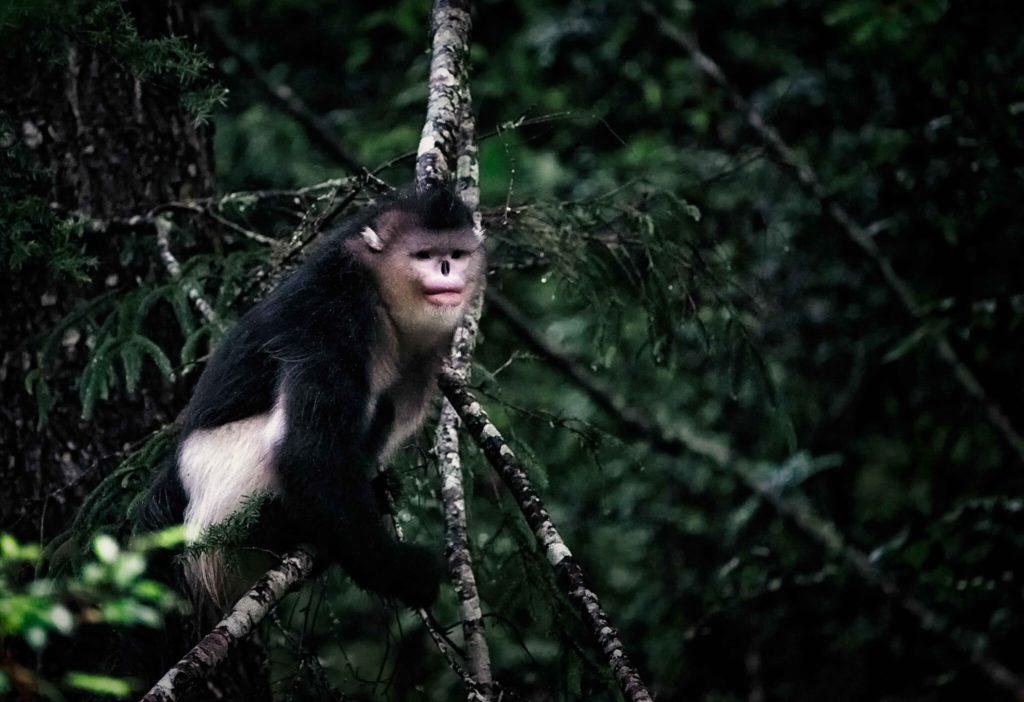
black snub-nosed monkey in a tree
“Black Snub-nosed Monkey” by Rod Waddington is licensed under CC BY-SA 2.0.

The black snub-nosed monkey, the rarest monkey in the world, lives at a higher altitude than any other primate besides humans. The species makes its home at roughly 10,000 to 15,000 feet above sea level in the majestic mountain forests of the Yunnan region in southern China. Lush, Eden-like valleys are their primary residence for much of the year. Here there is an ample supply of food (in the form of leaves) at their fingertips.

However, when winter arrives, they make a move that, at first, seems a bit counterintuitive. For the coldest months of the year, the monkeys choose to live in the highest part of their range. They brave the bone-chilling temperatures higher in the Himalayas because their favorite food, a particularly nourishing variety of lichen, is more abundant there. At high elevations, the monkeys rest on sunny rock outcrops to take advantage any available solar heat. This sensible tactic, along with huddling in groups of up to eight, helps the species survive.

Protecting the Black Snub-Nosed Monkey

Due to poaching and deforestation, the black snub-nosed monkey is considered endangered – even more endangered than the beloved panda. Conservation groups are hoping to make a change for the better as they work to find ways for the monkeys and their neighboring human communities to coexist. One notable development involves a forest monitoring campaign where some local villagers are trained as forest rangers who patrol the monkey habitat, searching for old poaching traps and installing infrared cameras to monitor and protect the small population. These positive and productive efforts are exactly what the black snub-nosed monkeys need in their ongoing struggle to survive in their mountain habitat. If these conservation initiatives are successful, the monkey population has an excellent chance of rebounding and recovering.

Snow Leopards Thrive at the Top
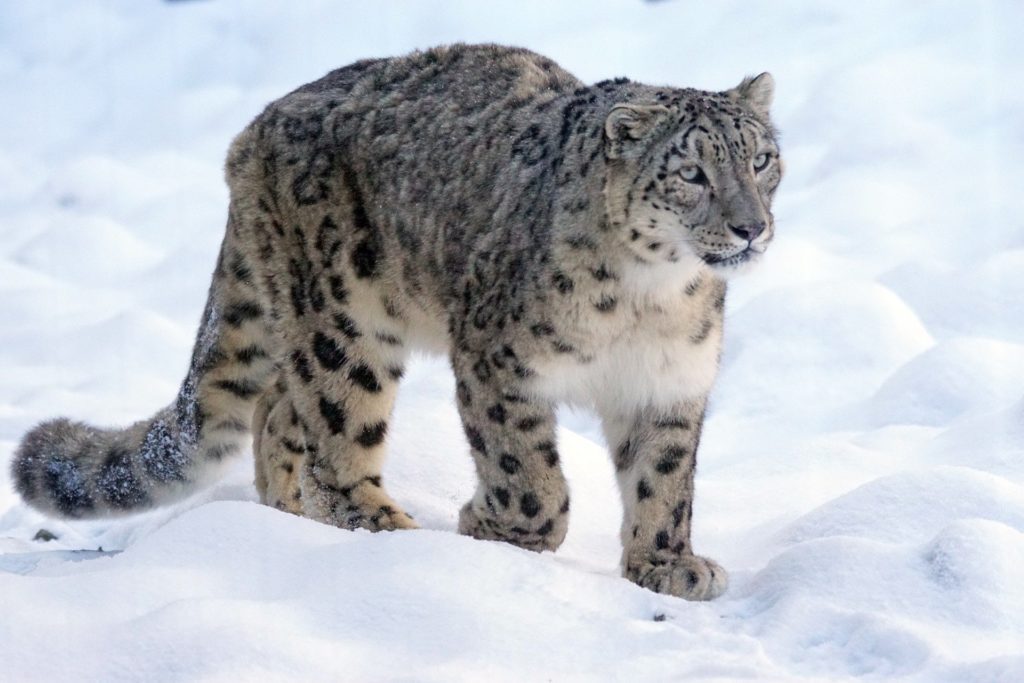
snow leopard in the snow
Image credit Marcel Langthim via Pixabay.

You might think that it’s lonely at the top, but snow leopards are very happy living a solo lifestyle. Mature adults live alone, high up (at elevations of 9,800 to 14,700 feet) in the steep and rocky mountains across Asia. They are perfectly designed to live in such a harsh and rugged environment. Their strong build allows them to effortlessly scale steep slopes, and their powerful hind legs give them the ability to leap six times the length of their body. Their long tail provides them with the agility and balance that is needed to traverse icy, slippery ground. It also does double duty as a soft, furry blanket that can be wrapped around the leopard’s body to provide warmth when sleeping. Appropriately referred to as the “ghost of the mountains,” they have an amazing knack of blending in with their frosty environment. 

Threats to Snow Leopard Survival

Snow leopards thick whitish-gray spotted coat with black rosettes blends in seamlessly with the snowy, jagged cliffs and ravines. However, this gift that provides them with virtual invisibility has also been a curse. In illegal wildlife trade, poached snow leopard pelts bring a high price. Unfortunately, it’s not only law-breaking hunters that set their sights on the cats. As local human development has increased, livestock grazing has expanded into the snow leopard’s range. Argali and Blue Sheep, the snow leopard’s natural prey, have become harder to find (humans hunt these sheep as well); the leopards are forced to prey on livestock for sustenance. In retaliation, snow leopards are often killed by local farmers and herders. 

Snow Leopard Conservation

This magnificent cat’s fate might seem a bit grim, but their future is brightening. In the Eastern Himalayas, conservationists are working with local communities to monitor and protect snow leopards. Predator-proof livestock pens are being installed to reduce the retaliatory killings, and in an attempt to spread the word about the leopard’s plight, leopard awareness programs are being presented to school students and the mountain communities at large. So, things are definitely looking up for the graceful and ghostly snow leopard. 

Meet the Takin 
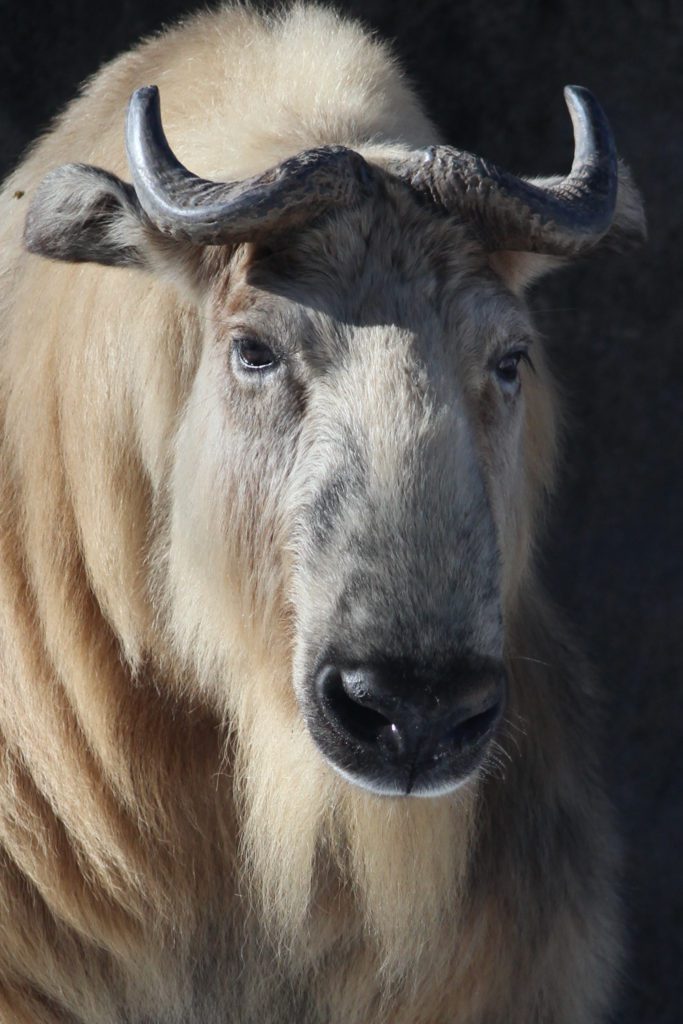
close up of a Takin's face
“Takin in the Soft Light” by Mark Dumont is licensed under CC BY-NC 2.0

The takin almost appears to be an imagined creature from a Star Wars movie, and it would by no means look out of place if it were roaming the windswept tundra of the ice planet of Hoth. Yet this ungulate, which looks like a compilation of a goat, muskox, and a gnu, is quite real.

Weighing up to 770 pounds, you would think that such a bulky bovid could never survive at mountain elevations as high as 14,000 feet. This nimble creature, which is most closely related to wild sheep, is an expert at maneuvering up and down steep rocky slopes. Takins have also adapted to the challenging weather of their lofty, chilly sanctuary. The species’ massive, moose-like snout has large sinus cavities that warm up the cold mountain air. Without this high-elevation adaptation they would lose a large amount of body heat simply by breathing. Another physical adaptation this mammal relies upon to combat the weather is an oily bitter substance they secrete through their skin. The secretion coats the takin’s fur and acts as a natural raincoat during storms and periods of fog.    

The Takin: Sacred and Endangered

Though this remarkable animal’s existence is generally unknown in the Western world, the creature is revered in Asia. The takin is sacred to Tibetan Buddhists, and it is also the national animal of the Kingdom of Bhutan, the landlocked country in the Eastern Himalayas, between China and India. Despite their elevated status, takins are endangered or vulnerable throughout much of their range. Habitat destruction is a major threat, and hunters poach them for food and fur. 

In response to the takin’s dire situation, China’s government has taken steps to ensure that its national treasure will survive. The takin has been given the country’s highest legal protection, and, in 2013, in cooperation with The Nature Conservancy, the Laohegou Land Trust Reserve was established. This tract of land links several existing reserves in China that together sustain a wide array of animals, including the takin, golden snub-nosed monkey, and the giant panda. These linked protected areas, along with some recently established programs promoting ecotourism and eco-friendly agriculture, are slowly transforming the dream of a successful and sustainable takin sanctuary into a reality.

Shangri-La: Fictional or Real Place?

It’s unfortunate that Shangri-La is only a fictional fabrication found within the pages of a book. Yet even though it does not exist in our physical world, Shangri-La does seem to exist for us in spirit. In a pivotal scene in Lost Horizon, one of the novel’s key characters, the High Lama of Shangri-La, foretells of a time when the nations of the world will tear each other apart through war. He proclaims that, after the chaos has finally come to an end, all that will remain are Shangri-La’s messages of wisdom, harmony, and hope for the future. His one great wish is to see this hopeful and harmonious way of life spread throughout the entire world.

In our real world, a genuine spirit of hope for the future is visible in the joint efforts of conservation organizations, governments, and local Himalayan communities as they work together to save endangered mountain species. Their efforts are showing the snub-nosed monkey, snow leopard, and takin the kindness and respect that they so rightfully deserve. These three extraordinary animals have found their own special Shangri-La. And as the self-appointed caretakers of this planet, it is up to us  to continue to help them to flourish in their wintry nirvana for many years to come.

Shelby Wyzykowski is a Gallery Experience Presenter in CMNH’s Lifelong Learning Department. Museum staff, volunteers, and interns are encouraged to blog about their unique experiences and knowledge gained from working at the museum. 

Related Content

Waddling in a Winter Wonderland: How Penguins, Humans, and Other Animals Traverse Ice and Snow

How Do Trees Survive the Winter?

Ice and Snow: The Effects of Temperature

Carnegie Museum of Natural History Blog Citation Information

Blog author: Wyzykowski, Shelby
Publication date: January 12, 2022
Share this post!

  • Share on Twitter Share on Twitter
  • Share on Facebook Share on Facebook
  • Share on Pinterest Share on Pinterest
  • Share on LinkedIn Share on LinkedIn
  • Share on Reddit Share on Reddit
  • Share via Email Share via Email

Filed Under: Blog Tagged With: Shelby Wyzykowski, Super Science, We Are Nature 2

December 8, 2021 by Erin Southerland

Ruthie the Red-Nosed Reindeer: The Natural History Behind Some Classic Christmas Carols

by Shelby Wyzykowski 

We all know Dasher and Dasher and Prancer and Vixen, Comet and Cupid and Donner and Blitzen. But do you recall the most famous reindeer of all? It’s Ruthie the red-nosed reindeer of course! No, that definitely does not sound quite right, does it. There is no Ruthie in the traditional song that we all know and love. The lead reindeer that guides Santa’s sleigh on that foggy Christmas Eve should be Rudolph, a boy, not Ruthie, a girl. Or so the song says. There are several widely known Christmas carols that incorporate animals into their lyrical stories. They are songs that many people know by heart and faithfully sing year after year. But have you ever taken the time to stop and really think about the ways in which wildlife are portrayed in these melodic tales? Are these stories scientifically accurate accounts that hold true to the realities of the natural world? Or are they simply lyrical flights of holiday fancy?

The Twelve Days of Christmas

“The Twelve Days of Christmas”, first published in England in 1780, is a carol that documents a very long list of gifts that a true love gives to their sweetheart over a period of twelve days. By the end of the ballad, the lucky giftee receives 184 birds, more than enough to open their own aviary. The large, feathered flock of six different avian species includes a partridge in a pear tree (twelve times over).

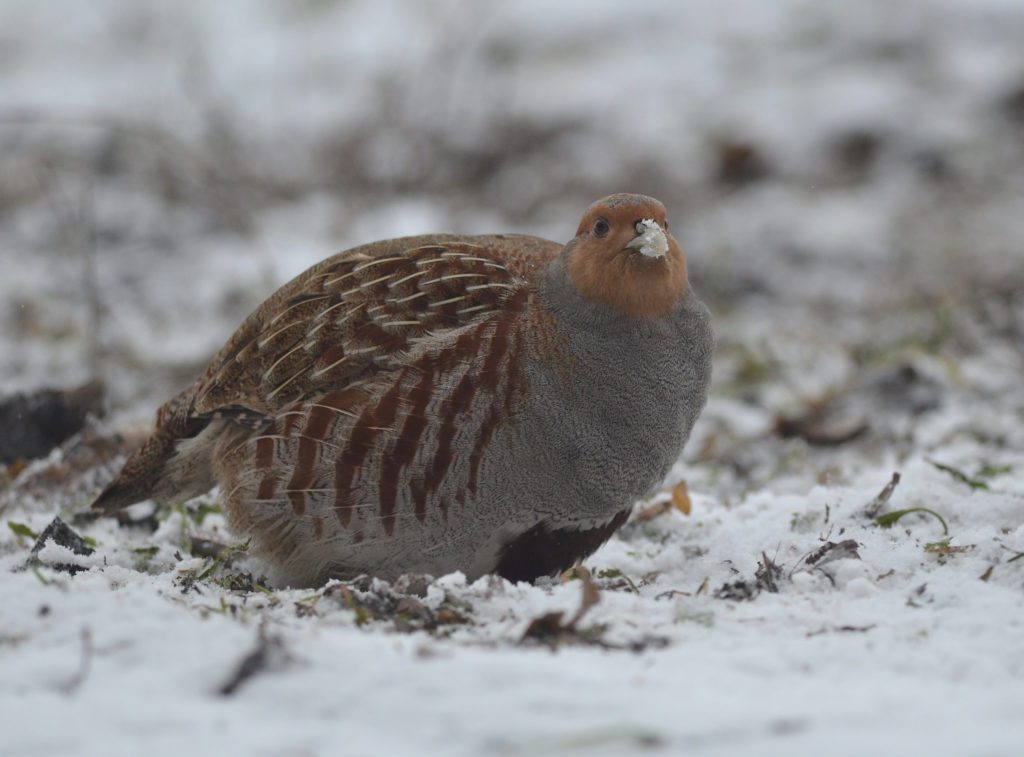
gray partridge on snowy ground
Gray Partridge. Image by Ekaterina Chernetsova (Papchinskaya) via Flickr.

A partridge in a pear tree would not be the most ideal gift since, not only would gift wrapping be a challenge, but it might not be possible to find such a gift. Do partridges even roost in pear trees? Though the iconic image of a treed fowl paints a pretty yuletide picture, it is not a natural occurrence in the real world. In North America, two species of partridge introduced as game birds have well-established populations. The Gray Partridge (Perdix perdix), a native of Europe, can be found in northern prairies, where it roosts and forages mostly on the ground, at the bases of shrubs, and, during winter, on the snow. The Chukar Partridge (Alectoris chukar), a native of Eurasia, inhabits the arid American West, where it roosts beneath sagebrush, under juniper trees, in rock outcrops, or in open rocky areas. Not only do both species build their nests exclusively on the ground, they are also both primarily seed-eaters (but they do enjoy the occasional leaf or insect). So, pears as a food source are of no real interest to either type of partridge.  

swan on the water
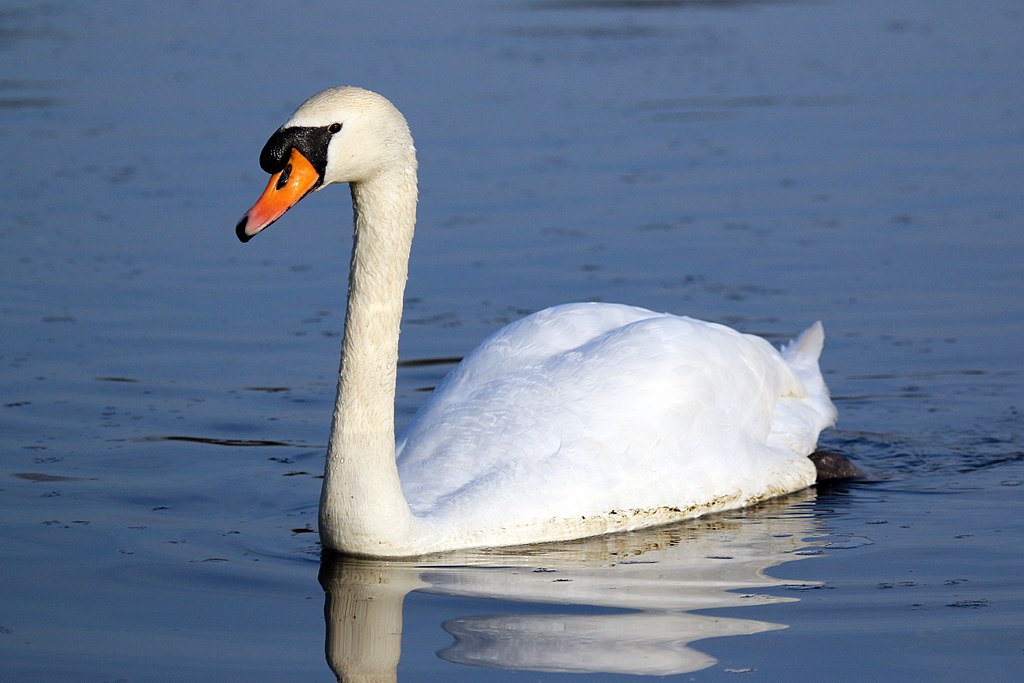
Mute Swan. Image by Charles J. Sharp, CC BY-SA 3.0, via Wikimedia Commons.

Among the many other birds this carol features are the “swans a-swimming”. If your beloved happens to be an avian enthusiast, the Mute Swan just could be the most fitting of gifts on the seventh day of Christmas. These birds have traditionally been associated with romance because of their graceful swimming and their long and beautifully curved S-shaped necks. They also mate for life, and paired couples tend to charmingly swim side by side. Native to Europe and parts of Asia, Mute Swans were brought to the United States as pond ornaments for private estates and have since gained a foothold in this country. Mute Swans, being very territorial, usually do not migrate and may be present at the same location all year round. They are very content living in icy cold weather if there is an abundant supply of food at hand. But can they swim in the blustery, inhospitable conditions of December, as this song claims? Surprisingly, the answer is yes. You would imagine that swimming in frigid waters would unmercifully freeze the feet of waterfowl, but swans and other waterfowl avoid this frosty fate by utilizing an intricate heat-exchange system called counter-current circulation. Through an intertwining of arteries and veins, the circulation system in the legs of these birds functions as a natural radiator. When arterial blood moving from the body to the feet passes alongside the venous blood returning from the feet to the body, heat is transferred from the warm arteries to the cool veins. This process keep’s the swan’s body at the right temperature while the extremities are still just warm enough to avoid tissue damage. There’s no doubt that if humans were gifted with this same circulatory trick, many a day of snow shoveling, and car cleaning would be made much more bearable!

Walking in a Winter Wonderland

One of the time-honored favorites of the season is “Walking in a Winter Wonderland,” the 1934 classic song about a couple’s romance during the holiday season. Though a snowman plays a prominent part in this tune, two types of bird are also mentioned.

bluebird on a branch
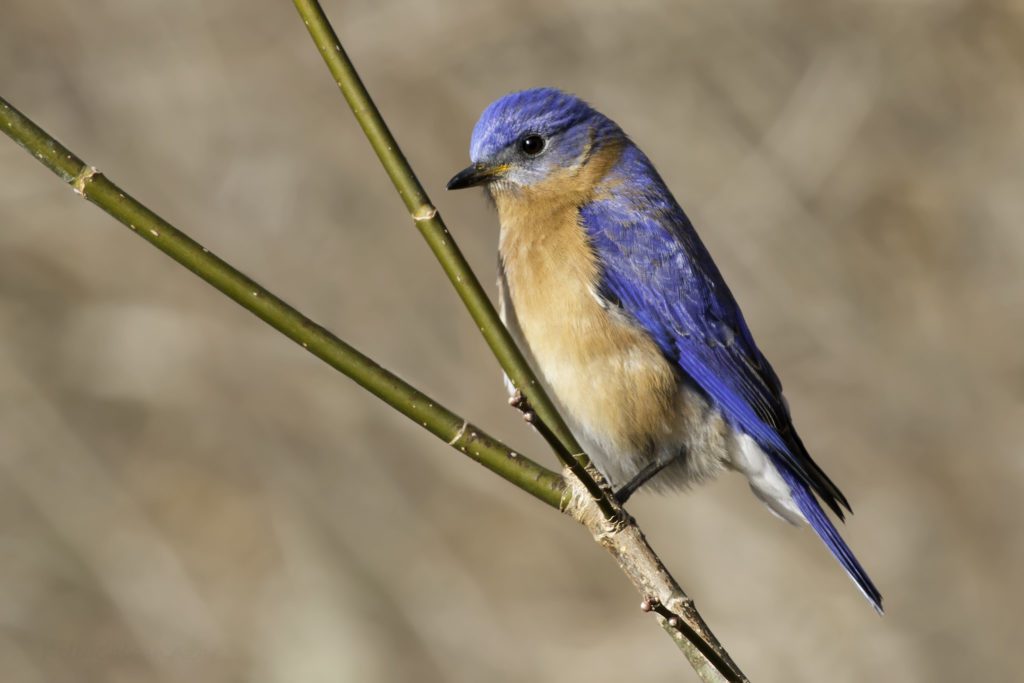
Eastern Bluebird. Image by Kelly Colgan Azar via Flickr.

The first is introduced into the musical story with the line “gone away is the bluebird.” This bluebird might symbolize the sadness that comes with being parted from a loved one. Or could it just literally mean that the songbird has left the wintry weather for warmer climes? Feathered with eye-catching plumage of bright azure and rust, the Eastern Bluebird (Sialia sialis) is found in many parts of our country during much of the year. However, as winter approaches, much of the population migrates to the southern U.S., with some members of the species flying as far south as Central America. Though they are occasionally seen in wintry weather, most do not return north again until February or March. So, if your own personal Winter Wonderland happens to be somewhere in the northern United States, the lyrics “gone away is the bluebird” are fairly accurate.

But what about the mysterious “new bird” that’s “here to stay” and sings a love song as the happy couple goes along? Some song aficionados suppose that the “new bird” represents the elation that two people share when starting their new life together. Others suggest that the unnamed bird is actually the stork, ready and waiting to eventually deliver a little bundle of joy. But storks cannot sing, can they? Well, no, not really. The Wood Stork is the only stork native to North America. It is a very large, heavy-billed bird that wades in the shallows of southern swamps, marshes, ponds, and lagoons. Adult storks are mostly silent except for the occasional hissing. They also can be heard bill clappering, which is when they make a loud, clattering sound by quickly opening and snapping shut their bills. But young storks do have a musical repertoire of sorts. Within stork breeding colonies, which are usually located in stands of tall cypress, nestlings will make a noisy ruckus as they beg for food. Their loud calls sound a bit nasally, kind of like a braying donkey. If the wood stork is in fact the “new bird”, his attempt at singing a love song would not be considered particularly romantic by many, unless you happen to be a lovesick donkey in search of a mate (as a side note, both male and female donkeys use bray vocalization during courtship).

Rudolph the Red-Nosed Reindeer

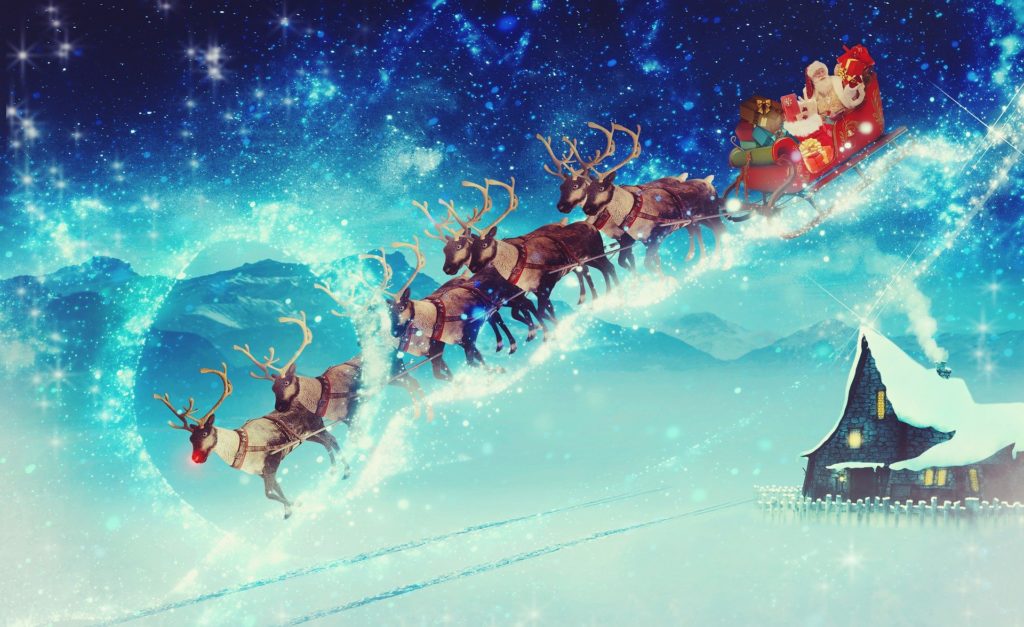
Image by Darkmoon_Art via Pixabay.

Now let’s get back to the catchy 1949 jingle about the gutsy hooved hero whose red nose saved Christmas. The surprising truth about “Rudolph the Red-Nosed Reindeer” is that these animals can actually have red noses! Reindeer have densely packed arrays of capillaries in their noses, which can sometimes cause them to appear pink. An excess flow of blood to their nose warms the air that they breathe in and can also help regulate their body temperature under extreme environmental conditions. To avoid overheating while running (or, in Rudolph’s case, flying) for long periods of time, large volumes of blood are brought to the nose where the excess heat can radiate out into the air. 

Also, according to the song, male reindeers at the North Pole sport their antlers well into the darkest days of winter. But outside the boundaries of Santa’s domain, males begin to shed their antlers in late autumn after the fighting of rutting season has ended. Females retain their antlers well into the spring when their calves are born. Access to food is critical during their winter pregnancy, so they must use their antlers to defend patches of vegetation in small areas of cleared snow. Also, during the colder months, females are in better physical condition than males because they have much larger stores of energy. Females enter winter with about fifty percent body fat, whereas the fat percentage of males can dip as low as five percent. So, although there don’t seem to be any females helping to pull Santa’s heavy, gift-laden sleigh, rest assured that these ladies would be more than capable of taking on the task!

Natural History of Christmas Songs

So now we know the true story behind some of our favorite Christmas ditties. Storks don’t sing sweet songs of love. And you’ll never see a partridge anywhere near a pear tree, not at Christmas or at any other time of the year. Yet despite the scientific inaccuracies of these traditional holiday songs, we still unconditionally adore them for what they represent…the joyous and hopeful spirit of the season. But what about Rudolph? If the reindeer rules of winter favor females, how can we account for our red-nosed friend and all of the other males that make up Santa’s team? Well, perhaps we can attribute it to a little bit of Christmas magic at work. Maybe some seasonal miracle allows these reindeer to hang on to their antlers for just long enough so that they can take part in that worldwide flight on the big night. We can only guess, since it seems to be a closely guarded secret between Santa and his crew. They’re the only ones that know the whole story. But that’s okay, because, during the holiday season, do we always need to know why things happen the way that they happen? Probably not. Sometimes, it’s perfectly fine just to wonder and imagine and not know all the answers. 

Because, sometimes, just believing is enough.

Shelby Wyzykowski is a Gallery Experience Presenter in CMNH’s Life Long Learning Department. Museum staff, volunteers, and interns are encouraged to blog about their unique experiences and knowledge gained from working at the museum.

Related Content

Fraser Fir

The Feast of the Seven Fishes

Are Santa’s Reindeer Real Mammals?

Carnegie Museum of Natural History Blog Citation Information

Blog author: Wyzykowski, Shelby
Publication date: December 13, 2021

Share this post!

  • Share on Twitter Share on Twitter
  • Share on Facebook Share on Facebook
  • Share on Pinterest Share on Pinterest
  • Share on LinkedIn Share on LinkedIn
  • Share on Reddit Share on Reddit
  • Share via Email Share via Email

Filed Under: Blog Tagged With: Carnegie Museum of Natural History, HATW, Shelby Wyzykowski, Super Science

October 22, 2021 by Erin Southerland

Trick or Tweet! Clever Creature Disguises

by Shelby Wyzykowski 

It’s that time of year,

As Winter draws near,

There’s a crisp, fall-fresh chill in the air.

And the trees once so green,

Paint a colorful scene,

With their typical, Autumnal flair.

Everyone dresses up,

Like a monster or pup,

Or anything else in between.

To shout “Trick or Treat!”

And get something so sweet.

Hooray! It must be Halloween!

But be on your guard,

For if you look hard,

You’ll discover a curious thing.

Some animals, too,

Wear disguises (like you!),

Some slither, or flutter, or sing.

It could be oh so thrilling,

And maybe quite chilling,

To learn of the what, why, and how.

So let’s waste no more time,

With these whimsical rhymes,

And talk about some of them now!

Which Snake Is Venomous and Which Is In Disguise?

If you just happen to be a hiker, camper, or all-around outdoorsperson, you might just recognize this catchy saying:

“Red touches yellow,

Kills a fellow,

Red touches black,

Friend of Jack.”

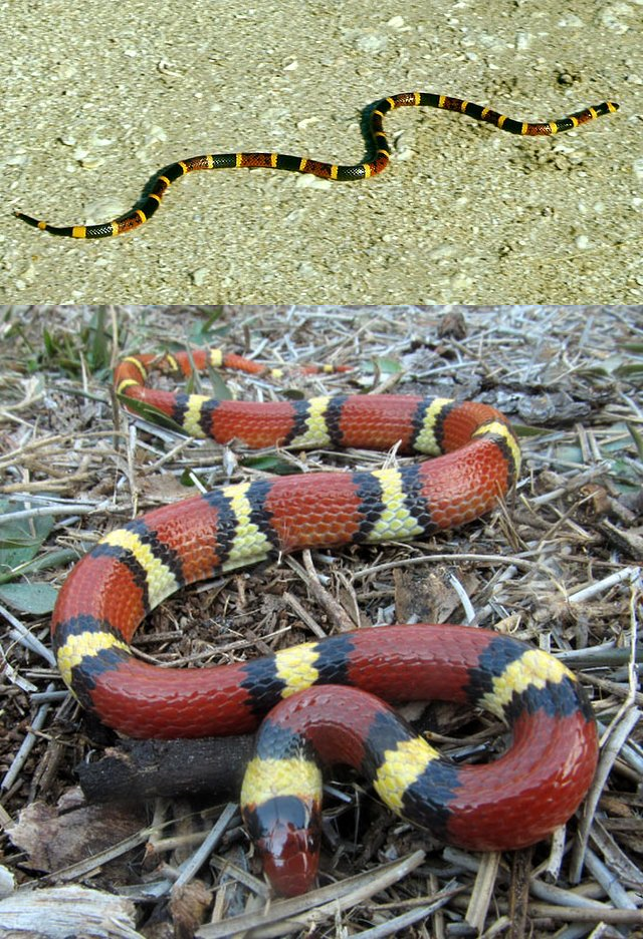
Yes, it’s true that I did just claim that we were finished with rhyming for now, but knowing this pithy poem might just come in handy one day. As a matter of fact, if you are in the forests of the Southeastern U.S. and happen to stumble across a snake sporting vibrant bands of red, yellow, and black, this memorable rhyme could even save your life. It describes the very important differences between two similar-looking snakes, the Eastern Coral snake and the Scarlet Kingsnake.

The venomous and potentially deadly Coral snake has a pattern of red, yellow, and black bands encircling its body. The non-venomous, harmless Kingsnake’s body displays a pattern of red, black, and yellow bands. So, why would a harmless snake evolve in such a way that it intentionally displays bright colors that are easily spotted by predators? Because it’s hoping that a predator will spot it, mistake if for the dangerous Coral snake, and leave it alone.

This evolutionary visual deception is known as Batesian mimicry. Named after the nineteenth century naturalist Henry Walter Bates (in honor of his work with mimicry in Amazonian butterflies), this type of mimicry offers a protective function to the mimic yet offers no benefit to the species being mimicked. Not surprisingly, the more noxious the model animal is (as in the case of the Coral snake, for example), the more mimics it tends to accumulate!

Can you spot the difference? The venomous coral snake is above the harmless scarlet kingsnake!

A Butterfly Dressed Like an Owl

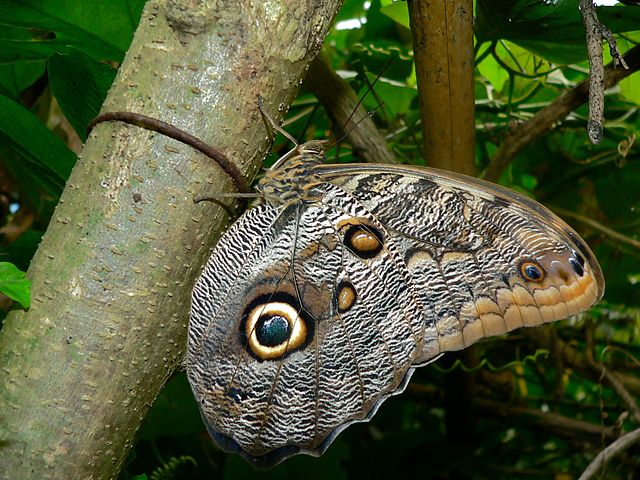
Besides venomous snakes, owls are also apex predators that many smaller predators make a point to avoid, and the Owl Butterfly has evolved to take advantage of this fact. With the conspicuous yellow and black “owl eye” spots in the middle of its hind wings, this giant insect can be easily spotted in the rainforests and secondary forests of Mexico and Central and South America. Smaller animals think twice when they see the face of an owl, and this hesitation gives the large, slow-flying butterfly the time that it needs to escape. But unlike the Scarlet Kingsnake, this butterfly’s wing pattern resembles multiple predatory models. Some small predators can also mistake their “large-pupil” eyespots to be lizards or amphibians, which are two other types of predators that hunt by sight. This multi-purpose disguise makes the Owl Butterfly look intimidating when it is in fact quite timid!

The owl butterfly uses its distinct pattern to fool potential predators.

Zone-tailed Hawk or Turkey Vulture?

But it’s not only prey species that take on other guises to deceive.  Predators want to join in on the costume fun as well.

When a hunter mimics an inoffensive species to get closer to its prey, it is called aggressive mimicry. A prime example of a species that artfully employs this type of trickster predation is the Zone-tailed Hawk. This winged “wolf in sheep’s clothing” looks remarkably like a Turkey vulture.

Turkey vultures, which are scavengers, are not seen as a threat to living creatures, so small prey animals, such as mammals, lizards, and smaller birds, learn to ignore them. Hawks take full advantage of their vulture-like façade and further increase their chances of capturing unsuspecting prey by behaving like Turkey vultures as well. They circle about and fly with their wings slightly raised, rocking back and forth in the same way as vultures. To make the act even more convincing, these raptors often soar and sometimes even roost with vultures! It’s an ingeniously cunning way to stealthily sneak up on prey and make a direct and powerful attack.  

Shrikes Are Excellent Mimics

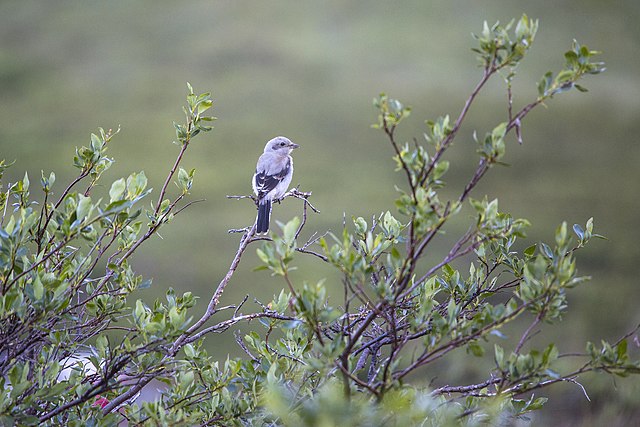
Another bird that uses an ingenious trick to acquire a well-earned treat is the Northern Shrike. Unlike the Zone-tailed hawk that employs visual and behavioral mimicry to catch its prey, this pretty, seemingly unassuming songbird utilizes vocal mimicry. Like the Sirens of Greek mythology that used irresistibly hypnotic singing to lure in passing ships, shrikes mimic the calls and songs of their intended prey. As soon as their bewitching avian melodies have attracted their target animal to within attack range, they dispatch their prey and commence feeding.

Though the shrike has a falcon-like hooked bill (like a raptor), it still has a songbird’s feet. And since it does not have talons to tear apart its food, it has a unique method of consuming its meal. Shrikes will impale their quarry on sharp objects such as thorns or barbed wire. Once the prey is sufficiently secured, it is easier to tear apart and eat with their strong, sharp bills. They tend to favor starlings, house sparrows, and black-capped chickadees, but they don’t limit themselves solely to songbirds. Voles, mice, bumblebees, and beetles are also favorite choices, and they also catch lizards and frogs on occasion (however reptiles are normally not eaten and are left untouched once impaled).

And it’s not just adults that display this intriguing impaling behavior. Just after fledgling, young shrikes practice their impaling skills by gathering leaves or blades of grass and piercing them onto thorny branches.

Apparently though, impaling is not learned from their parents and is instead an inherited behavior, since juvenile shrikes raised alone in captivity will attempt to fix prey onto anything that is available in their cages. Ornithologists suppose that this impaling behavior has uses other than just the immediate consumption of a meal. They have observed shrikes building up caches of impaled prey in specific vicinities. Caching is a way for shrikes to store up food, similar to squirrels gathering up acorns for the winter. Also, it seems that the larger a male shrike’s cache is, the more females he attracts for mating. In addition, scientists have observed that impaled prey is deliberately positioned in specific patterns as a way to mark the boundaries of a shrike’s territory. It’s an unnerving yet effective deterrent that seems to successfully ward off rival shrikes!

A juvenile Northern shrike, Lanius borealis, sitting on a branch.

Mimic Octopus of Indonesia

A blog post about animal pretenders wouldn’t be complete without mentioning the ultimate master of disguise, the Mimic Octopus of Indonesia. Like other octopuses, it uses chromatospheres (color-changing cells on its skin) to blend in with the shallow, sandy ocean bottom. Yet, unlike other octopuses, this crafty cephalopod is a natural-born shapeshifter. As it forages in the open water in full view of potential predators, it changes color, shape, and how it behaves based on its surroundings. Purportedly, it can mimic up to fifteen sea animals! For example, to disguise itself as the poisonous lion fish, its arms take on black and white bands and flare out and trail behind it. And to mimic the sole, a poisonous flatfish, it turns a mottled brown, arranges its arms in a leaf-shape and undulates its body as it skims along the sand.

Incredibly, scientists think that this marine mollusk can decide which costume to wear based on which predator is floating nearby. They have observed mimic octopuses, when threatened by the territorial damselfish, hide six arms in a hole and raise the other two arms (color-changed to display black and beige bands) in opposite directions. Now appearing to the confused damselfish to be a venomous banded sea snake (a known predator of damselfish), the eight-legged trickster is given the time it needs to make its escape! This use of dynamic mimicry (which is considered Batesian mimicry) is a brilliant tactic that allows the otherwise vulnerable octopus to move about freely while remaining cool, calm, and collected in a jeopardy-laden, predator-rich environment! 


So now you know why,

A creature’s disguise,

Can be such an important thing.

It helps them to thrive,

Or just stay alive,

To see what the next day will bring.

And as you have fun,

On your house-to-house run,

To collect all the candy you’ve earned,

Do make sure you recall,

This blog post, rhymes and all,

And please don’t forget what you’ve learned.

Yes, you should be quite wary,

‘Cause it could be real scary,

To see ghosts, ghouls, and goblins galore.

But remember, beware,

There’s a whole world out there,

Of real creatures that offer much more.

Like the owl butterfly,

And the hawks in the sky,

Or even a shrike or two.

Just know if shrikes could speak,

With those sharp little beaks,

They might shout “Trick or Treat!” right at you!

Happy Halloween!

Shelby Wyzykowski is a Gallery Experience Presenter in CMNH’s Life Long Learning Department. Museum staff, volunteers, and interns are encouraged to blog about their unique experiences and knowledge gained from working at the museum.

Related Content

Booseum: Vampires!

Jack-o-Lantern Chromatography

Spiders as Interior Designers

Carnegie Museum of Natural History Blog Citation Information

Blog author: Wyzykowski, Shelby
Publication date: October 22, 2021

Share this post!

  • Share on Twitter Share on Twitter
  • Share on Facebook Share on Facebook
  • Share on Pinterest Share on Pinterest
  • Share on LinkedIn Share on LinkedIn
  • Share on Reddit Share on Reddit
  • Share via Email Share via Email

Filed Under: Blog Tagged With: booseum, Shelby Wyzykowski

August 12, 2021 by wpengine

Survival of the Fishiest: Astonishing Adaptations of the Aquatic World

by Shelby Wyzykowski

For Charles Darwin, all sorts of species—from birds and large land animals to flowers and tiny invertebrates—captured his interest and encouraged him to explore the great diversity of life. After years of observation and research, he published his famous book On the Origin of Species in 1859. In it, he presented his revolutionary and controversial theory of natural selection, which is also commonly referred to as “survival of the fittest.” His theory suggested that individuals of a species are more likely to survive when they inherit traits from their parents that are best suited for their specific environment. Essentially, beneficial adaptations give an organism the greatest chance to live and carry on its genetic line. This well-known theory is in part rooted in Darwin’s early experiences with and on the ocean. In 1831, he embarked on a five-year journey on the HMS Beagle, serving as their on-board naturalist. As the crew surveyed and mapped the South American coastline, Darwin marveled at the wonder and beauty of the sea, observing and collecting surface plankton as well as theorizing how coral reefs form. Unfortunately, with no photography and limited technology, studying ocean life was difficult even in shallow water. So, in Darwin’s time, little if anything was known about life far beneath the waves. But if he were alive now, Darwin would no doubt delight in all of the incredible underwater discoveries that have been made by modern-day science. And he would more than likely be awestruck by the many amazing adaptations that sea animals employ to survive.

Aquatic Adaptations: Antarctica

Icebergs on a stormy day.
Image by Andrea Spallanzani from Pixabay.

When one thinks of an environment in which adaptation is of the utmost necessity, Antarctica may be the first spot that comes to mind. The Southern Ocean, which encircles Antarctica, is an unforgiving and inhospitable place to live. Rotating currents almost completely isolate these waters from the rest of the Earth’s much warmer seas. This keeps temperatures low…it can drop to 28.6 degrees Fahrenheit in the winter! To combat the cold, Antarctic icefish produce and carry special antifreeze proteins in their blood and body fluids. These proteins bind to ice crystals, dividing their crystalline structures and therefore inhibiting crystal growth. Without this antifreeze, microscopic ice crystals would form in their bodies, severing nerves and damaging tissues to a deadly degree. It’s an incredible adaptation, but it did not happen quickly. About 25 million years ago, the Southern Ocean, flowing around the isolated Antarctic continent, began to cool. Aquatic life in this area had to evolve the special antifreeze proteins, find some other way to adapt to the cold, or go extinct. Today, thanks to their special cold-water adaptation, icefish make up more than 90 percent of all fish species in the Antarctic!

Aquatic Adaptations: Mariana Trench

But Antarctica is not the only harsh environment that demands extreme adaptations. You’d be hard-pressed to find living conditions that are more punishing and severe than in the Mariana Trench. Located in the western Pacific, it is considered to be the deepest part of the ocean anywhere on Earth. Near the trench’s bottom, the lunar-like landscape is pitch-black, and the pressure of the freezing cold waters would instantly kill any land animal. But, amazingly, sea animals have found remarkable ways to thrive.

In most places in the trench, the temperatures are between 34 and 39 degrees Fahrenheit. This extreme cold would not be good for most animals’ bodies because it would damage their cell membranes. These membranes are of a fatty consistency and must stay liquid to function properly. The Mariana Trench’s frigid temperatures would make the fat in a land creature’s cell membranes solid like butter. But deep-sea animals have evolved in a unique way that enables them to avoid such a chilly catastrophe. They have lots of unsaturated fats in their membranes, and these kinds of fats remain liquid at low temperatures and keep their membranes loose and intact.

Besides the bone-chilling temperatures, these aquatic creatures must contend with the pulverizing pressure. Extreme pressure can have a devastating effect on a body’s proteins (these are the molecules that do much of the work in a cell). To keep their proteins healthy and working well, sea life collect tiny organic molecules called piezolytes in their cells. These piezolytes prevent water from distorting and damaging the proteins. The deeper in the ocean an animal lives, the more piezolytes they need to have in their cells. One type of piezolyte, called TMAO (Trimethlyamine-oxide), gives fish their “fishy” taste and smell. Since TMAO increases with depth, being “fishier” is crucial for survival in the deep-ocean environment!

But food is also crucial for the survival of any organism; how is it possible to hunt in a world of darkness? Sea life have found many ways to deal with the lack of light. The stout blacksmelt, for example, has giant eyes that can capture the faintest glimmer of fleeting prey. The tripod fish has such unreliable vision that it mainly relies on sensors in its pectoral fins to detect the movement of a potential meal. And the anglerfish actually emits its own light by a process known as bioluminescence. The light from their built-in “headlight” will actually attract the prey to them!

Aquatic Adaptations Near the Ocean’s Surface

Marine life that live a bit closer to the ocean’s surface have also developed ingenious ways to search for food. The Great White Shark could very well be thought of as the bloodhound of the sea. Its sense of smell is so good that it can detect one drop of blood in ten billion drops of water! But, if the prey is close enough, it need not spill one drop of blood for the Great White to detect its presence. This is because these sharks are experts in electroreception, which is the ability to detect weak electric fields in water. Unlike in air, the ability to conduct electricity in water is extremely easy. This scientific fact allows many underwater species, including Great Whites, to sense the weak electrical fields of biological sources (such as their prey). These sharks are known to react to charges of one millionth of a volt (for reference, a tiny AA battery has a mere 1.5 volts of stored energy). This acute sensitivity to electrical fields can be traced to electroreceptors in the shark’s skin. Pore openings peppered over its head receive minute electrical signals from the water and channel these signals into tubes of highly-conductive gel. Each tube ends in a bulb known as an ampulla of Lorenzini. Sensory nerves are activated in the ampulla and send the message to the shark’s brain. Their electrosensitivity is so precise that they can detect prey hiding in the sand bottom!

With such an extraordinary adaptation, Great Whites can be a formidable and terrifying predator. But sometimes even the hunter can become the hunted. If a Great White is foolish enough to go after a sick or young Bottlenose Dolphin, they might find themselves biting off more than they can chew. Living in groups called pods, dolphins have tightly-knit family groups with complex social structures. They actually have their own cultures and display positive cultural behaviors such as compassion and cooperation. So when one member of a pod is targeted as prey, the others will come to its defense and work in a coordinated effort to combat the Great White. They’ll surround the shark and attack it relentlessly. Some use their sturdy, bony snouts like battering rams and slam into the shark’s underbelly and gills, causing massive internal injuries. If the shark is lucky enough, it can make a quick escape, but pods have been known to actually kill sharks. These incidents involving selflessness and cooperation have also crossed the species barrier from time to time when pods of altruistic dolphins have come to the rescue of humans in distress. There have been many reported cases of dolphins encircling and protecting swimmers as they work to successfully fend off a shark’s persistent advances.

The altruistic and cooperative behaviors of dolphins are adaptations that exemplify the true meaning of Charles Darwin’s theory of natural selection. Believing that compassion was the key to evolutionary success, Darwin was in fact frustrated with the way many readers misinterpreted the phrase “survival of the fittest” (a term that he himself did not even coin…biologist Herbert Spencer did so in 1864). This phrase implies the use of selfishness, ruthlessness, and callousness to ensure survival. There’s certainly no denying that these actions have definitely played a part in evolution and in the realities of life. But Darwin chose to believe that sympathy, benevolence, and cooperation played even greater roles in the survival, flourishing, and evolution of a species. In the end, it’s the positive adaptive traits that determine as well as define the overall success of life on Earth.

Shelby Wyzykowski is a Gallery Experience Presenter in CMNH’s Life Long Learning Department. Museum staff, volunteers, and interns are encouraged to blog about their unique experiences and knowledge gained from working at the museum.

Related Content

Super Science Saturday: Splish Splash (August 14, 2021)

D is for Dugong

The Strange Saga of Spinosaurus, the Semiaquatic Dinosaurian Superpredator

Carnegie Museum of Natural History Blog Citation Information

Blog author: Wyzykowski, Shelby
Publication date: August 12, 2021

Share this post!

  • Share on Twitter Share on Twitter
  • Share on Facebook Share on Facebook
  • Share on Pinterest Share on Pinterest
  • Share on LinkedIn Share on LinkedIn
  • Share on Reddit Share on Reddit
  • Share via Email Share via Email

Share this post!

  • Share on Twitter Share on Twitter
  • Share on Facebook Share on Facebook
  • Share on Pinterest Share on Pinterest
  • Share on LinkedIn Share on LinkedIn
  • Share on Reddit Share on Reddit
  • Share via Email Share via Email

Filed Under: Blog Tagged With: Education, Shelby Wyzykowski, ssssplash

June 23, 2021 by wpengine

Diamonds Are the World’s Best Friend: The Important Roles Diamonds Play in Society

by Shelby Wyzykowski

In the classic 1953 movie “Gentlemen Prefer Blondes” is a memorable musical number performed by silver screen legend Marilyn Monroe. Wearing a striking pink satin gown and dripping in dazzling jewels, she is surrounded on the stage by a bevy of handsome suitors that are dressed to the nines. In this glamorous setting, she sings the praises of diamonds…how nothing in the world can compare to how it feels to possess these glittering gemstones. But off-screen, Monroe’s taste in brilliant baubles was radically different, preferring costume jewelry to the real thing. I have to admit that I agree with Marilyn. Diamonds have never held much interest for me. That is until now. After doing a little research, I’ve discovered that, besides their use in the jewelry industry, there are other ways in which diamonds are utilized in society today. In fact, there is so much more to these captivating stones than just their scintillating sparkle.

Perhaps you’ve heard the adage “one person’s trash is another person’s treasure.” Well, it just might surprise you that this saying holds true for diamonds. In the jewelry world, a diamond with perfect clarity is the much-desired ideal. But in the scientific world, a so-called “poor” specimen that is full of inclusions (imperfections), could hold a treasure trove of geologic information. Researchers are studying them to try and uncover the secrets of the deep-Earth environment. The majority of diamonds are created fairly close to the Earth’s surface, between 93 and 150 miles down. But there are some diamonds, called super-deep diamonds, that come from far down in the Earth’s mantle and are as deep as 500 to 600 miles (the mantle, which is mostly made up of solid and very hot rock, is directly below the Earth’s surface layer, or crust, and makes up more than 80 percent of our planet’s volume). These 3.5 billion-year-old gems formed at a pressure that is 240,000 times the atmospheric pressure at sea level, and this fact makes these tiny stone time capsules extremely valuable to researchers. No doubt geologists would love to travel deep under our planet’s surface like the characters in Jules Verne’s 1864 science fiction novel Journey to the Center of the Earth. Unfortunately they can’t, but these super-deep diamonds are the next best thing to journeying there themselves!

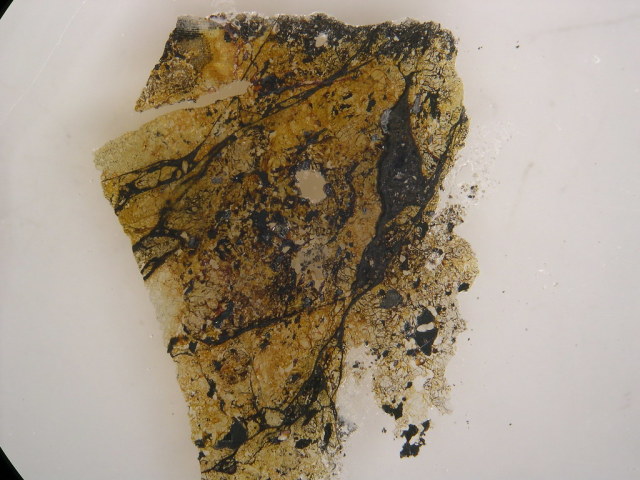
With these diamonds, scientists are uncovering clues to the origins of water on Earth. Did water come from incoming asteroids and comets, or was water an integral component at the planet’s formation? We’re still not quite sure. But diamond research has brought us closer to figuring out how much water lies deep underground. Scientists think that there may in fact be as much water present in our planet’s deep subsurface as there is found in our oceans. They have developed this idea after discovering a special water encased in the inclusions of deep diamonds. Called ICE-VII, this water ice can only be formed under tremendous deep-Earth pressure. In addition to water, geologists have found an elusive mineral in diamond inclusions. Scientists had theorized it to be an extremely common mineral that makes up to 38 percent of the Earth’s volume, but it’s been impossible to create in a lab. Now that it’s been found in nature, researchers have the proof of its existence and have named it Silicate-Perovskite (or Bridgmanite). In addition to Bridgmanite, they have discovered other trace minerals and elements that are commonly present in the Earth’s crust. This means that the materials were subducted (drawn back down into the Earth) billions of years ago by plate tectonics. Deep in the mantle, the materials were encased in a forming deep-diamond and then eventually sent back up to the surface by way of volcanic eruptions. Even more exciting than all of these discoveries is the thought of what geologists still have yet to uncover. They still hope to find carbon from primordial organic matter in these special diamonds. That matter could be a clue to the origins of life on Earth!

specimen of bridgmanite
“Earth’s most abundant mineral finally has a name” by Argonne National Laboratory is licensed under CC BY-NC-SA 2.0

In addition to their contributions to the scientific field, diamonds also have practical uses in society. In the mid-1950’s, synthetic diamonds were invented. Created in a lab, they are chemically and physically exactly the same as natural diamonds. However, these man-made gems do not possess the allure and mystery of natural diamonds, so they are not very desirable in the jewelry market. But since diamonds are the hardest known natural substance, they are ideal for industrial use. For example, they can be pulverized into a fine abrasive that can be made into a “diamond paste” and used for polishing other jewelry-grade gemstones. Small particles of diamond can also be embedded in tools like saw blades, drill bits, and grinding wheels. These diamond-coated tools are very wear-resistant and can be used for mining, deep-sea drilling, and road construction. And there are some ingenious uses for diamonds that you may find to be very surprising. Diamond windows can be made from very thin (thinner than a human hair) diamond membranes. These windows cover X-ray machines, laser openings, and vacuum chambers. A diamond can also make your music sound better. A speaker dome made out of diamonds can vibrate very rapidly because this gem is such a stiff material. So it is ideal for enhancing the performance of high-quality speakers. Diamonds can even help you keep track of time. Small mechanical devices, such as watches, have tiny bearings inside of them that make everything move (in a watch, it’s called its “movement”). A thin coating of diamond makes these parts wear-resistant and ensures accurate time-telling and lasting durability. From helping to build highways to making your timepiece tick, who knew that diamonds could be so useful in so many ways!

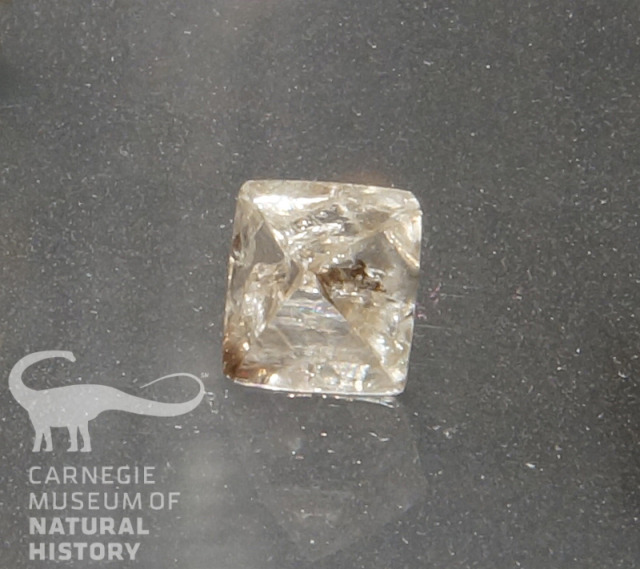
diamond specimen on gray background with dinosaur logo watermark in the left corner
CM18561 is located in the Native Elements case in Hillman Hall of Minerals and Gems. Source: https://carnegiemnh.org/emu_widgets/mineralogy.html#details=ecatalogue.2019718

Yet another important role that diamonds have played in our world is how they have influenced history. The brilliantly blue, supposedly cursed Hope Diamond, for example, has not brought much luck to its owners since it was discovered over 350 years ago. It was in the possession of Marie Antoinette and Louis XVI until their untimely deaths during the French Revolution. Subsequent owners also met with unfortunate outcomes until it was donated to the Smithsonian National Museum of Natural History where it is now safely on display. Another famous diamond, the 750 year-old Koh-i-Noor, has been owned by many royal rulers. It once decorated the Peacock Throne that was used by the Mughal Emperors of India, including Shah Juhan, the builder of the Taj Mahal. Now in England, the stone is part of the Imperial Crown. Due to an alleged curse, it can only ever be worn by the royal family’s female members. Finally, there is the Regent Diamond, which was unearthed in the early 1700’s. After being owned by several rulers, it disappeared during the French Revolution. Years later, it reappeared in the sword of Napoleon. But he was unable to hold onto it for long. After being defeated by the British in the Battle of Waterloo, the once-great ruler was exiled to the tiny island of Elba in disgrace. Since 1987, the Regent’s home has been at the French Royal Treasury in the Louvre in Paris. But you don’t need to travel to France or Great Britain or Washington D.C. to see the Regent Diamond, the Koh-i-Noor, and the Hope Diamond. Replicas of these three stones plus many more world-famous diamond replicas are on display at the Hillman Hall of Minerals and Gems. While you’re there, you can also admire some expertly crafted pieces of authentic diamond jewelry that would make any gem lover’s heart skip a beat.

Even though Hillman’s diamond collection is truly amazing, I can’t help but wonder if it would have impressed someone like Marilyn Monroe. Apart from a single piece of jewelry, the diamond wedding band that was given to her by Joe DiMaggio, she had no real affinity for diamonds. Apparently, the legendary actress didn’t believe that they’re a girl’s best friend. But if she had been given the opportunity to find out about all of the other meaningful ways in which diamonds benefit our world, perhaps this screen siren might have developed a new appreciation for these precious gems. I know that I have. I’d like to think that Marilyn would have too.

Shelby Wyzykowski is a Gallery Experience Presenter in CMNH’s Life Long Learning Department. Museum staff, volunteers, and interns are encouraged to blog about their unique experiences and knowledge gained from working at the museum.

Related Content

Wulfenite and Mimetite: CMNH’s Crystal Banquet

Rockin’ Minerals Coloring Pages

Ask a Scientist: Why do some minerals glow?

Carnegie Museum of Natural History Blog Citation Information

Blog author: Wyzykowski, Shelby
Publication date: June 23, 2021

Share this post!

  • Share on Twitter Share on Twitter
  • Share on Facebook Share on Facebook
  • Share on Pinterest Share on Pinterest
  • Share on LinkedIn Share on LinkedIn
  • Share on Reddit Share on Reddit
  • Share via Email Share via Email

Share this post!

  • Share on Twitter Share on Twitter
  • Share on Facebook Share on Facebook
  • Share on Pinterest Share on Pinterest
  • Share on LinkedIn Share on LinkedIn
  • Share on Reddit Share on Reddit
  • Share via Email Share via Email

Filed Under: Blog Tagged With: Hillman Hall of Minerals and Gems, minerals, minerals and gems, Shelby Wyzykowski, sssminerals, Super Science, Wertz Gallery

May 19, 2021 by wpengine

Incredible Junk Food Diets: Creatures That Clean Up Our World

by Shelby Wyzykowski with scientific information provided by Dr. Ainsley Seago, Associate Curator of Invertebrate Zoology.

What could be more thrilling than a summer weekend trip to explore one of the most exciting metropolises in the world, New York City. It has so much to offer, way too much to experience in a mere two or three days. There’s the sights…the Statue of Liberty, the Empire State Building, and Broadway. There’s the sounds…the beeping horns of taxi cabs and the noisy, bustling, crowded sidewalks. And there’s the smells…the sweet fragrances that drift from stalls in the Flower District, the tantalizing aromas wafting from street-side food carts, and the unmistakable odor of sixty thousand hot dogs sitting under the noon day sun in Times Square. Sixty thousand hot dogs? Really?! Well, no, not really, at least not literally. But the city that never sleeps is a city that loves to eat. And with the number of people that live, work, and visit this town, enormous amounts of food can litter the streets at any given time. The battle to keep public spaces free of food waste is daunting, but humans do have some unlikely tiny allies in this unending garbage war…insects. These crews of itsy-bitsy street cleaners, along with other arthropods like spiders and millipedes, are surprisingly efficient scavengers. We undoubtedly know this thanks to the work of researchers at North Carolina State University. Their entomologists, or insect scientists, studied these mini trash disposals at work in the urban ecosystem of New York. They found that pavement ants, cockroaches, and other hungry foragers can eat 2,100 pounds of food refuse (the equivalent of 60,000 hot dogs) in one year. Now in the grand scheme of things, a ton of food is not a lot, but researchers have still taken notice. They know that diverting food waste from landfills benefits our planet. And they are experimenting to try and find innovative ways to use insects to transform edible trash into eco-friendly treasure.

macro photo of an ant holding a bit of bread
Image by cp17 from Pixabay.

Entomologists at Louisiana State University are also doing their part to make their Baton Rouge campus more environmentally responsible. They’ve collaborated with the nearby Fluker Farms, a pet supply business that sells insects as reptile food. Together they’re taking food bound for a landfill and transforming it into animal feed. But there is also a third indispensable partner in this entomological endeavor. It’s the black soldier fly, an insect that is common in the Southern United States. The larvae of the black soldier fly do one thing exceptionally well…eat. A black soldier fly larva can eat twice its own body weight in one day! During their larval stage, they consume all the food that they’ll need for the rest of their lives. The fly’s feeding frenzy results in rapid growth. They’ll grow 300% in size during their two-week larval stage. But, after these two weeks, they’ll never eat again. It would be impossible, because an adult black soldier fly has no mouth!

Before the larvae can chow down on the leftovers from the campus’s dining halls, the food scraps have to be blended into a slurry. Then the ravenous little larvae get two weeks to eat to their heart’s content. They are then sifted out of the remaining slurry. Some larvae are sold as Fluker Farms reptile food while the others return to the colony to become adults. The leftover slurry/compost mixture is then spread on the flower beds that decorate the university’s campus. In 2019 alone, 15 tons of food waste was processed this way! The joint effort between LSU’s Entomology department and Fluker Farms is helping the university to reach its goal to reduce the amount of waste the campus sends to landfills by three quarters by the year 2030.

But the LSU scientists have an even grander vision for their larvae farm and other farms like it. Black soldier fly larvae can also take the place of soy and fish meal as feed for livestock, and this helps to take the pressure off the world fisheries. With an ever-increasing world population, perhaps larvae may even become a food staple for humans someday. Food scientists at Stellenbosch University in South Africa are already using black soldier fly larvae to produce dairy-free ice cream and Vienna-style sausage. Imagine, someday, sitting down to enjoy a full seven-course dinner with larvae as a key ingredient!

Fly larvae are not the only insects that are being utilized as animal feed. Cockroaches, which are actually very fastidious, well-groomed insects, are great little amateur recyclers. They can chew down almost anything, but they can live without food for up to one month if they need to. Luckily, the roaches at the Shadong Agricultural Technology Company in Jinan, China never need to worry about going hungry. The food waste recycling plant works on a much larger scale than LSU, housing a billion cockroaches that are fed fifty tons of kitchen scraps each day. That’s the equivalent of seven adult bull elephants! The cockroaches are allowed to live out their natural lifespan. Then they are steamed, cleaned, and processed into a protein-rich, antibiotic-free livestock feed that, like larvae, can take the place of fish meal. This profitable food waste plant, as well as others like it in other Chinese cities, undoubtedly proves that insect farms can help to solve our landfill problems.

Landfill with bulldozer. Evergreen trees and gray sky in the background.
Image by Pasi Mäenpää from Pixabay.

With the success of these promising initiatives, scientists are taking things a step further and applying insects to the problem of plastic waste. It’s no secret that the many types of plastic that we use in our everyday lives are polluting the planet. Marine ecologists have even found plastic microfibers in sea ice samples from Antarctica! Some researchers, in their quest to try and help to solve our plastic problem, have made a surprising discovery; some insects are plastivores, meaning they can eat plastic! A March 2020 project at Brandon University in Canada studied the larvae of the Greater Wax Moth (a regular beehive pest) and their ability to consume LDPE, or low-density polyethylene. This type of soft plastic, which is used to make grocery bags, is one of the leading contributors to non-biodegradable waste. It can be recycled, but much of it ends up in the trash. At the landfill, LDPE breaks down and releases dangerous greenhouse gases, including methane. This is cause for concern, since greenhouse gases contribute to climate change. Brandon University researchers have been trying to figure out the exact way that these caterpillar larvae are able to digest this troublesome plastic. Their goal was to isolate and identify the specific chemical that the caterpillar uses to break down LDPE, and they got off to a promising start. The scientists found that the amount of the larvae’s gut microbes (bacteria and fungi) actually increased when fed LDPE. Their intestinal biome actually preferred it over the caterpillar’s regular natural diet of honeycomb. The larvae thrived on plastic! And they seemed to love it because LDPE has the same chemical structure (specifically, a long, open-chain hydrocarbon) as beeswax! Further research revealed that the caterpillar’s breakdown of LDPE is a complicated process that has to happen in vivo (inside their bodies). One of the waste products that the caterpillars produce when they digest LDPE is called glycol. Glycol is toxic to humans, but, fortuitously, it can be biodegraded by several common, naturally occurring bacteria. For now, recycling LDPE is still the best option. But further research into the Greater Wax Moth larva’s in vivo process of digesting plastic may prove to be fruitful.

This summer, even if you’re not able to escape for a weekend getaway to the Big Apple, you are still likely to get the opportunity to enjoy a Sunday stroll along the sidewalks of your own hometown. And if, by chance, you look down and see a line of ants diligently portioning out and carrying away a cast-off crust of bread, take a moment to stop and watch them hard at work. You can maybe even silently thank them for their Herculean efforts. If it weren’t for their help, food waste would be an environmental hazard, a threat to public health, and an additional financial burden to your city. It’s a dirty job, but somebody’s got to do it. Fortunately for us, our voracious, multi-legged little friends are ready and willing to take on the task.

Shelby Wyzykowski is a Gallery Experience Presenter in CMNH’s Life Long Learning Department. Museum staff, volunteers, and interns are encouraged to blog about their unique experiences and knowledge gained from working at the museum.

Related Content

Super Science Slugs and Bugs Coloring Pages

Natural History Discoveries

Make Snail Slime

Carnegie Museum of Natural History Blog Citation Information

Blog author: Wyzykowski, Shelby
Publication date: May 20, 2021

Share this post!

  • Share on Twitter Share on Twitter
  • Share on Facebook Share on Facebook
  • Share on Pinterest Share on Pinterest
  • Share on LinkedIn Share on LinkedIn
  • Share on Reddit Share on Reddit
  • Share via Email Share via Email

Share this post!

  • Share on Twitter Share on Twitter
  • Share on Facebook Share on Facebook
  • Share on Pinterest Share on Pinterest
  • Share on LinkedIn Share on LinkedIn
  • Share on Reddit Share on Reddit
  • Share via Email Share via Email

Filed Under: Blog Tagged With: Bug Bonanza, Invertebrate Zoology, Shelby Wyzykowski

  • Page 1
  • Page 2
  • Go to Next Page »

sidebar

About

  • Mission & Commitments
  • Directors Team
  • Museum History

Get Involved

  • Volunteer
  • Membership
  • Carnegie Discoverers
  • Donate
  • Employment
  • Events

Bring a Group

  • Groups of 10 or More
  • Birthday Parties at the Museum
  • Field Trips

Powdermill

  • Powdermill Nature Reserve
  • Powdermill Field Trips
  • Powdermill Staff
  • Research at Powdermill

More Information

  • Image Permission Requests
  • Science Stories
  • Accessibility
  • Shopping Cart
  • Contact
  • Visitor Policies
One of the Four Carnegie Museums | © Carnegie Institute | Privacy Policy | Terms of Use | Accessibility
Rad works here logo