• Skip to primary navigation
  • Skip to main content
  • Skip to primary sidebar

Carnegie Museum of Natural History

One of the Four Carnegie Museums of Pittsburgh

  • Visit
    • Buy Tickets
    • Visitor Information
    • Exhibitions
    • Events
    • Dining at the Museum
    • Celebrate at the Museum
    • Powdermill Nature Reserve
    • Event Venue Rental
  • Learn
    • Field Trips
    • Educator Information
    • Programs at the Museum
    • Bring the Museum to You
    • Guided Programs FAQ
    • Programs Online
    • Climate and Rural Systems Partnership
  • Research
    • Scientific Sections
    • Science Stories
    • Science Videos
    • Senior Science & Research Staff
    • Museum Library
    • Science Seminars
    • Scientific Publications
    • Specimen and Artifact Identification
  • About
    • Mission & Commitments
    • Directors Team
    • Museum History
  • Tickets
  • Give
  • Shop

snails

September 6, 2016 by wpengine

Mollusk Collection

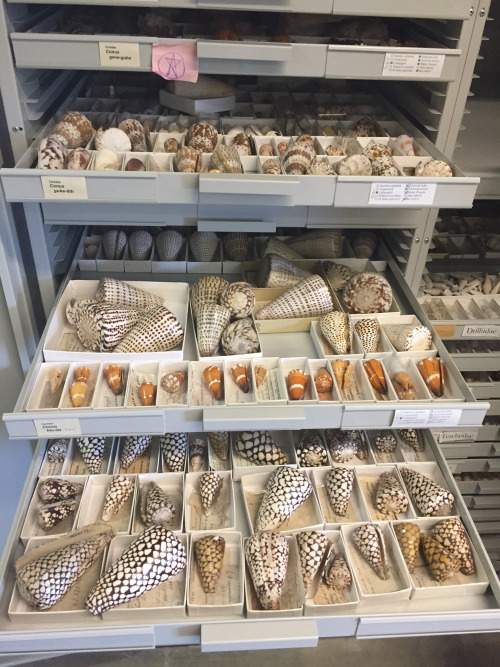
specimen drawers from the Mollusk Collectionby Hayley Pontia

Carnegie Museum of Natural History’s collection of mollusks is home to about 3 million specimens that include more land and freshwater snails from Pennsylvania and its adjacent states than all other U.S. museums combined.

What are mollusks you ask? They are one of the most diverse groups of animals on the planet. They have a soft body with a ‘head’ and ‘tail’ region. Their bodies are most commonly covered in a hard exoskeleton, but some can even have their shells on the inside.

You may know the most common mollusks without even knowing they are mollusks: snails, clams, octopuses, scallops, oysters, and even squids are all part of this phylum. Many people are around these animals, yet know very little about them.

As assistant curator and head of mollusks at Carnegie Museum of Natural History, Tim Pearce spends a lot of time researching and understanding these specimens.  Every second Saturday, Pearce gives tours of the collection found in the basement of the museum for those interested in learning more about these unique species.
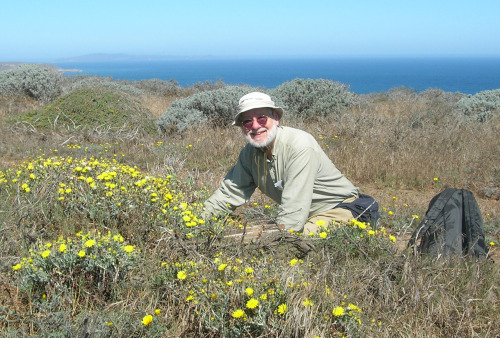
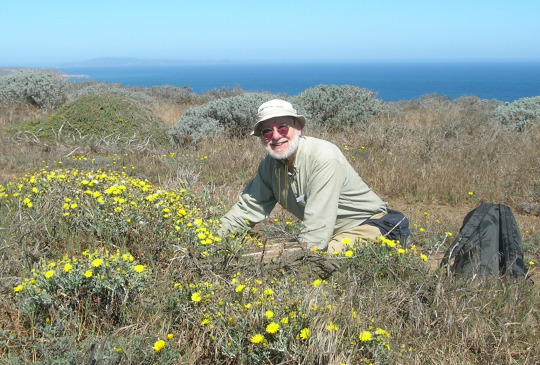
Pearce collecting snails at Carrington Point on Santa Rosa Island, California. San Miguel Island is visible in the distance. (Photo by Charles Drost.)

Hayley Pontia is the marketing assistant at Carnegie Museum of Natural History and a student at the University of Pittsburgh. Museum employees are encouraged to blog about their unique experiences of working at the museum.
Filed Under: Blog Tagged With: behind the scenes, collections, mollusks, snails, Tim Pearce

July 7, 2016 by wpengine

Researchers chase snails on Santa Rosa Island, California

Pearce collecting snails at Carrington Point
Pearce collecting snails at Carrington Point on Santa Rosa Island, California. San Miguel Island is visible in the distance. (Photo by Charles Drost.)

by Tim Pearce

Islands often contain peculiar species, including some that are endemic (found only there). Tim Pearce, Assistant Curator of the Section of Mollusks at Carnegie Museum of Natural History, spent five days with two other researchers surveying the land snails of Santa Rosa Island, one of the California Channel Islands. This survey is part of a larger project, funded by the National Park Service, to understand the land snails of the California Borderlands.

The researchers braved spiny vegetation and strong winds (sometimes pebbles became airborne) to find at least three new land snail records for the island among the dozen or so species they found. Several species found are endemic to the California Channel Islands. Further scrutiny of the finds will reveal whether any species are endemic to just Santa Rosa Island or possibly new to science.

Snails were often surprisingly difficult to find, which might reflect recent disturbance history of the island. The last of the large non-native mammals (goats, sheep, pigs, cattle, deer, and elk) were removed from the island in 2013. These animals can impact snail populations through trampling and more importantly by eating vegetation, changing it from forest to grassland. This study provides a baseline to inform future investigation of how snail faunas recover after disturbance.


Timothy A. Pearce, PhD, is the head of the mollusks section at Carnegie Museum of Natural History. Museum employees are encouraged to blog about their unique experiences and knowledge gained from working at the museum.


Filed Under: Blog Tagged With: mollusks, research, snails, Tim Pearce

June 18, 2016 by wpengine

Schenley Park’s Snail Population

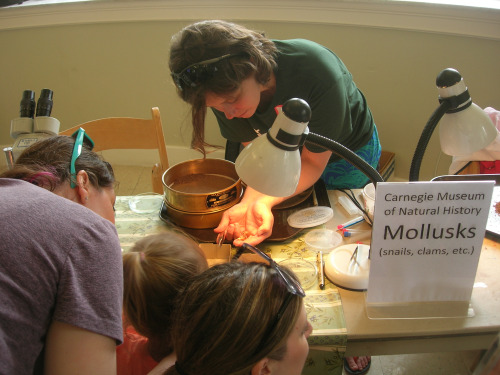
Volunteer Katie Zawrotniak showing snail finds to visitors.
Volunteer Katie Zawrotniak showing snail finds to visitors. (Photo by Tim Pearce).

by Timothy A. Pearce

What lives in our city parks? A BioBlitz is a good way to find out. At a BioBlitz, biologists search in a defined area (such as a park) for a given amount of time (5 a.m. to 5 p.m. in this case) to find as many species as they can in their area of specialty. These biologists share their methods and finds with curious members of the public.

Phipps Conservatory organized a BioBlitz of Schenley Park, which neighbors Carnegie Museum of Natural History in Oakland, on June 5. Museum Curator Dr. Tim Pearce and museum volunteer Katie Zawrotniak headed the snail team and looked in leaf litter samples to find minute snails. They showed snail finds to about 50 visitors. Of the 13 species of land snails they discovered in the park, only one was non-native.

Land snails can be used as an indicator of park’s health (T.A. Pearce. 2009. Land snails as indicator species: examples from seven bioblitzes in the eastern United States. Tentacle, Mollusk Conservation Newsletter, number 17: 12-14). Surprisingly,
compared to other city parks, this was a very low proportion of non-native species. Although the number of species was relatively low, these results suggest that Schenley Park is moderately healthy from the perspective of the land snail community.

Timothy A. Pearce, PhD, is the head of the mollusks section at Carnegie Museum of Natural History. Museum employees are encouraged to blog about their unique experiences and knowledge gained from working at the museum.

Filed Under: Blog Tagged With: Pittsburgh, snails, Tim Pearce

May 5, 2016 by wpengine

Critters in the Litter, Earth Day walks at Frick Park

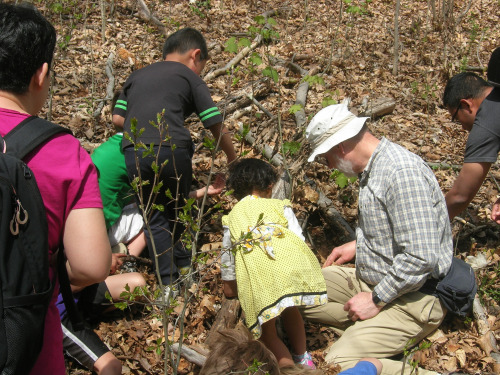
Children with Dr. Pearce digging in the leaves
Dr. Pearce with walk participants finding
critters in the leaf litter (Photo by Alice W. Doolittle.)

by Timothy A. Pearce

Since trees drop leaves every fall, why aren’t we up to our necks in dead leaves?

Thirty-seven people joined me on a series of four walks in Frick Park on April 24 to discover the answer: leaves are consumed by a myriad tiny creatures that turn them back into nutrients so plants can grow again.

Among the tiny creatures we found that consume leaves (and some that consume the leaf-eating creatures) were earthworms, sow bugs, spiders, daddy long legs, millipedes, centipedes, beetles, spring tails, and several species of snails, which are my favorite creatures. After the walks, we scrutinized our finds with magnifying glasses. The weather was sunny and the perfect temperature for walking outside. The children especially enjoyed digging in the soil.

Timothy A. Pearce, PhD, is the head of the mollusks section at Carnegie Museum of Natural History. Museum employees are encouraged to blog about their unique experiences and knowledge gained from working at the museum. 

Filed Under: Blog Tagged With: insects, leaves, snails, Tim Pearce

April 25, 2016 by wpengine

Cone Snails – Another Thing to Fear

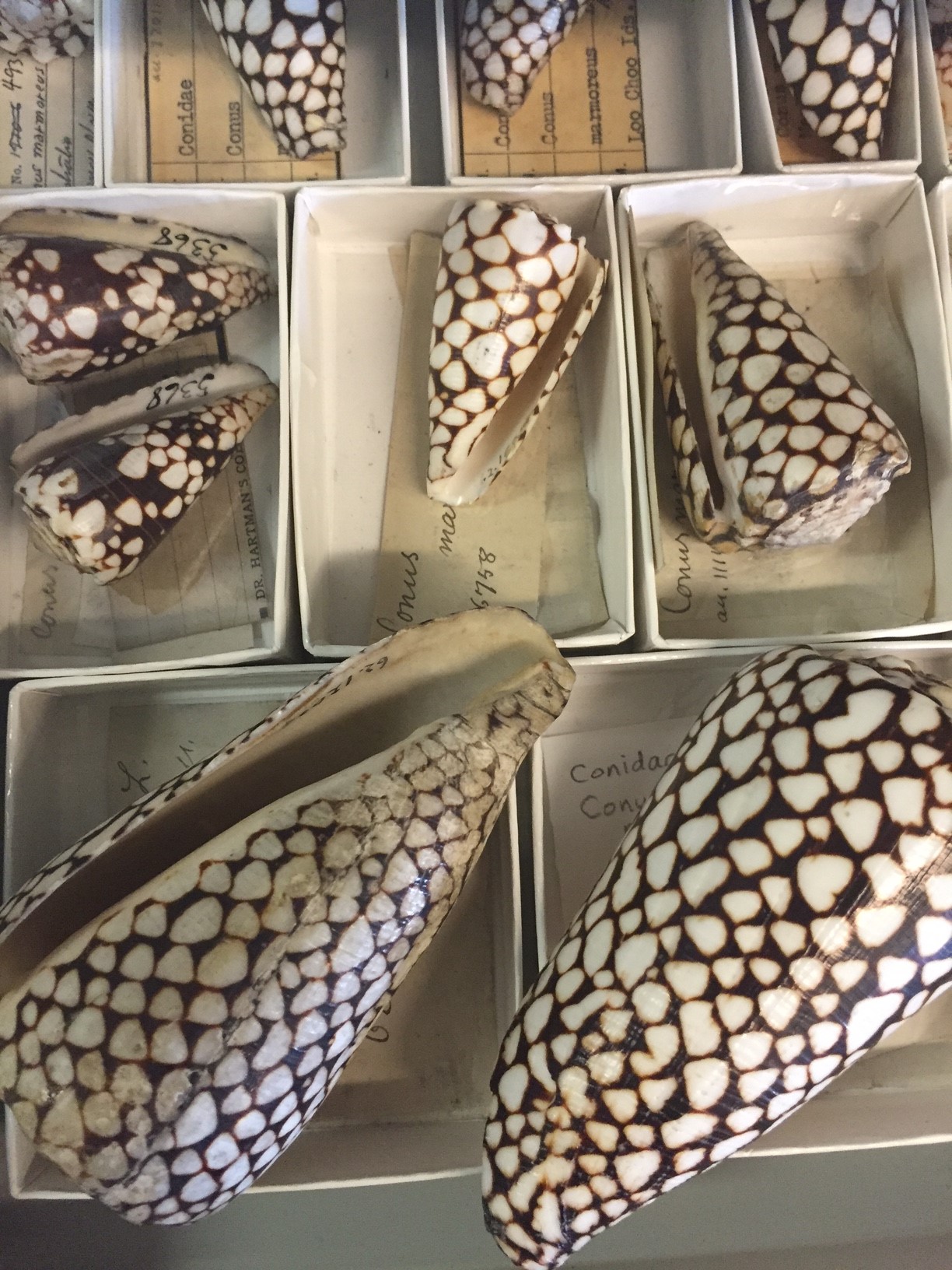
catalogued Cone Snails
In case sharks, rip tides, and tidal waves weren’t enough to keep you running away from the shoreline, lurking in shallow tropical waters and hidden in beautiful shells are one of the most venomous predators in the ocean –cone snails.

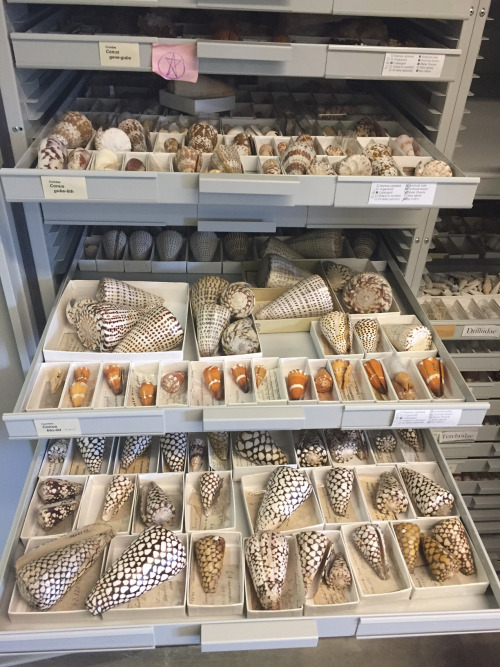
Here at Carnegie Museum of Natural History, our curator has several thousand cone snail shells in the behind-the-scenes collections. There are about 700 types of cone snails, members of the Conidae family, that range from the size of smaller than a penny to the size of 8 inches (20 cm.). Despite their wide variety, there is one thing all cone snails have in common – venom.

a collection of various cone snails

Cone snails are a fearsome example of carnivorous snails that hunt fish and worms use a tooth that is harpoon-like in shape that injects a
venom, so complex that some species can kill a human with one small prick. The venom varies from species to species, and most contain as many 50 different peptides which are short chains of amino acids.

The complexity of the venom makes creating an antidote difficult, but it also has piqued the interest of researchers who have been able to harness its potency for good.

“It’s better living through snails,” said Carnegie Museum of Natural History’s Assistant Curator of Mollusks Tim Pearce.

The venom of Conus magnus was used to develop a drug that may be 100 to 1,000 times more effective than morphine, without the risk of addiction and users do not build up a tolerance. Pearce said nearly all patients who have used this drug have had one strange side effect – they hear music.

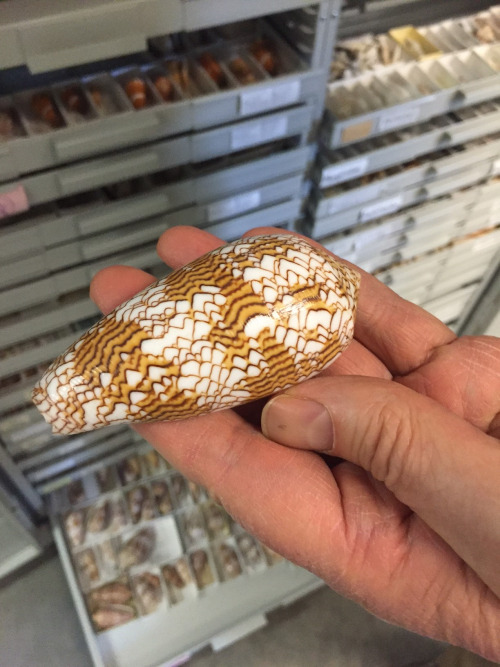
The good news is only two species (Conus textile and Conus geographus) are known to have actually killed humans, and the number of known cone snail fatalities is less than 100.

So swim along safely, but maybe think twice before pulling a beautiful shell from tropical waters especially if it is alive.

Click here to watch a cone snail hunt. 

A specimen of Conus Magnus

Filed Under: Blog Tagged With: ocean, snails, Tim Pearce

February 24, 2016 by wpengine

Snail eating snails: two species become one

Two land snails Land snail
by Timothy Pearce

The land snail family Haplotrematidae is widespread in North America. They are omnivorous, eating other snails as well as plants. Western North America hosts most (16 of 18) species of this family that occur in the
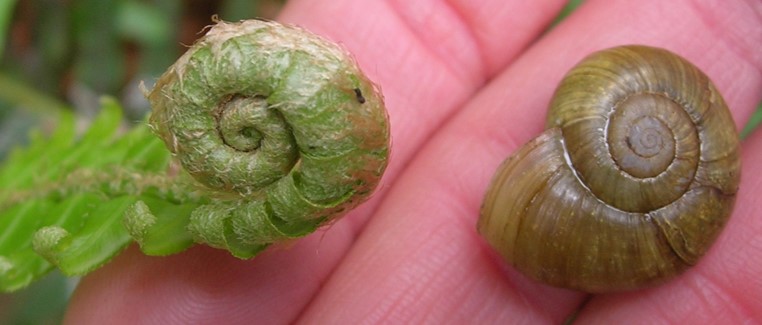
United States and Canada. Some species are found under sword ferns where they might gain protection by mimicking fern fiddleheads (see figure of Haplotrema vancouverense beside a fiddlehead).

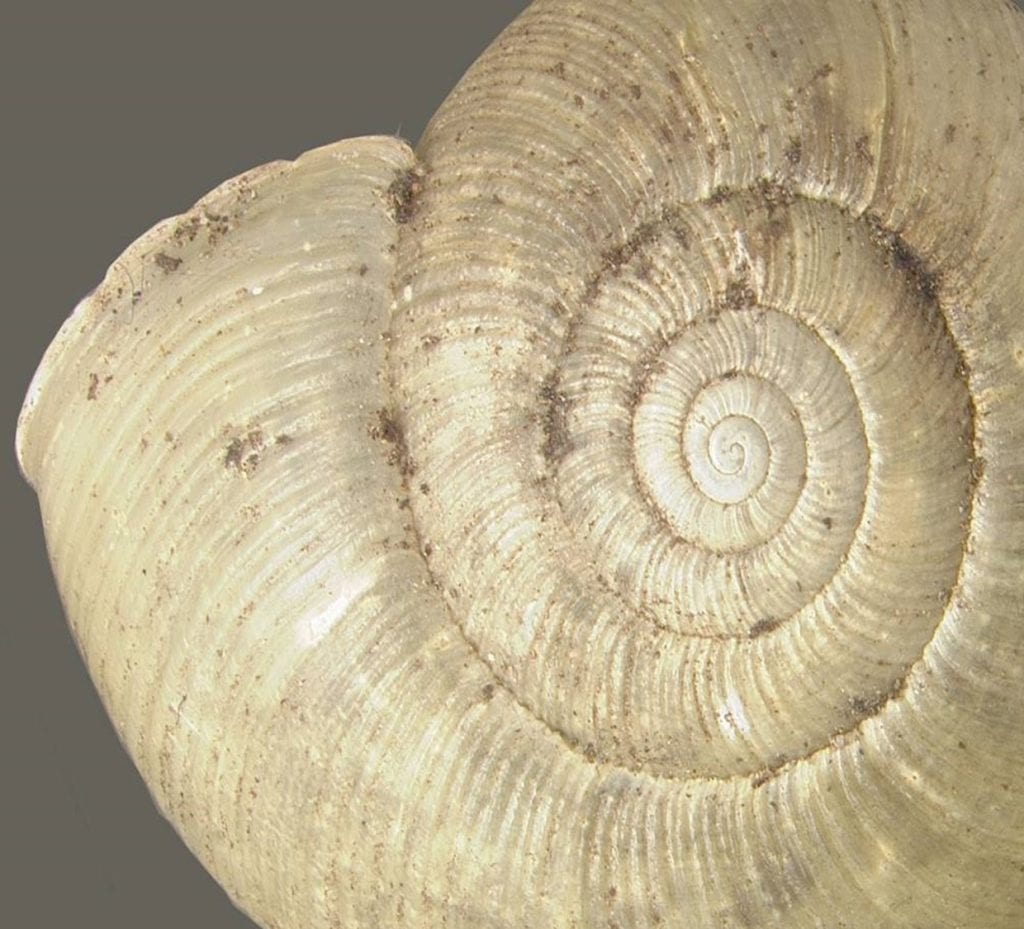
Two related species, Ancotrema hybridum and Ancotrema sportella, are sometimes difficult to separate. Their beautiful shell sculpture includes ridges radiating outward like bicycle spokes, and finer spiral grooves cutting across the tops of the ridges, looking like beads (see figure of Ancotrema with beaded sculpture). The beaded sculpture extends to the end of growth in A. sportella, but the sculpture becomes smooth on the last, largest whorl in A. hybridum. They are easy to tell apart until you find one that is smooth on only half, or a quarter, of the last whorl.

Two things made us suspect that they might really be one species. First, some shells were difficult to classify. Second, the ranges of both species coincide from northern California to Alaska.

To address whether they are two species or one, we examined 311 museum specimens. If they are two species, we expected to see a two-humped curve (bimodality) in amount of smooth sculpture on the last whorl. We expected
many specimens without smooth sculpture at the end, many specimens with smooth sculpture on the entire last whorl, and very few specimens having smooth sculpture on just half the last whorl.

Instead, we saw continuous variation, with no hint of bimodality. That result is consistent with their really being one species. Furthermore, we discovered on every shell the sculpture became smooth around whorl number 5. If shell growth stopped before whorl 5, then it resembled A. sportella. If it grew beyond whorl 5 before becoming adult, then it gained the smoother sculpture of A. hybridum.

Next, we looked for reproductive differences. When new species arise, reproductive structures are sometimes the first to change. These changes might help individuals to recognize the correct mate. We found no consistent differences in the reproductive parts.

These (and most land snails) are hermaphrodites (one individual is both male and female), so we know we were not looking at male – female differences. Also, we knew we had adults only because the upper lip dips
downward at the end of growth, so we were not comparing adult – juvenile features.

Finding continuous variation in the feature traditionally used for separating the two species, no differences in the reproductive parts, coincidental geographical ranges, and discovering that the sculpture always
diminished about whorl 5, all led us to conclude that they are one species. A. sportella was named first, so by the law of priority, that is the name we will use.

Scientists get more glory for naming new species, not sinking a name as we did here, but this taxonomic cleanup work is important, too.

For more details, please review Pearce, T.A. & Fields, M.C. 2015. Shell and genital morphology fails to separate Ancotrema hybridum (Ancey, 1888) and A. sportella (Gould, 1846) (Gastropoda: Haplotrematidae). Malacologia, 59(1): 21-32.

Tim Pearce is assistant curator of mollusks at the Carnegie Museum of Natural History. He studies ecology and systematics of land snails.

Filed Under: Blog Tagged With: mollusks, snails, Tim Pearce

  • « Go to Previous Page
  • Page 1
  • Page 2
  • Page 3

sidebar

About

  • Mission & Commitments
  • Directors Team
  • Museum History

Get Involved

  • Volunteer
  • Membership
  • Carnegie Discoverers
  • Donate
  • Employment
  • Events

Bring a Group

  • Groups of 10 or More
  • Birthday Parties at the Museum
  • Field Trips

Powdermill

  • Powdermill Nature Reserve
  • Powdermill Field Trips
  • Powdermill Staff
  • Research at Powdermill

More Information

  • Image Permission Requests
  • Science Stories
  • Accessibility
  • Shopping Cart
  • Contact
  • Visitor Policies
One of the Four Carnegie Museums | © Carnegie Institute | Privacy Policy | Terms of Use | Accessibility
Rad works here logo