• Skip to primary navigation
  • Skip to main content
  • Skip to primary sidebar

Carnegie Museum of Natural History

One of the Four Carnegie Museums of Pittsburgh

  • Visit
    • Buy Tickets
    • Visitor Information
    • Exhibitions
    • Events
    • Dining at the Museum
    • Celebrate at the Museum
    • Powdermill Nature Reserve
    • Event Venue Rental
  • Learn
    • Field Trips
    • Educator Information
    • Programs at the Museum
    • Bring the Museum to You
    • Guided Programs FAQ
    • Programs Online
    • Climate and Rural Systems Partnership
  • Research
    • Scientific Sections
    • Science Stories
    • Science Videos
    • Senior Science & Research Staff
    • Museum Library
    • Science Seminars
    • Scientific Publications
    • Specimen and Artifact Identification
  • About
    • Mission & Commitments
    • Directors Team
    • Museum History
  • Tickets
  • Give
  • Shop

Super Science Days

March 1, 2021 by wpengine

Archaeological Adventures in Egypt

Hello! I am Dr. Lisa Saladino Haney, Assistant Curator at Carnegie Museum of Natural History and resident Egyptologist. An Egyptologist is someone who studies the history, material culture, architecture, religion, and writing of the ancient Egyptians – one of the ancient cultural groups living in Africa’s Nile Valley. Learning about ancient cultures helps us to better understand the world today and to appreciate the creativity and ingenuity of people who lived thousands of years ago. Archaeology is one technique that allows us to interact with and study the past and there are hundreds of archaeological sites and projects throughout the Nile Valley that constantly add to our understanding of what life was like.
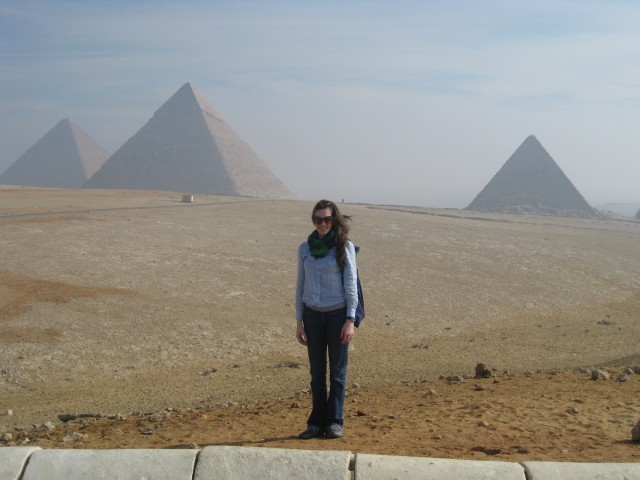
Trying to determine some of my favorite archaeological sites from my travels in Egypt turned out to be an impossible task! Please join me on this photo exploration of a few of the many interesting archaeological sites in Egypt and learn where you can find more information about active archaeological excavations and other projects going on in those areas.

Saqqara

Saqqara is an important cemetery site associated with the ancient Egyptian capital city of Memphis, near modern Cairo. The cemeteries at Saqqara contain a number of tombs, both royal and private, including the famous Step Pyramid of the Third Dynasty Egyptian king, Djoser (ca. 2630-2611 BCE). The earliest burials at the site date to the creation of the ancient Egyptian state and it remained an important site through the Graeco-Roman Period.

Royal Tombs: The Step Pyramid of Djoser

The Step Pyramid of Djoser marks an important step in the development of the pyramid-shaped royal tomb. The complex was designed by the famous royal architect Imhotep, who would later become deified in ancient Egypt. You can see a bronze statue of Imhotep in Walton Hall of Ancient Egypt. A 14-year long restoration project at the site was just completed in 2020 which included strengthening the overall integrity of the structure by filling in gaps in its six rectangular mastabas as well work on the interior burial chamber and passages of the pyramid.

Check out some pictures from my visit to the Step Pyramid in 2011, early on in the restoration process, or, for a gallery of photos and more on the newly completed restoration, click here.
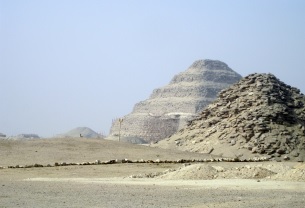
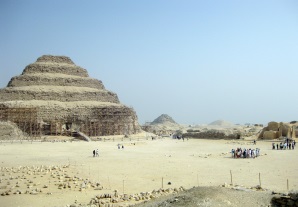
step pyramid

Views of the Step Pyramid at Saqqara showing the scaffolding used for the restoration project (photos by author).

Old Kingdom Mastabas: Tombs of Kagemni and Niankhkhnum and Khnumhotep

The Old Kingdom (ca. 2649-2150 BCE) mastabas at Saqqara are some of the most beautifully preserved and decorated tombs. Here are two of my favorites from my last visit. The tomb of Kagemni is the largest mastaba in the cemetery associated with the reign of the Sixth Dynasty king Teti (ca. 2323-2150 BCE). Kagemni was a Vizier, the highest position in the royal administration.
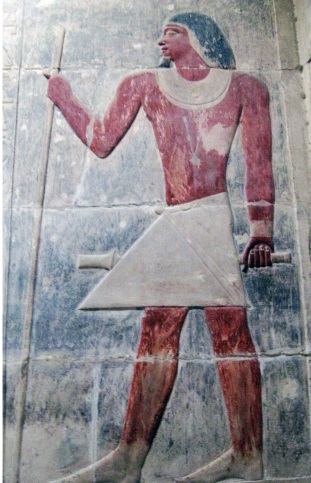
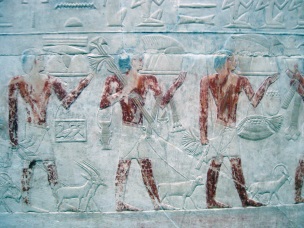
tomb decorations

tomb decorations

tomb decorations

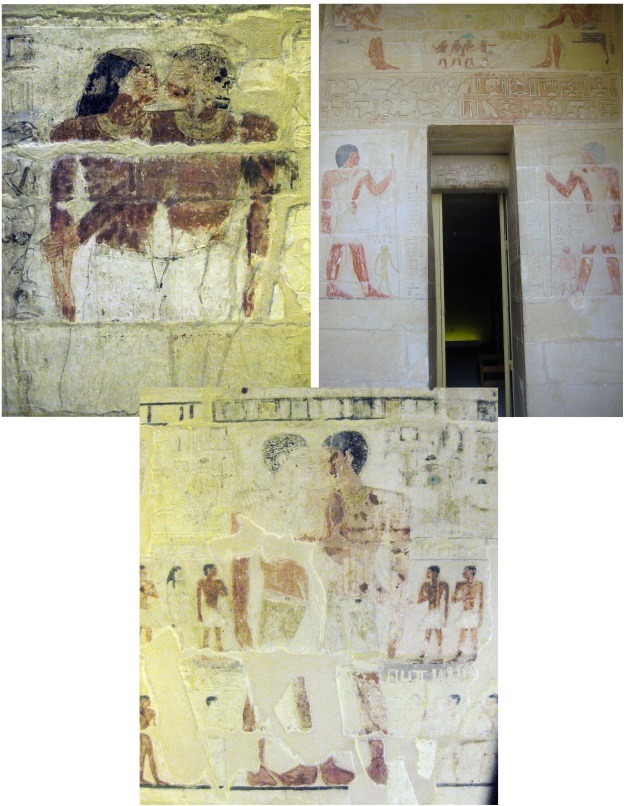
The tomb of Niankhkhnum and Khnumhoptep, also known as the tomb of the two brothers, dates to the late Fifth Dynasty and contains a number of exceptional scenes that underscore the closeness of the two men, both of whom served as overseers of the royal manicurists. Archaeologists uncovered a number of blocks from the tomb’s entrance repurposed in the nearby causeway of the pyramid complex of the late Fifth Dynasty king Unas (ca. 2353-2323 BCE). Thanks to the Egyptian Ministry of Tourism and Antiquities, you can now go on a virtual tour of the tomb!
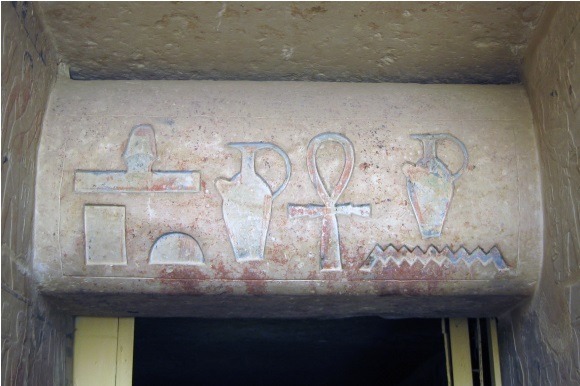
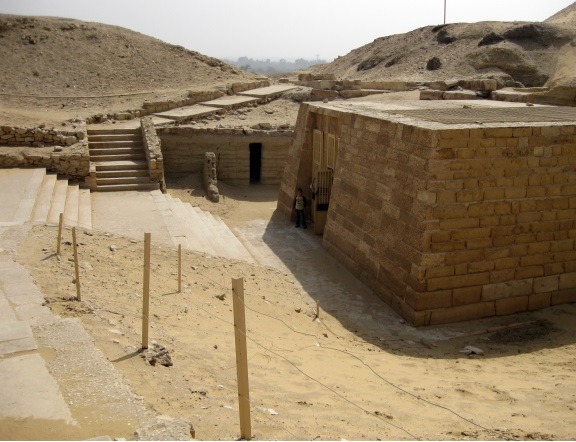
Here you see the names of the two tomb owners, Niankhkhnum and Khnumhotep on a stone doorway inside their tomb as well the exterior of the mastaba (photos by author).
Scenes depicting Niankhkhnum and Khnumhotep inside their tomb (photos by author).
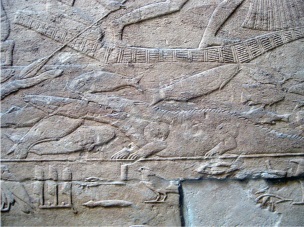
Images from the Tomb of Kagemni at Saqqara depicting the tomb owner himself, a parade of offering bearers bringing animals, plants, food, and other supplies to the deceased, and a scene taking place on the Nile where we get an underwater view of a crocodile eating a fish (photos by author).

Beni Hasan

Beni Hasan is a cemetery site located in Middle Egypt, near the modern city of Minya, that was important during Egypt’s Middle Kingdom (ca. 2030-1640 BCE). During that time some of the most elite Egyptians were buried on the escarpment (desert cliff) with one of the most beautiful views of Nile Valley around! For more on excavations at Beni Hasan in the early 1900s visit the Griffith Institute and for a virtual tour of the tomb of Kheti at Beni Hasan visit the Egyptian Ministry of Tourism and Antiquities.
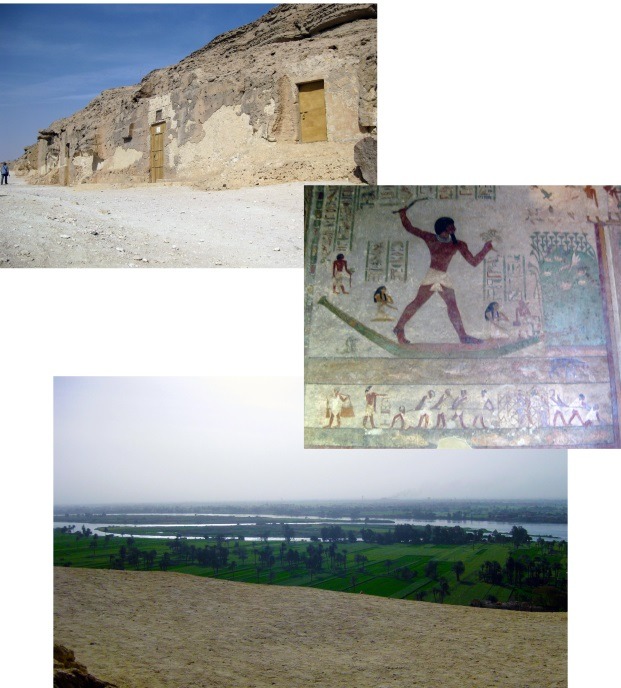
Top: A row of tomb entrances in the cliff face at Beni Hasan (photo by author). Middle: Image of the Nomarch Khnumhotep II fishing and fowling in his tomb (photo by author). Bottom: View of the Nile Valley from the tombs at Beni Hasan (photo by author).

Karnak

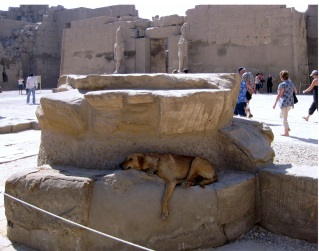
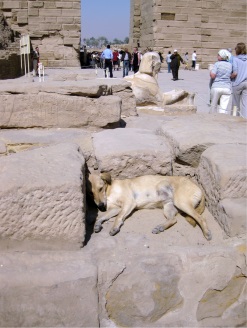
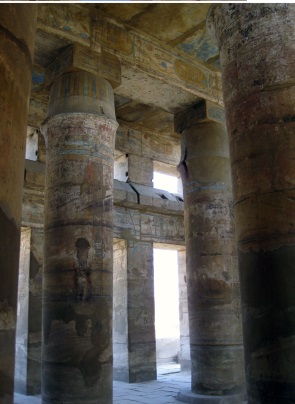
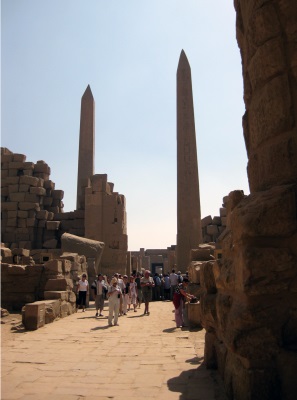
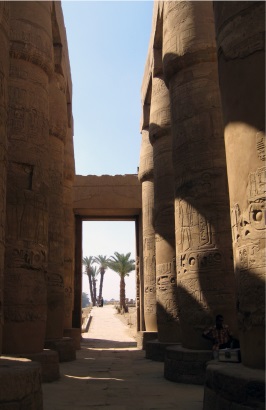
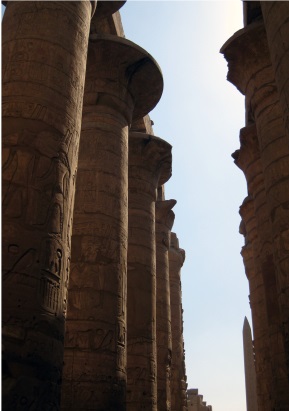
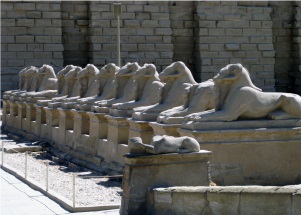
Karnak temple complex is one of the largest religious sites in the world. The first temple at the site was built during the Middle Kingdom (ca. 2030-1640 BCE) and the complex grew in size and complexity over time. The main temple at Karnak is dedicated to the Egyptian god Amun-Re, but there are smaller temples dedicated to Mut, Khonsu, and others. See if you can spot the snoozing pups in the pics below!

There are a number of ongoing excavations at Karnak that you can explore to learn more about the site. Check out this amazing minicourse on the Karnak Mut Precinct available on YouTube with Dr. Betsy Bryan, Alexander Badawy Chair of Egyptian Art and Archaeology and Director of Johns Hopkins’ excavations at the Mut Precinct.
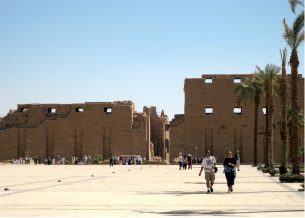
temple ruins and palm trees in Egypt

Approach to Karnak Temple and processional way lined with Ram-headed sphinxes for the god Amun-Re (photos by author).

sleeping dogs in Egyptian ruins

Sleepy Karnak pups (photos by author).

columns, part of ancient Egyptian ruins

obelisks and other ruins in Egypt

view toward a temple exit

columns
Inside Karnak Temple: Festival Hall of Thutmose III, Obelisks, exit towards the Sacred Lake, columns in the Hypostyle Hall (photos by author).

Lisa Saladino Haney is Postdoctoral Assistant Curator of Egypt on the Nile at Carnegie Museum of Natural History. Museum employees are encouraged to blog about their unique experiences and knowledge gained from working at the museum.

Related Content

Egypt and the Nile

Tuscarora Nu Yah

Ancient Egypt Through its Pottery

Carnegie Museum of Natural History Blog Citation Information

Blog author: Haney, Lisa
Publication date: March 1, 2021
Share this post!

  • Share on Twitter Share on Twitter
  • Share on Facebook Share on Facebook
  • Share on Pinterest Share on Pinterest
  • Share on LinkedIn Share on LinkedIn
  • Share on Reddit Share on Reddit
  • Share via Email Share via Email

Filed Under: Blog Tagged With: ancient egypt, anthropology, archaeology, Archaeology Extravaganza, Lisa Haney, Science News, Super Science Days

February 2, 2021 by Kathleen

Super Science Activity: DIY Helicopter Seeds

DIY Helicopter Seeds from CarnegieMNH on Vimeo.

Filed Under: Blog Tagged With: Super Science Days, Taking Flight

January 29, 2021 by Kathleen

Super Science Activity: Straw Rockets

Energy is necessary for flight, but how do scientists know how much is enough? You can make your own rocket to test different methods of liftoff!

*This activity requires adult supervision

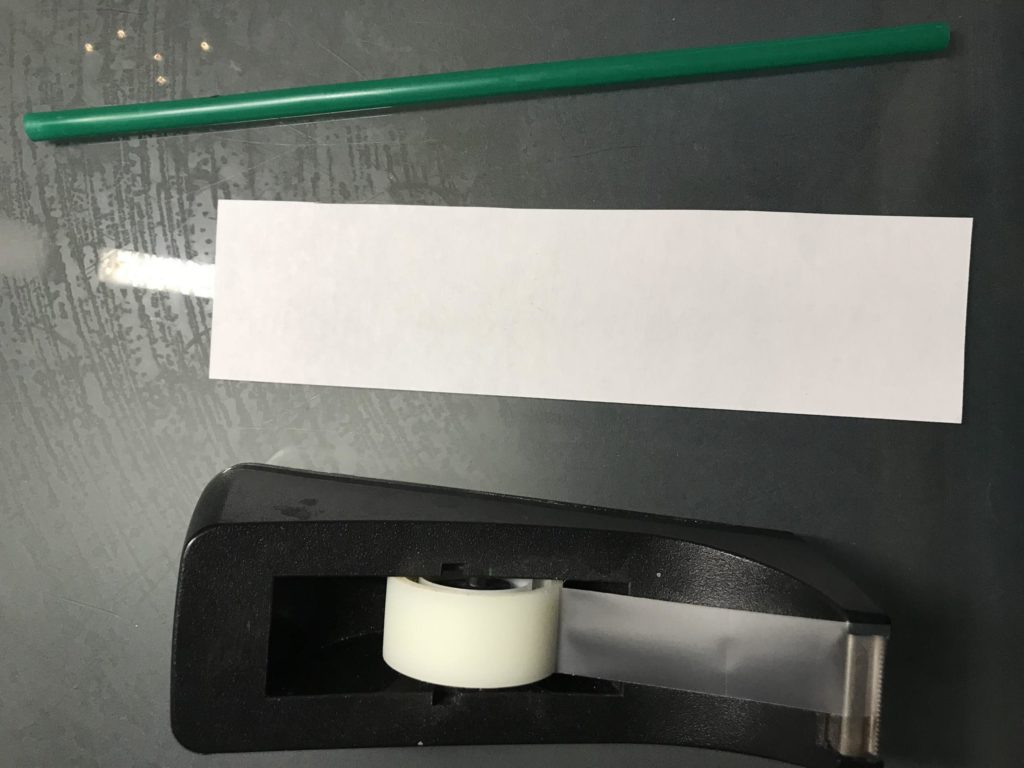
cut strip of paper for rocket
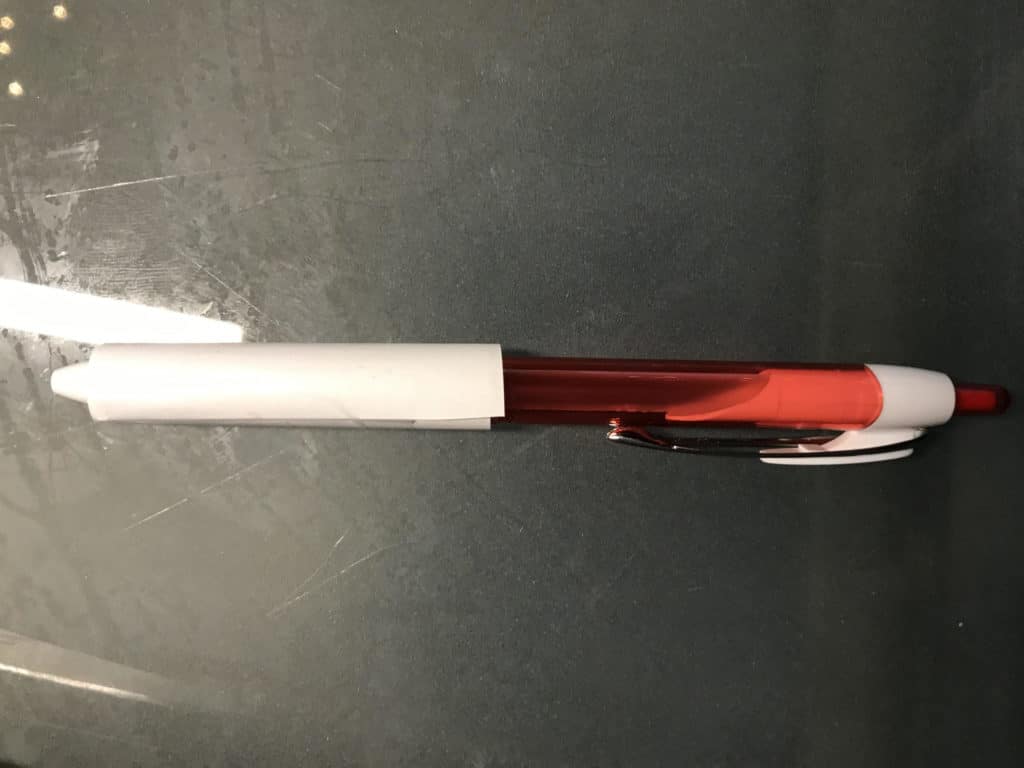
paper rocket on the tip of a pen
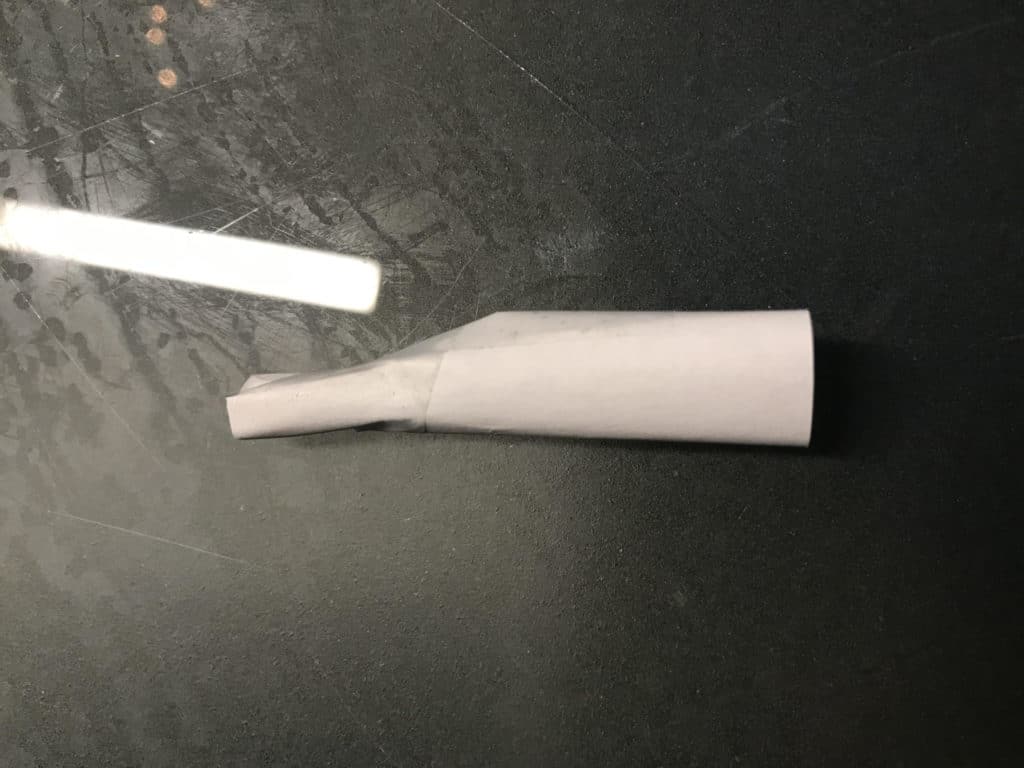
shaped paper rocket
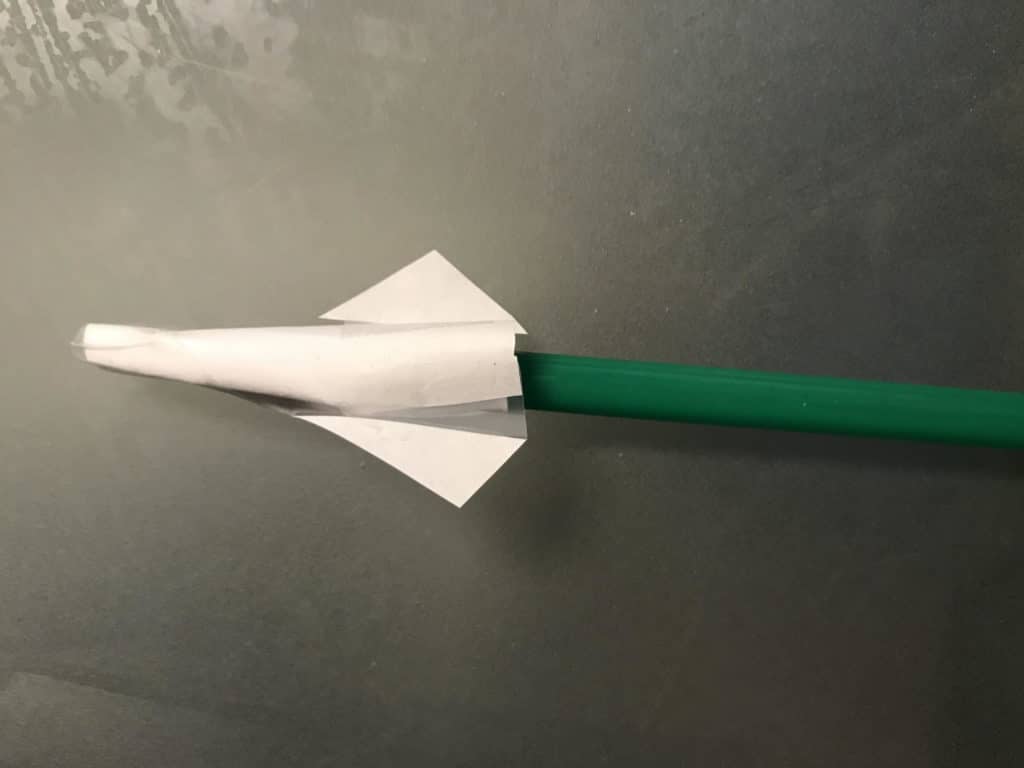
paper rocket on a straw

What You’ll Need to Make Straw Rockets

  • Plastic straws
  • Printer paper or similar quality paper
  • Scissors
  • Tape
  • OPTIONAL: crayons/markers

Directions

  1. Using scissors, cut a thin strip of paper roughly 2 inches wide.
  2. Wrap the paper into a cylinder shape (TIP: use a pencil or another plastic straw to help the paper keep its shape).
  3. Tape the paper at the seam to secure it.
  4. Take one end of the paper and fold it into a triangle shape. Tape down to secure the “nose” of the rocket (it’s ok if it’s not a perfect point!).
  5. Cut 2 triangles from your leftover paper and tape them to the bottom of your rocket, parallel from each other. This is the rockets tail and will help it glide in the air easier (TIP: make sure the bottom of your rocket has an opening big enough for your straw to fit into).
  6. OPTIONAL: using crayons or markers, make a design on your rocket.
  7. Once you’re satisfied with your rocket, place it on your plastic straw and blow through the other end

Observe:

So, what’s really happening? When you blow into the straw, you’re releasing hot air, which naturally wants to rise into the atmosphere. Because the air is being pushed through a narrow space in the straw, it launches the rocket into the air for a briefly—however, your rocket can’t create energy to keep itself in the air like a real rocket or animals like birds and insects can. Because it doesn’t have its own energy to keep it airborne, and because of Earth’s gravity, your rocket falls to the ground.

However, there’s also something else going on—although the air you blew into the straw is pushing your rocket up and away, there’s also air pushing against your rocket the minute it leaves your straw. This is called drag or air resistance, and it’s a real issue scientists and pilots face when trying to fly.

For the best results of this experiment, try making a few different rockets—try different shapes and sizes. Which one “flies” the longest?

Sponsors

Super Science Saturdays are sponsored by PA Cyber and Tender Care Learning Centers, a proud partner of Carnegie Museums of Pittsburgh. PAcyber The Pennsylvania Cyber Charter School LogoTendercare Learning Center logo

Filed Under: Blog Tagged With: Super Science Days, Taking Flight

January 29, 2021 by wpengine

Winging It: Quetzalcoatlus and the History of Aviation

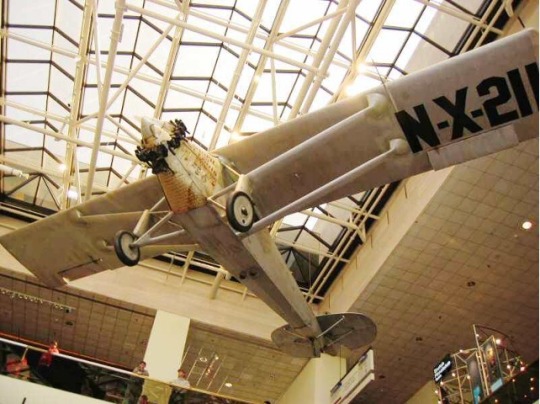
When I see Quetzalcoatlus northropi soaring above the Cretaceous in Dinosaurs in Their Time, I’m often reminded of the Spirit of St. Louis suspended aloft at the Smithsonian National Air and Space Museum. It might sound strange that a pterosaur from 70 million years ago would bring to mind an icon of twentieth century flight, but Q. northropi is a perfect starting point for exploring modern aviation history and the interconnections between nature and aeronautical engineering.

The Spirit of St. Louis in the Smithsonian, Washington, D.C.

When I was first introduced to Q. northropi, I knew it was named after the Mesoamerican feathered serpent god Quetzalcoatl, but I assumed the northropi part came from the name of the paleontologist who discovered the great pterosaur’s remains. I soon found to my surprise that the specific name northropi was bestowed in honor of Jack Northrop, the aeronautical engineer who experimented with flying wing aircraft designs in the 1940s. When the pterosaur was discovered in Big Bend National Park in the early 1970s by graduate student Douglas A. Lawson from the University of Texas at Austin, Lawson and his advisor were struck by its size (adults could grow as large as a giraffe), wingspan (up to 36 feet), and its lack of a tail. The last of these three features made Northrop a natural namesake for the species. As the fantastic news of Quetzalcoatlus spread in 1975, the journal Science unveiled one of its most memorable cover pages: depicted on the cover of its mid-March issue to dramatic effect is a Northrop flying wing aircraft (think the grandfather of the Stealth bomber), Quetzalcoatlus, a Pteranodon (with a puny wingspan of only 18 feet), and a condor (looking like a harmless sparrow in comparison). From the moment of its discovery in Far West Texas, Quetzalcoatlus northropi captured the imagination of both the paleontological and aviation communities and does so to this day.

The tailless design of Northrop’s flying wing allowed for better fuel efficiency and increased aerodynamics compared to traditional airplane designs. Debate, however, has raged over whether or not Quetzalcoatlus’s anatomy allowed the creature its own advantage in flight…or if it could fly at all. The jury is still out on the particulars of Q. northropi’s flying ability. Recent theorizing, from the mind of paleontologist Michael Habib, has the pterosaur capable of perhaps short flights powered by quadrupedal take-off as opposed to bipedal take-off, the method used by birds. Regardless of the debate, Q. northropi has itself inspired experimentation in drone technology. In 1985, at the behest of the Smithsonian, engineer Paul MacCready and a team of fellow scientists built and tested an orthocopter modeled after Quetzalcoalus with a modified wingspan of 18 feet. While the project was not without its technical hiccups, the team successfully test-flew their human-constructed pterosaur over Death Valley that year. This drone, called QN, is now housed at the Smithsonian National Air and Space Museum and remains an ambitious and fascinating example of how scientists attempt to fathom the biomechanics of extinct species. With this in mind, maybe it isn’t so strange that I’ve imagined Quetzalcoatlus and the Spirit of St. Louis in the same thought after all.

Comparison of Q. northropi with a similar plane to the Spirit of St. Louis, the Cessna 172

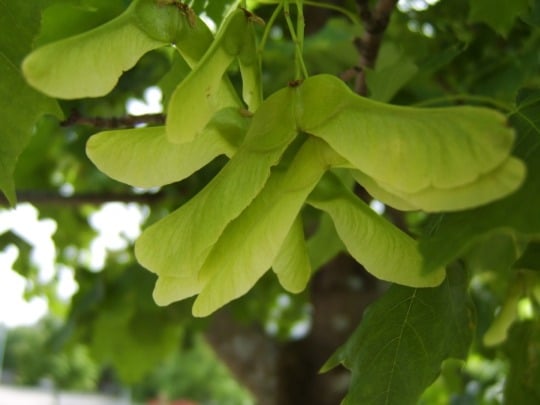
While Q. northropi’s flying skills remain ambiguous, its namesake’s design is indeed found directly in nature. Northrop’s flying wing shares its form and function with the seeds of the Javanese flying cucumber (Alsomitra macrocarpa), a fruit-bearing vine found in Southeast Asia. When its fruit, football-sized gourds, have ripened they release their seeds from high in the canopy of the rainforest. These seeds, light-weight, papery in texture, and shaped like flying wings glide to the ground sometimes several hundred meters away using autogyration to guide and slow their descent; this is the same phenomenon, for example, that guides maple trees’ “whirligig” seeds, known scientifically as samaras, to the ground. Nature is full of designs and forms that aeronautical engineers mine for the advancement of flight technology. Paul MacCready, when lecturing before an esteemed audience at MIT, once called dragonflies, hummingbirds, and hawk moths “nature’s helicopters.” Happily, each of those animals will be common in Southwestern Pennsylvania when spring and summer finally return. So, whether you’re marveling at Quetzalcoatlus northropi any time of year at the Carnegie Museum of Natural History or taking a leisurely walk at your local park, you’ll be able to ponder with renewed attention the interconnections between the natural world and the science of aviation.

Young maple tree samaras, still attached to their branches.

Nicholas Sauer is a Gallery Experience Presenter in CMNH’s Life Long Learning Department. Museum staff, volunteers, and interns are encouraged to blog about their unique experiences and knowledge gained from working at the museum.

Works Cited

Bryner, Jeanna. “How Huge Flying Reptiles Got Airborne.” Livescience.com. 7 Jan. 2009. <https://www.livescience.com/3190-huge-flying-reptiles-airborne.html>.

Carlson, Mark. “Northrop’s Radical Flying Wing Bomber of the 1940s.” July 2020. <https://www.historynet.com/northrops-radical-flying-wing-bomber-of-the-1940s.htm>.

MacCready, Paul and John Langford. “Human-Powered Flight: Potentials.” MIT Gardner Lecture, 27 April 1998. MIT Video Productions. <https://www.youtube.com/watch?v=t8C8-BB_7nw>.

Miller, David. “It’s A Bird; It’s a Plane; It’s a…Cucumber?” Boston University. 25 Nov. 2012. <http://blogs.bu.edu/bioaerial2012/2012/11/25/the-stabilizing-characteristics-of-alsomitra-macrocarpa/>.

“Texas Pterosaur Flies into Spotlight this National Fossil Day.” The University of Texas at Austin, Jackson School of Geosciences. 17 Oct. 2018. <https://www.jsg.utexas.edu/news/2018/10/texas-pterosaur-flies-into-limelight-this-national-fossil-day/>.

Related Content

Super Science: She-Ra, the American Kestrel

Live Animal Encounter Practice with Mango the Sun Conure

Are You Pishing at Me? Winter Birding in Pennsylvania

Filed Under: Blog Tagged With: Museum from Home, Super Science Days, Taking Flight

January 25, 2021 by Kathleen

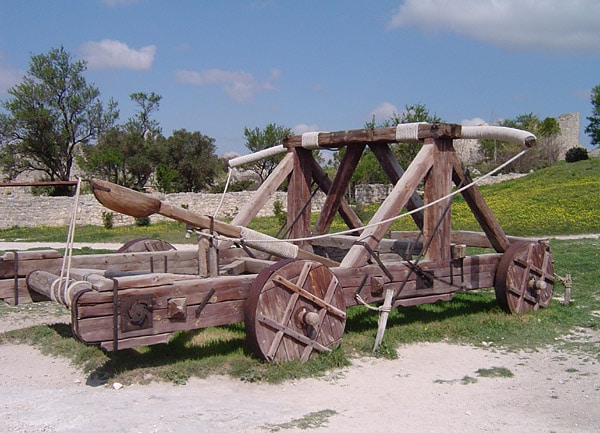
Super Science Activity: DIY Catapult

Petraria Arcatinus catapult replica

By Jane Thaler

Flight is possible because of the four basic forces of aerodynamics: lift, weight, thrust, and drag.
Lift and weight are opposing forces that, when controlled, allow things to stay up in the air. Thrust and drag are similarly opposing forces that either pull or resist movement through space. To be able to get into the air, animals and machines must be able to produce the two forces of lift and thrust against the forces of weight and drag.

model of the four forces of flight: thrust, lift, drag, and weight

Birds and helicopters have mechanisms that produce lift and thrust simultaneously. Birds do this through a twisting of their wings and helicopters accomplish the same idea through a single rotor. This allows them to conveniently take off for flight by moving straight up into the air. Not all flying machines can do this, however, and most require some sort runway to gain enough speed for taking off amongst all these flying forces. This can be fairly inconvenient when you don’t have a lot of time or space. Say you are trying to takeoff from an aircraft carrier in the sea for example that only has 300 feet of runway instead of the 2,300 feet needed for your average aircraft to takeoff. What you need, and what engineers have built, is a machine that can get those planes from 0 to 170 miles in less than 2 seconds. Aircraft carriers use steam-powered catapults to shortcut the force-based issues of flight takeoff.

Spring loaded catapults were used to launch aircraft beginning in 1903 and catapults were used on U.S. Navy ships as early as 1915, but their history as a tool for launching objects into the air for a distance began in 400 BC as weapons in siege warfare. Catapults work through a sudden release, or conversion, of stored potential energy to propel objects through the air. Essentially, energy stored as tension or torsion is converted during the release and transferred to the launched object. This energy of motion creates enough lift to get an object in the air while the force and angle of release provide the thrust necessary to cover long distances.

Let’s see how they work by building our own catapult! In this activity you will being using elastic potential energy stored in the tension of a wooden craft stick.

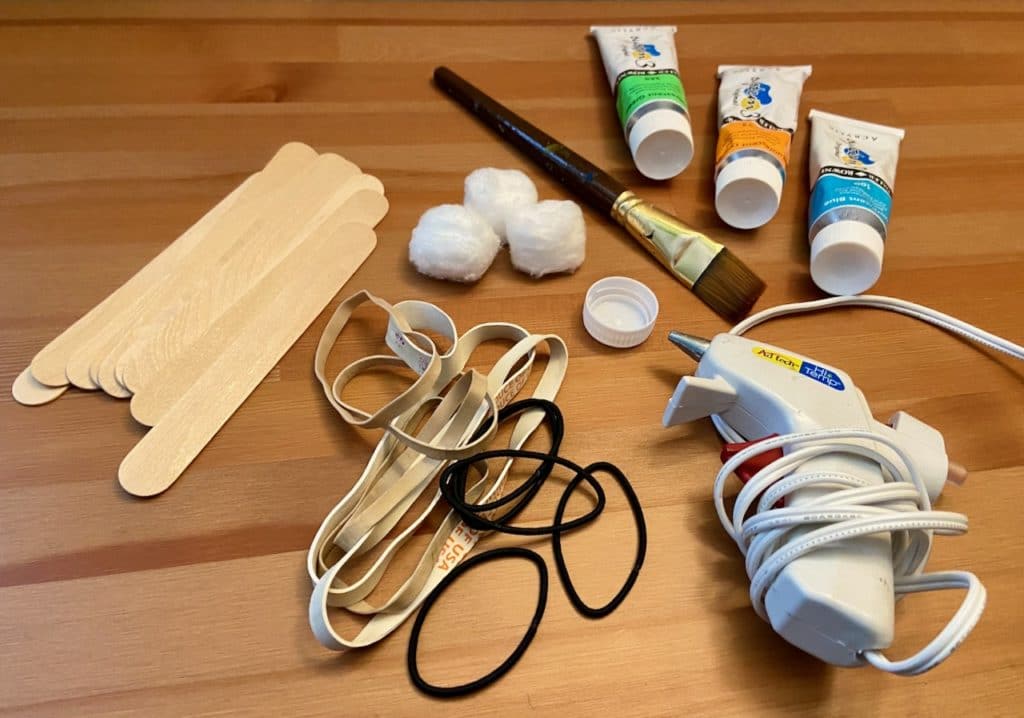
DIY Catapult supplies
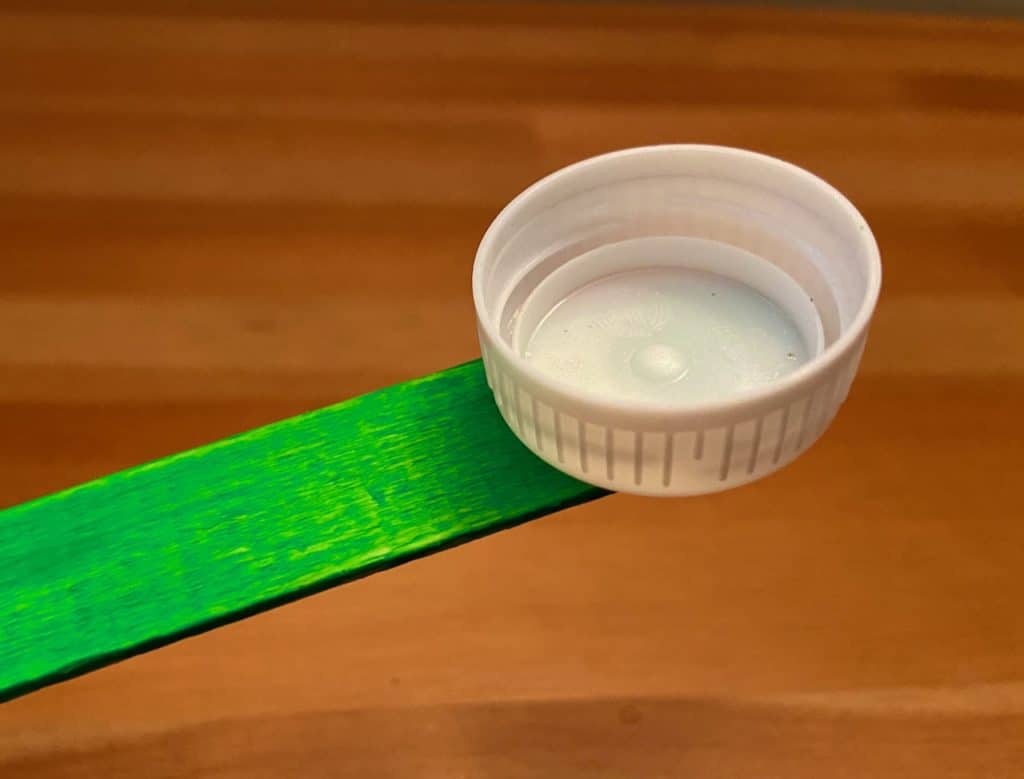
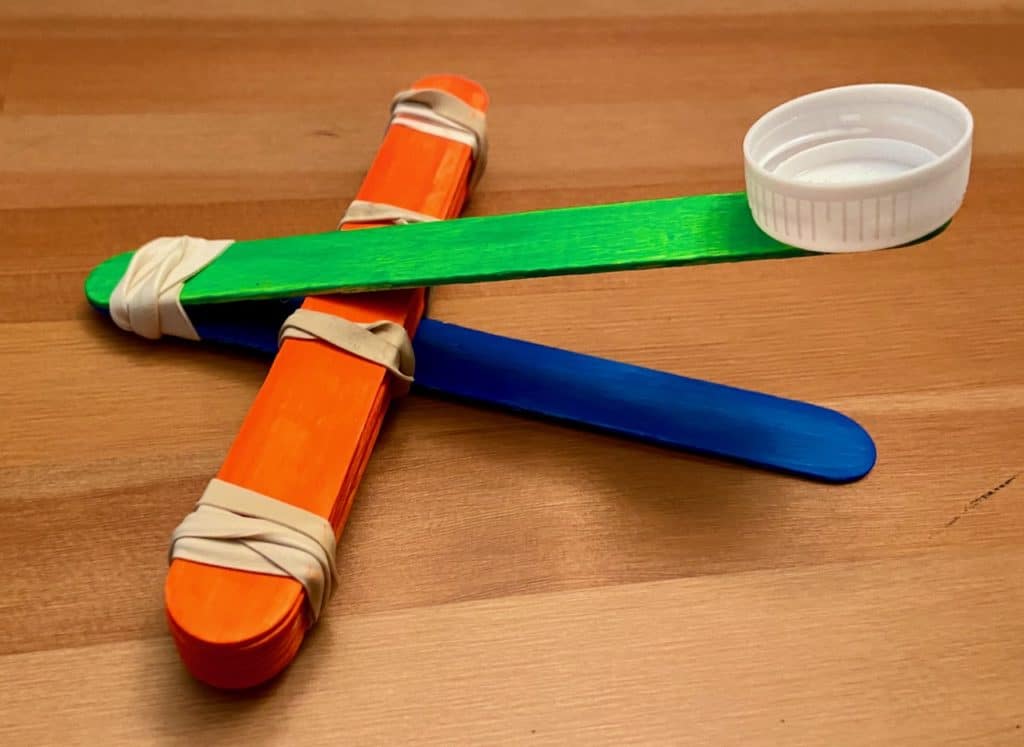
popsicle stick with plastic bottle cap glued on end
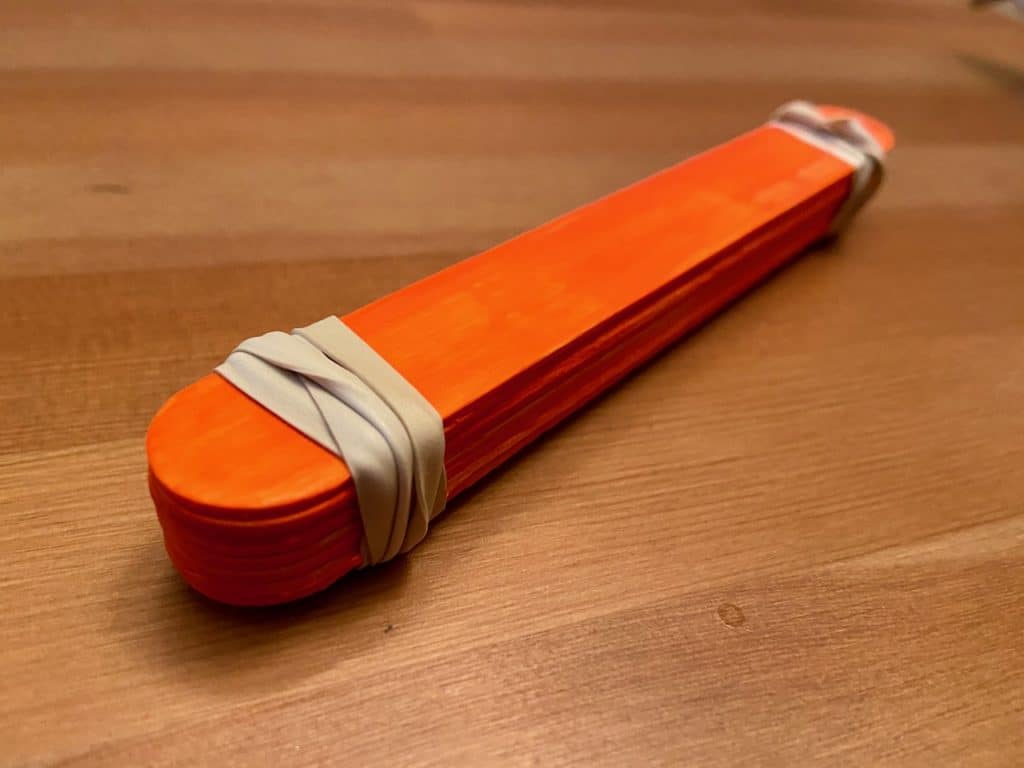
Eight popsicle sticks tied together with rubber bands

What You’ll Need to Make Your Own Catapult

• 10 craft sticks
• Rubber bands
• Plastic bottle cap – Or some other small, lightweight bucket
• Glue
• A cotton ball or small ball of crumpled paper
• Paint, markers, or other decorations – This is entirely optional

Directions

  1. (Optional) Decorate the craft sticks and bottle cap to your liking and wait till dry. It is much easier to do this before you begin assembling your catapult.
  2. Glue plastic bottle cap on the end of a craft stick facing up like a cup. Place aside to let dry. This will be the launching stick.
  3. Stack 8 craft sticks together. Wrap both ends of the stack with rubber bands to secure them together.
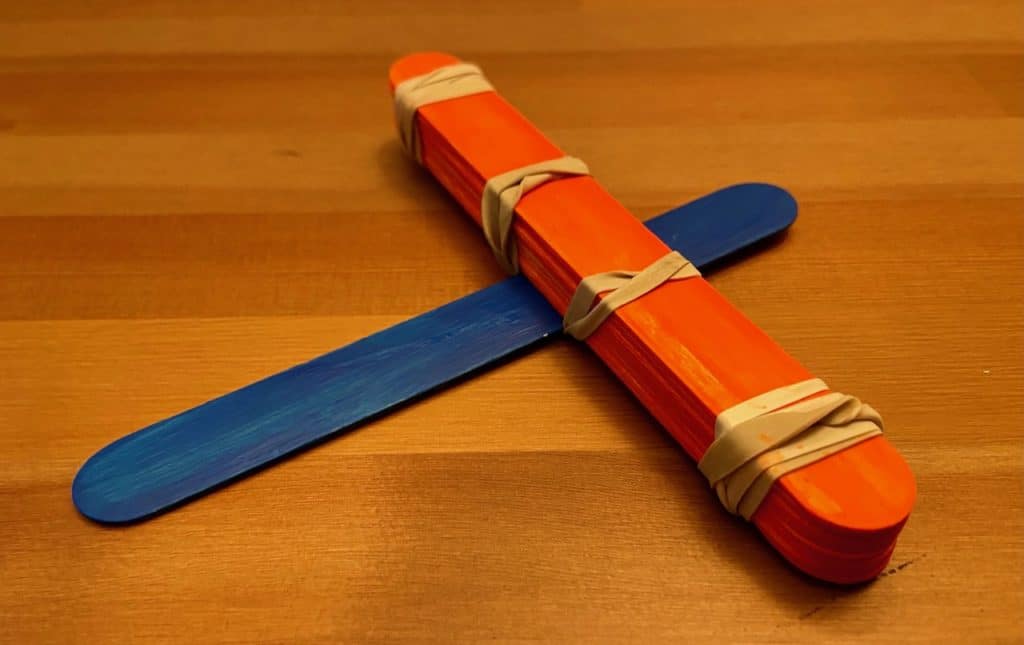
  4. Place a single craft stick on the bottom of the main stack at a perpendicular angle. Secure this cross shape with rubber bands wrapped in an X around the center.
  5. Attach your launching stick (bucket side up) on the other side of the stack, also perpendicular so that is lines up with the bottom stick. Attach the launching stick to the bottom stick using a rubber band. This will create a V-shape.
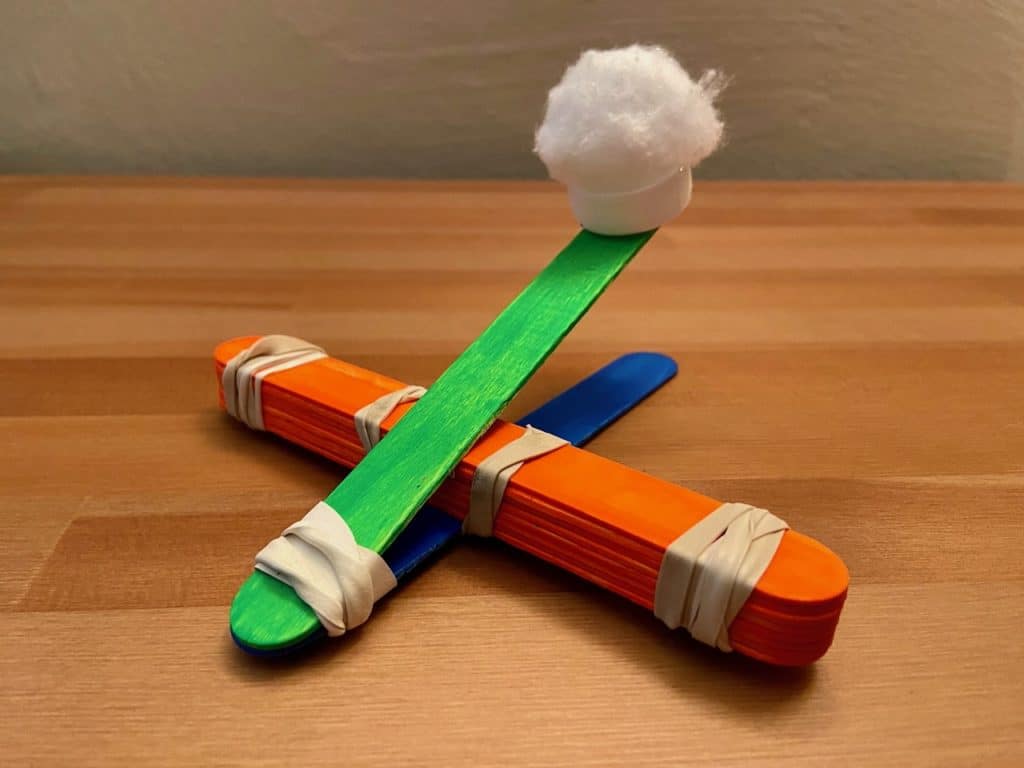
  6. Put your catapult on a flat area in an open space and place a cotton ball in the cup on the launching stick.
  7. Push the cup down a little bit and let go. Try changing up the how far you push the cup down before launching.

Observe:
Does your ball fly higher or lower when you push down a lot compared with when you push down a little? Does it land farther or nearer? Did the flight path change? What else do you observe?

Jane Thaler is a Gallery Experience Presenter in CMNH’s Life Long Learning Department. Museum staff, volunteers, and interns are encouraged to blog about their unique experiences and knowledge gained from working at the museum.

Stacked popsicle sticks attached to base popsicle stick
catapult cap stick attached to stacked popsicle stick perpendicularly
cotton ball in the catapult ready to launch!

Sponsors

Super Science Saturdays are sponsored by PA Cyber and Tender Care Learning Centers, a proud partner of Carnegie Museums of Pittsburgh. PAcyber The Pennsylvania Cyber Charter School LogoTendercare Learning Center logo

Filed Under: Blog Tagged With: Super Science Days, Taking Flight

January 25, 2021 by wpengine

Super Squid! Flying Marvels of the Natural World

Look up in the sky—it’s a bird! No, a plane! It’s…it’s…a squid?!  Most people wouldn’t expect a squid to fly, but truth is sometimes stranger than comic book fiction. The natural world is full of wonderful surprises, including many creatures that seemingly have no business being airborne. They can live in very different habitats, ranging from beneath the ocean waves to high up in the tree tops of a rainforest. Yet all these animals have expertly managed to adapt to their environments and utilize flight as a successful survival tool.

Flying Mammals

Wouldn’t it be a strange world if mice and rats could fly? Besides being a housecat’s worst nightmare, this notion also seems unbelievable. But out in the amazing world of wildlife, this isn’t so far from the truth! Gliding mammals can be found around the globe, from the tiniest of these arboreal aerialists, the Mighty-Mouse-sized Feathertail Glider, which lives in Australia, to the largest, the 16-inch-long Colugo, sailing through the tree tops of the rainforests of South East Asia.

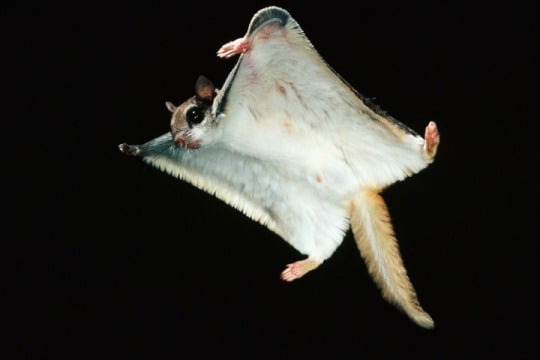
The Southern Flying Squirrel (also called the assapan) measures 10 inches long from nose to tail and covers a wide range of the eastern side of North America. It lives in the deciduous forests that stretch from Southeast Canada to Florida. Their habitat is like that of the Gray Squirrel, but we often don’t see them because they’re nocturnal.

These squirrels are nocturnal, and eat a variety of fruits, nuts, insects, spiders, flowers, and seeds. They’ll also eat bird eggs and gastropods like snails and slugs!

Flying squirrels, like all gliding mammals, has specialized flight gear that enables it to take to the skies. This unique flying tool is called a patagium, which is a stretchy cape of loose skin that starts at their wrists, extends along their body, and attaches at their ankles. To become airborne, they usually like to take a running start from a tree top. But they can also take off from a stationary jumping point by pulling in their limbs and head close to their body. Then, like releasing energy from a coiled spring, they push off and propel into the air. Once they’re in the air, they stretch out their arms and legs to create an “X” shape with their body. This causes their patagium to billow up and stretch into a square shape. This allows them to turn into furry little pilots, expertly maneuvering around obstacles and trees. They can even manage to make last- second, hair-raising 90-degree turns!

When preparing to land, they raise up their flattened tail, which acts like the stabilizer on a kite or airplane. This allows them to adjust their trajectory and hone in on their landing site. By pulling their limbs in front of them, the squirrel’s patagium transforms into a parachute and slows them down when they reach the limb of their choice. Although they’re clumsy walkers because of their patagium, the Southern Flying Squirrel’s ability to glide is an effective adaptation for traveling long distances, and a great tactic for evading predators.

Flying Reptiles

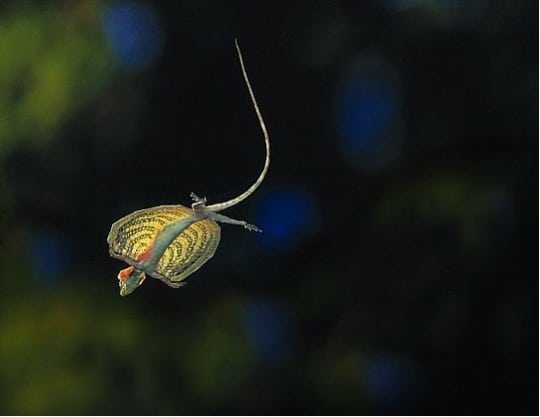
It’s not just mammals that can sail through the wild blue yonder; reptiles have their superhero moments, too. When you think of a flying reptile, the first thing that might come to mind is a menacing winged serpent or dragon out of some mythical Medieval legend. But these captivating creatures don’t just live in the land of fairytales—they inhabit our world, too. The Draco Lizard, also called the Flying Dragon, makes its home in the jungles of Southeast Asia and Southern India. Measuring a mere 8 inches from head to tail, it’s astounding that they can fly through the forest for up to 100 feet! They accomplish this by using folds of skin that rest against their body. When unfurled, this skin acts as wings. This tiny “dragon” can travel quickly from tree to tree using their wings for lift and their long, slender tail for steering. Their airborne expediency is very useful for avoiding danger, finding mates, and tracking down meals.

You wouldn’t think this little lizard could be airborne, but they can glide distances up to 10 times their body length!

Another gliding reptile is the nocturnal Flying Gecko, which lives in the tropical forests of Malaysia, Thailand, and Indonesia. Measuring up to 8 inches, they can fly for up to 200 feet! They have special webbing that surrounds their neck, limbs, feet, trunk, and rudder-like tail. When the gecko stretches itself out, this webbing acts as flaps that create surface area and generate lift.

Lastly, there is one brave reptile that seems to break all the rules of flight and aerodynamics. It’s the flying snake. There are currently five recognized species, and they range from Western India to Indonesia. Scientists are not quite sure why snakes fly. Maybe it’s to escape predators, hunt prey, or quickly move from tree to tree. Whatever their reasons, it is an amazing sight to see. The Paradise Tree Snake of Southeast Asia will slither to the end of a branch, dangle in a J shape, then spring off using the lower half of its body. Then they use the speed of free fall to fly. In midair, it flattens its body into a concave “C” shape to trap air and provide lift. As it glides, it undulates side to side in an “S” shape. This action increases stabilization so that it can cover more horizontal distance. No other gliding animal maintains stability like this. At just 4 feet long, the Paradise Tree Snake can fly for up to 330 feet! It’s quite an achievement for a reptile with no legs or wings.

Flying Sea Life

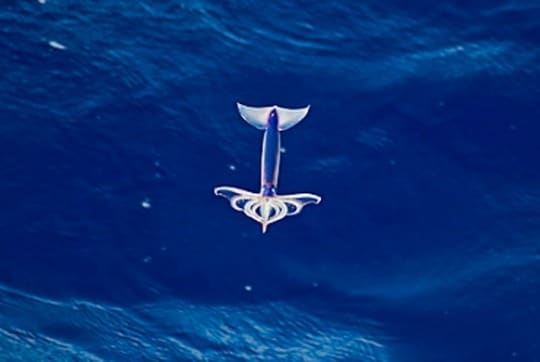
Most people think that dolphins and whales are the only aquatic acrobats of the animal world. But there are many other sea creatures that peek above the ocean waves from time to time. Perhaps you’ve heard of the flying fish. There are 40 known species that inhabit the Atlantic, Pacific, and Indian Oceans. Their streamlined, torpedo-shaped bodies can be as long as 18 inches. They’ll rapidly beat their forked tails to break the water’s surface and propel themselves through the air at 35 miles per hour. Using their unusually large pectoral fins as wings, they can glide for up to 655 feet before re-entering the water. It’s an astonishing feat that seems incomparable, but there has been a recent discovery of another flying marvel of the seas…Super Squid! All joking aside, this mollusk is called a flying squid. Scientists think that there are possibly dozens of species of squid that can fly, some of which are the Neon Flying Squid, the Orangeback Squid, and the Argentine Shortfin Squid.

Although there are several different species of flying squid, they most likely all evolved their mantles and funnels similarly for the most effective speed and aerodynamics when airborne.

A flying squid launches itself out of the water like a rocket by using its mantle and funnel. A mantle is a cloak of soft, muscular tissue that surrounds its body. When the squid contracts its mantle, it sends water shooting through the funnel, a tube below its head. It blasts out of the water like a jet and can travel as far as 100 feet in 3 seconds and fly as high as 10 feet above the water’s surface! It glides by spreading out its fins and flapping. But it also forms wings by spreading out its tentacles in a radial pattern. A membrane between their tentacles enables them to catch air, and this creates lift. Upon re-entry into the water, the squid folds back its fins and dives under the waves. Scientists have observed groups of over twenty squid flying together, and they’ve noticed that the squid don’t just glide passively. They change posture based on their distance from the water and their phase of flight. Scientists also think, more than likely, squids fly as a defense method for predatory escape.

So, the next time you’re outdoors, take a moment to look up into the sky and imagine seeing a snake, a squirrel, a lizard, or a squid sailing high above your head. It’s seems utterly inconceivable, but these amazing animals really do exist. And no, none of them wear a little red cape and have an “S” on their chest. And they’re not able to leap tall buildings in a single bound. But that doesn’t make their gravity-defying feats of flight any less super.

Shelby Wyzykowski is a Gallery Experience Presenter in CMNH’s Life Long Learning Department. Museum staff, volunteers, and interns are encouraged to blog about their unique experiences and knowledge gained from working at the museum.

Related Content

Flying Snakes? Unique Reptile Adaptations

Stuffed Animal Safari: Giraffe

A Hop, Skip, and a Stomp

Sponsors

Super Science Saturdays are sponsored by PA Cyber and Tender Care Learning Centers, a proud partner of Carnegie Museums of Pittsburgh. PAcyber The Pennsylvania Cyber Charter School LogoTendercare Learning Center logo

Filed Under: Blog Tagged With: Super Science, Super Science Days, Taking Flight

  • « Go to Previous Page
  • Page 1
  • Page 2
  • Page 3
  • Page 4
  • Interim pages omitted …
  • Page 9
  • Go to Next Page »

sidebar

About

  • Mission & Commitments
  • Directors Team
  • Museum History

Get Involved

  • Volunteer
  • Membership
  • Carnegie Discoverers
  • Donate
  • Employment
  • Events

Bring a Group

  • Groups of 10 or More
  • Birthday Parties at the Museum
  • Field Trips

Powdermill

  • Powdermill Nature Reserve
  • Powdermill Field Trips
  • Powdermill Staff
  • Research at Powdermill

More Information

  • Image Permission Requests
  • Science Stories
  • Accessibility
  • Shopping Cart
  • Contact
  • Visitor Policies
One of the Four Carnegie Museums | © Carnegie Institute | Privacy Policy | Terms of Use | Accessibility
Rad works here logo