• Skip to primary navigation
  • Skip to main content
  • Skip to primary sidebar

Carnegie Museum of Natural History

One of the Four Carnegie Museums of Pittsburgh

  • Visit
    • Buy Tickets
    • Visitor Information
    • Exhibitions
    • Events
    • Dining at the Museum
    • Celebrate at the Museum
    • Powdermill Nature Reserve
    • Event Venue Rental
  • Learn
    • Field Trips
    • Educator Information
    • Programs at the Museum
    • Bring the Museum to You
    • Guided Programs FAQ
    • Programs Online
    • Climate and Rural Systems Partnership
  • Research
    • Scientific Sections
    • Science Stories
    • Science Videos
    • Senior Science & Research Staff
    • Museum Library
    • Science Seminars
    • Scientific Publications
    • Specimen and Artifact Identification
  • About
    • Mission & Commitments
    • Directors Team
    • Museum History
  • Tickets
  • Give
  • Shop

t-rex

October 5, 2017 by wpengine

Tyrannosaurus rex

Tyrannosaurus rex was one of the largest predators to ever walk the Earth. Growing up to 46 feet in length and standing 13 feet high at the hips, this meat-eater could weigh up to seven tons.

T. rex was more than just enormous, it was ferocious. It had massive hind legs with three-toed feet, small, strong arms the size of a man’s, and a huge, heavy tail that was used as a counterbalance.
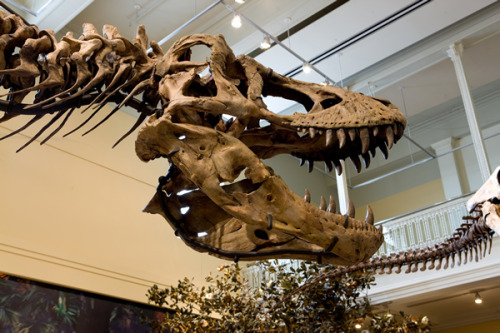
head of a T.rex skeleton
Credit: Joshua Franzos for Carnegie Museum of Natural History

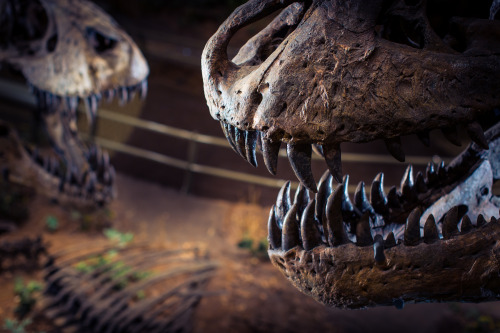
Its skull grew to five feet long and housed strong jaws that created a bone-crushing bite. It had nearly 60 serrated, razor-sharp teeth that grew up to six inches in length. With a name that means “tyrant lizard king,” this dinosaur feasted on the large herbivores of its time.
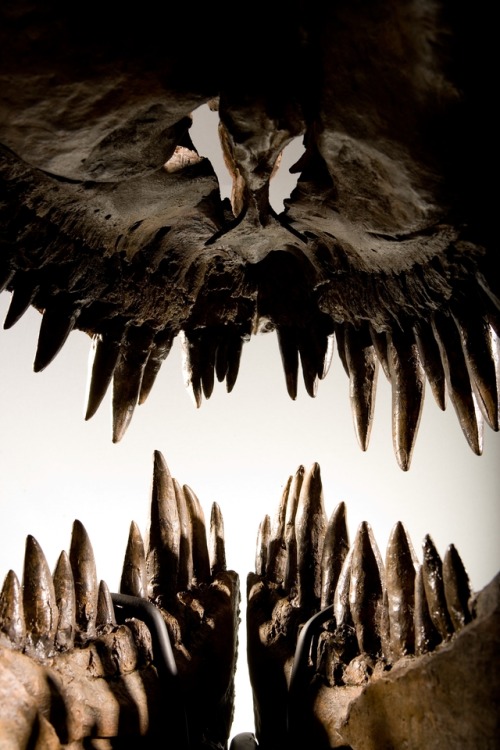
view of T.rex teeth from inside the dinosaur's mouth
Credit: Joshua Franzos for Carnegie Museum of Natural History

T. rex roamed the western United States and southwestern Canada during the late Cretaceous Period, about 66 to 68 million years ago. The specimen on display at Carnegie Museum of Natural History was discovered in 1902 by Barnum Brown and sent to the American Museum of Natural History. It was bought by the Carnegie Museum in 1941.

This specimen is extremely important because it is the holotype of the species. A holotype is a specimen upon which a given species is based. So, in other words, Carnegie Museum of Natural History’s T. rex is the ‘gold standard’ to which all potential fossils of this notorious meat-eater must forever be compared. Although a few specimens that are now known to belong to T. rex were found prior to the discovery of the holotype, the holotype was, by definition, the first fossil of the species to be recognized by science. Therefore, it can be considered the world’s first specimen of the world’s most famous dinosaur.
Filed Under: Blog Tagged With: dinosaur, dinosaurs, dinosaurs in their time, Matt Lamanna, t-rex, Tyrannosaurus Rex, Vertebrate Paleontology

December 13, 2016 by wpengine

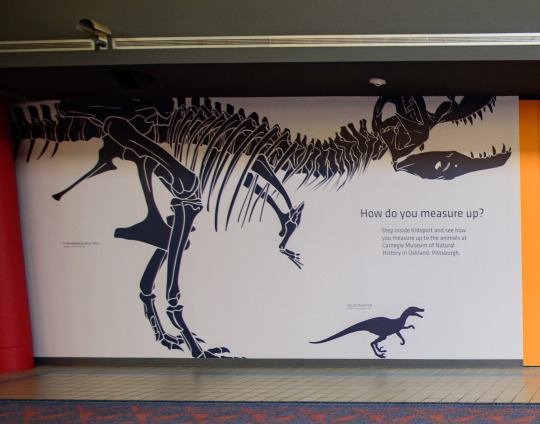
Measuring Up at Kidsport

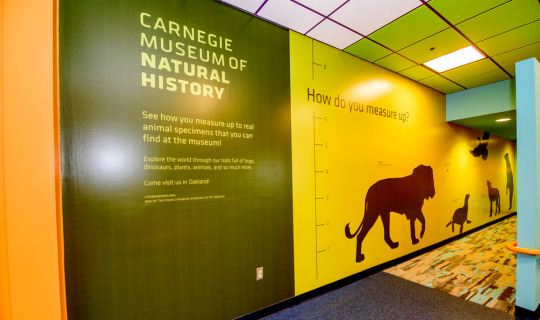
Wall art with animal silhouettes

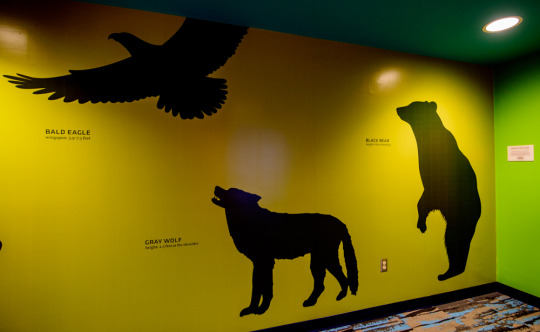
Wall art with eagle, wolf, and bear silhouettes
Wall art with T-rex silhouette

How do you size up to a bald eagle, a lion, or even a velociraptor?

You can find out next time you fly through Pittsburgh International Airport at the new Kidsport!

Carnegie Museum of Natural History, as well as several other cultural institutions in Pittsburgh, teamed up with the airport to help create the newly renovated Kidsport – a colorful, 2,100 square foot play and learning space with interactive exhibits for families to visit when they’re traveling.

Carnegie Museum of Natural History’s contribution was a series of wall art that lets kids compare themselves to different animals as short as a seal and as huge as a T-Rex!

The installations were made possible by funding from the Richard King Mellon Foundation.

(Photos courtesy of Pittsburgh International Airport)

Filed Under: Blog Tagged With: Pittsburgh, t-rex

November 14, 2016 by wpengine

Moving Day for Jane the T-Rex

Jane without head or tail

It was moving week for our juvenile Tyrannosaurus Rex Jane! She’s been living in the spine of our museum for quite sometime, but this week she was moved just a few hundred feet away into our brand new gift store, where she’ll be the center of attention.

Staff carefully disassembled Jane by removing her skull, tail, and ribcage before they wheeled her stand to it’s new location and reassembled her.

The gift store is currently undergoing renovations and will reopen later this month with three new exhibits.

the finished reconstructed T-Rex

Jane sitting pretty in her new home. 

Filed Under: Blog Tagged With: dinosaurs, fossils, paleontology, t-rex

October 17, 2016 by wpengine

T-Rex teeth in Dinosaurs in their Time

T-rex teeth

T-Rex teeth in Dinosaurs in their Time at Carnegie Museum of Natural History in Pittsburgh.

 (Photo by Josh Franzos)

Filed Under: Blog Tagged With: dinos, dinosaurs, dinosaurs in their time, Pittsburgh, t-rex

sidebar

About

  • Mission & Commitments
  • Directors Team
  • Museum History

Get Involved

  • Volunteer
  • Membership
  • Carnegie Discoverers
  • Donate
  • Employment
  • Events

Bring a Group

  • Groups of 10 or More
  • Birthday Parties at the Museum
  • Field Trips

Powdermill

  • Powdermill Nature Reserve
  • Powdermill Field Trips
  • Powdermill Staff
  • Research at Powdermill

More Information

  • Image Permission Requests
  • Science Stories
  • Accessibility
  • Shopping Cart
  • Contact
  • Visitor Policies
One of the Four Carnegie Museums | © Carnegie Institute | Privacy Policy | Terms of Use | Accessibility
Rad works here logo