• Skip to primary navigation
  • Skip to main content
  • Skip to primary sidebar

Carnegie Museum of Natural History

One of the Four Carnegie Museums of Pittsburgh

  • Visit
    • Buy Tickets
    • Visitor Information
    • Exhibitions
    • Events
    • Dining at the Museum
    • Celebrate at the Museum
    • Powdermill Nature Reserve
    • Event Venue Rental
  • Learn
    • Field Trips
    • Educator Information
    • Programs at the Museum
    • Bring the Museum to You
    • Guided Programs FAQ
    • Programs Online
    • Climate and Rural Systems Partnership
  • Research
    • Scientific Sections
    • Science Stories
    • Science Videos
    • Senior Science & Research Staff
    • Museum Library
    • Science Seminars
    • Scientific Publications
    • Specimen and Artifact Identification
  • About
    • Mission & Commitments
    • Directors Team
    • Museum History
  • Tickets
  • Give
  • Shop

Tim Pearce

June 10, 2022 by Erin Southerland

Prozac and Caffeine in Our Wastewater: Effect on Freshwater Mollusks

by Tim Pearce

Chemicals in our medications, supplements, foods, and beverages often pass through our bodies and wind up in our wastewater. Antidepressants are one of the more common pharmaceuticals in wastewater, and in some samples, concentrations of the stimulant caffeine exceeded those of pharmaceuticals (Raj et al. 2021). Although treatment plants can remove more than 50% of caffeine, the enormous popularity of caffeine consumption by humans results in such large levels of this chemical in wastewater that caffeine is sometimes used as an indicator of human-caused pharmaceutical pollution. These chemicals, along with our vitamins and other food additives, can affect freshwater organisms.

In this blog, I focus on two common chemicals: Prozac (fluoxetine) and caffeine (e.g., coffee, tea). 

Prozac in low concentrations stimulates reproduction in marine and freshwater bivalves (Fong & Ford 2014), as well as in some freshwater snails, including the invasive New Zealand mud snail (Pomatopyrgus antipodarum). Interestingly, high concentrations of Prozac decreased reproduction in the snails. 
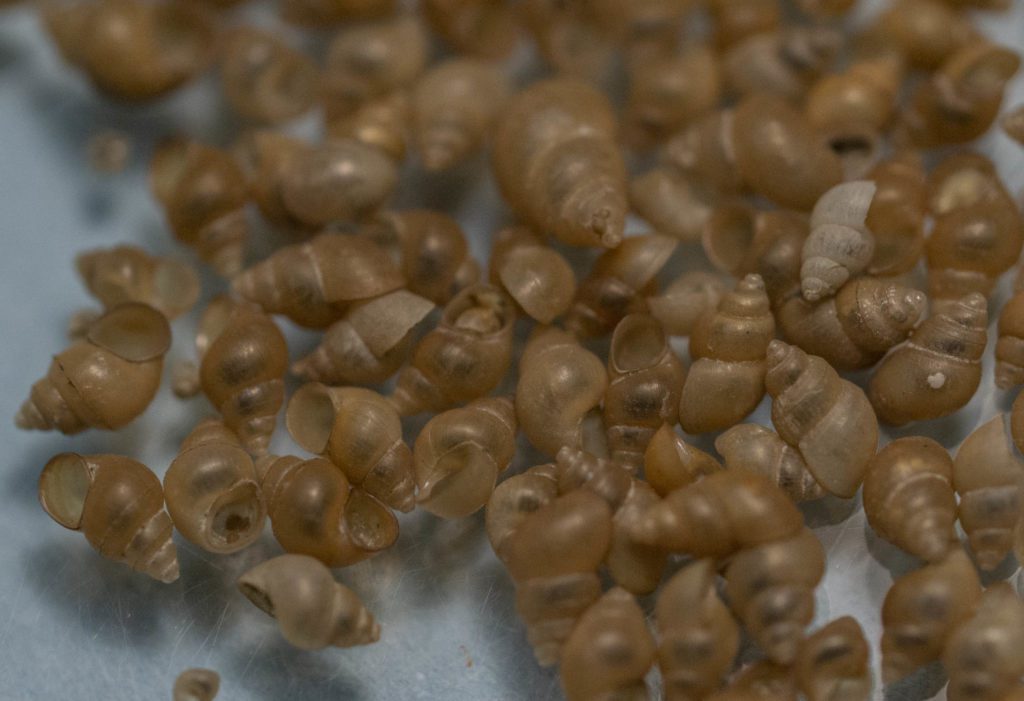
snail shells
Fig. 1. New Zealand mud snail, Potamopyrgus antipodarum. Found in Romania in 1950 (CM 63909). Shells average about 5 mm (0.2 inches) long. Photo by Ryan Utz.

Clams on Prozac release gametes or young (Fong & Ford 2014). Small freshwater pill clams (Sphaeriidae) brood their young, and Prozac stimulates the release of these brooded offspring. In freshwater mussels, Prozac stimulates release of their larvae. Our knowledge of this effect can be used to augment propagation efforts to support recovery of endangered freshwater mussel species, but only with a clear understanding of these fascinating creatures’ full reproductive cycle. As part of their development, freshwater mussel larvae temporarily attach themselves to the gills of fish. If Prozac in the water of a natural setting stimulated larval release at times when fish hosts were absent or the larvae were too immature to attach, then the Prozac would be counterproductive to mussel reproduction.

Caffeine negatively affects marine bivalves by inducing oxidative stress (Júnior et al. 2019), leading to degradation of cell membranes (Silvia et al. 2022). When exposed to environmentally relevant concentrations of caffeine, the freshwater clam Corbicula fluminea experienced physiological changes, including DNA damage (Aguirre-Martínez et al. 2015). Caffeine might have less effect on freshwater snails. One study on the freshwater snail Helisoma trivolvis showed little effect of caffeine on adult survival, but normal embryonic rotation in developing eggs was slowed at higher caffeine concentrations (Sanchez & Prezant 2016). (The caffeine used as a slug repellent in terrestrial agriculture is in much greater concentrations than that found in wastewater.)
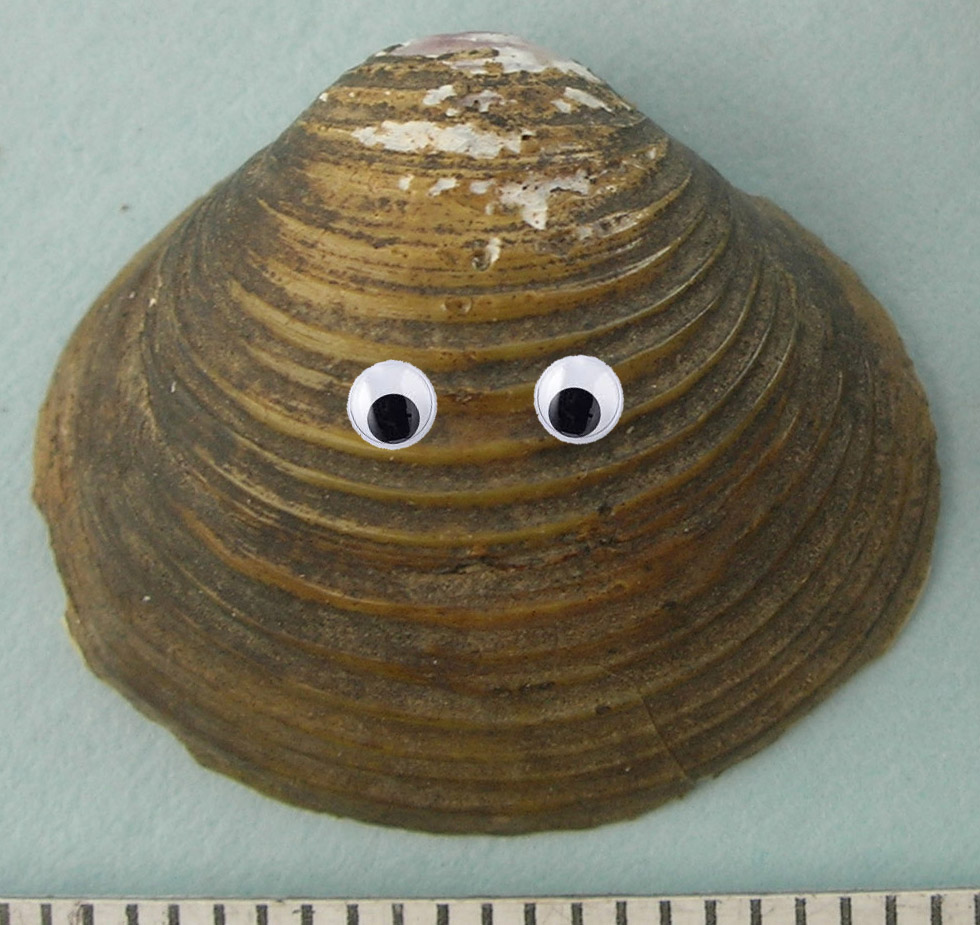
clam shell with googly eyes
Fig. 2. Asian clam, Corbicula fluminea. Found in Westmoreland County, Pennsylvania in 1993 (CM 72879). Scale in mm. [Googly eyes Photoshopped in] Photo by Tim Pearce.

If you needed another reason to reduce your consumption of pharmaceuticals and caffeine, the fact that it affects reproduction in freshwater creatures could be a consideration.

These findings about anti-depressants in our wastewater give new meaning to the phrase, “Happy as a clam.”

Timothy A. Pearce, PhD, is the head of the mollusks section at Carnegie Museum of Natural History.

Literature Cited

Aguirre-Martínez, G.V., DelValls, A.T. & Martín-Diaz, M.L. 2015. Yes, caffeine, ibuprofen, carbamazepine, novobiocin and tamoxifen have an effect on Corbicula fluminea (Müller, 1774). Ecotoxicology and Environmental Safety, 120: 142–154.

Fong, P.P. & Ford, A.T. 2014. The biological effects of antidepressants on the molluscs and crustaceans: a review. Aquatic Toxicology, 151: 4-13.

Júnior, C.A.M., Luchiari, N.C. & Gomes, P.C.F.L. 2019. Occurrence of caffeine in wastewater and sewage and applied techniques for analysis: a review. Eclética Química Journal, 44(4): 11-26.

Raj, R., Tripathi, A., Das, S. & Ghangrekar, M.M. 2021. Removal of caffeine from wastewater using electrochemical advanced oxidation process: a mini review. Case Studies in Chemical and Environmental Engineering, 4: 100129.

Sanchez, D. & Prezant, R.S. 2016. Influence of diphenhydramine HCl and caffeine on embryonic development and adult reproductive success of the freshwater gastropod Helisoma trivolvis. American Malacological Bulletin, 34(2): 92-102.

Silvia, S., Cravo, A., Rodrigues, J., Correia, C. & Almeida, C.M.M. 2022. Potential impact of UWWT effluent discharges on Ruditapes decussatus: an approach using biomarkers. Advances in Environmental and Engineering Research, 2(2): doi:10.21926/aeer.2102015 [18 pp].

Related Content

Clams In the Concrete! How Old Is This Sidewalk?

Stalking the Freshwater Sponges of Western Pennsylvania

The Zebra Mussel and the Shopping Cart

Carnegie Museum of Natural History Blog Citation Information

Blog author: Pearce, Timothy A.
Publication date: June 10, 2022
Share this post!

  • Share on Twitter Share on Twitter
  • Share on Facebook Share on Facebook
  • Share on Pinterest Share on Pinterest
  • Share on LinkedIn Share on LinkedIn
  • Share on Reddit Share on Reddit
  • Share via Email Share via Email

Filed Under: Blog Tagged With: mollusks, Science News, Tim Pearce

February 14, 2022 by Erin Southerland

Can Snails Feel Love?

by Dr. Timothy A. Pearce

A reader recently asked whether snails can feel love. I sometimes wonder that too; do my pet snails feel any affection for me? I don’t know the answer, but I’ll discuss this intriguing question from two perspectives: biochemical and philosophical.

Biochemically, many of our emotions are influenced by hormones. For example, higher levels of the hormone oxytocin are associated with greater trust and affection. Hormones in other species might have similar effects, for example, oxytocin in octopuses is associated with behaviors that are reasonably interpreted as affection. Humans and octopuses are very different evolutionarily – the common ancestor between our lineages occurred a very long time ago, at least 500 million years ago. The presence of oxytocin as an influencing hormone in both humans and octopuses could be interpreted as, (a) the ability to produce and respond to oxytocin might have been present in all or most animals living 500 million years ago and consequently is present in most modern animals that descended from those ancestors, or (b) the ability to produce and respond to oxytocin might have evolved independently in the lineage that led to humans and in the lineage that led to octopuses. A recent paper (Kumara et al. 2020) reported oxytocin-like proteins in a wide variety of vertebrates and invertebrates, suggesting the first possibility, that oxytocin might be widespread in animals due to shared common ancestry. If oxytocin, and other hormones that are associated with what we humans experience as love, are present in snails, then it could be reasonably argued that snails at least have the potential to feel love.

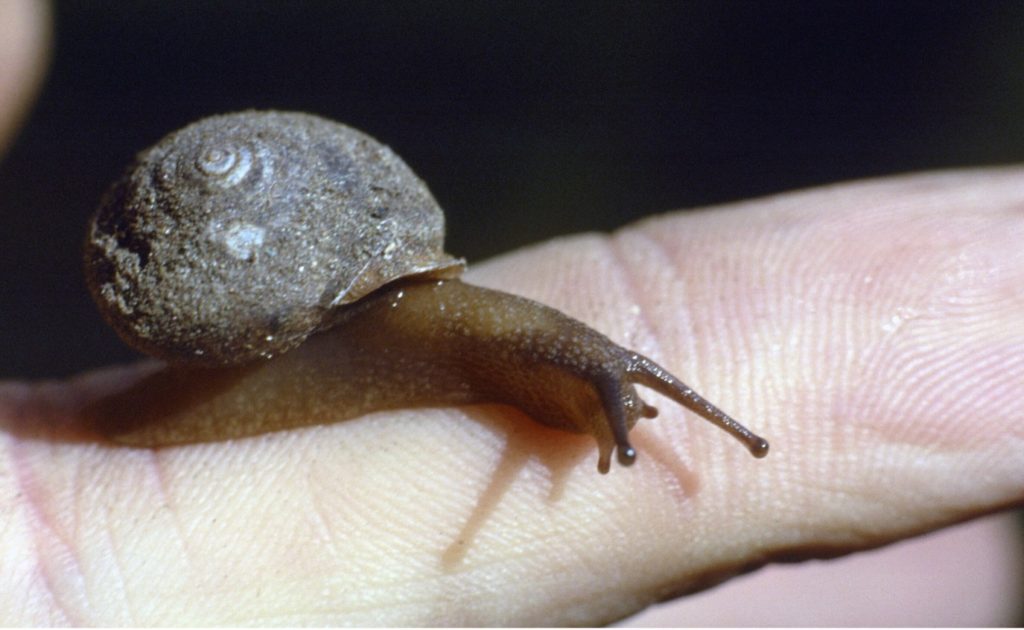
snail on a person's finger
Does my pet snail love me when it crawls on my finger? Vespericola sp. from Siskiyou County, CA. Photo by T.A. Pearce 31 Jul 1985.

Philosophically, in an evolutionary perspective, what would love be good for? Love in the broad sense might be useful in social organisms to strengthen bonds between individuals such as partners, parents and offspring, and group members working toward a common goal. Inter-species bonds, such as humans and their pets, or even between individuals of non-human species, are reasonably interpreted as manifestations of love. However, these evolutionary benefits of love are for social species, and I can’t think of any social snails. Snails do not show evidence of mate fidelity or parental care, and they do not seem to crave each other’s company. Although snails sometimes gather in large numbers, my study of such aggregations suggests mutually valued resources are the cause of such occurrences rather than a desire to be together (Pearce & Porter 2011). So, I can’t think how the capacity to experience love would be useful to a snail in a way that evolution could select for a snail’s ability to feel love.

Snails do copulate, for reproduction, and that can be interpreted as a form of love. Some snails use calcareous darts, often called “love darts” as part of a courtship dance before copulation (the darts themselves are not used in sperm transfer). Reproductive behaviors are probably influenced by hormones. I like to think that snails find reproduction to be a pleasurable experience, but we really don’t have much idea what is pleasurable to a snail.

We sometimes use the word love to mean intense liking. In this sense, snails might have the capacity to love. I have noticed some of my pet snails are so attracted to cucumbers that I commonly say, “Snails love cucumbers.” I interpret the consumption of cucumbers as being deeply satisfying to snails.

In summary, snails might have the biochemical potential to feel love, but they might not have a socially-mediated evolutionary reason to feel love. They engage in reproductive behaviors, but we don’t know whether they feel love or pleasure during reproduction. At least some snails seem to have an intense like for cucumbers. Maybe snails do feel love, and maybe they don’t; we don’t know. You are free to believe as you like. Your pet snail Fluffy might really love you!

Timothy A. Pearce, PhD, is the head of the mollusks section at Carnegie Museum of Natural History. Museum employees are encouraged to blog about their unique experiences and knowledge gained from working at the museum.

Literature Cited

Kumara, S., Vijayasarathya, M., Venkatesha, M.A., Sunita, P. & Balaram, P. 2020. Cone snail analogs of the pituitary hormones oxytocin/vasopressin and their carrier protein neurophysin. Proteomic and transcriptomic identification of conopressins and conophysins. Biochimica et Biophysica Acta (BBA) – Proteins and Proteomics, 1868(5): 140391

Pearce, T.A. & Porter, K.A. 2011. Do Philomycus carolinianus (Gastropoda: Philomycidae) prefer to congregate? Nautilus 125: 83-85.

Related Content

Do Plants Have Lips? No, But One Genus Sure Looks Like It Does!

Mesozoic Monthly: Thrinaxodon

Leaping Slugs! Did That Slug Just Jump?

Carnegie Museum of Natural History Blog Citation Information

Blog author: Pearce, Timothy A.
Publication date: February 14, 2022

Share this post!

  • Share on Twitter Share on Twitter
  • Share on Facebook Share on Facebook
  • Share on Pinterest Share on Pinterest
  • Share on LinkedIn Share on LinkedIn
  • Share on Reddit Share on Reddit
  • Share via Email Share via Email

Filed Under: Blog Tagged With: mollusks, Science News, Tim Pearce

December 20, 2021 by Erin Southerland

Sea Snails from Christmas Island

by Timothy A. Pearce

There really is a Christmas Island. It is in the Indian Ocean about 250 km (155 mi) SW of Java and it is administered by Australia. Christmas Island, which was uninhabited by humans until the late 1800s, has a highly endemic flora and fauna, reflecting little human disturbance. Nearly two-thirds of the island is designated as a national park. 

Carnegie Museum of Natural History has two species of sea snails from Christmas Island. Neither of these species is endemic to the island, and neither is rare.

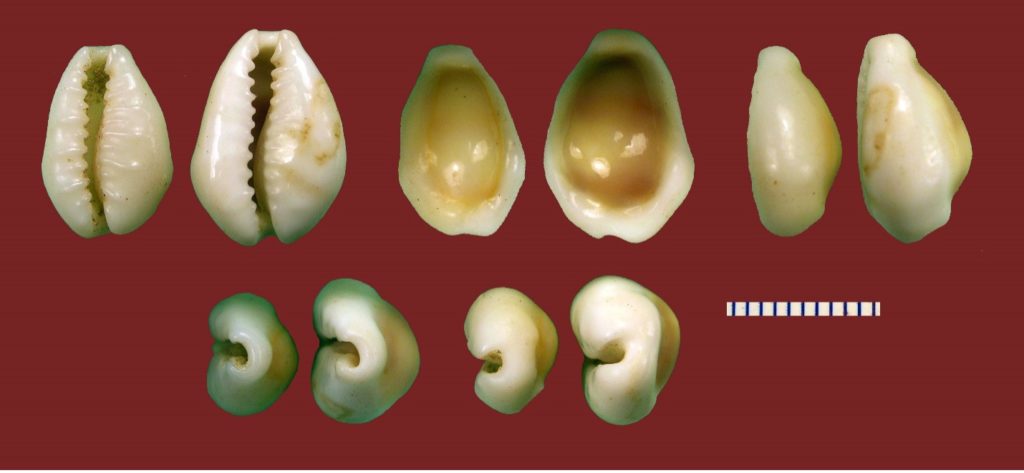
Money Cowries from Christmas Island

Ten Monetaria moneta snail shells from Christmas Island on a red background.
Fig. 1. Monetaria moneta, the money cowry, from Christmas Island. Views from top left: aperture, dorsal, left side, anterior, posterior. Specimen CM 123323 at Carnegie Museum of Natural History. Scale in mm. Photo by T.A. Pearce. 

These Moneteria moneta (Fig. 1), also known as money cowries, are from Christmas Island. They were donated to the museum by Casimir Potyraj, Jr. in September of 2012, although we don’t know when they were collected. These specimens are smaller than average M. monetaria. This species of cowry is used as decoration and was used as currency in many islands of the south Pacific Ocean region into the 1800s. Both the genus and the species names, Monetaria moneta, reflect their use as currency. This species occurs broadly in tropical areas of the Indian and Pacific Oceans, but not in the Atlantic. Monetaria moneta is in the cowry family, Cypraeidae, a group of snails appreciated around the world for their shiny, colorful shells, that look like they have a zipper underneath.

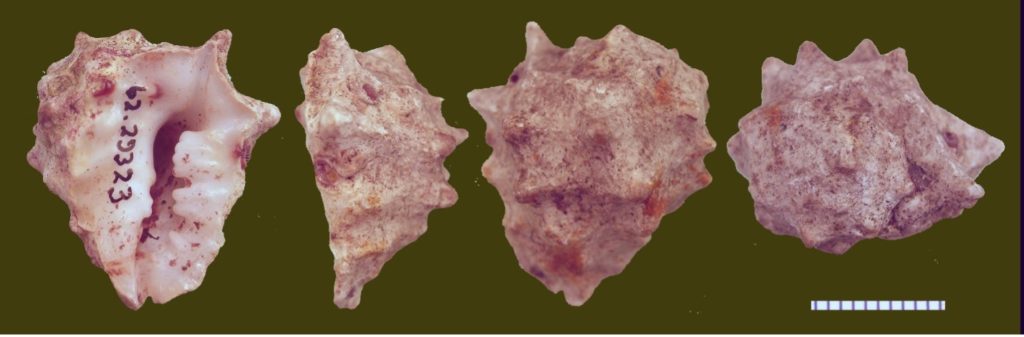
Castor Bean Shells from Christmas Island

Four castor bean shells from Christmas Island on a green background.
Fig. 2. Drupa ricina, the castor bean shell, from Christmas Island. Views from left: aperture, side, dorsal, spire. Specimen CM 62.29323 at Carnegie Museum of Natural History. Scale in mm. Photo by T.A. Pearce. 

This Drupa ricinus (Fig. 2), also known as the castor bean shell, is also a sea snail from Christmas Island. It came to Carnegie Museum of Natural History by way of the British Museum of Natural Science on July 25, 1935. It’s unclear whether that was the date the British Museum gave it to us, or the date it was collected; my guess is the former. Like the Monetaria moneta, Drupa ricinus also occurs broadly in tropical areas of the Indian and Pacific Oceans, but not in the Atlantic. Drupa ricinus is in the murex family, Muricidae, which includes snails that produce the purple dye prized by the Romans and Phoenicians.

Every day is Christmas on Christmas Island! We wish Merry Christmas to all the creatures there.

Timothy A. Pearce, PhD, is the head of the mollusks section at Carnegie Museum of Natural History. Museum employees are encouraged to blog about their unique experiences and knowledge gained from working at the museum.

Related Content

A Perfect Mineral for the Christmas Season

Ask a Scientist: How did snails evolve from living in water to living on land?

Collected on Christmas Eve 1883: Mistletoe

Carnegie Museum of Natural History Blog Citation Information

Blog author: Pearce, Timothy A.
Publication date: December 20, 2021

Share this post!

  • Share on Twitter Share on Twitter
  • Share on Facebook Share on Facebook
  • Share on Pinterest Share on Pinterest
  • Share on LinkedIn Share on LinkedIn
  • Share on Reddit Share on Reddit
  • Share via Email Share via Email

Filed Under: Blog Tagged With: Carnegie Museum of Natural History, mollusks, Science News, Tim Pearce

December 1, 2021 by Erin Southerland

How to Talk with an Extra-Terrestrial Alien? Practice with an Octopus

by Timothy A. Pearce

Despite typical depictions of outer space creatures in movies and on TV, the chance that extra-terrestrial aliens will look like us is vanishingly small, and they are also likely to think and communicate very differently than we do. Most species on Earth communicate with smells (note that most animal species on Earth are insects), while fewer species, including humans, communicate primarily with sight and sound. As far as I know, humans are the only ones on Earth using radio waves to communicate, although radio transmitters and receivers are external to our biological bodies. (Nerds will point out that radio waves and light waves are all part of the electromagnetic spectrum, just pulses of the same phenomenon at different frequencies.) 

illustration of a green creature with big black eyes

If we humans actually made contact with extra-terrestrial alien intelligence, how would we communicate with them? Extra-terrestrial organisms, likely being completely separate instances of life, and potentially evolving under dramatically different temperatures and chemical environments (think cold moons of Jupiter or Saturn where the solvent of life could be liquid hydrocarbons instead of water), might not use smell, sight, or sound as Earth creatures do. They might have very different ways of conveying information. 

I suggest if we want to practice communicating with space aliens, we should look no further than our 8-legged ocean intelligence: the octopus. The octopus is evolutionarily the most different of all the intelligences on Earth. Here, I include in the “intelligence club” organisms such as primates (including humans), cetaceans (dolphins and whales), certain birds (parrots, jays, and crows), and cephalopods (particularly octopus). If you’d like to include other favorite creatures capable of acquiring and applying knowledge, such as elephants, dogs, and horses, well sure, we can include them in the intelligence club. What I want you to notice is that all of them except the cephalopods are vertebrate animals, and all but the birds are mammals. 

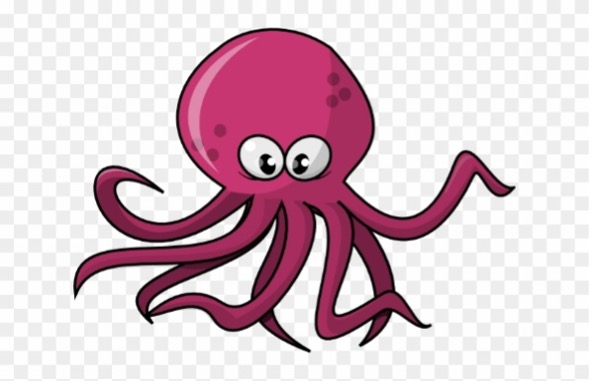
illustration of a maroon octopus

The cephalopods are the most different of all those intelligences. The cephalopod and vertebrate lineages split from each other more than half a billion years ago. Although the common ancestors of the different vertebrate lineages were not likely highly intelligent, something about the vertebrate body plan might have been a precursor for intelligence. If this is the case, we might expect similarities in the different instances of vertebrate intelligence. On the other hand, because cephalopods and their intelligence came from a very different ancient ancestor, it is as different an intelligence as we can find on Earth. To appreciate how different, look up the fundamental difference between protostomes (including octopus) and deuterostomes (including vertebrates).

I suggest that our best chance to practice communicating with space aliens is to practice communicating with octopuses.

One other non-vertebrate I can think of that might be considered for the intelligence club is the jumping spider (family Salticidae, particularly genus Portia), whose intelligent hunting behaviors indicate they can reason and learn. And hey, they have eight legs, just like the octopus. Coincidence? What do you think?

Timothy A. Pearce, PhD, is the head of the mollusks section at Carnegie Museum of Natural History. Museum employees are encouraged to blog about their unique experiences and knowledge gained from working at the museum.

Related Content

Octopus Mystery: How Do They See Color?

Cuttlefish Pass Marshmallow Test

Vampire Squid: Cutest Dracula

Carnegie Museum of Natural History Blog Citation Information

Blog author: Pearce, Timothy A.
Publication date: December 1, 2021

Share this post!

  • Share on Twitter Share on Twitter
  • Share on Facebook Share on Facebook
  • Share on Pinterest Share on Pinterest
  • Share on LinkedIn Share on LinkedIn
  • Share on Reddit Share on Reddit
  • Share via Email Share via Email

Filed Under: Blog Tagged With: mollusks, Science News, Tim Pearce

October 15, 2021 by Erin Southerland

Happy Highsmith Halloween! A review of two scary snail short stories by Patricia Highsmith

by Timothy A. Pearce and Alice W. Doolittle

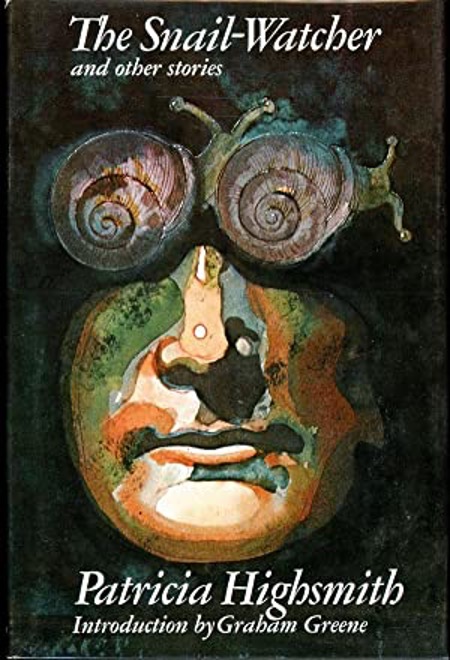
Book cover featuring a face with snails for eyes. Title "The Snail-Watcher and other stories." Author: Patricia Highsmith.

Patricia Highsmith was an accomplished author of thrillers and horror stories from the 1950s to the 1990s. Film buffs might be familiar with Alfred Hitchcock’s Strangers on a Train (1951), which was based on Highsmith’s first novel. The Talented Mr. Ripley (1999), starring Matt Damon, was also based on a Highsmith novel, as was Carol (2015), starring Cate Blanchett.

Highsmith was known to be enchanted with snails. Two short horror stories featuring snails, “The Snail-Watcher” and “The Quest for ‘Blank Claveringi’” are included in her collection The Snail-Watcher and Other Stories (1970, Doubleday, 177pp).

In “The Snail-Watcher,” readers meet Peter Knoppert who finds great delight keeping snails in terraria in his study, and enjoys watching them eat, mate, and reproduce. Scientifically accurate details in the story reflect Highsmith’s own careful observations of snails she kept. The snail population in Knoppert’s study grows rapidly through his diligent care and feeding (the story didn’t mention what the exorbitant weekly lettuce bill must have been) and he adds still more terraria to accommodate the mollusks. One day, after being otherwise occupied for a couple of weeks, Knoppert enters the study to find that the snails have escaped their terraria and are crawling on every surface in the room, including the ceiling. He slips on the slimy mucus and you can guess the gory ending.

In “The Quest for ‘Blank Claveringi,’” scientist Avery Clavering travels to a South Sea island where giant carnivorous snails are rumored to exist. Professor Clavering aims to collect one of this new species and name it after himself. Highsmith did not touch on the fact that among scientists, it is considered tacky to name species after yourself, so it is rarely done in the real world. Still, given Professor Clavering’s arrogant nature, it is believable that he could be egotistical enough to name a species after himself. He doesn’t yet know the genus of the snail, hence the “blank” in the title’s scientific name. He naively dismisses fears of locals from neighboring islands as superstitions, and considers stories of enormous snails to be exaggerations. When he encounters a snail the size of a Volkswagen, however, his plans to take one back alive quickly change. He can easily out-walk the giant beast, but when pursuer becomes the pursued, the slow-motion horror begins. 

It was refreshing to read Highsmith’s accurate anatomical descriptions of the snails: the thousands of teeth in the snail’s radula, the fact that land snails are hermaphrodites, and the descriptions of the snails’ lung being visible within the translucent shell. Even the mention that land snails don’t normally tolerate salt water is accurate, heightening the horror when Professor Clavering learned that the snails on this island did not hesitate to pursue him into the ocean.

So, next time you are in the mood for a thrilling snail horror story, consider one of Patricia Highsmith’s short stories.

Two scary snail jokes for you:

1. Two snails named Gaston and Shelly are telling scary stories. Gaston says, “Psycho Snail isn’t really a snail at all, he is really a hermit slug. He murders snails then wears their shells so he can blend in with other snails and kill again.” Shelly says, “I don’t believe in Psycho Snail.” Gaston says, “You better believe, because *I* am Psycho Snail!” Shelly screams, “Ahhhhh!” Gaston, seeing no reaction, says, “You were supposed to jump and run away in terror.” Shelly says, “I did and I am.”

2. The snail prophet warned that if the snails didn’t behave, the snail God would punish them with a rain of young chickens. Although the snails started behaving only slightly better, the rain of chickens didn’t materialize. One snail said to another, “Phew, looks like we dodged a slug this time!” (I bet you thought I was going to say dodged a pullet!)

Timothy A. Pearce is Curator of Collections and Head of the Section of Mollusks and Alice W. Doolittle is a volunteer in the Section of Mollusks at Carnegie Museum of Natural History. Museum employees and volunteers are encouraged to blog about their unique experiences and knowledge gained from working at the museum.

Related Content

Vampire Squid: Cutest Dracula

The Tell-Snail Heart

Land Snail Webbhelix multilineata Rediscovered Living in Pennsylvania After 72 Years

Carnegie Museum of Natural History Blog Citation Information

Blog author: Pearce, Timothy A.; Doolittle, Alice W.
Publication date: October 14, 2021

Share this post!

  • Share on Twitter Share on Twitter
  • Share on Facebook Share on Facebook
  • Share on Pinterest Share on Pinterest
  • Share on LinkedIn Share on LinkedIn
  • Share on Reddit Share on Reddit
  • Share via Email Share via Email

Share this post!

  • Share on Twitter Share on Twitter
  • Share on Facebook Share on Facebook
  • Share on Pinterest Share on Pinterest
  • Share on LinkedIn Share on LinkedIn
  • Share on Reddit Share on Reddit
  • Share via Email Share via Email

Filed Under: Blog Tagged With: Alice Doolittle, mollusks, Science News, Tim Pearce

August 18, 2021 by wpengine

Diet-wise, Snails are Like Cows, Not Bugs

by Timothy A. Pearce

When classifying organisms into broad categories, many people would group snails with insects rather than mammals. When it comes to diet, however, snails are much more like mammals than insects. That’s because, when choosing what to eat, insects tend to be specialists, while most mammals, and most snails, tend to be generalists. This pattern is especially striking when considering just herbivorous species.

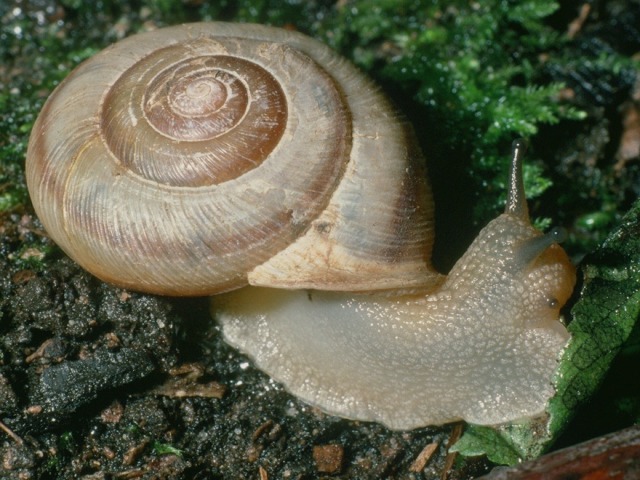
Snail eating a leaf
Webbhelix multilineata snail eating leaf.
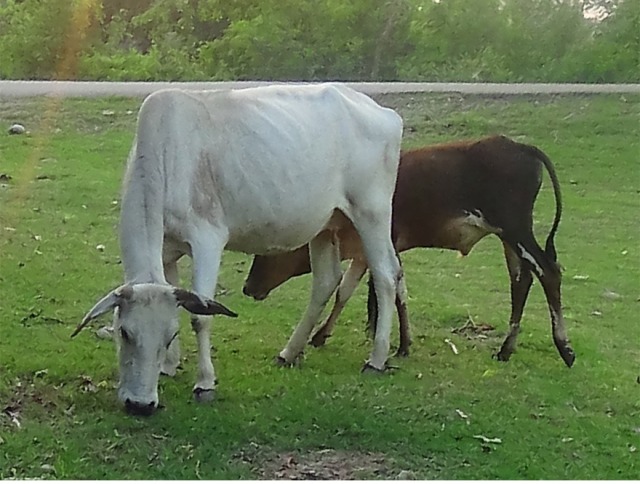
Two cows in a grassy field.
Cows eating grass. Image by Shubham Khatri, from Wikimedia Commons.

Many herbivorous insects specialize on eating one or a few species of plants, and most often within a single plant family. For example, when we think of tent caterpillars, we expect to see them on cherry trees. In the caterpillar life stage of butterflies and moths, 69% of species feed upon just a single family of plants. If you look at just tropical butterflies and moths found within 25 degrees of the equator, the figure rises to 83% (Forister et al. 2015). Herbivorous mammals, on the other hand, tend to be generalists, eating a wide variety of plants from numerous plant families. Snails, it turns out, have broad diets including a variety of plants from numerous plant families, making snails more like mammals than insects, at least in their diets.

Of course, there are exceptions. While most herbivorous mammals are generalists, two mammals are famous diet specialists. Can you think of them? Hint: one eats bamboo, the other eats Eucalyptus leaves. Did you come up with panda and koala? Good for you! Similarly, while most insects are diet specialists, sometimes we do hear about plagues of locusts that have broad diets, so they eat practically every green thing in sight.

Most plants make chemicals that are not directly involved in growth or other metabolic functions. Scientists call these chemicals secondary compounds. In fact, secondary compounds are responsible for many of the distinct aromas and tastes in the spices we rely upon to flavor our cooking. But why would plants bother making secondary compounds that don’t directly benefit the plant? The most common hypothesis for why plants make secondary compounds is to protect the plants from diseases or herbivores.

Herbivores have ways (e.g., enzymes) to detoxify or reduce the effects of plant chemical defenses. Herbivorous insects that specialize on a few related species of plants can, over evolutionary time, develop strategies that effectively detoxify the defenses of those plants. Sometimes co-evolution results, an ongoing process in which the plant will modify its secondary compound to be more toxic, then the insect will develop the ability to detoxify that, and so on. The plant’s arsenal of chemical defenses protects it from the vast majority of herbivorous insects, but not the insects that specialize on that particular plant group. For example, milkweed is fed on by only a very few insects, including monarch butterfly caterpillars, that have countered its defenses.

Caterpillar hanging upside down eating a leaf.
Caterpillar eating leaf. Image by Krishna A. Gopala, from Wikimedia Commons.

In contrast to specialist insect herbivores, mammals tend to eat a wide variety of plant species. Consequently, mammals need general detoxification strategies that will protect them from a variety of plant secondary compounds. Thanks to detoxification enzymes located mostly in our livers and kidneys (Freeland & Janzen 1974), we can enjoy eating a wide variety of tasty plants without being poisoned.

Like herbivorous mammals, herbivorous snails also have general detoxification strategies, which might account for their large livers, where most of the detoxification occurs.

Now you know one way that snails are more like cows than insects: their diet!

Here is a joke about snails eating:

Two snails were munching a tasty salad made with a large number of different plants. One of the snails accidently dropped one of the exotic leaves from the salad. The other snail said, “You can still eat it, use the five-hour rule.”

Timothy A. Pearce is the head of the Section of Mollusks at Carnegie Museum of Natural History. Museum employees are encouraged to blog about their unique experiences and knowledge gained from working at the museum.

Literature Cited

Forister, M.L., Novotny, V., Panorska, A.K., Baje, L., Basset, Y., Butterill, P.T., Cizek, L., Coley. P.D., Dem, F., Diniz, I.R., Drozd, P., Fox, M., Glassmire, A.E., Hazen, R., Hrcek, J., Jahner, J.P., Kaman, O, Kozubowski, T.J., Kursar, T.A., Lewis, O.T., Lill, J., Marquis, R.J., Miller, S.E., Morais, H.C., Murakami, M., Nickel, H., Pardikes, N.A., Ricklefs, R.E., Singer, M.S., Smilanich, A.M., Stireman, J.O., Villamarín-Cortez, S., Vodka, S., Volf, M., Wagner, D.L., Walla, T., Weiblen, G.D. & Dyer, L.A. 2015. Global insect herbivore diet breadth. Proceedings of the National Academy of Sciences, 112(2):442-447; DOI: 10.1073/pnas.1423042112

Freeland, W.J. & Janzen, D.H. 1974. Strategies in herbivory by mammals: the role of plant secondary compounds. American Naturalist, 108(961): 269-289.

Related Content

Eating Shipworms to Save the World

Ask a Scientist: What is the biggest snail?

Cuttlefish Pass Marshmallow Test

Carnegie Museum of Natural History Blog Citation Information

Blog author: Pearce, Timothy A.
Publication date: August 18, 2021

Share this post!

  • Share on Twitter Share on Twitter
  • Share on Facebook Share on Facebook
  • Share on Pinterest Share on Pinterest
  • Share on LinkedIn Share on LinkedIn
  • Share on Reddit Share on Reddit
  • Share via Email Share via Email

Share this post!

  • Share on Twitter Share on Twitter
  • Share on Facebook Share on Facebook
  • Share on Pinterest Share on Pinterest
  • Share on LinkedIn Share on LinkedIn
  • Share on Reddit Share on Reddit
  • Share via Email Share via Email

Filed Under: Blog Tagged With: mollusks, Science News, Tim Pearce

  • « Go to Previous Page
  • Page 1
  • Page 2
  • Page 3
  • Page 4
  • Interim pages omitted …
  • Page 11
  • Go to Next Page »

sidebar

About

  • Mission & Commitments
  • Directors Team
  • Museum History

Get Involved

  • Volunteer
  • Membership
  • Carnegie Discoverers
  • Donate
  • Employment
  • Events

Bring a Group

  • Groups of 10 or More
  • Birthday Parties at the Museum
  • Field Trips

Powdermill

  • Powdermill Nature Reserve
  • Powdermill Field Trips
  • Powdermill Staff
  • Research at Powdermill

More Information

  • Image Permission Requests
  • Science Stories
  • Accessibility
  • Shopping Cart
  • Contact
  • Visitor Policies
One of the Four Carnegie Museums | © Carnegie Institute | Privacy Policy | Terms of Use | Accessibility
Rad works here logo