• Skip to primary navigation
  • Skip to main content
  • Skip to primary sidebar

Carnegie Museum of Natural History

One of the Four Carnegie Museums of Pittsburgh

  • Visit
    • Buy Tickets
    • Visitor Information
    • Exhibitions
    • Events
    • Dining at the Museum
    • Celebrate at the Museum
    • Powdermill Nature Reserve
    • Event Venue Rental
  • Learn
    • Field Trips
    • Educator Information
    • Programs at the Museum
    • Bring the Museum to You
    • Guided Programs FAQ
    • Programs Online
    • Climate and Rural Systems Partnership
  • Research
    • Scientific Sections
    • Science Stories
    • Science Videos
    • Senior Science & Research Staff
    • Museum Library
    • Science Seminars
    • Scientific Publications
    • Specimen and Artifact Identification
  • About
    • Mission & Commitments
    • Directors Team
    • Museum History
  • Tickets
  • Give
  • Shop

Tim Pearce

July 23, 2021 by wpengine

Eating Shipworms to Save the World

by Timothy A. Pearce

Shipworms, which bore into the wood of ships and the pilings of docks have been a menace to mariners for centuries. Recently, however, some sustainable food advocates are pointing to the disreputable creatures as a key to feeding the growing human population.
Black and white illustration of a shipworm.
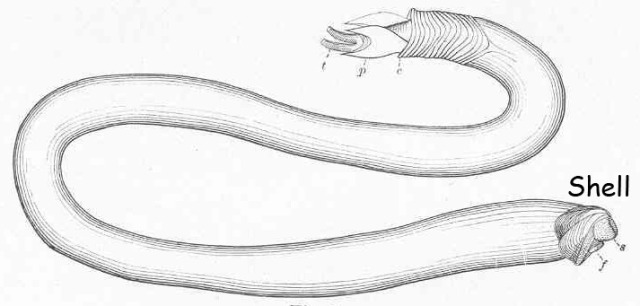
Figure 1. Body of a shipworm showing the tiny shell at the lower right. Image from Wikimedia Commons taken from Goode (1884).

Surprisingly, shipworms are not worms at all, but are a type of clam in the family Teredinidae whose bivalved shells have been reduced to small rasp-like structures at one end of a worm-like body (Fig. 1). Some shipworms grow exceptionally fast, reaching 30 cm (12 inches) in six months. The small shells, which are roughly 5% of the creature’s body length, function as excavators. The shipworm uses the tiny pair to dig into wood, forming a burrow to protect its soft body, and digesting the excavated bits of wood as food. Symbiotic bacteria in the clam’s gills provide the necessary enzymes to digest the wood.
wood damaged by shipworms
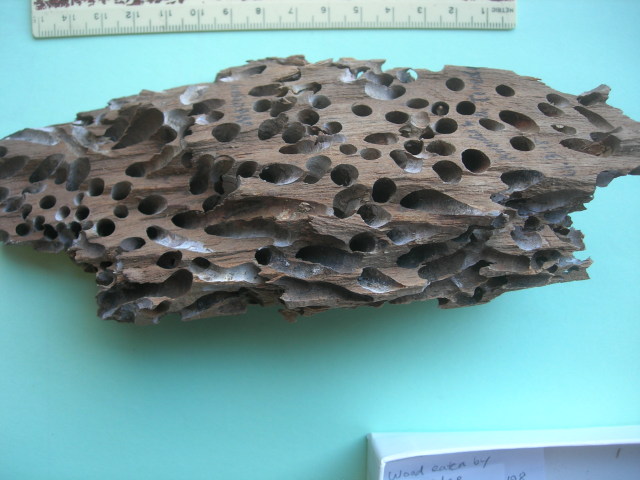
Figure 2. Wood bored by the shipworm Lyrodus pedicellatus. Image by T.A. Pearce.

Sailors and stevedores (dock workers) have battled shipworms over the centuries because the holes created by the tiny mollusks weaken the wood, eventually causing ships to sink and docks to collapse (Fig. 2). Consequently, instead of causing yawns, these boring mollusks caused people to take notice. And while the shipworms’ wood-eating regime continues to plague sea-faring people who rely upon wooden vessels, other people are now taking note for a culinary reason.

From baddy to buddy, from scourge to supper, shipworms are undergoing a reputation transformation. As we look to the future, we see staring back at us both the hungry, growing human population and the threat of climate change. We understand the need to produce more food sustainably, including more protein, while reducing our greenhouse gas emissions. As an alternative to methane-belching cattle, some experts have advised eating sustainable protein sources such as insects and shipworms.

Among the advantages of shipworms as food are their exceptionally fast growth, their ability to thrive on a diet of waste wood or sustainable microalgae, and their high protein and omega-3 fatty acids content. (Willer & Aldridge 2020).

Today, shipworms are eaten primarily in parts of southeast Asia. But because they show great promise as a sustainable protein source, they are being considered for aquaculture to help feed the growing human population. In the not-so-distant future, you might be spicing up your meals by including (not so) boring clams!

Keep clam and carry on.

Timothy A. Pearce is the head of the Section of Mollusks at Carnegie Museum of Natural History. Museum employees are encouraged to blog about their unique experiences and knowledge gained from working at the museum.

Literature Cited

Goode, G.B. 1884. Fisheries and Fishery Industries of the United States: Section I, Natural History of Useful Aquatic Animals, Plates. Washington, DC: Government Printing Office.

Willer, D.F. & Aldridge, D.C. 2020. From pest to profit—the potential of shipworms for sustainable aquaculture. Frontiers in Sustainable Food Systems, 4: 575416. doi: 10.3389/fsufs.2020.575416

Related Content

Cuttlefish Pass Marshmallow Test

Vampire Squid: Cutest Dracula

Ask a Scientist: How did snails evolve from living in water to living on land?

Carnegie Museum of Natural History Blog Citation Information

Blog author: Pearce, Timothy A.
Publication date: July 23, 2021
Share this post!

  • Share on Twitter Share on Twitter
  • Share on Facebook Share on Facebook
  • Share on Pinterest Share on Pinterest
  • Share on LinkedIn Share on LinkedIn
  • Share on Reddit Share on Reddit
  • Share via Email Share via Email

Share this post!

  • Share on Twitter Share on Twitter
  • Share on Facebook Share on Facebook
  • Share on Pinterest Share on Pinterest
  • Share on LinkedIn Share on LinkedIn
  • Share on Reddit Share on Reddit
  • Share via Email Share via Email

Filed Under: Blog Tagged With: mollusks, Science News, Tim Pearce, We Are Nature 2

June 25, 2021 by wpengine

Cuttlefish Pass Marshmallow Test

by Tim Pearce

The club for species that can pass the marshmallow test has recently gotten a new member: the cuttlefish. Cuttlefish are the first invertebrate known to show self-control.

The marshmallow test examines whether an individual has sufficient self-control to use delayed gratification. In the original marshmallow test, a child could have one marshmallow immediately, or if they were able to wait 15 minutes, they received two marshmallows. Some of the 3- to 5-year-old children waited and got the double treat, indicating that they could delay gratification for a larger reward. Other species such as chimpanzees, crows, parrots, and dogs have passed modified versions of the marshmallow test

We humans think we are special. We form clubs in which we initially believe we are the only member, but then other species creep into those clubs. In times past, humans thought they were the only members of the language club and the tool use club, but now we know many other species are in those clubs.

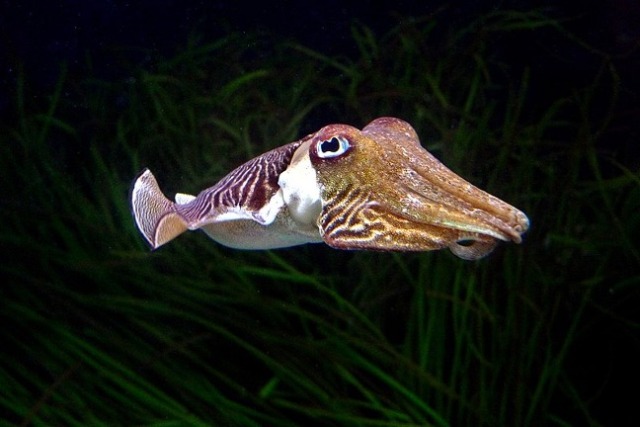
cuttlefish on dark background
Cuttlefish. Image by David Sim, from Wikimedia Commons under the Creative Commons Attribution 2.0 Generic license.

To examine whether cuttlefish could delay gratification for a better reward, researchers (Schnell et al. 2021) offered them an Asian shore crab (a less preferred food) immediately, or a grass shrimp (a more preferred food) if they were able to wait. The food was offered in two chambers with sliding doors. Before the test, cuttlefish were trained to recognize symbols on the doors that indicated if it would open immediately (a circle) or with a delay (a triangle). Most of the cuttlefish waited 50 to 130 seconds to get the more desirable grass shrimp, comparable to time delays shown by chimpanzees and crows.

Some cuttlefish appeared to move their bodies away from the immediate, less preferred reward. Similar behaviors are seen in humans and other animals (e.g., parrots close their eyes, dogs turn away) as they try to resist temptation while waiting for the better reward.

Furthermore, those cuttlefish that waited longest for their favorite foods also performed best during learning tests. Cuttlefish have good memories and can learn from past experiences.

The standard explanation for ability to use delayed gratification, is that it helps animals with long, social lives. This reasoning doesn’t apply to cuttlefish. They live just two years and are not social, so the benefits of delayed gratification to cuttlefish are less obvious. One possibility is that the evolution of self-control in cuttlefish is related to predator avoidance and camouflage; those that can stay camouflaged longer might avoid detection by predators.

Relevant joke:

What is the most affectionate fish in the ocean?

The cuttlefish!

Tim Pearce is the head of the Section of Mollusks at Carnegie Museum of Natural History. Museum employees are encouraged to blog about their unique experiences and knowledge gained from working at the museum.

Reference

Schnell, A.K., Boeckle, M., Rivera, M., Clayton, N.S. & Hanlon, R.T. 2021. Cuttlefish exert self-control in a delay of gratification task. Proceedings of the Royal Society B, Biological Sciences, 288 (1946): 20203161 doi.org/10.1098/rspb.2020.3161.

Related Content

Ask a Scientist: What is the biggest snail?

Water Bears: Why My Yard is Like the Moon

Extremely Rapid Evolution of Cone Snail Toxins

Carnegie Museum of Natural History Blog Citation Information

Blog author: Pearce, Timothy A.
Publication date: June 25, 2021

Share this post!

  • Share on Twitter Share on Twitter
  • Share on Facebook Share on Facebook
  • Share on Pinterest Share on Pinterest
  • Share on LinkedIn Share on LinkedIn
  • Share on Reddit Share on Reddit
  • Share via Email Share via Email

Share this post!

  • Share on Twitter Share on Twitter
  • Share on Facebook Share on Facebook
  • Share on Pinterest Share on Pinterest
  • Share on LinkedIn Share on LinkedIn
  • Share on Reddit Share on Reddit
  • Share via Email Share via Email

Filed Under: Blog Tagged With: mollusks, Science News, Tim Pearce

May 27, 2021 by wpengine

Leaping Slugs! Did that Slug Just Jump?

by Timothy A. Pearce

Some species of slugs and snails can thrash their tail from side to side, twitching with such vigor that the creatures seem to jump. In some cases, they can become airborne briefly. I don’t know whether this behavior can properly be called jumping, but given that slugs are the quintessential slow-moving animals (slugs gave their name to the word sluggish), the vigorous twitching is certainly an un-slug-like behavior.

In contrast to slugs, snails keep their internal organs (guts) within the shell on their back and they have a strong, nimble, muscular foot. Slugs, which evolved from snails, have hollowed out their foot to accommodate their guts, since they no longer have a convenient shell for that purpose. Because the slug’s foot contains the guts, it is no longer as nimble as the foot of a snail.

The transition from snails (with external shells) to slugs (with internal or no shells) goes through an intermediate stage called a semi-slug, in which the animal has an external shell too small to accommodate the body. The guts are partly in the shell and partly in a hump on the semi-slug’s back. In the semi-slug form, the foot is still strong, nimble, and muscular. Many semi-slugs persist around the world today; in the United States, we have one species in the Smokey Mountains and several species in the Pacific Northwest.

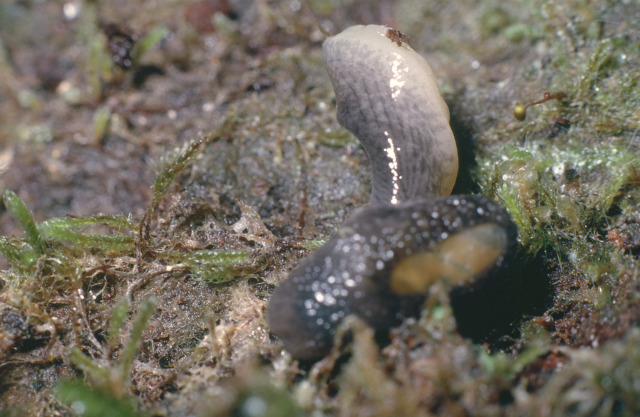
Semi-slug with its body twisted as it thrashes its tail.
Figure 1. Hemphillia semi-slug thrashing its tail so the body flops about (photo: T.A. Pearce).


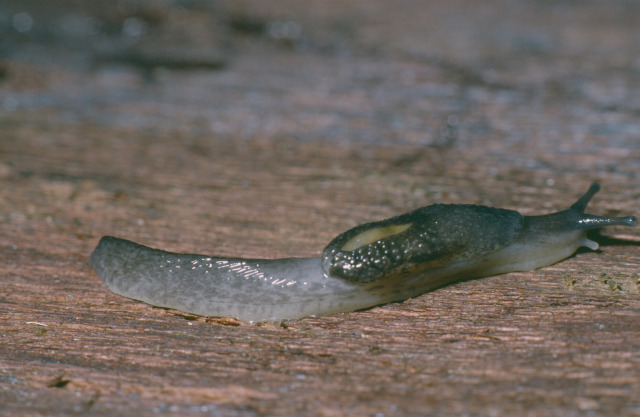
Semi-slug crawling across a piece of wood.
Figure 2. Hemphillia semi-slug crawling in typical slug-like motion (photo: T.A. Pearce).

The semi-slugs in the Pacific Northwest, in the genus Hemphillia, are commonly known as jumping slugs, although they are not commonly seen. The yellowish shell is visible through a slit in the mantle, and the internal organs are contained in a hump on the back. When I have found them, sometimes they will thrash the tail from side to side or twist it into a corkscrew shape and flop about like a fish out of water (Figure 1). In my experience, the Hemphillia slugs will “jump” for a second or two, then they crawl away at a normal slug’s pace (i.e., sluggishly) (Figure 2).

When I was in Madagascar (off the east coast of Africa), I saw a semi-slug of an unknown species on a leaf about a meter above the ground. When I reached to grab the semi-slug, it vigorously thrashed its tail, propelling itself off the leaf and safely into the vegetation below, not to be found.

A jumping snail (Ovachlamys fulgens) originally from southern Japan, arrived in North America in the past few years.The jumping snail sustains its vigorous jumping for a longer period of time than do the Hemphillia jumping slugs I saw in Washington State, and it covers more ground with its antics. See a video of the snail jumping here.

Why do they jump? First, let me say “why” questions are some of the hardest to answer in science. Science can never prove something to be true, we can only prove some things to be false (falsifying). To answer “why,” we try to think of all the possible answers, then set about testing each one, falsifying as many as we can. The remaining possibility (or possibilities) is our best guess at the truth, but we don’t know for sure because we are not guaranteed to have thought of all the possibilities.

The answer to why they jump has not yet been thoroughly studied, but people have speculated. The most common thought is that the slugs and snails likely jump to startle predators. A hungry predator that saw a tasty morsel flopping about might want it for lunch, but when the gastropod stops flopping, the predator might not be able to find it (and meanwhile the slug or snail surreptitiously crawls away). The jumping snails in the video jumped in response to prodding, and the semi-slug on a leaf evaded my grasp by jumping; both consistent with the idea that jumping could be an adaptation against predation.

Why don’t more snails jump? There are way more species of snails than semi-slugs, and although some semi-slugs jump, I am aware of only one snail that jumps. Jumping is therefore more common in semi-slugs than in snails. If jumping is an anti-predator adaptation, and given that the reduced shells of semi-slugs offer less protection from predators, I speculate that semi-slugs benefit from an additional anti-predator strategy.

Here is another mystery that I believe has not been studied: how can these gastropods jump If their mucus sticks them to the substrate? Snails and slugs are famous for their tenacious slime, by which they stick so firmly that they can crawl upside down on the undersides of objects. The answer might be that the jumping species have less slimy mucus, but I suspect that the answer involves variability in the mucus itself. Mucus changes its stickiness depending on how much pressure is applied. That is how snails can move (when they are stuck to the surface). My guess is that the jumping species can rapidly reduce the stickiness of their mucus when it is time to jump.

After the past year, when time sometimes seemed to crawl slowly by, it seems appropriate to write about leaping slugs and snails. And here is a bonus joke:

A jumping slug could jump higher than the Empire State Building.

That’s because the Empire State Building can’t jump.

Tim Pearce is the head of the mollusks section at Carnegie Museum of Natural History. Museum employees are encouraged to blog about their unique experiences and knowledge gained from working at the museum.

Related Content

Ask a Scientist: Are Slugs Just Snails with Their Shells Taken Off?

What’s So Good About Being a Slug?

Ask a Scientist: Can a Snail Mate with a Slug?

Carnegie Museum of Natural History Blog Citation Information

Blog author: Pearce, Timothy
Publication date: May 27, 2021

Share this post!

  • Share on Twitter Share on Twitter
  • Share on Facebook Share on Facebook
  • Share on Pinterest Share on Pinterest
  • Share on LinkedIn Share on LinkedIn
  • Share on Reddit Share on Reddit
  • Share via Email Share via Email

Share this post!

  • Share on Twitter Share on Twitter
  • Share on Facebook Share on Facebook
  • Share on Pinterest Share on Pinterest
  • Share on LinkedIn Share on LinkedIn
  • Share on Reddit Share on Reddit
  • Share via Email Share via Email

Filed Under: Blog Tagged With: mollusks, Science News, Tim Pearce

April 29, 2021 by wpengine

Water Bears: why my yard is like the moon

by Tim Pearce

Water bears, also known as tardigrades or moss piglets, are microscopic animals, famous for being cute and nearly indestructible. Looking a bit like the Michelin Man with eight claw-tipped legs, they can survive extreme highs and lows of temperature and pressure, and ionizing radiation. They are among the few animal groups that can completely dry up into suspended animation, a process called anhydrobiosis, and tardigrades can survive dried up for decades. Tardigrades have even survived in outer space (see “Tardigrade” in Wikipedia for more amazing feats).

Large ones can be 1 mm (1/25 inch) long, but most species are less than half that long. They live in many environments, and can often be found in moss and lichen. I even saw some tardigrades digesting the waste stream during an open house at ALCOSAN, Pittsburgh’s sewage treatment plant.

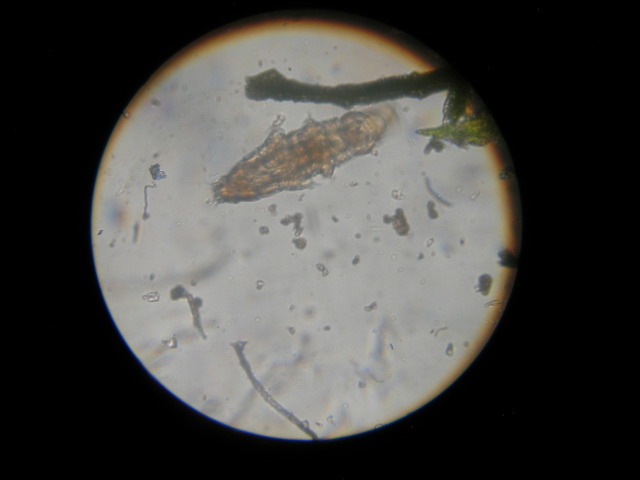
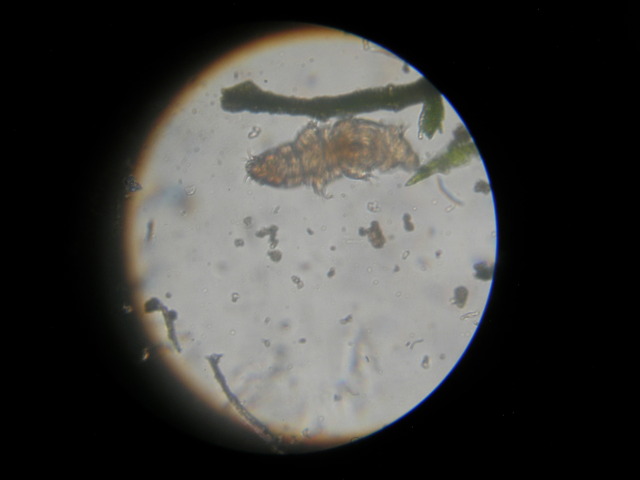
To practice for the 2021 City Nature Challenge, I looked for tardigrades in my back yard. I scraped up a bit of moss, shook it in some water, and then examined the settled material under a microscope. Within a few minutes, I had found the tardigrade illustrated here! I also saw nematodes and rotifers, two other common microscopic organisms. I just checked iNaturalist, and no tardigrades have been reported from Pittsburgh, so mine will be the first!

image of a tardigrade
Two shots of the tardigrade from my back yard in Squirrel Hill, Pittsburgh, 20 Apr 2021. Head is to the right. Animal is 0.6 mm long.

How does finding tardigrades make my yard like the moon? You might remember in 2019 an Israeli lunar probe crashed on the moon. Part of its payload was dehydrated tardigrades, which evidently have been scattered across a section of the lunar surface. My yard is like the moon because they both have tardigrades!

Examining the world of the small can yield big contributions. I encourage you to participate in the City Nature Challenge, and pay attention to tiny things.

Tim Pearce is the head of the mollusks section at Carnegie Museum of Natural History. Museum employees are encouraged to blog about their unique experiences and knowledge gained from working at the museum.

Related Content

Naturally Pittsburgh: Big Rivers and Steep Wooded Slopes

Go For a Color Walk

Evidence Counts for Absent Creatures – City Nature Challenge

Carnegie Museum of Natural History Blog Citation Information

Blog author: Pearce, Timothy
Publication date: April 29, 2021

Share this post!

  • Share on Twitter Share on Twitter
  • Share on Facebook Share on Facebook
  • Share on Pinterest Share on Pinterest
  • Share on LinkedIn Share on LinkedIn
  • Share on Reddit Share on Reddit
  • Share via Email Share via Email

Filed Under: Blog Tagged With: City Nature Challenge, mollusks, Science News, Tim Pearce

February 9, 2021 by wpengine

For Some Snails, Reproduction is a Jab Well Done

Some land snails possess darts in their reproductive systems. During courtship, one or both partners jab the other partner with the dart, which some observers have likened to Cupid’s arrow. If the dart misses or otherwise fails to stab the partner, then courtship and mating stop, unfinished. And we’re not talking about tiny darts; in one species the dart is a fifth the length of the creature’s body!

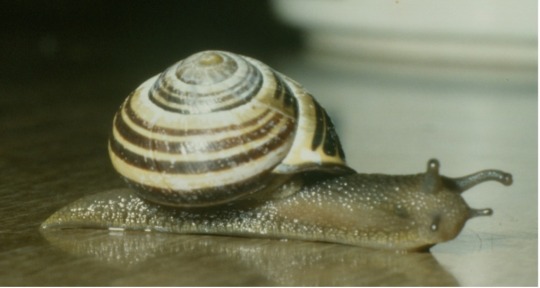
Dart-bearing (not shown) hermaphroditic snail, Cepaea nemoralis (family Helicidae). Shell ca 2 cm diam. 

In those species studied, the dart appears to deliver hormones into the partner to increase the chance of paternity. Most land snails are hermaphrodites (both male and female within one individual). During mating, sperm enters the partner’s copulation pouch, which is not a safe haven because digestive processes begin! The hormones help the sperm escape that pouch so they can find their way to the fertilization chamber.

Note that in these land snails, the dart is used during courtship before copulation. These land snails are not using the dart to transfer sperm, a behavior known as traumatic insemination in some other creatures such as saccoglossans (relatives of sea slugs), some flatworms, and bed bugs.

Dart-bearing snails that you might know include the escargot snails (family Helicidae), the large native snails in southwestern USA (Xanthonychidae), and some of the large native slugs of eastern North America (Philomycidae). Note that the Polygyridae, the larger land snails in eastern North America, lack a dart.

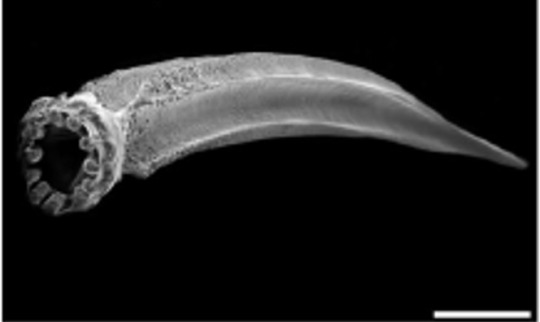
Love dart of Cepaea hortensis. Scale bar is 0.5 mm. Image from Wikimedia Commons, from Koene & Schulenburg (2005).

The dart is formed in a structure called a dart sac, and after the dart is used, a new one grows after about a week. While many species have a single dart sac, some snail groups possess two, four, or even more dart sacs, so presumably they can mate again without waiting for the single dart to re-grow.

A mystery: most groups of land snails lack darts in the reproductive system, although multiple, relatively un-related groups of snails possess darts. Two explanations exist for this diversity of having or lacking darts: (1) the ancestor of all land snails possessed a dart, and then evolutionarily the dart was lost in most groups, or (2) the ancestor lacked a dart, and then a dart was acquired independently in multiple lineages.

Some snail biologists favor the ancestral dart idea, although others (e.g., Tompa 1980) favor the independent origin idea. I like the independent origin idea because of dramatic differences among darts: in some groups, the dart is made of calcium carbonate, in others it is chitin, and in still others it is cartilaginous. I hold that in evolution, it is sometimes easier to start over from scratch than to change fundamental building materials. Nevertheless, most snail biologists agree that the ancestor to the superfamily Helicoidea, which contains the familiar escargot snails, had at least one dart (e.g., Schileyko 1989), but whether it was one dart that proliferated into multi-dart forms or vice versa remains unresolved.

One way to solve this mystery could be to examine molecular processes used in forming and deploying the dart. If all dart-possessing land snails use similar biochemical pathways to form and deploy their darts, those similarities would be consistent with the ancestral dart idea. On the other hand, if love darts of different groups rely on different biochemistry to form and deploy, that would suggest multiple independent origins of darts, with their apparently similar shapes and functions being due to convergent evolution.

Meanwhile, snails continue reproducing, and for those that use a dart, I say, “A jab well done!”

References

Koene, J.M. & Schulenburg, H. 2005. Shooting darts: co-evolution and counter-adaptation in hermaphroditic snails. BMC Evolutionary Biology 5(25): 13 pp. https://doi.org/10.1186/1471-2148-5-25

Schileyko, A.A. 1989. Taxonomic status, phylogenetic relations and system of the Helicoidea sensu lato (Pulmonata). Archiv für Molluskenjunde 120: 187-236.

Tompa, A.S. 1980. The ultrastructure and mineralogy of the dart from Philomycus carolinianus (Pulmonata: Gastropoda) with a brief survey of the occurrence of darts in land snails. Veliger 23: 35-42.

Tim Pearce is the head of the mollusks section at Carnegie Museum of Natural History. Museum employees are encouraged to blog about their unique experiences and knowledge gained from working at the museum.

Related Content

Ask a Scientist: Are slugs just snails with their shells taken off?

Nerding Out Over Masting, or Why Unusual Plant Reproduction Excites Animal Ecologists

The Story of a Beetle, a Dolphin, and Some Remarkable Genitalia

Filed Under: Blog Tagged With: mollusks, Science News, snails, Tim Pearce

October 27, 2020 by wpengine

Clams in the Concrete! How Old is this Sidewalk?

Mollusk shells persist long after the death of the soft-bodied animals whose secretions formed the protective covers. These sturdy remains can inform us about species living in an area at that time. Many mollusks occur in specific habitats and during certain time periods in Earth’s history. When we find mollusks in sediment with dinosaur bones, for example, we receive a clue about the geologic age and habitat in which those dinosaurs lived. When mollusks first appear in an area, deposits containing their shells allow us to estimate when events in Earth’s history occurred, including archaeological events, or even relatively recent construction projects.

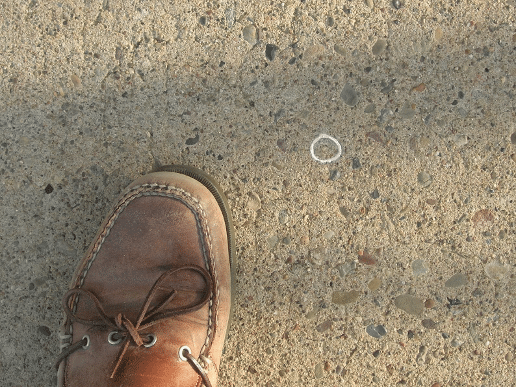
This morning as I walked across the Panther Hollow bridge near Carnegie Museum of Natural History in Pittsburgh, Pennsylvania, I noticed clam shells in the concrete of the sidewalk. What can the presence of these clam shells tell me about how long that sidewalk has been there?

tip of boat shoe on sidewalk near clam shell for scale
clam shell embedded in concrete
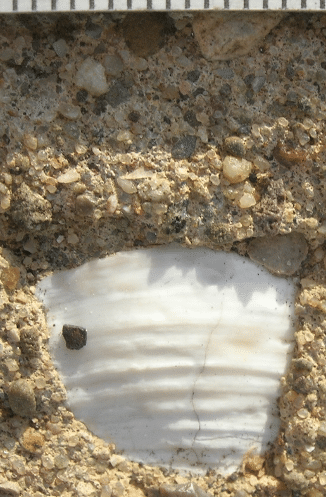
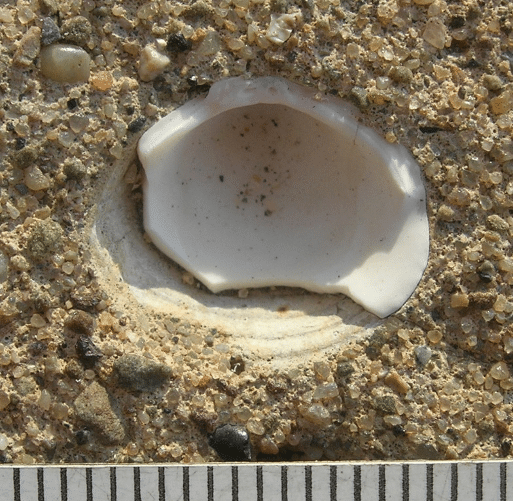
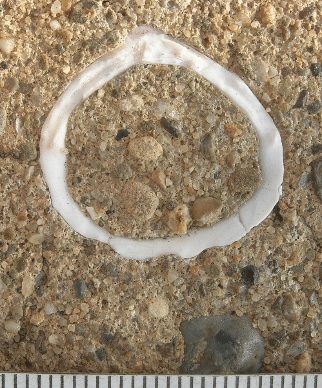
Top: Clam shell in sidewalk on Panther Hollow Bridge. Bottom: Close-up of clam shell, inside view. Scale in mm.

Concrete is a mixture of cement with sand and gravel. When sand and gravel are taken from rivers, this natural resource sometimes contains clam shells. I believe the clam shells in this sidewalk were scooped up along with the sand and gravel to make the concrete. Then after the sidewalk was poured, but before it fully hardened, the clam shells floated to the upper surface.  

As an aside, information about comparative densities is instructive here. Two common crystal forms of calcium carbonate are calcite and aragonite, which have different densities (calcite 2.71g/cc, aragonite 2.93). Most mollusks form shells of aragonite. However, shells are not pure aragonite, containing small amounts of protein and other substances, so clam shells can have densities around 2.5-2.6. In comparison, the density of quartz, which makes up much of the sand used in making concrete, is 2.65. The clam shells are slightly lighter than the sand, which probably explains why they floated up to the sidewalk surface.

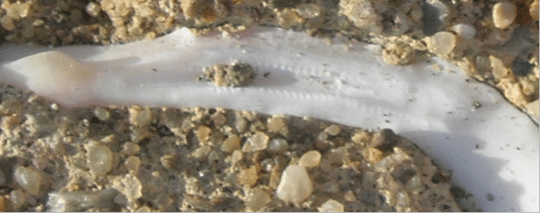
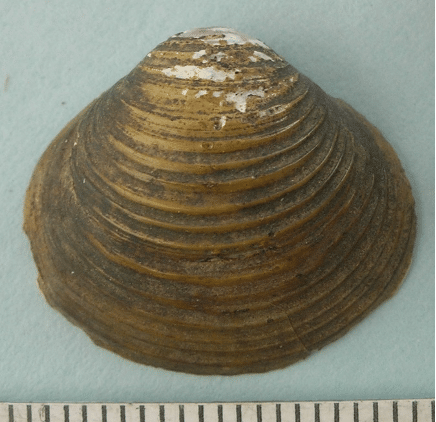
I identified these clam shells as Corbicula fluminea (common name: the Asian clam). They have the characteristic shape and size, the outside has strong regular growth ribs, and on the inside, the lateral teeth bear minute serrations. This species was first recorded in North America in British Columbia about 1924. As an invasive species, it has spread, through human activity, to at least 46 US States.

clam shell embedded in concrete
broken clam shell embedded in concrete
close up of clam shell embedded in concrete
Top: Outside view of clam showing strong ribs. Middle: Partly broken clam, inside view showing external rib impressions in concrete below. Bottom: Close-up of clam’s lateral teeth showing minute serrations. Scale in mm.

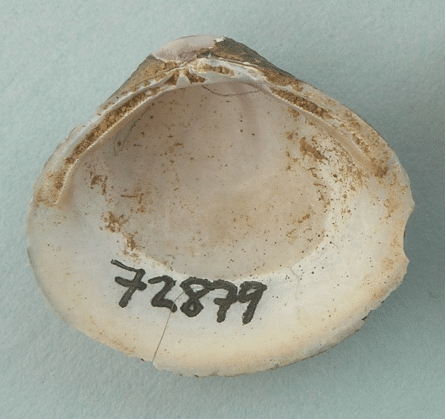
When did the species appear in southwestern Pennsylvania? There is a record of Corbicula fluminea in 1979 from the Ohio River just downstream from Pittsburgh and another in Greene County, southwestern Pennsylvania from 1981. Museum records of this species became more common after about 1993, suggesting that the clam probably became more common about then.

clam shell labeled with numbers 72879
top of clam shell on blue background
Corbicula fluminea collected in 1993 from Loyalhanna Creek, Southwestern Pennsylvania. Top: inside of shell. Bottom: outside of shell showing strong ribs. Scale in mm.

Consequently, I conclude that the Corbicula fluminea-containing concrete sidewalk on the bridge next to Carnegie Museum must have been poured after the late 1970s, and possibly after 1993, when the clam became abundant in freshwater of western Pennsylvania, the region where Pittsburgh is located.

Museum collections provide useful information about when non-native species arrived in an area. Now you know that one of the many uses of mollusks is estimating ages of things.

Although some people might think of clams as an abstract concept, here is an example of clams in the concrete!

Timothy A. Pearce, PhD, is the head of the mollusks section at Carnegie Museum of Natural History. Museum employees are encouraged to blog about their unique experiences and knowledge gained from working at the museum.

Related Content

Ask a Scientist: What is the biggest snail? 

Stalking the Freshwater Sponges of Western Pennsylvania

A Day at the Beach: The Anthropocene on Vacation

Filed Under: Blog Tagged With: Anthropocene Living Room, Science News, Section of Mollusks, Tim Pearce

  • « Go to Previous Page
  • Page 1
  • Page 2
  • Page 3
  • Page 4
  • Page 5
  • Interim pages omitted …
  • Page 11
  • Go to Next Page »

sidebar

About

  • Mission & Commitments
  • Directors Team
  • Museum History

Get Involved

  • Volunteer
  • Membership
  • Carnegie Discoverers
  • Donate
  • Employment
  • Events

Bring a Group

  • Groups of 10 or More
  • Birthday Parties at the Museum
  • Field Trips

Powdermill

  • Powdermill Nature Reserve
  • Powdermill Field Trips
  • Powdermill Staff
  • Research at Powdermill

More Information

  • Image Permission Requests
  • Science Stories
  • Accessibility
  • Shopping Cart
  • Contact
  • Visitor Policies
One of the Four Carnegie Museums | © Carnegie Institute | Privacy Policy | Terms of Use | Accessibility
Rad works here logo