• Skip to primary navigation
  • Skip to main content
  • Skip to primary sidebar

Carnegie Museum of Natural History

One of the Four Carnegie Museums of Pittsburgh

  • Visit
    • Buy Tickets
    • Visitor Information
    • Exhibitions
    • Events
    • Dining at the Museum
    • Celebrate at the Museum
    • Powdermill Nature Reserve
    • Event Venue Rental
    • Gift Cards
  • Learn
    • Field Trips
    • Educator Information
    • Programs at the Museum
    • Bring the Museum to You
    • Guided Programs FAQ
    • Programs Online
    • Climate and Rural Systems Partnership
  • Research
    • Scientific Sections
    • Science Stories
    • Science Videos
    • Senior Science & Research Staff
    • Museum Library
    • Science Seminars
    • Scientific Publications
    • Specimen and Artifact Identification
  • About
    • Mission & Commitments
    • Directors Team
    • Museum History
  • Tickets
  • Give
  • Shop

Tim Pearce

May 28, 2020 by Erin Southerland

Carnegie Museum of Natural History Partners with TikTok to Create Educational Videos

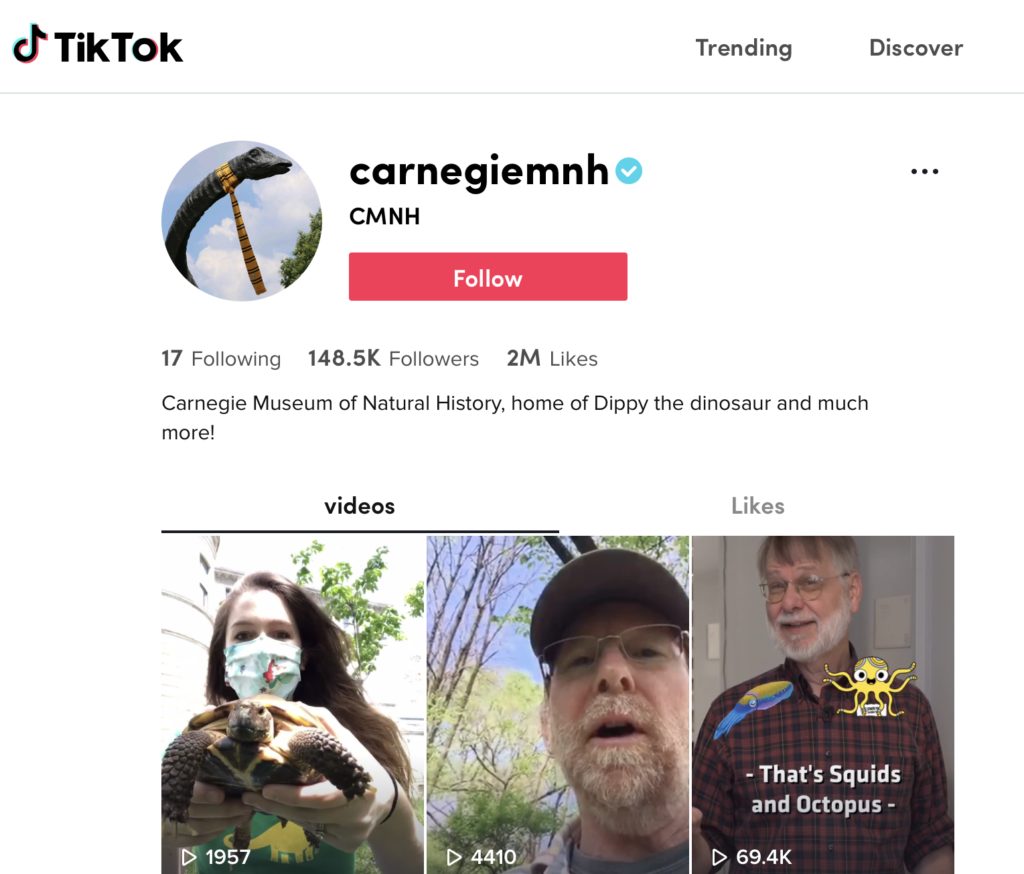
screenshot of @carnegiemnh TikTok account

Carnegie Museum of Natural History announces a partnership with TikTok as part of the Creative Learning Fund, a program designed to populate the social media platform with accessible and educational short-form mobile videos. The grant is a part of TikTok’s $50M investment to bring more learning content to the platform. 
 
Carnegie Museum of Natural History’s marketing team launched its TikTok account on January 6, 2020 with a snail joke from curator of mollusks Tim Pearce, who quickly became a TikTok icon (or “shell-ebrity” as Pearce says). Over the past five months, its following has grown from zero to over 148,500 with over 8 million video views and 2 million likes. The weekly snail jokes for #MolluskMonday are follower favorites, but the museum also posts videos featuring other staff, including scientists, with live animals and scientific specimens. 

@carnegiemnh

Happy molluskmonday. Hope you’re hungry! #naturalhistorymuseum #snail #fyp

♬ original sound – CMNH

“I’m amazed (and pleased) that so many people are enjoying the snail jokes. I hope they are educational, too, and consciousness raising, and that they help people be more aware of these often-overlooked creatures with whom we share the planet,” said Pearce. “All you snail TikTok fans are helping me with my plan to make snails more popular than football!”

Recently, Mary R. Dawson Associate Curator of Vertebrate Paleontology Matt Lamanna has begun to build a fan base of his own with dinosaur facts filmed from home and a visit to check on the museum’s signature dinosaur, Dippy, short for Diplodocus carnegii. With this new partnership, the museum is excited to build on existing success to introduce TikTok users from around the world to the museum’s experts and educators.

“Carnegie Museum of Natural History’s goal is to be as relevant as possible to our growing audiences,” said Sloan MacRae, director of marketing, whose team creates most of the museum’s digital content. “One obvious path to relevance is access, and that means producing content that is digestible and appealing. It also means reaching audiences where they physically are, namely glued to their screens amid the pandemic. I’m especially proud that we’re entering this partnership with TikTok now, when demand for digital educational content is so high for individuals and schools alike.”

“While TikTok has always provided users with an outlet for creative expression and fun, wholesome, light-hearted content during these unprecedented times, we’ve seen our community gravitate toward an even more enriching experience on the platform,” said Bryan Thoensen, Head of Content Partnerships, TikTok U.S. “Last month, we announced the formation of our $50 million Creative Learning Fund to bring more informative, instructional, motivational and even inspirational content to TikTok. We’re excited to share that we’ve partnered with over 800 leading creators, public figures, media publishers, educational institutions, nonprofit organizations, and real users affected by COVID-19 to make that mission a reality. We can’t wait to be inspired by the creative ways the TikTok community comes together to #LearnOnTikTok.”

The museum’s partnership videos launched on May 13, 2020. Visit TikTok.com/@CarnegieMNH to see them. 

About TikTok

TikTok is the leading destination for short-form mobile video. Their mission is to inspire creativity and bring joy.
Filed Under: Uncategorized Tagged With: Tim Pearce

April 8, 2020 by wpengine

The Largest Snail I Have Ever Seen

An inquiry came in (with the subject line: urgent snail question) asking, “How big is the biggest snail you’ve ever seen?” Thinking that others might be interested, here is my answer.

The largest snail? There could be many ways of answering that question. Size could refer to length, diameter, volume, or mass. The longest mollusk I have seen is the giant squid on display at the Smithsonian, but that is a cephalopod, not a snail, and it doesn’t have a shell. The largest shell I have seen is a fossil ammonite that was more than 2 meters in diameter, but that is also a cephalopod, not a snail, and maybe fossils are not acceptable for this answer.

The largest modern shell I have seen is that of a giant clam, but that is a bivalve, not a snail. The largest bona fide snail I have seen could be the snail in the Dr. Dolittle movie that carried Dr. Dolittle under the sea, but movies don’t always depict reality (sorry), so maybe that one doesn’t count. Another large snail I read about is a fossil sea snail from the Eocene Epoch (34-56 million years ago) called Campanile giganteum, which grew up to 1 meter long (Houbrick, 1984). But I haven’t actually seen one, which is really what you asked, and maybe you don’t want to include fossils.

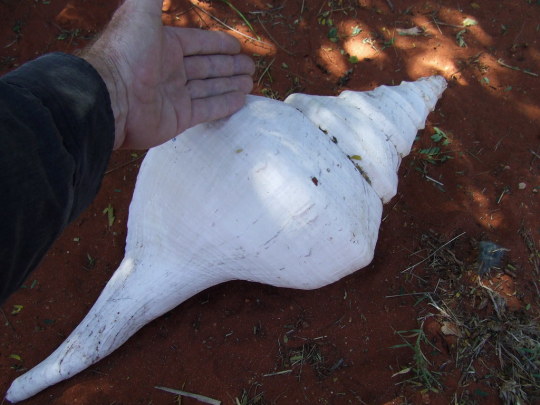
Real answers start here. I would have to say the largest modern snail shell I have seen is that of the Australian sea snail Syrinx aruanus (which gets up to 91 cm long). The two largest shells of that species I have seen are at the Delaware Museum and the Philadelphia Academy, both of which were shorter than 91 cm; I didn’t measure them, but my memory suggests they were probably 65 to 75 cm long, which is pretty big for a snail! Given that slugs are also snails (gastropods), there are reports of slug-like sea hares (family Aplysiidae) whose bodies can get nearly a meter long, but the longest one I ever saw was around 25 cm long, so the Syrinx still wins for what I have seen. Another way to answer your question about largest is not longest but instead greatest volume. For that, the sea snail Melo melo might have the greatest volume (although it’s possible a large Syrinx might also win at volume, I’m not sure).

image

Syrinx auruanus by Bill & Mark Bell is licensed under CC BY-NC-SA 2.0 .

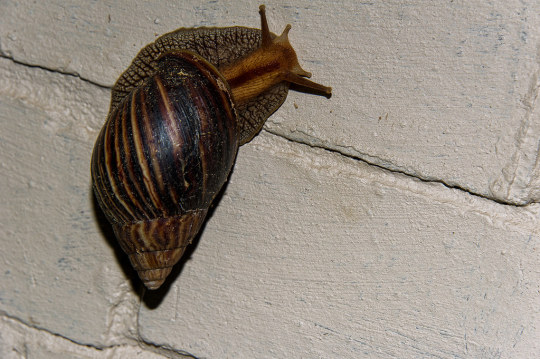
Then again, given that my specialty is land snails, you might be asking about the largest land snail I have seen. That would be the giant African snails in the family Achatinidae. I have seen plenty of living Achatina fulica, with shells up to about 12 cm, but I have seen shells of larger species, such as Achatina achatina and Archachatina marginata. Note that we do have some large snails native to South America in the family Strophocheilidae (including a very large extinct one), but the giant African snails are larger.

image

Giant african land snail by Steve Slater (used to be Wildlife Encounters) is licensed under CC BY 2.0 . Shell estimated to be 10-15cm (4-6 inches) long.

Or maybe today is opposite day and you are really asking about the smallest snail I have seen. Although I do know about a minute sea snail, Ammonicera minortalia, at 0.4 mm diameter reported to be the smallest snail in the United States (Bieler & Mikkelsen 1998), I have never seen one. If you mean land snails, I recall that Wenz (1938-1944) reported some land snails in the family Diplommatinidae to be 0.5 mm, although I have not seen any Diplommatinidae that small, and I wonder if Wenz was reporting shell diameter rather than maximum dimension (most Diplommatinidae are taller than wide). (On the subject of narrow snails, I have seen the minute Carychium nannodes, which is only 0.4 mm diameter, but it is about 1.4 mm tall.) I do know some tiny snails from east Asia got a lot of press a few years ago for being able to fit into the eye of a needle (Páll-Gergely et al. 2015), and at 0.8 mm in greatest dimension, they are certainly minute, but again, I have never seen one.

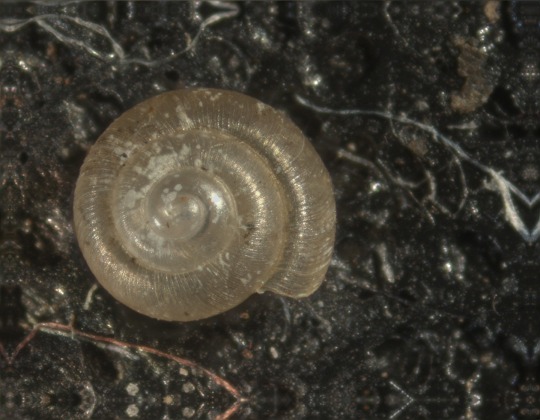
The smallest adult land snails I have seen are either Punctum minutissimum or Guppya sterkii, both on the order of 1 mm diameter. Of course, their babies are even smaller, and I have seen babies of both those species, especially of P. minutissimum. Amazingly, Punctum minutissimum appears to be one of the most abundant land snails in northeastern North America, but it is rarely noticed due to its minute size.

image

Punctum minutissimum. Shell 1 mm (1/25 inch) diameter. 

To recap (and more directly answer your question), the largest snail shell I have seen is Syrinx aruanus, the largest land snail shell I have seen is one of the giant African land snails, the largest living land snail I have seen is Achatina fulica, and the smallest land snail I have seen is babies of Punctum minutissimum.

Timothy A. Pearce, PhD, is the head of the mollusks section at Carnegie Museum of Natural History. Museum employees are encouraged to blog about their unique experiences and knowledge gained from working at the museum.

References

Bieler, R. & Mikkelsen, P.M. 1998. Ammonicera in Florida: notes on the smallest living gastropod in the United States and comments on other species of Omalogyridae (Heterobranchia). The Nautilus 111(1): 1-12.

Houbrick, R.S. 1984. The giant creeper, Campanile symbolicum Iredale, an Australian relic marine snail. In: Eldredge N. & Stanley S.M. (eds.), Living Fossils. Casebooks in Earth Sciences. Springer-Verlag, New York.

Páll-Gergely, B., Hunyadi, A., Jochum, A. & Asami, T. 2015. Seven new hypselostomatid species from China, including some of the world’s smallest land snails (Gastropoda, Pulmonata, Orthurethra). ZooKeys 523: 31–62. doi: 10.3897/zookeys.523.6114.

Wenz, W. 1938-1944, Gastropoda, Teil 1, Allgemeiner Teil und Prosobranchia. In: Schindewolf, Handbuch der Palaozoologie, v. 6. Borntraeger, Berlin. vii + 1639 p.

Filed Under: Blog Tagged With: mollusks, Museum from Home, Science News, Tim Pearce

March 9, 2020 by wpengine

How to Wear Your Shell: Snail vs. Monoplacophoran

Do you wear your baseball cap with the brim in front or in the back? For some headgear, the orientation matters, for example, a football helmet worn in non-standard orientation might hinder your ability to see.

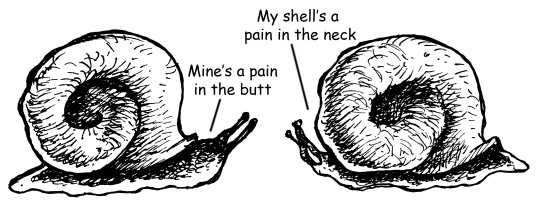
In most snails (gastropods), the shell coils over the tail. In some other mollusks, the shell coils over the head.

Torsion is a feature of all snails. Torsion is a 180° twisting of the head-foot with respect to the shell and internal organs, early in development. Torsion results in the anus being over the head (snails are real poop heads!). Why snails are torted remains a biological mystery, but a common hypothesis is that torsion also brings the gills and sensory organs to the front, and the anus just came along for the ride.

Snails have muscles that attach their bodies to the inside of their shells. Snails tighten these muscles to pull the body into the shell. A consequence of torsion is that the muscle scars (where muscles attach to the shell) are asymmetrical.

Monoplacophorans are a class of mollusks like snails except they do not undergo torsion. The lack of torsion means the shell coils over the head (in those having coiled shells). Furthermore, the muscle scars on their shells are symmetrical. Few monoplacophorans survive today, but they were more plentiful millions of years ago.

When I see snails in the funny pages in the newspaper, I notice that the cartoonists drew the shells in the standard orientation about half the time (50%, or random chance). When you see a cartoon snail with its shell in a non-standard orientation, you might wonder if it is really a monoplacophoran?

Next time you put on your baseball cap, think about how snails wear their shells, and remember the famous baseball snail: Slicky Mantle – he was quite a slugger – you should see him slide into home plate!

Cartoon mollusks with shell oriented as gastropod (left) and monoplacophoran (right). Illustration by Geoff Weber.

Timothy A. Pearce, PhD, is the head of the mollusks section at Carnegie Museum of Natural History. Museum employees are encouraged to blog about their unique experiences and knowledge gained from working at the museum.

Filed Under: Blog Tagged With: mollusks, Science News, Tim Pearce

February 10, 2020 by wpengine

Land Snail Webbhelix multilineata Rediscovered Living in Pennsylvania After 72 Years

Imagine the excitement of finding an organism that was presumed extinct. Until 2019, the handsome land snail Webbhelix multilineata had not been documented anywhere in Pennsylvania since 18 May 1947 so it was presumed locally extinct (it does still survive elsewhere in the Mid-West). Finding a living individual of that species in Pennsylvania this year is cause for excitement.

Webbhelix multilineata has never been an abundant snail in Pennsylvania. Of 10 museum records of that species in PA, all but one is in western Pennsylvania from 1898 to 1947. The one record from eastern Pennsylvania, in Berks County, was collected about 1938.

Fig. 1. Webbhelix multilineata juvenile found in York County in 2019 (photo: Kerry Givens).

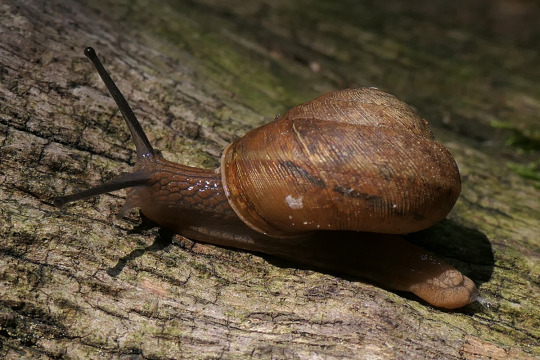
Photographs of an immature Webbhelix multilineata in Hellam Hills Natural Area in York County, Pennsylvania were sent to me on 2 Jun 2019 (Fig. 1). I recognized the species by the reddish spiral lines on the shell and by the relatively large, reddish body tubercles. This sighting is the first record in 72 years of Webbhelix multilineata anywhere in Pennsylvania, and it represents a new county record as well.

Curiously, this snail was seen in the relatively dry habitat of a mature deciduous forest, at least 150 m from the nearest stream. Five scientific publications indicate its habitat to be low, moist areas including floodplains, marshes, and swamps. I wonder why the York County snail is from such a different habitat.

Because this snail is now known to be living in Pennsylvania, it can no longer be considered locally extinct, so conservation organizations such as the Natural Heritage Program will monitor it. Although there is no evidence that the snail population recovered (as opposed to just being overlooked), I like to think that conservation efforts have played a role in improving conditions for this snail.

I am grateful to Kerry Givens for noticing and photographing the snail, and for alerting me to its existence.

Timothy A. Pearce, PhD, is the head of the mollusks section at Carnegie Museum of Natural History. Museum employees are encouraged to blog about their unique experiences and knowledge gained from working at the museum.

Filed Under: Blog Tagged With: mollusks, Science News, Tim Pearce

October 29, 2019 by wpengine

Tornadoes, Snails, and Sample Sizes

woman collecting snail species specimens
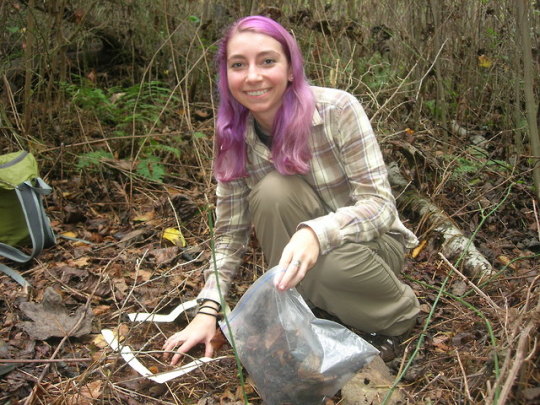
Abbey collecting snails after braving unkind vegetation. Photo by Tim Pearce.

In 2012, a tornado felled trees in four places at Carnegie Museum’s field station, Powdermill Nature Reserve in southwestern Pennsylvania, about 1-hour drive East of Pittsburgh. Each blowdown was 3-6 ha (8-15 acres), within 3 km (2 miles) of each other. These blowdowns provide natural replicates to examine land snail response to habitat change. Given that some snail species are known to occur in forests and others in meadows, we might expect the snail species composition to shift when the wind turns part of a forest into a meadow.

Samples taken in 2016 showed differences in snail species community composition between the blowdown areas and the adjacent, intact forest. However, other statistical tests did not show differences that were significant, but they were nearly significant.

A good scientist should readily accept “no difference” when statistical results show that the differences are not significant. However, when the differences are tantalizingly close to significant, one might wonder whether “no difference” is real, or if a larger sample size might have demonstrated a significant difference.

So, we sampled again this year and took more samples. We are still processing the samples, so results are not in yet, but with the larger sample size, we will accept “no difference” if that is what the statistics tell us.

In the photo, Abbey is collecting leaf litter (containing snails) at the Laurel Run blowdown. The sample she collected contained 23 snails, of five species: Glyphyalinia indentata, Punctum minutissimum, Striatura ferrea, Striatura milium, and Zonitoides arboreus.

Timothy A. Pearce, PhD, is the Head of the Section of Mollusks and Abbey Hines is a Gallery Experience Presenter at Carnegie Museum of Natural History. Museum employees are encouraged to blog about their unique experiences and knowledge gained from working at the museum.

Filed Under: Blog Tagged With: land snails, mollusks, Powdermill Nature Reserve, snails, Tim Pearce

September 18, 2019 by wpengine

Is It a New Species? Wish They All Could Be California Snails

Discovering a new species is exciting but determining whether it’s a new species can take some doing.

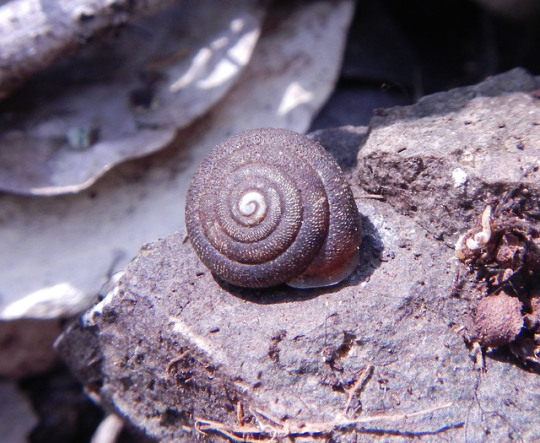
photo of possible new Trilobopsis species snail
Fig. 1. Trilobopsis species from Santa Cruz Island. Note scale-like hairs on shell. Diameter approximately 8 mm (1/3 inch). (Photo by T. Pearce)

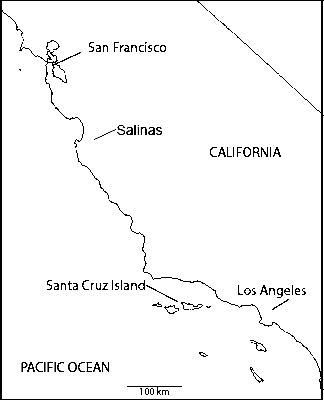
During our project on land snails in the California Borderlands, team member Jeff Nekola discovered a population of the land snail genus Trilobopsis on Santa Cruz Island (Fig. 1). That genus does not occur on any other California Channel Islands; in fact, the closest known mainland locality for that genus is 335 km (210 mi) north in the Salinas Area. We recognize that conditions on the northern Channel Islands tend to be cooler than the adjacent mainland, due to the California Current, and some other typically northern plant and animal taxa (or close relatives) also occur surprisingly far south on the northern islands. The Santa Cruz Island population of Trilobopsis represents a serious range extension to the south for the genus (Fig. 2). Is it merely a range extension of a known species, or could it be a new species?

Fig. 2. Trilobopsis on Santa Cruz Island are 335 km south of the nearest other population near Salinas.

Peculiarities about the distribution of Trilobopsis on Santa Cruz Island make us wonder if it is a long-established native species or a recent introduction from the mainland. Its localized occurrence on Santa Cruz Island spans only a couple of hectares (a few acres) near an area where humans have been active over the past century or so. Small ranges, near human activity, often hint that a population was introduced. In contrast, if the snail had been on the island for thousands of years, we would expect it to have spread to other parts of the island that have suitable habitat.

Fortunately, team member Barry Roth is an expert on Trilobopsis. He is a very careful worker, scrutinizing shell features and internal soft-part anatomy before drawing conclusions. His impression is that the Santa Cruz snail is different from any described species. The next question could be, to what mainland form is it most closely related?

These days, DNA can supplement evidence from shell and internal anatomy features to help elucidate relationships. To get DNA, we usually need live-caught individuals. While museum collections contain libraries of snail shells, and sometimes soft parts, rarely do they contain all the species needed, or fresh enough DNA for the comparison. So, it was time for a field trip.

In August 2019, team member Charles Drost organized an expedition to northern California to seek live specimens of Trilobopsis species for DNA. Jeff had annotated numerous maps with known locations, compiled from some of my past field work (when I was a student at Berkeley in the mid-1980s) and extensive field work by Barry. Fortunately, despite the normal late summer drought conditions, we were able to find living specimens of Trilobopsis at nearly all the target sites we visited.

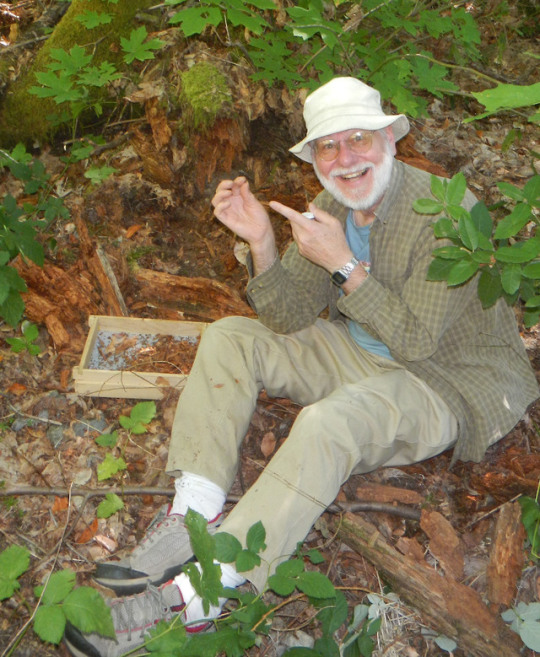
Fig. 3. Charles showed me where to find live Trilobopsis snails in a log. (Photo by C. Drost)

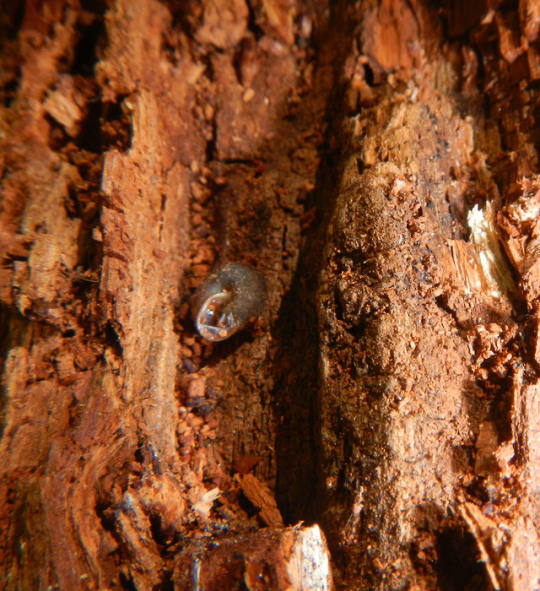
We were struck by the differing habitats of some populations. We think of typical Trilobopsis species living in talus rock piles (as does the one on Santa Cruz Island), but we found some populations living in leaf litter, and one population we found was living inside of rotting logs (Figs. 3-4).

Fig. 4. Living Trilobopsis in a cavity in rotting log. (Photo by C. Drost)

One likely side benefit of this research will be a revision of the genus; there might be more species of Trilobopsis than currently recognized, or there might be fewer species than currently recognized if some forms simply look different by growing in different environments.

We await results of the DNA comparisons, so we can learn which mainland populations are most closely related to the Santa Cruz Trilobopsis. Gotta love those California snails.

Timothy A. Pearce, PhD, is the head of the mollusks section at Carnegie Museum of Natural History. Museum employees are encouraged to blog about their unique experiences and knowledge gained from working at the museum.

Filed Under: Blog Tagged With: mollusks, new species, Section of Mollusks, Tim Pearce

  • « Go to Previous Page
  • Page 1
  • Interim pages omitted …
  • Page 3
  • Page 4
  • Page 5
  • Page 6
  • Page 7
  • Interim pages omitted …
  • Page 11
  • Go to Next Page »

sidebar

About

  • Mission & Commitments
  • Directors Team
  • Museum History

Get Involved

  • Volunteer
  • Membership
  • Carnegie Discoverers
  • Donate
  • Employment
  • Events

Bring a Group

  • Groups of 10 or More
  • Birthday Parties at the Museum
  • Field Trips

Powdermill

  • Powdermill Nature Reserve
  • Powdermill Field Trips
  • Powdermill Staff
  • Research at Powdermill

More Information

  • Image Permission Requests
  • Science Stories
  • Accessibility
  • Shopping Cart
  • Contact
  • Visitor Policies
One of the Four Carnegie Museums | © Carnegie Institute | Privacy Policy | Terms of Use | Accessibility
Rad works here logo