• Skip to primary navigation
  • Skip to main content
  • Skip to primary sidebar

Carnegie Museum of Natural History

One of the Four Carnegie Museums of Pittsburgh

  • Visit
    • Buy Tickets
    • Visitor Information
    • Exhibitions
    • Events
    • Dining at the Museum
    • Celebrate at the Museum
    • Powdermill Nature Reserve
    • Event Venue Rental
  • Learn
    • Field Trips
    • Educator Information
    • Programs at the Museum
    • Bring the Museum to You
    • Guided Programs FAQ
    • Programs Online
    • Climate and Rural Systems Partnership
  • Research
    • Scientific Sections
    • Science Stories
    • Science Videos
    • Senior Science & Research Staff
    • Museum Library
    • Science Seminars
    • Scientific Publications
    • Specimen and Artifact Identification
  • About
    • Mission & Commitments
    • Directors Team
    • Museum History
  • Tickets
  • Give
  • Shop

Travis Olds

February 28, 2025 by Erin Southerland

Michael J. Bainbridge Wins the 2024 Carnegie Mineralogical Award

by Travis Olds, Assistant Curator of Minerals
March 4, 2025

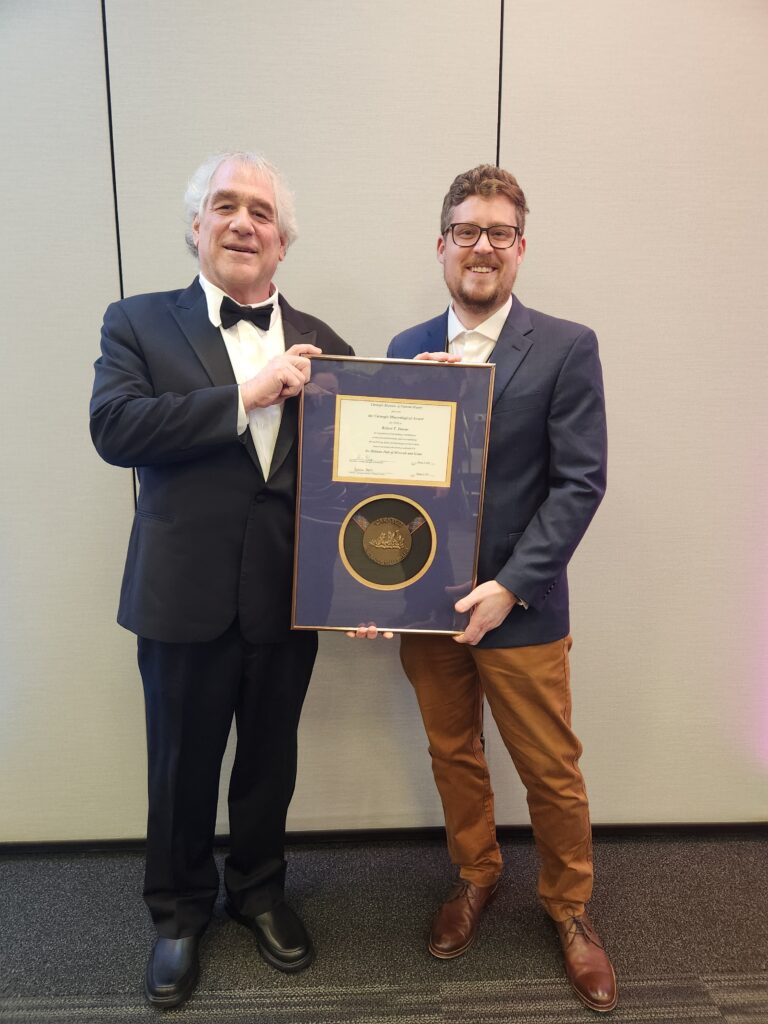
I am pleased to announce Michael J. Bainbridge as the winner of the 2024 Carnegie Mineralogical Award. Established in 1987 through the generosity of The Hillman Foundation Inc., the award honors outstanding contributions in mineralogical preservation, conservation, and education.

Michael is the Assistant Curator of Mineralogy at the Canadian Museum of Nature in Ottawa. Over the course of his career, he has elevated the field of mineral photography, published in leading mineralogical publications, and contributed to groundbreaking works such as Minerals of the Grenville Province: New York, Ontario, and Québec.

Travis Olds and Michael Bainbridge holding the Carnegie Mineralogical Award.
Travis Olds and Michael Bainbridge holding the Carnegie Mineralogical Award at the Tucson Gem and Mineral Show.

Michael has blended art and science to preserve and showcase the beauty of minerals, inspiring collectors and researchers alike. He has immortalized some of the rarest and best-of-species minerals, and this award recognizes the many wonderful contributions he has made to mineral heritage through his lens. 

Among his achievements, Bainbridge’s mineral photography has been featured in important works, such as The Pinch Collection at the Canadian Museum of Nature, and numerous articles in Rocks and Minerals and The Mineralogical Record. His work has ensured that specimens of scientific and cultural significance are preserved and appreciated by future generations. As a co-author of Minerals of the Grenville Province, Bainbridge helped document the mineralogical heritage of one of North America’s most storied geological regions. His contributions to Mindat.org and numerous mineral symposia have further enriched the global mineralogical community.

“I love to teach, and I love to tell stories, but I think both are fueled by a desire to learn for myself,” said Michael, reflecting on his achievements. “I’ve always been technically minded but artistically inclined, so combining my passion for minerals with my love of photography has proven the perfect vehicle for me to pursue and share both the scientific and the aesthetic. It has afforded me access to some of the world’s great collections and sparked collaborations with some of the community’s most influential amateurs and professionals alike.

“Among my proudest accomplishments, the Pinch book stands in high relief. Pushing the boundaries of photomicroscopy in documenting some of the smallest and rarest specimens of Mont Saint-Hilaire has been both challenging and rewarding. Ensuring top-notch reproductions for Lithographie’s publications has proven a similarly worthy endeavor. The significant finds I have made as a field collector are also close to my heart. But seeing new people come to the hobby through doors I have helped to open—whether through the Recreational Geology Project or co-founding the new Ottawa Valley Mineral Club—has perhaps been the most rewarding of all.

“More than anything, I am grateful for the many opportunities to share what I have learned along the way. And now, I look forward to the next chapter in my career as I assist in curating Canada’s national collection at the Canadian Museum of Nature. I am truly honored and humbled by this recognition of my small part in helping to present and preserve the world’s mineralogical heritage for future generations.”

I had the honor of presenting the award to Michael at the Tucson Gem and Mineral Show on February 15, 2025. Congratulations, Michael! 

2025 Carnegie Mineralogical Award

Nominations are now being accepted for the 2025 Carnegie Mineralogical Award, and the deadline is November 15, 2025. Eligible candidates include educators, private mineral enthusiasts and collectors, curators, museums, mineral clubs and societies, mineral symposiums, universities, and publications. For information, contact Travis Olds, Assistant Curator, Section of Minerals & Earth Sciences, at 412-622-6568 or oldst@carnegiemnh.org.

Filed Under: Blog Tagged With: mineralogical award, minerals, minerals and earth sciences, Travis Olds

February 20, 2024 by Erin Southerland

Robert T. Downs Wins 2023 Carnegie Mineralogical Award 

two people posing for the camera holding a framed award
Robert T. Downs, 2023 Carnegie Mineralogical Award Winner, and Travis Olds, Assistant Curator of Minerals at Carnegie Museum of Natural History. 

Carnegie Museum of Natural History (CMNH) is pleased to announce Robert T. Downs as winner of the 2023 Carnegie Mineralogical Award. The award honors outstanding contributions in mineralogical preservation, conservation, and education. 

Robert T. Downs is Professor Emeritus in the Department of Geosciences at The University of Arizona. Over the course of his career, he has taught thousands of students, published more than 300 peer-reviewed papers, and co-authored three books.  

“In his long career, Bob has influenced countless students and people from all walks of life through his lectures and publications, and as one of his supporters best put it, his influence on the mineralogy community is unique, lasting and profound. Congratulations, Bob,“ said Travis Olds, Assistant Curator of Minerals at Carnegie Museum of Natural History. 

Among his many achievements, Downs developed and continues to curate the RRUFF mineralogical database, one of the most widely used open-access mineral databases in the world, which has fundamentally changed how mineralogical data is kept and shared. The Raman spectra, X-ray diffraction, and chemistry data within RRUFF help mineral researchers identify specimens on Earth and beyond. Downs was a principal investigator on the Mars rover Curiosity, part of the Mars Science Laboratory mission. In 2023, he was second author on a paper in JGR Planets that summarizes a survey of 161 probable or confirmed Martian minerals and suggests that mineral diversity on Mars is an order of magnitude less than on Earth.  

Downs also prioritized making mineral education accessible to the public. He led the development of the popular, new University of Arizona Alfie Norville Gem & Mineral Museum in Tucson. 

“I found that the beauty of minerals was rivaled by the beauty of the math that described their crystal structures and the bonding of their atoms,” said Downs. “I am so thankful for a life in mineralogy that provided me the excitement of discovery and feel honored to receive the award.” 

Olds presented the award to Downs on February 10, 2024, at the Tucson Gem and Mineral Show. 
 
Carnegie Museum of Natural History established the Carnegie Mineralogical Award, funded by the Hillman Foundation, in 1987. 
 
Nominations are now being accepted for the 2024 Carnegie Mineralogical Award, and the deadline is November 15, 2024. Eligible candidates include educators, private mineral enthusiasts and collectors, curators, museums, mineral clubs and societies, mineral symposiums, universities, and publications. For information, contact Travis Olds, Assistant Curator, Section of Minerals & Earth Sciences, at 412-622-6568 or oldst@carnegiemnh.org.  
 
Past recipients include: 

2022 Willliam B. “Skip” Simmons, Jr. 
2021 Barbara Lee Dutrow, PhD. 
2020 John C. Medici, PhD. 
2019 John F. Rakovan, PhD. 
2018 Dudley P. Blauwet 
2017 W. Lesley Presmyk 
2016 Anthony R. Kampf, PhD. 
2015 George Harlow, PhD. 
2014 Bryon N. Brookmyer 
2013 Gloria A. Staebler 
2012 George W. Robinson, PhD. 
2011 Jeffrey E. Post, PhD. 
2010 The Rochester Mineralogical Symposium 
2009 Peter K.M. Megaw, PhD. 
2008 Frank C. Hawthorne, PhD. 
2007 Jeffrey A. Scovil 
2006 Richard C. Whiteman 
2005 June Culp Zeitner 
2004 Joel A. Bartsch, PhD. 
2003 Eugene S. Meieran, Sc.D. 
2002 Terry C. Wallace, Jr., PhD. 
2001 Wendell E. Wilson, PhD. 
2000 F. John Barlow, Sc.D. (honorary)  
1999 Sterling Hill Mining Museum  
1998 Robert W. Jones 
1997 Bryan K. Lees 
1996 Cornelis (Kase) Klein, PhD. 
1995 Marie E. Huizing 
1994 The Mineralogical Record 
1993 Cornelius S. Hurlbut, Jr., PhD. 
1992 Carl A. Francis, PhD. 
1991 Miguel A. Romero Sanchez, PhD. 
1990 Paul E. Desautels 
1989 Frederick H. Pough, PhD. 
1988 John Sinkankas, DHL. (honorary) 
1987 The Tucson Gem & Mineral Society 

Filed Under: Press Release Tagged With: mineralogical award, minerals, Science News, Travis Olds

June 1, 2022 by Erin Southerland

Cryptocurrency and Its Environmental Impact

by Dr. Travis A. Olds

Since the onset of the pandemic, millions of new miners have begun working to uncover raw resources; however, these miners are not the typical rock movers at your local quarry. They are instead making cryptographic calculations that reward newly minted digital currency – cryptocurrency.

You have likely heard a great deal about cryptocurrency lately, but may not understand what it is and may be wondering how something that doesn’t exist physically could hold any value? Gold and silver, as minerals with unique physical properties, have market value beyond that of currency, but consider for a moment the $20 bill. This paper currency itself has little physical value; it costs just under 14 cents to produce it, but the value of the bill is based on the fact that millions of people use and rely on it daily. The situation is similar for cryptocurrency. High demand for use and ownership of cryptocurrency creates its value.

Some cryptocurrencies have experienced a meteoric rise, and recently, an equally dramatic fall in value. The details are complex from a technical perspective, but people find crypto attractive for several reasons: using and owning it is significantly more secure than traditional banking, there are no limits to how much can be moved, and you can move it at any time. All transactions, even those made internationally, can be completed in just seconds and with significantly lower fees than those charged by traditional banks. Additionally, new mining methods, called “proof of stake,” even allow people to invest with crypto and earn interest over time. 

Of course, there are new risks and controversies surrounding cryptocurrency that are not encountered in everyday banking and investing. Because crypto is decentralized, there is no governmental or organizational control, and this has many people questioning how to regulate and protect its use. Only a few vendors accept payments in cryptocurrency because of this. With conventional banking, every purchase, withdrawal, or deposit you make through a bank or credit union with cash or credit is tracked by an electronic ledger to verify and secure your activities. The government helps to regulate and ensure the safety of these required systems. 

Cryptocurrency, on the other hand, uses a shared and system-wide electronic ledger called the “blockchain.” All transactions made through the blockchain are tracked, verified, and securitized using rapid cryptographic calculations made via individual miners. This ongoing electronic verification process ensures the massive digital transaction ledger cannot be controlled or altered by individual users. Crypto miners contribute to the ongoing verification process by operating machines to run the necessary calculations. A fraction of a freshly minted electronic coin is awarded for the cryptography calculations one miner does to help secure a transaction, what is termed the “proof of work” consensus mechanism.

Cryptocurrency mining machine
A water-cooled computer used for mining cryptocurrency. A graphics card, the large rectangular component in the center of the image, makes the cryptographic calculations. 

Performing proof of work calculation consumes electricity. Globally, the amount of electricity used by crypto miners has increased exponentially since its inception and this has drawn controversy regarding its impact on our environment. Some large mining farms use more electricity in one day than most small cities or countries do in several; however, the total electricity used by crypto miners still makes up just a small percentage of that used by the traditional electronic banking and investing systems. In fact, traditional banking and crypto systems are both environmentally unfriendly in places that get their electricity from carbon-based power generation, such as coal, heating oil, and natural gas. In early 2022 here in Pennsylvania, 66% of our power came from carbon-based sources, with 30% from nuclear, and the remaining 3% from hydroelectric and other renewable sources. While that cocktail of energy sources makes electricity cheaper here than in most other states, it also means that Pennsylvanians indirectly emit considerably more carbon to keep their lights on. Coal, oil, and natural gas are the cheapest but also the three least efficient fuels for electricity generation and have collectively done the most harm to the environment. 

Specialized crypto mining hardware, including graphics cards and ASIC units, generates heat while performing rapid calculations, so it helps to mine in areas with cool weather. If the hardware can operate at a cooler temperature, it can perform more calculations, which is measured in hashes/second, and is used to quantify the rewards received. Many miners take advantage of the easy scalability of mining hardware, by building large farms that can contain thousands of graphics cards and make thousands of dollars per day, but that also consume enormous amounts of electricity.

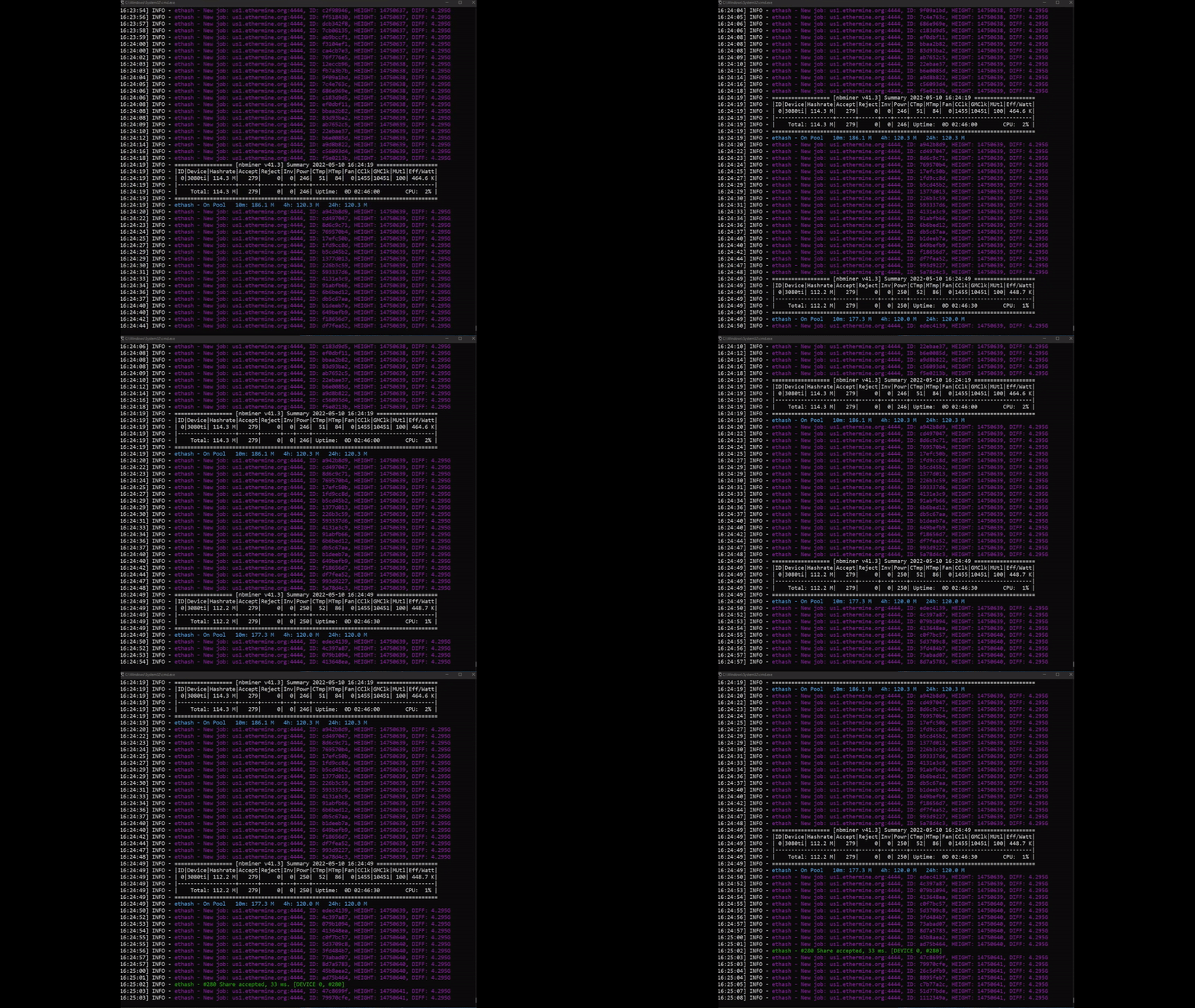
The output from mining software shown in real time. Jobs (in magenta) are sent from the blockchain over the internet to your hardware to make calculations that secure transactions and mint new coins. Sometimes, your work is awarded with a share (green), which is redeemable for coins. 

Electrical inefficiency and negative environmental impact have encouraged some cryptocurrency coin developers to come up with more energy efficient algorithms for rewards, but implementation is a slow and complex process. Many miners focus on whichever cryptocurrency is most profitable on any given day, regardless of its efficiency. Many of the largest mining farms are built in areas where energy is cheapest, or where local governments provide property or other tax incentives. Typically, no consideration of environmental impact is made when establishing new farms. In contrast, small amateur and at-home miners with only a few graphics cards can mine cryptocurrency without much increase to their monthly electrical bill. It is possible to make a small profit if you live in an area with cheap electricity, or if you can offset the use with renewable energy, for example, by using solar panels. With two graphics cards, one can make up to $6 a day mining Ethereum, a currently extremely popular crypto coin. 

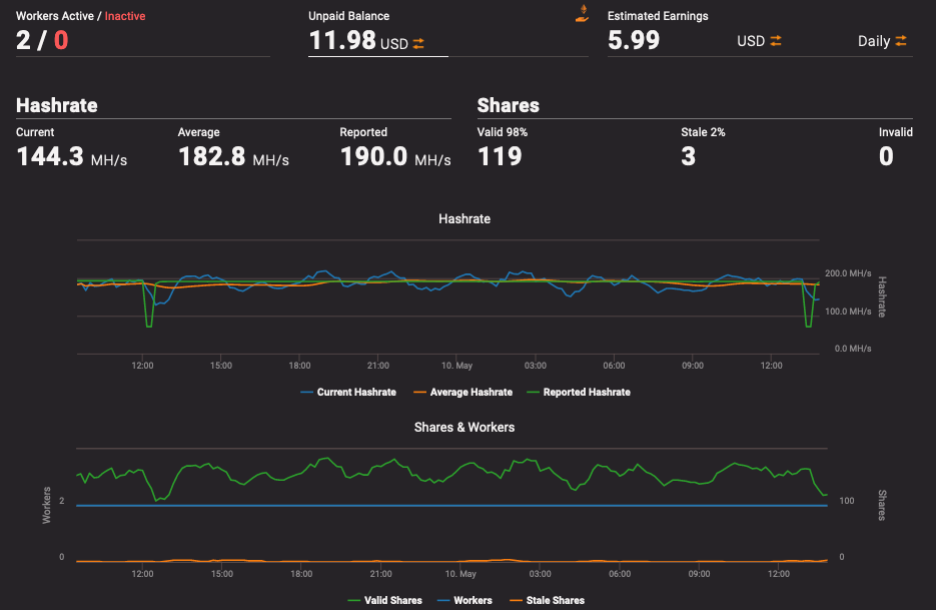
A screenshot with common metrics used to judge performance and profitability while mining Ethereum (ethermine.org). A high computation rate, or hashrate, given in units of Megahash/second, defines the chances for finding shares, which translate roughly to earnings based on the value of the coin that day.

The visible costs to start mining include buying the hardware, which can cost up to several thousand dollars, and paying for the electricity to power it. A mining “rig” with two graphics cards consumes 600 W, and costs $1.50 per day to mine $6 of Ethereum. Put that another way, the electricity needed to realize a $4.50 profit in one day is equivalent to leaving a 60W light bulb on continuously for 10 days. The invisible and usually overlooked cost of that profit is how roughly two-thirds of the electricity needed to profit was generated by burning fossil fuels and has indirectly but significantly contributed to climate change. 

Cryptocurrency is fraught with inefficiency, complexity, and controversy. The framework is constantly evolving and improving, and although it is far from replacing the day to day use of physical currency, many argue that digital currency is here for the long run. The development of less power-intensive mining methods and more energy efficient hardware is helping to offset the carbon footprint of crypto mining. Crypto mining will become more environmentally friendly in the future, as nuclear power and other renewables like solar and wind energy become cheaper, replacing the dirty and archaic coal and natural gas-burning power stations. 

Dr. Travis A. Olds is Assistant Curator of Minerals at Carnegie Museum of Natural History.

Related Content

Understanding Fossil Fuels Through Carnegie Museums’ Exhibits

Unidentified Gold Nugget

Sea Snails from Christmas Island (Money Cowries and Castor Bean Shells)

Carnegie Museum of Natural History Blog Citation Information

Blog author: Olds, Travis A.
Publication date: June 1, 2022

Share this post!

  • Share on Twitter Share on Twitter
  • Share on Facebook Share on Facebook
  • Share on Pinterest Share on Pinterest
  • Share on LinkedIn Share on LinkedIn
  • Share on Reddit Share on Reddit
  • Share via Email Share via Email

Filed Under: Blog Tagged With: climate change, Hillman Hall of Minerals and Gems, minerals, Science News, Travis Olds

December 7, 2021 by Erin Southerland

New Mineral Named For Carnegie Museum of Natural History Scientist

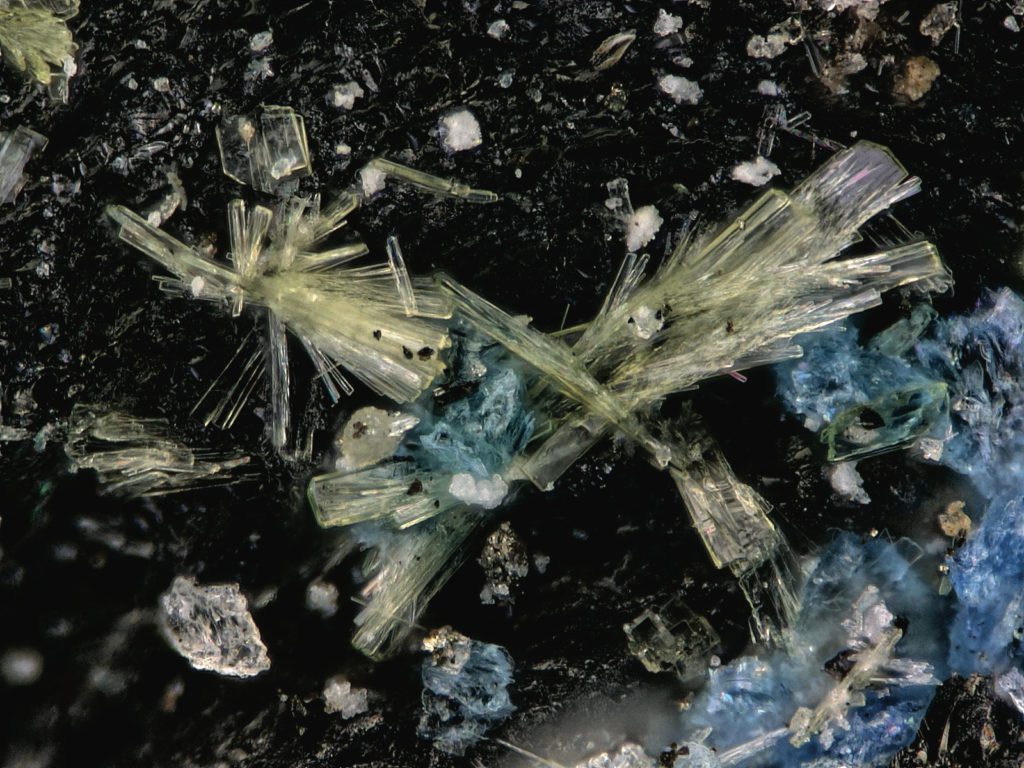
Yellow oldsite blades with blue stanleyite and white szomolnokite on asphaltum. Horizontal field of view is 0.7 millimeters. Photo by Dr. Anthony Kampf.

Carnegie Museum of Natural History announces the naming of the new mineral Oldsite after Dr. Travis Olds, the museum’s Assistant Curator of Minerals. The International Mineralogical Association (IMA) verified the mineral, which was accepted in October 2021 by an international team of scientists. Oldsite is named in recognition of Olds’ contributions to uranium minerology. 

Collected at Utah’s North Mesa mines near Temple Mountain, Oldsite forms from the interaction of air and water with uranium and iron-sulfide ores in the humid underground environment, leading to crystalline deposits on the surfaces of mine walls. Oldsite occurs as tiny yellow, rectangular blades measuring up to 0.3 millimeters in length. The crystals are thin and brittle and dissolve in water. 

The holotype specimen of Oldsite, or original specimen to be named, is held in the collections of the Natural History Museum of Los Angeles County. Its chemical formula is K2Fe2+[(UO2)(SO4)2]2(H2O)8.

“I’m honored to be the namesake of such a fascinating mineral,” said Olds. “My research focuses on descriptive minerology, particularly minerals containing uranium, which has been my passion since I knew I wanted to become a mineralogist. Oldsite is unique because it helps us fill in some puzzle pieces about how uranium behaves in the environment. The way its atoms connect to each other in the crystal structure tells us about the conditions that led to its formation. This information can be useful to help keep uranium out of drinking water, or to clean up nuclear waste.”

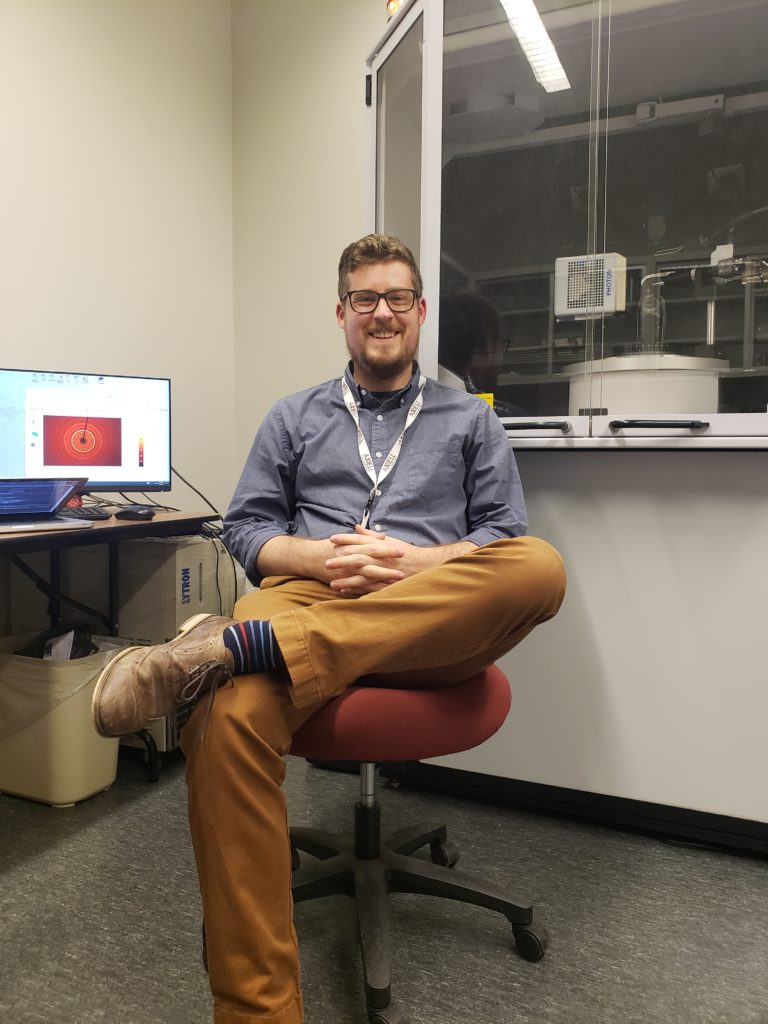
Dr. Travis Olds, Assistant Curator of Minerals at Carnegie Museum of Natural History

The research team that discovered and described Oldsite includes Dr. Jakub Plášil from the Czech Republic’s Institute of Physics ASCR, Dr. Anthony R. Kampf of the Natural History Museum of Los Angeles County, Dr. Chi Ma of California Institute of Technology, and German mineralogist Joy Desor. 

About Travis Olds

Olds is assistant curator of minerals at Carnegie Museum of Natural History’s Section of Minerals and Earth Sciences. He obtained his B.S. in chemistry from Michigan Technological University in 2012 and received his Ph.D. from the University of Notre Dame in 2017, where he explored the mineralogy and crystallography of the radioactive elements uranium and neptunium. From 2017-2019 Olds conducted post-doctoral research at Washington State University, as a part of the U.S. Department of Energy-funded Actinide Ceramic Materials Laboratory, which investigates the materials science of nuclear fuel. His research focuses on the structure-property relationships of minerals and materials, employing spectroscopic, diffraction and particle scattering techniques to study them at the atomic scale. Olds has discovered or been involved in the description of 24 new minerals, of which 21 contain uranium.

Filed Under: Press Release Tagged With: minerals and gems, Travis Olds

March 9, 2021 by wpengine

Section of Minerals and Earth Sciences Celebrates Being Lucky!

The etymology, or origin, of the word ‘luck’ is centuries old and has strong roots in minerals and mining. Although the exact origin is unknown, the verb “lukken,” meaning to “happen by chance” or “happen fortunately,” first appeared in Old English literature sometime in the mid 15th century and is thought to be associated with gambling. According to several sources, this meaning was likely borrowed from earlier Middle Dutch (“gheluc”) or Germanic (“gelücke”) speakers, who applied these words to good fortune and happiness associated with it.

Not long afterwards, beginning around the late 16th century, the traditional German miner’s greeting, “Glück auf!”, which translates to “luck to!” or “luck on!” became popular among many European miners. It describes a hope for good fortune to find ore that will bring riches, and was likely also directed to having luck in safety on their shift underground, since underground mining during that time was extremely dangerous.

The traditional German miner’s greeting, Glück auf.


The more modern term “luck of the Irish” also has likely origins in mining, since Irish immigrants and Irish American miners were considered to be some the most successful and famous prospectors during the gold and silver rush in the Western U.S. in the mid 1800s.

Miners sometimes encountered “unlucky” minerals underground that, at the time, were worthless and not considered pay dirt. Around the 1600s, silver miners in the Bohemia region of Czech Republic and Germany often encountered a dark and dense mineral that they referred to as “pechblende,” or bad-luck ore. This pechblende was actually the mineral uraninite, a major ore of the radioactive element uranium that would later become a hotly contested resource of developing nuclear nations.

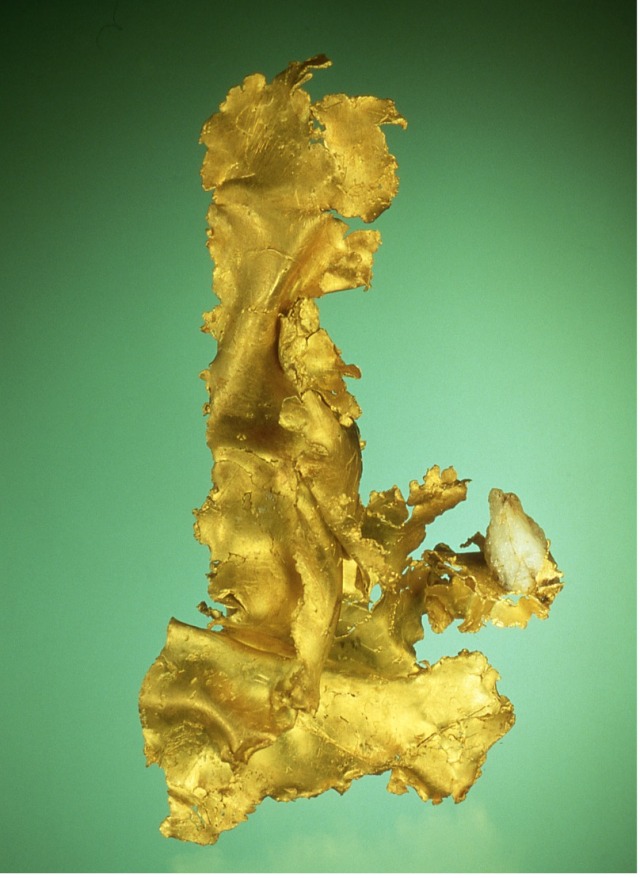
Nowadays, good luck is linked to many minerals, including gold, mythical pots of which receive attention around St. Patrick’s Day. Gold is considered lucky because of its association with wealth and fortune, but did you know that the reason gold is used for money is linked to its mineralogy? Consider gold’s properties as a mineral: it’s very stable (doesn’t spontaneously burst into flames or corrode), melts at a relatively low temperature, and is easily malleable (hammered or pressed). Gold was an ideal candidate to be used as money for early civilizations. Matching all those requirements, plus being the right balance of rare, but not too rare, means that out of over 100 elements in the periodic table, gold hits the sweet spot for monetary value.

A 2.5 ounce leaf gold standing 12.5 cm tall from Tuolumne County, California, on display in the Masterpiece Gallery of Hillman Hall of Minerals and Gems. Photo: Harold and Erica Van Pelt.

Carla Rosenfeld is the Assistant Curator of Earth Sciences, Travis Olds is Assistant Curator of Minerals, and Debra Wilson is Collection Manager of Minerals at Carnegie Museum of Natural History. Museum employees are encouraged to blog about their unique experiences and knowledge gained from working at the museum.

Related Content

Ask a Scientist: Why do some minerals glow?

What’s a Shamrock?

The Connemara Marble: A Cross-Atlantic Connection Between Ireland and Pittsburgh

Share this post!

  • Share on Twitter Share on Twitter
  • Share on Facebook Share on Facebook
  • Share on Pinterest Share on Pinterest
  • Share on LinkedIn Share on LinkedIn
  • Share on Reddit Share on Reddit
  • Share via Email Share via Email

Carnegie Museum of Natural History Blog Citation Information

Blog author: Rosenfield, Carla; Olds, Travis; and Wilson, Debra
Publication date: March 9, 2021

Share this post!

  • Share on Twitter Share on Twitter
  • Share on Facebook Share on Facebook
  • Share on Pinterest Share on Pinterest
  • Share on LinkedIn Share on LinkedIn
  • Share on Reddit Share on Reddit
  • Share via Email Share via Email

Filed Under: Blog Tagged With: Carla Rosenfeld, Debra Wilson, minerals, Science News, Travis Olds

November 9, 2020 by wpengine

Thanksgiving and Nutritional Mineralogy

by Travis Olds

We each have plenty to be thankful and hopeful for this year, but did you know that our traditional American Thanksgiving feast “with all the fixings,” would not be possible without minerals or the people who mine, process, and manufacture the mineral-related materials found in our kitchens?

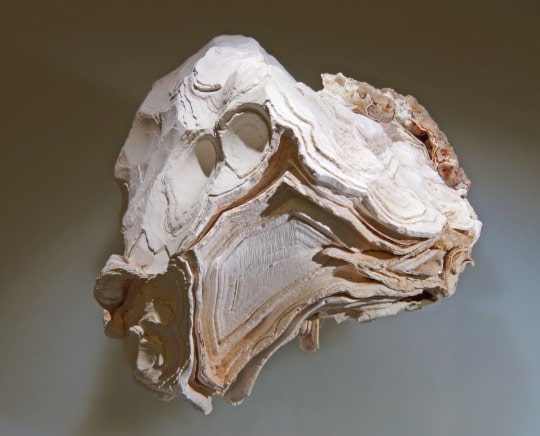
Kaolinite
Kaolinite. Photo Credit: Debra Wilson

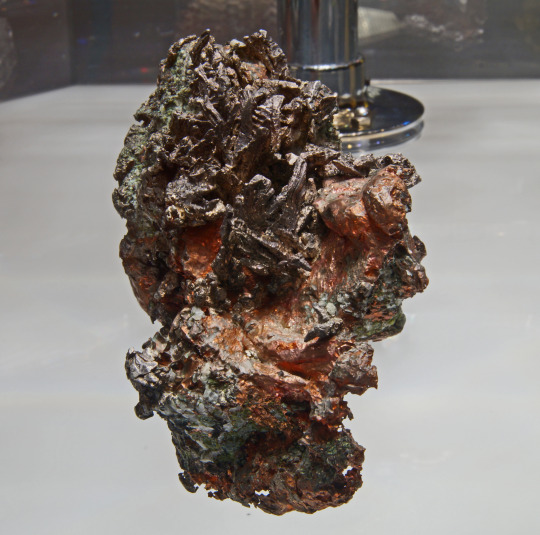
You should thank miners, in part, for the kaolinite clay used to make the fine porcelain china or ceramic plates at your dinner table. When kaolinite is fired in the factory, it partially melts, and crystals of an aluminum-silicate mineral called mullite that hold the ceramic together and give it high heat resistance form on cooling. Also, whether you eat and serve food with silver, steel, or aluminum utensils, extensive work and energy were needed to extract and refine the silver, iron, or aluminum metal necessary for their creation. Silver ore, for example, usually contains many other elements, including lead, zinc, copper, and gold, which can require lengthy chemical or electrochemical processes to separate.

silver on copper
Silver on copper. Photo credit: Debra Wilson

There might also be some unwanted mineral interactions occurring at the dinner table. If your gluttonous Uncle Ned consumes too much salt (sodium) with his gravy and potatoes (high in oxalate) this year, his body may begin to form kidney stones; which are biologically formed minerals made up of crystals of the phosphate mineral struvite and the calcium oxalate mineral whewellite. These biominerals, which can form when your bladder isn’t fully emptied after a sodium or oxalate-rich meal, can be extremely painful, so be sure to drink plenty of water with your meal. Large crystals take time to grow and drinking more water can reduce the concentration of sodium and oxalate in your body, slowing growth of the kidney stones.

Turkey meat, the mainstay of many Thanksgiving meals, also depends heavily on minerals. Did you know that turkeys actually need to swallow small rocks and pebbles, which are made of minerals, in order to digest their food? “Gastroliths,” or stomach stones, are used by other species of birds, reptiles, amphibians, worms, whales, and even some fish to crush their food and provide more nutrients! Fortunately, we humans have a variety of enzymes and strong stomach acids to break down nutrients in the food we eat.

A surprising amount of nutritional science is applied to raising turkeys; their diet is closely monitored and controlled for proper protein and “mineral” content so that they grow large. You have likely heard the term “mineral” applied to many of our dietary items as well, from mineral water, to a variety of products being fortified with vitamins and minerals, or even the advice that it’s important to maintain a healthy balance of minerals in your diet. The term is somewhat misleading because “minerals” in this sense typically refers to individual atomic elements such as potassium or iron, or to other compounds containing these elements, rather than actual minerals in the strict sense. To a mineralogist like me, minerals are naturally occurring crystalline solids made from a specific combination of elements.

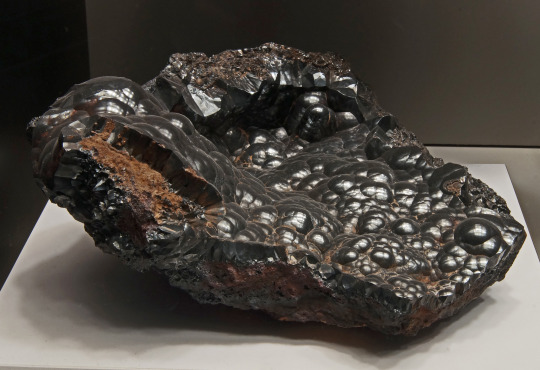
hematite
Hematite. Photo credit: Debra Wilson

Most often, the elements essential for our diet have been pre-digested, extracted or processed by another plant or animal, or have been chemically separated from a mineral source that makes it easier for our bodies to absorb. For example, most rice and cereal in the U.S. is fortified with B-vitamins and iron with a coating of finely ground nutrient powder. While the source of iron used in the fortifying powder varies, it all originates with the iron-oxide minerals hematite and goethite. Plants, bacteria, or stomach acids break down these minerals into iron cations that are easier for our body to process.

Thanksgiving vegetable dishes deserve special attention because plants can be the best sources for certain nutrients. In many cases, fruits and veggies grown on the farm also need help with their diet. Feldspar minerals present in soil hold on strongly to certain elements like K, more commonly known as potassium, making it hard for plants to extract this element. Farmers address this problem by using fertilizers like manure, containing predigested and readily absorbed phosphorous, nitrogen, and potassium, to produce a bountiful harvest

This year, please extend a bit of thankfulness to minerals, but mostly give thanks and recognition to the people that work hard to make your Thanksgiving possible; be it a miner, factory worker, your grocer, butcher, farmer, doctor, or all those working behind the scenes and on the front lines that keep us happy, healthy, and well fed.

Travis Olds is Assistant Curator of Minerals at Carnegie Museum of Natural History. Museum employees are encouraged to blog about their unique experiences working at the museum.

Related Content

Ask a Scientist: What is biogeochemistry? 

Why Do Leaves Change Color?

Beauty From the Ashes

Carnegie Museum of Natural History Blog Citation Information

Blog author: Olds, Travis
Publication date: November 9, 2020

Share this post!

  • Share on Twitter Share on Twitter
  • Share on Facebook Share on Facebook
  • Share on Pinterest Share on Pinterest
  • Share on LinkedIn Share on LinkedIn
  • Share on Reddit Share on Reddit
  • Share via Email Share via Email

Filed Under: Blog Tagged With: gems and minerals, Hillman Hall of Minerals and Gems, minerals, minerals and gems, Museum from Home, Science News, Section of Minerals, Travis Olds

  • Page 1
  • Page 2
  • Go to Next Page »

sidebar

About

  • Mission & Commitments
  • Directors Team
  • Museum History

Get Involved

  • Volunteer
  • Membership
  • Carnegie Discoverers
  • Donate
  • Employment
  • Events

Bring a Group

  • Groups of 10 or More
  • Birthday Parties at the Museum
  • Field Trips

Powdermill

  • Powdermill Nature Reserve
  • Powdermill Field Trips
  • Powdermill Staff
  • Research at Powdermill

More Information

  • Image Permission Requests
  • Science Stories
  • Accessibility
  • Shopping Cart
  • Contact
  • Visitor Policies
One of the Four Carnegie Museums | © Carnegie Institute | Privacy Policy | Terms of Use | Accessibility
Rad works here logo