• Skip to primary navigation
  • Skip to main content
  • Skip to primary sidebar

Carnegie Museum of Natural History

One of the Four Carnegie Museums of Pittsburgh

  • Visit
    • Buy Tickets
    • Visitor Information
    • Exhibitions
    • Events
    • Dining at the Museum
    • Celebrate at the Museum
    • Powdermill Nature Reserve
    • Event Venue Rental
  • Learn
    • Field Trips
    • Educator Information
    • Programs at the Museum
    • Bring the Museum to You
    • Guided Programs FAQ
    • Programs Online
    • Climate and Rural Systems Partnership
  • Research
    • Scientific Sections
    • Science Stories
    • Science Videos
    • Senior Science & Research Staff
    • Museum Library
    • Science Seminars
    • Scientific Publications
    • Specimen and Artifact Identification
  • About
    • Mission & Commitments
    • Directors Team
    • Museum History
  • Tickets
  • Give
  • Shop

Travis Olds

June 17, 2020 by wpengine

Meet our two new curators!

Dr. Travis Olds

photo of new curator of minerals Travis Olds

Hello! My name is Travis Olds. I’m Assistant Curator of Minerals in the Section of Minerals and Earth Sciences at Carnegie Museum of Natural History. I’m from the Upper Peninsula of Michigan, the northern part of the state that is sometimes confused as being a part of Canada, but also considered by many as one of the most beautiful places on Earth. People born in the U.P., as we call it, are known colloquially as “Yoopers,” and like Canadians we are some of the kindest people you will meet. Many Yoopers have an accent that is best described as a mix between Canadian and Minnesotan; we tend to elongate and over-emphasize vowels in spoken words, with favorites being “ya, eh, you betcha, and don’tchya know.” Our favorite dish is the pasty (“pastee”), a baked meat and vegetable-filled pastry that was introduced early in our state’s history by Cornish miners who traveled to the area to make a living and share their knowledge of mining techniques developed overseas.

Hundreds of mines have operated in the U.P. over the last ~200 years, yielding billions of tons of iron and manganese used for the steel produced here in Pittsburgh, and millions of tons of copper used across the world for plumbing, electrical lines, and electronics. Although many mines in the U.P. have long been abandoned, a few iron and copper mines are still in operation today. For several generations my family has made a living working in the mines, including my father and uncle, who were large influencers to my interest in minerals.

As I started collecting and learning more about minerals I became fascinated by radioactive minerals, the ones containing uranium and thorium. Uranium minerals come in many beautiful shapes and colors. They sometimes fluoresce neon green and yellow colors under UV light, and emit invisible high-energy particles during their decay. Although we owe our basic understanding of X-rays and many modern medical technologies and treatments to early studies of radioactive minerals, uranium remains one of the most controversial elements on the periodic table. It has been used to create exceptionally valuable technology but has also created unimaginable evil and pain. In the future, I believe nuclear power will likely become one of the dominant methods for producing “base-load” power to replace the antiquated and highly pollutive coal and natural-gas burning energy plants. I study the atomic arrangement and properties of uranium minerals because they are good analogs for advancing several aspects of nuclear power generation, from mining to processing and storage of used fuel and waste. My mineral collecting trips have taken me to unique places underground in Colorado, Utah, and the Czech Republic, and thanks to the group of friends and researchers that I work with, I have been lucky to find and describe 20 new minerals. At the museum, I research minerals to improve technology and better understand how humans are changing the minerals found on the Earth’s surface.

Photos of our new minerals can be found on my Mindat.org page.

Dr. Carla Rosenfeld

photo of new curator of earth sciences Carla Rosenfeld

Hello! I’m Carla Rosenfeld, the new Assistant Curator of Earth Sciences in the Section of Minerals and Earth Sciences at Carnegie Museum of Natural History. I received my Ph.D. in Soil Science and Biogeochemistry from Penn State and a B.S in Chemistry from McGill University. Following my Ph.D., I worked as a postdoctoral fellow at the Smithsonian National Museum of Natural History and University of Minnesota. After several years away, I am so excited to be returning to Pennsylvania to continue my research!

As a researcher, I am an interdisciplinary environmental biogeochemist. I use tools from mineralogy, geochemistry, and microbiology to study how pollutants and nutrients behave in the environment. I am fascinated by how biology, geology, and chemistry interact – for example when plant roots scavenge nutrients from soils by dissolving minerals, or when organisms form biominerals (think teeth, shells, and corals). Understanding how living and non-living things interact in different environments helps us to understand and predict how nature will respond to changing climate and other human impacts. Because I’m interested in how microbes make and alter minerals in soils, I’ve visited all sorts of places to collect soils, plants, water, and microbes (mostly bacteria and fungi). I’ve been down to the bottom of the deepest and oldest underground iron mine in Minnesota (Sudan Mine, ~ 1 mile below the ground surface!), to hot springs and the world’s only captive geyser in Idaho, and, right here in Southwest PA, to acid mine drainage remediation systems! Outside of science, I love to spend time outdoors biking (I even biked across the US from CT to CA one summer), mushroom hunting (my favorite mushrooms to find are golden chanterelles, Cantharellus cibarius or Cantharellus lateritius), and generally spending time outdoors. I also love to bake (including science cakes!), and I’ve kept a spreadsheet detailing everything I’ve baked for the last 5 years!

Related Content

Fungi Make Minerals and Clean Polluted Water Along the Way!

What do Minerals and Drinking Water Have to do with Each Other?
The Mineralogy of Ice Cream

Filed Under: Blog Tagged With: Carla Rosenfeld, gems and minerals, Hillman Hall of Minerals and Gems, Museum from Home, Science News, Section of Minerals, Travis Olds, Wertz Gallery

June 16, 2020 by wpengine

The Mineralogy of Ice Cream

by Travis Olds

Have you ever made ice cream at home?

You may have noticed that homemade ice cream has a different texture than what you buy at the grocery store or get at an ice cream shop. Homemade ice cream can taste “grainy” with a coarse texture, unlike the creamy Ben and Jerry’s from the store. This is because ice crystals in homemade ice cream are usually much larger than the ice cream made by professionals.

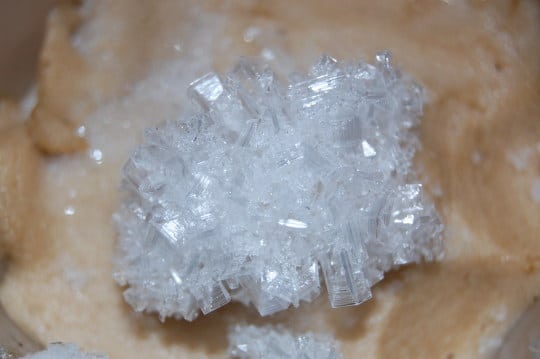
close up of ice crystals
“Ice Crystals”by glenngurley is licensed under CC BY-NC-SA 2.0

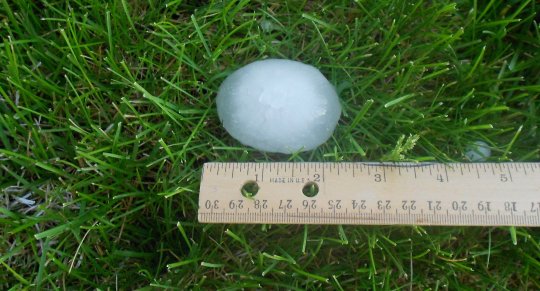
This is where mineralogy comes in. In nature, large mineral crystals take time to grow, sometimes growing for up to 100,000 years or more! The same is true for ice and snow, which happen to be minerals too. The shape and size of snow crystals that fall from the sky are controlled intricately by the outside air temperature, relative humidity, and time. Snowflakes are usually largest when they spend a long time in the air and at temperatures a bit below the freezing point, near 15 °F. At colder temperatures, the crystals grow quickly and are smaller. Fortunately, we won’t be seeing snow for a while, however, summer can bring even larger balls of ice from the sky! During thunderstorms, hail stones can grow VERY large (up to 15 cm or nearly 6 inches in diameter), sometimes spending up to 30 minutes swirling around updrafts in the icy and rainy conditions within storm clouds.

two-inch piece of hail next to ruler in the grass

To make a smooth and creamy ice cream, companies like Ben and Jerry’s use freezers cooled to very cold temperatures, -40 °F, that quickly freezes the cream thereby producing tiny ice crystals. Ice cream prepared at home is made with a salty mixture of ice and water that can reach nearly -5 °F, but at this temperature the ice crystals grow more slowly and larger. When the crystal size reaches about 50 micrometers, roughly the width of a human hair, your mouth senses the coarse texture.

Three steps you can take to make creamier ice cream at home:

1.     Use a higher fat content by adding more cream. More fat will “spread” out water molecules in the cream, creating more nucleation sites, or growth places, for ice and smaller crystals.

2.     Using crushed ice, instead of ice cubes, will bring the ice/salt mixture to a lower temperature. Also, pre-chilling the cream and sugar before placing it in the salt bath will help speed up freezing, producing smaller crystals.

3.     Use “dry ice,” or frozen carbon dioxide, available at many grocery stores, for even lower temperatures and faster crystallization. But be careful, dry ice should only be used with proper gloves and under adult supervision.

Travis Olds is Assistant Curator of Minerals at Carnegie Museum of Natural History. Museum employees are encouraged to blog about their unique experiences working at the museum.

Related Content

Hip and “Trashy” Ice Cream

What Do Minerals and Drinking Water Have To Do With Each Other?

Thanksgiving and Nutritional Mineralogy

Carnegie Museum of Natural History Blog Citation Information

Blog author: Olds, Travis
Publication date: June 16, 2020

Share this post!

  • Share on Twitter Share on Twitter
  • Share on Facebook Share on Facebook
  • Share on Pinterest Share on Pinterest
  • Share on LinkedIn Share on LinkedIn
  • Share on Reddit Share on Reddit
  • Share via Email Share via Email

Share this post!

  • Share on Twitter Share on Twitter
  • Share on Facebook Share on Facebook
  • Share on Pinterest Share on Pinterest
  • Share on LinkedIn Share on LinkedIn
  • Share on Reddit Share on Reddit
  • Share via Email Share via Email

Filed Under: Blog Tagged With: gems and minerals, Hillman Hall of Minerals and Gems, Museum from Home, Science News, Section of Minerals, Travis Olds

June 15, 2020 by wpengine

What Do Minerals and Drinking Water Have to Do With Each Other?

In the same way scientists discover new plant or animal species, new minerals are usually found by exploring new places with hard work and determination, but also sometimes by pure chance and luck. In fact, you do not need to be a scientist to make exciting discoveries. You do need, however, to follow the basic steps of the scientific method when doing any research: (1) first ask a question you are interested in; (2) research that question; (3) develop a hypothesis; (4) test it; (5) analyze the data your tests generate; (6) draw conclusions; (7) and communicate the results.

When describing a new mineral, mineralogists like me gather a slew of analytical data about the atomic arrangement, chemical makeup, and optical and physical properties to completely characterize the mineral. The data we gather is recorded and accessible, so that when others find similar crystals the analytical data for those specimens can be compared. Allowing your findings to be further tested and improved, or even shown to be wrong, forms the foundation of all fields of science and medicine.

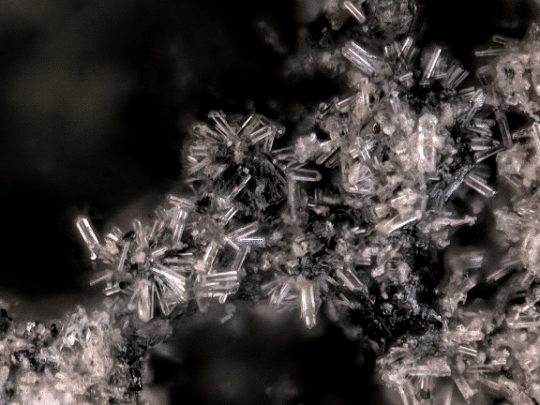
tiny hydroxylpyromorphite crystals
A microscope image of tiny transparent crystals of hydroxylpyromorphite from the Copps mine, Marenisco, Gogebic County, Michigan. Field of view is 0.45 mm. 

I recently gathered analytical data for the new mineral hydroxylpyromorphite, a mineral with a mouthful for a name, but one that is extremely important to removing toxic lead from drinking water. Hydroxylpyromorphite is a lead phosphate mineral, and part of a larger group of minerals with related crystal structures (the arrangements of atoms) called the apatite group. Our bones and teeth are made of apatite, calcium phosphate, and the natural processes that move this critical building block throughout our bodies are disrupted when exposed to lead, potentially causing brain damage and other diseases. Lead is especially dangerous to children, and to prevent lead poisoning, water treatment plants often add phosphate to the water supply. Under the right conditions, phosphate grabs strongly onto lead atoms, forming hydroxylpyromorphite and removing it from the water. Until our description, the crystal structure of this mineral was unknown. Now that we understand the crystal structure, the information can be used by others to develop better techniques or processes that reduce lead in drinking water.

Travis Olds is Assistant Curator of Minerals at Carnegie Museum of Natural History. Museum employees are encouraged to blog about their unique experiences working at the museum.

Filed Under: Blog Tagged With: gems and minerals, Hillman Hall of Minerals and Gems, Museum from Home, Science News, Section of Minerals, Travis Olds

  • « Go to Previous Page
  • Page 1
  • Page 2

sidebar

About

  • Mission & Commitments
  • Directors Team
  • Museum History

Get Involved

  • Volunteer
  • Membership
  • Carnegie Discoverers
  • Donate
  • Employment
  • Events

Bring a Group

  • Groups of 10 or More
  • Birthday Parties at the Museum
  • Field Trips

Powdermill

  • Powdermill Nature Reserve
  • Powdermill Field Trips
  • Powdermill Staff
  • Research at Powdermill

More Information

  • Image Permission Requests
  • Science Stories
  • Accessibility
  • Shopping Cart
  • Contact
  • Visitor Policies
One of the Four Carnegie Museums | © Carnegie Institute | Privacy Policy | Terms of Use | Accessibility
Rad works here logo