• Skip to primary navigation
  • Skip to main content
  • Skip to primary sidebar

Carnegie Museum of Natural History

One of the Four Carnegie Museums of Pittsburgh

  • Visit
    • Buy Tickets
    • Visitor Information
    • Exhibitions
    • Events
    • Dining at the Museum
    • Celebrate at the Museum
    • Powdermill Nature Reserve
    • Event Venue Rental
    • Gift Cards
  • Learn
    • Field Trips
    • Educator Information
    • Programs at the Museum
    • Bring the Museum to You
    • Guided Programs FAQ
    • Programs Online
    • Climate and Rural Systems Partnership
  • Research
    • Scientific Sections
    • Science Stories
    • Science Videos
    • Senior Science & Research Staff
    • Museum Library
    • Science Seminars
    • Scientific Publications
    • Specimen and Artifact Identification
  • About
    • Mission & Commitments
    • Directors Team
    • Museum History
  • Tickets
  • Give
  • Shop

Uprooted

April 29, 2020 by wpengine

From cultivation to invasion: a common route

Collected on this Day in 1937
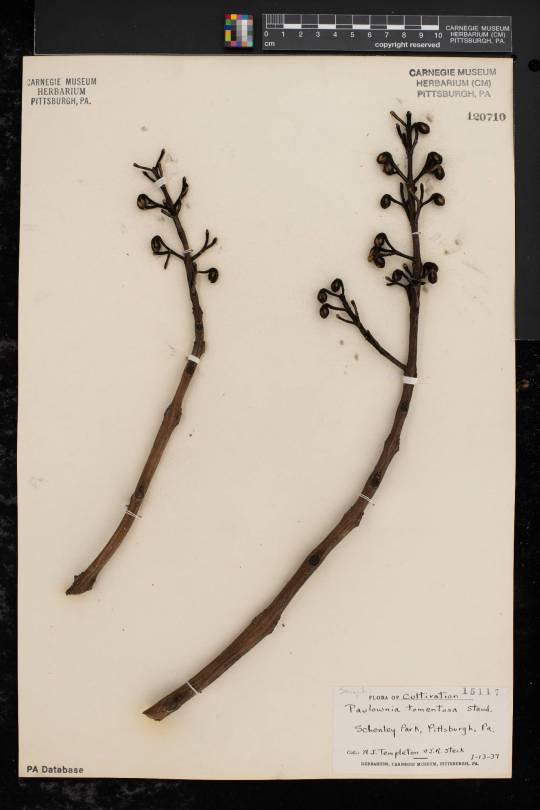
This specimen of princess tree (Paulownia tomentosa) was collected on January 13, 1937 in Schenley Park, Pittsburgh by R.J. Templeton and J.R. Steck.  Though subtle, note the heading on the label “Flora of Cultivation.”  This header suggests that this tree was planted in the park, rather than naturally occurring on its own.
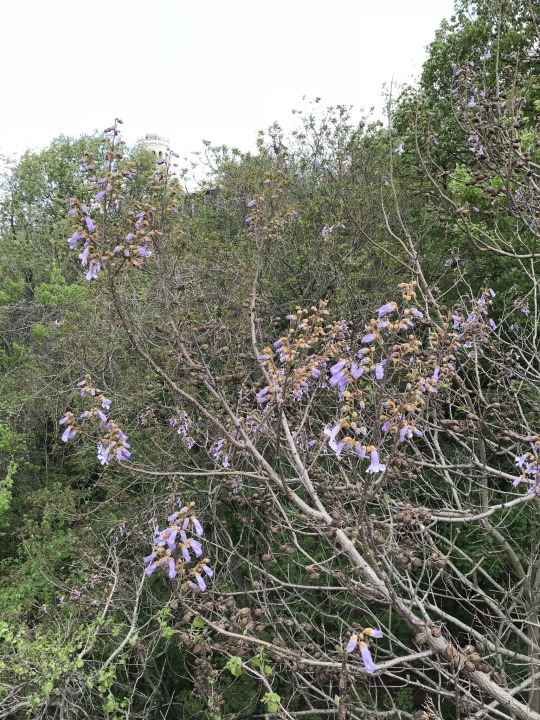
Princess tree has a remarkable presence – large wide leaves larger than your face (though you can’t see that in this winter collected specimen) and very showy, fragrant flowers that burst from large buds in the spring.  Signs of the flowers/fruits remain obvious on the branches year round.
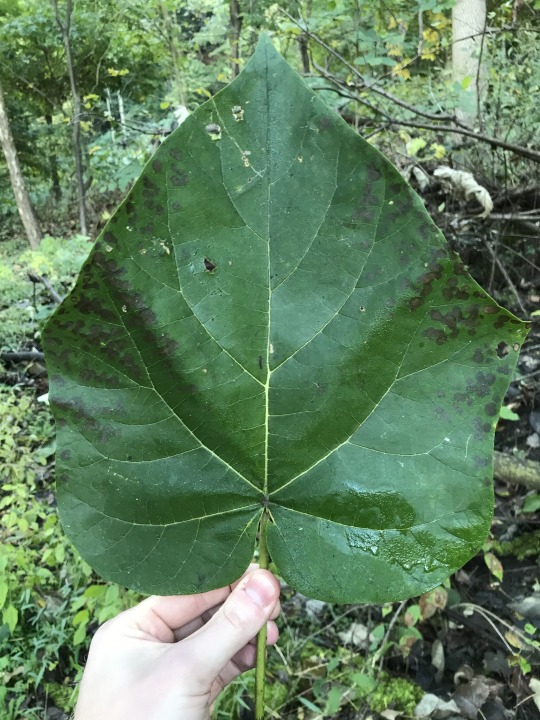
Princess tree is a common urban weedy tree that is not native to Pennsylvania or the United States. Rather, it is native to Central and Western China.  It was brought to Europe in the 1830s (and then to the US) by the Dutch East India Company, with many historical medicinal and ornamental uses, as well as its wood. The tree was named after a Romanov princess, the Grand Duchess Anna Pavlovna.
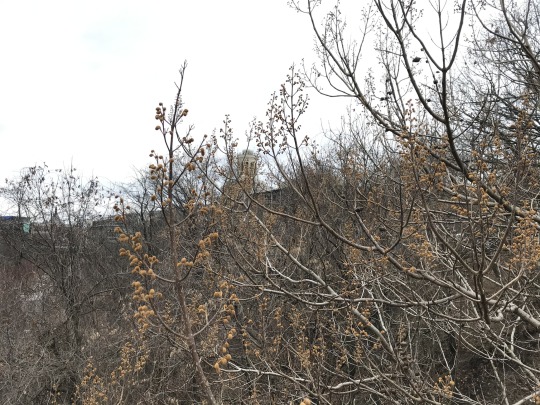
Princess tree can still be found in Schenley Park.  It is especially noticeable, with its flowers at eye level, as you walk or drive across the bridge from the museum to Phipps Conservatory (Schenley bridge).

Listed as invasive by the state, Princess tree should not be planted in Pennsylvania.  It grows quickly and actively spreads beyond its planting, into roadsides, streams, and disturbed forests with potential to displace native plants.

Find this specimen and more here: http://midatlanticherbaria.org/portal/collections/list.php?db=all&catnum=CM120710&othercatnum=1

Check back for more! Botanists at the Carnegie Museum of Natural History share digital specimens from the herbarium on dates they were collected. They are in the midst of a three-year project to digitize nearly 190,000 plant specimens collected in the region, making images and other data publicly available online. This effort is part of the Mid-Atlantic Megalopolis Project (mamdigitization.org), a network of thirteen herbaria spanning the densely populated urban corridor from Washington, D.C. to New York City to achieve a greater understanding of our urban areas, including the unique industrial and environmental history of the greater Pittsburgh region. This project is made possible by the National Science Foundation under grant no. 1801022.

Mason Heberling is Assistant Curator of Botany at the Carnegie Museum of Natural History. Museum employees are encouraged to blog about their unique experiences and knowledge gained from working at the museum.
Filed Under: Blog Tagged With: Anthropocene, Botany, botany hall, collected on this day, Hall of Botany, Mason Heberling, Museum from Home, Uprooted

February 10, 2020 by wpengine

Collected on this Day in 2012: Wintercreeper

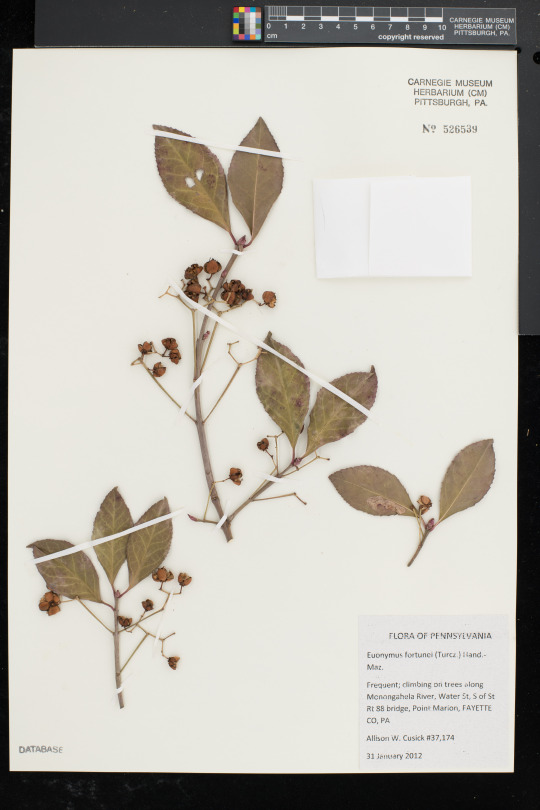
This specimen of wintercreeper (Euonymus fortunei) was collected on January 31, 2012 along the Monongahela River in Fayette County, PA by Alison Cusick.  Alison Cusick is a current Research Associate in the Section of Botany at the museum.  He can be frequently found in the Carnegie Museum herbarium.  He has a unique wealth of knowledge on plants, herbaria, botanical history, and more.  He authored three books and more than 50 scientific papers on the flora of eastern North America. Before retiring, he was the Chief Botanist for the Ohio Department of Natural Resources.  He continues to collect today, and many thousands of his specimens can found at herbaria across the country.  

Note the label on this specimen reads “Cusick, A.W.   37174”  The number following a collectors name is known as the…you guessed it… collector number (surprise!).  The collector number is the number assigned to a specimen by the collector.  It is common for several specimens to have the same collector number, if they are from the same individual or species in the same location on the same day (“duplicate specimens”).  Unfortunately, there are no universal rules on how collector numbers are used or assigned.  Collector numbers primary use is so the collector and/or others using the specimen can go back to the collector’s field notebook for additional information on the specimen.  Collector numbers are different from specimen numbers (which are assigned by the herbarium, such that every specimen has a unique ID for reference).  Most collectors number their specimens chronologically in order they were collected (but not always), but some collector numbers consist of dashes and/or letters, too.  

Anyway, what I’m getting at is that this specimen (Cusick 37174) suggests Alison has collected AT LEAST over 37,000 specimens.  The number is actually higher than that, with duplicates and an additional 8 years of collecting.  Not that numbers are everything, but Alison’s contribution to the herbarium record is clearly impressive and impactful.

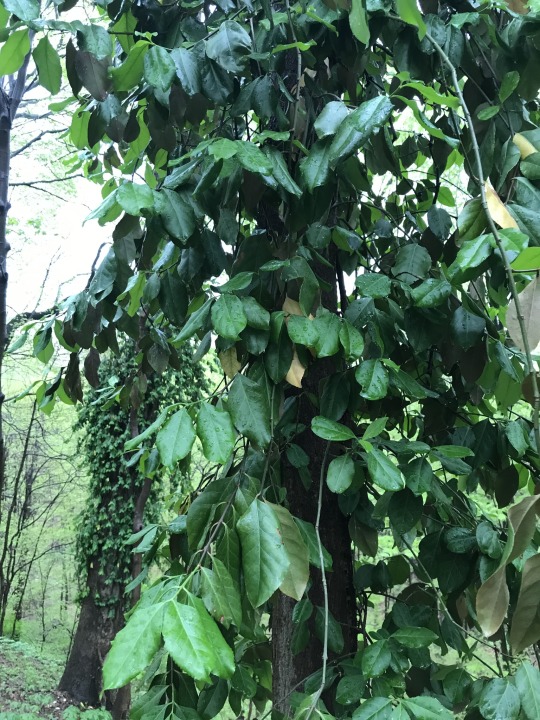
Ok, now back to the plant!  Winter creeper (Euonymus fortunei), native to Asia, is commonly planted in Pennsylvania and many other places, and unfortunately has also spread to become invasive.  It is still commonly planted.  It is a woody vine that climbs trees, but also is a thick ground cover.  It has leaves that persist through the winter, with attractive fruits.  Despite those advantages, it can impact native species and habitats as an invasive species, and therefore, should not be planted.

Find this specimen and more here: http://midatlanticherbaria.org/portal/collections/individual/index.php?occid=12134036&clid=0

Check back for more! Botanists at the Carnegie Museum of Natural History share digital specimens from the herbarium on dates they were collected. They are in the midst of a three-year project to digitize nearly 190,000 plant specimens collected in the region, making images and other data publicly available online. This effort is part of the Mid-Atlantic Megalopolis Project (mamdigitization.org), a network of thirteen herbaria spanning the densely populated urban corridor from Washington, D.C. to New York City to achieve a greater understanding of our urban areas, including the unique industrial and environmental history of the greater Pittsburgh region. This project is made possible by the National Science Foundation under grant no. 1801022.

Mason Heberling is Assistant Curator of Botany at the Carnegie Museum of Natural History. Museum employees are encouraged to blog about their unique experiences and knowledge gained from working at the museum.
Filed Under: Blog Tagged With: Botany, collected on this day, Mason Heberling, Science News, Uprooted, wintertide

October 15, 2019 by wpengine

Callery Pear from October 11, 1979: 40 years ago

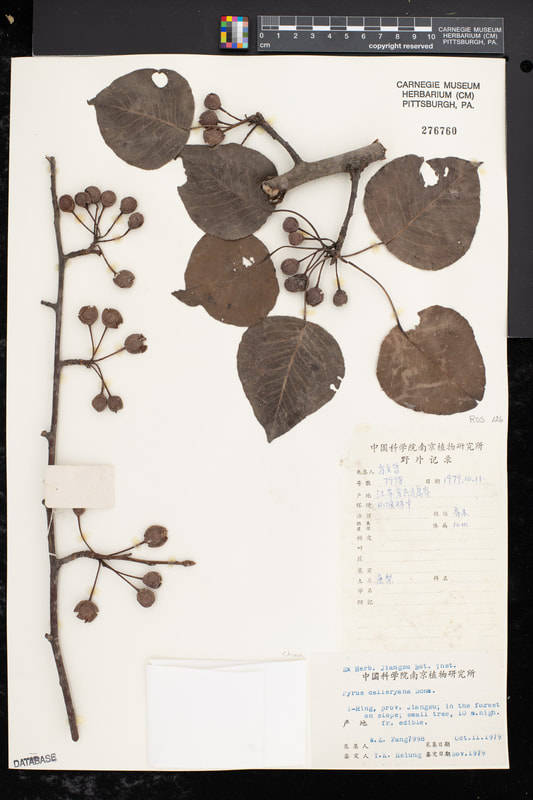
Callery pear herbarium specimen

From wild to cultivated to invasive

This specimen of Callery pear (Pyrus calleryana) was collected on October 11, 1979 by W.Z. Fang in Jiangsu, China. Callery pear is native to East Asia (China, Vietnam).

But…Callery pear can be found in the United States. It was (and is) widely planted as an ornamental landscape tree.  Along streets, in residential yards, in parking lots  – it was a prized plant for well-groomed anthropogenic landscapes. It uniformly grows in low resource conditions, explodes with many beautiful blossoms each spring, provides shade, and has a decent foliage display in the autumn. As many introduced plants go, it went from prized ornamental to an unwanted “invasive species,” spreading across the landscape and affecting the environment. It is now widely recognized invasive species in many states or closely watched as a species likely to become invasive. That said, beyond the legacy of over half a century of mass plantings across the country, it is still commonly planted and old and new cultivars are commercially available. USDA estimated over $23 million in sales in the US in 2009 alone.

How’d Callery pear get to the US? The story behind the introduction of Callery pear is a fascinating one.  Like many of our cultivated plants, seeds were collected on special expeditions in search of plants useful to horticulture, agriculture, or just because. Pyrus calleryana was first introduced to the US in the early 1900s, though not for its attractive blossoms as you might expect. Instead, it was first introduced for its disease resistance. It was successfully used in horticulture as a root stock for European pear fruit production. At the time, European pears in the Pacific northwestern US were being hit hard, grafting to a Callery pear rootstock dramatically decreased crop losses to disease. Callery pear does not produce edible fruit.

​The tree was widely planted starting in the 1960s, when it became commercially available and promoted by the nursery industry as a hardy ornamental tree. Before that, it was planted by the US Department of Agriculture (USDA) for testing at Plant Introduction Stations in Corvallis, Oregon, and Glenn Dale, Maryland. One of these Maryland planted trees was targeted for its special traits and became the source of the hugely popular ‘Bradford’ cultivar (“Bradford pear”). In 1952, one tree was used to graft to rootstock, a plant propagation method making all plants genetically identical.  Other cultivars have since been commercialized, but ‘Bradford’ were/are exceptionally popular. Though intended to be sterile (non-reproducing), it turned out the trees were capable of setting viable seed.  The cultivars themselves are not invasive, but because multiple cultivars exist, together they can cross-pollinate to become invasive.

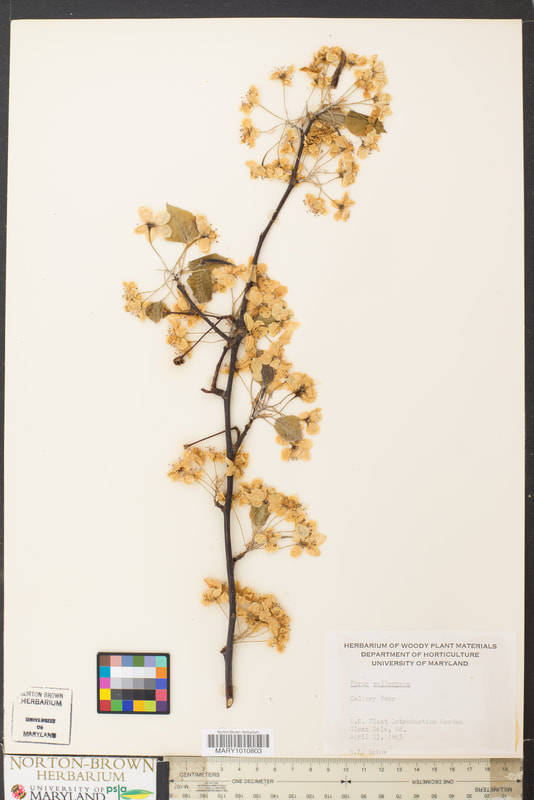
This flowering specimen (above) from University of Maryland Norton-Brown Herbarium (MARY) was collected  in 1963 from the US  Plant Introduction Garden in Glenn Dale, MD  – THE site behind the widespread introduction of this species!

Herbarium specimens have been critical to understanding the spread of this species. In a 2005 study, Dr. Michael Vincent (Miami University in Ohio) found that 50% of all specimens examined over the range of 39 years were collected between 2000-2003.  Though some specimens  were collected in the 1960s in natural areas, it became widely “escaped” from cultivation in many natural  areas in the 1990s.

You may have noticed that most of our specimen images to date are those collected in Pennsylvania and surrounding states.  That’s because these specimens are being digitized as part of a multi-institutional project, the Mid-Atlantic Megalopolis Project, with the overarching goal to mobilize herbarium specimens across the region to understand the effects of urbanization on plant life.  However, this project is a step towards digitizing the entire Carnegie Museum Herbarium. The herbarium is worldwide in scope, and specimens in the Mid-Atlantic region account for only 35% of the 540,000 specimens.

As more specimens become digitized as part of the Mid-Atlantic Megalopolis Project, we’ll have a more complete understanding of the introduction and spread of Callery pear in the region.

Herbarium specimens are collected in the native range too! We’ll be able to compare specimens collected in the invaded range to those in its native China. The use of cultivated specimens and those collected in the native range are underutilized but can provide critical information.

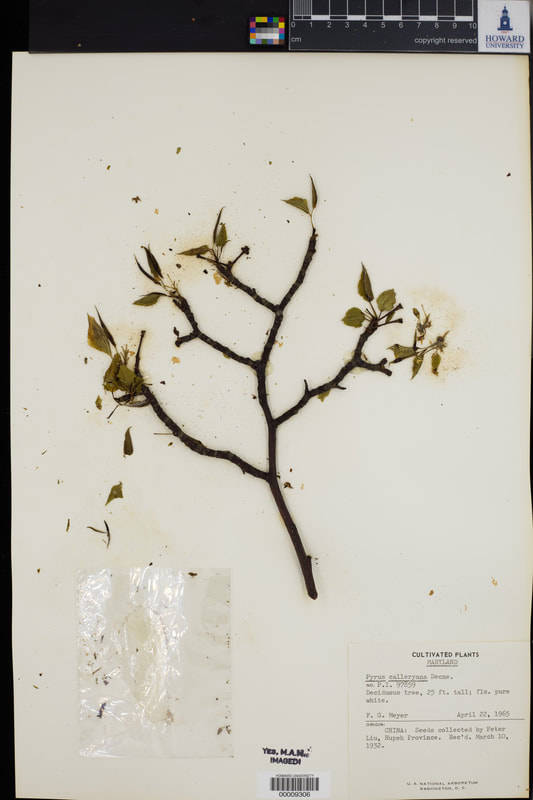
This historically fascinating specimen (above) from Howard University Herbarium (HUDC) below, digitized through the Mid-Atlantic Megalopolis Project, is among the oldest specimens collected in the region. Collected in spring of 1965 in Maryland by Frederick Meyer from a cultivated plant at the US National Arboretum, with the note on the label: “China: Seeds collected by Peter Liu, Hupeh Province. Rec’d.  March 10, 1932.” The US National Arboretum was instrumental in the development and popularity of the ‘Bradford’ and other cultivars.

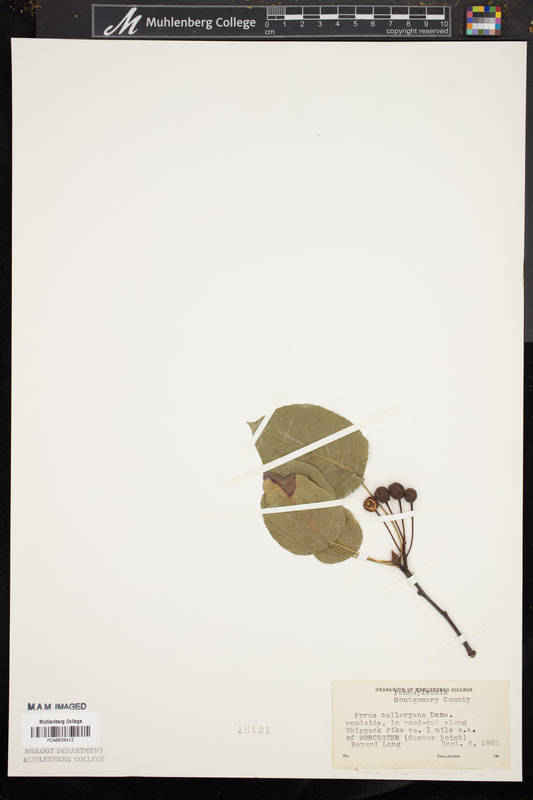
Escaped from cultivation. This specimen (above) from Muhlenberg College Herbarium (MCA) was collected along the roadway in Montgomery county, Pennsylvania by Bayard Long in 1962. This specimen is probably the earliest specimen collected in the wild in Pennsylvania.

Many more specimens like this will be brought to light through the Mid-Atlantic Megalopolis Project.

Read more about this species introduction history in the popular press, published in the Washington Post last year, and in an excellent overview by Dr. Theresa Culley (University of Cinncinati) in Arnoldia and another in BioScience.

See all the Pyrus calleryana specimens being made available online from the Mid-Atlantic Megalopolis project here: http://midatlanticherbaria.org/portal/collections/list.php?db=277%2C328%2C334%2C329%2C333%2C320%2C330%2C40%2C410%2C316%2C335%2C331%2C332%3B11&includecult=1&taxa=Pyrus+calleryana&usethes=1&taxontype=2

Check back for more! Botanists at the Carnegie Museum of Natural History share digital specimens from the herbarium on dates they were collected. They are in the midst of a three-year project to digitize nearly 190,000 plant specimens collected in the region, making images and other data publicly available online. This effort is part of the Mid-Atlantic Megalopolis Project (mamdigitization.org), a network of thirteen herbaria spanning the densely populated urban corridor from Washington, D.C. to New York City to achieve a greater understanding of our urban areas, including the unique industrial and environmental history of the greater Pittsburgh region. This project is made possible by the National Science Foundation under grant no. 1801022.

Mason Heberling is Assistant Curator of Botany at the Carnegie Museum of Natural History. Museum employees are encouraged to blog about their unique experiences and knowledge gained from working at the museum.
Filed Under: Blog Tagged With: Anthropocene, Botany, collected on this day, Mason Heberling, Uprooted

  • « Go to Previous Page
  • Page 1
  • Page 2

sidebar

About

  • Mission & Commitments
  • Directors Team
  • Museum History

Get Involved

  • Volunteer
  • Membership
  • Carnegie Discoverers
  • Donate
  • Employment
  • Events

Bring a Group

  • Groups of 10 or More
  • Birthday Parties at the Museum
  • Field Trips

Powdermill

  • Powdermill Nature Reserve
  • Powdermill Field Trips
  • Powdermill Staff
  • Research at Powdermill

More Information

  • Image Permission Requests
  • Science Stories
  • Accessibility
  • Shopping Cart
  • Contact
  • Visitor Policies
One of the Four Carnegie Museums | © Carnegie Institute | Privacy Policy | Terms of Use | Accessibility
Rad works here logo