• Skip to primary navigation
  • Skip to main content
  • Skip to primary sidebar

Carnegie Museum of Natural History

One of the Four Carnegie Museums of Pittsburgh

  • Visit
    • Buy Tickets
    • Visitor Information
    • Exhibitions
    • Events
    • Dining at the Museum
    • Celebrate at the Museum
    • Powdermill Nature Reserve
    • Event Venue Rental
  • Learn
    • Field Trips
    • Educator Information
    • Programs at the Museum
    • Bring the Museum to You
    • Guided Programs FAQ
    • Programs Online
    • Climate and Rural Systems Partnership
  • Research
    • Scientific Sections
    • Science Stories
    • Science Videos
    • Senior Science & Research Staff
    • Museum Library
    • Science Seminars
    • Scientific Publications
    • Specimen and Artifact Identification
  • About
    • Mission & Commitments
    • Directors Team
    • Museum History
  • Tickets
  • Give
  • Shop

Hall of Botany

January 16, 2024 by Erin Southerland

Collected On This Day: Witch Hazel, January 1923

by Mason Heberling
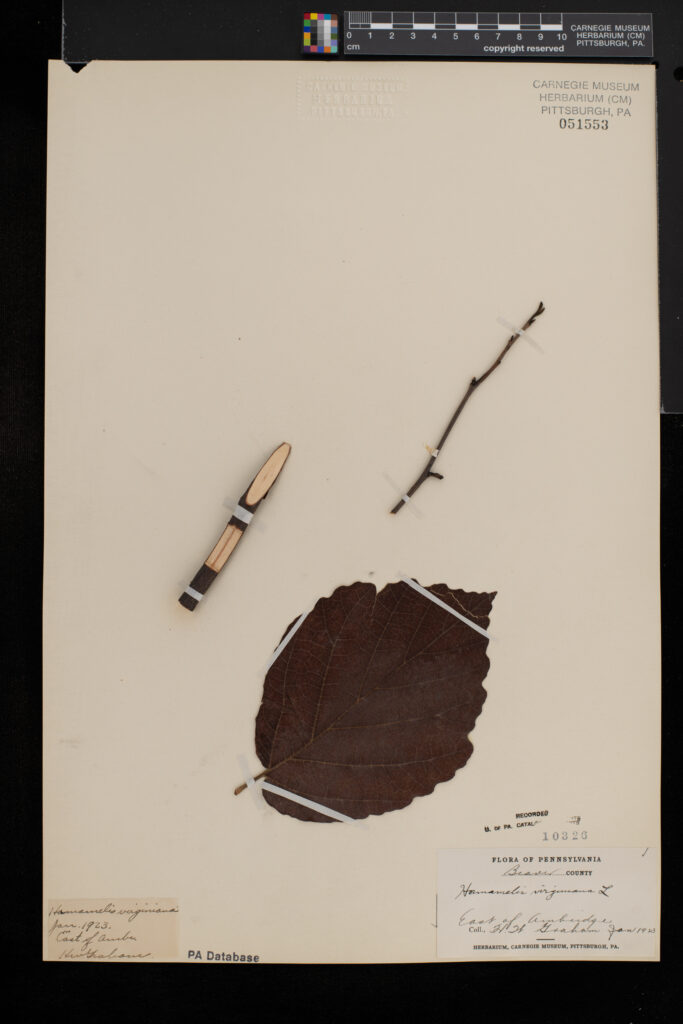
witch hazel branch, buds, and leaf on an herbarium sheet

This specimen of common witch hazel (Hamamelis virginiana) was collected in January 1923 in Beaver County, Pennsylvania “East of Ambridge” by H.W. Graham.  Herbert W. Graham (1905-2009) was an “Assistant” in Botany at the Carnegie Museum from 1925-1929 while he was a student at the University of Pittsburgh who later became an oceanographer at the Woods Hole Oceanographic Institution. During his time at the museum, he collected many specimens, often with his brother, Edward H. Graham, who was also an Assistant in Botany, later curator (1931-1937) and later, a well-known conservationist with the US Department of Agriculture.  The Graham brothers went on expeditions to the Sonoran Desert in the late 1920s, collecting specimens and information that was used to create the desert diorama that remains in the museum’s Hall of Botany today.

This specimen has a “bits and pieces” feel to it, but shows what the plant looks like in winter, with branches, buds, a leaf, and even including a nice cross section cut out of the stem. The leaf is in great shape, which makes me question whether the leaf was truly was collected in January, when the leaves are usually dry and crumbled from the wrath of winter. 

The specimen was simply collected in “January 1923” with no note on the day of year.  I feel that coming off a holiday break (what day is it?).  But more seriously, it reminds us that many specimens of the past were collected for different purposes with many of their uses today unanticipated.  For instance, collectors today would certainly record the calendar date of collection, valued just as much as information on the location it was collected, as scientists routinely use specimens to date information to understand the seasonal timing of leafing, flowering, and fruiting with changing environmental conditions over time.
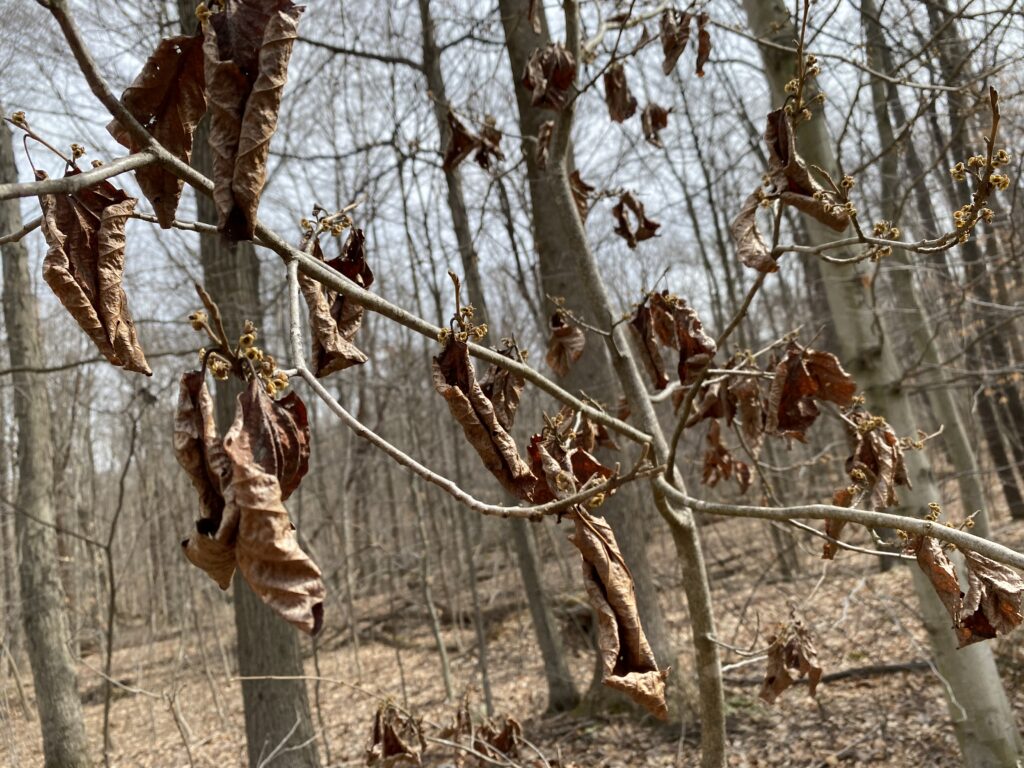
brown, dry leaves hanging from branches

The leaf is a nice touch, too.  It indicates that at least some leaves were still around in the winter of 1923, and it is quite possible they were even still connected to the stem.  Though this species is deciduous (drops its leaves seasonally), common witch hazel has been known to sometimes hang onto some dead leaves on branches through winter.  This phenomenon is known as “marcescence.”  Why this happens isn’t fully known.  Read more here.

You can find this specimen and 588 others of the species in the Carnegie Museum herbarium here.

Above: Witch hazel exhibiting marcescence, with last year’s leaves still attached in early spring (photo taken March 23 2021 at Powdermill Nature Reserve)

Below: Witch hazel’s magnificent autumn blooms. Unlike many woody plants in our region that bloom in spring as leaves are emerging, this species blooms in fall, as its leaves are dropping! (Photo taken October 29 2022 in New Kensington, PA.)
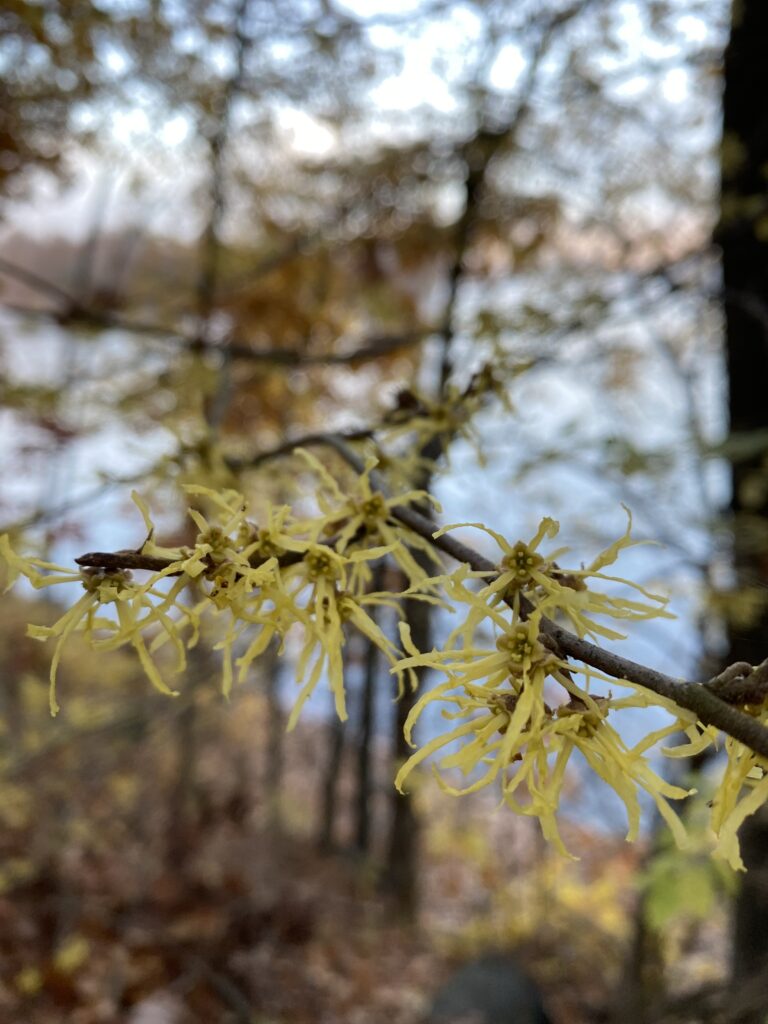
witch hazel blooms

Mason Heberling is Associate Curator of Botany at Carnegie Museum of Natural History.

Related Content

Witch Hazel Collected on Halloween in 1931

Collected On This Day in 1951: Bittersweet

What’s in a Name? Japanese Knotweed or Itadori

Carnegie Museum of Natural History Blog Citation Information

Blog author: Heberling, Mason
Publication date: January 16, 2024
Share this post!

  • Share on Twitter Share on Twitter
  • Share on Facebook Share on Facebook
  • Share on Pinterest Share on Pinterest
  • Share on LinkedIn Share on LinkedIn
  • Share on Reddit Share on Reddit
  • Share via Email Share via Email

Filed Under: Blog Tagged With: Botany, collected on this day, Hall of Botany, Mason Heberling, Science News

May 30, 2023 by Erin Southerland

Collected On This Day: White Trillium from May 28, 1993

by Mason Heberling
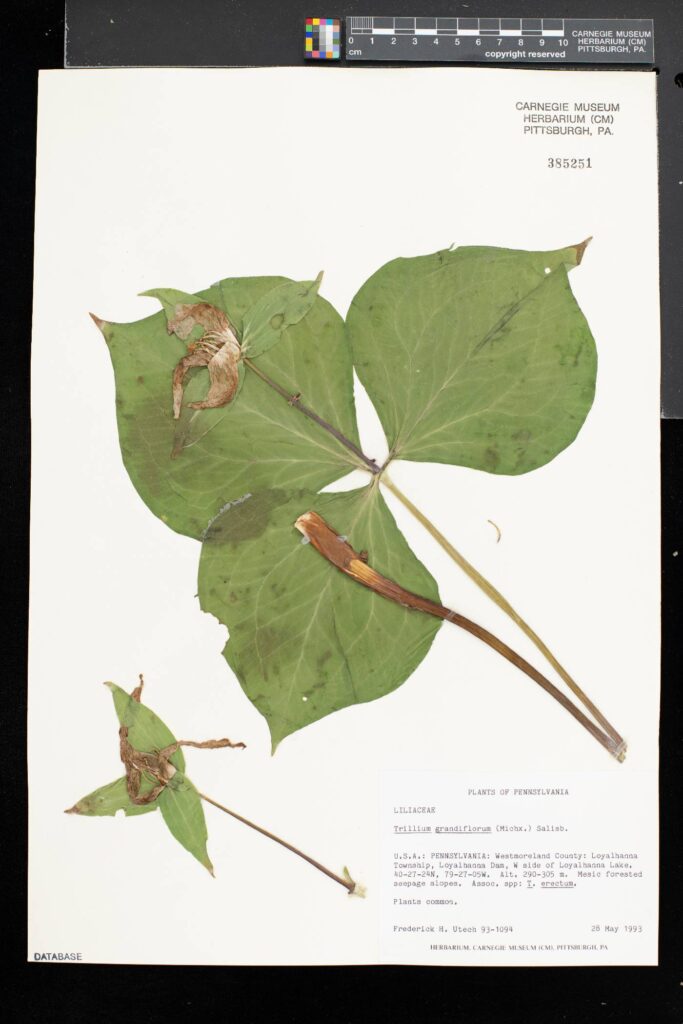
herbarium specimen of white trillium

Spring flowers fade, but some leaves hang on

This specimen of white trillium (Trillium grandiflorum) was collected by Fred Utech in Loyalhanna Township, Pennsylvania on May 28, 1993.  Fred Utech was Curator of Botany at Carnegie Museum of Natural History from 1976-1999. You can find this specimen here and search for many more trillium at midatlanticherbaria.org.

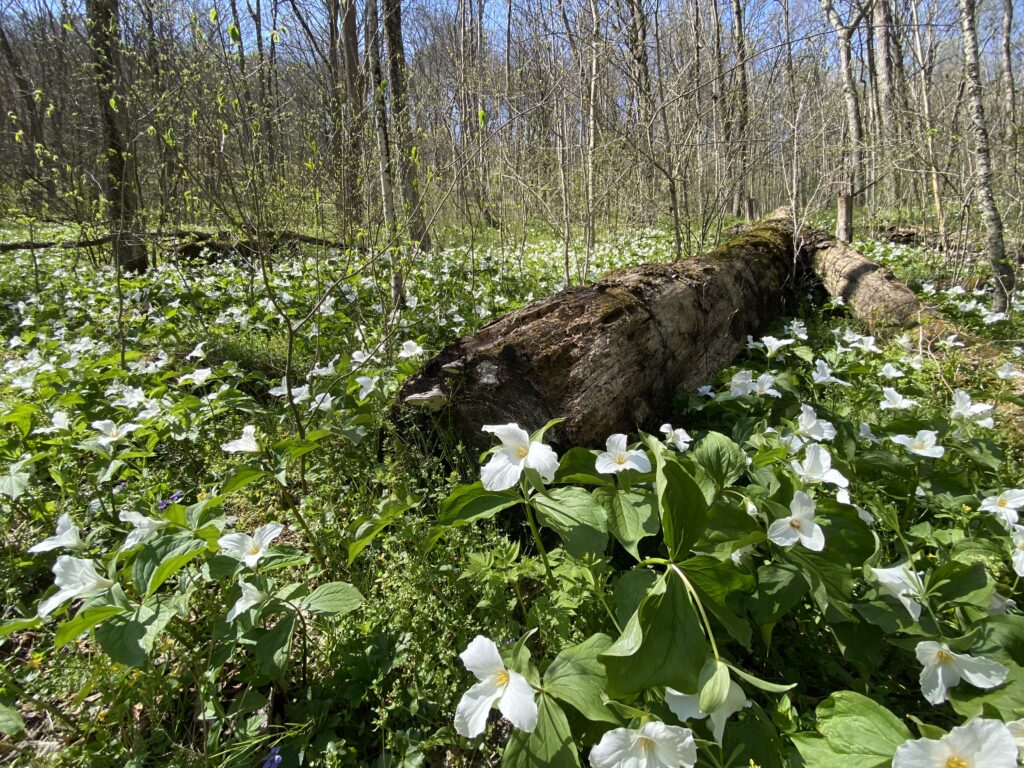
Trillium grandiflorum (white large-flowered trillium) is perhaps the most common trillium species in western Pennsylvania, along with Trillium erectum (red trillium, though petals can be white, red/purple, or occasionally yellow; the ovary is deep red, unlike white trillium).  Peak blooms of this species can be breathtaking when covering hillsides. Deer also enjoy trillium, and herbarium specimens have been used to understand their impact.

numerous white trillium flowers growing in a forest

As the heat of summer is upon us, these spring blooming species begin to fade. Or at least their flowers do.  Some trillium keep their leaves into the deep shade of summer. Though light levels are low due to the shade of overstory trees, early summer is an important time for many spring blooming species to develop their fruits.  A local study from our group found more than 20% of photosynthetic energy gains in Trillium grandiflorum after overstory trees produced leaves.

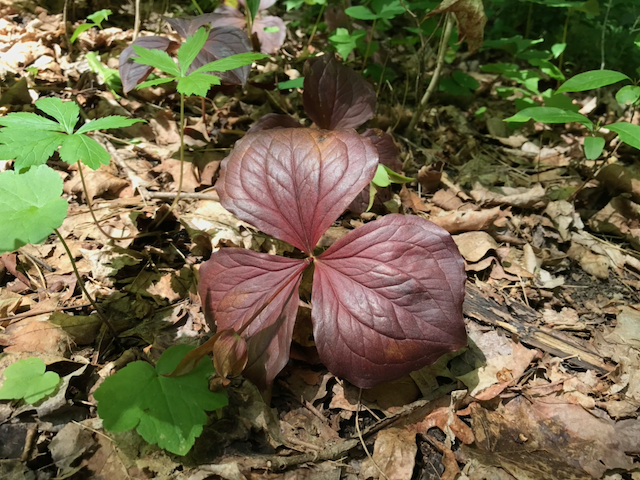
White trillium leaves do die back in mid-summer, however.  We often think of leaf coloration in the fall, but some trillium curiously have leaves that turn a deep red as they fade in mid-summer.  We are currently working up an undergraduate students-led project on this intriguing natural history phenomenon. Only about 10% of plants turn red (but highly variable), and first results suggest there doesn’t seem to be a method to the madness that explains why. More soon!  For now, enjoy the “fall” foliage of summer below.

red leaved white trillium growing in the woods

Mason Heberling is Assistant Curator of Botany at Carnegie Museum of Natural History.

Related Content

Collected On This Day in 1925: A Flower with No Leaves?

Collected On This Day in 1982: One Specimen Isn’t Always Enough!

Mayapple at Powdermill [Video]

Carnegie Museum of Natural History Blog Citation Information

Blog author: Heberling, Mason
Publication date: May 30, 2023

Share this post!

  • Share on Twitter Share on Twitter
  • Share on Facebook Share on Facebook
  • Share on Pinterest Share on Pinterest
  • Share on LinkedIn Share on LinkedIn
  • Share on Reddit Share on Reddit
  • Share via Email Share via Email

Filed Under: Blog Tagged With: Botany, collected on this day, Hall of Botany, liocf, Mason Heberling, Science News

November 22, 2022 by Erin Southerland

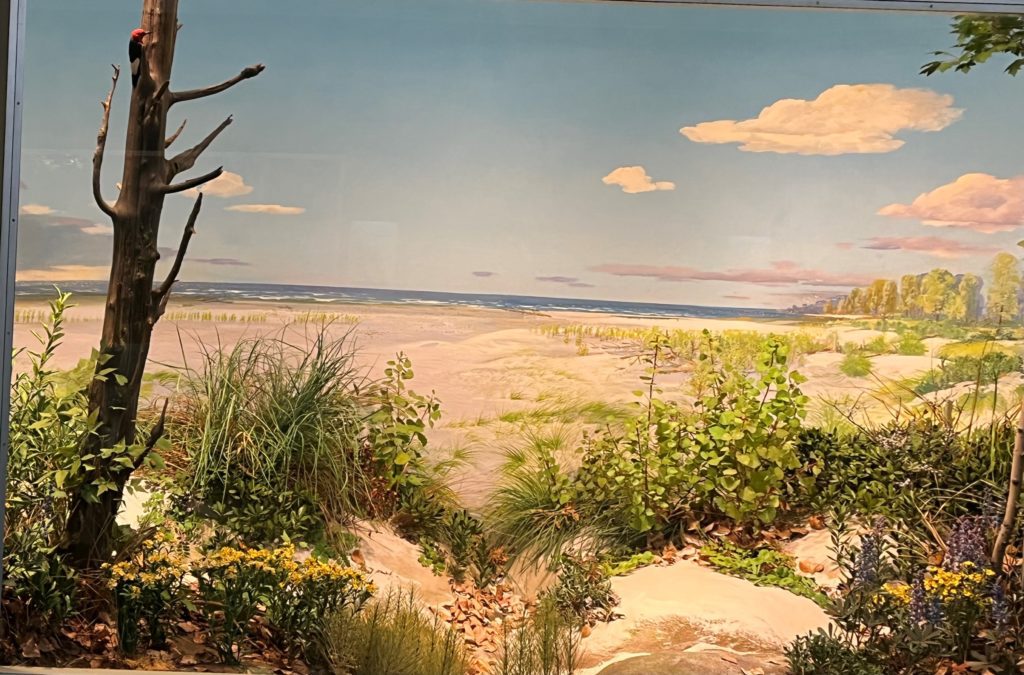
A Bit of Presque Isle, Erie, PA in the Hall of Botany

by Patrick McShea
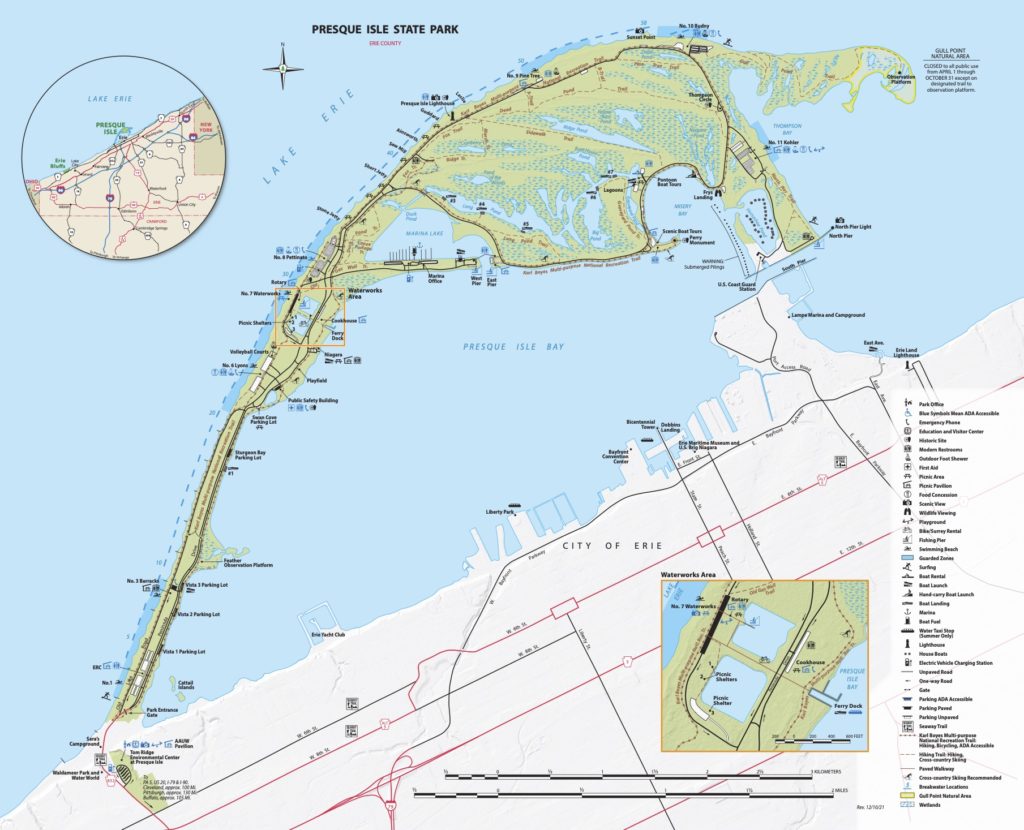
Credit: Pennsylvania State Parks

Presque Isle State Park is the most visited component of Pennsylvania’s 121 park system. In recent years, the beaches, trails, and ponds of this six-mile-long, 3,200-acre Lake Erie sand spit have drawn more than four million annual visitors. Repeat visits by local residents account for a significant portion of the seven-figure tally. The peninsula’s eastward curl into the lake creates the bay which fronts the city of Erie, and the park, which celebrated its 100th anniversary in 2021, frames northward views in many city neighborhoods.

Some 120 miles south of the park, at Carnegie Museum of Natural History, visitors encounter a life-sized and un-peopled section of this unique landscape when they enter the Hall of Botany. This spacious plant-centered hall honors the vision of the museum’s first and longest-serving Curator of Botany, Otto Jennings, with eight dioramas created between the 1920s and 1970s that depict biomes with visually distinctive characteristics. The Presque Isle diorama, which opened in 1966, earns a spot among detailed three-dimensional depictions of the Sonoran Desert, Florida Everglades, and high-altitude slopes of Mount Rainier, by virtue of its representation of land continually shaped by the actions of wind, waves, and plant succession.  

As a label adjacent to the summer scene explains, Presque Isle is a place where a full cycle of plant community development can be observed in a compact space. At many park locations, a cross-peninsula transect of a few hundred yards might include the bare sand of new beach deposits, dunes stabilized by pioneering plants, marshes framed by sand ridges supporting shrubs and young trees, and patches of mature forest.

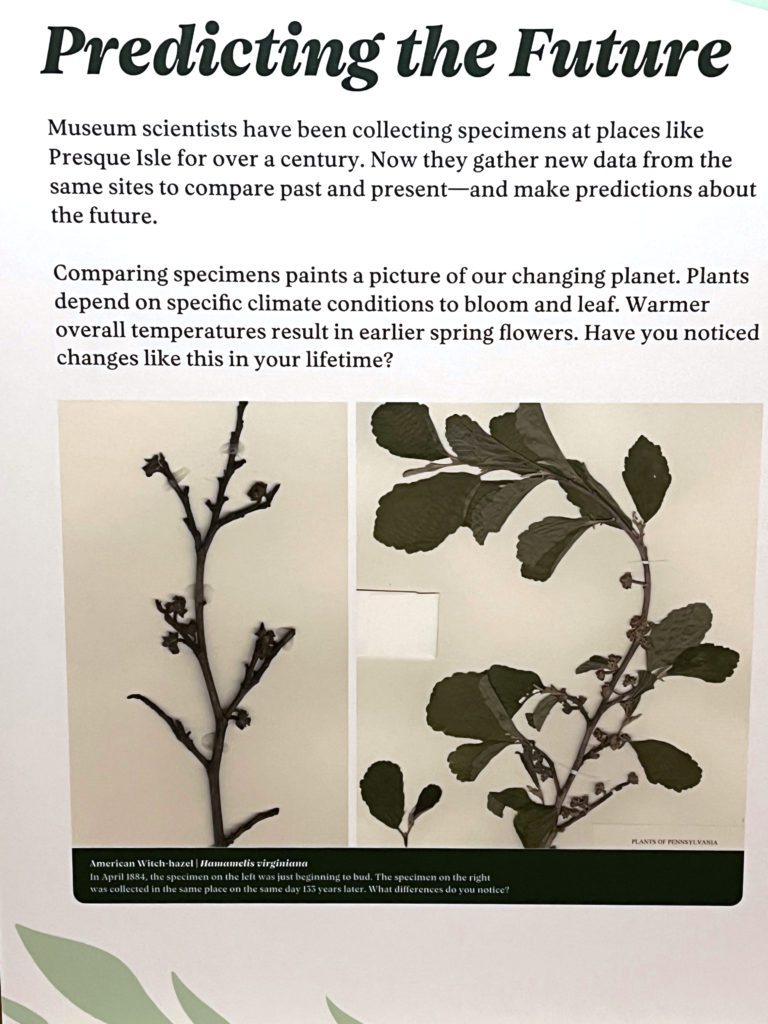
One of the diorama’s interpretive panels invites viewers to notice a half dozen featured plants and animals, while another uses two preserved specimens of witch hazel branches, collected on Presque Isle on the same date, but 133 years apart, to document dramatic changes in this common tree’s spring leaf-out date. The museum’s herbarium holds more than 3,300 Presque Isle plant specimens from ongoing collection efforts that date to 1868. These preserved plants, along with the standardized information recorded with each one, document such changes as the relatively recent abundance of non-native flora, and the decline of some rare plant populations in the wake of engineered beach stabilization efforts. 

Like all the museum’s dioramas, this window into the frozen time of a specific place lends itself to multiple interpretations by museum educators. In addition to narratives about plant succession, or the irrefutable evidence botanical records provide of a changing climate, the diorama’s recreated beach scene is a good place for students to listen to an explanation of the geology term “longshore drift,” or to consider how freshwater, even in a watershed as vast as the Great Lakes Basin, is a limited natural resource.

For some viewers, the diorama will serve as a visual prompt to visit or revisit the park and leave their own footprints on Presque Isle sands. Anyone considering a visit will find the experience enriched by making a preliminary electronic stop at the park website maintained by the Pennsylvania Department of Conservation and Natural Resources, as well a physical stop, just outside the park entrance, at interpretive exhibits in the 16-year-old Tom Ridge Environmental Center (TREC).

 On the website, among activity descriptions, park maps, recent news releases, and relevant advisories, a tab labelled “History” (under the category “Additional Information”) leads not only to a summary of the peninsula’s role in sheltering a fleet of American ships during the War of 1812 and a link to geology-focused park guide, but also to a brief account that, when repeated, serves to acknowledge how this unusual landscape was long ago utilized and cherished by Native Peoples. 

The Erie Indians lived along the southern shores of Lake Erie and were early inhabitants of the area. They hunted game from the forests, gathered plants, and fished from the waters of Lake Erie in birch-bark canoes.

According to legend, the Erie ventured far into the lake to find the place where the sun sank into the waters.

The spirits of the lake caused a great storm to arise, so the Great Spirit stretched out his left arm into the lake to protect the Erie from the storm. Where the sheltering arm of the Great Spirit had lain in the lake, a great sandbar in the shape of an arm-like peninsula was formed to act as an eternal shelter and harbor of refuge for the Great Spirit’s favorite children, the Erie.

https://www.dcnr.pa.gov/StateParks/FindAPark/PresqueIsleStatePark/Pages/History.aspx

Repeating the account in the Hall of Botany can add a new dimension to a 56-year-old diorama.

Patrick McShea works in the Education and Marketing departments at Carnegie Museum of Natural History.

Related Content

Collected On This Day in 1930: Native or Not?

Feather and Bone Connections to American History

Witch Hazel

Carnegie Museum of Natural History Blog Citation Information

Blog author: McShea, Patrick
Publication date: November 22, 2022

Share this post!

  • Share on Twitter Share on Twitter
  • Share on Facebook Share on Facebook
  • Share on Pinterest Share on Pinterest
  • Share on LinkedIn Share on LinkedIn
  • Share on Reddit Share on Reddit
  • Share via Email Share via Email

Filed Under: Blog Tagged With: Botany, Hall of Botany, Pat McShea, Science News

November 13, 2020 by wpengine

Collected on this Day 105 years ago

So long, leaves.

Autumn has fallen.

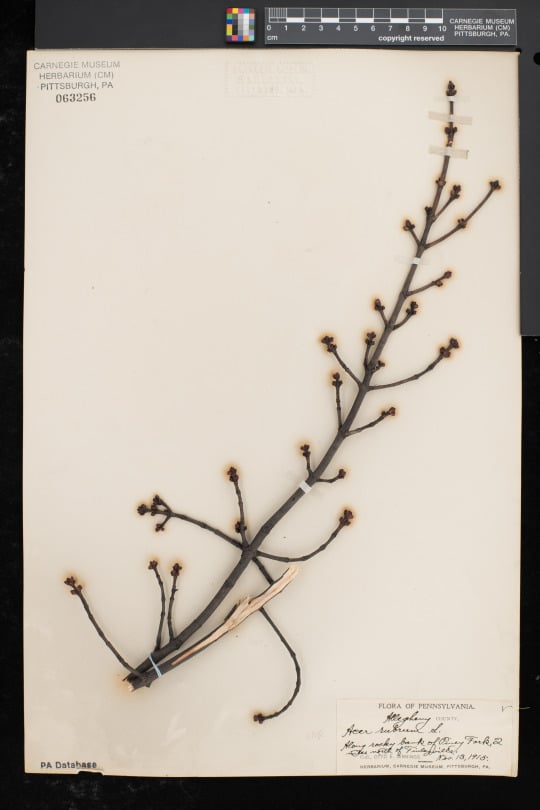
specimen of red maple on herbarium sheet

This specimen of red maple (Acer rubrum) was collected on November 13, 1915 by Otto Jennings near Finleyville, Pennsylvania (about 30 miles south of Pittsburgh).  Jennings was an influential botany curator (and biology professor at University of Pittsburgh and director of Carnegie Museum, among many other roles through his many decades career at the museum).

Just imagine how beautifully red these leaves must have been.   And you’ll have to imagine because this specimen is just twigs!

But upon closer look, the twigs have a lot to admire.  As with other deciduous trees in Pennsylvania, the buds are primed and ready.  In spring (as early as March for red maple!), these buds will swell and flowers will emerge.  Leaves will follow.

But first, we wait it out through winter.

Pay attention to tree buds this winter. They have a lot to say.

Find this red maple specimen here (along with 512 others!).

Check back for more! Botanists at the Carnegie Museum of Natural History share digital specimens from the herbarium on dates they were collected. They are in the midst of a three-year project to digitize nearly 190,000 plant specimens collected in the region, making images and other data publicly available online. This effort is part of the Mid-Atlantic Megalopolis Project (mamdigitization.org), a network of thirteen herbaria spanning the densely populated urban corridor from Washington, D.C. to New York City to achieve a greater understanding of our urban areas, including the unique industrial and environmental history of the greater Pittsburgh region. This project is made possible by the National Science Foundation under grant no. 1801022.

Mason Heberling is Assistant Curator of Botany at Carnegie Museum of Natural History. Museum employees are encouraged to blog about their unique experiences and knowledge gained from working at the museum.

Related Content

Collected On This Day 98 Years Ago (Chestnuts)

Who Likes Teaberry? Collected 56 Years Ago

Ask a Scientist: How do you find rare plants?

Filed Under: Blog Tagged With: Botany, botany hall, collected on this day, Hall of Botany, Mason Heberling, Museum from Home, Science News

October 21, 2020 by wpengine

Collected on This Day 98 Years Ago

Chestnuts (used to be) on Chestnut Ridge

And across the entire state of Pennsylvania.


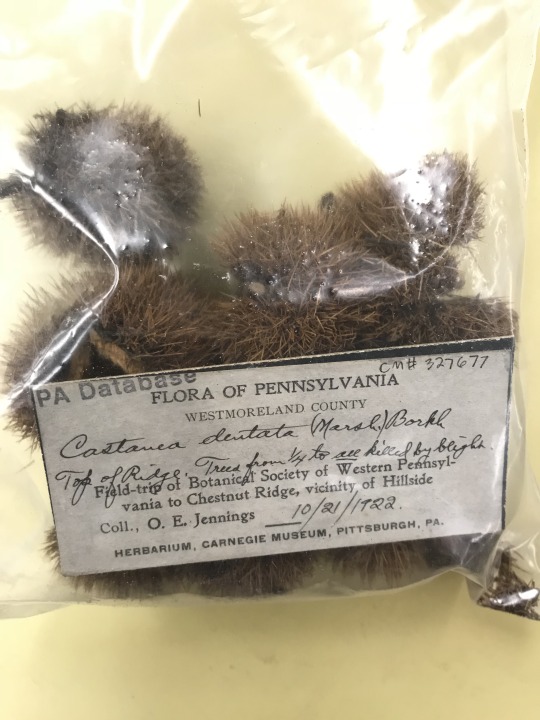
bag of chestnut seeds

American chestnut (Castanea dentata) was once a very common tree, native from Maine to Mississippi. In the heart of the Appalachians, the historical range covered the entire state of Pennsylvania. I say “historical” and “once a very common tree” because it is no longer.  You may occasionally stumble upon an American chestnut tree, especially small trees and saplings persisting as sprouts from the large trees that graced our landscape a century ago. Older trees, with mature fruits, are quite rare.  

In fact, some estimates suggest American chestnut accounted for one in four trees in some forests!  So, what happened?  In the early 1900s, a disease caused by a pathogenic fungus (Cryphonectria parasitica) was accidentally introduced with imported Asian trees. It was first recorded in New York City in 1904.  In a matter of decades, American chestnut was nearly decimated by this disease known as Chestnut blight.

The Carnegie Museum of Natural History herbarium captures this change in our forests.  

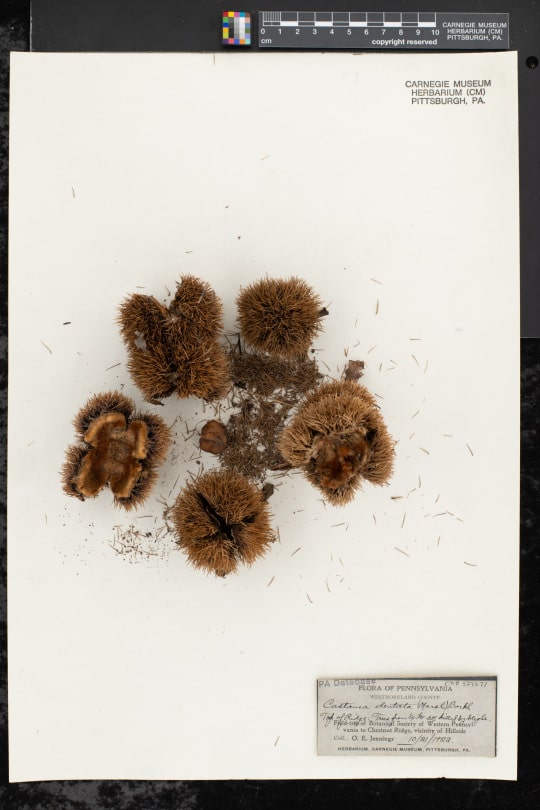
American chestnut specimen on herbarium sheet

This specimen of American chestnut was collected by influential Carnegie Museum curator Otto Jennings on October 21, 1922 on a field trip of the Botanical Society of Western Pennsylvania to Chestnut Ridge, near Derry Township, Pennsylvania.  Chestnut Ridge is a ridge of the Allegheny Mountains, presumably named for its (once) many American chestnuts.  

This specimen is from the fruit collection of the herbarium.  These specimens are different than the “standard” pressed flat specimens on paper.  Instead, they are stored to maintain their three-dimensional structure.

Note the note made by Jennings on the label on this specimen: “Trees from ¼ to all killed by blight.”

The case of the American chestnut is an interesting one.  It served important cultural and ecological roles; some even calling it a “keystone” species.  There is no doubt that the functional extinction of American chestnut ricocheted through the ecosystem, causing long-term biological changes. Many of these changes we may not know.  Yet, at the same time, despite the species importance, our forests continue.  Presumably other species have filled the functional and physical space of American chestnut.  

Disease and pest outbreaks in Pennsylvania’s forests continue.  Many of our critical tree species are likely to decline in coming years and decades.  Some iconic species have already declined or are at risk.  These include our ash species (mortality caused by introduced Emerald Ash Borer), American beech (Beech leaf disease, Beech bark disease caused by an introduced scale insect), and eastern hemlock (mortality caused by introduced sap sucking bug, the hemlock woolly adelgid)…to name only a few threats.

What will Penn’s woods look like in another 100 years?  

Our collections document the past and present to inform our decisions for the future.

Find this American chestnut specimen here (along with 268 others!): https://midatlanticherbaria.org/portal/collections/list.php?db=328&includecult=1&taxa=Castanea+dentata&usethes=1&taxontype=2

Check back for more! Botanists at the Carnegie Museum of Natural History share digital specimens from the herbarium on dates they were collected. They are in the midst of a three-year project to digitize nearly 190,000 plant specimens collected in the region, making images and other data publicly available online. This effort is part of the Mid-Atlantic Megalopolis Project (mamdigitization.org), a network of thirteen herbaria spanning the densely populated urban corridor from Washington, D.C. to New York City to achieve a greater understanding of our urban areas, including the unique industrial and environmental history of the greater Pittsburgh region. This project is made possible by the National Science Foundation under grant no. 1801022.

Mason Heberling is Assistant Curator of Botany at Carnegie Museum of Natural History. Museum employees are encouraged to blog about their unique experiences and knowledge gained from working at the museum.

Related Content

Our Eureka Moment! 

Super Science: Goldenrod

A Day Late, But Thanks for Your Impatiens! 

Filed Under: Blog Tagged With: Botany, collected on this day, Hall of Botany, Mason Heberling, Science News, Section of Botany

October 8, 2020 by wpengine

How Do You Preserve a Giant Pumpkin?

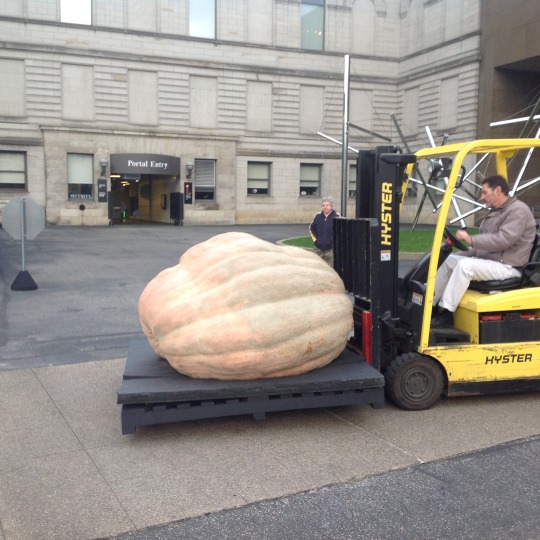
giant pumpkin being moved with a forklift

A few years ago, I came across a dilemma that I wasn’t sure how to resolve. The Section of Botany was given permission to preserve, for the scientific collection, part of the giant pumpkin that was in the exhibition, We Are Nature: Living in the Anthropocene. This was an intriguing offer. I just wasn’t sure how to go about it. Preserving any large fruits or plant parts can be a real challenge. Plant materials must be dried before they rot, and the process must happen at a temperature low enough to prevent the material from being cooked. The normal procedure of putting a plant or plant part into a plant press and drying it with warm dry air was not really an option; at least not for a 2,090-pound pumpkin that wouldn’t even fit in my car, let alone my plant press.

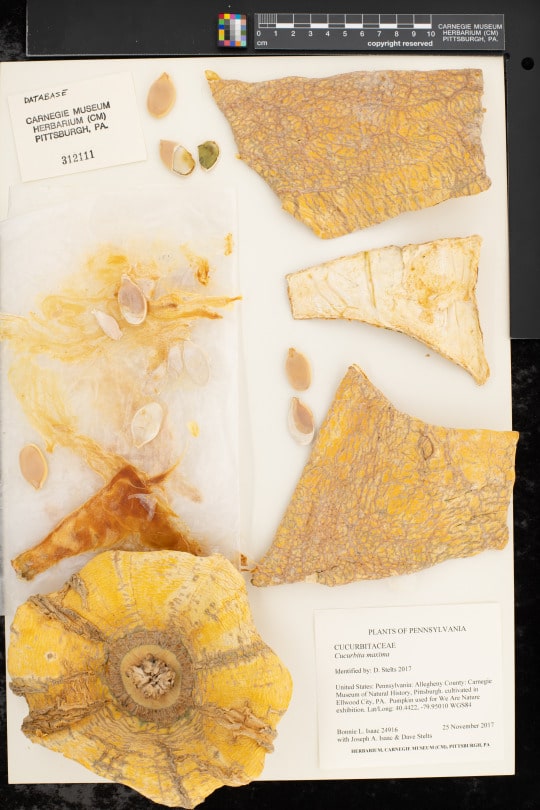
Pumpkins are a type of squash, but trying to literally squash one to dry it seemed a bit daunting. The farmers who grew this giant pumpkin were more than willing to give us whatever parts of the pumpkin we wanted to preserve, and they were even willing to help with cutting them from the pumpkin. We decided on trying to keep the unique parts of the pumpkin, like the stem and the blossom end (bottom). We also saved some of the inner tissue and a few seeds. The seeds on a pumpkin this large are a prize commodity. If a pumpkin from which seeds are properly harvested was a champion, as this one was, each seed could sell for $30 to upwards of $50. It was very generous of the farmers to allow us to have some of these seeds for our collection.

dried pieces of a pumpkin on an herbarium sheet

Pumpkin farmers keep close tabs on the genetics of these giants and actively work at growing larger pumpkins. You can actually find family tree information for this very pumpkin online if you search for it. Who knows how large mankind will eventually enable pumpkins to grow? The plants that grow these large squashes (the Cucurbita maxima variety known as ‘Atlantic Giant’) are a variety of the same species that produce Hubbard Squash. This species, which was originally from South America, has become one of the more diverse domesticated plants.

Giant pumpkins have been a focal point of imagination and literature for some time. Think of Cinderella. There are several variants on the Cinderella tale going back hundreds of years that involve large squash. Back when these stories were written though, it was a fantasy to think there actually could be a pumpkin that a person could fit inside.

Now that we are using QR codes on our herbarium labels, it’s easy to add photographs to plant specimen records. I wish we had thought to do this  before the massive pumpkin was cut up. Maybe I will go back and add a QR code to the label, so the actual pumpkin can be seen again in its full glory. What we have in the collection now are bits and pieces, mere remnants of the gentle giant that grew 45-50 pounds per day in 2017.

Getting back to my original question, how do you preserve a giant pumpkin? I guess the answer is a little bit at a time!

More on this giant pumpkin:

Sasquatch Squash

Giant Pumpkin Seed Harvest 

Collected on This Day: November 25, 2017

Bonnie Isaac is the Collection Manager in the Section of Botany. Museum staff, volunteers, and interns are encouraged to blog about their unique experiences and knowledge gained from working at the museum.

Filed Under: Blog Tagged With: Anthropocene Studies, Bonnie Isaac, Botany, Hall of Botany, halloween, Science News, Section of Botany

  • Page 1
  • Page 2
  • Page 3
  • Page 4
  • Go to Next Page »

sidebar

About

  • Mission & Commitments
  • Directors Team
  • Museum History

Get Involved

  • Volunteer
  • Membership
  • Carnegie Discoverers
  • Donate
  • Employment
  • Events

Bring a Group

  • Groups of 10 or More
  • Birthday Parties at the Museum
  • Field Trips

Powdermill

  • Powdermill Nature Reserve
  • Powdermill Field Trips
  • Powdermill Staff
  • Research at Powdermill

More Information

  • Image Permission Requests
  • Science Stories
  • Accessibility
  • Shopping Cart
  • Contact
  • Visitor Policies
One of the Four Carnegie Museums | © Carnegie Institute | Privacy Policy | Terms of Use | Accessibility
Rad works here logo