• Skip to primary navigation
  • Skip to main content
  • Skip to primary sidebar

Carnegie Museum of Natural History

One of the Four Carnegie Museums of Pittsburgh

  • Visit
    • Buy Tickets
    • Visitor Information
    • Exhibitions
    • Events
    • Dining at the Museum
    • Celebrate at the Museum
    • Powdermill Nature Reserve
    • Event Venue Rental
  • Learn
    • Field Trips
    • Educator Information
    • Programs at the Museum
    • Bring the Museum to You
    • Guided Programs FAQ
    • Programs Online
    • Climate and Rural Systems Partnership
  • Research
    • Scientific Sections
    • Science Stories
    • Science Videos
    • Senior Science & Research Staff
    • Museum Library
    • Science Seminars
    • Scientific Publications
    • Specimen and Artifact Identification
  • About
    • Mission & Commitments
    • Directors Team
    • Museum History
  • Tickets
  • Give
  • Shop

volunteers

December 7, 2020 by wpengine

“Quaran-Teened”: Closed Spaces, Open Minds

laptop keyboard

We are living in a time of drastic changes, uncertain futures, and confounding boundaries. The pandemic shook our core values by keeping everyone physically separated. Here at Carnegie Museum of Natural History, educators had to think outside-the-box for ways to keep staff connected and our audiences engaged. Creating virtual programs was no small feat, but a special group of young people embraced the changes.

A handful of museum educators with responsibility for summer camp programs pressed onward with a group of returning teen volunteers, including some who have been volunteering with CMNH for a several years. Creating virtual programs was no small feat as Online Museum sessions replaced in person camps. Our teens embraced the changes and helped participants feel comfortable in this new normal by providing positive energy and continual encouragement. As part of their transformation from classroom helpers to virtual instruction assistants, several teen volunteers developed insightful, natural history-related literature in the form of blog posts. The Museum is proud to introduce these keyboard warriors, our very first cohort of teenage volunteer bloggers. You may have already read some of these blogs, and there are more to come! Meet just a few of these promising young writers:

Claire Ianachione: Hi, my name is Claire Ianachione, and I am excited to be writing blogs for the museum. I love learning new things about history and sharing them with other people. I cannot wait to start sharing blogs and I hope people enjoy reading them.

Samhita Vasudevan: My name is Samhita Vasudevan, and I’m super excited to write blogs for the museum! In my free time, I enjoy baking, going on runs, listening to music, and watching movies. My favorite exhibits at the museum are the Hillman Hall of Minerals & Gems and the Art of the Diorama.

Caroline Lee: My name is Caroline Lee and I’ve been involved with Powdermill since I was 10. When I heard of this great opportunity to write blogs for the museum, I was very excited to start because while I love PNR and Carnegie Museums, I also love writing! In my free time I am a musician in my school marching band, and a member of the “Science Matters” club!

Niko Borish: A longtime admirer of natural science, I attended summer camp at Powdermill Nature Reserve several times before becoming a volunteer there. Though primarily interested in herpetofauna, I enjoy investigating all aspects of the natural world whenever I can. Currently a junior in high school, I plan to study environmental science in college.

Angela Wu: Most of my passions can be summarized by “I love to create.” I’m interested in software development and its many applications in a variety of fields, but I also create writings, drawings, paintings, and music (albeit not very well). In my spare time, I enjoy reading, writing, and eating Ramen.

Xavier Ramirez: I am a sophomore in high school. I enjoy acting, music, and STEM. Currently, I keep myself busy with writing and long games of Risk.

Teen volunteers are an integral part of making summer camp a meaningful experience for campers. While 2020 brought about some difficult challenges that radically changed the summer camp experience, we want to extend a big thank you to all of our teen volunteers who helped the program!

Sara Klingensmith is an Environmental Educator & Naturalist at Powdermill Nature Reserve and Brandon Lyle is a Museum Educator at Carnegie Museum of Natural History. Museum employees are encouraged to blog about their unique experiences and knowledge gained from working at the museum.

Related Content

Teaching About Teeth

Digital Developments: Why Archiving and Herpetology Go Hand-in-Hand
How-to Make Hatchable Dinosaur Eggs

Filed Under: Blog Tagged With: Educators, Museum from Home, volunteers

October 29, 2020 by wpengine

Did Neanderthals Make Musical Instruments?

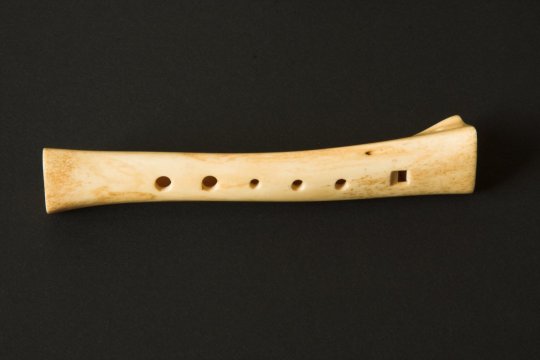
bone flute on black background

Do you like to listen to music? Have you ever admired the skill of a musician? Maybe you even know how to play an instrument yourself. Unsurprisingly, humans (Homo sapiens) have enjoyed this rewarding art for all of recorded history. In fact, the earliest evidence of musical instrument construction dates back to the great unknown ages of prehistory.

In 1995, researchers excavating deposits thought to be between 40,000 and 60,000 years old in a cave called Divje Babe (which translates to “Witch Cave”) in Slovenia found the femur (a leg bone) of a juvenile cave bear with an unusual line of small holes perforating one side. The find was recognized as being a fragment of a flute-like musical instrument. Due to the age and location of the discovery, the manufacture of the flute was attributed to Homo neanderthalensis (the Neanderthals) rather than Homo sapiens!

This discovery was extremely important in shaping our view of the Neanderthals, another species of hominid with which we share a common ancestor. Prior to this, they were often viewed as brutish, animalistic, and wholly incapable of aesthetic sensibilities. However, if they made musical instruments and played them for entertainment or ritual purposes, these activities mean that the Neanderthals were creating a complex culture reminiscent of our own when they went extinct around 40,000 years ago for reasons still unclear. The ability to modify a material so that it can then be used to create a variety of pitches implies, in the minds of some researchers, greater motor ability and a higher capacity for abstract thought.

There are many skeptics, however. Some posit that the holes in the bones are the result of hyenas making a meal of a juvenile cave bear, while others point to uncertainty about exactly when the perforations in the bone were created. Perhaps the interpretation of a modified bone as a musical instrument is all exaggeration brought on by our desire to relate to those who came so long before us. As of this writing, the scientific community is still undecided about how the holes into the bone were created and when it happened. There are two things we can all agree on, though: we hope someday to uncover the true origin of the Divje Babe bone flute, and musical instruments certainly rank among the greatest inventions of members of the genus Homo.

Niko Borish is a Teen Volunteer in the Education Department. Museum employees, volunteers, and interns are encouraged to blog about their unique experiences and knowledge gained from working at the museum.

Works Cited

Montagu, J. (2017, June 20). How Music and Instruments Began: A Brief Overview of the Origin and Entire Development of Music, from Its Earliest Stages (A. Nikolsky, Ed.). Frontiers in Sociology. Retrieved September 5, 2020, from https://www.frontiersin.org/articles/10.3389/fsoc.2017.00008/full

National Museum of Slovenia (Ed.). (n.d.). Neanderthal flute. Narodni Muzej Slovenije. Retrieved September 5, 2020, from https://www.nms.si/en/collections/highlights/343-Neanderthal-flute

The Royal Society. (2015, April 9). Are Neanderthal bone flutes the work of Ice Age hyenas? Phys.org. Retrieved September 5, 2020, from https://phys.org/news/2015-04-neanderthal-bone-flutes-ice-age.html

University of Wisconsin (Ed.). (2017). Neanderthal jam. The Why Files. Retrieved September 5, 2020, from https://whyfiles.org/114music/4.html

Related Content

Ancient Egypt Through its Pottery

Archaeology Merit Badge: Who Had More Fun, Me or the Boy Scouts?

History of Teddy Bears

Filed Under: Blog Tagged With: anthropology, Education, Educators, volunteers

June 28, 2019 by wpengine

Students, Research Associates, and Volunteers: Anthropology’s Real Treasure

The Anthropology Department is very fortunate to have a strong core of dedicated volunteers, research associates, and students. Without their valuable assistance, we would have a very hard time maintaining the quality of collection care and excellence in public engagement for which we feel immense amounts of pride. We’ve hosted volunteers for many years; some have specific interests which can help to augment our knowledge base, and others simply love the museum and want to help in any way that they can. Students come to us mostly from nearby universities, but occasionally from farther away. We have a long-standing partnership with Duquesne University to fulfill their Masters of Public History Collection Management internships. We’ve hosted students from the University of Pittsburgh, California University of Pennsylvania, Clarion University of Pennsylvania, Indiana University of Pennsylvania, Humboldt University (California), University College (London), and even students from China, the Netherlands, Australia, and Costa Rica. Our Research Associates fill in knowledge gaps that we lack in the section and use the collections to further their research and contribute to the academic world. Their expertise covers a wide range of topics from zooarchaeology and Eastern Woodlands archaeology to ethnology and cultural anthropology.

I’d like to toot a few horns regarding the annual meeting for the Society for Pennsylvania Archaeology, which was held in Uniontown, PA on April 5-7th, 2019. Two of our distinguished research associates were interviewed for an oral history project being conducted by representatives of PennDOT, the State Historic Preservation Office of Pennsylvania, and the Carnegie Museum of Natural History.  Dr. Mark McConaughy and Dr. William C. Johnson sat down to talk about their unique experiences with the history of archaeology in Pennsylvania. They also presented papers at the conference along with many other research associates. The collection at CMNH was mentioned in 75% of the papers given all weekend!

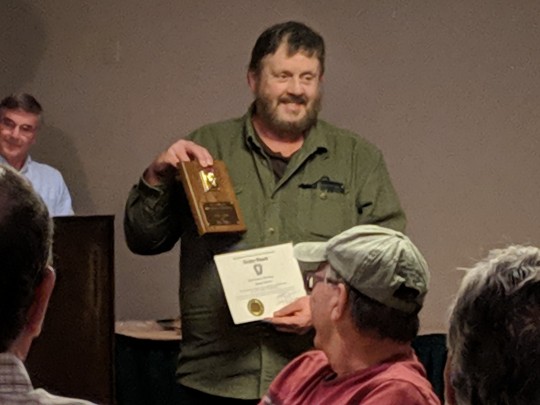
Three of our outstanding students/volunteers were presented awards at the banquet. Mr. James Barno has been a volunteer in the section for two years. He began as an intern from California University of Pennsylvania and has remained a volunteer since his graduation. He was given this year’s Archey Award, which is presented to members of the Society able to devote only spare time to their archaeological interests. It is given for some significant contribution (or contributions) over an appreciable period toward the unselfish furtherance of archaeology. We’re very proud of him!

James Barno holding the award

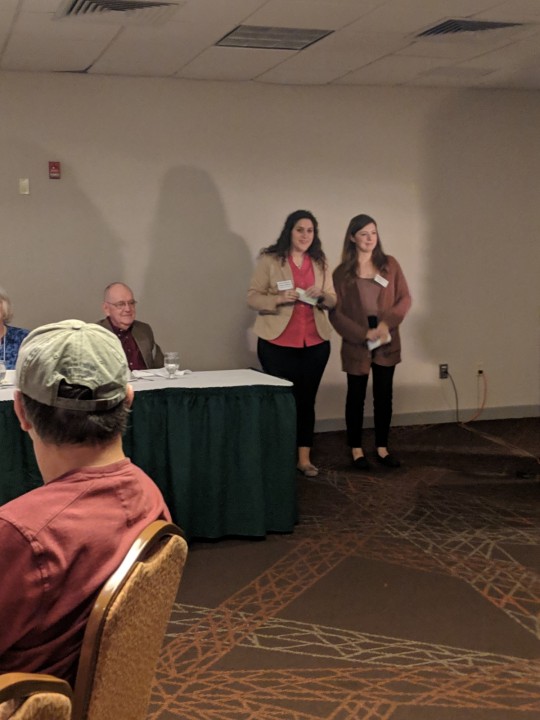
Also awarded were two James W. Hatch Scholarships for students presenting at the conference. One went to Tamara Alchoufete, who is our current work-study student from the University of Pittsburgh, and the other went to Indiana University of Pennsylvania graduate student and CMNH volunteer, Kristina Gaugler. Ms. Gaugler was also awarded the W. Fred Kinsey Scholarship, which is given to a student who presents a single authored paper at the meetings. It comes with a complimentary Society for Pennsylvania Archaeology membership and free conference banquet, along with a stipend for research expenses. Congratulations to both!

Tamara Alchoufete and Kristina Gaugler at the award ceremony

Cultivating an interest in professional development is something that we can offer to our students and volunteers, besides valuable museum related skills training. Volunteers, students, and research associates are truly our most valuable treasure.

More information on how to volunteer with CMNH can be found here: https://carnegiemnh.org/visitor/things-to-do/volunteer/

More information on the Society for Pennsylvania Archaeology can be found here: https://www.pennsylvaniaarchaeology.com/

Amy L. Covell-Murthy is the Archaeology Collection Manager at Carnegie Museum of Natural History. Museum employees are encouraged to blog about their unique experiences and knowledge gained from working at the museum.

Filed Under: Blog Tagged With: Amy Covell-Murthy, anthropology, Research Associates, volunteers, western pennsylvania

February 11, 2019 by wpengine

Benedum Hall of Geology –  A Teaching Laboratory for the Carnegie Interpreters

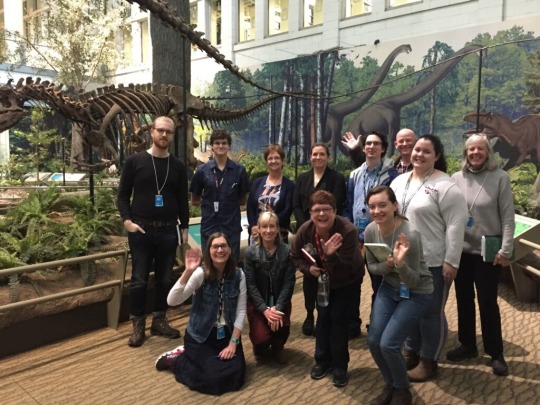
The new class of Education Interpreters of the Carnegie Museum of Natural History are training for their new positions through classroom instruction and practicing their presentations on the exhibit floors. The new name of Interpreters supersedes the language of Docents that previously described educators leading museum tours.  The Interpreters are enthusiastic, eager to learn, and rely on their diverse backgrounds and experiences to find their comfort zone about natural history sciences. Their training is being coordinated by Patty Dineen and Joann L. Wilson of CMNH Education.

As the museum’s geologist and invertebrate paleontologist, I’ve been asked to help train the Interpreters on geologic time, and to expound upon some of the new science recently published on the fossils and exhibits on display in Benedum Hall of Geology.  Most Interpreters have little or no working knowledge about geology and paleontology. This is not unusual in the least, as many of our patrons are not schooled in the geologic sciences. That’s unfortunate, because the scientific principles of geologic time, evolution, extinction, climate change, and biodiversity, are featured throughout the dioramas as noted in Benedum Hall of Geology, Dinosaurs in Their Time, Age of Mammals: The Cenozoic Era and Ice Age – The Pleistocene.

group of interpreters in from of dinosaur display

Andrew Carnegie’s interest in geology, paleontology and minerals is well documented. He instructed the Carnegie architects Alden & Harlow to design museum galleries to showcase the museum’s growing collections in invertebrate fossils, Vertebrate Paleontology (dinosaurs), and Minerals for his museum that opened in 1907. Some eighty years later, Alden & Harlow’s gallery opened as Benedum Hall of Geology and was recognized as the premier public exhibition to celebrate the geologic history of the state of Pennsylvania (Dawson 1988 and Harper & Dawson 1992). Even though the hall’s dioramas are more than 30 years old, most of the science concepts are relatively unchanged.

Over the last several years, publications and geology guides by section staff, research associates, and volunteers present new science on some of the hall’s content. For example, Brezinski & Kollar 2011 determined from years of field work in the central Appalachian Basin, the relationship of Pennsylvanian Age climate change events and congruent biotic responses, i.e., the evolution and extinction of the short lived Fedexiaamphibian. The fossil climate events as cited in the publication can be inferred through the content in the Pennsylvanian Coal Forest, Pennsylvanian Marine Life, and local stratigraphy dioramas – and as an extension to the modern anthropogenic climate events.

Two famous fossils discovered from western Pennsylvania, the giant eurypterid trackway from Elk County, PA (Brezinski & Kollar 2016 & Harper, Kollar & Hughes in press) and Fedexia striegeli, an amphibian skull from Moon Twp. (Berman, Henrici, Brezinski, Kollar 2010) are exciting new fossils to look at.  There are several unpublished education manuscripts that address other content in the hall: What Do Fossils Tell Us– brachiopod evolution and extinction (Kollar, Carter (deceased) & Hughes), Strata Wall (Kollar), and What’s A Fossil Fuel (Kollar).

In their instruction with me, the Interpreters receive printed handouts summarizing the published citations and section geology guides relevant to the hall’s dioramas.  The PAlS guides are, Geology of the Marcellus Shale 2011 (Strata Wall), History and Geology of Pennsylvania Petroleum 2012 (Stratavator), Geology of Pennsylvania’s Coal 2014 (Fossil Fuel), and The Geological Evolution of Pittsburgh’s Three Rivers (Where has the Water Gone).  The Interpreters are the museum’s ambassadors to the public, our advocates of Carnegie science, collections, and exhibitions. Welcome.

Albert D. Kollar is the Collection Manager in the Section of Invertebrate Paleontology at Carnegie Museum of Natural History. Museum employees are encouraged to blog about their unique experiences and knowledge gained from working at the museum.

Filed Under: Blog Tagged With: Albert Kollar, Benedum Hall of Geology, invertebrate paleontology, volunteers

August 27, 2018 by wpengine

The Volunteers: Can’t Live Without Them

By Albert Kollar

What makes an ideal volunteer at the Carnegie Museum of Natural History? Maybe the question should be how does one find a volunteer? For the Section of Invertebrate Paleontology, it was with luck and timing.  In 2002, I met Sam in Benedum Hall of Geology, who recently retired and was looking to learn about Pittsburgh geology and fossils. Sam with a Ph.D. in metallurgy had minored in geology in college in London. To train a volunteer without a background in fossils requires time and patience. With Sam it was easy, as he already was familiar with the scientific method. More luck and timing followed when two retired engineers Earl and Rich joined us. Our quartet was complete when Vicky arrived soon after.  By then, we recognized what type of volunteer will work for us going forward.

When the section formed the PAlS Program in 2004 we gained many more volunteers over the years.  PAlS (Patrons and lauradanae Supporters) is a section geology program that offered lectures on western Pennsylvania geology, fossil field trips, and in lab fossil workshops to the membership. We soon discovered that many PAlS members wanted to help in ways outside the museum.  We refer to these volunteers as the section’s ambassadors because they invest their time into promoting what the section and museum can offer to the region.  Some volunteers helped with financial support and collaborative projects with the Pittsburgh Geological Society, the Montour Trail Council, and the Allegheny County Parks – North Park.

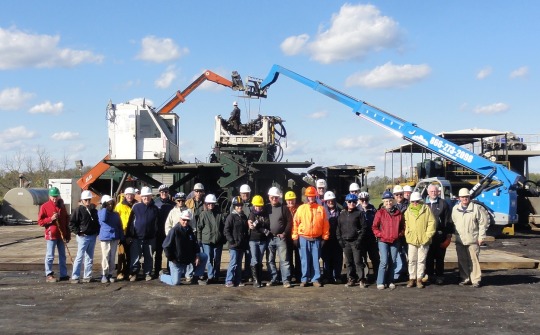
volunteers

From 2002 to 2018 the thirty-three volunteers contributed much to the section and museum.  First and foremost is their dedication to assisting with the curation of the section’s fossil groups. These include fossil corals, bryozoans, brachiopods, mollusks, ammonites, echinoderms, and gastropods. Some volunteers published peer reviewed papers based on the section’s fossils. Other worked with the section staff to publish 21 PAlS Geology Guides.  The former section curator John L. Carter and his wife Ruth provided financial support for field work and to publish the PAlS Guide No. 8, Geology and Fossils of the Tri-State Region Coloring Book Guide for school groups.

The professional backgrounds of the volunteers create knowledge that the section can use in its mission. For instance, the twenty-seven adults’ working careers varied from paleontologists and geologists, to medical doctors and a dentist, earth science teachers, teachers, museum docents, architecture historian, an author, an accountant, and a pharmacist assistant. Several of our volunteers were former graduate students with me (Dave, John, Henry and Roman) in the Department of Geology of the University of Pittsburgh. We are often referred to as Bud’s Men, in honor of the late Professor of Paleontology H.B. Rollins who was a volunteer as well.

We have had four college age volunteers who majored in geology. I am happy to report they found employment in the sciences or their chosen fields. Two high school volunteers who received their early start in fossils are doing very well. One is employed as a consultant in the health industry. The other is attending undergraduate college in Massachusetts. During the summer, she is a part-time research assistant in the section helping with our research projects.

As a final tribute here is the list of names: Bob, Bud (deceased), Chrissy, Dakota, Dan, Dave and Lauradanae, Earl, Ed, John, John and Ruth (both deceased), Harlan, Henry, Irina, J.J., Karen, Kay, Kendall, Laurie, Matt, Pam, Peter, Ray, Rich, Roman, Sam (deceased), Tamara, Tara, Thad, Valerie, Vicky, and Will. Thank you volunteers. Albert D. Kollar Section of Invertebrate Paleontology.

Albert D. Kollar is the Collection Manager in the Section of Invertebrate Paleontology at Carnegie Museum of Natural History. Museum employees are encouraged to blog about their unique experiences and knowledge gained from working at the museum.

Filed Under: Blog Tagged With: fossils, geology, invertebrate paleontology, volunteers

July 2, 2018 by wpengine

Without Volunteers, Carnegie Museum Mollusk Collection Could Not Exist

By Charles F. Sturm and Timothy A. Pearce

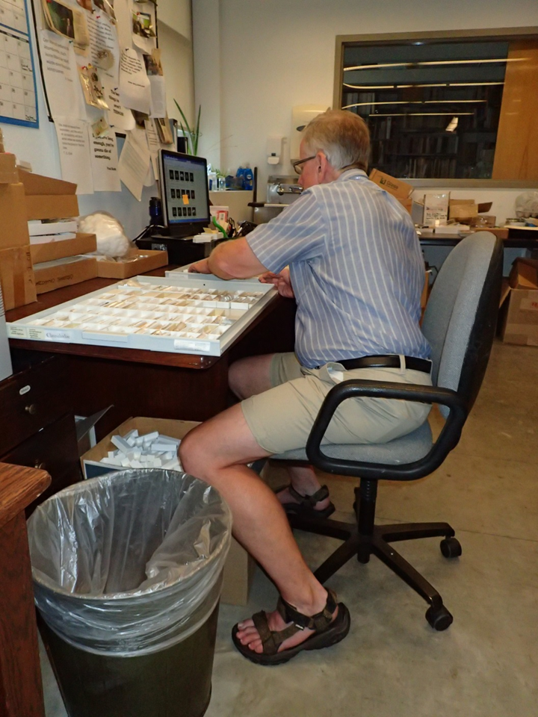
Volunteer Dan Cornell helps to sort and distribute specimens to their proper places in the research collection.

Scientists from around the world converged at the joint meeting of the American Malacological Society and the Western Society of Malacologists in Honolulu for a symposium on Museums and Modern Society on 21st of June 2018. One topic covered the importance of volunteers in Museums. Our paper in the symposium, entitled, “Without volunteers, collections as we know them could not exist,” highlighted some of the myriad ways volunteers play vital roles in the section of mollusks.

Volunteers provide essential efforts in the process of acquiring, sorting specimens from matrix, identifying and updating identifications, rehousing, labeling, cataloging and databasing, distributing
(shelving), and organizing.

One example of the crucial role of volunteers is the incorporation of the extensive Aldrich collection (collected pre-1953) into our research collection. The Aldrich collection, sent to us from California,
included material from around the world and most of it was housed in non-archival boxes. Volunteers recorded locality information for each lot, re-housed the specimens in archival vials and trays, updated the nomenclature, and then distributed the specimens into the collection. In total some 17,000 lots were processed, by dedicated volunteers, over a six-year period. The specimens are now housed in their proper places in the research collection, and the information is available on the internet.

In another example, Carnegie Museum received, in 1931, a large donation from the research
of Herman Wright. This material sat unprocessed for 9 decades and over the past few years, is being curated to be more accessible to scientists. While most of the lots have locality numbers, the original data cards were lost, so the meaning of most of the locality numbers was unknown. Volunteers have recovered approximately 80% of the locality information from some lots that did have locality data with the locality numbers, from reviewing published literature, and from other sources of information such as archival records. These efforts are allowing us to incorporate this material into the collection.

Another example of the necessity of volunteers is the Pennsylvania Land Snail Atlas Project. Volunteers have helped by collecting samples from around Pennsylvania and assisting with other field collecting. Volunteers accomplished a major part of picking minute snails (mostly less than 3 mm or 1/8 inch) from leaf litter samples. Following identification and cataloging of the specimens, volunteers distributed them to their proper places in the research collection and helped upload the information to the internet. This material is readily available for study by amateur and professional naturalists. These efforts have facilitated the production of updated distribution maps of Pennsylvania land snails, as well as imperilment ranks (how rare or secure they are).

These are some of the many projects that could not have been accomplished without the vital assistance of many men and women volunteers over the years.


Teens, college students, and adults of all ages may become volunteers to support almost every department at Carnegie Museum of Natural History. Learn more about volunteering at carnegiemuseums.org.

Filed Under: Blog, Scientific Sections Tagged With: mollusks, volunteers

sidebar

About

  • Mission & Commitments
  • Directors Team
  • Museum History

Get Involved

  • Volunteer
  • Membership
  • Carnegie Discoverers
  • Donate
  • Employment
  • Events

Bring a Group

  • Groups of 10 or More
  • Birthday Parties at the Museum
  • Field Trips

Powdermill

  • Powdermill Nature Reserve
  • Powdermill Field Trips
  • Powdermill Staff
  • Research at Powdermill

More Information

  • Image Permission Requests
  • Science Stories
  • Accessibility
  • Shopping Cart
  • Contact
  • Visitor Policies
One of the Four Carnegie Museums | © Carnegie Institute | Privacy Policy | Terms of Use | Accessibility
Rad works here logo