• Skip to primary navigation
  • Skip to main content
  • Skip to primary sidebar

Carnegie Museum of Natural History

One of the Four Carnegie Museums of Pittsburgh

  • Visit
    • Buy Tickets
    • Visitor Information
    • Exhibitions
    • Events
    • Dining at the Museum
    • Celebrate at the Museum
    • Powdermill Nature Reserve
    • Event Venue Rental
  • Learn
    • Field Trips
    • Educator Information
    • Programs at the Museum
    • Bring the Museum to You
    • Guided Programs FAQ
    • Programs Online
    • Climate and Rural Systems Partnership
  • Research
    • Scientific Sections
    • Science Stories
    • Science Videos
    • Senior Science & Research Staff
    • Museum Library
    • Science Seminars
    • Scientific Publications
    • Specimen and Artifact Identification
  • About
    • Mission & Commitments
    • Directors Team
    • Museum History
  • Tickets
  • Give
  • Shop

We Are Nature

July 30, 2018 by wpengine

None Like It Hot

By Joylette Portlock

July. Long known across the U.S. for fireworks, barbecues, and a desire to stay cool any way we can. Whether it’s air conditioning, swimming pools, beaches or popsicles, the dog days of summer are often reminders that as humans, our comfort depends on an experienced ambient temperature roughly somewhere between 59 and 77 degrees (Fahrenheit).

But what if, instead of 77, it’s a full 40 degrees more: 117 degrees, like it was in California on July 6? Or 105, like it was in Japan last week? Then, it’s more than an issue of comfort; our lives depend on finding a way to stay cool, and in fact more than a hundred people have perished in heat-related deaths globally already this year.

Life in this new age, the Anthropocene, is marked by many things, including a human-caused increase in global heat, commonly referred to as global warming, or climate change. Risk from heat (or wildfires, or floods) is no longer something we have to rely on the overwhelmingly strong scientific consensus about global warming to tell us; every year, climate change impacts are becoming more and more obvious to everyone, whether you have a degree in climate science or not.

Weather and climate are different. Weather is what happens on a day-to-day basis. Climate is the range of weather that we expect and consider normal (i.e., summer is hot) – but normal is changing.
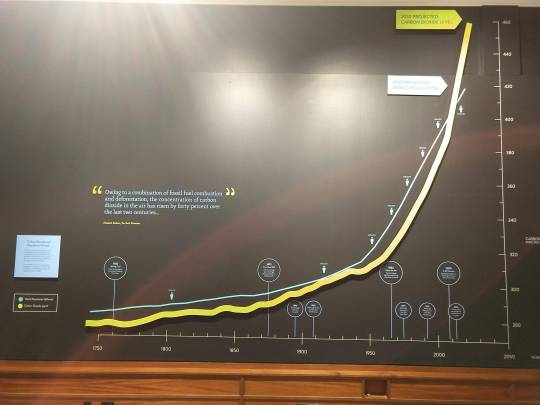
Graph showing the amount of CO2 in the atmosphere and human population
Photo: Graph showing the amount of CO2 in the atmosphere and human population from We Are Nature, on display until September 2018.

We’re now up to over 400 consecutive warmer-than-average months and counting. Carnegie Museum of Natural History’s collections, which span more than 140 years, can help show these shifts in many ways. One of the most important things we can do is to make connections and show the relevance between the basic scientific principles underlying natural phenomena and the evidence all around us; between what’s happening globally and what’s happening locally.
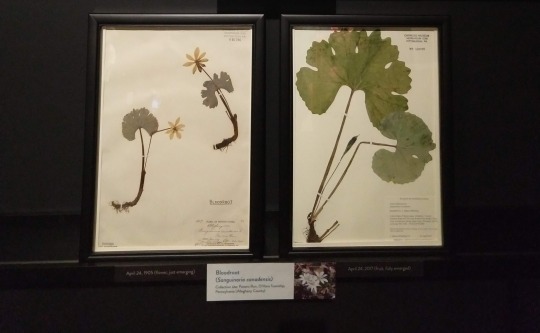
side by side comparison of plant specimens collected 100 years apart
Photo: The growth of plants collected today versus 100 years ago in the same locations, shown in We Are Nature, corroborates the observation of increasingly earlier springtime by documenting earlier maturation of these species.

The globe’s increasing heat is a result of fossil fuel use, food production, and our land use practices. We need energy and food, of course; but it’s critical that we recognize that the systems we impact also impact us. It’s not just our actions, but our interactions with the world around us that are the story. To understand what’s happening and improve our interactions with nature, we have to look at the big picture, and work to meet our needs in ways that minimize disruption to the overall system.

As summer heat waves get longer, more numerous, and more intense (and it seems the whole world is on fire, with deadly fires everywhere from California to Greece to inside the Arctic Circle) one connection is obvious: our need to be cool.

Joylette Portlock, Ph.D., is associate director of science and research at Carnegie Museum of Natural History. She is also executive director of Communitopia, a nonprofit focused on climate change communication, and holds many other roles in the community.
Filed Under: Blog Tagged With: Anthropocene, climate change, global warming, We Are Nature, We Are Nature: Living in the Anthropocene

July 13, 2018 by wpengine

Migrate or Die

By Dr. Nicole Heller

Becoming Migrant was this year’s theme for the Carnegie Nexus. The series explored the science and art of passage through creative programming. Migration is a very important issue for wildlife conservation in the Anthropocene. Roads and building developments heavily fragment landscapes, leading more animals to be hit by cars or run into trouble with people. Movement is especially hard for animals that don’t fly and need large home ranges to gather sufficient food, such as American Black Bears and bobcats, two large mammal species that live here in Allegheny County.

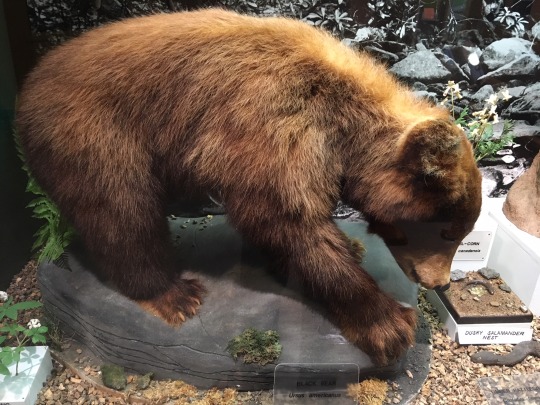
baby black bear taxidermy
Baby black bear, Ursus americanus, on display at Powdermill Nature Reserve.

Conservation has long recognized the need to create connectivity between protected areas to support the movement of large mammals in the landscape, but with climate change, connectivity has become paramount to the long-term success of protected areas and species in general.  As the climate changes, plants and animals must migrate to track suitable climate conditions.  This means that more species are becoming migrant, and their long-term survival depends on it.

Prioritizing connectivity planning and making sure we do it in ways that are climate-smart is a leading edge of conservation science.  There are many different types of corridor projects, from building crossings over particularly dangerous roads, such as the Liberty Canyon Wildlife Crossing in Los Angeles, CA. Or large-landscape connectivity projects to create continental migration pathways such as Y2Y project.

I first wrote about climate adaptation 10 years ago. In this research, I identified that the most impactful thing we could do to help species survive climate change is to create habitat connectivity in the landscape. Recently, I published two scientific articles, with a group of colleagues, further exploring the issue of climate change and connectivity. In one paper, published in Environmental Research Letters, we explore the best models and methods for incorporating climate change into connectivity conservation planning. And in the other paper, published in Conservation Biology, we consider best practices to take corridors from idea to implementation on the ground.

We hope this information will be helpful to conservation groups around the world who are working to make sure the landscape supports wildlife today and into the future.

Dr. Nicole Heller is Curator of the Anthropocene for Carnegie Museum of Natural History. Museum employees are encouraged to blog about their unique experiences working at the museum.

Filed Under: Blog Tagged With: Anthropocene, climate change, Nicole Heller, We Are Nature, We Are Nature: Living in the Anthropocene

July 2, 2018 by wpengine

We Are Nature: Future Thinking

By: Pat McShea

image

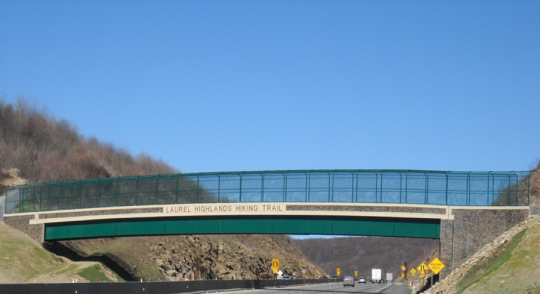
Although activities in the Future Thinking Lab section of We Are Nature seldom focus on the past, historic examples of the process are important. Some 50 miles southeast of Pittsburgh, travelers on the Pennsylvania Turnpike pass steel and concrete proof of regional future thinking dating back to at least the 1960s.

image

Photo credit: Gibson-Thomas Engineering

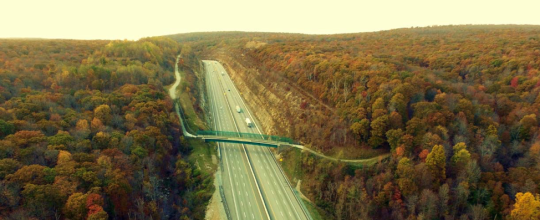
At mile mark 100.5, where the busy east/west route crosses over the crest of the mountain fold known variously as Laurel Hill, Laurel Mountain, and Laurel Ridge, the highway passes under the Laurel Highlands Hiking Trail.

image

Photo: Gibson-Thomas Engineering

image

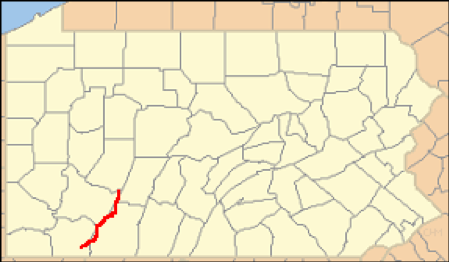
This 70-mile long footpath winds along the ridge crest between water gaps carved by the Conemaugh River on the north, and the Youghiogheny River on the south. The turnpike crossing is located between mile posts 36 and 37, as measured from the trail’s southern terminus in Ohiopyle.

Credit for this recreational resource, which was officially dedicated in 1976, rests largely with the Western Pennsylvania Conservancy and Pennsylvania’s Bureau of State Parks. The WPC, an 86-year-old Pittsburgh-based conservation organization, began acquiring key tracts on the ridge in the 1960’s for state parks, game lands, and forests. The Bureau of State Parks, which constructed the trail across the resulting patchwork of public and private land, has maintained the path under the auspices of Laurel Ridge State Park.

The trail is but one “product” from decades of future thinking, future planning, and future actions by many organizations and individuals. Far-sighted land conservation efforts on Laurel Hill, which include the establishment and operation of the Museum’s Powdermill Nature Reserve, also protect water supplies and biodiversity, and create recreational opportunities ranging from bicycling to downhill skiing.

Patrick McShea works in the Education and Visitor Experience department of Carnegie Museum of Natural History. Museum employees are encouraged to blog about their unique experiences and knowledge gained from working at the museum.

Filed Under: Blog, Exhibitions, Featured Exhibitions Tagged With: We Are Nature, We Are Nature: Living in the Anthropocene

June 12, 2018 by wpengine

Bard Birds

By Pat McShea

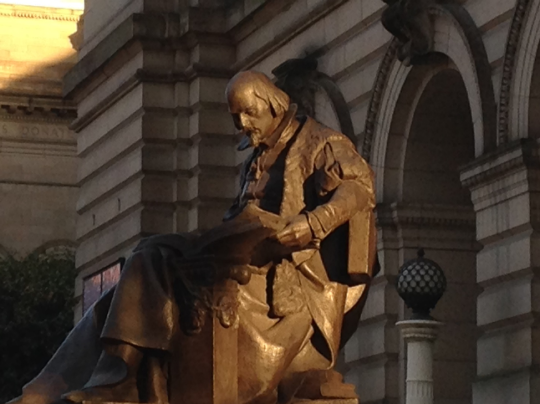
Statue of William Shakespeare along Forbes Avenue entrance to Carnegie Music Hall

Visitors to We Are Nature are challenged to make connections between short-sighted human actions and a range of persistent wide-ranging negative impacts.

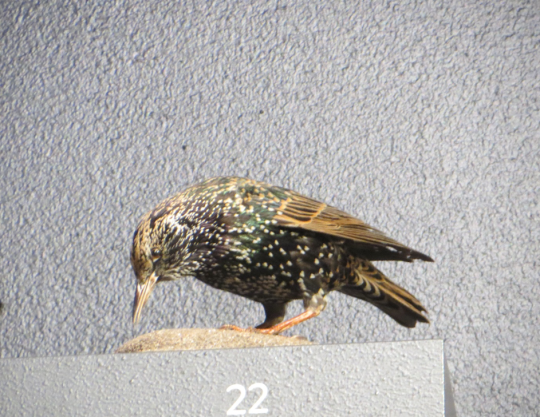
If the displays profiling the unintended consequences of such practices create interest in an example with literary connections, the William Shakespeare statue outside the museum building and a Common Starling taxidermy mount within the exhibit provide requisite props.

Common Starling on display

The Common Starling, also known as the European Starling, is number 22 in a wall-mounted array of 33 creatures whose assemblage celebrates the diversity of wildlife found in Pittsburgh.

Unlike most of its display neighbors, however, the starling is not native to North America. The species was deliberately introduced to the continent, beginning in New York City’s Central Park, during the 1890s through the efforts of the American Acclimatization Society. Members of this group attempted to introduce every bird mentioned, more than two centuries earlier, in the works of William Shakespeare. The starling was their only “success.”

The species’ population in territory ranging from Alaska to Mexico is now measured in hundreds of millions, and starlings, which frequently congregate in enormous flocks, are considered agricultural pests and airport navigation hazards.

Ironically, although Shakespeare’s works frequently mention nightingales and several other bird species, starlings are only mentioned once, in the play Henry IV Part I.

Patrick McShea works in the Education and Visitor Experience department of Carnegie Museum of Natural History. Museum employees are encouraged to blog about their unique experiences and knowledge gained from working at the museum.

Filed Under: Blog Tagged With: Anthropocene, Pat McShea, We Are Nature

May 23, 2018 by wpengine

Pittsburgh Environmentalist Group Meetup Makes Eco-Friendly Activities Fun

Rethinking your impact on the environment, or carbon footprint, could be as simple as eating less barbecue or not choosing a green cleanser over your favorite fragrant household cleaner. Bonnie Siefers of the Pittsburgh Environmentalist Group Meetup started a group to help make the process of becoming more environmentally friendly fun and social.

“I feel like a lot of people are anxious to find groups of people that are like-minded in this space,” Siefers said. “I used to live in the suburbs of Pittsburgh and when I moved into the city, I found more like-minded people here because they are younger and more mindful. They are growing up and talking about climate change.”

Bonnie Siefers

Pittsburgh Environmentalist Group Meetup was founded in July 2013 and quickly gained 30 members in a few days. Today, it has 738 members and a number of meetups under its belt on topics such as eco-stewardship training, the future of recycling, and veganism.

“People are glad to have community and that was the number one thing I found. You don’t join a Meetup like this if you are not a stakeholder in this process, and people feel isolated,” Siefers said.

Members of the Meetup are encouraged to go back to their communities as “The Green Team” and lead conversations and corrective actions to lessen their neighborhood’s carbon footprint. Siefers said this is the type of outreach that can build personal fulfillment for those wanting to do their part for the environment.

“One of our members was very vocal to get people to change their energy option to renewable energy and encouraged their neighbors to go to Penn Power and select 100% renewable energy. It’s a personal choice,” she said.

She added: “I want to be a change activist. I want to inspire those that I meet to think about things deeply and differently. Lots of people are interested in sustainability in Pittsburgh and it has been the most livable city many, many years in a row, I think there is a trend to build in a sustainable manner and keep the green space alive that we have.”

Siefers is encouraged by the increasing number of universities offering degree programs in sustainability and the impact the next generation of students can have on the environment.

“It’s certainly a growing field. Almost every business or organization you can think of has a sustainability department and its main focus is to save the organization money,” she said. Her own sustainability work has afforded her opportunities to help large organizations rethink their footprint.

“I did a sustainability action plan for the Pittsburgh YMCA that included an audit of their larger buildings. It was already sustainable, and I gave them ways to save even more money,” Siefers said. “They wanted an ROI in three years and I made that possible. Just changing your light bulbs can save you a lot of money.”

So, what are five practical ways people can reduce their footprint? Here is what Siefers recommended:

●     Carpool to destinations with co-workers or with friends.

●     Offset carbon use when traveling by purchasing carbon offsets on plane tickets.

●     Purchase organic food and fabric to help minimize the amount of pollutants entering aquifers.

●     Be mindful about your energy and chemicals at home by turning off lights when leaving a room, using surge protectors on appliances, placing electronics in sleep mode when not in use, and selecting non-toxic cleaning products.

●     Tell somebody. Create a community to discuss and exchange information on how to personally change your home and neighborhood for the sake of the environment.

Siefers’ work is an excellent example of how you can apply the concepts and ideas about the human impact on the environment to your daily life. At the Carnegie Museum of Natural History,  we hope that our exhibition We Are Nature: Living in the Anthropocene inspires more people to take action and join groups like Pittsburgh Environmentalist Group Meetup.

Learn more about beneficial sustainability practices and ideas at Bonnie Siefers website eco Couture.

________________________________________________________________

In the spirit of recognizing all we are already doing in Pittsburgh, we have started a new blog series to compliment We Are Nature: Living in the Anthropocene, the exhibition about the complex relationship between humans and nature currently on display at Carnegie Museum of Natural History. We are featuring Pittsburghers who are committed to improving the environment in which we live. Each blog features a new individual and shares some of the ways in which they are helping issues of sustainability, conservation, restoration, climate change, or helping Pittsburgh to be an even more beautiful place to live.

Melonee Gaines is a freelance journalist and writer based in Memphis, TN and has written for MLK50.com and The Crisis Magazine. She is the lead maven and founder of the digital media and public relations firm MPact Media Group. She enjoys foodie adventures, beach excursions, and herb gardening.

Filed Under: Blog Tagged With: Anthropocene, Pittsburgh, We Are Nature, We Are Nature: Living in the Anthropocene

May 23, 2018 by wpengine

Poison Ivy Potency?

By Rachael Carlberg

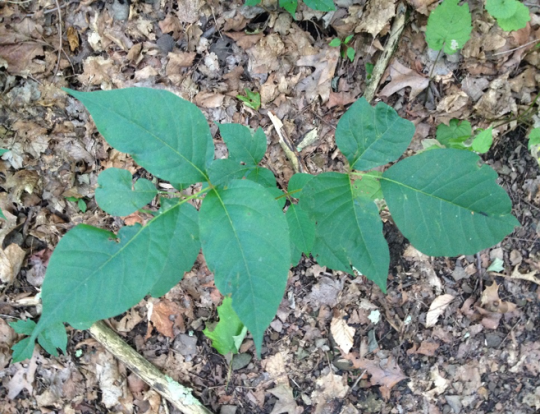
Poison ivy

When prompted with the phrase “climate change,” people often think of increasing temperatures, melting ice, and flooding shores. While global temperatures are on the rise, the story of humanity’s impact on the environment is much more complex.  As carbon dioxide levels in the atmosphere rise, and temperatures increase, we face unanticipated changes to the world around us.

Poison ivy, for example, grows larger in our changing climate. Higher levels of carbon dioxide in the atmosphere cause increases in photosynthesis, allowing plants like poison ivy to grow more and produce larger leaves. In carbon-rich conditions the vine also creates more toxic forms of urushiol, the oil that causes an allergic reaction in people.

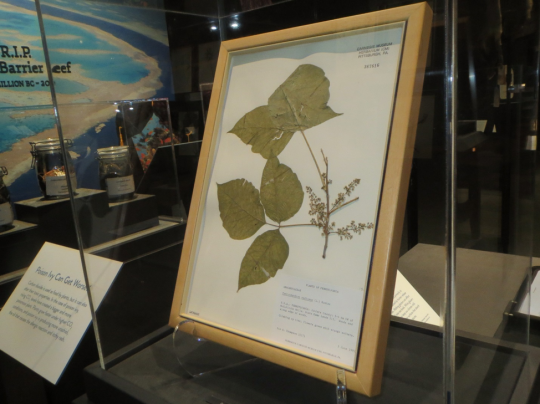
Preserved poison ivy

Preserved poison ivy displayed in We Are Nature.

You might be thinking, if higher levels of carbon dioxide mean higher levels of photosynthesis, won’t all plants benefit?  The problem is that increased levels of carbon dioxide don’t impact all plants in the same way.  Vines like poison ivy can reap the rewards of increased photosynthesis with more leaf area because, unlike upright plants, they don’t need to devote as many resources to structural support like trunks and thick branches.

As an intern in the Education department of Carnegie Museum of Natural History, Rachael Carlberg wrote blog posts related to ideas presented in We Are Nature. Museum employees are encouraged to blog about their unique experiences of working at the museum.    

Filed Under: Blog Tagged With: Anthropocene, Botany, We Are Nature, We Are Nature 2, We Are Nature: Living in the Anthropocene

  • « Go to Previous Page
  • Page 1
  • Page 2
  • Page 3
  • Page 4
  • Interim pages omitted …
  • Page 8
  • Go to Next Page »

sidebar

About

  • Mission & Commitments
  • Directors Team
  • Museum History

Get Involved

  • Volunteer
  • Membership
  • Carnegie Discoverers
  • Donate
  • Employment
  • Events

Bring a Group

  • Groups of 10 or More
  • Birthday Parties at the Museum
  • Field Trips

Powdermill

  • Powdermill Nature Reserve
  • Powdermill Field Trips
  • Powdermill Staff
  • Research at Powdermill

More Information

  • Image Permission Requests
  • Science Stories
  • Accessibility
  • Shopping Cart
  • Contact
  • Visitor Policies
One of the Four Carnegie Museums | © Carnegie Institute | Privacy Policy | Terms of Use | Accessibility
Rad works here logo