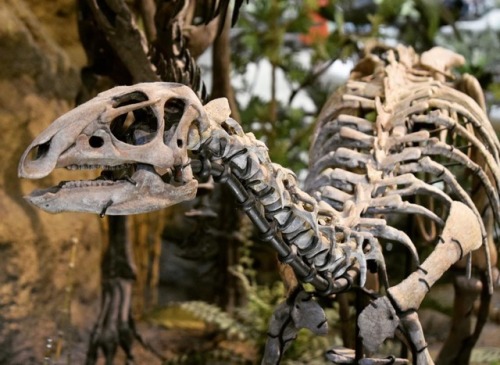
Dryosaurus altus was a Jurassic plant eater that could be found in the forests and fern prairies of North America 150 million years ago. As a small dinosaur, measuring about 10 feet long, this dinosaur’s best defense against predators was its speed.
Carnegie Museum of Natural History
One of the Four Carnegie Museums of Pittsburgh
Dryosaurus altus was a Jurassic plant eater that could be found in the forests and fern prairies of North America 150 million years ago. As a small dinosaur, measuring about 10 feet long, this dinosaur’s best defense against predators was its speed.
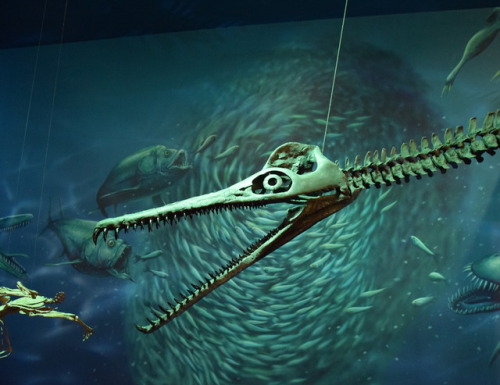
“Toto, I’ve a feeling we’re not in Kansas anymore.”
This scene represents a moment in time 83 million years ago, in what is now the state of Kansas, which was covered by a body of water known as the Western Interior Seaway and populated by diverse, prehistoric marine life. In this diorama near Dinosaurs in Their Time, an agile marine reptile, Dolichorhynchops bonneri, dives after the penguin-like bird, Hesperornis regalis.
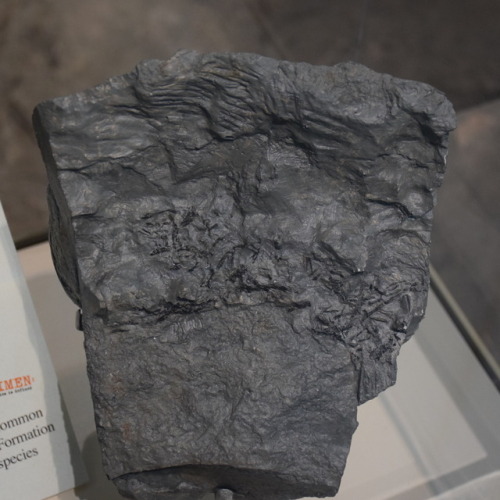
This small fossil found in Dinosaurs in Their Time is the most complete frog fossil known from the Upper Jurassic Morrison Formation. It was named by Carnegie Museum of Natural History’s paleontologist, Amy Henrici, in 1998.
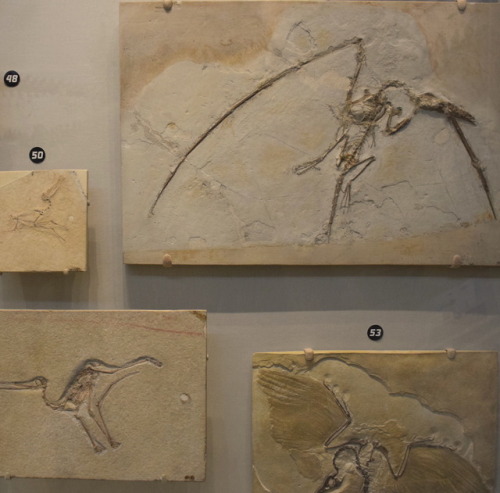
These fossils were found in a quarry in Solnhofen, Germany, which was once a series of shallow, tropical lagoons. The environmental conditions at Solnhofen resulted in remarkably preserved fossils of Late Jurassic plants, invertebrates, fish, reptiles, and bird species like these fossils on display in Dinosaurs in Their Time.
Tyrannosaurus rex was one of the largest predators to ever walk the Earth. Growing up to 46 feet in length and standing 13 feet high at the hips, this meat-eater could weigh up to seven tons.
T. rex was more than just enormous, it was ferocious. It had massive hind legs with three-toed feet, small, strong arms the size of a man’s, and a huge, heavy tail that was used as a counterbalance.
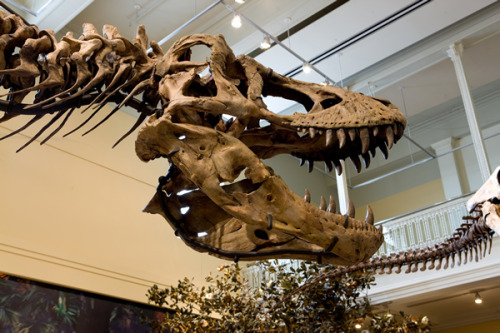
Its skull grew to five feet long and housed strong jaws that created a bone-crushing bite. It had nearly 60 serrated, razor-sharp teeth that grew up to six inches in length. With a name that means “tyrant lizard king,” this dinosaur feasted on the large herbivores of its time.
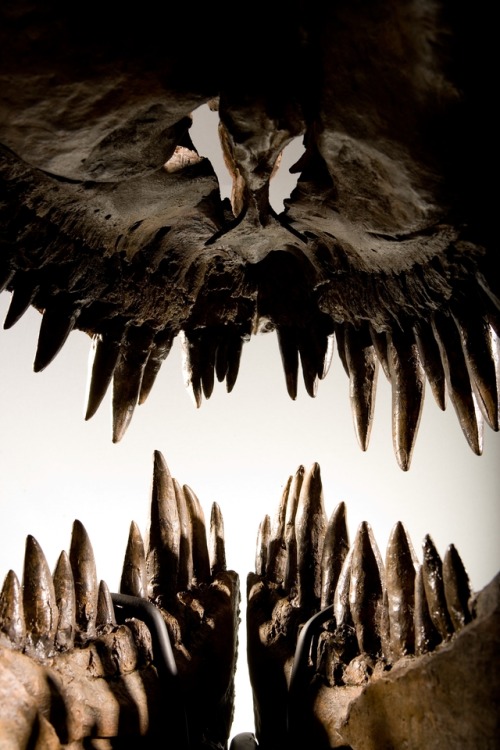
T. rex roamed the western United States and southwestern Canada during the late Cretaceous Period, about 66 to 68 million years ago. The specimen on display at Carnegie Museum of Natural History was discovered in 1902 by Barnum Brown and sent to the American Museum of Natural History. It was bought by the Carnegie Museum in 1941.
This specimen is extremely important because it is the holotype of the species. A holotype is a specimen upon which a given species is based. So, in other words, Carnegie Museum of Natural History’s T. rex is the ‘gold standard’ to which all potential fossils of this notorious meat-eater must forever be compared. Although a few specimens that are now known to belong to T. rex were found prior to the discovery of the holotype, the holotype was, by definition, the first fossil of the species to be recognized by science. Therefore, it can be considered the world’s first specimen of the world’s most famous dinosaur.
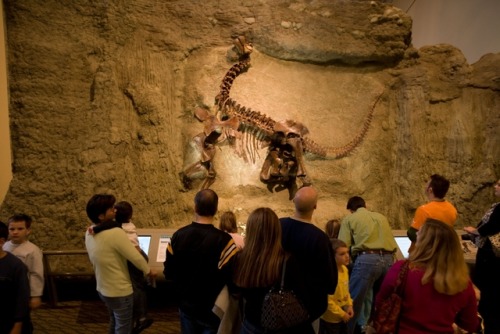
A large, herbivorous quadruped, Camarasaurus was among the most common of the giant sauropod dinosaurs found in the Jurassic Period in North America. With a name that means “chambered lizard,” this dinosaur was named for its partly hollow vertebrae, and reached up to a massive 60 feet in length.
Camarasaurus lived during the Late Jurassic, some 145 to 150 million years ago, and featured a long, thick neck which made its head appear small in comparison. It had sturdy, spoon-shaped teeth, indicating its diet probably differed from other large herbivores that lived in the same ancient environment, with Camarasaurus most likely feeding on coarser plant materials.
Real fossils of both an adult and a juvenile Camarasaurus discovered at Dinosaur National Monument in Utah are on view in the Dinosaurs in Their Time exhibition at Carnegie Museum of Natural History. The juvenile is represented by a nearly complete skeleton that includes a full skull and even ear bones. The skeleton is displayed with its right side still mostly enveloped in sandstone belonging to a rock unit called the Morrison Formation.
