• Skip to primary navigation
  • Skip to main content
  • Skip to primary sidebar

Carnegie Museum of Natural History

One of the Four Carnegie Museums of Pittsburgh

  • Visit
    • Buy Tickets
    • Visitor Information
    • Exhibitions
    • Events
    • Dining at the Museum
    • Celebrate at the Museum
    • Powdermill Nature Reserve
    • Event Venue Rental
  • Learn
    • Field Trips
    • Educator Information
    • Programs at the Museum
    • Bring the Museum to You
    • Guided Programs FAQ
    • Programs Online
    • Climate and Rural Systems Partnership
  • Research
    • Scientific Sections
    • Science Stories
    • Science Videos
    • Senior Science & Research Staff
    • Museum Library
    • Science Seminars
    • Scientific Publications
    • Specimen and Artifact Identification
  • About
    • Mission & Commitments
    • Directors Team
    • Museum History
  • Tickets
  • Give
  • Shop

Dinosaurs

October 5, 2017 by wpengine

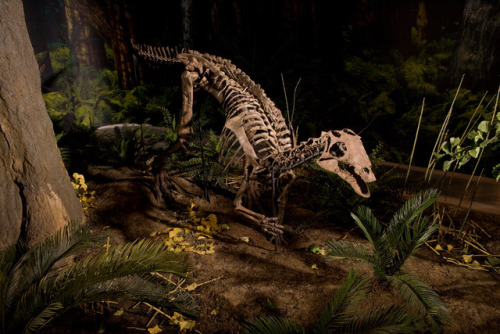
Camptosaurus aphanoecetes

skelleton of Camptosaurus aphanoecetes dinosaur in the museum
Photo Credit: Joshua Franzos for Carnegie Museum of Natural History

Camptosaurus aphanoecetes, which means “flexible lizard hiding in plain sight,” was a medium-sized plant-eating dinosaur that lived about 145–150 million years ago during the late Jurassic Period. Remains of Camptosaurus have been found in North America and, according to some paleontologists, in England as well. Although the Camptosaurus skeleton on display at Carnegie Museum of Natural History was discovered in 1922, it wasn’t studied in detail until relatively recently.

On exhibit in Pittsburgh for more than six decades, still half buried in Jurassic sandstone, the skeleton was fully removed from the rock in 2005–2006 to transform it into a three-dimensional mount. After the specimen was completely unearthed, it was discovered to show differences with fossils of the dinosaur species it was long thought to represent, Camptosaurus dispar. So, in 2008, the skeleton was established as the type, or name-bearing, specimen of the new species Camptosaurus aphanoecetes by scientists Kenneth Carpenter and
Yvonne Wilson.

This Camptosaurus skeleton was excavated by Earl Douglass and his field crew from rocks belonging to the Morrison Formation in the Carnegie Quarry at Dinosaur National Monument in Utah. Today it is on display at Carnegie Museum of Natural History.

Filed Under: Blog Tagged With: dinosaur, dinosaurs in their time

October 5, 2017 by wpengine

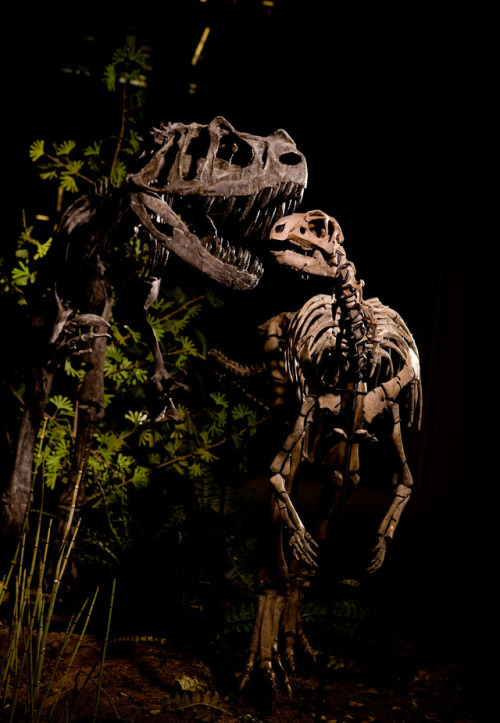
Dryosaurus altus

Dryosaurus altus skeleton
Photo Credit: Image by Josh Franzos

Unlike many herbivores of its time, Dryosaurus altus was not very large. Standing four feet high at the hips and growing up to 11 feet in length, Dryosaurus may have weighed only 200 pounds. But this bipedal dinosaur was fast. It had long, powerful hind legs that carried it through the Late Jurassic wilderness, providing its primary defense against predators.

With a name that means “tall oak tree lizard,” Dryosaurus had short front limbs and a long tail that may have been used as a counterbalance. It had a beak for cropping vegetation and was most likely an efficient chewer, with strong teeth and a hinged jaw. This hinge allowed the herbivore to slide its upper and lower jaws past one another as it chewed, an unusually advanced feeding adaptation for this time period.

One of the oldest known members of the dinosaur group Ornithopoda, Dryosaurus fossils have been found in the western United States and possibly eastern Africa (though some paleontologists think the African fossils belong instead to a close relative called Dysalotosaurus). The specimen on display at Carnegie Museum of Natural History was discovered in 1910 by Earl Douglass and his field crew in the Morrison Formation at what is now Dinosaur National Monument in Utah.

Filed Under: Blog Tagged With: dinosaur, dinosaurs in their time

October 5, 2017 by wpengine

Who is Dr. Matt Lamanna?

Matt Lamanna on expedition in Antarctica

Did you know that Section of Vertebrate Paleontology curator Matt Lamanna has discovered dinosaur fossils on all seven
continents, including Antarctica?

Dr. Lamanna leads the Antarctic Peninsula Paleontology Project, an international team of scientists investigating the end
of the Mesozoic Era (”Age of Dinosaurs”) in Antarctica, and also leads or co-leads research projects studying dinosaurs in Patagonia (Argentina), the Sahara (Egypt), and the Australian Outback.

Lamanna has named or co-named 15 new species of dinosaurs and fossil birds, including Anzu wyliei and three of the largest land animals known to science—the titanosaurian sauropods Dreadnoughtus schrani, Notocolossus gonzalezparejasi, and Paralititan stromeri. Each of these massive sauropods is estimated to have weighed more
than 40 tons, roughly equivalent to eight adult elephants.

Lamanna has co-authored two papers in the preeminent journal Science and appeared on television programs for PBS (NOVA), the Discovery Channel, the History Channel, A&E, the Science Channel, and more. Recently, he assisted the US Department of Homeland Security in their investigation of a dinosaur fossil that had been illegally smuggled out of China.

Filed Under: Blog Tagged With: Antarctic Peninsula Paleontology Project, dinosaurs, Matt Lamanna, Vertebrate Paleontology

July 14, 2017 by wpengine

Dippy Dino Rocks

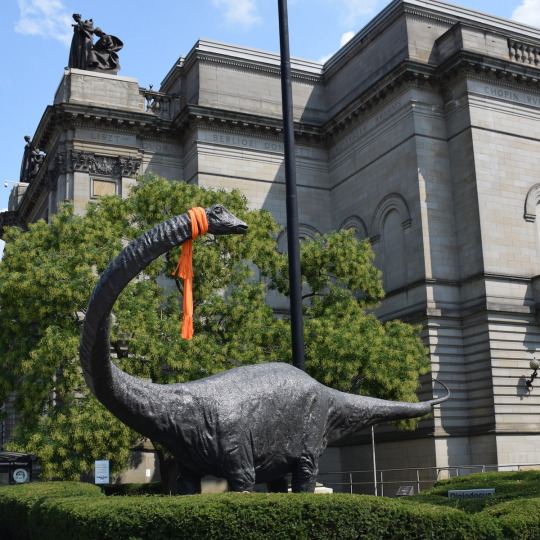
Dippy dinosaur statue with orange scarf

Dippy, our museum’s most famous dinosaur, has inspired young paleontologists for years, and his statue on Forbes Avenue inspires selfies outside of the museum every day! Most recently, Pittsburgh’s favorite dinosaur was the inspiration for a new flavor of ice cream —Dippy Dino Rocks!

You can sample Dippy Dino Rocks, on July 22 at Super Science Saturday courtesy of Klavon’s Ice Cream Parlor, where the new ice cream will be sold!

Filed Under: Blog Tagged With: Pittsburgh

April 27, 2017 by wpengine

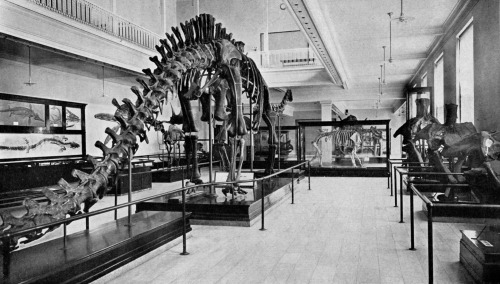
Gallery of Paleontology, 1907

Gallery of Paleontology as it was in 1907

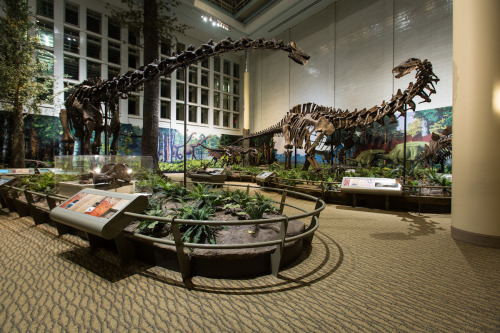
Dinosaurs in Their Time 2015

Gallery of Paleontology, 1907 vs. a recent picture of Dinosaurs in Their Time.  It is amazing how much one museum can change in a century!

Filed Under: Blog Tagged With: dinosaur, dinosaurs in their time, museum history

January 4, 2017 by wpengine

Andrew Carnegie

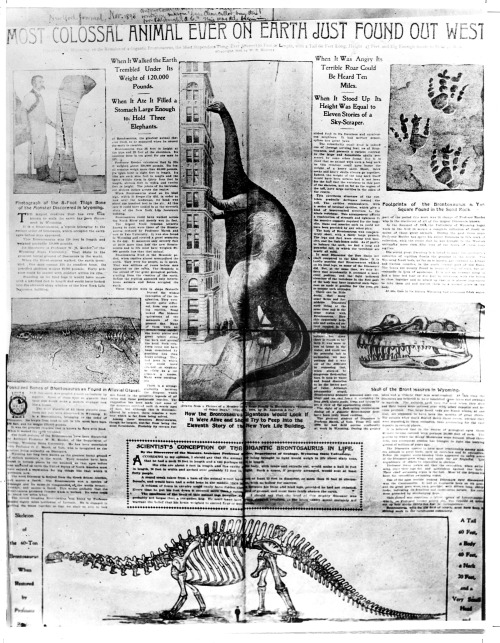
Newspaper report of "most colossal animal ever on earth"

In 1898, Andrew Carnegie sent this newspaper clipping to Carnegie Museum of Natural History Director Dr. William J. Holland with a $10,000 check and a note that read, “buy this for Pittsburgh.”

Filed Under: Blog Tagged With: dinos, dinosaurs, dinosaurs in their time, museum history

  • « Go to Previous Page
  • Page 1
  • Page 2
  • Page 3
  • Page 4
  • Page 5
  • Go to Next Page »

sidebar

About

  • Mission & Commitments
  • Directors Team
  • Museum History

Get Involved

  • Volunteer
  • Membership
  • Carnegie Discoverers
  • Donate
  • Employment
  • Events

Bring a Group

  • Groups of 10 or More
  • Birthday Parties at the Museum
  • Field Trips

Powdermill

  • Powdermill Nature Reserve
  • Powdermill Field Trips
  • Powdermill Staff
  • Research at Powdermill

More Information

  • Image Permission Requests
  • Science Stories
  • Accessibility
  • Shopping Cart
  • Contact
  • Visitor Policies
One of the Four Carnegie Museums | © Carnegie Institute | Privacy Policy | Terms of Use | Accessibility
Rad works here logo