• Skip to primary navigation
  • Skip to main content
  • Skip to primary sidebar

Carnegie Museum of Natural History

One of the Four Carnegie Museums of Pittsburgh

  • Visit
    • Buy Tickets
    • Visitor Information
    • Exhibitions
    • Events
    • Dining at the Museum
    • Celebrate at the Museum
    • Powdermill Nature Reserve
    • Event Venue Rental
  • Learn
    • Field Trips
    • Educator Information
    • Programs at the Museum
    • Bring the Museum to You
    • Guided Programs FAQ
    • Programs Online
    • Climate and Rural Systems Partnership
  • Research
    • Scientific Sections
    • Science Stories
    • Science Videos
    • Senior Science & Research Staff
    • Museum Library
    • Science Seminars
    • Scientific Publications
    • Specimen and Artifact Identification
  • About
    • Mission & Commitments
    • Directors Team
    • Museum History
  • Tickets
  • Give
  • Shop

Powdermill

February 27, 2020 by wpengine

What is Bird Banding?

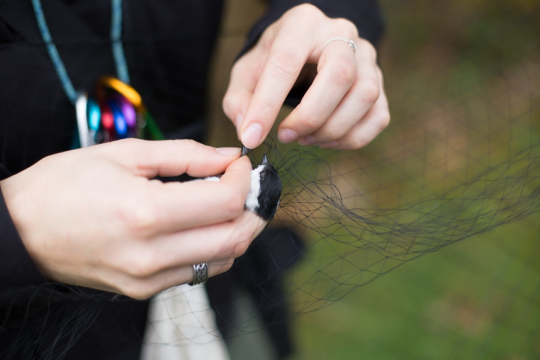
A bird bander extracts a Black-capped Chickadee from a mist net at Powdermill.

What is a bird band?

Bird bands are small aluminum rings that are engraved with a series of numbers that identifies individual birds. The bands come in different sizes from a tiny hummingbird band to a “size 9” that fits an eagle. A band fits a bird’s leg like a bracelet: it can spin around the bird’s leg but not slip over ankle or foot joints.
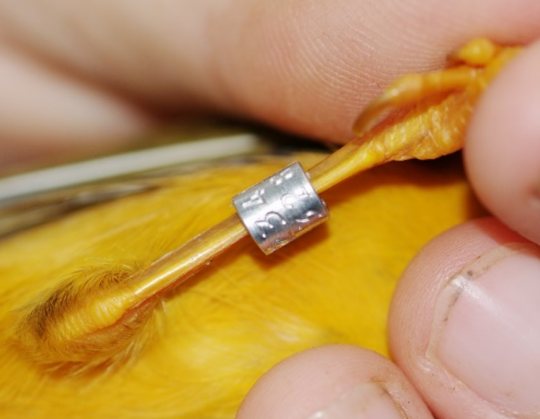
Bird band. Photo credit: John Fraser

How do we band birds?

There are different ways to catch birds but at Powdermill, we primarily use mist nets or potter traps. Mist nets are very fine mesh nets that are 12 meters long and about 8 feet high that are suspended between poles in various habitat types. It’s very difficult to see mist nets, so as birds fly through the area they hit the net and gently drop into one of the net’s pockets. An experienced bird bander carefully extracts the bird, places it into a clean cotton bag, and brings it back to a central banding station or lab. In the lab, banders use specially-designed pliers to carefully close the band around the bird’s tarsus, then determine the age and sex of the bird, measure the wing length, quantify fat, weigh the bird, and release it. The banding process is quick: it usually takes less than a minute for each bird!

Who bands birds?

Bird banders operate under a permit from the federal Bird Banding Lab. Banders train as apprentices, often for many years, to learn and perfect the highly-specialized skills necessary to run their own banding stations. High-volume banding stations, usually those that operate during the migration seasons or that can catch hundreds of birds each day, usually have field techs, interns, and volunteers who help while they hone their skills.
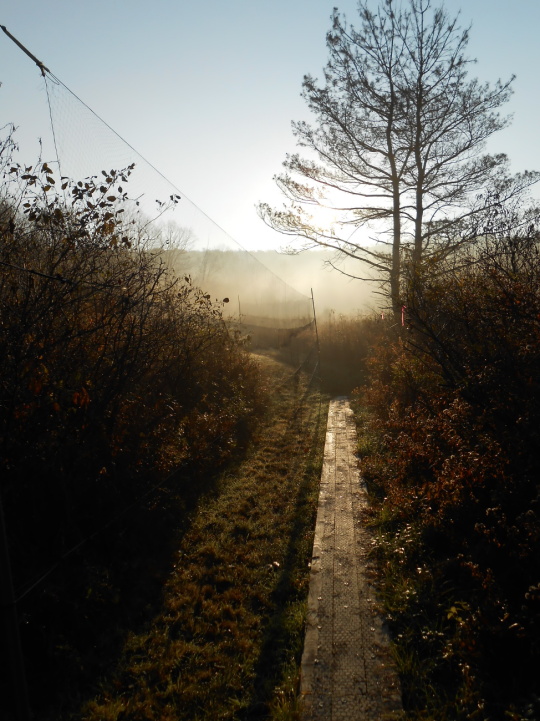
Mist net at dawn.

When do we band birds?

Bird banders can band year-round and any time of the day or night, as long as it’s safe for birds! If it’s too hot, too cold, too windy, or too rainy we wait until conditions improve. Of course, the species and number of birds we catch depends on when we band: for example, it’s usually most productive to band songbirds in the mornings and to catch owls at night!

So, what is bird banding?

Bird banding is the process of catching birds, placing a numbered band on their legs, collecting data about each bird, then letting them go. The resulting database can be used to answer all kinds of questions about bird populations. Please stay tuned for our next blog to learn what sorts of questions we can answer from the data we collect during banding!

Annie Lindsay is Banding Program Manager at Carnegie Museum of Natural History’s Powdermill Nature Reserve. Museum employees are encouraged to blog about their unique experiences and knowledge gained from working at the museum.
Filed Under: Blog, Powdermill Tagged With: Powdermill

August 1, 2018 by Erin Southerland

Powdermill Nature Reserve sets Pollinator Festival

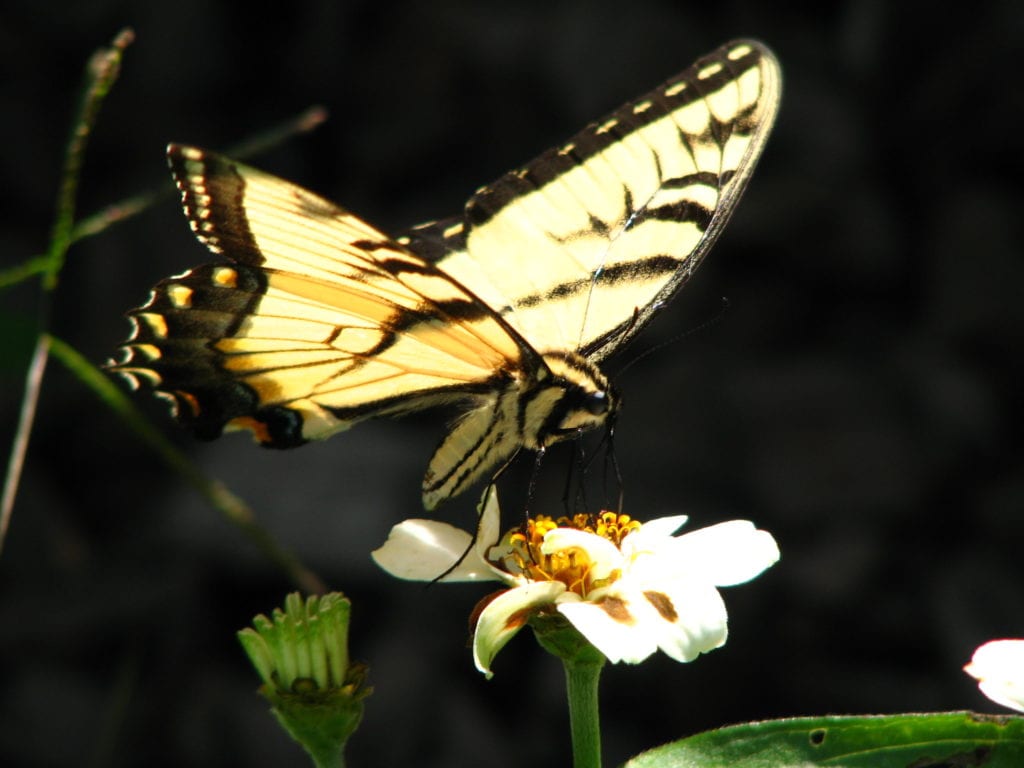
butterfly on a flower
Photo credit: Joe Stavish

Three speakers will highlight the annual Pollinator Festival at Powdermill Nature Reserve on Saturday, August 11, 2018.  Mark Slater, horticulturist and environmental educator with Reading Community College, will present “Plants versus Animals, a study in cooperation and competition.” Andrea Kautz, Staff Entomologist at Powdermill Nature Reserve, will present a program on the pollinator project at the Flight 93 Memorial, and Luke DeGroote, Avian Ecologist at Powdermill, will speak about hummingbirds as pollinators.

The event, which is free and open to the public, will include sales of honey and bee products, as well as a large plant sale that will emphasize native plants that attract pollinators.

Many people aren’t aware that, besides honey bees, there are hundreds of other important pollinators that play a vital role in the pollination of food crops. Attracting these insects and birds to the garden requires plants that act as larval host plants as well as nectar sources. People who attend the festival will learn about the most recent research on the plants most likely to draw beneficial pollinators to private and public gardens.

Powdermill has six gardens that focus on specific plant communities: a butterfly garden, a rain garden, a barrens, a wetland, a woodland path, and an herb garden.  Perennials from the mid-Atlantic region are featured in ecological habitats; the herb garden has plants from the worldwide temperate flora. Martha Oliver, horticulturist of The Primrose Path in Scottdale and designer of Powdermill’s gardens will be on hand to lead tours.

The festival is on the grounds of Powdermill Nature Reserve, from 10a.m.-3p.m. on Saturday, August 11, 2018.

For more information, contact Cokie Lindsay, lindsayc@carnegiemnh.org.

Filed Under: Powdermill, Press Release

July 2, 2018 by wpengine

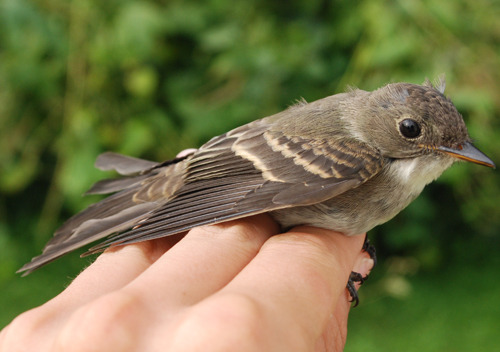
Eastern Wood Pewee

image

The buffy tips to many of the coverts and body feathers identifies this as a HY bird.  For banders, this bird can be identified by their short tarsus and long wings.


Powdermill Nature Reserve’s avian research center is part of Carnegie Museum of Natural History’s biological research station in Rector, Pennsylvania.  The research center operates a bird banding station, conducts bioacoustical research, and performs flight tunnel analysis with the goal of reducing window collisions.


Filed Under: Blog, Powdermill Tagged With: Birds, parc, Powdermill Nature Reserve

sidebar

About

  • Mission & Commitments
  • Directors Team
  • Museum History

Get Involved

  • Volunteer
  • Membership
  • Carnegie Discoverers
  • Donate
  • Employment
  • Events

Bring a Group

  • Groups of 10 or More
  • Birthday Parties at the Museum
  • Field Trips

Powdermill

  • Powdermill Nature Reserve
  • Powdermill Field Trips
  • Powdermill Staff
  • Research at Powdermill

More Information

  • Image Permission Requests
  • Science Stories
  • Accessibility
  • Shopping Cart
  • Contact
  • Visitor Policies
One of the Four Carnegie Museums | © Carnegie Institute | Privacy Policy | Terms of Use | Accessibility
Rad works here logo
