• Skip to primary navigation
  • Skip to main content
  • Skip to primary sidebar

Carnegie Museum of Natural History

One of the Four Carnegie Museums of Pittsburgh

  • Visit
    • Buy Tickets
    • Visitor Information
    • Exhibitions
    • Events
    • Dining at the Museum
    • Celebrate at the Museum
    • Powdermill Nature Reserve
    • Event Venue Rental
  • Learn
    • Field Trips
    • Educator Information
    • Programs at the Museum
    • Bring the Museum to You
    • Guided Programs FAQ
    • Programs Online
    • Climate and Rural Systems Partnership
  • Research
    • Scientific Sections
    • Science Stories
    • Science Videos
    • Senior Science & Research Staff
    • Museum Library
    • Science Seminars
    • Scientific Publications
    • Specimen and Artifact Identification
  • About
    • Mission & Commitments
    • Directors Team
    • Museum History
  • Tickets
  • Give
  • Shop

January 10, 2023 by

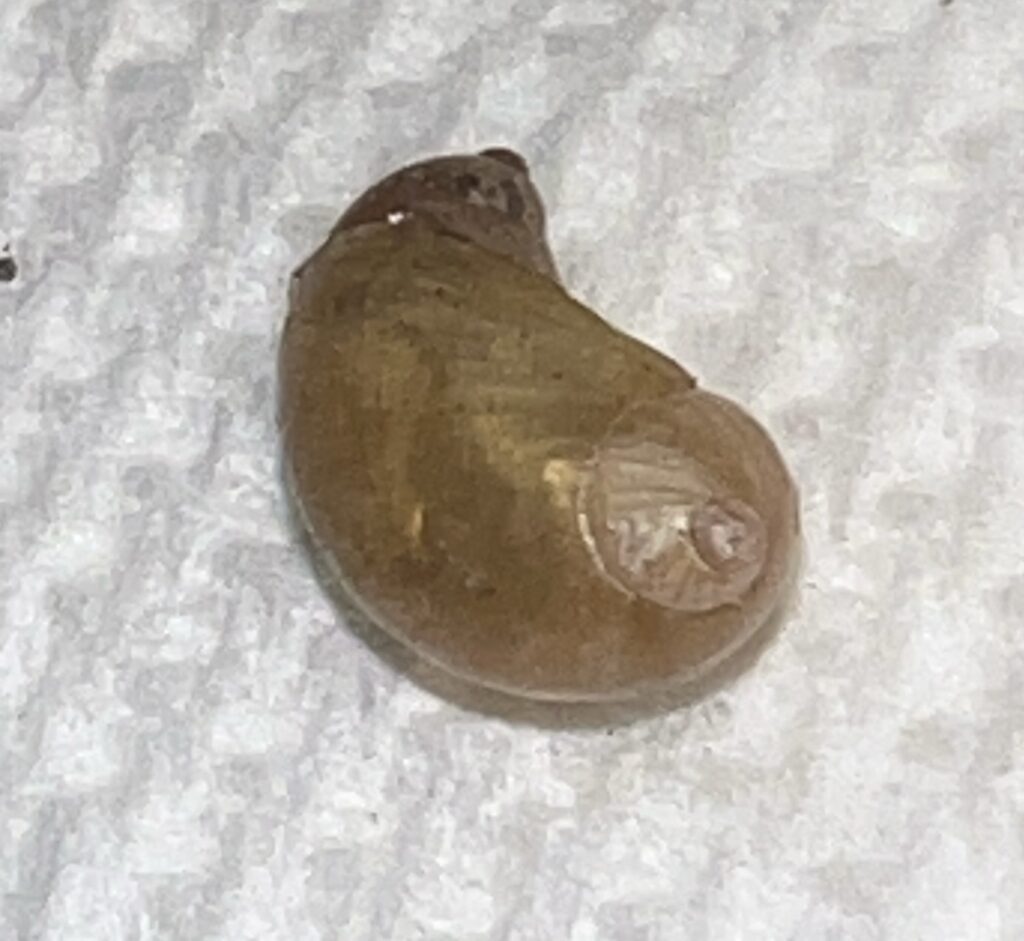
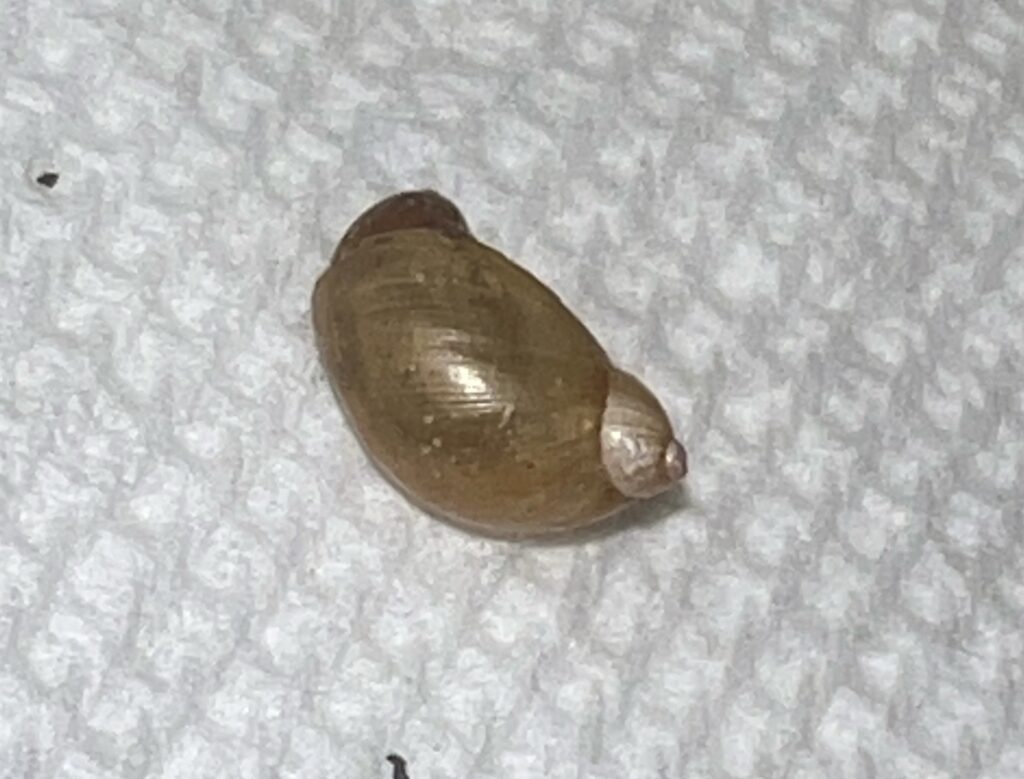
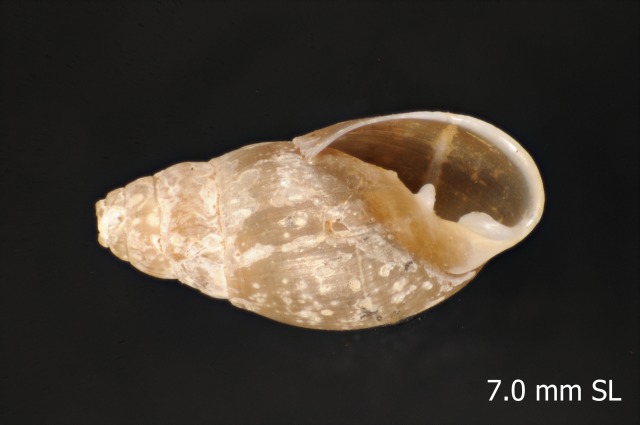
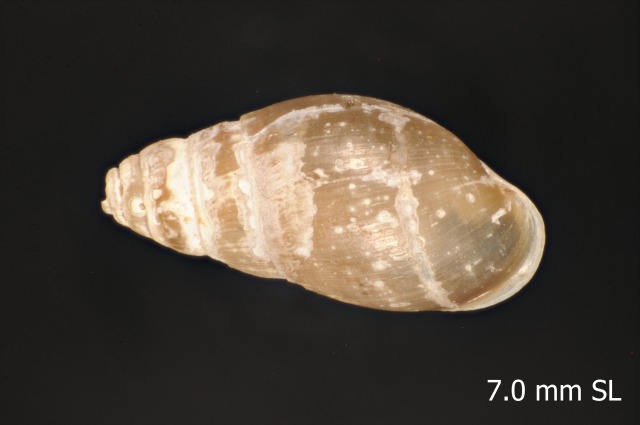
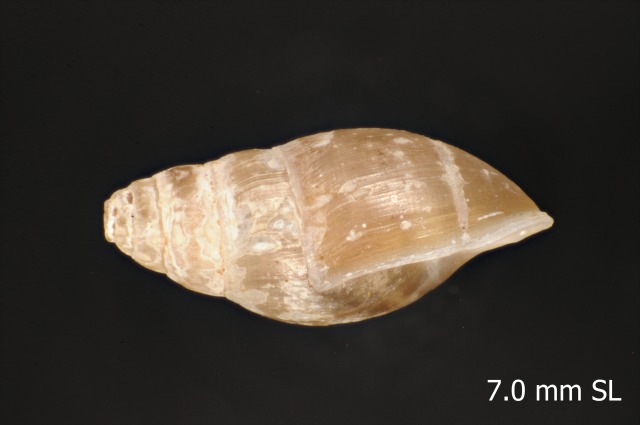
Oxyloma retusum

Image Usage Information
  • Michael J. Oldham
  • CC BY-NC 4.0 DEED
  • Additional information about this specimen

Image Usage Information

  • Naturalis Biodiversity Center
  • CC BY-NC 3.0 DEED
  • For additional information about this specimen: Steven van der Mije (collectie@naturalis.nl)

Family: Succineidae

Common name: Blunt Ambersnail

Discovery: I. Lea, 1834

Identification

Length: 6-14 mm
Whorls: 3

This ambersnail is intermediate in size. It has shallower sutures and flatter whorls, giving it a more streamlined look than Catinella vermeta. It also has a taller aperture, about 2/3 the total shell length. The basal margin of its aperture may appear nearly flat, although this may vary to more rounded. The animal is stippled with small black spots, which form bands on top of the head, including a stripe to each antennae.

Ecology

Oxyloma retusum is often found in damp fields or shoreline habitats, sometimes at high densities in the warmer months. It may be seen crawling in muddy areas or on wetland plants (Hubricht 1985). Along a small lake in Maryland, this species was eating mostly dead plants in the spring, but both live and dead plants in summer and fall (Örstan, 2006).

In Maryland a few individuals of this species survive the winter, then grow until the end of June when the larger animals die off following an initial mating period (Örstan, 2006). Offspring from the first mating period engage in their own mating in late summer. Survivors of the spring and late summer generations enter winter hibernation.

Courtship is initiated by one snail crawling onto the shell of another and crawling around the shell apex toward its partner’s head (Örstan, 2006). At this point the animal initiating mating twists its head to bring the right-side genital openings together, or repeats the crawling cycle. Mating takes from one to one and a half hours, and is usually reciprocal (both animals donating sperm).

Taxonomy

Synonyms for Oxyloma retusum include: Oxyloma retusa, Succinea calumetensis, S. higginsi, Succinea retusa decampi, S. retusa, and S. r. magister.

Distribution

Oxyloma retusum ranges from interior New York and New England west through the great Lakes to the Dakotas. Virginia has only scattered reports including Highland County (Hubricht, 1985; lacking a museum specimen record so not appearing on the range map) and New Kent County – reports that are uncertain due to its similarities with close relatives.

Conservation

NatureServe Global Rank: G5
NatureServe State Rank: SNR

January 10, 2023 by

Oxyloma peoriense

placeholder

Family: Succineidae

Common name: Depressed Ambersnail

Discovery: Wolf, 1894

Identification

Width: 6-8 mm
Height: 10-13.5 mm
Whorls: 3

The shell is very thin, elongate-ovate, and “ashy,” with an inflated final whorl. The spire is wide, and it is longer than that of O. retusa. The aperture is ovate with a rounded lower lip, in contrast to the “retracted” and effuse” lip of O. retusa (Baker, 1939; Pilsbry, 1948).

Dissection may be necessary to identify succineid species. The genus Oxyloma has a penial sheath enclosing its entire penis and epiphallus, and there is an appendix on the end of the penis (Pilsbry, 1948; Grimm et al., 2009).

Note that Succineidae show a great deal of intraspecific variation in size and proportions, both within and between sites (Pilsbry, 1948).

Ecology

The snail may be found climbing on cattails in wet conditions. It rests on and lays eggs in cattail sheaths (Hubricht, 1985).

Little is known about the ecology of Oxyloma peoriense. Its congener, O. retusa,lays eggs in the summer, is dormant during the winter, and aestivates (forms a diaphragm over its shell opening) during dry conditions. The snail consumes plant material, fungi, algae, and pollen (Lannoo and Bovbjerg, 1985; Örstan, 2006).

Taxonomy

Synonyms are Oxyloma deprimida, Succinea peoriensis, S. retusa peoriensis, S. ovalis peoriensis, S. illinoisensis, and S. retusa illinoisensis.

Distribution

The species is found in southeastern Canada and in the northeastern US, ranging west to Illinois, south to DC and West Virginia, and north to Maine.

Conservation

NatureServe Global Rank: G4, G5, Secure.

January 10, 2023 by

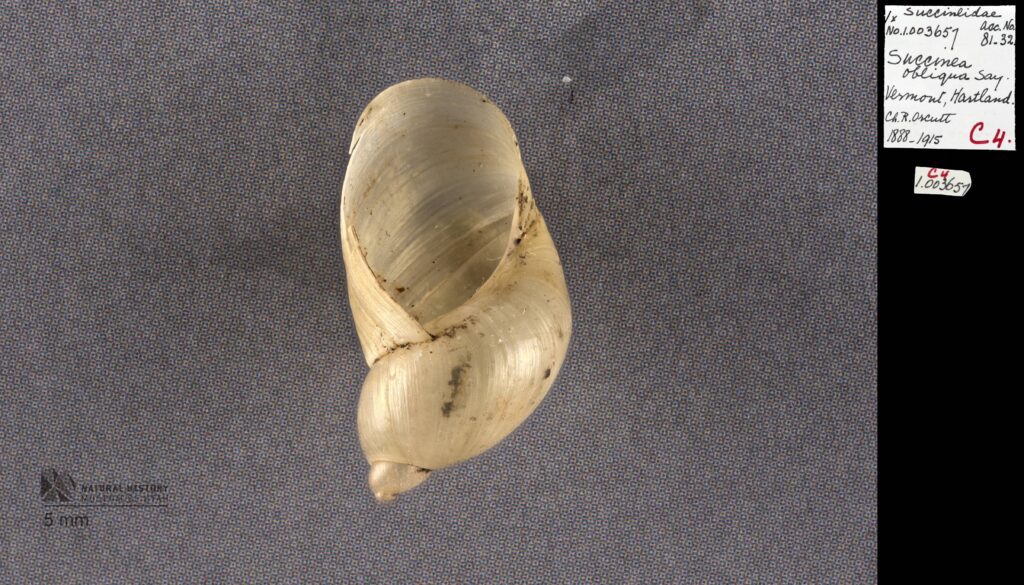
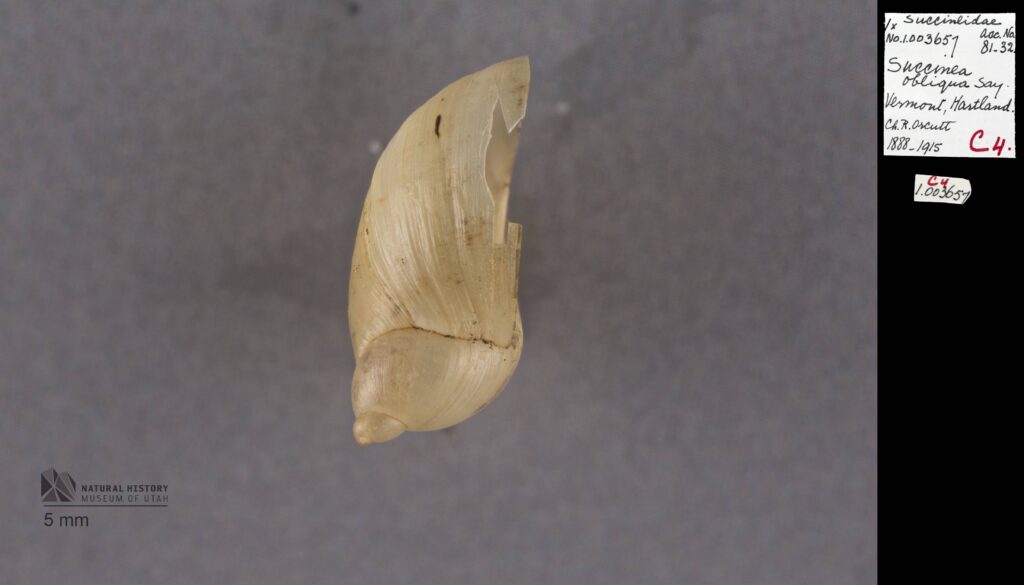
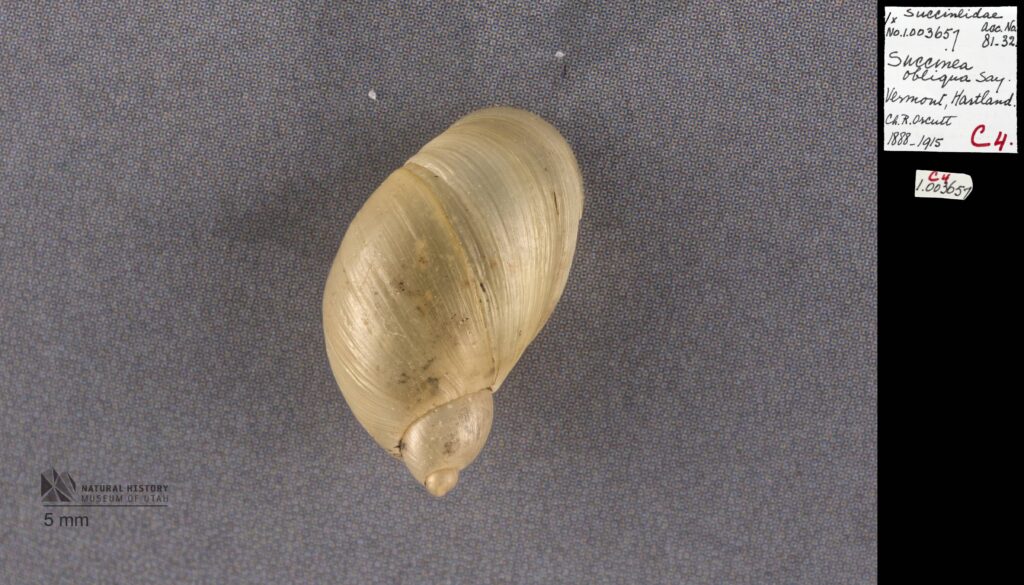
Novisuccinea ovalis

Image Usage Information

  • Natural History Museum of Utah
  • Public Domain
  • For additional information about this specimen: Christy Bills (cbills@nhmu.utah.edu)

Family: Succineidae

Common name: Oval Ambersnail

Discovery: Say, 1817

Identification

Height: 14.2-16.5 mm
Width: 9-11 mm
Whorls: 2+

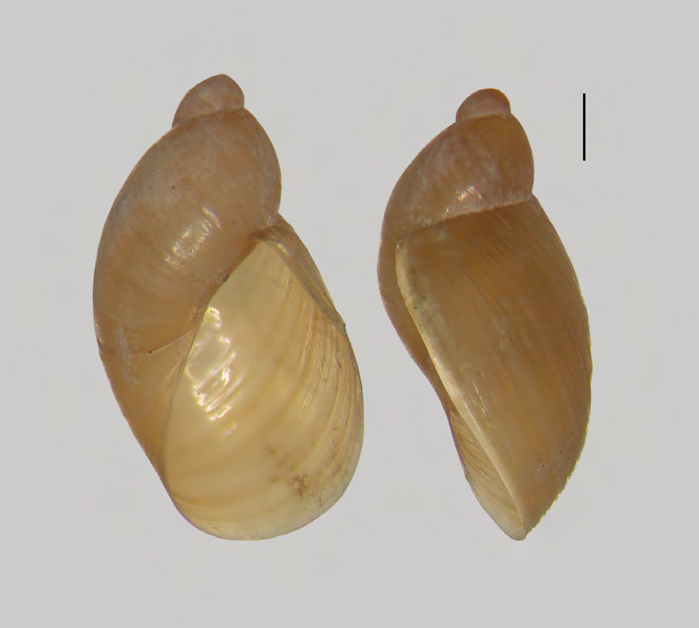
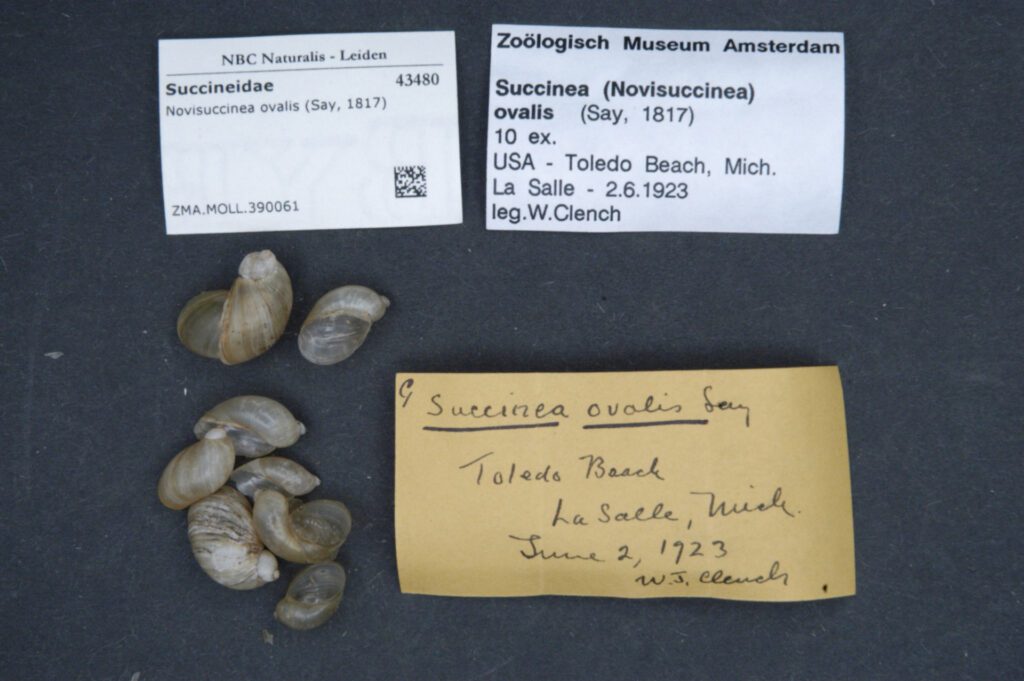
Novisuccinea ovalis is a medium-sized snail with a transparent, glossy yellow shell. The fragile shell has a rela­tively low spire and an oval aperture about two-thirds the height of the entire shell. The animal is pale with dark upper antennae. There are several look-alike members of its family, but it tends to be large and has more rounded whorls than its congeners.

Ecology

Novisuccinea ovalis can be found among herbaceous plants along ditches, streams or rivers, but also in hillside woods, sometimes hundreds of meters from water. It typi­cally occurs in moderate to low numbers. It is the most upland-dwelling species in the Family Succineidae.

Taxonomy

Novisuccinea ovalis has also been known as: Helix (Cochlohydra) ovalis, H. (C.) putris, Succinea campestris, S. obliqua, S. totteniana, S. ovalis, and S. ovatis.

Distribution

This species is found throughout the eastern and Midwestern states and provinces, but also a bit further south along the Mississippi and Appalachian Mountains. It is found in the western Virginia mountains.

Conservation

NatureServe Global Rank: G5, Secure

January 10, 2023 by

Novisuccinea chittenangoonsis

Image Usage Information

  • wkilthau
  • CC BY-NC 4.0 DEED
  • Additional information about this specimen

Family: Succineidae

Common name: Chittenango Ambersnail, Chittenango Ovate Ambersnail

Discovery: Pilsbry, 1908

Identification

Width: ~10.5-11.5 mm
Height: ~19-24 mm
Whorls: ~3.5

The shell of this animal is fragile and elongate, with a relatively tall spire (Pilsbry, 1948). The wide aperture is more than half of total shell length. The shell suture is deep, and its microsculpture is mainly growth wrinkles. The shell is translucent yellow or whitish. It has a taller spire and flatter final whorl than the more common Novisuccinea ovalis (Say, 1817).

Distinguishing shells of this species is difficult, especially for immature animals (in Breisch and Niver, 2006). After N. chittenangoensis reach a length of 6-9 mm they exhibit a unique black spot on the dorsal surface of the posterior foot (Thomee, 1986). The live animal is pale yellow with gray eyestalks and a faint gray side stripe.

Ecology

This rare ambersnail lives upon vegetated limestone ledges in a high-humidity “spray zone” habitat near a 50 m-tall waterfall. This early seral habitat is likely maintained by annual flooding and winter ice. The snails become active in May, mate in May to July, and lay eggs in June and July (Thomee, 1986; Breisch and Niver, 2006). 

At the falls, eggs number 8-14 in clusters, laid at the base of plants, under dead vegetation or in damp soil, and hatch in 2-3 weeks (in Breisch and Niver, 2006). Molloy (1995) noted as many as 29 eggs laid in captivity. Novisuccinea chittenangoensis is most abundant near seeps, and most active on mornings with low light, no wind, and relative humidity >85% (Thomee, 1986). Inactive snails may be found attached with a dried-mucus epiphragm to green plants. Lifespan in the wild is estimated at 2-2.5 years.

Though they may feed briefly upon various items, the preferred food of captive Novisuccinea chittenangoensis is partially-decomposed hardwood leaf litter (Gilbertson in Platt, 2015; S.U.N.Y. College of Environmental Science and Forestry, 2017).

Novisuccinea chittenangoensis occurs with a non-native ambersnail, probably related to the European Succinea putris (Linnaeus, 1758), (referred to as Sp. B: Hoagland and Davis, 1987; Campbell et al., 2014) and certainly confused with it by earlier researchers (e.g. Pilsbry, 1948). These two species each have a differently-timed life cycle, which may facilitate their co-existence (Campbell et al., 2014). However, other workers note the circumstantial evidence of declining N. chittenangoensis numbers concurrent with expansion of other succineid populations at the falls (e.g. Molloy, 1995).

Genetic microsatellites of N. chittenangoensis show that snails on a given ledge tend to be more closely related to one another than to snails on other ledges (King et al., 2012).

Taxonomy

Novisuccinea chittenangoensis is part of a family whose taxonomy is incompletely understood. Solem (1976) considered this animal a form of N. ovalis due to anatomical similarities. Analysis of allozymes of succineids at Chittenango Falls and elsewhere did not find differences between the common N. ovalis and N. chittenangoensis, but did find differences in reproductive anatomy and shell shape judged worthy of species designation (Hoagland and Davis, 1987).

This animal has been previously known as Succinea ovalis chittenangoensis and Succinea chittenangoensis.

Distribution

Novisuccinea chittenangoensis’ global native range is Chittenango Falls, New York, although there are several misleading reports from other states (e.g. Hubricht, 1985). There are two captive populations as well.

Conservation

NatureServe Rank: G1, Critically Imperiled. NatureServe State Rank: New York, S1.

Federally Threatened; New York State Endangered

This species lives within a fenced-off protection zone in Chittenango Falls State Park. It has been the subject of recovery work by the U.S. Fish & Wildlife Service, New York Dept. of Environmental Conservation, State University of New York College of Environmental Science & Forestry (S.U.N.Y.-E.S.F.), the Rosamond Gifford Zoo, and other partners (e.g. Anonymous, 2017).

Identified threats include: trampling by visitors; other succineid species that may interfere with or otherwise impact the population; water pollution, flooding or drought; cliff erosion and rockslides; predators such as salamanders and parasitic flies; and stochastic effects associated with small population size (e.g. Breisch and Niver, 2006; Platt, 2015).

The federal recovery plan seeks to stabilize the population at the falls and establish captive populations (Breisch and Niver, 2006). To augment populations of this rare animal, captive bred N. chittenangoensis from S.U.N.Y.-E.S.F. were released at Chittenango Falls in 2014 and 2017. Molloy (1995) visited other area waterfalls and developed a snail habitat ranking system.

January 10, 2023 by

Myosotella myosotis

Image Usage Information

  • The Academy of Natural Sciences of Philadelphia
  • CC BY-NC 3.0 DEED
  • Additional information about this specimen

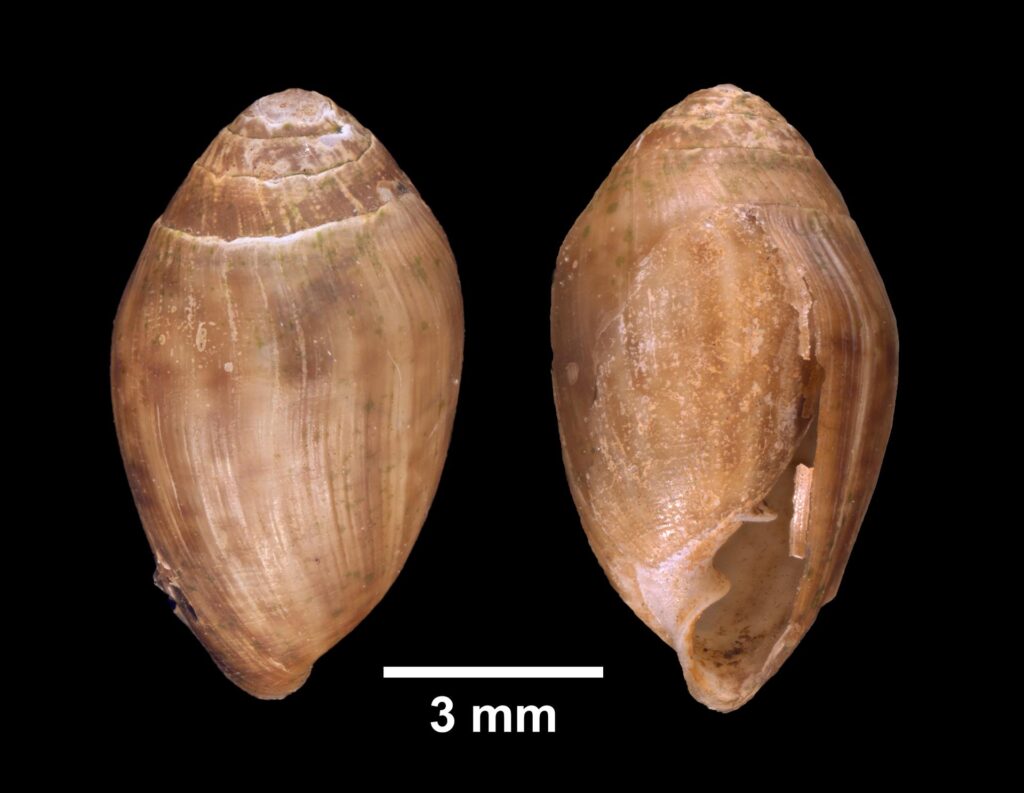
Family: Ellobiidae

Common name: Mouse Ear Snail

Discovery: Draparnaud, 1801

Non-native

Identification

Width: ~3.5 mm
Height: ~7 mm
Whorls: 5+

The small shell of Myosotella myosotis is brown to yellowish or reddish (Fofonoff et al., 2003). The apex of the shell is pointed, the umbilicus closed, and the aperture large and oval. There are two or three transverse parietal lamellae in the aperture, and some varieties may have lamellae on the interior palatal side as well. Younger specimens may have small bristles around the top of the whorls.

Ecology

This amphibious salt marsh snail is introduced from Europe. Introduced populations in the Chesapeake Bay region appear to remain patchy rather than spreading (Fofonoff et al., 2003. In the Pacific Northwest this species did not appear to out-compete native species (Berman and Carlton, 1991).

Taxonomy

There are a great many synonyms for this animal, including Auricularia myosotis, Alexia myosotis, Alexia setifer, Carychium myosotis, Convulvulus myosotis, Melampus myostis, Pythia myosotis, Alexia myostis marylandica, Carychium personatum, Alexia bermudensis, Voluta denticulate, and Ovatella myosotis (in Fofonoff et al., 2003).

Distribution

In Eastern North America there are scattered records for this Eurasian species ranging from Nova Scotia, Canada, south to the West Indies (in Fofonoff et al., 2003), as well as the West Coast and many other shores around the globe.

Conservation

NatureServe Global Rank: GNR, Not yet ranked (but surely secure).

January 10, 2023 by

Melampus bidentatus

Image Usage Information

  • Yale Peabody Museum of Natural History
  • CC BY-NC 3.0 DEED
  • For additional information about this specimen: Eric Lazo-Wasem (eric.lazo-wasem@yale.edu)

Image Usage Information

  • Bailey-Matthews National Shell Museum
  • CC BY-NC 4.0 DEED
  • For additional information about this specimen: José H. Leal, Science Director & Curator (jleal@shellmuseum.org)

Family: Ellobiidae

Common name: Eastern Melampus

Discovery: Say, 1822

Identification

Height:10-15 mm
Whorls: 5-6

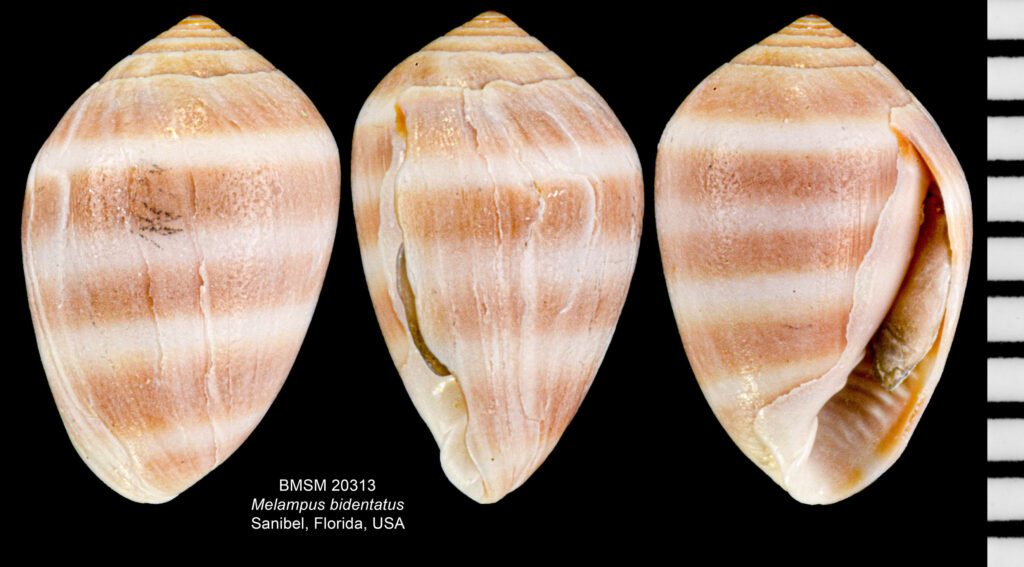
The shell of Melampus bidentatus is heavy and ovate-conical in shape (Abbott, 1974). The apex is low, and the whorls are tall and broadly shouldered. The upper shouldered have a microsculpture of incised spiral lines. A narrow aperture runs for most of the whorl height, with 2 lamellae on the inner columella, and 1-4 raised lirae within the outer lip. The shell color is tan or light brown with 3-4 broad,darker brown bands. Maine specimens may be unbanded or vertically banded (Hotopp, pers. obs). The animal is reddish-brown.

Ecology

This snail is an amphibious salt-marsh dweller of bays and estuaries. It is an air-breather, or pulmonate, that can survive for extended periods upon vegetation above or beyond the water. It consumes rotten vegetation, especially saltmarsh cordgrass. Melapus bidentatus shells may be encountered along old saltmarsh hayfields, marsh edge roadbeds or walking trails.

In Massachusetts, snails reached reproduction size at 5mm, engaging in a six-week reproductive period in May-July (Apley, 1970). These hermaphroditic snails laid in saltwater an average of 39 gelatinous egg masses, each averaging 850 eggs. Hatching of veligers occurred after 16 days, followed by 2-6 weeks as planktonic larvae. Individual snails lived 3-4 years.

Taxonomy

Synonyms of Melampus bidentatus are M. corneus, M. lineatus, and M. redfieldi.

Distribution

Melampus bidentatus lives from the Maritime Provinces of Canada to the Texas Gulf Coast. In Virginia it is reported from coastal counties.

Conservation

NatureServe Global Rank: G5

  • « Go to Previous Page
  • Page 1
  • Interim pages omitted …
  • Page 49
  • Page 50
  • Page 51
  • Page 52
  • Page 53
  • Go to Next Page »

sidebar

About

  • Mission & Commitments
  • Directors Team
  • Museum History

Get Involved

  • Volunteer
  • Membership
  • Carnegie Discoverers
  • Donate
  • Employment
  • Events

Bring a Group

  • Groups of 10 or More
  • Birthday Parties at the Museum
  • Field Trips

Powdermill

  • Powdermill Nature Reserve
  • Powdermill Field Trips
  • Powdermill Staff
  • Research at Powdermill

More Information

  • Image Permission Requests
  • Science Stories
  • Accessibility
  • Shopping Cart
  • Contact
  • Visitor Policies
One of the Four Carnegie Museums | © Carnegie Institute | Privacy Policy | Terms of Use | Accessibility
Rad works here logo