• Skip to primary navigation
  • Skip to main content
  • Skip to primary sidebar

Carnegie Museum of Natural History

One of the Four Carnegie Museums of Pittsburgh

  • Visit
    • Buy Tickets
    • Visitor Information
    • Exhibitions
    • Events
    • Dining at the Museum
    • Celebrate at the Museum
    • Powdermill Nature Reserve
    • Event Venue Rental
    • Gift Cards
  • Learn
    • Field Trips
    • Educator Information
    • Programs at the Museum
    • Bring the Museum to You
    • Guided Programs FAQ
    • Programs Online
    • Climate and Rural Systems Partnership
  • Research
    • Scientific Sections
    • Science Stories
    • Science Videos
    • Senior Science & Research Staff
    • Museum Library
    • Science Seminars
    • Scientific Publications
    • Specimen and Artifact Identification
  • About
    • Mission & Commitments
    • Directors Team
    • Museum History
  • Tickets
  • Give
  • Shop

Amy Covell-Murthy

July 14, 2022 by Erin Southerland

A Trip to Grave Creek Mound

by Amy L. Covell-Murthy

It was my pleasure to organize a field trip for Anthropology and Anthropocene staff, students, and friends to the Grave Creek Mound Archaeological Complex in Moundsville, West Virginia. Our gracious host, Dr. Olivia Jones, who is the facility’s lead curator showed us around the complex while explaining the history of the facility and of the mound. She also provided us with plenty to explore on our own.

Maintaining a relationship between Carnegie Museum of Natural History and the Grave Creek Mound Complex has been a highlight of my responsibilities as collection manager over the past five years. Dr. Jones and I work hard to keep each other informed of current research and initiatives in our institutions, while sharing resources that pertain to the history of the region. 
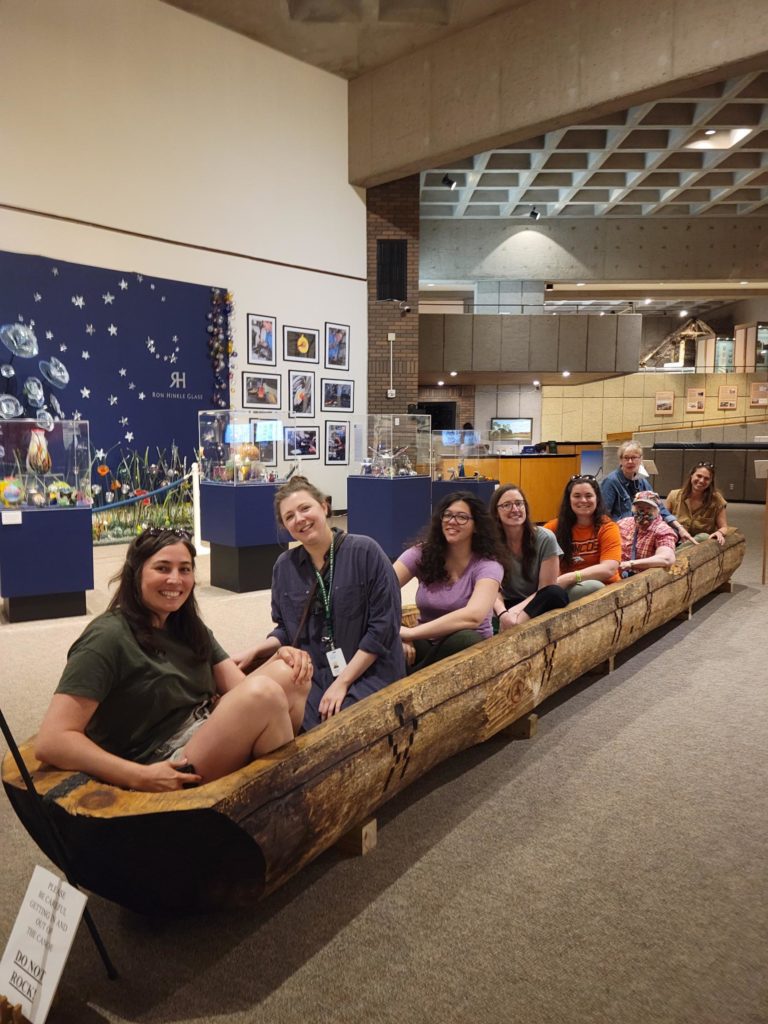
Group of people in a canoe in a museum
This picture shows the Carnegie crew posing in a dugout canoe that was commissioned from artists of the Seneca Nation/Onöhsagwë:de’ Cultural Center.

Adena is the name given by archaeologists to the mound building cultural group who developed around 2500 years ago in the Ohio River Valley and many of its major tributaries. The Grave Creek Mound, now located in the center of a town whose name references the structure, is one of the largest of the conical Adena burial mounds. Dr. Jones, curator Hank Lutton, and the staff of the Archaeological Complex work to maintain the integrity of this National Historic Landmark. According to their website, the mound was constructed between 250 and 150 B.C.E. and in 1838 it was measured as being 69 feet tall, and 295 feet in diameter. 
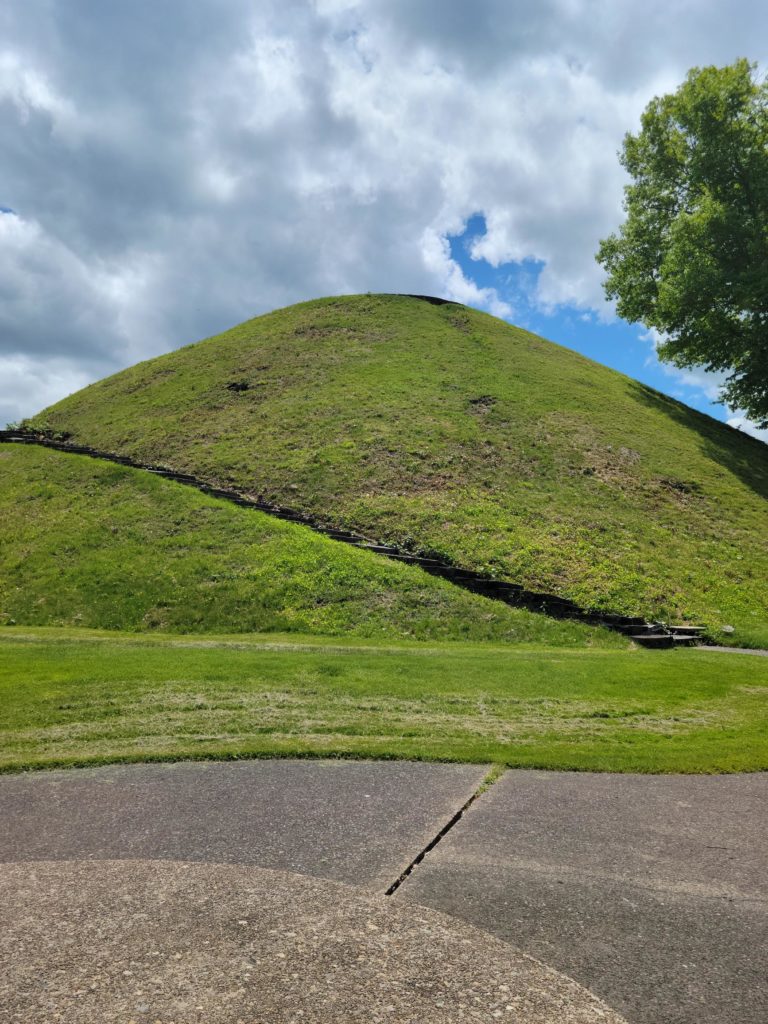
The Grave Creek Mound from a walkway near the base of the 2,000-year-old structure.

In addition to the mound, the complex consists of an archaeological research and collection facility, and the Delf Norona Museum, which interprets lifeways of the Adena people for the public. The museum, named for the author of the mound’s definitive history, opened its doors in 1978, and the research facility was constructed later in 2008. This facility is the repository for all of West Virginia’s State-owned collections and artifacts. 

Although our exhibits do not explain the arrangement, Carnegie Museum of Natural History once served as a repository for the State Museum of Pennsylvania for all cultural material excavated in Western Pennsylvania.  This material remains in our care at our collection facility and is used for research. As we try to reconcile our institutional past and bring equity and inclusion into our storytelling, these collections will help us interpret the pre-contact narratives of the region. 
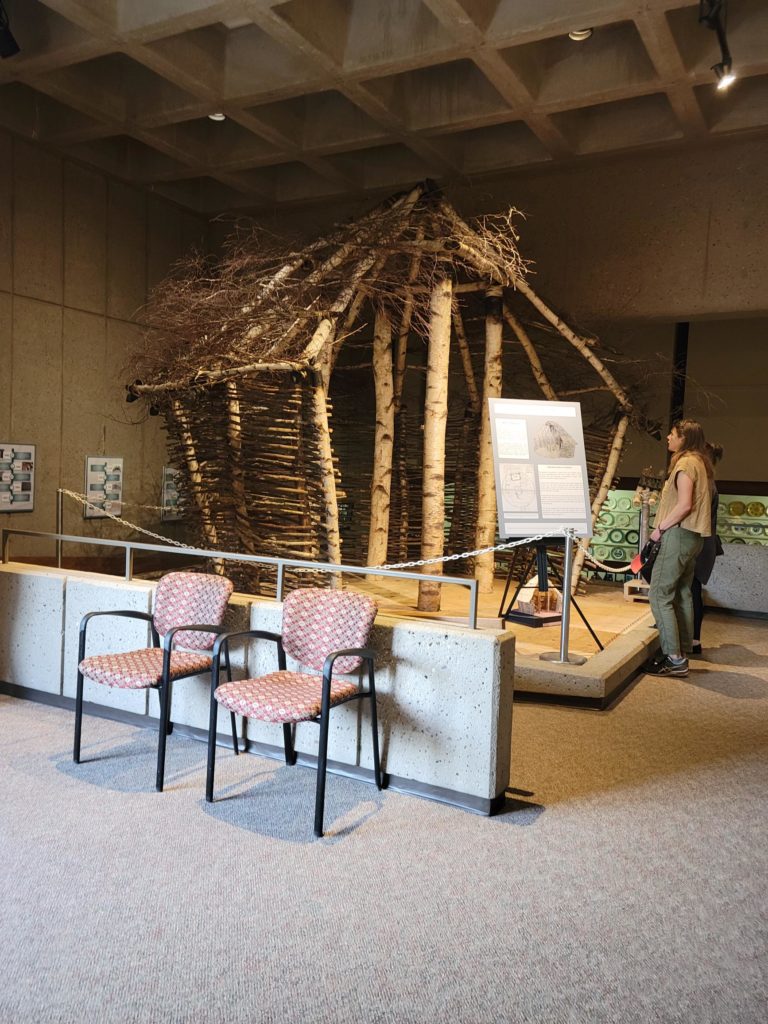
Dr. Nicole Heller viewing the Adena Structure replica in the Delf Norona Museum. 

I am very lucky to be able to offer these educational experiences to my students and volunteers and I encourage those of you who can, to take the 90-minute drive from Pittsburgh to Moundsville, West Virginia to check out the Archaeology Complex. And the next time you find yourself in the North Eastern section of the Alcoa Hall of American Indians at CMNH, take some time to think about the mound builders who were here before the Haudenosaunee, Lenape, and Shawnee in Western Pennsylvania. 

Amy L. Covell-Murthy is the Collection Manager for the Section of Anthropology and Archaeology at Carnegie Museum of Natural History.

Related Content

Celebrating Indigenous Peoples’ Day

Grass Baskets of the Chumash

Queer Eye for Lakota Art

Carnegie Museum of Natural History Blog Citation Information

Blog author: Covell-Murthy, Amy L.
Publication date: July 14, 2022
Share this post!

  • Share on Twitter Share on Twitter
  • Share on Facebook Share on Facebook
  • Share on Pinterest Share on Pinterest
  • Share on LinkedIn Share on LinkedIn
  • Share on Reddit Share on Reddit
  • Share via Email Share via Email

Filed Under: Blog Tagged With: Amy Covell-Murthy, anthropology, archaeology, Science News

October 11, 2021 by Erin Southerland

Celebrating Indigenous Peoples’ Day

by Amy L. Covell-Murthy

Indigenous Peoples’ Day is observed in the City of Pittsburgh alongside Columbus Day and I would like to suggest some ways to observe the holiday for those who do not claim Indigenous heritage. In a state with no habitable federally recognized Indigenous land, Native people are all too often seen as existing only in the past. While educating yourself on the Indigenous history of the region is an important part of observing the holiday, it’s also important to recognize that many First Nations people live, work, and play in the Greater Pittsburgh Area. Indigenous Peoples’ Day should not be a memorial, but a recognition of the important history and cultural heritage of those who are the past, present, and future caretakers of this land. Here are some things you can do to respectfully celebrate on October 11, 2021. 

Educate Yourself

Learn about the people who have called Pittsburgh home. Many different cultural groups have occupied the Upper Ohio River Valley including but not limited to the Delaware/Lenape, the Haudenosaunee, the Shawnee, and the Wyandotte. The Osage Nation also claims origin in the Ohio River Valley, and you can learn about all these nations on their official websites. I also suggest hitting up your local library to check out books on these groups as well as the cultural traditions and ancestors who came before them. This region was home to those who are often referred to as the Adena, Hopewell, and Monongahela. But keep in mind, we have no idea what they called themselves. Here are some resources:

Haudenosaunee Confederacy

Lenape Nation of Pennsylvania

Eastern Shawnee History

Wyandotte Nation

The Osage Nation

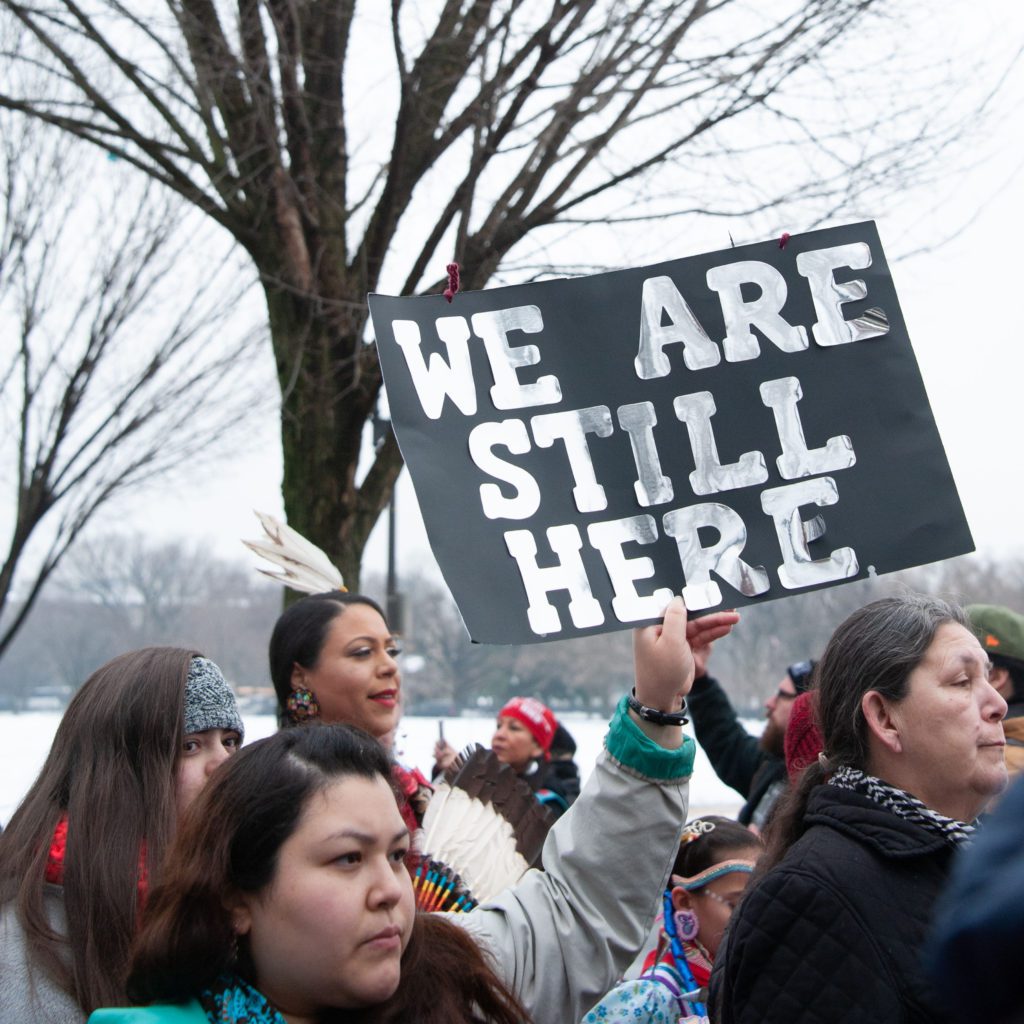
Person in a crowd holding a sign that says "We are still here"
Indigenous Peoples March, January 18, 2019

Educate Yourself Some More

Learn about the history that may have been left out of your primary and secondary school curriculums. You may be unaware of the atrocities that Indigenous people faced in the State of Pennsylvania. Many First Pennsylvanians were forced from their homelands and infected with unfamiliar diseases by colonizers. Later, beginning in 1879, the first assimilation school was created in Carlisle, PA and used as a model for 24 additional institutions whose primary goal was to force Indigenous children to abandon their Native languages and customs. In the 1960s, the building of the Kinzua Dam on the Allegheny River upstream from Warren, PA forced Seneca Nation citizens to move into the State of New York, breaking the 1794 Treaty of Peace and Friendship. Indigenous communities thrive despite these events and institutions, but it is important to recognize and not try to hide these gruesome parts of our shared American history. You can find more information about these examples on these websites: 

Kinzua Dam

Smallpox

Carlisle Indian School Project

Support Local Indigenous Groups

The Council of Three Rivers American Indian Center is a regional intertribal nonprofit that promotes the socio-economic development of the Native American community and others who experience the same type of economic difficulties in the Greater Pittsburgh metropolitan area. One way to support them is to plan to attend their annual Pow Wow that is held just outside of Pittsburgh in Dorseyville in late September. Learn more about their Early Childhood Education, Native American Elders, Veterans, and Employment programs here: 

Council of Three Rivers American Indian Center (website)

Council of Three River American Indian Center (Facebook page)

Honor the Land

gourds, corn, and seeds on a wooden platter on a black counter

Planting Native Pennsylvanian plants is a wonderful way to honor our connection to the Earth and to provide food and shelter for the diverse species who live here. You can learn about how Indigenous People use trees, ferns, flowers, vegetables, fruits, and grasses to enhance their quality of life. The Pennsylvania Department of Conservation and Natural Resources and the Audubon Society of Western Pennsylvania offer suggestions for those who are interested:  

Landscaping with Native Plants

List of Western PA Native Plants

Attend an Online or In Person Event

Many cities around the United States hold events to celebrate Indigenous Peoples’ Day. A quick Google Search can point you in the right direction. I’m going to be learning about the current racial and social landscape from young Black-Indigenous activists at the Smithsonian.  You can tune in to the National Museum of the American Indian at 1 p.m. on October 11th to attend this free webinar titled, Indigenous Peoples’ Day: Black-Indigenous Youth Advancing Social Justice.                        

Support Indigenous Artists, Authors, Film Makers, and Musicians

You have so many options! The Sundance Institute has a version of its 2021 Indigenous Short Film Tour available to stream. It’s an 85-minute program featuring 7 short films. The Carnegie Library of Pittsburgh website offers staff picks and lists of Indigenous authors. My favorite is a list of Indigenous Science Fiction from 2020 which is intended for adults, but they also have lists of Indigenous books for children and teens. Independent Lens presented a list of Indigenous musicians you should know in 2019, which included Raye Zaragoza and Pamyua. You can support Indigenous artists by purchasing art through the online gift shop of the Seneca Iroquois National Museum/Onöhsagwë:de’ Cultural Center.                 

Help Change Derogatory Mascots and Place Names                                                                         

Sign petitions, attend community forums, and advocate for the changing of harmful stereotypes and offensive signage in our community.  From the Cleveland Guardians to Hemlock Hollow Road, there are many instances of this happening around us. The National Congress of American Indians offers a state tracker of schools with offensive mascots, and Pennsylvania has 45 districts and 115 schools who need a change. 

Consider Donating Time or Resources

The Seneca Iroquois National Museum/ Onöhsagwë:de’ Cultural Center is only a few hours’ drive from Pittsburgh and occasionally may be looking for volunteers. Check their website and follow their social media accounts (Instagram and Facebook) for more information.

If you are able, here are just a few organizations who can use your help:

Native American Agriculture Fund

NDN Collective

Honor the Earth

Indigenous Environmental Network

So, join me in unlearning some Columbus Day myths and celebrating the cultural diversity of Indigenous People throughout the history of our region. Remember that the best places to start educating yourself are the local libraries and museums. Carnegie Museum of Natural History offers guided tours of our cultural halls that strengthen the messages we wish to share with the community. Visit the Alcoa Hall of American Indians to learn more about the Tlingit, Lakota, Hopi, and Haudenosaunee, and keep in mind that there are so many other Indigenous groups, traditions, nations, and organizations for you to explore on your own!

Amy L. Covell-Murthy is Archaeology Collection Manager at Carnegie Museum of Natural History. Museum employees are encouraged to blog about their unique experiences and knowledge gained from working at the museum.

Related Content

An Indigenous Presence: Cultural Survivance and Contemporary American Indian Art & Design

Seldom Seen: Archaeological Textiles in the Eastern United States

Queer Eye for Lakota Art

Carnegie Museum of Natural History Blog Citation Information

Blog author: Covell-Murthy, Amy L.
Publication date: October 11, 2021

Share this post!

  • Share on Twitter Share on Twitter
  • Share on Facebook Share on Facebook
  • Share on Pinterest Share on Pinterest
  • Share on LinkedIn Share on LinkedIn
  • Share on Reddit Share on Reddit
  • Share via Email Share via Email

Share this post!

  • Share on Twitter Share on Twitter
  • Share on Facebook Share on Facebook
  • Share on Pinterest Share on Pinterest
  • Share on LinkedIn Share on LinkedIn
  • Share on Reddit Share on Reddit
  • Share via Email Share via Email

Filed Under: Blog Tagged With: Amy Covell-Murthy, anthropology, Science News

March 3, 2021 by wpengine

Pennsylvania Archaeology and You

The Pennsylvania Archaeological Council (PAC) is an organization of professional archaeologists from all over the State dedicated to education, consultation, ethics, and advocation of Pennsylvania archaeology. The PAC works to advise policy and legislative interests in the commonwealth as well as provide consultation with the Pennsylvania Department of Transportation. Anyone with a graduate degree in anthropology, archaeology, or a similar subject is encouraged to apply. Recently this membership has been expanded to include those with extensive experience and PAC has taken an interest in student membership. Check out this website for more information.

outline of the state of Pennsylvania with the letters PAC on it diagonally

For anyone interested in local archaeology, the Society for Pennsylvania Archaeology (SPA) exists alongside PAC. Anyone is welcome to join this special interest group that is made up of regional chapters. Established in 1929, the goals of SPA include; promoting the study of archaeological resources in PA, discouraging irresponsible exploration, connecting avocational and professionals, and promoting the conservation of sites, artifacts, and information. To disseminate information, the SPA facilitates one of the oldest State Archaeology Journals, Pennsylvania Archaeologist. 83 years of the publication are available for purchase on the website.

The Society for Pennsylvania Archaeology, Inc., the parent archaeological society, meets annually at announced places. Membership in the SPA is highly recommended. Dues are $30 per year for individuals. Membership entitles one to receive The Pennsylvania Archaeologist twice a year. For those interested in taking an active role, the SPA is made up of many individuals from regional chapters. I’ve decided to highlight two of those chapters in this blog. To find your regional chapter visit pennsylvaniaarchaeology.com/Chapters.htm

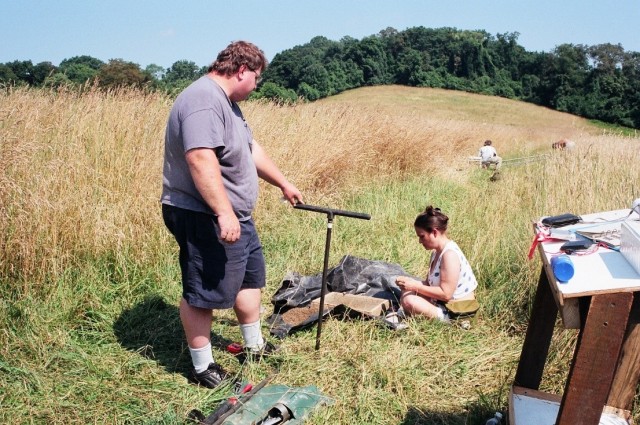
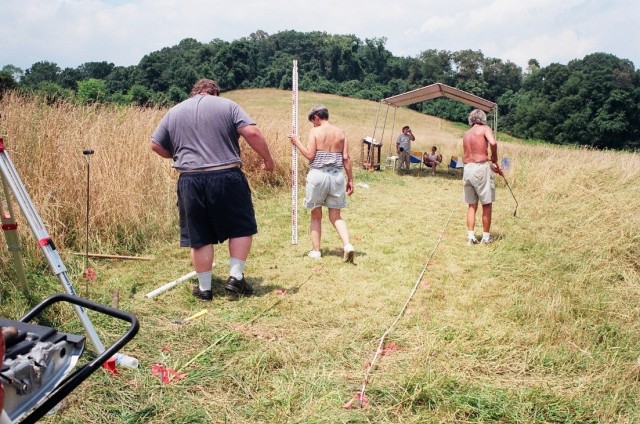
If you live in Pittsburgh, our local chapter is called Allegheny Chapter #1. We meet the first Tuesday of every month at 7:30 p.m. Due to the pandemic, this is currently done virtually. For membership information contact Amanda Valko at amanda@quemahoning.com The chapters take an active approach by conducting investigations of sites in their region. The Allegheny Chapter started working on a local site called the Hatfield site back in July of 2007. The first thing we did was set up a grid and took some geomorphology samples under the direction of Brian Fritz.

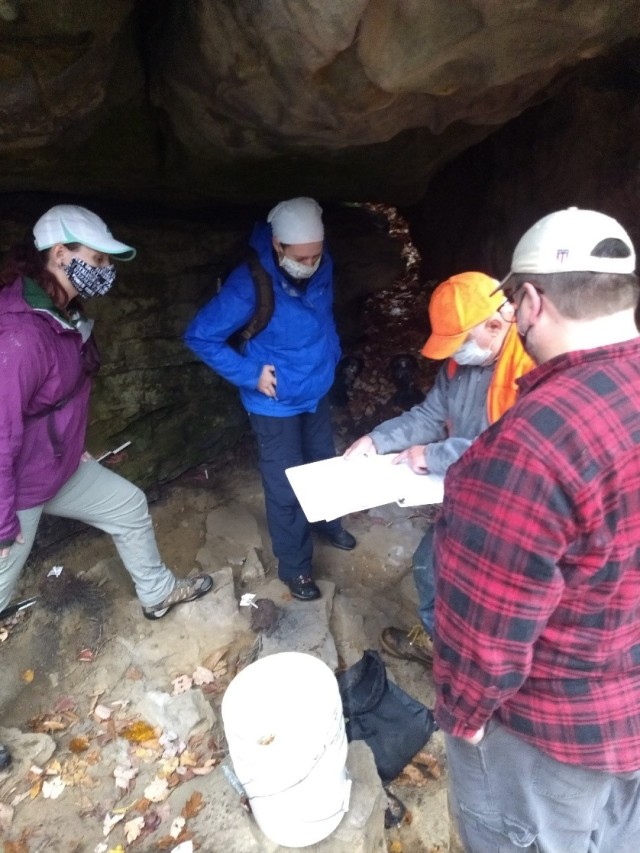
Brian Fritz and Nina Larsen examining a soil core sample at the Hatfield Site. (Photo Credit: Amanda Valko)
Setting up the grid for soil sampling. Chapter members front to back: Brian Fritz, Peggy Sinclair, Ken Fischer. Chapter members under the shade shelter: Don McGuirk, Nina Larsen. (Photo Credit: Amanda Valko)

The Allegheny Chapter is hoping to produce a report of these excavations soon. Hopefully we can get the Chapter together over the summer to work with the artifacts and start the whole report preparation process.

Southeast of Allegheny County, the Westmoreland Archaeological Society Chapter #23 used to meet on Wednesdays, but due to the pandemic are following an erratic schedule. For membership information contact Jim Barno at bar3686@calu.edu (Jim Barno is a dedicated volunteer in the section of Anthropology at CMNH.)

Chapter #23 was actively engaged in 16 years of excavation at the Console Site, which was an important Monongahela Site. They reach out to the students and faculty at the Indiana University of Pennsylvania encouraging them to become involved with the Westmoreland Archaeological Society by participating in various public events such as artifact displays and colloquiums held at the IUP campus, Fort Necessity National Battlefield, Green County Historical Society as well as local community events such the Derry Agricultural Fair.

IUP students are actively involved in continuing excavations at the Bergstrom Hollow Rock Shelter Site (weather permitting). The chapter also publishes a monthly newsletter called The Trowel that has interesting archaeological subject material as well as listings of local archaeological events and now Zoom links for folks interested in these types of activities.

From the left are the following people Stephanie Zellers, Rachael Smith, Bob Oshnock, and Dr. Chadwick at the Bergstrom rock Shelter. (Photo Credit: Jim Barno)
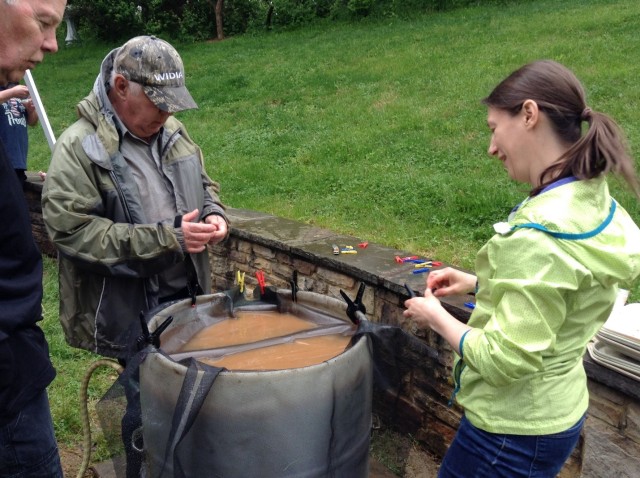
Earth Day Event at St. Vincent College. Bob Oshnock and Dr. Lara Homsey-Messer (IUP) doing flotation. (Photo Credit: Jim Barno)

Remember to always report archaeological finds to the State Historic Preservation Office! Follow the guidelines specified in the links below.

PA SHPO/State Museum of PA: Instructions for Recording Archaeological Sites in Pennsylvania

PA State Historic Preservation Office (PA SHPO): Guidelines for Archaeological Investigations in Pennsylvania

Amy L. Covell-Murthy is Archaeology Collection Manager at Carnegie Museum of Natural History as well as a member of the SPA Allegheny Chapter 1, and a recently elected executive board member of the PAC. Museum employees are encouraged to blog about their unique experiences and knowledge gained from working at the museum.

Related Content

Archaeological Adventures in Egypt

Minecraft Lied to Me?!

Super Science Activity: Hieroglyphs

Filed Under: Blog Tagged With: Amy Covell-Murthy, archaeology, Archaeology Extravaganza, Educators, Super Science

October 30, 2019 by wpengine

“Minecraft™ Lied to Me!?”

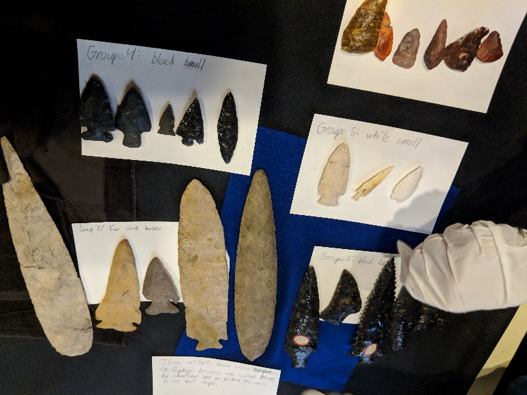
On October 19, 2019, the Section of Anthropology once again had the pleasure of assisting the Education and Interpreter staff in awarding the BSA Scouts Merit Badge for archaeology. The Scouts spent the day learning how to excavate artifacts from dig boxes and creating mini-exhibits for museum visitors to enjoy. The mini-exhibits were focused on typology. Scouts were asked to organize lithics (mostly arrow heads and spear points) by physical characteristics. Stem and shoulder shape, cross section, and flaking styles are often used by archaeologists to categorize objects. Other basic morphological typology categories can rely on color, weight, or material.

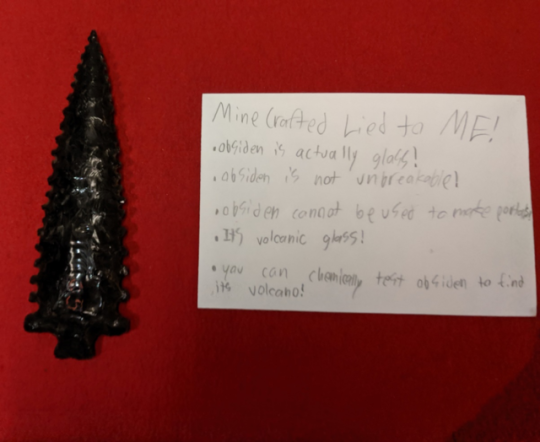
The Scouts were asked to create labels for their mini-exhibits to explain the reasoning behind their classifications. Some Scouts organized objects by size, while others chose to compare the different shapes. One Scout was organizing objects by material, specifically obsidian. He asked if it was nearly indestructible like in Minecraft™ and I had to tell him that obsidian is actually volcanic glass that breaks pretty easily resulting in a conchoidal fracture, which is why people have made so many arrow heads and spear points out of it. He replied, “well, next you’ll tell me that it doesn’t create portals into a nether dimension.” Sorry Scout, to my knowledge it does not.

black arrow head with index card that says Minecraft lied to me, obsidian is actually glass, obsidian is not unbreakable, obsidian cannot be used to make portals, it's volcanic glass, you can chemically test obsidian to find its volcano!

To investigate further into how obsidian is used in Minecraft™, I called the most knowledgeable gamer I know. My nephew, Zak, was happy to explain to me that in the game you combine lava and water to create obsidian blocks. This isn’t exactly true. Obsidian is formed when molten rock material cools so fast it cannot form a crystalline structure at an atomic level. It usually solidifies on the Earth’s surface, making it an extrusive rock. According to Zak, the obsidian in Minecraft™ can be used to create a very strong wall or to access the nether dimension that I had learned about from the Scout. Weapons are not made from it and it is very hard to break. In reality, obsidian is easily broken by human action and can also be worn down by the weather. This would make it a terrible substance from which to build a fortress. While obsidian is not used to build indestructible walls or portals, it is used to make surgical tools. It can be made sharper than steel and can be placed in scalpels for precision procedures. So, while the obsidian in Minecraft™is different than obsidian on Earth, at least it sparked a conversation.

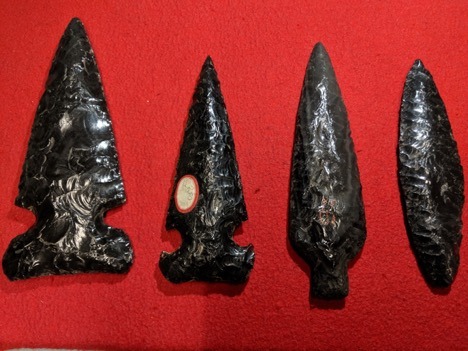
four obsidian artifacts

The obsidian artifacts in this photo are a part of the educational collection maintained by the Section of Anthropology.

To learn more about the BSA Merit Badge for archaeology visit: https://meritbadge.org/wiki/index.php/Archaeology

To read another CMNH blog about obsidian visit: https://carnegiemnh.org/tag/emerald-obsidianite/

Amy L. Covell-Murthy is the Archaeology Collection Manager at Carnegie Museum of Natural History. Museum employees are encouraged to blog about their unique experiences and knowledge gained from working at the museum.

Filed Under: Blog Tagged With: Amy Covell-Murthy, archaeology, Boy Scouts, Education, gems and minerals

June 28, 2019 by wpengine

Students, Research Associates, and Volunteers: Anthropology’s Real Treasure

The Anthropology Department is very fortunate to have a strong core of dedicated volunteers, research associates, and students. Without their valuable assistance, we would have a very hard time maintaining the quality of collection care and excellence in public engagement for which we feel immense amounts of pride. We’ve hosted volunteers for many years; some have specific interests which can help to augment our knowledge base, and others simply love the museum and want to help in any way that they can. Students come to us mostly from nearby universities, but occasionally from farther away. We have a long-standing partnership with Duquesne University to fulfill their Masters of Public History Collection Management internships. We’ve hosted students from the University of Pittsburgh, California University of Pennsylvania, Clarion University of Pennsylvania, Indiana University of Pennsylvania, Humboldt University (California), University College (London), and even students from China, the Netherlands, Australia, and Costa Rica. Our Research Associates fill in knowledge gaps that we lack in the section and use the collections to further their research and contribute to the academic world. Their expertise covers a wide range of topics from zooarchaeology and Eastern Woodlands archaeology to ethnology and cultural anthropology.

I’d like to toot a few horns regarding the annual meeting for the Society for Pennsylvania Archaeology, which was held in Uniontown, PA on April 5-7th, 2019. Two of our distinguished research associates were interviewed for an oral history project being conducted by representatives of PennDOT, the State Historic Preservation Office of Pennsylvania, and the Carnegie Museum of Natural History.  Dr. Mark McConaughy and Dr. William C. Johnson sat down to talk about their unique experiences with the history of archaeology in Pennsylvania. They also presented papers at the conference along with many other research associates. The collection at CMNH was mentioned in 75% of the papers given all weekend!

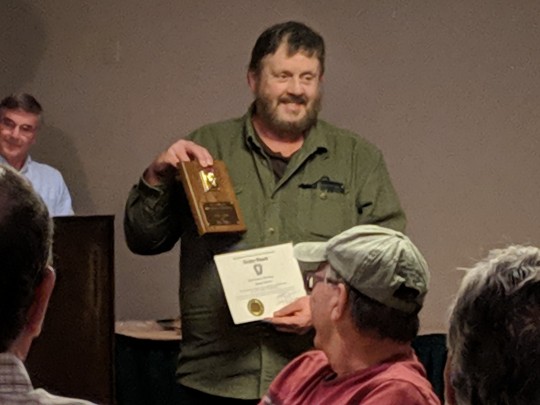
Three of our outstanding students/volunteers were presented awards at the banquet. Mr. James Barno has been a volunteer in the section for two years. He began as an intern from California University of Pennsylvania and has remained a volunteer since his graduation. He was given this year’s Archey Award, which is presented to members of the Society able to devote only spare time to their archaeological interests. It is given for some significant contribution (or contributions) over an appreciable period toward the unselfish furtherance of archaeology. We’re very proud of him!

James Barno holding the award

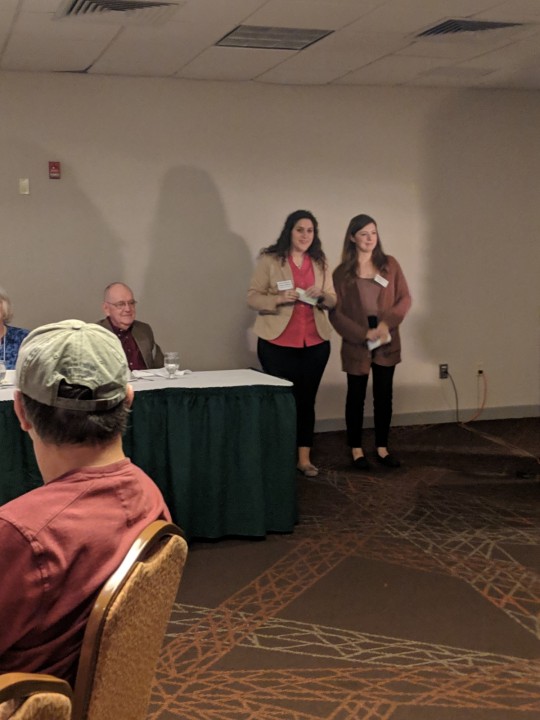
Also awarded were two James W. Hatch Scholarships for students presenting at the conference. One went to Tamara Alchoufete, who is our current work-study student from the University of Pittsburgh, and the other went to Indiana University of Pennsylvania graduate student and CMNH volunteer, Kristina Gaugler. Ms. Gaugler was also awarded the W. Fred Kinsey Scholarship, which is given to a student who presents a single authored paper at the meetings. It comes with a complimentary Society for Pennsylvania Archaeology membership and free conference banquet, along with a stipend for research expenses. Congratulations to both!

Tamara Alchoufete and Kristina Gaugler at the award ceremony

Cultivating an interest in professional development is something that we can offer to our students and volunteers, besides valuable museum related skills training. Volunteers, students, and research associates are truly our most valuable treasure.

More information on how to volunteer with CMNH can be found here: https://carnegiemnh.org/visitor/things-to-do/volunteer/

More information on the Society for Pennsylvania Archaeology can be found here: https://www.pennsylvaniaarchaeology.com/

Amy L. Covell-Murthy is the Archaeology Collection Manager at Carnegie Museum of Natural History. Museum employees are encouraged to blog about their unique experiences and knowledge gained from working at the museum.

Filed Under: Blog Tagged With: Amy Covell-Murthy, anthropology, Research Associates, volunteers, western pennsylvania

November 5, 2018 by wpengine

Archaeology Merit Badge: Who Had More Fun, Me or the Boy Scouts?

by Amy L. Covell-Murthy

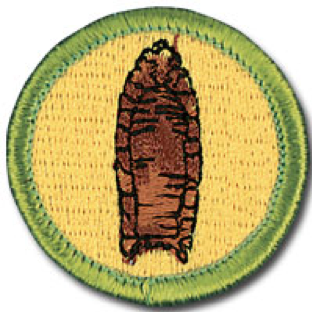
The Archaeology merit badge for the Boy Scouts of America was established in 1997. It has a list of eleven different requirements that must be fulfilled before receiving the recognition and patch. The first seven requirements ask the Scout to research archaeology and then answer a long list of questions. These questions include everything from what archaeology is to the difference between absolute and relative dating of sites. They are required to research five separate sites, learn about laws that protect archaeological sites, and make a list of household trash that could be interpreted by archaeologists in the future. Needless to say, this badge is no joke!  I have supervised nearly forty college students in my time here at the museum and I think that every one of them would be challenged by the requirements of this badge.

archaeology merit badge

Requirement numbers eight and nine are where we came in to the process:

“8. With your counselor’s approval, take part in a simulated archaeological project designed by a qualified archaeologist. The project must include the use of a simulated archaeological site including artifacts and features for the site. Using the steps of archaeological inquiry, analyze the “artifacts and features” and document the spatial relationships of the “artifacts and features” at the simulated site. Explain how the environment and time can affect the interpretation of an artifact and the overall archaeological site. Tell how you would share the results of your analysis with other researchers and the public

Note: To find out how to make a simulated archaeological site, talk with a professional archaeologist, trained avocational archaeologist, museum school instructor, junior high or high school science teacher, advisor from a local archaeology society, or other qualified instructor.

9. Help prepare an archaeological exhibit for display in a museum, visitor center, school, or other public area.”

mix of artifacts laid out on a table

Phillip Mendenhall is a member of our Natural History Interpreter staff, a volunteer in the Section of Anthropology, a graduate student at the University of Pittsburgh, and a professional archaeologist who has excavated all over the world. To achieve requirement eight, he created a simulated archaeological project in one of the basement classrooms, using dig boxes and artifacts. The Scouts could dig and screen the dirt and map out the features that they discovered. He made a fun learning environment and really taught the Scouts the intricacies of the archaeological process.

I had the pleasure of helping them achieve requirement nine. With the help of Tamara Alchoufete, my work study student from Pitt, and Shari Bechtel, a delightful CMNH Interpreter, we made two large piles of man-made objects. The objects were donated to the museum many years ago, but lack any proper provenance. These unaccessioned teaching tools were sorted by the Scouts into mini exhibits on a large cart and wheeled from the Resource Room outside of Polar World into the public space. The Scouts were organized into four groups of ten. We repeated the same exercise twice before lunchtime and twice after. Each group was accompanied by several Scout leaders and parents. They seemed just as interested as the participants.

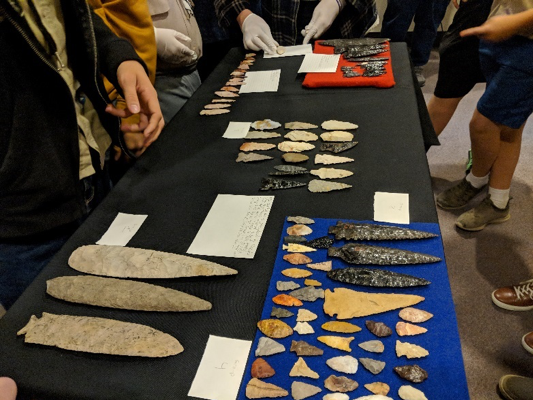
human made artifacts on a table

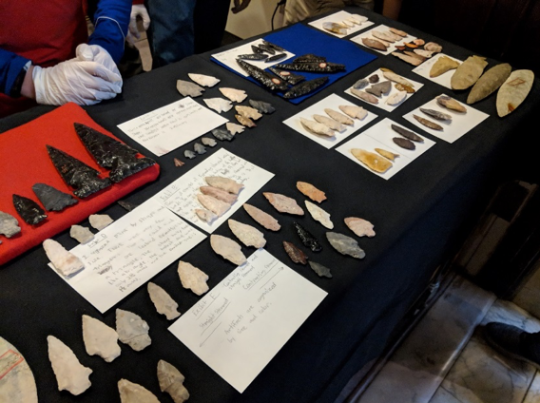
They organized the objects by typology, which in archaeology simply means they are classified by their physical characteristics. They made label copies on index cards, describing the objects and their classifications. Once the mini exhibits were wheeled into the museum’s public space, the Scouts entertained questions from patrons. They had grouped the artifacts into categories by color, size, shape, and material. Each Scout was proud of their own mini exhibit and was very excited to tell people about why they had chosen those objects. Some Scouts talked about different stem shapes, while some had discovered all the obsidian tools. Some Scouts went so far as to measure each object and work together as a four-person group to make a cohesive exhibit that flowed nicely from one Scout to the next.

human made artifacts on a table

It was a whirlwind of a day and we received excellent feedback from the participants. Seeing the transition from fun to science, as soon as I asked them to put on their rubber gloves, was incredible. Each and every Scout asked relevant questions and made calculated decisions about how to curate their exhibit. It was so fascinating to see their choices and reasoning. I appreciated every unique decision and every kid who asked additional questions about manufacturing techniques and possible cultural groups or time frame. I would like to think that they had the most fun, but I honestly can’t wait to do it again next year!

Amy L. Covell-Murthy is the Archaeology Collection Manager at Carnegie Museum of Natural History. Museum employees are encouraged to blog about their unique experiences and knowledge gained from working at the museum.

Filed Under: Blog Tagged With: Amy Covell-Murthy, archaeology, Boy Scouts

  • « Go to Previous Page
  • Page 1
  • Page 2
  • Page 3
  • Go to Next Page »

sidebar

About

  • Mission & Commitments
  • Directors Team
  • Museum History

Get Involved

  • Volunteer
  • Membership
  • Carnegie Discoverers
  • Donate
  • Employment
  • Events

Bring a Group

  • Groups of 10 or More
  • Birthday Parties at the Museum
  • Field Trips

Powdermill

  • Powdermill Nature Reserve
  • Powdermill Field Trips
  • Powdermill Staff
  • Research at Powdermill

More Information

  • Image Permission Requests
  • Science Stories
  • Accessibility
  • Shopping Cart
  • Contact
  • Visitor Policies
One of the Four Carnegie Museums | © Carnegie Institute | Privacy Policy | Terms of Use | Accessibility
Rad works here logo