• Skip to primary navigation
  • Skip to main content
  • Skip to primary sidebar

Carnegie Museum of Natural History

One of the Four Carnegie Museums of Pittsburgh

  • Visit
    • Buy Tickets
    • Visitor Information
    • Exhibitions
    • Events
    • Dining at the Museum
    • Celebrate at the Museum
    • Powdermill Nature Reserve
    • Event Venue Rental
  • Learn
    • Field Trips
    • Educator Information
    • Programs at the Museum
    • Bring the Museum to You
    • Guided Programs FAQ
    • Programs Online
    • Climate and Rural Systems Partnership
  • Research
    • Scientific Sections
    • Science Stories
    • Science Videos
    • Senior Science & Research Staff
    • Museum Library
    • Science Seminars
    • Scientific Publications
    • Specimen and Artifact Identification
  • About
    • Mission & Commitments
    • Directors Team
    • Museum History
  • Tickets
  • Give
  • Shop

Annie Lindsay

March 24, 2021 by wpengine

Spring Birds in Your Backyard

by Annie Lindsay

On spring mornings that I’m not banding birds, I like to sit on my back porch with my binoculars, watching for movement at the edge of the woods behind my house, keeping my ears tuned in to songs and short, usually high-pitched, chip and contact notes. On mornings following a night of heavy migration, small flocks of mixed species often move through the trees, feeding on insects as they refuel for the next stage of migration. These flocks often have warblers, thrushes, tanagers, grosbeaks, or sparrows foraging in their own niches: warblers tend to be in mid- to high-canopy, whereas thrushes stay low and sparrows are often on the ground.

Occasionally, I’ll stand outside in a quiet, dark spot just before dawn and listen for the soft, high-pitched flight calls of migrants settling into habitat after a night of flying. I’m an avid birder: I love to see both new and familiar birds, and watch the species that use my yard and favorite birding patches.
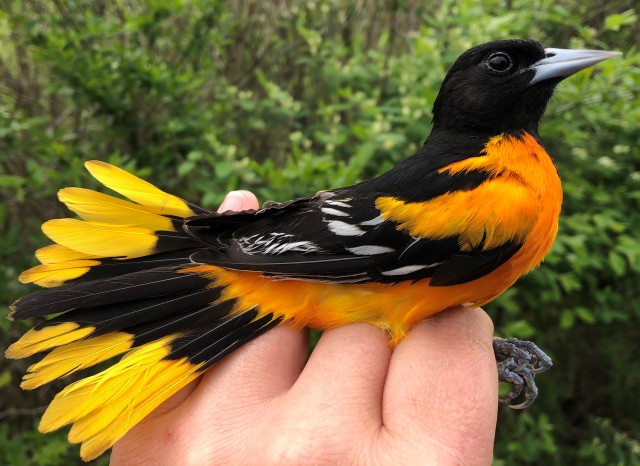
Baltimore Orioles arrive in southwest PA by mid-to late-April. Providing fresh orange halves on spikes can bring them to your feeders from spring through fall migration.

Last year, many people discovered birding. We spent much of the spring working from home, perhaps gazing out of our windows at our bird feeders or backyard plants, and for the first time noticed birds that we didn’t know existed or didn’t realize visited our yards. The opportunity to learn about the diversity of birds in our area and develop a passion for watching them was a bright spot (both literally and metaphorically!) in an otherwise difficult year. The seasons progressed, and now we once again eagerly anticipate the arrival of beautiful and colorful migratory songbirds. Let’s explore common spring backyard birds in southwest Pennsylvania and how to attract and find them!
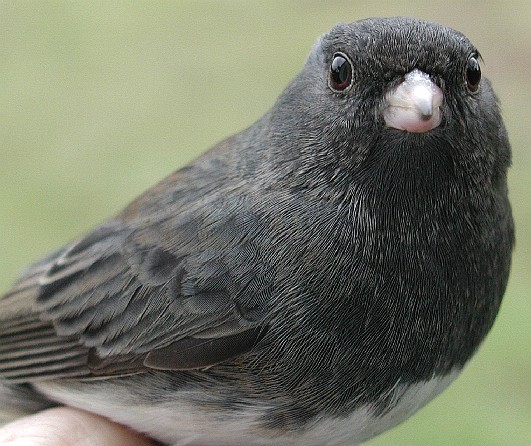
Dark-eyed Juncos are a species we usually associate with winter in southwest PA. They start singing in March, then do an elevational migration up the nearby mountains.

Each year, as the temperature warms, migratory birds move through our area in search of their breeding grounds. Although arrival timing is a bit variable between years due to annual variation in weather patterns, there is a predictable progression of species, so we know what to expect next relative to what we’ve already seen. The first, and often most conspicuous, to arrive are Red-winged Blackbirds and Common Grackles, usually in late February. They are followed by “peenting” American Woodcocks in early March, Eastern Phoebes in mid-March, and kinglets peaking in late-March. Keep your eyes to the sky any time you’re outdoors during these early spring weeks to watch for migrating waterfowl and raptors.
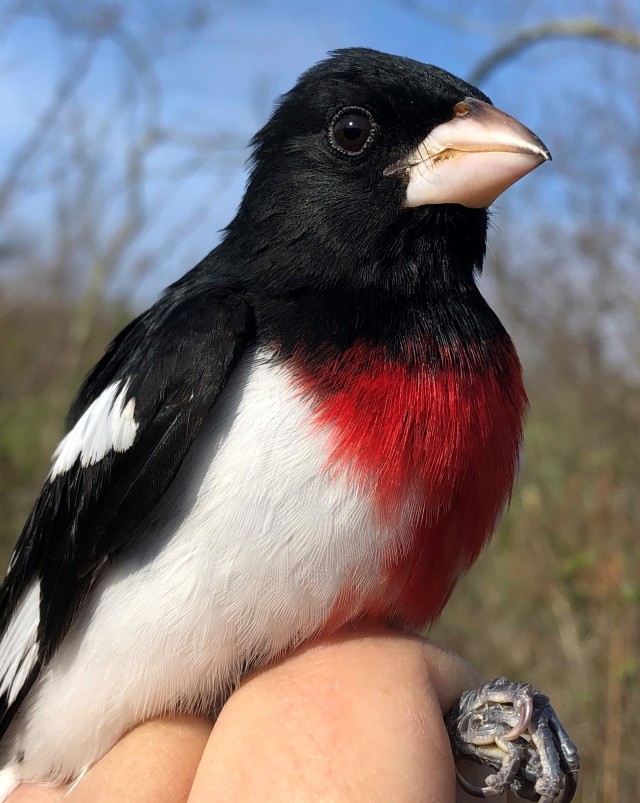
Rose-breasted Grosbeaks readily visit feeders with black oil sunflower seeds or safflower seeds usually in early- to mid-May before moving off into the forest to set up breeding territories.

By April, more songbirds, including vireos, swallows, early warblers, Blue-gray Gnatcatcher (a tiny bird with a wheezy song), House Wren, and the fan favorite, Gray Catbird make their way through our region, many remaining here to set up their breeding territories. In May, the migration floodgates open and some of the most brilliantly plumaged birds we’ve ever seen, like Baltimore Oriole, Rose-breasted Grosbeak, Ruby-throated Hummingbird, Scarlet Tanager, Indigo Bunting, and several warblers, may visit our yards and feeders, along with the less flashy, but equally beautiful, sparrows and thrushes.

Orioles readily come to feeders with orange halves, especially during migration, and seed-eating species like grosbeaks, buntings, and sparrows often visit feeders with sunflower or other seeds (or, in the case of many sparrows, clean up seeds on the ground under feeders!). Hummingbirds come to feeders with nectar (four parts water to one part white sugar, please avoid using food dyes or commercial nectar that has been dyed red). Most of these species are insectivorous, especially during spring migration, and are often observed picking things like caterpillars, midges, and spiders from foliage.
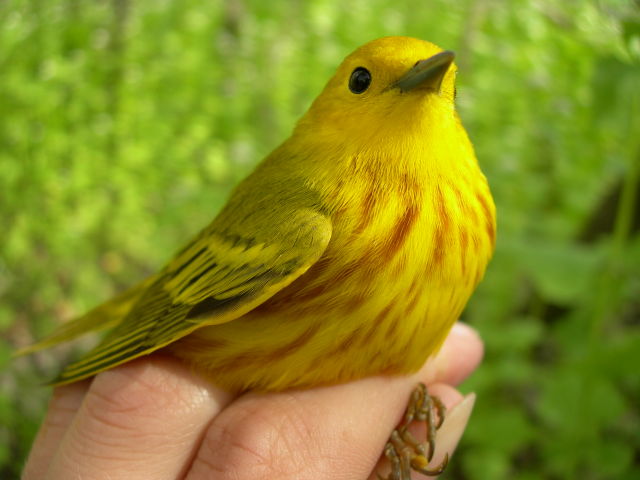
Yellow Warblers are often recognized by their signature “sweet sweet I’m so sweet!” song. You may see them flitting through small woody plants like dogwoods as they forage for caterpillars.

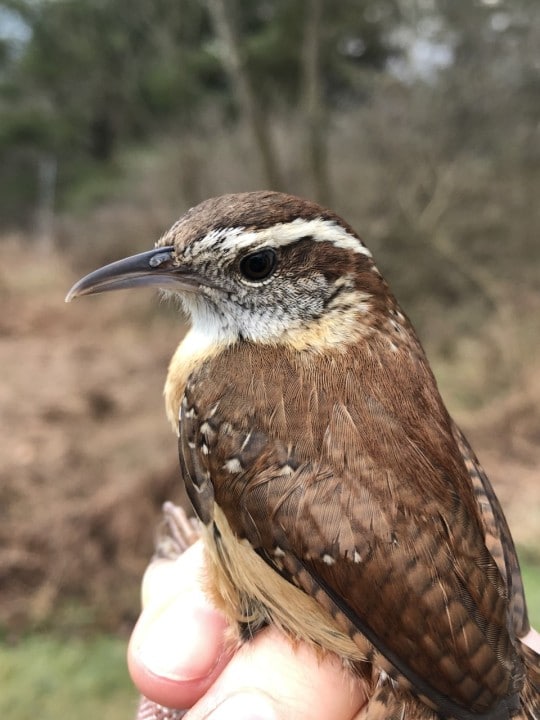
In addition to the migratory species that we see and hear in the spring, many birds that are year-round residents also frequent our yards. Black-capped and Carolina Chickadees, Tufted Titmice, White-breasted Nuthatches, Carolina Wrens, five species of woodpeckers (Downy, Hairy, Red-bellied, Pileated, and Northern Flicker, plus two more if we’re lucky – Red-headed Woodpecker and Yellow-bellied Sapsucker), and the colorful American Goldfinch, Northern Cardinal, and Eastern Bluebird mix with migratory birds. Most of these species visit bird feeders filled with sunflower or safflower seeds (chickadees, titmice, cardinals, nuthatches, woodpeckers), suet (woodpeckers, wrens), nyjer seed (finches), and mealworms (bluebirds, titmice, chickadees).
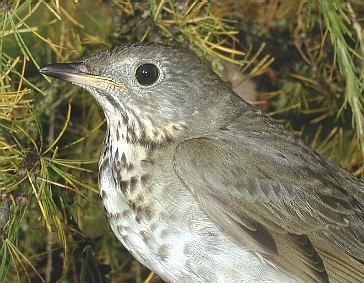
Gray-cheeked Thrushes are cryptic and secretive, but can be found skulking on the forest floor in mid- to late-May before they continue northward migration. They have a beautiful, flutey song and a distinctive call note.

One of the best ways to attract birds to your yard is planting native trees, shrubs, wildflowers, and other plants. Native plants are hosts for a high diversity of insects, especially during their larval stages, and provide nutritious seeds and fruit, all of which are important food resources for birds. These plants are also valuable as cover for safety and nest sites. Although often overlooked, a source of clean, fresh water, as simple as a bird bath or as complex as a pond with a bubbler or waterfall, can make your yard especially attractive to birds. And one of the easiest and most popular ways to attract birds for close viewing is providing bird food in clean, safe feeders. I recommend visiting your local bird feeding specialty store.

You may see all of the birds mentioned in this blog in your yard, but this is a non-exhaustive list and you may even see something unexpected. Visiting a local birding hotspot with complex and diverse habitats is certainly worth the effort as well. Birding these spots several times throughout the season will reward you with an impressive list and will boost your knowledge of natural history. The combination of a good pair of binoculars and a field guide with identification tips, range maps, and text about habitat is one of the best ways to maximize your birding, whether at home or in the field.

Please visit CMNH’s blog page to find bird ID tips and field guide recommendations.

The Audubon Society put together a great guide to the best binoculars at various price ranges.

You can put your bird observation skills to good use (or further develop those skills) by participating this spring in a broad survey of local wildlife and plants called the City Nature Challenge. The observation portion of this event is April 30 – May 3.

Annie Lindsay is the Bird Banding Program Manager at Carnegie Museum of Natural History’s Powdermill Nature Reserve. Museum employees are encouraged to blog about their unique experiences and knowledge gained from working at the museum.

Related Content

The Christmas Bird Count During an Irruption Year

Wind and Migration

Bird Banding with a Crew of One

Carnegie Museum of Natural History Blog Citation Information

Blog author: Lindsay, Annie
Publication date: March 24, 2021
Share this post!

  • Share on Twitter Share on Twitter
  • Share on Facebook Share on Facebook
  • Share on Pinterest Share on Pinterest
  • Share on LinkedIn Share on LinkedIn
  • Share on Reddit Share on Reddit
  • Share via Email Share via Email

Share this post!

  • Share on Twitter Share on Twitter
  • Share on Facebook Share on Facebook
  • Share on Pinterest Share on Pinterest
  • Share on LinkedIn Share on LinkedIn
  • Share on Reddit Share on Reddit
  • Share via Email Share via Email

Filed Under: Blog Tagged With: Annie Lindsay, Birds, City Nature Challenge, Powdermill Nature Reserve, Science News

January 11, 2021 by wpengine

2020 Rector Christmas Bird Count Results

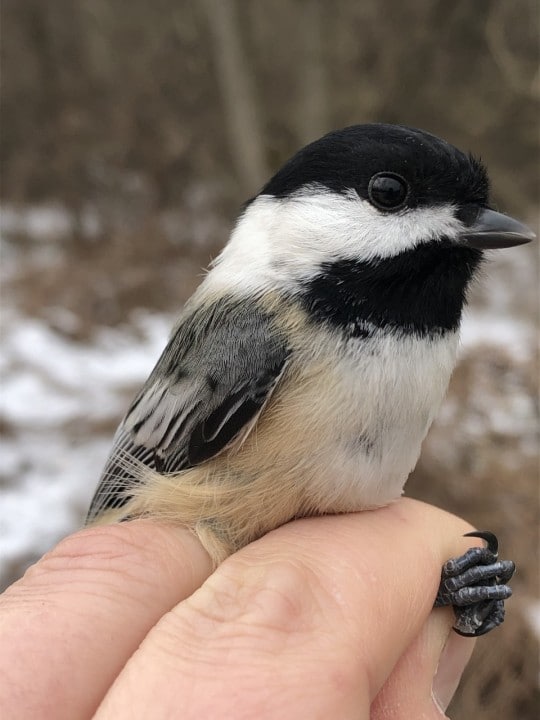
Black-capped Chickadee

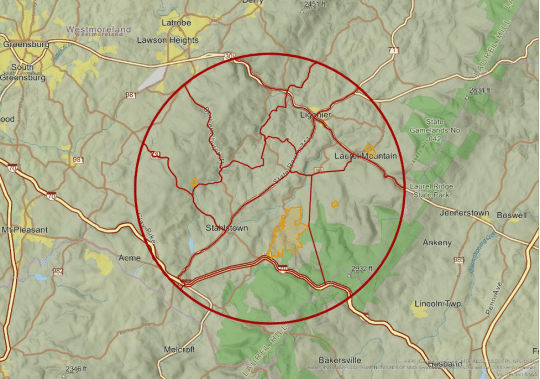
On December 20, 2020, 34 intrepid birders braved a wintry mix to count birds in assigned sectors within a 15-mile diameter circle centered just northwest of Powdermill Nature Reserve. Another eight, who lived within designated territory, closely watched their bird feeders and yards for avian visitors. Why would so many birders be out in less-than-ideal weather conditions? They were all participating in the Rector Christmas Bird Count.

Map of the Rector Christmas Bird Count circle with each count sector outlined with red, created by James Whitacre, GIS Research Scientist at Powdermill Nature Reserve.

Christmas Bird Count (CBC) is an annual event sponsored by the National Audubon Society that happens in mid-December through early January, with the compiler of each count circle choosing a specific count date within that timeframe. This year marks the 121st anniversary of the activity. The count started on Christmas day in 1900 with the purpose of censusing birds by counting them in the field using optics rather than by using shotguns. Although there were only 25 count circles in the first CBC, it has grown into an international event with nearly 2900 circles spread across the Western Hemisphere and even to Pacific Islands as far away as Guam and the Northern Mariana Islands.

Today, the CBC is a fun day for birders and bird watchers of all skill levels to head outside with the goal of identifying and counting every bird they see and hear within their count areas. The data gathered though this citizen science initiative contributes to both long-term and short-term population studies. To date, more than 200 peer-reviewed scientific publications have used CBC data in their analyses.

Although the count was a bit different this year with COVID-19 precautions keeping counters in different germ pools separate, we had an excellent turnout of both advanced and beginner birders, including some young birders.

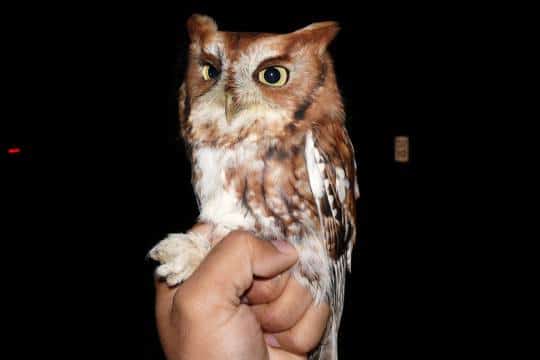
Eastern Screech Owl
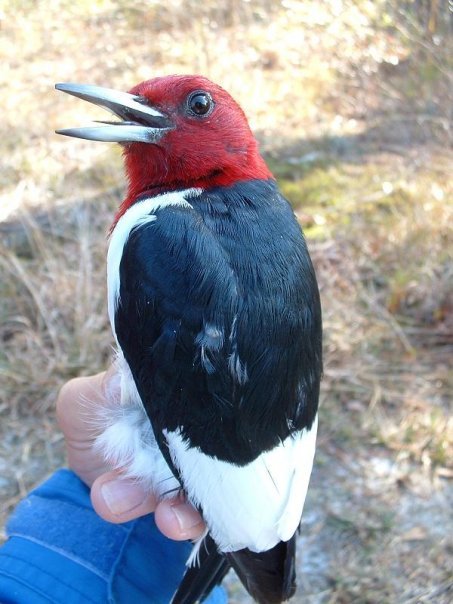
Red-headed Woodpecker

And what a count it was! This winter is an irruption year (for more info on irruptive migration, please see this blog.) for many species, and although we didn’t find hordes of these birds during the count, we did see Pine Siskins, Purple Finches, Red-breasted Nuthatches, higher-than-average numbers of Black-capped Chickadees, and the much sought after Evening Grosbeak. The counters recorded many interesting and less common species this year, including the count’s third ever Snow Goose, third ever Eastern Phoebe, and fifth ever Common Yellowthroat. Both the phoebe and Common Yellowthroat are species that winter in the southeastern US. Counting efforts that began an hour before dawn produced exceptional owl numbers (eight Eastern Screech-Owls, one Great Horned Owl, and two Barred Owls). Additionally, the birders recorded high counts for several species including Ruddy Duck, Black Vulture, Bald Eagle, Red-shouldered Hawk, Red-bellied Woodpecker, Common Raven, Carolina Wren, and Song Sparrow. Most notably, the group counted a record-setting seven Red-headed Woodpeckers, a species that is uncommon in southwestern Pennsylvania and can be reliably found in only one spot of suitable habitat within the count circle.

Carolina Wren

We thank all of the participants for a wonderful count this year! In all, we tallied 4361 birds of 69 species, a remarkable result thanks to the valiant effort of all of the counters. We look forward to hosting the Rector count next year!

Annie Lindsay is the Bird Banding Program Manager at Carnegie Museum of Natural History’s Powdermill Nature Reserve. Museum employees are encouraged to blog about their unique experiences and knowledge gained from working at the museum.

Related Content

Ask a Scientist: Ravens and crows, what’s the difference?

Oh deer, that’s a lot of parasites!

Snowflakes and Snow Fleas

Filed Under: Blog Tagged With: Annie Lindsay, Birds, Powdermill Nature Reserve, Science News

December 8, 2020 by wpengine

The Christmas Bird Count During an Irruption Year

Since 1900, the National Audubon Society has hosted the Christmas Bird Count (CBC), a fun day for birders and bird watchers of all skill levels to get outside and count everything they see and hear within a designated count circle. The CBC was started with the purpose of creating a new way of censusing winter birds. Before binoculars and optics were widely available, people used shotguns during a competition to see who could bring back the biggest pile of birds and mammals. In 1900, conservationists developed a non-destructive way to tally what they saw, and the Christmas Bird Count was born. The CBC’s initial 25 count circles have blossomed into coverage across the continent, in Central and South America, and to the Pacific Islands.

Each year, Powdermill Nature Reserve sponsors the Rector, PA Christmas Bird Count. This year, with some extra pandemic-related safety precautions, an intrepid group of local birders will canvass a 15-mile diameter circle centered just a bit north of Powdermill on Sunday, December 20. Upcoming counts promise to be interesting and exciting locally and across much of North America due to the irruption of many species of “winter finches.”

So, what is an irruption and what birds might we expect to see during an irruption year? Irruptive migration happens most often when there’s a change in food availability over much of a species’ normal range. It’s less predictable than the annual migration that we observe every spring and fall, and often happens in a cyclical pattern, reflecting normal changes in abundance of food items. Species that breed in the far north and winter generally farther north than Pennsylvania are those most likely to be irruptive migrants. When there is a poor seed crop, birds that eat things like conifer seeds, such as Pine Siskins, Red-breasted Nuthatches, and Evening Grosbeaks, as well as birds that prey upon small seed-eating animals, such as Snowy Owls, are often seen south of their typical range. This year has already proven to be a major irruption year and the season has barely begun!

image
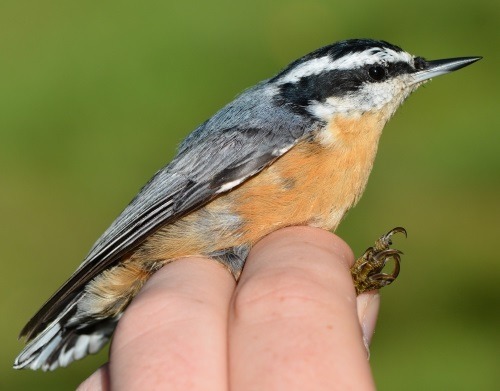
Red-breasted nuthatch

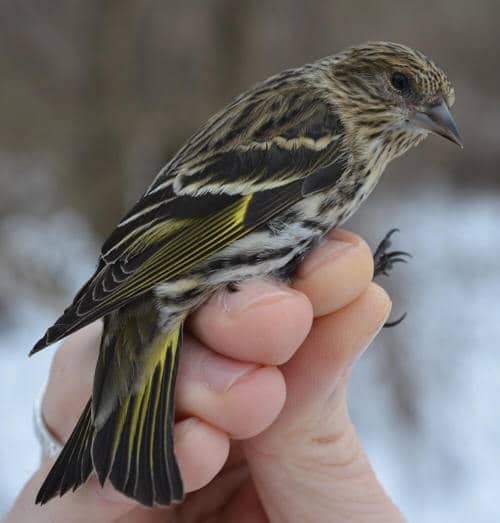
At the beginning of September, we started to see Red-breasted Nuthatches at Powdermill in higher numbers than in previous years. They were followed in early October by large flocks of Pine Siskins, small finches that look a bit like streaky goldfinches. Although many remain in the area, quite a few siskins continued south and are currently flocking to feeders in the Carolinas and beyond! Even more exciting was the influx of Evening Grosbeaks, which first appeared in mid-October. This species’ population is in steep decline: these birds used to be commonly seen here in the winter until about 30-35 years ago, but now visit during only the biggest irruption years.

image
Pine Siskin
Northern Saw-whet Owl. Photo credit: Catherine Werth

Northern Saw-whet Owls are a species that we generally see each year, but this year banders are catching more than usual. One evening at Powdermill the team caught eight individuals, three of which were foreign recaptures! (This term refers to birds that were banded and recaptured at different banding stations. The three owls from that evening came from northeastern Pennsylvania, southeastern Ontario, and, for a bird initially banded four years ago, western Virginia.) Even familiar and common species that we see year-round but that have ranges that extend far north, such as Black-capped Chickadees and Purple Finches, are being seen in higher numbers this year.

image
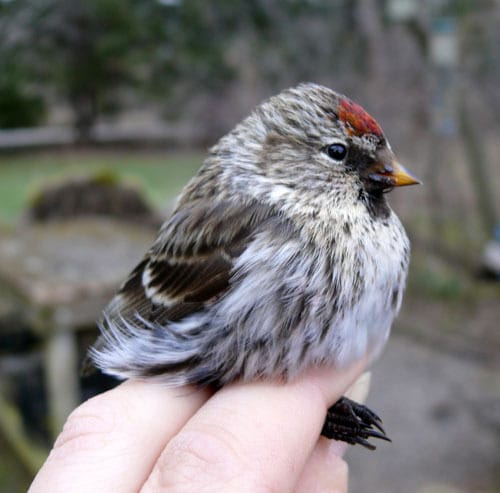
Common Redpoll

What species can we expect next? Red Crossbills and Common Redpolls haven’t been reported in the Powdermill area yet but are creeping ever closer, and if we’re really lucky perhaps we may even spot White-winged Crossbills, Pine Grosbeaks, or Hoary Redpolls. So, keep your eyes peeled, your ears primed for unfamiliar calls, your binoculars polished, and a field guide nearby, and you may have a spectacular Christmas Bird Count season!

For more information about the Christmas Bird Count, please visit: https://www.audubon.org/conservation/join-christmas-bird-count

And for a fun kickoff to the Christmas Bird Count season, Powdermill avian researchers, along with colleagues and a very special guest, will be hosting a watch party of the movie The Big Year the evening of December 18. For more information and to register: https://carnegiemnh.org/event/the-big-year-watch-party/

Annie Lindsay is the Bird Banding Program Manager at Carnegie Museum of Natural History’s Powdermill Nature Reserve. Museum employees are encouraged to blog about their unique experiences and knowledge gained from working at the museum.

Related Content

Bird Safe Glass Installed at Carnegie Museums

Camouflage in Your Yard?

One Man’s Trash is Another Man’s Weather Instrument

Filed Under: Blog Tagged With: Annie Lindsay, Birds, parc, Powdermill Nature Reserve

July 13, 2020 by wpengine

Bird Banding with a Crew of One

This year, spring migration was different. Cold weather early in the season (one night during peak migration saw a low of 23 degrees and was accompanied by snow) seemed to delay the arrival of many species. The paucity of insects resulting from the low temperatures seemed to drive many birds like Baltimore Orioles to find food at feeders, which delighted socially distancing observers. Then, when warm winds from the south brought the bulk of migrants north, there were a few days of really great birding until those birds either settled into local breeding territories or continued to trickle north.

One gauge of “really great birding” is seeing more than 20 species of warblers in one day, and this eye-pleasing event happened at Powdermill more than once this spring!

woman in an office holding a bird

Just as spring migration was a bit different for the birds, it was quite different for those who study birds. Across the continent, field seasons were cancelled and research projects redesigned or postponed due to the Covid-19 pandemic. For the first time in nearly 60 years, Powdermill’s bird banding program was unable to be run as normal. A banding operation of this magnitude requires many staff and volunteers working as a team to safely and efficiently extract, band, and process birds each day. Because bird banders’ priorities place bird safety and well-being along with human health ahead of dataset continuity, the difficult decision was made to cancel the banding season.

bird sitting on an open hand

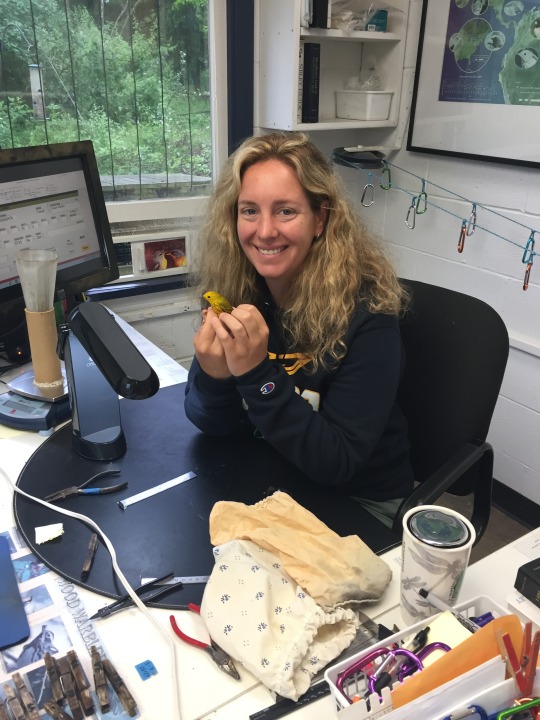
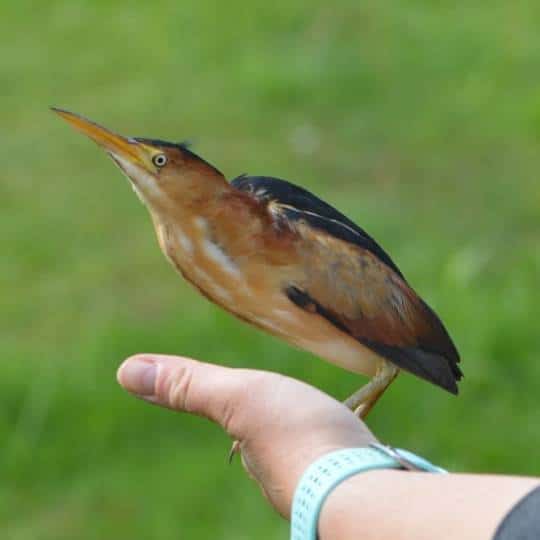
Despite the pandemic, there were many bright spots this spring. Although a lot of research was put on hold, projects that could be run solo or by people in the same germ pool were given approval to proceed. As part of my dissertation work, I conducted a research project that is a collaboration between Powdermill and the University of Toledo to investigate the distance migratory songbirds fly between stopover locations. This project uses a novel method, sampling subcutaneous fat deposits to infer the geographic location of previous stopover areas using the data generated by stable-hydrogen isotope analysis. This first phase of the larger project was a success: I sampled 39 individuals of two species! I had mixed emotions about operating the mist nets at Powdermill alone. It was certainly lonely, but it was also peaceful and rewarding. Because the focus was on banding only a few study species, I released all other birds that I caught at the net. This meant that there were a few extra moments to marvel at the beauty of spring birds in their fresh and brightly colored breeding plumage, and to reflect on the incredible migratory journeys these relatively tiny birds make each year. There were even a few surprises in the nets, including a Prairie Warbler that stayed in the Powdermill banding area for a few weeks, and Powdermill’ s fifth ever capture of a Least Bittern, a secretive marsh bird that many yearn to see! Despite the pandemic and shutdown, spring banding with a crew of one was successful and productive.

Annie Lindsay is the Bird Banding Program Manager at Carnegie Museum of Natural History’s Powdermill Nature Reserve. Museum employees are encouraged to blog about their unique experiences and knowledge gained from working at the museum.

Related Content

Field Guides: An Introduction

Bird Proof Glass Installed at Carnegie Museum of Art and Natural History

Powdermill at a Glance

Carnegie Museum of Natural History Blog Citation Information

Blog author: Lindsay, Annie
Publication date: July 13, 2020

Share this post!

  • Share on Twitter Share on Twitter
  • Share on Facebook Share on Facebook
  • Share on Pinterest Share on Pinterest
  • Share on LinkedIn Share on LinkedIn
  • Share on Reddit Share on Reddit
  • Share via Email Share via Email

Filed Under: Blog Tagged With: Annie Lindsay, bird banding, Hall of Birds, Museum from Home, Powdermill Nature Reserve, Science News, Section of Birds

  • « Go to Previous Page
  • Page 1
  • Page 2

sidebar

About

  • Mission & Commitments
  • Directors Team
  • Museum History

Get Involved

  • Volunteer
  • Membership
  • Carnegie Discoverers
  • Donate
  • Employment
  • Events

Bring a Group

  • Groups of 10 or More
  • Birthday Parties at the Museum
  • Field Trips

Powdermill

  • Powdermill Nature Reserve
  • Powdermill Field Trips
  • Powdermill Staff
  • Research at Powdermill

More Information

  • Image Permission Requests
  • Science Stories
  • Accessibility
  • Shopping Cart
  • Contact
  • Visitor Policies
One of the Four Carnegie Museums | © Carnegie Institute | Privacy Policy | Terms of Use | Accessibility
Rad works here logo