• Skip to primary navigation
  • Skip to main content
  • Skip to primary sidebar

Carnegie Museum of Natural History

One of the Four Carnegie Museums of Pittsburgh

  • Visit
    • Buy Tickets
    • Visitor Information
    • Exhibitions
    • Events
    • Dining at the Museum
    • Celebrate at the Museum
    • Powdermill Nature Reserve
    • Event Venue Rental
    • Gift Cards
  • Learn
    • Field Trips
    • Educator Information
    • Programs at the Museum
    • Bring the Museum to You
    • Guided Programs FAQ
    • Programs Online
    • Climate and Rural Systems Partnership
  • Research
    • Scientific Sections
    • Science Stories
    • Science Videos
    • Senior Science & Research Staff
    • Museum Library
    • Science Seminars
    • Scientific Publications
    • Specimen and Artifact Identification
  • About
    • Mission & Commitments
    • Directors Team
    • Museum History
  • Tickets
  • Give
  • Shop

Anthropocene Living Room

May 18, 2020 by wpengine

Air Quality and Urban Gardening

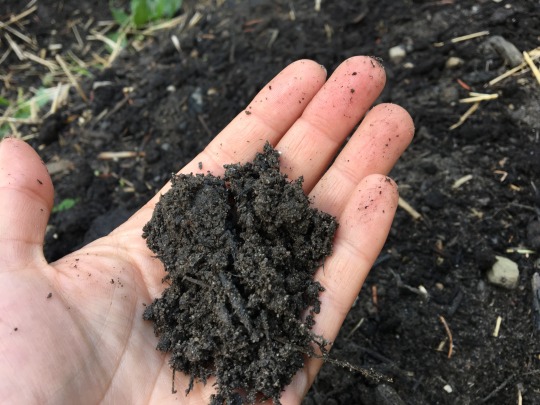
close up photo of hand full of soil

Transforming my ultra-tiny backyard into a garden has been a kind of mental, physical, and spiritual therapy for me during this COVID-19 pandemic. It’s work, even at this scale. But is it healthy? I’m new to Pittsburgh, and unlike my past community gardening experiences at places with better air quality and soil ratings, I now wonder if it’s safe to eat the plants I grow. When I look at the soil, I wonder what more than 150 years of air pollution has done to it. How can I amend past damage, manage the current risks and then eat from it?

I’m not alone in this work. Before I dive in, I want to share a quote by Robin Wall Kimmerer, author of Braiding Sweetgrass: Indigenous Wisdom, Scientific Knowledge and the Teachings of Plants:

“Even a wounded world is feeding us. Even a wounded world holds us, giving us moments of wonder and joy. I choose joy over despair. Not because I have my head in the sand, but because joy is what the earth gives me daily and I must return the gift.”

Professional advice guided my urban garden work. If you are contemplating a similar project, information at the sites listed below will be valuable.

Resources: amending the soil, soil testing, garden planning, and a cool foraging app

Grow Pittsburgh: Info Hub

University of Minnesota: How to Manage Soil and Nutrients in Home Gardens

Phipps Conservatory: Modifying PH Levels in Soil

Falling Fruit – Map the Urban Harvest!

Resources: dangers and benefits of urban gardening and foraging

The Geological Society of America: Hunting Down Hidden Dangers and Health Benefits of Urban Fruit

EurekAlert!: Risk of Lead Poisoning from Urban Gardening is Low, New Study Finds

Oxford Academic: Phytoremediation of Lead: What Works, What Doesn’t

First Step: Soil Test

The work I did to make my soil safe for gardening began with a soil test. A City of Pittsburgh site directed me to a Penn State University Agriculture Extension Office, where for a $9.00 fee, postage to mail a soil sample, and a couple of weeks’ time for testing, I learned that my typical Pittsburgh soil is full of clay and in need of compost and lime.

My front yard faces a busy intersection and contains lead and other contaminants. I decided to try phytostabilization, which is a cheap way to use plants, lime, and compost to both reduce the mobility of heavy metals in the soil and lower the bioavailability of contaminants to the food chain. I wore a mask and gloves when I tilled this soil because contaminants can bind to soil particles and can be inhaled. I mixed some nearby oak leaves into the soil to break up the clay, mixed in some lime, and planted sunflowers. (Any additions of lime should be done according to package directions about how much to use and when to plant.)
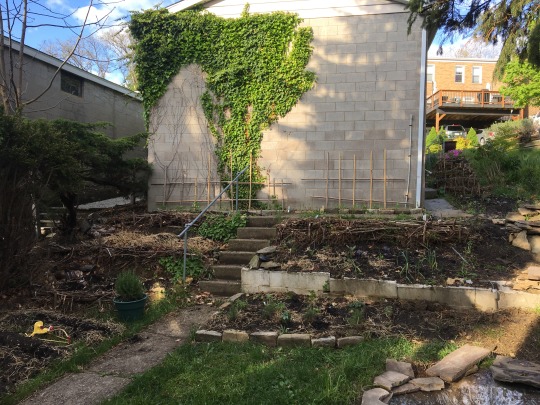
photo of a backyard garden under construction

Soil conditions in my backyard were better, requiring only lime to adjust the pH and lots and lots of compost. The backyard is where I will grow vegetables. I learned during my research that pH and compost are the key elements to healthy soil. If the air quality fluctuates during the gardening season, I will be fine as long as I wash the produce thoroughly before consuming and wash my hands after gardening. Now, after long days of online meetings, I’m able to retreat to my garden and, in good way, work myself tired. I feel better now. I feel happy.

I confess, I’m a renter, and I’m doing this work (with my landlord’s approval of course) even though I don’t own the property. My homeowner neighbors ask me why I care and put in so much energy and money into something I don’t own. I think it’s an easy answer: I live here for now, and I do this work to improve my quality of life, and because “joy is what the earth gives me daily and I must return the gift.”

Asia Ward is CMNH Anthropocene Program Manager and Science Communication Fellow. Museum staff, volunteers, and interns are encouraged to blog about their unique experiences and knowledge gained from working at the museum.


Filed Under: Blog Tagged With: Anthropocene, Anthropocene Living Room, Asia Ward, Museum from Home, Science News, We Are Nature 2

April 16, 2019 by Erin Southerland

Carnegie Museums of Art and Natural History to Host Catherine Chalmers, Acclaimed Artist and Photographer

Artist and photographer Catherine Chalmers

Carnegie Museums of Art and Natural History announce “Catherine Chalmers: The Arts of Living in the Anthropocene” to be held on Thursday, May 16 at 5:30 in the CMOA Theater. Artist and photographer Catherine Chalmers will join Curator of Photography Dan Leers and Anthropocene Curator Dr. Nicole Heller to discuss Chalmers’ art practice and award-winning short film Leafcutters, currently featured in Carnegie Museum of Natural History’s Anthropocene Living Room.

Chalmers’ work examines life in the Anthropocene, the proposed name of the current geological epoch when humans have become the dominant planetary force, restructuring earth system processes as well as the diversity and abundance of life.  The Anthropocene calls into question the idea that nature and culture are separated. Similarly, Chalmers’ work blurs the line between natural history and art. She writes in her Artist Statement at CatherineChalmers.com, “My work is at the intersection of art, science and nature.  I do extensive research for each of my long-term, multimedia projects and a direct engagement with the natural world is central to what I do.”

Still from the short film Leafcutters.

Nicole Heller, curator of the Anthropocene Living Room, says, “I chose Chalmers as our first Anthropocene artist to feature because her visually rich and beautiful film takes the viewer into the intimate and busy world of the leafcutter ants, new world ants in genus Atta, famous for their symbiotic fungal gardens. Chalmers’ art practice demonstrates a subtle but vital response to the Anthropocene crisis, namely the importance of multispecies collaboration and paying close attention. I love the way this piece, by showing the collective work of millions of social ants, invites comparisons to the collective impact of billions of human beings in the Anthropocene.”

With her art practice, Chalmers joins an established legacy of artists who turn their lens on the role of humanity within the natural world. Her work prompts questions about how to live in a culture so defined by the division between people and their natural surroundings.

“For nearly the past twenty years, Chalmers has created photographs and videos that raise awareness about environmental concerns in a whimsical and visually stunning manner,” says Dan Leers, Curator of Photography. “Leafcuttersreveals uncanny parallels between ants and humans to encourage viewers to contemplate their own relationship to the surrounding world.”

Carnegie Museum of Natural History adopted the Anthropocene as a major new theme for scientific research and visitor engagement in 2017 and appointed Nicole Heller as the world’s first Curator of the Anthropocene. TheAnthropocene Living Room, opened in 2019, showcases contemporary Anthropocene science, art, and related literature. The content of the gallery, both scientific and artistic, evolves in response to community interest and current events. As a transdisciplinary cultural and scientific concept, with deep relevance to all sectors of society and knowledge, the Anthropocene is a fertile subject for ongoing collaboration among the Carnegie Museums of Pittsburgh and the region’s scientific and cultural organizations. The museum is excited to plan future collaborations that examine this concept through the collision of natural history science, contemporary art exhibitions, and community conversation.

Tickets to “Catherine Chalmers: The Arts of Living in the Anthropocene” are $10 for adults, $5 for members, and free for students. Get tickets and more information at carnegiemnh.org.

Catherine Chalmers holds a B.S. in Engineering from Stanford University and an M.F.A. in Painting from the Royal College of Art in London.  She has exhibited her artwork around the world, including MoMA P.S.1; MASSMoCA; Kunsthalle Vienna; Today Art Museum, Beijing; among others.  Her work has appeared in a variety of publications, including theNew York Times, Washington Post, ArtNews and Artforum.  She has been featured on PBS, CNN, NPR, and the BBC.  Two books have been published on her work: FOOD CHAIN (Aperture 2000) and AMERICAN COCKROACH (Aperture 2004).  Her video “Safari” received a Jury Award (Best Experimental Short) at SXSW Film Festival in 2008.  In 2010 Chalmers received a Guggenheim Fellowship and in 2015 she was awarded a Rauschenberg Residency.  In 2018 she created a course called Art & Environmental Engagement and taught it spring quarter at Stanford University.  Her video “Leafcutters” won Best Environmental Short at the 2018 Natourale Film Festival in Wiesbaden, Germany and in 2019 it won the Gil Omenn Art & Science Award at the Ann Arbor Film Festival. She lives in New York City.


Filed Under: Uncategorized Tagged With: Anthropocene, Anthropocene Living Room

January 24, 2019 by wpengine

Anthropocene Living Room

Welcome to the Anthropocene Living Room, a new space in the museum inspired by how humans have and will continue to shape natural history and nature. Hear Dr. Nicole Heller, Curator of the Anthropocene, share her vision for the space and introduce its various elements including items from our collections, books, and other tools for reflection and learning.

Filed Under: Blog Tagged With: Anthropocene, Anthropocene Living Room, climate change, nature, Nicole Heller

January 2, 2019 by wpengine

Earth History in Your Hand

By Gil Oliveira

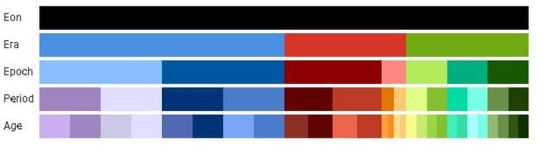
© Chart: The Conversation, CC-BY-ND

In my previous blog, I wrote about the last Jurassic World movie, which ends with the rise of a new fictional Jurassic Age, where humans and dinosaurs must learn to coexist. The Jurassic is one of the most famous geological time-periods. But when exactly was the Jurassic? The Jurassic Period ran from 200 to 145 million years ago. A long time ago… To put it into perspective, the origin of our species, Homo sapiens, dates back approximately 300 thousand years ago, which also seems a long time ago, but represents only 0.007% of the entire history of the planet (4.5 billion years)! What happened on Earth the 99.993% of the time when we did not yet even exist?

To understand earth history, natural history museums travel back through time. To do this they use a communication tool called the Geological Time Scale. In the same way we measure time with segments (such as years, months, weeks, and days), geologists subdivide deep time into useable, agreed upon units (eons, eras, periods, epochs, and ages).

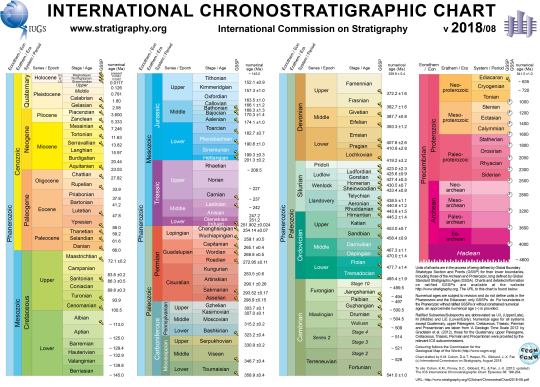
chronostratigraphic chart
© ICS: http://www.stratigraphy.org, CC BY-NC-ND

But the Geological Time Scale is not exactly a calendar, because these time intervals are not equal in length like the hours in a day. Instead, divisions are based on significant events in the history of the Earth, that are detectable in rock, fossil and ice records, such as the extinction of the dinosaurs 66 million years ago, which defines the beginning of the Cenozoic era.

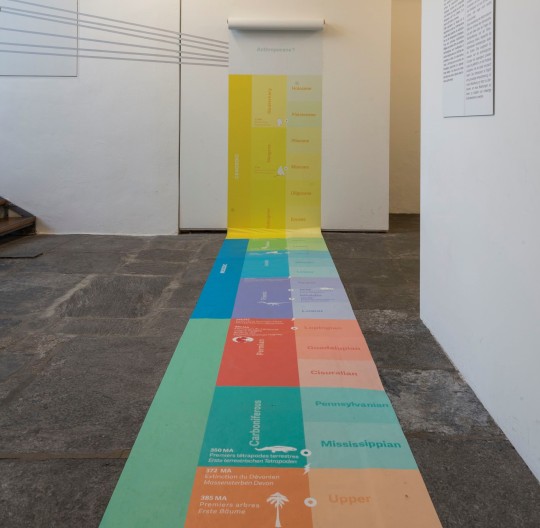
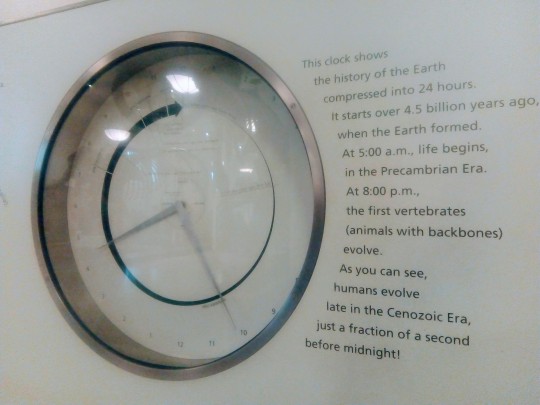
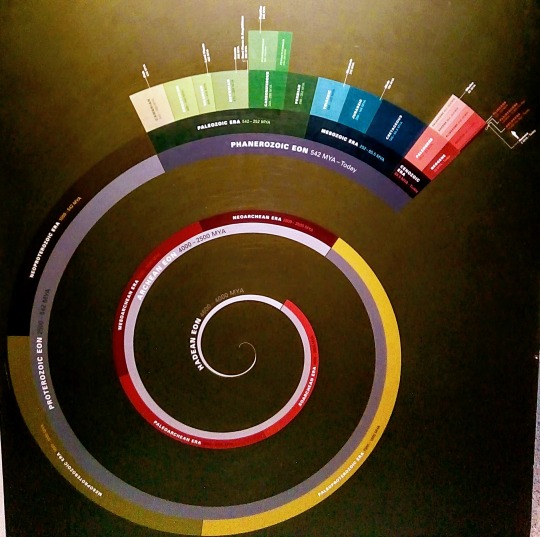
Museums don’t seek to teach the official chart of geologic time. But they seek to teach about deep time and the planet’s history, helping to put current times into a longer historical context. Museums use different techniques to make the geological time scale comprehensible. One approach is linear and usually consists of a strip of paint that represents the geological time scale rolled out on a surface. It was used for instance in the Objective Earth: Living in the Anthropocene exhibition at the Valais Nature Museum (Switzerland), which rolled out a linear poster around 30 feet long on the ground (and the wall). A second approach I have seen is more focused on aesthetics and takes the form of a spiral of time. Another technique is to take the age of the Earth and compress it into one year or one day. The American Museum of Natural History in New York used this approach with a 24-hour clock. The label indicates that life began at 5 am and the first vertebrates evolved at 8 am. As for the humans, they appeared just a fraction of a second before midnight.

Objective Earth. Living the Anthropocene © Robert Hofer


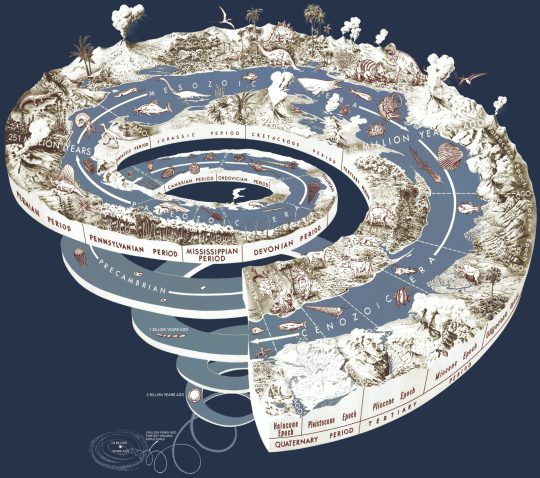
illustration of deep time
© USGS https://pubs.usgs.gov/gip/2008/58/


clock illustrating deep time
© Gil Oliveira

Each approach has benefits and disadvantages. The Geologic Time Spiral for instance can be visually striking, but the perspective of the spiral’s depth runs the risk to lose any perception of the proportion of geological time, which is the main information. It may also give a false impression of accelerating events (geological, biological, climatic, human) as we move closer to the present.

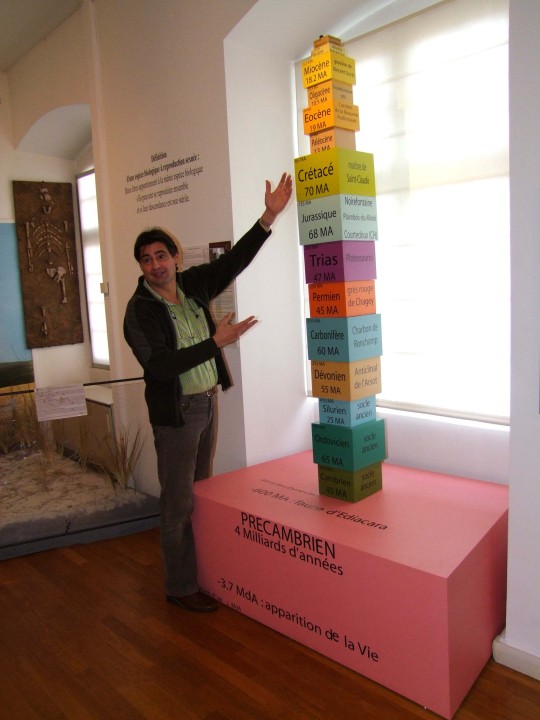
In 2007, the Cuvier Museum in Montbeliard (France) came up with a new way to represent the geological time scale. Thierry Malvesy, now curator of Geology Collections at the museum of natural history of Neuchatel (Switzerland), did it using cubes of different volumes. The advantage is to respect the proportions of time while allowing the public to see everything at a glance. It was used to explain the principle of biological evolution, emphasizing the importance of time in the evolution of life.

Cuvier Museum, 2007 © Thierry Malvesy

What is the best way to make the geological time scale understandable? There’s no easy answer. Each approach is a compromise in a way. The dinosaurs exhibit at the Smithsonian’s National Museum of Natural History uses both the spiral and the linear approach. This choice may only be temporary, as the new hall called The David H. Koch Hall of Fossils—Deep Time will open in less than a year. I wonder which approach they will use to help visitors connect to Earth’s distant past?

illustration of deep time
© Gil Oliveira

how long did dinosaurs live compared to us?
© Gil Oliveira


As the Carnegie Museum of Natural History is embracing the Anthropocene as a major theme for the future, it is important to place this newly proposed epoch in deep time. It is equally important for museums to find the best way to do it.

Gil Oliveira is postgraduate student working as an intern in the Section of the Anthropocene at the Carnegie Museum of Natural History. Museum employees are encouraged to blog about their unique experiences working at the museum.

Filed Under: Blog Tagged With: Anthropocene, Anthropocene Living Room, Gil Oliviera, museums

  • « Go to Previous Page
  • Page 1
  • Page 2
  • Page 3
  • Page 4

sidebar

About

  • Mission & Commitments
  • Directors Team
  • Museum History

Get Involved

  • Volunteer
  • Membership
  • Carnegie Discoverers
  • Donate
  • Employment
  • Events

Bring a Group

  • Groups of 10 or More
  • Birthday Parties at the Museum
  • Field Trips

Powdermill

  • Powdermill Nature Reserve
  • Powdermill Field Trips
  • Powdermill Staff
  • Research at Powdermill

More Information

  • Image Permission Requests
  • Science Stories
  • Accessibility
  • Shopping Cart
  • Contact
  • Visitor Policies
One of the Four Carnegie Museums | © Carnegie Institute | Privacy Policy | Terms of Use | Accessibility
Rad works here logo