• Skip to primary navigation
  • Skip to main content
  • Skip to primary sidebar

Carnegie Museum of Natural History

One of the Four Carnegie Museums of Pittsburgh

  • Visit
    • Buy Tickets
    • Visitor Information
    • Exhibitions
    • Events
    • Dining at the Museum
    • Celebrate at the Museum
    • Powdermill Nature Reserve
    • Event Venue Rental
  • Learn
    • Field Trips
    • Educator Information
    • Programs at the Museum
    • Bring the Museum to You
    • Guided Programs FAQ
    • Programs Online
    • Climate and Rural Systems Partnership
  • Research
    • Scientific Sections
    • Science Stories
    • Science Videos
    • Senior Science & Research Staff
    • Museum Library
    • Science Seminars
    • Scientific Publications
    • Specimen and Artifact Identification
  • About
    • Mission & Commitments
    • Directors Team
    • Museum History
  • Tickets
  • Give
  • Shop

archaeology

April 12, 2024 by Kathleen

Carnegie Connectors Young Professionals: The Stories We Keep

You’re invited!

Join us for a Carnegie Connector’s exclusive event at Carnegie Museum of Natural History! Engage with museum objects like never before, pose questions to conservators, and learn the tricks and tools of the conservation trade at The Stories We Keep: Conserving Objects from Ancient Egypt.

Every object in the museum’s care has stories, from its creation and original use to the diligent conservation work undertaken to preserve it for future generations. This exhibition features more than 80 items from ancient Egypt—including the 4,000-year-old Dahshur boat, one of four in existence in the world—and the work necessary to safeguard them.

Network with members, interact with a conservator, and enjoy complimentary drinks and light bites at this exclusive event. Business casual or party attire suggested.

You must be 21 years of age or older to attend this event. Valid ID is required for entry.
Exclusive event for young professionals, 21-40.

Tagged With: archaeology, paleontology

March 22, 2024 by Noelle Swart

Teen Night: The Stories We Keep

Teens (ages 13-18) are invited to Carnegie Museum of Natural History for a fun event celebrating the new exhibition, The Stories We Keep. Take the exhibit design challenge and learn what it takes to build engaging, exciting exhibitions. Check out the tools museum conservators use to preserve ancient objects, like a 4,000 year old wooden boat from Ancient Egypt. Discover the “Agents of Deterioration” that conservators dodge and deflect to keep artifacts safe, and see if you can guess the use of old-time objects. Stop by the lounge for a snack while you enjoy a night just for teens.

Whether you’ve already signed up for a free Teen Membership from Carnegie Museums of Pittsburgh, or just want to see what it’s all about – we hope you’ll stop by! Please register early to secure your free ticket; capacity is limited. Open to everyone ages 13-18.

Make your reservation today before this exciting event sells out. Free to everyone ages 13-18.

Teen Night: The Stories We Keep

Thursday, April 18, 2024, 5 p.m. to 8 p.m.

Community Access Membership is presented by
Huntington Bank

Teen Membership is generously supported by

The Grable Foundation and the Robert and Mary Weisbrod Foundation

Tagged With: archaeology, paleontology, teen night, teens

May 24, 2023 by Erin Southerland

Bringing A Little O-Gah-Pah to Pittsburgh

by Amy L. Covell-Murthy

It is important for Carnegie Museum of Natural History (CMNH) to maintain relationships with the diverse Indigenous communities whose stories we hope to share with the Greater Pittsburgh Area. This ensures that we are centering Indigenous knowledge in how we collect, display, care for, and interpret cultural material. A very important part of this work is to continuously consult with tribal representatives and Indigenous advisors. This is most evident in the process of repatriation, which is governed in the United States by a federal law called the Native American Graves Protection and Repatriation Act (NAGPRA), which was signed in 1991. 

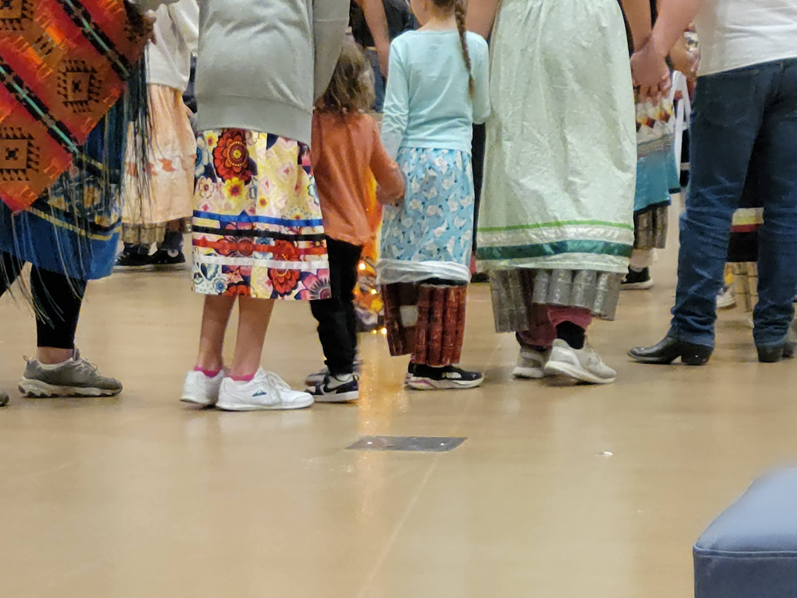
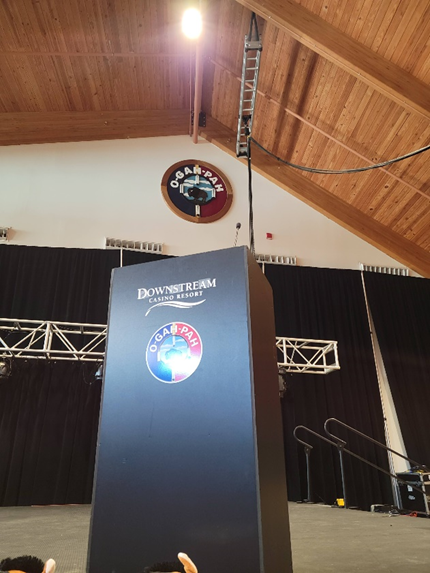
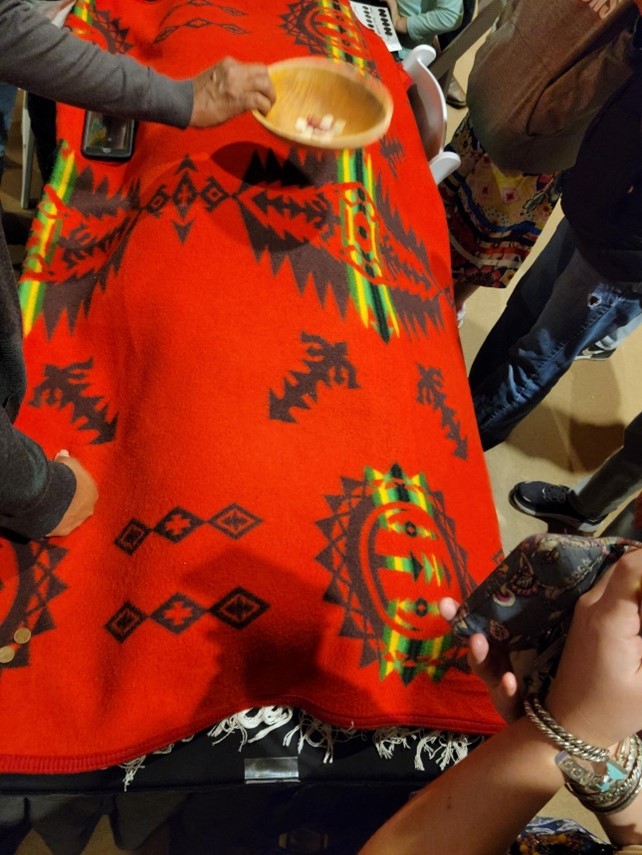
In November 2022, as the concluding action of nearly ten years of consultation, I travelled 962 miles West to complete a NAGPRA transfer with a representative of the Quapaw Nation. I met Carrie Wilson, Quapaw NAGPRA Director, at the Arkansas Archaeological Survey at the University of Arkansas, where we rejoined human remains from Poinsette County with other Quapaw people to await a proper and private reinternment in the future. Afterward, by volunteering at the O-Gah-Pah “Quapaw” Fall Gathering in Northeastern Oklahoma at the Downstream Resort and Casino, I had the pleasure of a brief immersion in some aspects of Quapaw Culture. 

Quapaw Dice Game, photo by Amy Covell-Murthy
Stomp Dance Participants, photo by Amy Covell-Murthy

Carrie and I had our work cut out for us preparing for the Fall Gathering. We got to know one another better over lunch and then drove to Quapaw, Oklahoma to get ready. On the day of the event, I rolled up my sleeves and helped sell 50/50 raffle tickets, organize games for kids, keep track of auction items, and set up for the Stomp Dance. I learned how to play Quapaw Dice and cheered everyone on in the foot races. I met so many wonderful people and was humbled by the welcome I received. I ate my share of fry bread and chili and paused to be thankful for the opportunity to forge such meaningful relationships.

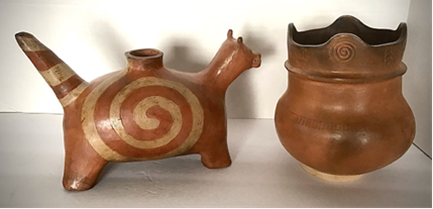
Dog Effigy and Quapaw Pot by Betty Gaedtke, photo by Betty Gaedtke

While volunteering I was able to meet Betty Gaedtke or Te-mi-zhi-ka (little buffalo woman). Betty is an accomplished Quapaw artist who specializes in authentic Quapaw and Mississippian Pottery. While Betty’s pieces are authentic, they are not archaeological and provide a window into Quapaw style and technique. Her work can be seen in fifteen different venues, including the Crystal Bridges Museum, the Museum of The Ghost Ranch, and the Gilcrease Museum. Thanks to a generous endowment, CMNH was able to purchase two pieces from Betty in 2023 to add to our collection and help us bring the story of the Quapaw to Pittsburgh. These pieces are a great reminder that the Quapaw Nation is alive and well.

O-Gah-Pah logo at the Downstream Casino, Photo by Amy Covell-Murthy

So many things in Pittsburgh are inspired by the confluence of our three rivers. Things are named after them, transported on them, and festivals are held on and around them. Like the important role the three rivers play in our local culture, the Mississippi River is very significant to the Quapaw Nation and instrumental in how their name formed. According to the Quapaw Nation website: “The Quapaw were a division of a larger group known as the Dhegiha Sioux many years ago. The Dhegiha split into the tribes known today as the Quapaw, Osage, Ponca, Kansa, and Omaha when they left the Ohio Valley. The Quapaw moved down the Mississippi River into Arkansas, this is the origin of the word Ogaxpa, which can be translated as “downstream people.” You can learn more by visiting QuapawTribe.com.

Caring for culturally significant collections takes empathy and the willingness to accept Indigenous ways of knowing when making decisions on behalf of the material. We are working hard to bring authentic and diverse voices into the narratives that CMNH shares. So, join me in learning more about the O-Gah-Pah and remember to stop relegating Indigenous people and communities to the past when they are thriving across our country. 

Amy L. Covell-Murthy is Archaeological Collection Manager at Carnegie Museum of Natural History.

Related Content

New Vision of Old Rock Art

A Trip to Grave Creek Mound

Grass Baskets of the Chumash

Carnegie Museum of Natural History Blog Citation Information

Blog author: Covell-Murthy, Amy
Publication date: May 24, 2023

Share this post!

  • Share on Twitter Share on Twitter
  • Share on Facebook Share on Facebook
  • Share on Pinterest Share on Pinterest
  • Share on LinkedIn Share on LinkedIn
  • Share on Reddit Share on Reddit
  • Share via Email Share via Email

Filed Under: Blog Tagged With: Amy Covell-Murthy, anthropology, archaeology, Science News

May 10, 2023 by Noelle Swart

Teen Night: Field Science

Are you interested in learning about Archaeology and Paleontology? Join us for a Teen Night all about field science! Learn the difference between these two scientific fields and see the tools scientists use on expeditions. Try your hand at being a Paleontologist as you dig for replica fossils in Bone Hunters’ Quarry. Observe replica artifacts based on real objects unearthed by Archaeologists from all over the world. Food will be available from 5-8 p.m. so grab a snack and hang out in our relaxing teens-only lounge.

Whether you’ve already signed up for a free Teen Membership from Carnegie Museums of Pittsburgh, or just want to see what it’s all about – we hope you’ll stop by! Please register early to secure your free ticket; capacity is limited. Open to everyone ages 13-18.

Make your reservation today before this exciting event sells out. Free to everyone ages 13-18.

Teen Night: Field Science

Thursday, July 13, 2023, 5 p.m. to 8 p.m.

 
Community Access Membership is presented by
Huntington Bank

Teen Membership is generously supported by The Grable Foundation

Tagged With: archaeology, paleontology, teen night, teens

July 14, 2022 by Erin Southerland

A Trip to Grave Creek Mound

by Amy L. Covell-Murthy

It was my pleasure to organize a field trip for Anthropology and Anthropocene staff, students, and friends to the Grave Creek Mound Archaeological Complex in Moundsville, West Virginia. Our gracious host, Dr. Olivia Jones, who is the facility’s lead curator showed us around the complex while explaining the history of the facility and of the mound. She also provided us with plenty to explore on our own.

Maintaining a relationship between Carnegie Museum of Natural History and the Grave Creek Mound Complex has been a highlight of my responsibilities as collection manager over the past five years. Dr. Jones and I work hard to keep each other informed of current research and initiatives in our institutions, while sharing resources that pertain to the history of the region. 

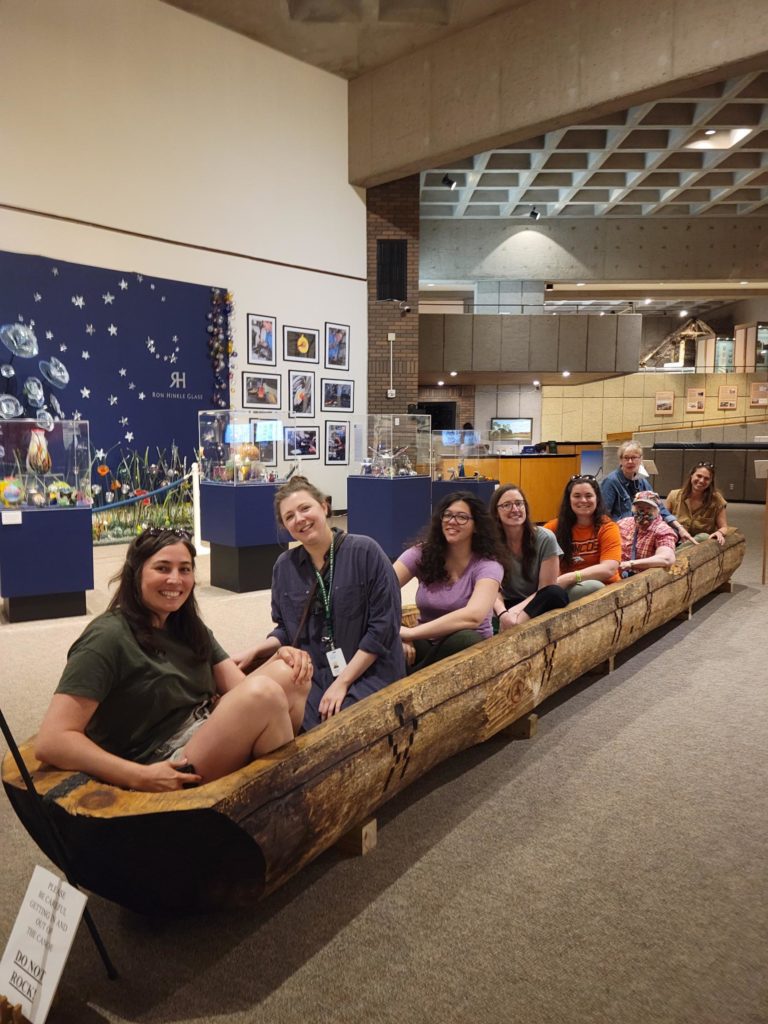
Group of people in a canoe in a museum
This picture shows the Carnegie crew posing in a dugout canoe that was commissioned from artists of the Seneca Nation/Onöhsagwë:de’ Cultural Center.

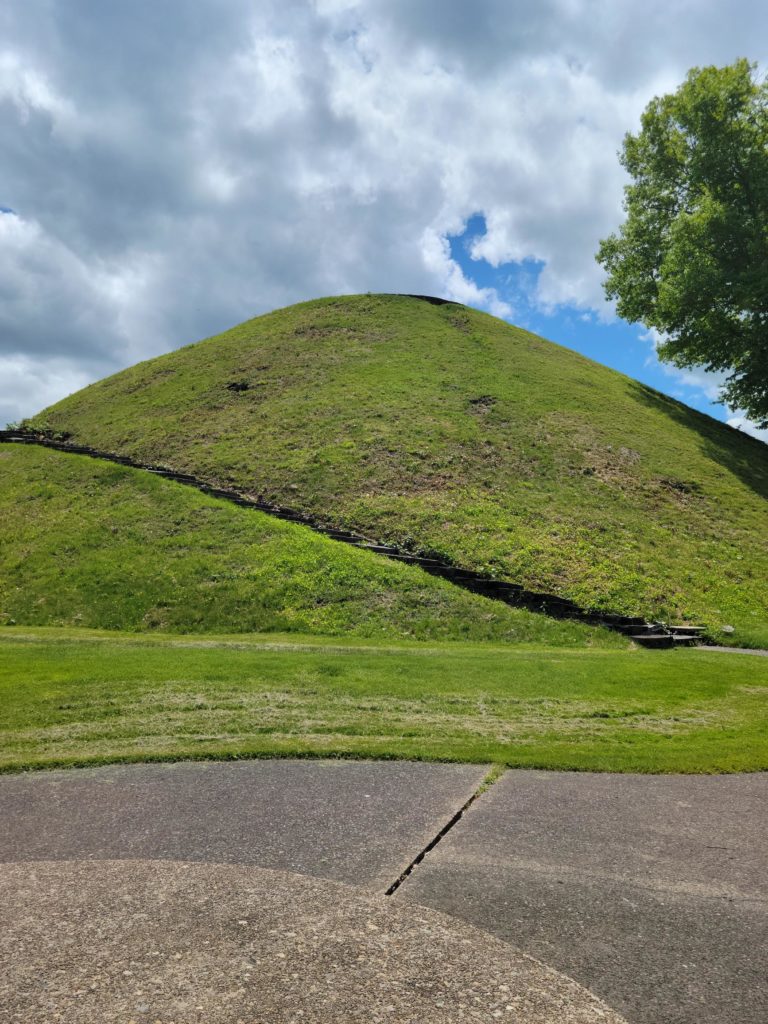
Adena is the name given by archaeologists to the mound building cultural group who developed around 2500 years ago in the Ohio River Valley and many of its major tributaries. The Grave Creek Mound, now located in the center of a town whose name references the structure, is one of the largest of the conical Adena burial mounds. Dr. Jones, curator Hank Lutton, and the staff of the Archaeological Complex work to maintain the integrity of this National Historic Landmark. According to their website, the mound was constructed between 250 and 150 B.C.E. and in 1838 it was measured as being 69 feet tall, and 295 feet in diameter. 

The Grave Creek Mound from a walkway near the base of the 2,000-year-old structure.

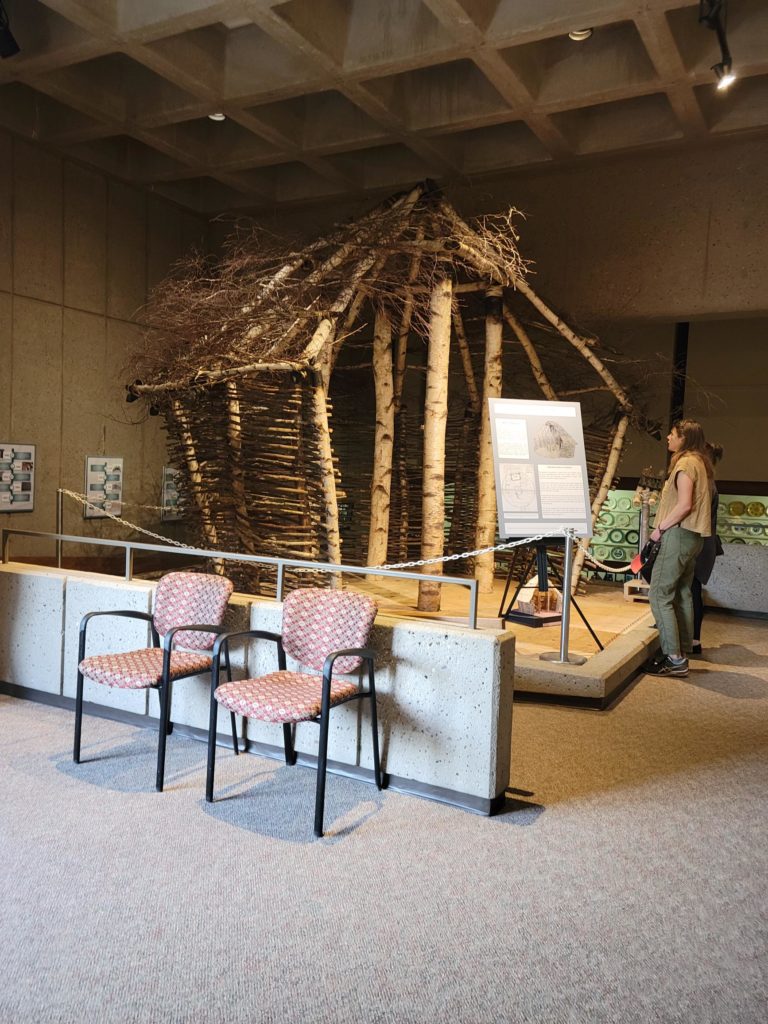
In addition to the mound, the complex consists of an archaeological research and collection facility, and the Delf Norona Museum, which interprets lifeways of the Adena people for the public. The museum, named for the author of the mound’s definitive history, opened its doors in 1978, and the research facility was constructed later in 2008. This facility is the repository for all of West Virginia’s State-owned collections and artifacts. 

Although our exhibits do not explain the arrangement, Carnegie Museum of Natural History once served as a repository for the State Museum of Pennsylvania for all cultural material excavated in Western Pennsylvania.  This material remains in our care at our collection facility and is used for research. As we try to reconcile our institutional past and bring equity and inclusion into our storytelling, these collections will help us interpret the pre-contact narratives of the region. 

Dr. Nicole Heller viewing the Adena Structure replica in the Delf Norona Museum. 

I am very lucky to be able to offer these educational experiences to my students and volunteers and I encourage those of you who can, to take the 90-minute drive from Pittsburgh to Moundsville, West Virginia to check out the Archaeology Complex. And the next time you find yourself in the North Eastern section of the Alcoa Hall of American Indians at CMNH, take some time to think about the mound builders who were here before the Haudenosaunee, Lenape, and Shawnee in Western Pennsylvania. 

Amy L. Covell-Murthy is the Collection Manager for the Section of Anthropology and Archaeology at Carnegie Museum of Natural History.

Related Content

Celebrating Indigenous Peoples’ Day

Grass Baskets of the Chumash

Queer Eye for Lakota Art

Carnegie Museum of Natural History Blog Citation Information

Blog author: Covell-Murthy, Amy L.
Publication date: July 14, 2022

Share this post!

  • Share on Twitter Share on Twitter
  • Share on Facebook Share on Facebook
  • Share on Pinterest Share on Pinterest
  • Share on LinkedIn Share on LinkedIn
  • Share on Reddit Share on Reddit
  • Share via Email Share via Email

Filed Under: Blog Tagged With: Amy Covell-Murthy, anthropology, archaeology, Science News

June 21, 2021 by wpengine

The Power of the Falcon in Ancient Egypt

by Raina Holt

I have always been super curious about how the natural environment influences people’s beliefs and rituals. As I learned about ancient Egyptian religion, I found elements that fascinated me. My curiosity led me to build a replica of a pyramid in 5th grade with a secret trapdoor inside. In college, I learned about mummification and continued to discover how and why the ancient Egyptians’ belief in an afterlife was so extensive. My recent internship with Carnegie Museum of Natural History gave me the opportunity to dig deep into my interest in Egypt using research to explore the significance of birds in ancient Egyptian religion.

Research involves asking questions and searching for answers by finding facts and information to explain the unknown. My research allowed me to explore how birds, including vultures, ibises, and even owls, were a big part of Egyptian culture and religion. In ancient Egypt, birds were very commonly associated with different gods. For example, the falcon represented the god Horus. In a comprehensive compilation of related essays titled, Between Heaven and Earth: Birds in Ancient Egypt (University of Chicago Press, 2012), the culture-wide association of gods with birds is partially explained as people’s perception that birds could fly and therefore be closer to the gods. Some birds of prey such as falcons, hawks, and owls are particularly skilled flyers, owing to physical adaptations such as long wings, relatively short tails, and powerful chest muscles. These features, when combined with others, including keen eyesight, sharp, curved talons, and sturdy, razor-edged bills, enable them to capture and kill prey. In some predator-prey encounters, speed is also a vital part of the killing equation. Lanner Falcons, for example, a species well-represented in ancient Egyptian art works, can reach diving speeds of up to 90 miles-per-hour in pursuit of smaller flying birds. Their strength, speed, and beauty made them ideal representatives for certain Egyptian gods.

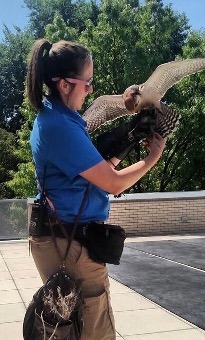
Staff member at the National Aviary training a Lanner Falcon (photo by author).

In the Summer of 2017, I participated in a program called Soar! On Skydeck at the National Aviary on Pittsburgh’s North Side. I signed up, along with a handful of other Aviary visitors, because I knew I could learn at a deeper level through firsthand observation of live birds of prey. The highly skilled trainer, who worked with a Lanner Falcon during the presentation, relied upon a thick leather glove so her left hand could serve as a suitable and talon-proof resting perch for the bird.

The highlight of the presentation was a hunting demonstration. The trainer first let the falcon circle above us for a short while. Then the bird saw a chunk of meat placed for it and dove quickly, spreading its wings at the last moment to slow down and grab the food with its sharp talons. The falcon, as I could see with my own eyes, was fast, fierce, and powerful, which is why it was used to represent a god in ancient Egypt.

The god Horus, represented as a falcon or a human with a falcon head, was a sun god as well as the ancient Egyptian god of kingship, representing the living king of Egypt. Falcons, along with other birds, could have easily been seen by everyone in ancient Egypt. The sight of a falcon soaring overhead near the sun would have been a particularly striking scene. The pharaoh was believed to be not merely a powerful ruler, but to be the embodiment of the god, Horus. The job of Horus was to protect Egyptians in their daily lives, just like the pharaoh. In recognition of Horus’s important role, people would decorate their tombs with falcons. In later periods the ancient Egyptians offered mummified falcons to Horus, gifts which were sometimes placed in a small coffin with a bronze falcon on top.

Lanner falcon
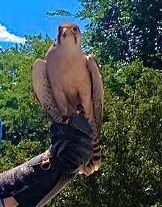
Lanner Falcon at National Aviary (photo by author)

Pittsburgh currently offers several falcon viewing opportunities. You can see Lanner Falcons, as I did at the National Aviary, but you can also watch the livestream of the Peregrine Falcon pair and their offspring in their nest on a high ledge of the Cathedral of Learning in Oakland! Because the feeding territory of these birds extends far beyond this University of Pittsburgh landmark, Peregrine Falcons can also be seen flying high above Schenley Park, and much of the University of Pittsburgh Campus. Occasionally the birds can even be heard screeching loudly near Carnegie Museum of Natural History and Carnegie Museum of Art!

Raina Holt is currently an intern for Carnegie Museum of Natural History’s Section of Anthropology. Museum staff, volunteers, and interns are encouraged to blog about their unique experiences and knowledge gained from working at the museum.

Related Content

Cats: The Archeological Site!

Wooden Sokar Falcon

Weighing She-Ra the American Kestrel

Carnegie Museum of Natural History Blog Citation Information

Blog author: Holt, Raina
Publication date: June 21, 2021

Share this post!

  • Share on Twitter Share on Twitter
  • Share on Facebook Share on Facebook
  • Share on Pinterest Share on Pinterest
  • Share on LinkedIn Share on LinkedIn
  • Share on Reddit Share on Reddit
  • Share via Email Share via Email

Share this post!

  • Share on Twitter Share on Twitter
  • Share on Facebook Share on Facebook
  • Share on Pinterest Share on Pinterest
  • Share on LinkedIn Share on LinkedIn
  • Share on Reddit Share on Reddit
  • Share via Email Share via Email

Filed Under: Blog Tagged With: ancient egypt, anthropology, archaeology, Egypt on the Nile, Raina Holt

  • Page 1
  • Page 2
  • Page 3
  • Go to Next Page »

sidebar

About

  • Mission & Commitments
  • Directors Team
  • Museum History

Get Involved

  • Volunteer
  • Membership
  • Carnegie Discoverers
  • Donate
  • Employment
  • Events

Bring a Group

  • Groups of 10 or More
  • Birthday Parties at the Museum
  • Field Trips

Powdermill

  • Powdermill Nature Reserve
  • Powdermill Field Trips
  • Powdermill Staff
  • Research at Powdermill

More Information

  • Image Permission Requests
  • Science Stories
  • Accessibility
  • Shopping Cart
  • Contact
  • Visitor Policies
One of the Four Carnegie Museums | © Carnegie Institute | Privacy Policy | Terms of Use | Accessibility
Rad works here logo