• Skip to primary navigation
  • Skip to main content
  • Skip to primary sidebar

Carnegie Museum of Natural History

One of the Four Carnegie Museums of Pittsburgh

  • Visit
    • Buy Tickets
    • Visitor Information
    • Exhibitions
    • Events
    • Dining at the Museum
    • Celebrate at the Museum
    • Powdermill Nature Reserve
    • Event Venue Rental
  • Learn
    • Field Trips
    • Educator Information
    • Programs at the Museum
    • Bring the Museum to You
    • Guided Programs FAQ
    • Programs Online
    • Climate and Rural Systems Partnership
  • Research
    • Scientific Sections
    • Science Stories
    • Science Videos
    • Senior Science & Research Staff
    • Museum Library
    • Science Seminars
    • Scientific Publications
    • Specimen and Artifact Identification
  • About
    • Mission & Commitments
    • Directors Team
    • Museum History
  • Tickets
  • Give
  • Shop

Botany Blogs

These blogs are written about and by our Section of Botany researchers. The herbarium at the museum which contains approximately 3,000 type specimens--specimens that define an entire plants' species. These type specimens only represent about 0.6 % of the collection.

Mason Heberling, head of the section, regularly shares herbarium specimens that have been "Collected on this day" in history.

June 9, 2020 by wpengine

Our Eureka Moment!

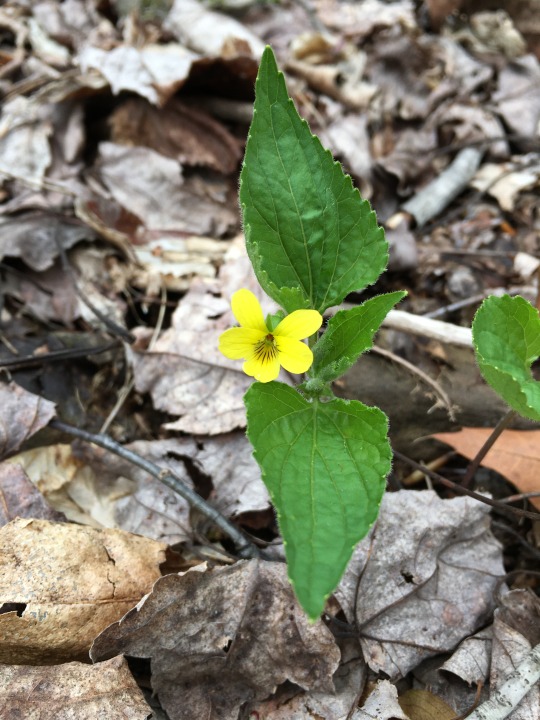
photo of viola glaberrima

Searching for rare or endangered plants has become a passion for me. It’s always exciting to find something that hasn’t been seen by very many people. It’s also special when I can share these finds with someone close to me who cares as much about them as I do. I am rather lucky in that my husband, Joe, is also a botanist and shares my passion for finding rare plants. Our household pursuit has even become a bit competitive. I will freely admit, when Joe spots a rare plant first, there is some jealousy intermingled with my excitement that we were in the right place at the right time.

For the last couple of years, we have been on a quest to find Viola glaberrima, a yellow violet last seen in Pennsylvania in 1920, May 30, 1920, to be exact.

I’ve pressed my friend Harvey Ballard, a professor at Ohio University and a renowned Violet expert, for details about habitats to investigate, the characteristics that distinguish the plant from other violets, and any tidbits I could glean to help us find this elusive plant. At least a dozen of my emails to Harvey involved questions about information I’d found in other sources relating to the plant commonly called the smooth yellow violet.

In all honesty, I was suspicious that this violet ever grew in Pennsylvania, even going so far as questioning Harvey about whether he had correctly identified one of the historic specimens. In many ways Viola glaberrima resembles other yellow violets. Pennsylvania has about 30 different kinds of violets, five of which are yellow. The other yellow stemmed violets known to occur in the Commonwealth are usually many stemmed with stems that more-or-less lay down on the ground. These other violets also have either heart shaped or what are termed hastate shaped leaves, that is leaves with outlines reminiscent of a spear point with two points protruding from its base. Many of the plants in this group have flowers that are yellow on the front and back. Some of these flowers develop purple coloring on the back of the petals with age. The violet we’ve been searching for has a single, upright stem with cuneate or wedge-shaped leaves and always has purple on the back of the petals.

Harvey served as a coach for our search for Viola glaberrima, and in doing so he did much more than advise us to look on moist wooded slopes. Many floras list our target plant as merely a variety of Viola tripartita, a flower commonly known as the threepart violet. Harvey assured us that Viola glaberrima is a good species in its own right, and provided additional motivation by making a prediction. He told us that if we found it in the field we would have a “Eureka” moment, because the species is visibly different from the other yellow violets.

Historically, the smooth yellow violet was collected 5 or 6 times in Pennsylvania. The earliest collection is pretty vague, “Mercersburg Pa. in 1845.” The other collections aren’t any more precise. One collection from 1900 is from somewhere “between Ruffsdale and Jacobs Creek in Westmoreland County.” There are two collections from the area of Hillside, PA collected in 1907 and again in 1909. The site we felt we had the best chance of relocating this difficult to find violet was Killarney Park in Fayette County. This seemed to be the most precise locality and the most recent. In May of 1920 Otto Jennings of Carnegie Museum fame and Ernest Gress, a student of Jennings who later worked for the Pennsylvania Department of Agriculture, both collected this violet at this location on the same day. Killarney Park, established in 1909, was a popular place for folks to get out of town and have a picnic or a reunion. It featured a dance hall, lakes for boating, picnic grounds and overnight accommodations. With a stop on the Indian Creek Valley Railroad, the park was easily accessible to rail travelers.

The park property changed hands a few times over the years. Its name changed in 1926 and again in 1939, and it was eventually sold in 1941 to the Christian Church of Somerset for use as a summer camp. Thus, the current name of Camp Christian came into being. In June of 2016, Joe and I spent some time at Camp Christian helping guide field trips for the Botanical Society of America, Northeast Section Joint Field Meeting. I got to know the manager of Camp Christian and told him about the rare violet that had last been collected there. June was a little late, the violets were pretty much done blooming. We looked around for the violet without any luck, but the manager invited us to come back and look anytime. Last year, 2019, we spent parts of two days looking around the property again for the little yellow violet that seemed so elusive.

Most of the violets had already gone to fruit at the time of our 2019 visit, which coincided with the historic collection calendar date of May 30. This year, we visited earlier in May, found many violets blooming, and checked thousands of them without finding a smooth yellow violet.
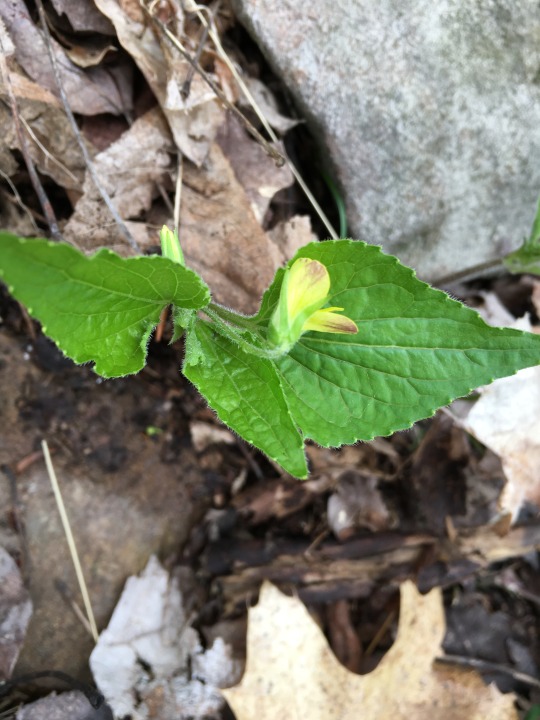
photo of viola glaberrima showing underside of petals

So, in the process of doing field work and looking for other rare plants, it became a habit for us to look for what seemed to be mythical yellow gems. During a field work day in Indiana County on May 16, while cutting up over a hill to take a shorter route back to the car, we came upon a small patch of yellow violets that were different than any we had seen before. They had single stems, with lance shaped leaves and purple coloring on the backs of the petals. There was no denying that this violet was different than any we had seen before. The plants fit all the characteristics that Harvey had so patiently described for us over the many e-mails. This was finally our promised “Eureka” moment.

Begrudgingly I’ll admit that Joe was first to spot it. (He walks faster than I do.) Of course, Harvey was one of the first people I contacted, I sent him several photographs and to my delight we received the following response: “Hi Bonnie and Joe, YOU NAILED IT!!! You found Viola glaberrima! What a great find! It is likely rare and sporadic along that mountain range. Congratulations. Big ice cream sundaes for you!” How did Harvey know I love ice cream sundaes?

I would love to say this was a “Eureka “moment 100 years in the making, but it was only 99 years and 351 days.

Bonnie Isaac is the Collection Manager in the Section of Botany. Museum staff, volunteers, and interns are encouraged to blog about their unique experiences and knowledge gained from working at the museum.

Related Posts and Videos

Rediscovering Viola glaberrima (Video)

How Do You Preserve a Giant Pumpkin?

Hidden Treasure of Pittsburgh Found

Carnegie Museum of Natural History Blog Citation Information

Blog author: Isaac, Bonnie
Publication date: June 9, 2020
Share this post!

  • Share on Twitter Share on Twitter
  • Share on Facebook Share on Facebook
  • Share on Pinterest Share on Pinterest
  • Share on LinkedIn Share on LinkedIn
  • Share on Reddit Share on Reddit
  • Share via Email Share via Email

Filed Under: Blog Tagged With: Bonnie Isaac, Botany, Hall of Botany, Museum from Home, Science News, Section of Botany

May 15, 2020 by wpengine

Going Digital for Nature

The Section of Botany continues to make progress on our NSF funded Mid-Atlantic Megalopolis digitization project. This massive three-year effort involves the creation of a searchable database of nearly a million herbarium specimens from thirteen institutions within the urban corridor stretching from New York City to Washington, D.C. 

Although the imaging portion of the project has come to a screeching halt with no access to the specimens and the camera, work continues with the processing and posting of existing images. Since 2018, when the Museum became involved in this project, critical work has been masterfully handled by Curatorial Assistant Sarah Williams. Please check out our collection and their images at midatlanticherbaria.org.

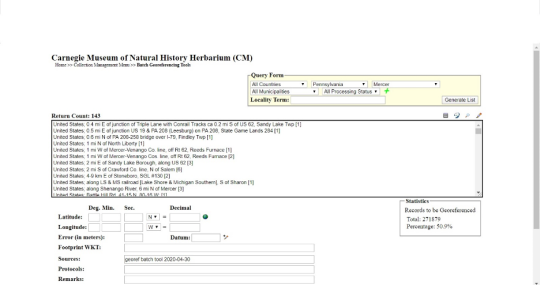
Despite all work being performed away from the museum since March 14, great strides have been made in getting specimens georeferenced. This term refers to the electronic pairing of the historic recorded location for each collected plant with an established system of geographic ground coordinates. In an effort to keep this project on schedule, I have spent about half my time working on it, adding over 7000 images to our Symbiota portal and georeferencing over 3800 specimens.

Screenshot of georeferencing portal for CM specimens.

With more images going up almost every day, the georeferencing problems have become easier to find and fix. In addition to being able to see the specimen and its label, it is also possible to query where the collector was on a given day. So not only can we see if the data was possibly mistyped or misread, we can also check to see if the locality is within the known range for each species collected. All this associated information makes for fun sleuthing projects. With almost half of our specimens currently georeferenced, I am also currently working on fixing problems with localities that map outside of the geopolitical unit to which they were assigned.

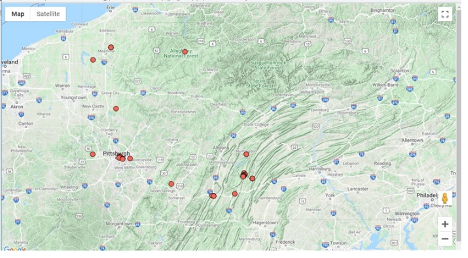
Screenshot of Pennsylvania locations with collections by former Botany Curator, Dr. Dorothy Pearth.

Georeferencing has become a bit of an obsession for a few of our volunteers and me because it combines history, plant collecting, and old maps into one big bundle. I must sometimes watch that I don’t go down some historical wormholes while looking for some very obscure place names. Some sets of georeferenced specimens have also added insights into the habits of some former Carnegie staff and volunteers and the haunts they liked to visit. I now know which collectors were precise in their collecting locality descriptions and which were more likely to stick to roadsides. We had at least one former curator who preferred to make localities vague when they were near parks and another who seemed to favor collecting where roads crossed streams. Fun times were had by all electronic explorers, or at least by me, and I’m learning a lot in the process.

Bonnie Isaac is the Collection Manager in the Section of Botany at Carnegie Museum of Natural History. Museum staff, volunteers, and interns are encouraged to blog about their unique experiences and knowledge gained from working at the museum.

Filed Under: Blog Tagged With: Bonnie Isaac, Botany, botany hall, Section of Botany

May 13, 2020 by wpengine

Spring is in the Air, Botanists are in the Field

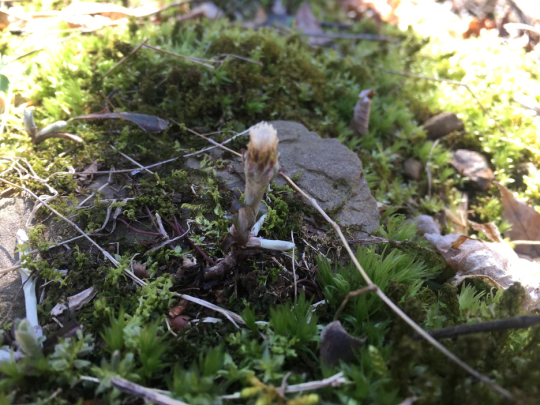
Antennaria solitaria in Ryerson Station State Park. Photo: BL Isaac.

With the arrival of warmer weather, botanists stop dreaming about what plants will be blooming and get out and look. CMNH botanists managed to make an early spring trip to the southwestern corner of Pennsylvania, visiting Ryerson Station State Park in Greene County. At Ryerson, we found some of the more common spring flowering species along with some non-native invasive species. While collecting more than a dozen plants as current vouchers for ongoing phenology comparisons with older specimens, we also visited a known site for a Pennsylvania proposed Endangered plant species, the single headed pussy-toes, or Antennaria solitaria.

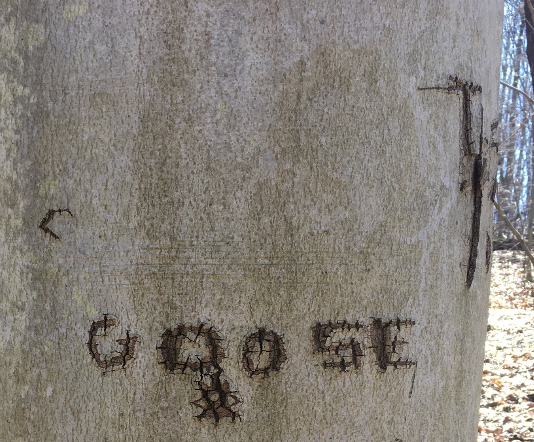
While out and about, I am always interested to see how well plants that have been labeled are identified. Over the years I have found some gross misidentifications on signs along trails. Last year I visited a boy scout camp that had a tree trail with over half of the trees misidentified. I found an especially egregious label along one of the trails in Ryerson Station State Park. This one was not on a park sign but was placed there by some misguided soul. What is obviously a beech tree (Fagus grandifolia) is clearly labeled as a goose (Branta canadensis). Evidently there were no scientific editors around when this mislabeling abuse took place by someone who not only can’t tell the forest for the trees but can’t tell a tree from a bird.

Beech tree in Ryerson Station State Park. Photo: BL Isaac.

All silliness aside, as spring moved along important field work stalled. With visits to Yellow Creek State Park and Cook Forest State Park in the works, we were notified by the Bureau of State Parks that all scientific permit holders must suspend collecting in the parks until further notice. So, our state park project, which has been running since 2017, was temporarily suspended due to the COVID-19 pandemic.

Collecting restrictions were lifted weeks later, however, we have missed one of the most important seasons for our long-term state park phenology study. With our 10-year plan in place it may be another decade before we can collect to evaluate Yellow Creek State Park flora. Hopefully we can double up on parks next year, so we won’t have to wait another 10 years to get these parks involved in our phenology project.

Bonnie Isaac is the Collection Manager in the Section of Botany. Museum employees are encouraged to blog about their unique experiences and knowledge gained from working at the museum.

Filed Under: Blog Tagged With: Bonnie Isaac, Botany, Hall of Botany, Museum from Home, Section of Botany

April 29, 2020 by wpengine

From cultivation to invasion: a common route

Collected on this Day in 1937

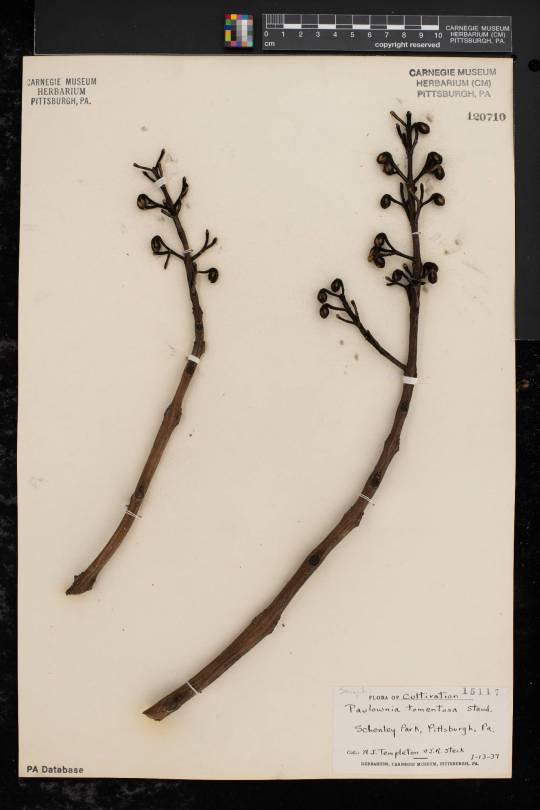
This specimen of princess tree (Paulownia tomentosa) was collected on January 13, 1937 in Schenley Park, Pittsburgh by R.J. Templeton and J.R. Steck.  Though subtle, note the heading on the label “Flora of Cultivation.”  This header suggests that this tree was planted in the park, rather than naturally occurring on its own.

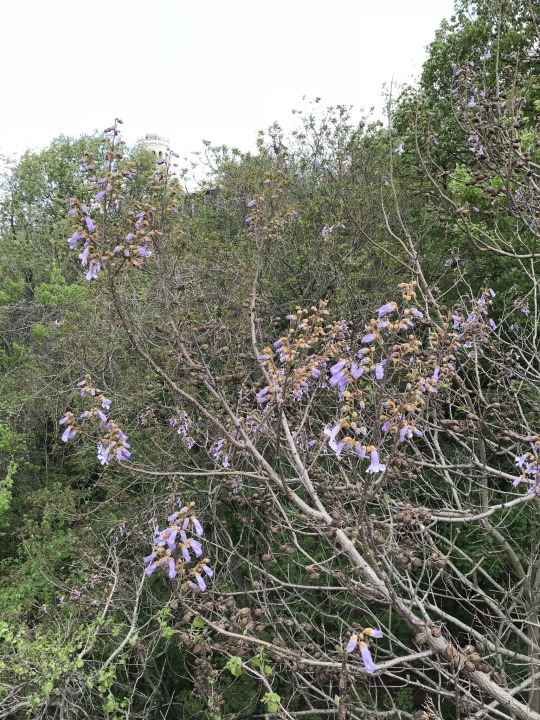
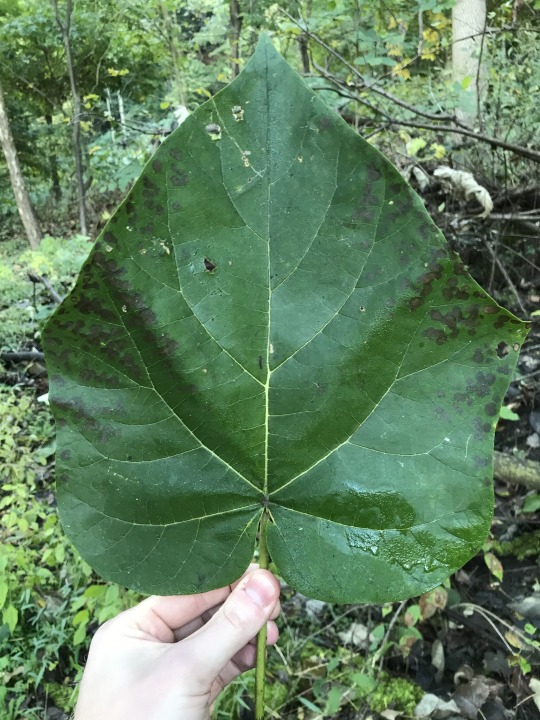
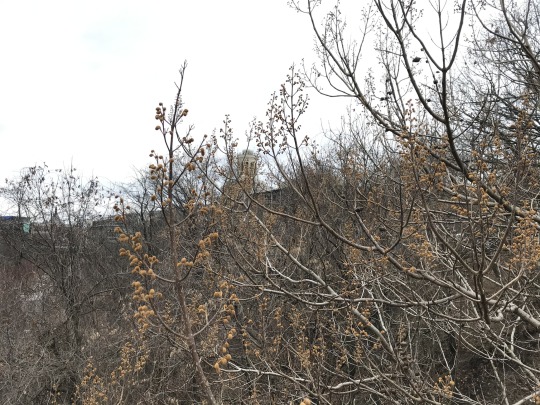
Princess tree has a remarkable presence – large wide leaves larger than your face (though you can’t see that in this winter collected specimen) and very showy, fragrant flowers that burst from large buds in the spring.  Signs of the flowers/fruits remain obvious on the branches year round.

Princess tree is a common urban weedy tree that is not native to Pennsylvania or the United States. Rather, it is native to Central and Western China.  It was brought to Europe in the 1830s (and then to the US) by the Dutch East India Company, with many historical medicinal and ornamental uses, as well as its wood. The tree was named after a Romanov princess, the Grand Duchess Anna Pavlovna.

Princess tree can still be found in Schenley Park.  It is especially noticeable, with its flowers at eye level, as you walk or drive across the bridge from the museum to Phipps Conservatory (Schenley bridge).

Listed as invasive by the state, Princess tree should not be planted in Pennsylvania.  It grows quickly and actively spreads beyond its planting, into roadsides, streams, and disturbed forests with potential to displace native plants.

Find this specimen and more here: http://midatlanticherbaria.org/portal/collections/list.php?db=all&catnum=CM120710&othercatnum=1

Check back for more! Botanists at the Carnegie Museum of Natural History share digital specimens from the herbarium on dates they were collected. They are in the midst of a three-year project to digitize nearly 190,000 plant specimens collected in the region, making images and other data publicly available online. This effort is part of the Mid-Atlantic Megalopolis Project (mamdigitization.org), a network of thirteen herbaria spanning the densely populated urban corridor from Washington, D.C. to New York City to achieve a greater understanding of our urban areas, including the unique industrial and environmental history of the greater Pittsburgh region. This project is made possible by the National Science Foundation under grant no. 1801022.

Mason Heberling is Assistant Curator of Botany at the Carnegie Museum of Natural History. Museum employees are encouraged to blog about their unique experiences and knowledge gained from working at the museum.

Filed Under: Blog Tagged With: Anthropocene, Botany, botany hall, collected on this day, Hall of Botany, Mason Heberling, Museum from Home, Uprooted

March 19, 2020 by wpengine

Collected on this Day in 1898

Spring goes on! Spring seems to happen fast, which makes it all the more special and worth our attention. Comfort can be found in the new life of spring, a time of change.

Happy official first day of spring! For many people, spring conjures images of sunshine (and rain), birds tweeting about, and plants emerging from winter. Trees flower and leaf out high up in the canopy. Wildflowers emerge below, many playing a delicate balance between getting injured by cold or frost but taking advantage of the longer sunny days before being shaded out by tree leaves.

Many deciduous trees flower before, during, or just after they produce a new spring flush of leaves. That’s right – trees flower too! Keep a careful look out for them now and over the coming month. Many trees flower early in the spring, with small clusters of flowers. These easy to overlook flowers 40 feet or more up in the canopy are easy to overlook.  They are often quite small and are wind pollinated. That means that rather than relying on insects, the wind blows their pollen, transferring it to female flowers. (And also…as many with allergies know, we breathe in pollen too.)  Upon fertilization, seeds begin to develop. Flowering early, before leaves are out, is adaptive because the flowers are not blocked by vegetation.

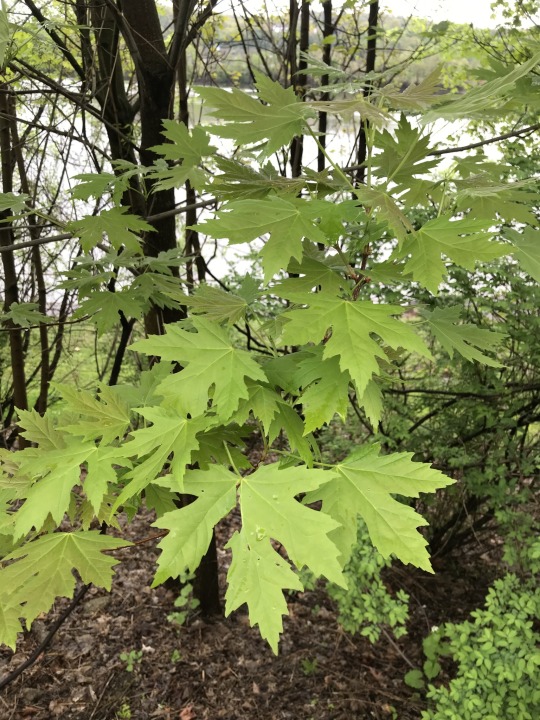
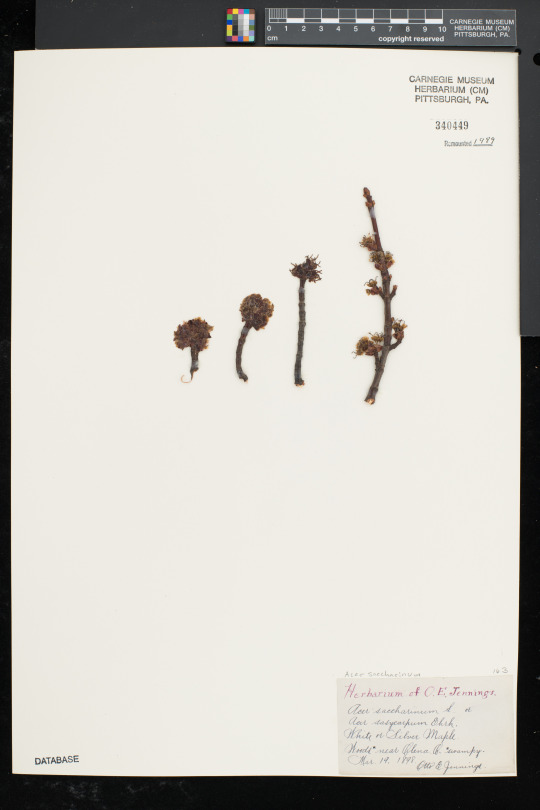
This specimen of silver maple (Acer saccharinum) is in flower, but leaves are not yet emerged. Silver maple is native to swampy, wet areas such as around lakes across eastern North America.  It is also planted, so it is now found in many habitats. It has beautiful bark that forms distinctive strips and with “maple-looking” leaves that are deeply loped.

Beyond the science, this specimen also tells an important cultural story about the history behind the Carnegie Museum. This specimen was collected by Otto Jennings in Olena, Ohio in 1898.  Otto Jennings was one of the first curators of botany at the museum. This specimen was collected when he was only 20 years old, six years before he moved to the museum. He was born in 1877 on a farm in Olena, Ohio. He collected this specimen not far from his childhood home.  Jennings started his 60-year tenure at the Carnegie Museum six years later, in 1904. He made many contributions throughout his career, serving as the Curator of Botany, Director of Education, and eventually Director of the Carnegie Museum of Natural History.  He also was Head of the Department of Biological Sciences at the University of Pittsburgh, having advised many students.  His legacy remains to this day for his influence on the museum, botany, conservation, and environmental education.

So many stories behind these specimens.

Find this specimen and the 304 other specimens Jennings collected near his childhood home here.

Check back for more! Botanists at the Carnegie Museum of Natural History share digital specimens from the herbarium on dates they were collected. They are in the midst of a three-year project to digitize nearly 190,000 plant specimens collected in the region, making images and other data publicly available online. This effort is part of the Mid-Atlantic Megalopolis Project (mamdigitization.org), a network of thirteen herbaria spanning the densely populated urban corridor from Washington, D.C. to New York City to achieve a greater understanding of our urban areas, including the unique industrial and environmental history of the greater Pittsburgh region. This project is made possible by the National Science Foundation under grant no. 1801022.

Mason Heberling is Assistant Curator of Botany at the Carnegie Museum of Natural History. Museum employees are encouraged to blog about their unique experiences and knowledge gained from working at the museum.

Filed Under: Blog Tagged With: Botany, collected on this day, Mason Heberling

March 18, 2020 by wpengine

Collected on this Day in 1951: Bedstraw

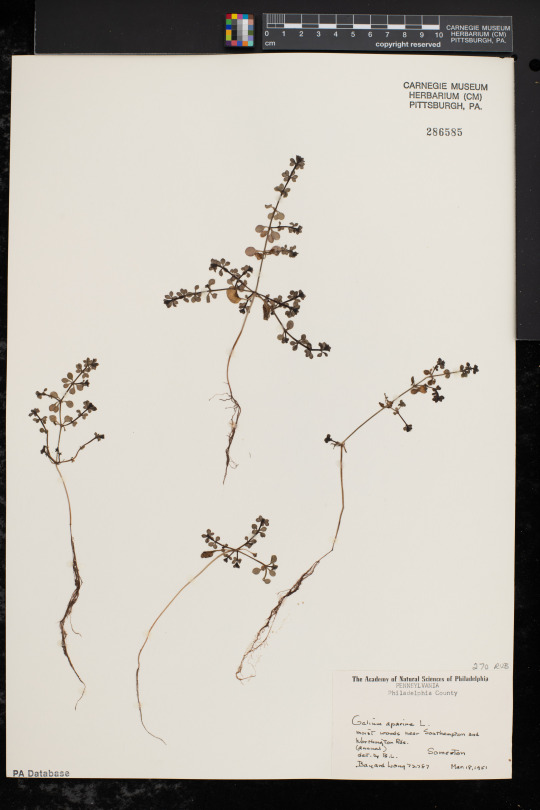
This bedstraw specimen was collected on March 18, 1951 by Bayard Long in Philadelphia county, Pennsylvania.

Bayard Long (1885-1969) was a Philadelphia-area botanist and an active member of the Philadelphia Botanical Club (founded in 1891 and still exists today).  He was a prolific collector and served as Curator of the Club’s Local Herbarium for 56 years (housed at the Academy of Natural Sciences).

Fogg writes of his collections in 1970 in the journal Rhodora: “It is doubtful that anyone ever possessed a higher standard for the quality of an herbarium specimen than Bayard Long.  Every leaf had to be laid out flat, every inflorescence properly displayed, every flower part clearly shown. Extra flowers and loose fruits and seeds were placed in pockets affixed to the sheet. Root systems (collected in their entirety whenever possible) were scrupulously clean, habitats were accurately described, and localities were identified to the nearest tenth of a mile and closest compass point. All of this seems the more remarkable when it is realized that Long collected close to 80,000 numbers, not including collections made as a member of Fernald’s expeditions.”

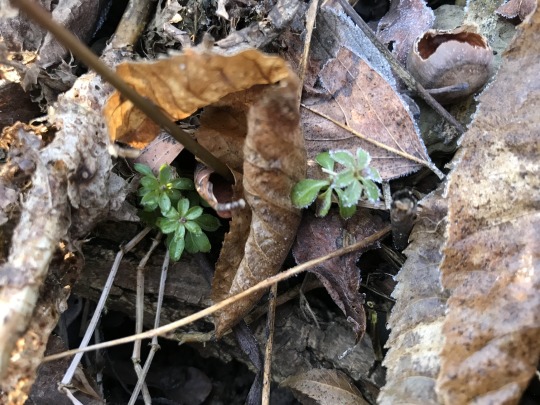
Bedstraws (species in the genus Galium, in the coffee family Rubiaceae) are common and memorable in our woods. They have many historical and traditional uses. In particular, they were used to stuff mattresses, hence the funny name. Also called cleavers or catchweed, the stems are sticky (due to fine hook hairs) and can be fun to stick on your clothes. They have likely stuck to you or your pet. This specimen is Galium aparine. An annual plant, seeds germinate in spring and produce tiny white flowers. They are emerging now, poking through the leaf litter.

Find this specimen and more here.

There are >64,000 specimens collected by Bayard Long currently digitized and online.

Check back for more! Botanists at the Carnegie Museum of Natural History share digital specimens from the herbarium on dates they were collected. They are in the midst of a three-year project to digitize nearly 190,000 plant specimens collected in the region, making images and other data publicly available online. This effort is part of the Mid-Atlantic Megalopolis Project (mamdigitization.org), a network of thirteen herbaria spanning the densely populated urban corridor from Washington, D.C. to New York City to achieve a greater understanding of our urban areas, including the unique industrial and environmental history of the greater Pittsburgh region. This project is made possible by the National Science Foundation under grant no. 1801022.

Mason Heberling is Assistant Curator of Botany at the Carnegie Museum of Natural History. Museum employees are encouraged to blog about their unique experiences and knowledge gained from working at the museum.

Filed Under: Blog Tagged With: Botany, collected on this day, Mason Heberling, Museum from Home, Science News

  • « Go to Previous Page
  • Page 1
  • Interim pages omitted …
  • Page 5
  • Page 6
  • Page 7
  • Page 8
  • Page 9
  • Interim pages omitted …
  • Page 28
  • Go to Next Page »

sidebar

About

  • Mission & Commitments
  • Directors Team
  • Museum History

Get Involved

  • Volunteer
  • Membership
  • Carnegie Discoverers
  • Donate
  • Employment
  • Events

Bring a Group

  • Groups of 10 or More
  • Birthday Parties at the Museum
  • Field Trips

Powdermill

  • Powdermill Nature Reserve
  • Powdermill Field Trips
  • Powdermill Staff
  • Research at Powdermill

More Information

  • Image Permission Requests
  • Science Stories
  • Accessibility
  • Shopping Cart
  • Contact
  • Visitor Policies
One of the Four Carnegie Museums | © Carnegie Institute | Privacy Policy | Terms of Use | Accessibility
Rad works here logo