• Skip to primary navigation
  • Skip to main content
  • Skip to primary sidebar

Carnegie Museum of Natural History

One of the Four Carnegie Museums of Pittsburgh

  • Visit
    • Buy Tickets
    • Visitor Information
    • Exhibitions
    • Events
    • Dining at the Museum
    • Celebrate at the Museum
    • Powdermill Nature Reserve
    • Event Venue Rental
  • Learn
    • Field Trips
    • Educator Information
    • Programs at the Museum
    • Bring the Museum to You
    • Guided Programs FAQ
    • Programs Online
    • Climate and Rural Systems Partnership
  • Research
    • Scientific Sections
    • Science Stories
    • Science Videos
    • Senior Science & Research Staff
    • Museum Library
    • Science Seminars
    • Scientific Publications
    • Specimen and Artifact Identification
  • About
    • Mission & Commitments
    • Directors Team
    • Museum History
  • Tickets
  • Give
  • Shop

climate change

August 5, 2022 by Erin Southerland

Chimney Swift Conservation

by Patrick McShea

In urban, suburban, and even rural areas of southwestern Pennsylvania, the high-pitched twittering cries of circling Chimney Swifts create a soundtrack for summer days. The birds’ aerial maneuvers are a mix of rapid wing beats and dynamic glides, and much of the action relates to feeding. Chimney Swifts eat on the wing, using their unusually large mouths to capture up to 5,000 flying insects per day. (A summary of a Powdermill Aviation Research Center study of the birds’ diet preferences can be found here:  Chimney Swift Research – Powdermill Nature Reserve.)
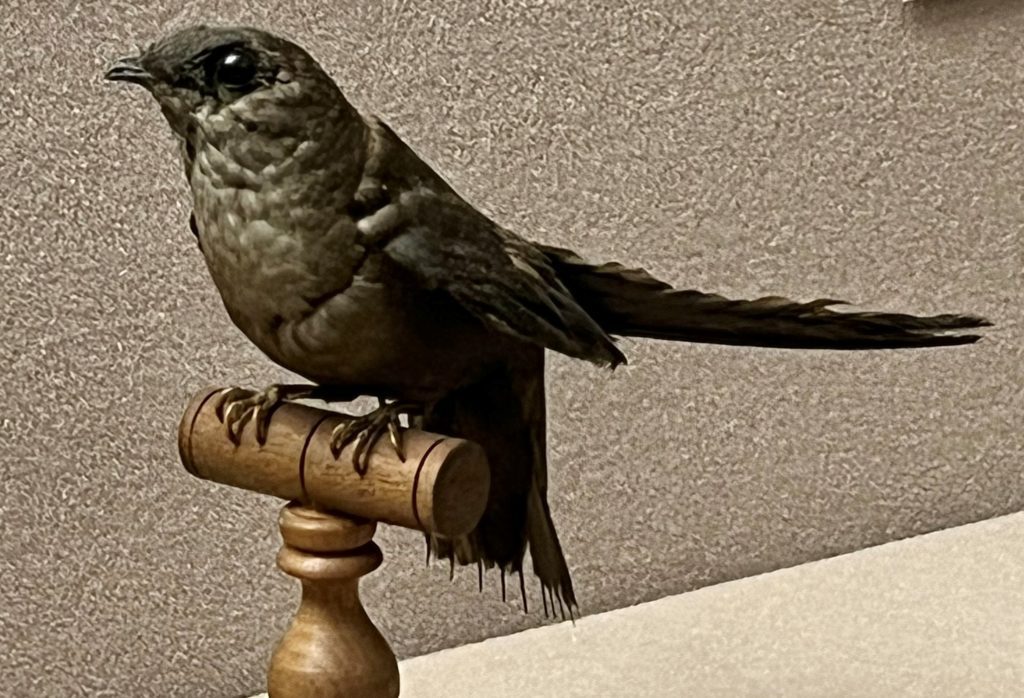
chimney swift taxidermy mount

When observed overhead, passing swifts are frequently described as resembling “flying cigars,” a visual analogy attributable to the birds’ five-inch-long, tube-shaped bodies, comparatively long, narrow wings, and muted grey-brown plumage. Our region is part of the species’ summer range, an enormous portion of eastern North America stretching from the Gulf Coast to just north of the Great Lakes. In South America, an equally large region of the upper Amazon Basin in Peru, Ecuador, and Brazil supports the population during the winter.

The architectural reference in the species’ common name alludes to commensalism involving birds and people that dates to the European settlement of eastern North America. As a biology term, commensalism denotes situations in which one species obtains benefits from another, without harming or benefiting the provider. Historic records indicate that before colonial times the species now known to science as Chaetura pelagica used hollow trees for roosting and nesting. Accounts in New England of the species nesting in chimneys date to the 1670s, and along the Atlantic coastal plain the birds’ exclusive use of chimneys for nest sites was established by 1800.

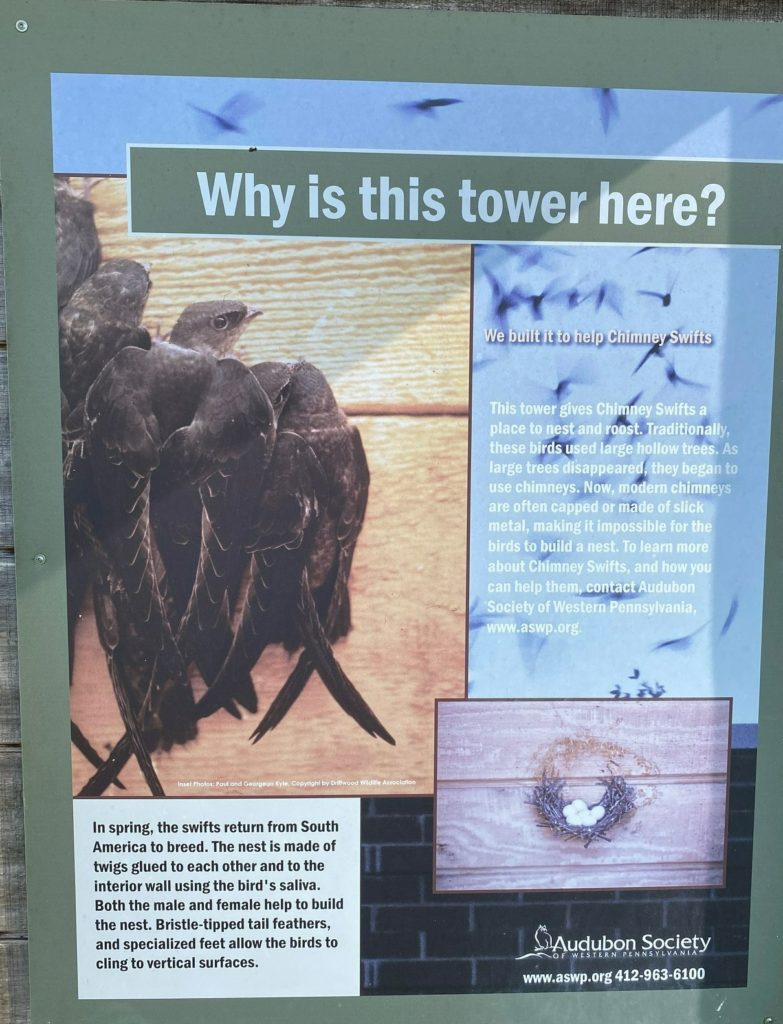
Within hollow trees and chimneys, sheltered interior walls meet the birds’ requirements for nesting and roosting. Chimney Swifts are unable to perch. Instead, they cling to vertical surfaces with their feet, and use the stiff shafts that protrude from the ends of their tail feathers as a brace. For nests, swifts collect branch-end twigs with their feet, in-flight, then use their quick-drying adhesive saliva to construct a narrow platform with the tiny sticks on an interior chimney or tree cavity wall.                                                                                                                           

In his landmark 1940 publication, Birds of Western Pennsylvania, CMNH curator W.E. Clyde Todd summarized the species’ association with chimneys as “more than accidental and connotes a remarkable adaptation to the changed conditions brought about by civilization.” In the eight decades since, changes in the built environment of modern civilization have become less welcoming to Chimney Swifts. 

The population of Chimney Swifts has declined over 70% since the 1960s. Although reductions in flying insect abundance, along with still undetermined threats during migration and on wintering grounds, appear to be critical factors in the decline, potential nest and roost sites have also decreased due to the widespread practice of capping viable chimneys and demolishing those no longer in use. 

In 2013, the Audubon Society of Western Pennsylvania (ASWP) launched a regional initiative to publicize the species’ plight and address reductions in Chimney Swift nesting and roosting habitat. The 106-year-old conservation organization has since led a broad coalition of partners in an ongoing effort to construct, install, and monitor more than 150 Chimney Swift towers at appropriate locations in southwestern Pennsylvania. Although Chimney Swifts are known to fly and roost in large flocks during migration, the birds’ behaviors are far different during the breeding season. Only one pair will nest in a chimney or tower, and research indicates the same pair will return to the same nesting location in subsequent years.
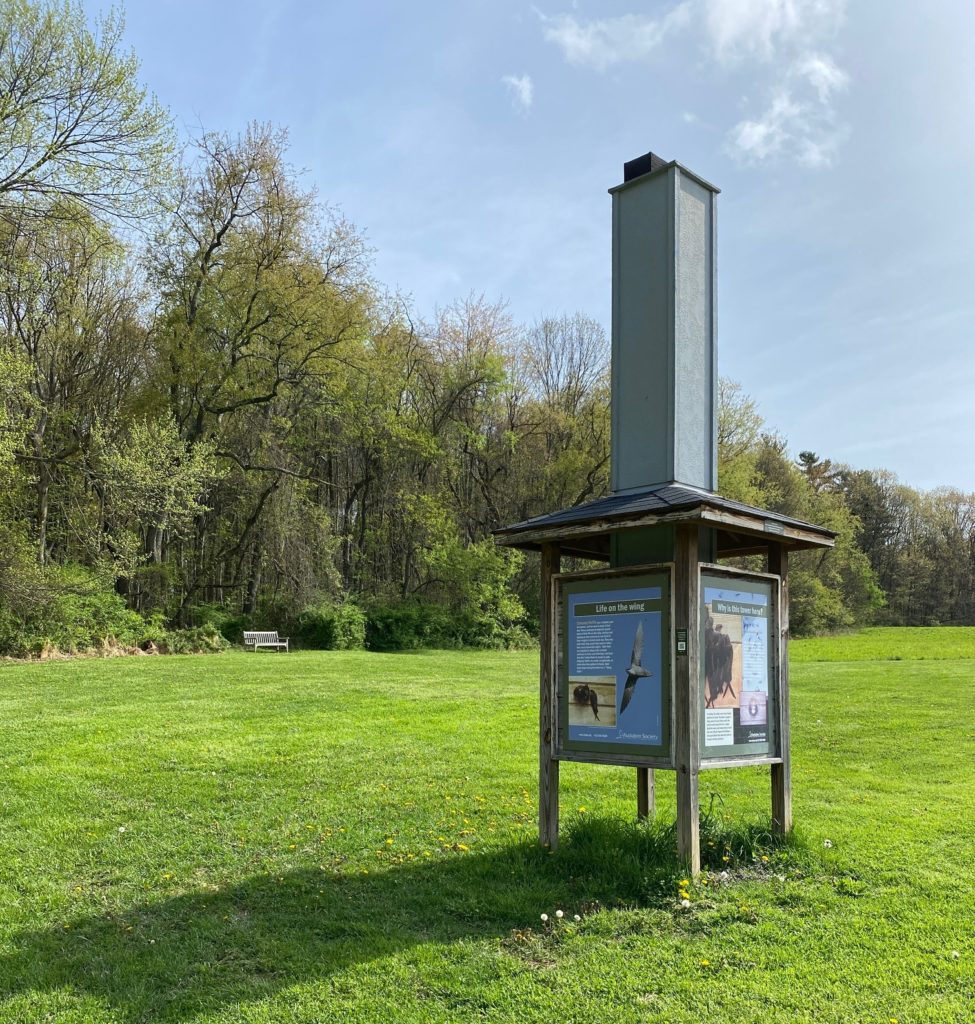
chimney swift tower

The design of these sturdy towers, which mimic actual chimneys, is based upon construction plans detailed in the 2005 publication, Chimney Swift Towers: New Habitat for America’s Mysterious Birds, by Paul and Georgean Kyle. The couple are project directors of the Texas-based Driftwood Wildlife Association’s North American Chimney Swift Nest Site Research Project, an all-volunteer effort to expand public awareness about the beneficial nature and the plight of the species.
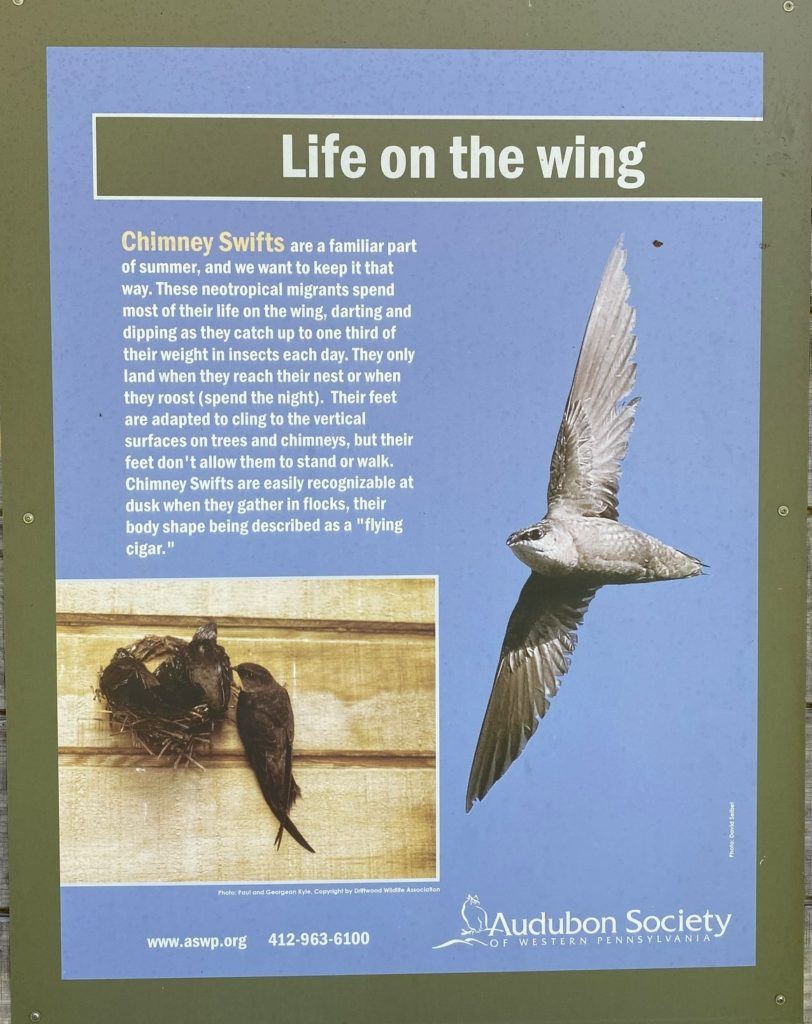
educational sign about chimney swifts
educational sign about chimney swift towers

At sites where ASWP offers regular programming, five towers were constructed of stone to enable the structures to also function as entrance signs for the facilities. In Allegheny County’s seven parks, 12-feet high kiosk-style towers constructed of lumber, shingles, and other roofing materials are now familiar landscape features. Through a partnership with Allegheny County, the Allegheny County Parks Foundation, and the Peaceable Kingdom Fund of The Pittsburgh Foundation, a total of one hundred towers, most bearing colorful informational panels, have been installed to make these public properties more welcoming to Chimney Swifts.

Observations of Chimney Swift activity near any of the towers can contribute to the ongoing evaluation of this regional conservation initiative. Allegheny County Park Rangers have been monitoring towers within the parks where they serve, and towers elsewhere are monitored by ASWP staff and volunteers, however wider public participation is welcome. For more information about Chimney Swift conservation, including a map of tower locations and an online form for reporting observations, please visit the website of the Audubon Society of Western Pennsylvania.

Patrick McShea is an Educator at Carnegie Museum of Natural History. 

Related Content

Bird Architecture on Human Infrastructure

Teaching in the Parks

Sharing a City Park With a Resident Reptile

Carnegie Museum of Natural History Blog Citation Information

Blog author: McShea, Patrick
Publication date: August 5, 2022
Share this post!

  • Share on Twitter Share on Twitter
  • Share on Facebook Share on Facebook
  • Share on Pinterest Share on Pinterest
  • Share on LinkedIn Share on LinkedIn
  • Share on Reddit Share on Reddit
  • Share via Email Share via Email

Filed Under: Blog Tagged With: Birds, climate change, Pat McShea, We Are Nature 2

July 20, 2022 by Erin Southerland

Scientists Call for New Research Studying the Combined Effects of Climate Change and Urbanization on Body Size Across Species

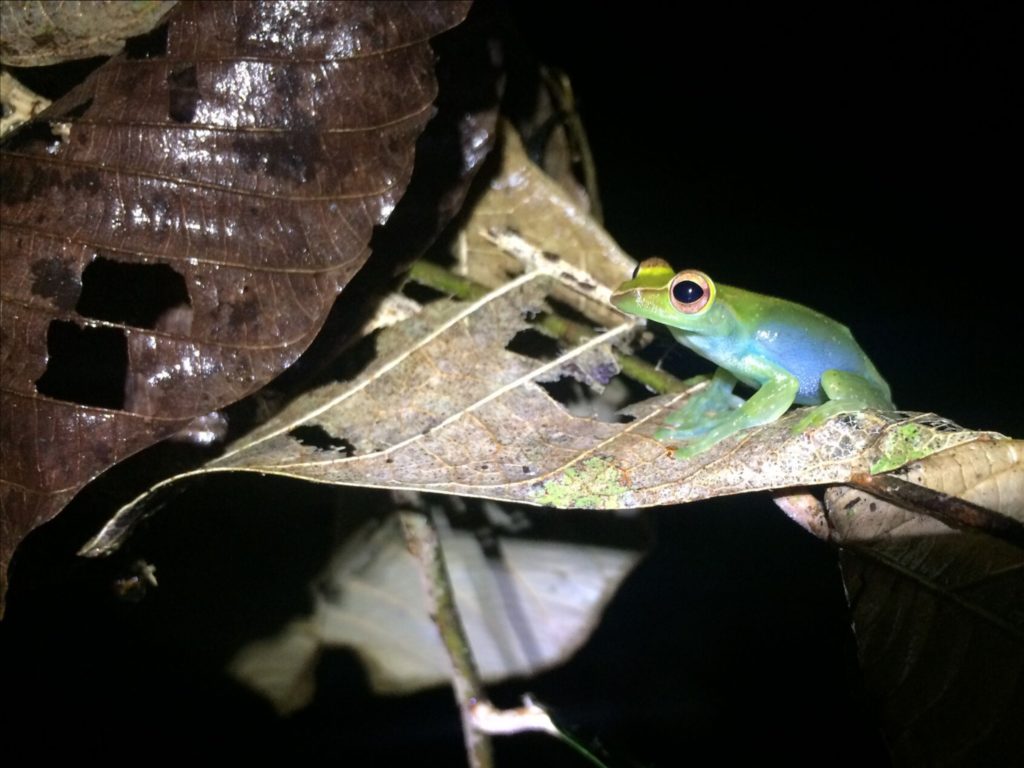
Rhacophorus dulitensis (jade tree frog). Photo by Dr. Jennifer Sheridan, Carnegie Museum of Natural History

Researchers from Carnegie Museum of Natural History have described impacts of climate change and land use on the size of organisms. Dr. Jennifer Sheridan, Assistant Curator of Amphibians and Reptiles, and Dr. Amanda Martin, post-doctoral researcher, review the causes that lead to changes in size as well as ecological interactions, while making the case for more research studying the combined effects of climate change and urbanization. The paper, entitled “Body size responses to the combined effects of climate and land use changes within an urban framework,” was published in in the journal Global Change Biology on June 27. 

Body size is considered one of the most important traits of an organism, affecting thermal regulation, mobility, reproductive output, and capacity to acquire resources. Over many generations, body sizes usually increase within lineages. Recent observations, however, show a decrease in size over relatively short time periods. This could have profound ramifications for individual organisms and ecosystems alike. For example, size-related reproductive success means that interacting populations in the same location will be dominated by smaller species, leading to long-term changes in predator-prey dynamics. Most research suggests climate change as the primary driver of changes in size, but emerging research indicates that land use—especially urbanization—may also contribute.  

Human-induced climate change has significantly altered temperatures since the 1950s, and temperature affects the size of organisms. At roughly the same time, the Earth has experienced rapid urbanization and a tripling of the human population. Unlike climate change, urbanization has been shown to cause an increase in size of some organisms due to the advantage size has on mobility, and the greater availability of food and other resources. Urbanization does not affect all organisms equally; however, and some species—including some birds—are unable to take advantage of food abundance in urban settings and have become smaller.

“There is a gap in the literature,” says Dr. Sheridan. “Given that climate change and urbanization are projected to continue their rapid growth, there is an urgency to understanding how their respective effects may be working in concert. Specimens from museum collections are a unique data source that can shed light on changes in size with respect to climate and land use changes over time.”  

Sheridan and Martin recommend several steps researchers can take to better understand biodiversity loss and ultimately work toward species conservation. These include expanding the taxonomic and geographic scope of research–including the use of museum collections; increasing the use of quantitative data—such as impervious surface area–over categorical data such as urban versus rural zones; and increasing the testing of climate change and land use interactions. Better understanding of the combined effects of climate change and urbanization is imperative for responding to rapid environmental change. 

Filed Under: Press Release Tagged With: Amanda Martin, amphibians and reptiles, climate change, Jennifer Sheridan, Science News

June 1, 2022 by Erin Southerland

Cryptocurrency and Its Environmental Impact

by Dr. Travis A. Olds

Since the onset of the pandemic, millions of new miners have begun working to uncover raw resources; however, these miners are not the typical rock movers at your local quarry. They are instead making cryptographic calculations that reward newly minted digital currency – cryptocurrency.

You have likely heard a great deal about cryptocurrency lately, but may not understand what it is and may be wondering how something that doesn’t exist physically could hold any value? Gold and silver, as minerals with unique physical properties, have market value beyond that of currency, but consider for a moment the $20 bill. This paper currency itself has little physical value; it costs just under 14 cents to produce it, but the value of the bill is based on the fact that millions of people use and rely on it daily. The situation is similar for cryptocurrency. High demand for use and ownership of cryptocurrency creates its value.

Some cryptocurrencies have experienced a meteoric rise, and recently, an equally dramatic fall in value. The details are complex from a technical perspective, but people find crypto attractive for several reasons: using and owning it is significantly more secure than traditional banking, there are no limits to how much can be moved, and you can move it at any time. All transactions, even those made internationally, can be completed in just seconds and with significantly lower fees than those charged by traditional banks. Additionally, new mining methods, called “proof of stake,” even allow people to invest with crypto and earn interest over time. 

Of course, there are new risks and controversies surrounding cryptocurrency that are not encountered in everyday banking and investing. Because crypto is decentralized, there is no governmental or organizational control, and this has many people questioning how to regulate and protect its use. Only a few vendors accept payments in cryptocurrency because of this. With conventional banking, every purchase, withdrawal, or deposit you make through a bank or credit union with cash or credit is tracked by an electronic ledger to verify and secure your activities. The government helps to regulate and ensure the safety of these required systems. 

Cryptocurrency, on the other hand, uses a shared and system-wide electronic ledger called the “blockchain.” All transactions made through the blockchain are tracked, verified, and securitized using rapid cryptographic calculations made via individual miners. This ongoing electronic verification process ensures the massive digital transaction ledger cannot be controlled or altered by individual users. Crypto miners contribute to the ongoing verification process by operating machines to run the necessary calculations. A fraction of a freshly minted electronic coin is awarded for the cryptography calculations one miner does to help secure a transaction, what is termed the “proof of work” consensus mechanism.

Cryptocurrency mining machine
A water-cooled computer used for mining cryptocurrency. A graphics card, the large rectangular component in the center of the image, makes the cryptographic calculations. 

Performing proof of work calculation consumes electricity. Globally, the amount of electricity used by crypto miners has increased exponentially since its inception and this has drawn controversy regarding its impact on our environment. Some large mining farms use more electricity in one day than most small cities or countries do in several; however, the total electricity used by crypto miners still makes up just a small percentage of that used by the traditional electronic banking and investing systems. In fact, traditional banking and crypto systems are both environmentally unfriendly in places that get their electricity from carbon-based power generation, such as coal, heating oil, and natural gas. In early 2022 here in Pennsylvania, 66% of our power came from carbon-based sources, with 30% from nuclear, and the remaining 3% from hydroelectric and other renewable sources. While that cocktail of energy sources makes electricity cheaper here than in most other states, it also means that Pennsylvanians indirectly emit considerably more carbon to keep their lights on. Coal, oil, and natural gas are the cheapest but also the three least efficient fuels for electricity generation and have collectively done the most harm to the environment. 

Specialized crypto mining hardware, including graphics cards and ASIC units, generates heat while performing rapid calculations, so it helps to mine in areas with cool weather. If the hardware can operate at a cooler temperature, it can perform more calculations, which is measured in hashes/second, and is used to quantify the rewards received. Many miners take advantage of the easy scalability of mining hardware, by building large farms that can contain thousands of graphics cards and make thousands of dollars per day, but that also consume enormous amounts of electricity.

The output from mining software shown in real time. Jobs (in magenta) are sent from the blockchain over the internet to your hardware to make calculations that secure transactions and mint new coins. Sometimes, your work is awarded with a share (green), which is redeemable for coins. 

Electrical inefficiency and negative environmental impact have encouraged some cryptocurrency coin developers to come up with more energy efficient algorithms for rewards, but implementation is a slow and complex process. Many miners focus on whichever cryptocurrency is most profitable on any given day, regardless of its efficiency. Many of the largest mining farms are built in areas where energy is cheapest, or where local governments provide property or other tax incentives. Typically, no consideration of environmental impact is made when establishing new farms. In contrast, small amateur and at-home miners with only a few graphics cards can mine cryptocurrency without much increase to their monthly electrical bill. It is possible to make a small profit if you live in an area with cheap electricity, or if you can offset the use with renewable energy, for example, by using solar panels. With two graphics cards, one can make up to $6 a day mining Ethereum, a currently extremely popular crypto coin. 

A screenshot with common metrics used to judge performance and profitability while mining Ethereum (ethermine.org). A high computation rate, or hashrate, given in units of Megahash/second, defines the chances for finding shares, which translate roughly to earnings based on the value of the coin that day.

The visible costs to start mining include buying the hardware, which can cost up to several thousand dollars, and paying for the electricity to power it. A mining “rig” with two graphics cards consumes 600 W, and costs $1.50 per day to mine $6 of Ethereum. Put that another way, the electricity needed to realize a $4.50 profit in one day is equivalent to leaving a 60W light bulb on continuously for 10 days. The invisible and usually overlooked cost of that profit is how roughly two-thirds of the electricity needed to profit was generated by burning fossil fuels and has indirectly but significantly contributed to climate change. 

Cryptocurrency is fraught with inefficiency, complexity, and controversy. The framework is constantly evolving and improving, and although it is far from replacing the day to day use of physical currency, many argue that digital currency is here for the long run. The development of less power-intensive mining methods and more energy efficient hardware is helping to offset the carbon footprint of crypto mining. Crypto mining will become more environmentally friendly in the future, as nuclear power and other renewables like solar and wind energy become cheaper, replacing the dirty and archaic coal and natural gas-burning power stations. 

Dr. Travis A. Olds is Assistant Curator of Minerals at Carnegie Museum of Natural History.

Related Content

Understanding Fossil Fuels Through Carnegie Museums’ Exhibits

Unidentified Gold Nugget

Sea Snails from Christmas Island (Money Cowries and Castor Bean Shells)

Carnegie Museum of Natural History Blog Citation Information

Blog author: Olds, Travis A.
Publication date: June 1, 2022

Share this post!

  • Share on Twitter Share on Twitter
  • Share on Facebook Share on Facebook
  • Share on Pinterest Share on Pinterest
  • Share on LinkedIn Share on LinkedIn
  • Share on Reddit Share on Reddit
  • Share via Email Share via Email

Filed Under: Blog Tagged With: climate change, Hillman Hall of Minerals and Gems, minerals, Science News, Travis Olds

August 16, 2021 by wpengine

Watercolors

by Samhita Vasudevan

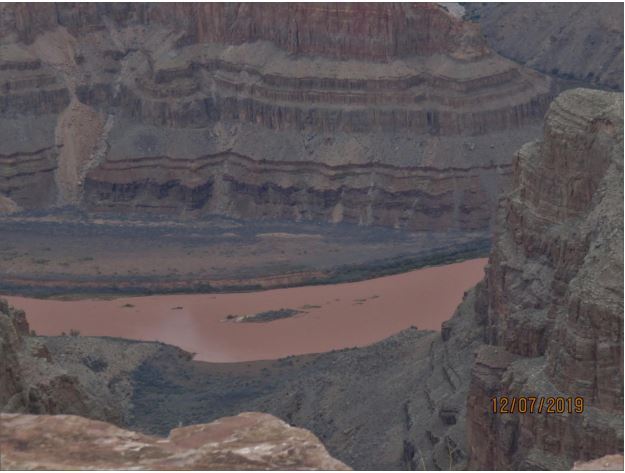
Smooth reds, muted oranges, and sandy browns painted the landscape that graced my sight. An overcast sky drizzled almost cautiously onto our heads, while the crunch of the rocky terrain echoed after every footstep, as my parents and I trekked up the precarious path on the West Rim of the Grand Canyon. It was early December of 2019, on the Hualapai Reservation, a site our family reached after a two-hour cellular-signal-less drive from Las Vegas.

River running through a canyon with a date stamp of 12/07/2019 in the lower right corner.

As we hiked up the path to the second and last stop of our tour, Guano Point (aptly named considering its history—In the 1930s the U.S. government spent about $3.5 million to extract the nitrogen-rich bat droppings), the terror I felt about being so close to plummeting down hundreds of feet evaporated when an opaque, red-colored Colorado River came into my view. Like a ribbon, it weaved through the towering cliffs, drawing everyone’s attention. Today, however, it was especially eye-catching: its striking color was unlike anything I’d ever seen before.

Prior to the completion of the Glen Canyon Dam in 1963, the reddish color of the Colorado was much more prominent. In fact, the Colorado River’s original name, El Rio Colorado, meaning “the reddish river,” came about when the first Spanish explorers to see the river encountered an even more vibrant red than I did. The river’s color is tied to the amount of sediment its water contains while flowing through the canyon. Since the dam’s construction, however, this color has been dulled severely, as the dam blocks much of the sediment from travelling further downstream. Most days, the river is a clear greenish-blue. The reddish-brown color I saw on my visit can most likely be credited to the rain stirring up the sediments earlier that day.

The subject of sediment reminded me of my other favorite National Park, Crater Lake. Unlike the Colorado River, this waterbody’s bright color is caused by a lack of sediment. In 2013, I found myself boating on possibly the most beautiful body of water I have ever seen: Crater Lake in southwestern Oregon. This roughly 5-mile-wide lake, which formed through the collapse of a volcano more than 7,000 years ago, has no tributaries, or smaller rivers flowing into it. In much of the world today, rivers and their tributaries are impacted by human activities, and the effects travel downstream. The reason Crater Lake has some of the cleanest water in the world is because most of its water comes from melted snow or rain. Being free from the inward flow of potentially contaminated water and sediments, Crater Lake maintains its clarity resulting in one of the deepest, brightest, blues.

Lake with hills and mountains.

As beautiful as both bodies of water are, they can only be protected through active efforts to preserve their sanctity. The Colorado River, a source of water for 40 million people, has been negatively impacted due to climate change, population growth, nearby natural resource exploitation, and the over-allocation of its flow for crop irrigation. Crater Lake has become increasingly at risk due to careless visitors who head onto the lake with items prohibited by the National Park due to their potential to pollute the pristine water. The pandemic has only heightened this chronic problem. Increased visitation has brought an increase in people, knowingly or unknowingly, bringing in prohibited items like wetsuits, kayaks, and innertubes. These materials could introduce non-native species that are known to hitchhike on watercraft, jeopardizing the lake’s ecosystem. Visitors to such natural beauties must accept some responsibility to keep these areas alive and well. These positive outcomes can only be achieved by following park guidelines and being conscious of one’s impact on the environment around them.

Samhita Vasudevan is a Teen Volunteer in the Education Department. Museum employees, volunteers, and interns are encouraged to blog about their unique experiences and knowledge gained from working at the museum.

Sources:

https://grandcanyonwest.com/explore/west-rim/guano-point/

Releasing a flood of controversy on the Colorado River

The American Nile

12 Things You Didn’t Know About Crater Lake National Park

Crater Lakes clear waters under threat

Related Content

Chasing Snails in the Great Smoky Mountains

Duck Bite

None Like it Hot

Carnegie Museum of Natural History Blog Citation Information

Blog author: Vasudevan, Samhita
Publication date: August 16, 2021

Share this post!

  • Share on Twitter Share on Twitter
  • Share on Facebook Share on Facebook
  • Share on Pinterest Share on Pinterest
  • Share on LinkedIn Share on LinkedIn
  • Share on Reddit Share on Reddit
  • Share via Email Share via Email

Share this post!

  • Share on Twitter Share on Twitter
  • Share on Facebook Share on Facebook
  • Share on Pinterest Share on Pinterest
  • Share on LinkedIn Share on LinkedIn
  • Share on Reddit Share on Reddit
  • Share via Email Share via Email

Filed Under: Blog Tagged With: climate change, Samhita Vasudevan

April 30, 2021 by wpengine

Warmer Springs and Earlier Birds

by Bonnie McGill

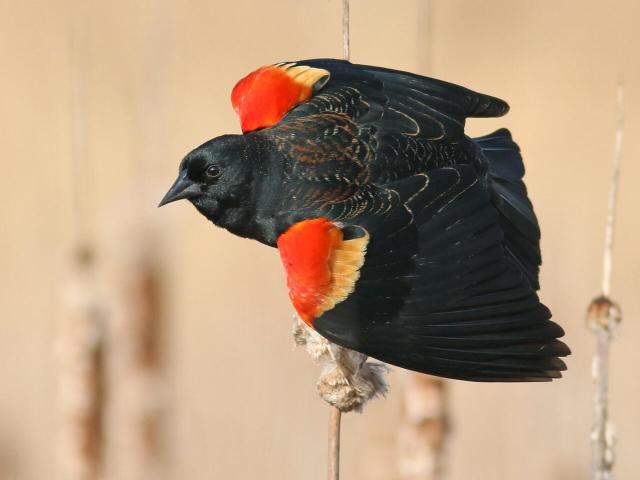
Male Red-winged Blackbird (Agelaius phoeniceus) by Jonathan Eckerson via Macaulay Library.

Male Red-winged Blackbirds! For me, their calls and bright red shoulders are one of the signs that spring is really here. Mind you, this is no subtle sign of spring that takes an expert naturalist to notice. No, this is a sign of spring that slaps you across the face, as if spring is calling, “I’m here! CONK-A-REE! Look at me!” Next time you drive past a wetland area with cattails, there is a good chance you’ll see one or more showing off their red shoulders (the brown females are beautiful too). Red-winged Blackbirds have been back in western PA and announcing their territorial claims since March. Whether you live in the country or the city, bird watching is a great way to observe the change in seasons and connect with the nature around you (and in you).

As a member of the Climate and Rural Systems Partnership (CRSP) team I’ve been gathering evidence-based stories of how climate change is impacting natural processes in western PA. Since this week is the City Nature Challenge, folks might be paying closer attention to birds, creating an opportunity for museum scientists to explain what migratory songbirds in our region can teach us about climate change.

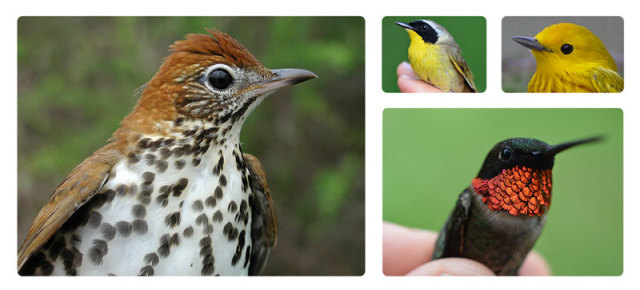
Since 1961 scientists at the museum’s Powdermill Avian Research Center (PARC) in Pennsylvania’s Laurel Highlands have been monitoring birds. In that time they have captured, studied, marked, and released almost 800,000 birds! This week, for example, PARC’s mist nets are temporarily capturing birds like the Common Yellowthroat, Yellow Warbler, House Wren, Ruby-throated Hummingbird, American Redstart, and Wood Thrush.

Migratory birds that are part of the PARC long term dataset (clockwise from left): Wood Thrush, Common Yellowthroat, Yellow Warbler, and Ruby-throated Hummingbird. All of these species are breeding earlier in the year in response to climate change that has already occured. Photos courtesy of Powdermill Avian Research Center.

All of these species are migratory–spending the winter in the southern US, the Caribbean, Central America, and/or South America. Many fly across the Gulf of Mexico (!) on their way north in the spring. All of these birds share another trait–they are nesting earlier in the year than they once did. We will follow the Wood Thrush as an example of how many birds are responding to the warming climate.

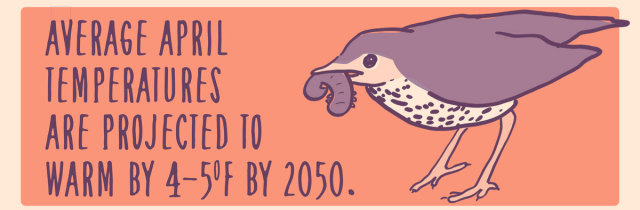
on the right side, text reads "Average April temperatures are projected to warm by four to five degrees Fahrenheit by 2050." On the left, there's an illustration of a bird holding a worm in its beak.
The artwork in this blog post is by the author and part of an infographic depicting the information written here.

PARC’s unique 50 year dataset allows scientists to study how birds respond to long term changes, including the warming climate. Average April temperatures in the Laurel Highlands have already increased by two degrees Fahrenheit since the 1960s, and are projected to warm by another four to five degrees Fahrenheit by 2050. Warmer springs trigger earlier plant budburst. Insects, especially caterpillars, feast on buds and young leaves, which have less toxins than mature leaves. Caterpillars are the breakfast of champions (among birds). So, migratory songbirds, including the Wood Thrush, need to synchronize their northward movement with the budburst. This means an earlier arrival, according to the calendar, at points all along their migration route.

Wood Thrushes arrive from Central America five days earlier than they did in the 1960s. Research suggests that migratory birds respond to temperature cues along their migration route and speed up (warmer temperatures) or slow down (cooler temperatures). Birds may be responding to temperature directly or indirectly via other temperature-dependent cues such as wind speed and direction and spring leaf out.

Eat, Love, Nest, 24 days earlier

Early arrival is not the only adjustment Wood Thrushes are making, however. The birds are also making their nests and hatching young earlier. Wood Thrushes are nesting 24 days earlier than they did in the 1960s. All four of the  bird species in the photo above are breeding earlier. Within the web of organisms that supplies food for birds, May 19 of the present feels like June 11 of the 1960s. The earlier nesting in response to a warming climate means birds that normally hatch and rear multiple broods per breeding season, such as House Wrens and Northern Cardinals, may  have greater reproductive capacity. PARC research shows that Gray Catbirds and Northern Cardinals are having more young in warmer springs, but other multi-brood species such as House Wrens and Common Yellowthroats are not.

While birds seem to be keeping pace with climate change now, they may not be able to in the future. Their capacity to adjust migratory and reproductive behavioral traits in response to climate change is finite. Also, we’ve already lost an estimated 3 billion North American birds since 1970 due to factors including habitat loss, insect declines, pesticide use, and predation by domestic cats. Now climate change is making bird survival even more difficult. The capacity of bird populations to evolve in response to climate change is also limited – climate change in the Anthropocene is happening much more rapidly than climate change in past epochs, many times faster than evolution can keep up. The good news is we can help birds, ecosystems, and ourselves by taking action to reduce the severity of climate change.

illustration of two birds flying with the text "You can help birds and climate"

Here are three ways individuals and communities can help birds by mitigating climate change:

1) Conserve habitat: Habitats like forests, wetlands, and prairies provide food and shelter for birds while the plants and soils remove and store carbon away from the atmosphere. These habitats are needed throughout birds’ migratory ranges. Create habitat by reducing lawns and planting native plants. For example, many birds enjoy eating the fruits of spicebush, elderberry, and black cherry, which are native to western Pennsylvania. You can find more bird-friendly plants native to your area at https://www.audubon.org/plantsforbirds.

2) Renewable energy: A just transition to renewable energy sources like properly-sited wind* and solar will reduce greenhouse gas emissions, provide local jobs, improve air quality, and help protect birds and people from climate change. *The National Audubon Society supports properly-sited wind energy.

3) Eat your vegetables: A more plant-based diet is an impactful way to reduce greenhouse gas footprints. Also, choosing food that is grown with less pesticides, and using less pesticides in the stewardship of your garden, helps support the survival of insects that are food for birds. Reductions in demand for pesticides also reduces their manufacture, which further reduces greenhouse gas emissions. Learn more from Project Drawdown.

So get out there, find the signs of spring that are gentle (Trout Lilies) and not-so-gentle (Red-winged Blackbirds), log them in iNaturalist for the City Nature Challenge, and talk with your family and your community about how you can implement one or two (or three!) of the actions suggested above!

You can also read this as an infographic here.

Thank you to the many folks who helped with the development of this blog post and infographic: Luke DeGroote, Mary Shidell, and Annie Lindsay at PARC; the Laurel Highlands network of the Climate and Rural Systems Partnership; Nicole Heller; Taiji Nelson; and Sarah Crawford.

Bonnie McGill, Ph.D. is a science communication fellow for the Climate and Rural Systems Partnership and based in the Anthropocene Studies Section at Carnegie Museum of Natural History. Museum employees are encouraged to blog about their unique experiences and knowledge gained from working at the museum.

Related Content

Teaching About Local Wildlife with the City Nature Challenge

Water Bears: Why My Yard is Like the Moon

Botanists Use Data Collected By Thoreau to Uncover Unexpected Effects of Climate Change

Carnegie Museum of Natural History Blog Citation Information

Blog author: McGill, Bonnie
Publication date: April 30, 2021

Share this post!

  • Share on Twitter Share on Twitter
  • Share on Facebook Share on Facebook
  • Share on Pinterest Share on Pinterest
  • Share on LinkedIn Share on LinkedIn
  • Share on Reddit Share on Reddit
  • Share via Email Share via Email

Share this post!

  • Share on Twitter Share on Twitter
  • Share on Facebook Share on Facebook
  • Share on Pinterest Share on Pinterest
  • Share on LinkedIn Share on LinkedIn
  • Share on Reddit Share on Reddit
  • Share via Email Share via Email

Filed Under: Blog Tagged With: Anthropocene, Anthropocene Living Room, Anthropocene Studies, Bonnie McGill, City Nature Challenge, climate change, CRSP

January 24, 2019 by wpengine

Anthropocene Living Room

Welcome to the Anthropocene Living Room, a new space in the museum inspired by how humans have and will continue to shape natural history and nature. Hear Dr. Nicole Heller, Curator of the Anthropocene, share her vision for the space and introduce its various elements including items from our collections, books, and other tools for reflection and learning.

Filed Under: Blog Tagged With: Anthropocene, Anthropocene Living Room, climate change, nature, Nicole Heller

  • « Go to Previous Page
  • Page 1
  • Page 2
  • Page 3
  • Page 4
  • Page 5
  • Go to Next Page »

sidebar

About

  • Mission & Commitments
  • Directors Team
  • Museum History

Get Involved

  • Volunteer
  • Membership
  • Carnegie Discoverers
  • Donate
  • Employment
  • Events

Bring a Group

  • Groups of 10 or More
  • Birthday Parties at the Museum
  • Field Trips

Powdermill

  • Powdermill Nature Reserve
  • Powdermill Field Trips
  • Powdermill Staff
  • Research at Powdermill

More Information

  • Image Permission Requests
  • Science Stories
  • Accessibility
  • Shopping Cart
  • Contact
  • Visitor Policies
One of the Four Carnegie Museums | © Carnegie Institute | Privacy Policy | Terms of Use | Accessibility
Rad works here logo