• Skip to primary navigation
  • Skip to main content
  • Skip to primary sidebar

Carnegie Museum of Natural History

One of the Four Carnegie Museums of Pittsburgh

  • Visit
    • Buy Tickets
    • Visitor Information
    • Exhibitions
    • Events
    • Dining at the Museum
    • Celebrate at the Museum
    • Powdermill Nature Reserve
    • Event Venue Rental
  • Learn
    • Field Trips
    • Educator Information
    • Programs at the Museum
    • Bring the Museum to You
    • Guided Programs FAQ
    • Programs Online
    • Climate and Rural Systems Partnership
  • Research
    • Scientific Sections
    • Science Stories
    • Science Videos
    • Senior Science & Research Staff
    • Museum Library
    • Science Seminars
    • Scientific Publications
    • Specimen and Artifact Identification
  • About
    • Mission & Commitments
    • Directors Team
    • Museum History
  • Tickets
  • Give
  • Shop

dinosaur

October 5, 2017 by wpengine

Tyrannosaurus rex

Tyrannosaurus rex was one of the largest predators to ever walk the Earth. Growing up to 46 feet in length and standing 13 feet high at the hips, this meat-eater could weigh up to seven tons.

T. rex was more than just enormous, it was ferocious. It had massive hind legs with three-toed feet, small, strong arms the size of a man’s, and a huge, heavy tail that was used as a counterbalance.
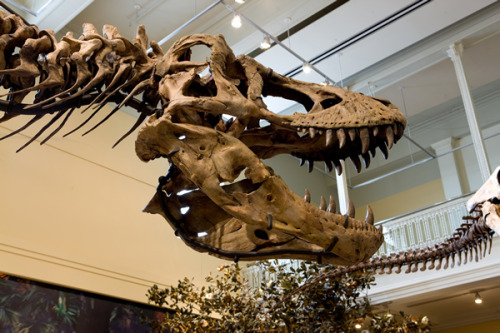
head of a T.rex skeleton
Credit: Joshua Franzos for Carnegie Museum of Natural History

Its skull grew to five feet long and housed strong jaws that created a bone-crushing bite. It had nearly 60 serrated, razor-sharp teeth that grew up to six inches in length. With a name that means “tyrant lizard king,” this dinosaur feasted on the large herbivores of its time.
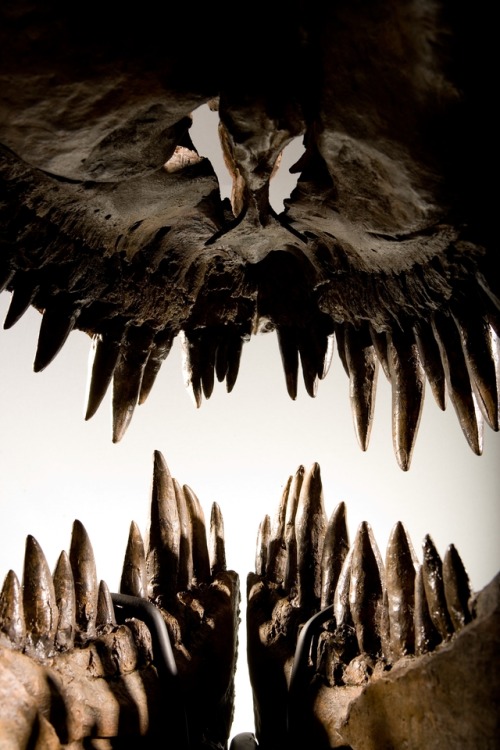
view of T.rex teeth from inside the dinosaur's mouth
Credit: Joshua Franzos for Carnegie Museum of Natural History

T. rex roamed the western United States and southwestern Canada during the late Cretaceous Period, about 66 to 68 million years ago. The specimen on display at Carnegie Museum of Natural History was discovered in 1902 by Barnum Brown and sent to the American Museum of Natural History. It was bought by the Carnegie Museum in 1941.

This specimen is extremely important because it is the holotype of the species. A holotype is a specimen upon which a given species is based. So, in other words, Carnegie Museum of Natural History’s T. rex is the ‘gold standard’ to which all potential fossils of this notorious meat-eater must forever be compared. Although a few specimens that are now known to belong to T. rex were found prior to the discovery of the holotype, the holotype was, by definition, the first fossil of the species to be recognized by science. Therefore, it can be considered the world’s first specimen of the world’s most famous dinosaur.
Filed Under: Blog Tagged With: dinosaur, dinosaurs, dinosaurs in their time, Matt Lamanna, t-rex, Tyrannosaurus Rex, Vertebrate Paleontology

October 5, 2017 by wpengine

Camarasaurus

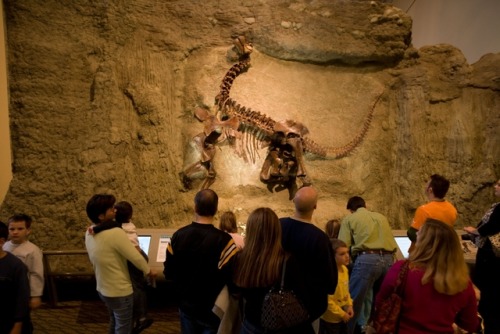
museum visitors looking at a dinosaur skelleton
Photo Credit: Joshua Franzos for Carnegie Museum of Natural History

A large, herbivorous quadruped, Camarasaurus was among the most common of the giant sauropod dinosaurs found in the Jurassic Period in North America. With a name that means “chambered lizard,” this dinosaur was named for its partly hollow vertebrae, and reached up to a massive 60 feet in length.

Camarasaurus lived during the Late Jurassic, some 145 to 150 million years ago, and featured a long, thick neck which made its head appear small in comparison. It had sturdy, spoon-shaped teeth, indicating its diet probably differed from other large herbivores that lived in the same ancient environment, with Camarasaurus most likely feeding on coarser plant materials.

Real fossils of both an adult and a juvenile Camarasaurus discovered at Dinosaur National Monument in Utah are on view in the Dinosaurs in Their Time exhibition at Carnegie Museum of Natural History. The juvenile is represented by a nearly complete skeleton that includes a full skull and even ear bones. The skeleton is displayed with its right side still mostly enveloped in sandstone belonging to a rock unit called the Morrison Formation.

Filed Under: Blog Tagged With: dinosaur, dinosaurs in their time

October 5, 2017 by wpengine

Camptosaurus aphanoecetes

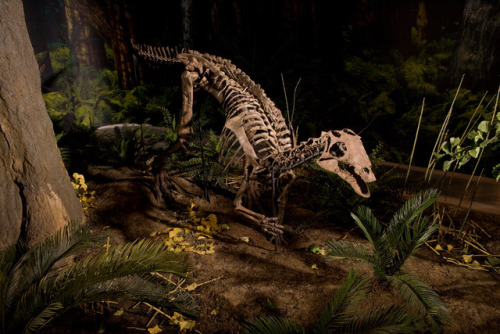
skelleton of Camptosaurus aphanoecetes dinosaur in the museum
Photo Credit: Joshua Franzos for Carnegie Museum of Natural History

Camptosaurus aphanoecetes, which means “flexible lizard hiding in plain sight,” was a medium-sized plant-eating dinosaur that lived about 145–150 million years ago during the late Jurassic Period. Remains of Camptosaurus have been found in North America and, according to some paleontologists, in England as well. Although the Camptosaurus skeleton on display at Carnegie Museum of Natural History was discovered in 1922, it wasn’t studied in detail until relatively recently.

On exhibit in Pittsburgh for more than six decades, still half buried in Jurassic sandstone, the skeleton was fully removed from the rock in 2005–2006 to transform it into a three-dimensional mount. After the specimen was completely unearthed, it was discovered to show differences with fossils of the dinosaur species it was long thought to represent, Camptosaurus dispar. So, in 2008, the skeleton was established as the type, or name-bearing, specimen of the new species Camptosaurus aphanoecetes by scientists Kenneth Carpenter and
Yvonne Wilson.

This Camptosaurus skeleton was excavated by Earl Douglass and his field crew from rocks belonging to the Morrison Formation in the Carnegie Quarry at Dinosaur National Monument in Utah. Today it is on display at Carnegie Museum of Natural History.

Filed Under: Blog Tagged With: dinosaur, dinosaurs in their time

October 5, 2017 by wpengine

Stegosaurus armatus

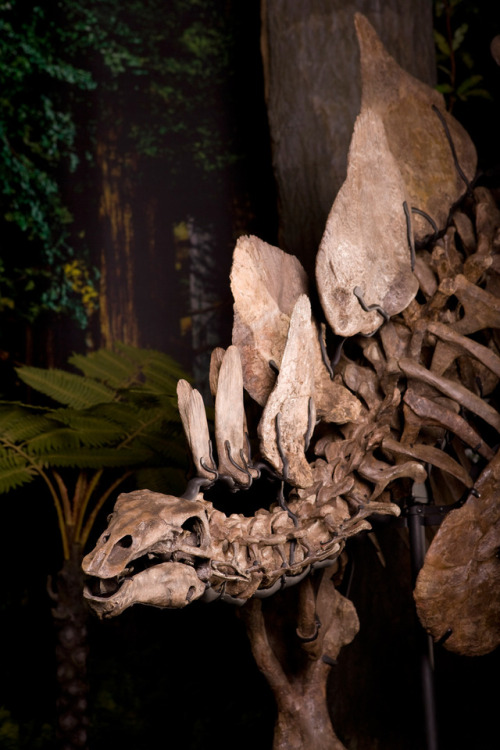
skelleton of Stegosaurus armatus dinosaur
Photo Credit: Joshua Franzos for Carnegie Museum of Natural History

Stegosaurus armatus is one of the most recognizable dinosaurs of all. With a name that means “plated reptile,” Stegosaurus is a favorite among dinosaur enthusiasts. An herbivore, this dinosaur roamed western North America during the late Jurassic Period, between 145 and 150 million years ago.

Stegosaurus had small, simple teeth and weak jaw muscles. Scientists believe these reptiles were not effective chewers and ate vegetation that grew low to the ground, most likely ripping and swallowing most of it whole.

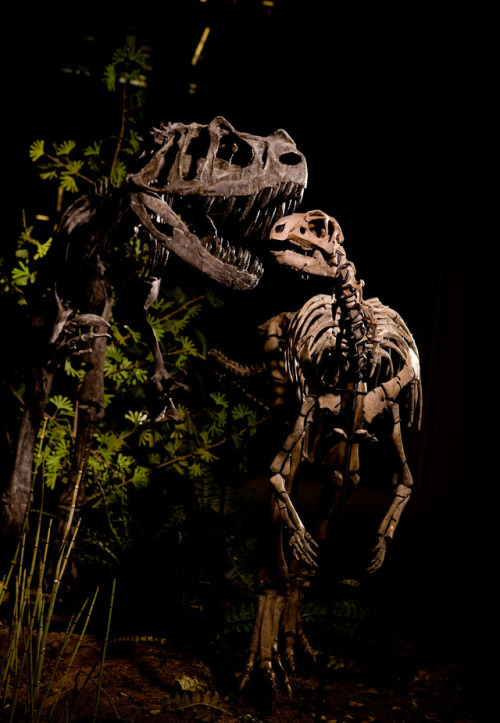
Growing up to 25 feet long, Stegosaurus had tall, bony plates that lined its back. While these plates probably offered protection, they were also crisscrossed by blood vessels and may have been used to regulate the animal’s body temperature or to signal to other Stegosaurus individuals. Stegosaurus also featured paired spikes on its tail, which it used for protection against large carnivorous dinosaurs such as Allosaurus. A few Allosaurus fossils have even been found with what are believed to be wounds inflicted by the tail of Stegosaurus.

Filed Under: Blog Tagged With: dinosaur, dinosaurs in their time

October 5, 2017 by wpengine

Dryosaurus altus

Dryosaurus altus skeleton
Photo Credit: Image by Josh Franzos

Unlike many herbivores of its time, Dryosaurus altus was not very large. Standing four feet high at the hips and growing up to 11 feet in length, Dryosaurus may have weighed only 200 pounds. But this bipedal dinosaur was fast. It had long, powerful hind legs that carried it through the Late Jurassic wilderness, providing its primary defense against predators.

With a name that means “tall oak tree lizard,” Dryosaurus had short front limbs and a long tail that may have been used as a counterbalance. It had a beak for cropping vegetation and was most likely an efficient chewer, with strong teeth and a hinged jaw. This hinge allowed the herbivore to slide its upper and lower jaws past one another as it chewed, an unusually advanced feeding adaptation for this time period.

One of the oldest known members of the dinosaur group Ornithopoda, Dryosaurus fossils have been found in the western United States and possibly eastern Africa (though some paleontologists think the African fossils belong instead to a close relative called Dysalotosaurus). The specimen on display at Carnegie Museum of Natural History was discovered in 1910 by Earl Douglass and his field crew in the Morrison Formation at what is now Dinosaur National Monument in Utah.

Filed Under: Blog Tagged With: dinosaur, dinosaurs in their time

October 5, 2017 by wpengine

Protoceratops andrewsi

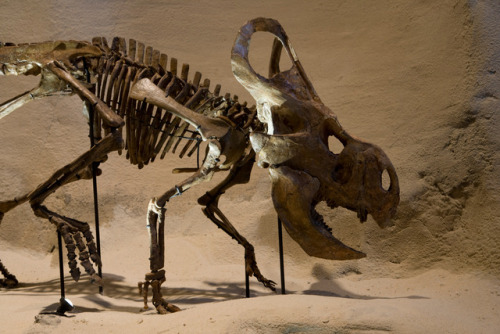
dinosaur fossil of Protoceratops andrewsi in a museum display
Photo Credit: Image by Josh Franzos for Carnegie Museum of Natural History

Protoceratops andrewsi is a fairly small and primitive ceratopsian, or horned dinosaur. Although it lacked the horns of later species, Protoceratops had a distinct bump above its nostrils and thickened bone over its eye sockets. Like its larger and geologically younger relative Triceratops, this herbivore also had a bony neck frill that may have been used for species identification and display. With a name that means “Andrews’ early horned face,” this dinosaur reached two and one-half feet tall at the hips and grew up to six feet long. It weighed around 200 pounds and had a horn-covered beak that it used to crop plants and to defend itself.

Protoceratops was first discovered in Mongolia, and a great many specimens have since been found in that nation and in northern China. They range in size from hatchlings to full-grown adults, including one that is preserved locked in combat with an individual of Velociraptor, the predatory ‘raptor’ made famous by the Jurassic Park films.

Protoceratops thrived in Central Asia during the late Cretaceous Period, roughly 80-75 million years ago. Roughly 20 million years beforehand, a ceratopsian species that closely resembled Protoceratops is thought to have migrated from Asia to North America via a land bridge that spanned the region between what are now Siberia and Alaska. The descendants of this dinosaur eventually evolved into the huge horned ceratopsians such as Triceratops.

The Protoceratops on display at Carnegie Museum was collected by the American Museum of Natural History during an expedition to Mongolia in 1925 and obtained via an exchange in 1945.

Filed Under: Blog Tagged With: dinosaur, dinosaurs in their time, Vertebrate Paleontology

  • « Go to Previous Page
  • Page 1
  • Page 2
  • Page 3
  • Page 4
  • Go to Next Page »

sidebar

About

  • Mission & Commitments
  • Directors Team
  • Museum History

Get Involved

  • Volunteer
  • Membership
  • Carnegie Discoverers
  • Donate
  • Employment
  • Events

Bring a Group

  • Groups of 10 or More
  • Birthday Parties at the Museum
  • Field Trips

Powdermill

  • Powdermill Nature Reserve
  • Powdermill Field Trips
  • Powdermill Staff
  • Research at Powdermill

More Information

  • Image Permission Requests
  • Science Stories
  • Accessibility
  • Shopping Cart
  • Contact
  • Visitor Policies
One of the Four Carnegie Museums | © Carnegie Institute | Privacy Policy | Terms of Use | Accessibility
Rad works here logo