• Skip to primary navigation
  • Skip to main content
  • Skip to primary sidebar

Carnegie Museum of Natural History

One of the Four Carnegie Museums of Pittsburgh

  • Visit
    • Buy Tickets
    • Visitor Information
    • Exhibitions
    • Events
    • Dining at the Museum
    • Celebrate at the Museum
    • Powdermill Nature Reserve
    • Event Venue Rental
  • Learn
    • Field Trips
    • Educator Information
    • Programs at the Museum
    • Bring the Museum to You
    • Guided Programs FAQ
    • Programs Online
    • Climate and Rural Systems Partnership
  • Research
    • Scientific Sections
    • Science Stories
    • Science Videos
    • Senior Science & Research Staff
    • Museum Library
    • Science Seminars
    • Scientific Publications
    • Specimen and Artifact Identification
  • About
    • Mission & Commitments
    • Directors Team
    • Museum History
  • Tickets
  • Give
  • Shop

Education

June 18, 2020 by wpengine

Eastern Garter Snake Encounter

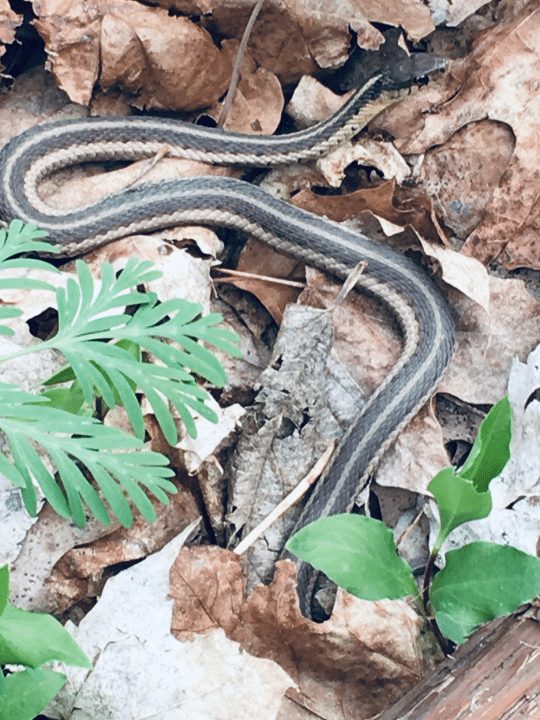
photo of garter snake in leaves

The eastern garter snake never moved. I only noticed the harmless reptile because my hands were within inches of its sleek body as I crouched to photograph a large-flowered trillium. The image above is a result of an abrupt subject change, but rushing wasn’t necessary. I was later able to photograph the intended wildflower without disturbing its striped neighbor.

After perhaps 90 seconds of sharing space with the snake, I backed carefully away from the blooming patch of forest understory within the Allegheny Land Trust’s Barking Slopes Natural Area. Later that day, in the pages of a trusted reference book, I found an explanation for what seemed an unusually passive predator.

Amphibians and Reptiles of Pennsylvania and the Northeast, is a Cornell University Press publication from 2001 by three authors with deep ties to CMNH, Arthur C. Hulse, long a Research Associate for the Museum’s Section of Herpetology, the late C. J. McCoy, a curator within the Section between 1964 and 1993, and Ellen J. Censky, a curator within the Section between 1994 and 1998.

The 5 pages of the 400-page volume devoted to garter snakes includes a description of the snake’s wide range of reactions to close encounters with our species.

“At one extreme, some remain fairly quiescent and allow themselves to be picked up and will not attempt any defensive behavior. At the other extreme, individuals flatten the head and body, flare the lips to expose teeth, and strike violently.”

The authors cite research indicating that young garter snakes are more aggressive after eating a large meal, a behavior that might occur because recently ingested food reduces their mobility, and therefore their chances for successful escape.

By this line of reasoning, the docile creature I encountered might simply have been hungry.

Patrick McShea works in the Education and Visitor Experience department of Carnegie Museum of Natural History. Museum employees are encouraged to blog about their unique experiences and knowledge gained from working at the museum.
Related Content

Northern Ribbon Snake

Lost and Found

Flying Snakes? Unique Reptile Adaptations

Filed Under: Blog Tagged With: Education, Educators, herpetology, Museum from Home, Pat McShea, Patrick McShea

May 29, 2020 by wpengine

Educator Spotlight: Christian Shane

In mid-March, like every teacher who suddenly found work and home life disrupted by Covid-19 related school closings, Christian Shane was concerned about his students. During the earliest days of sheltering restrictions, however, the science teacher from North Allegheny School District’s Ingomar Middle School was also worried about fish.

Christian and his seventh-grade students participate in Trout in the Classroom, an inter-disciplinary program made possible by a unique partnership between the Pennsylvania Council of Trout Unlimited and the Pennsylvania Fish and Boat Commission. A 55-gallon tank in Christian’s classroom held some 200 fingerling rainbow trout, fish raised from eggs since November, and destined for eventual release in designated stocked trout waters.

The release occurred far earlier than planned, and without any student participation. “When the school closed, teachers were instructed not to enter the building,” Christian explained, “but a custodian called that very first Saturday and said I’d better come get the fish.”

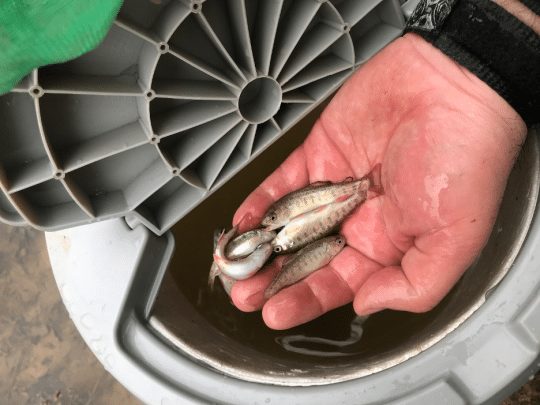
Fingerling trout on the early release date. A video of the release was shared with students.

I learned of the rescue and release weeks afterward when I called Christian to ask if his home-based lessons involved any of the mammal skulls he borrowed from the Museum’s loan program in early March. The skulls were secure in his classroom, Christian reported, but the first-hand learning experiences the specimens provided for students before the school closure proved to be vitally important during later home bound instruction. “I’ve been trying to get the students outside. Whatever the size of their yard, I want them to notice things where they live that relate to what we’re covering in our remote lessons.”

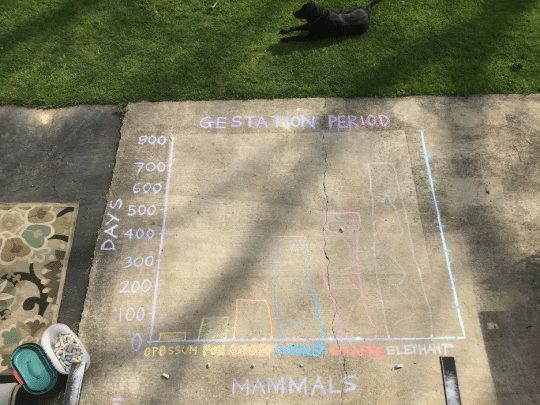
A teach-from-home innovation: Christian Shane created a driveway graph of mammal gestation periods.

According Christian, in a semester where teaching goals progressed from understanding the structures and processes of organisms to fuller comprehension of the roles of organisms in ecosystems, being able to make detailed observations of something as common as fern or a blooming violet was vitally important. “Students took two weeks to acclimate to the new conditions, but I’m confident they’ve learned a lot this spring.”

No doubt an innovative teacher had something to do with that progress.

Patrick McShea works in the Education and Visitor Experience department of Carnegie Museum of Natural History. Museum employees are encouraged to blog about their unique experiences and knowledge gained from working at the museum.
Filed Under: Blog Tagged With: Education, Educator Loan Program, Pat McShea, Patrick McShea

May 26, 2020 by wpengine

South American Hippo Habitat

two South American hippo toys

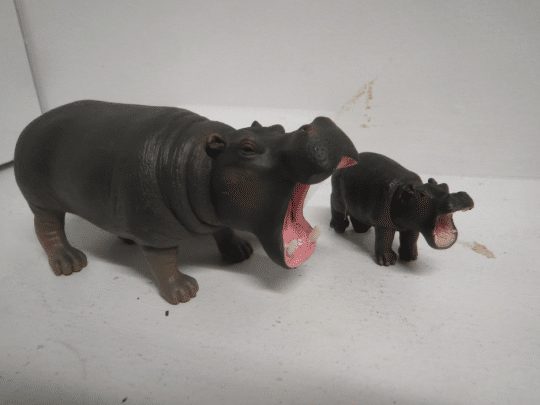
In the wake the groundbreaking exhibition, We Are Nature, museum educators increasingly recognize opportunities for existing exhibits to foster discussions of profound human impacts. Because of a recent research study published in Proceedings of the National Academy of Science, even these sturdy plastic components of the African Wildlife Play Table (above) can spark wide ranging discussions about the impacts of large animal relocations.

The research paper Introduced herbivores restore Late Pleistocene ecological functions, by ecologist Erick Lundgren (University of Technology, Sydney, Australia) and ten co-authors, documents the establishment and growth of a hippo population along a section of Columbia’s Magdalena River over the past three decades. The founding members of a population now estimated to include as many as 80 individuals were four hippos, three females and one male, acquired during the 1980s by notorious drug lord Pablo Escobar for a private zoo on his estate.

According to researchers, the population of Magdalena River hippos could grow to between 800 and 5,000 animals by the year 2050.

For a summary of the research and its implications by The New York Times science writer Asher Elbein, please visit “Pablo Escobar’s Hippos Fill a Hole Left Since Ice Age Extinctions.”

Patrick McShea works in the Education and Visitor Experience department of Carnegie Museum of Natural History. Museum employees are encouraged to blog about their unique experiences and knowledge gained from working at the museum.
Filed Under: Blog Tagged With: Anthropocene Living Room, Anthropocene Studies, Education, Educators, mammals, Museum from Home, Pat McShea, Patrick McShea

May 22, 2020 by wpengine

The World of Bee Vomit

If you’re squeamish, this blog post might not be for you. We are deep diving in the world of vomit. Did you know insects like bumblebees vomit just like we do? Humans tend to vomit (upchuck, throw up, whatever you want to call it) as a reaction to something we don’t like or a sickness. However, bees are more methodical with their vomit.

The Thought Process

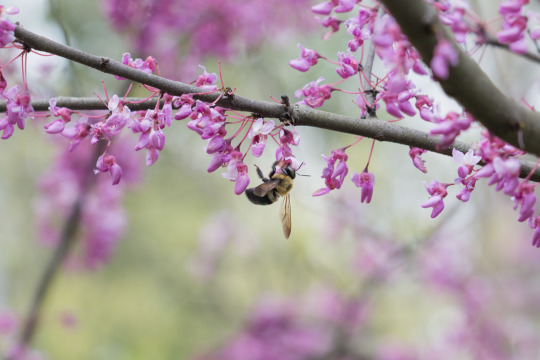
A bee collecting nectar from a redbud. Photo by Melissa Cagan.

Bumblebees put a lot of thought into choosing which flower to gather nectar from. Some common factors are how far the flower is from the hive, the shape of the petals, and how sugary the nectar is.

A recent study published in the Journal of Royal Society Interface shows bees also consider how long it will take for them to vomit the nectar back up.

Bees will go out on foraging duty to drink and collect the nectar. Then, they return to the nest and regurgitate the nectar into wax honeypots so the other bees can have nectar.

Observing the Bee Vomit

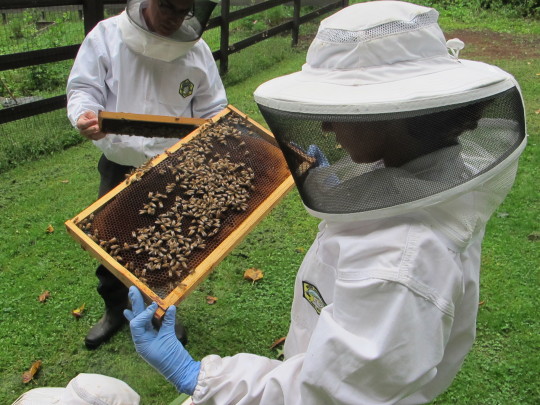
Beekeepers looking for the queen bee. Photo by Melissa Cagan.

Bumblebee vomit is something that is normally overlooked when observing the insect. Scientist Dr. Johnathan Pattrick from The University of Oxford was so intrigued he set up a nest to observe this important step.

In his lab, Dr. Pattrick’s team set up a nest and filled it with Bombus terrestris, which is Europe’s common bumblebee.  The experiment started off by giving the bees access to three different sugar solutions of different thicknesses, one as thick as maple syrup and the thinnest being a soupy liquid. The object was to see which solution the bee preferred and the timing difference between how much they’re slurping and the thickness.

Scientists found that the thicker nectar could take almost 2 minutes for the bee to throw back up. When vomiting up the less thick solution, the vomiting was faster and less energy intensive. Overall the bees chose a less concentrated nectar so they could get the job done in a timelier manner.

How Can We Help

Dr. Pattrick’s study helped us realize that vomit and regurgitation is actually very important to consider during the process of pollination. One thing we can do to make this process easier for bumblebees is be cautious of what flowers we are planting. This video from Cambridge University does a great job at demonstrating what research is being done in pollination.

Fun Fact

Bombus dahlbombii is one of the largest species of bees in South America. The queen bees can grow up to 40 mm long and have been described to look like flying mice.

Filed Under: Blog Tagged With: Education, Museum from Home, Nature 360, Nature Lab, Section of Invertebrate Zoology

May 18, 2020 by Kathleen

Virtual Learning Week

Join us as we kickoff our navigation of the Nile to discover what life was like in ancient Egypt. Learn about the role of animals in Egyptian life and lore. Plus we’ll get you started on this week’s design challenge. Registrants will receive an activity guide via e-mail that will support your participation in the offline design challenge.

We welcome all kids (ages 5-13).

4 opportunities to join are available. Pick the virtual kick-off and wrap sessions your household would like to attend. This program is a combination of live video and self-guided craft activity.

The content/experience for each program is the same in each of the four planned sessions.
Registrants should pick a SINGLE Kickoff program and a SINGLE Wrap program.

Households with multiple children only need to register one time. No need to register per child for this program.

If you are experiencing page loading problems or registration problems, please email ProgramRegistration@CarnegieMuseums.org.

Choose Your Morning Kickoff Video Session
10 a.m. – 10:40 a.m.


Choose Your Afternoon Wrap Video Session
4 p.m. – 4:40 p.m.


Tagged With: Education

May 12, 2020 by wpengine

Draw a Flower

This is the season of colorful flowers and we can truly appreciate their vibrance after a typical grey and chilly winter.  One way to make the beauty last and keep a reminder of springtime all year-round is to draw a flower.

Andrey Avinoff was an entomologist and Director of the Carnegie Museum of Natural History from 1926 to 1946.  But he was also an illustrator and painter in his free time!  Many of his beautiful illustrations can be found in “Wild Flowers of Western Pennsylvania and the Upper Ohio Basin,” a botanical guide authored by the botanist Otto E Jennings, and later Director of the Carnegie Museum of Natural History.

One of the most ubiquitous flowers of the season, for me, is the violet.  I love the way they sprout up through lawns and in the forest alike.  They come in a dazzling array of colors—pink, white, yellow, blue, and purple—and the detail when you look closely is inspiring.  There are about 600 species in the Viola genus, so there are plenty to choose from.

Before we get started you might need to gather some supplies.  Use a pencil and eraser, just in case you make some mistakes (it’s okay to make a mistake).  Get some paper and a comfy spot to draw—make sure you cover your table to avoid making marks on it.  Don’t forget the colors!  I like colored pencils, but you can use markers, crayons, paint, or anything else to color with.

Here’s a tip: try out some ideas on scrap paper so that you know what works best for you.  Practice makes perfect!

Step 1: Shapes

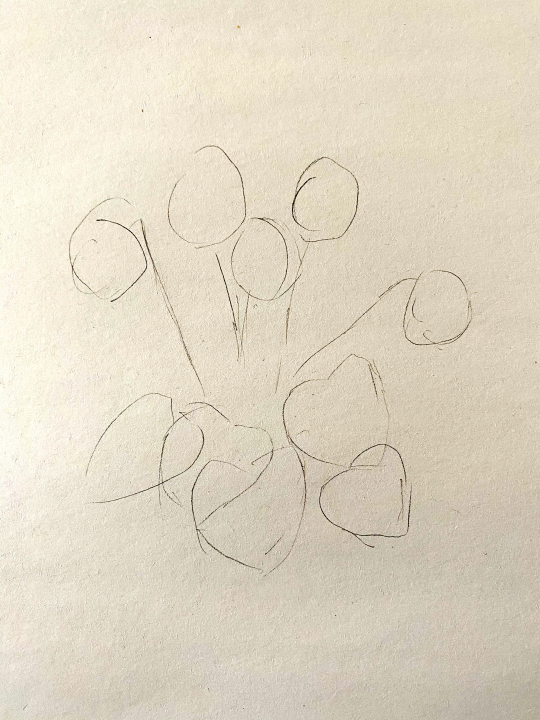
circles and lines drawn in pencil to show the basic shapes to begin drawing flowers

Use some basic shapes—circles, triangles, squares, and lines—to make up the general shape of your flower.  You can draw little lollipops or popsicles for now and we’ll add more details as we go.  Use light pencil strokes so that they’ll be easy to erase later.

Try to keep all of your flower shapes the same size—you want all your flowers to be similar in size.

I also draw some leaf shapes.  Make sure your leaves are balanced to your flowers and don’t worry about how they overlap just yet.

I also like to have a photo that I’ve taken or found online to use as a reference for what I’m drawing.  I even picked some flowers to get a good idea of what they look like—just make sure you leave some flowers for the wildlife.

If you want to take it to the next level, you can also check out some botanical illustrations (like Andrey Avinoff’s) where individual flower parts, seeds, leaves, and roots are sometimes drawn to help with identification.

Step 2: Silhouette

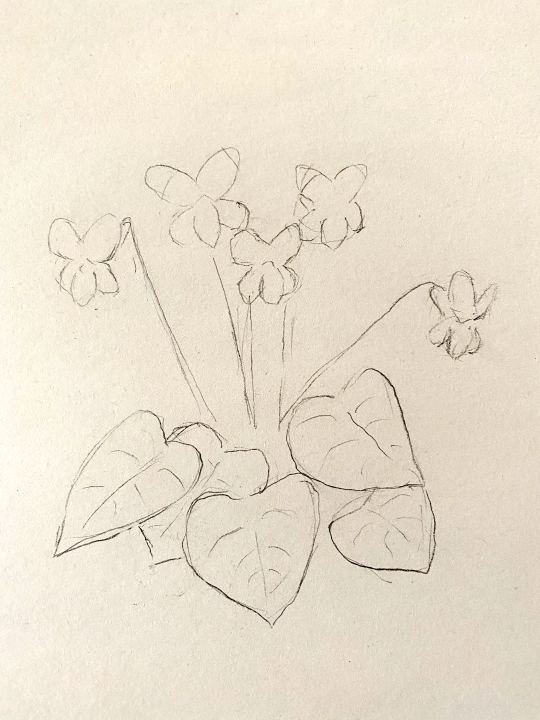
basic pencil drawing of flowers

Next let’s draw individual flower petals.  It’s good to know how many petals your flower has and how they look—violets have five that look a little like a butterfly.  Flowers come in a lot of shapes, so take some time studying the flower and practice drawing the shape.  If you haven’t already, you can also draw the flower stalks, or petioles.

The leaf shape is important too, leaves come in lots of shapes like the violet’s heart-shaped leaves.

Step 3: Details

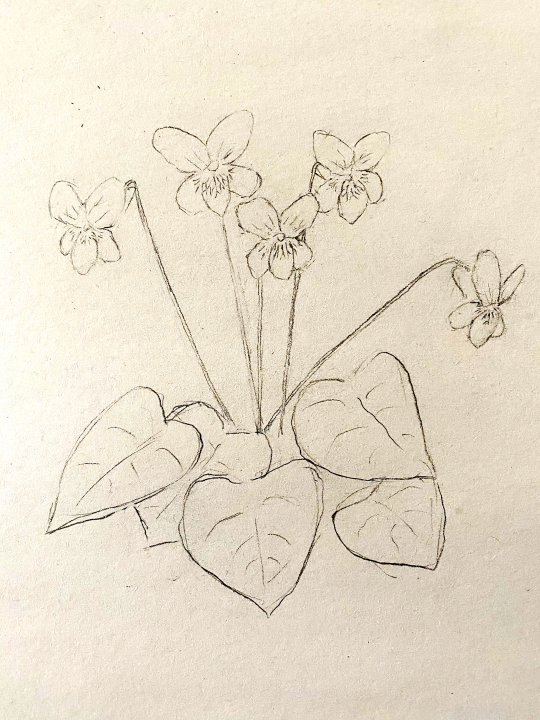
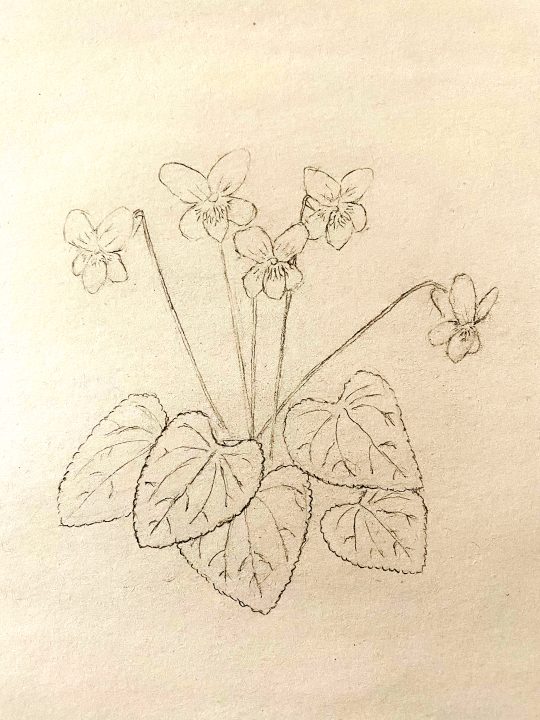
detailed pencil drawing of flowers

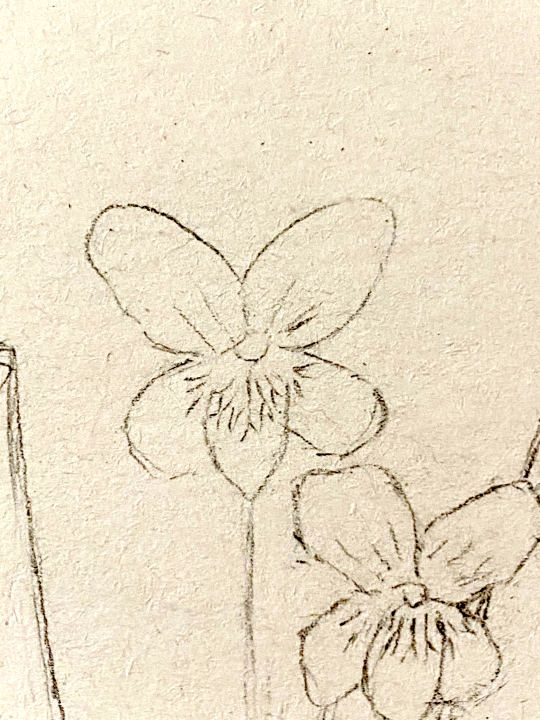
Add more details.  Mark where colors might change on flower petals and if there are any veins on the leaves or petals.  You can add details to the leaf edges to make them wavy, scalloped, or toothed.

detail of pencil drawing of flowers

It’s also important in this step to know how detailed you want to be. Remember: a smaller sketch doesn’t need as much detail, but a bigger sketch can have more.  Whatever you think looks best.

detailed pencil sketch of flowers

Step 4: Color

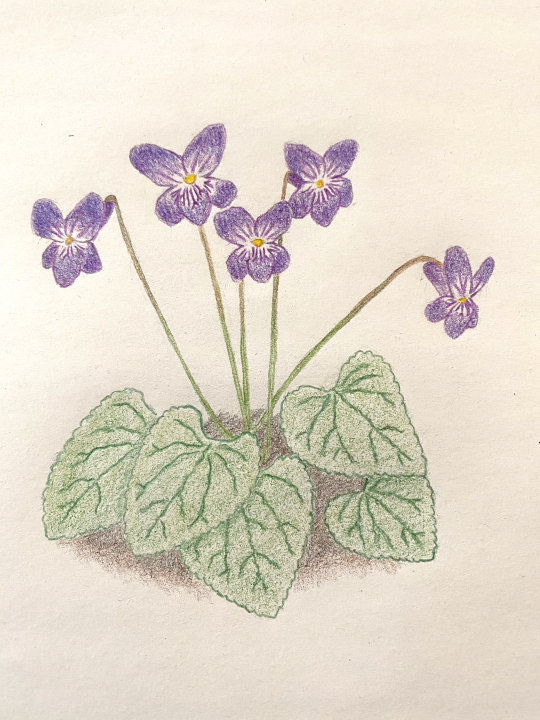
colored drawing of flowers with purple petals, yellow centers, and green stems and leaves

This step is optional, sometimes a black and white sketch can tell a great story.  However, if you have some time, then adding color to your drawing can also really bring it to life.

You can use crayons, markers, paint, or any other color tool you want.  It’s always a good idea to test your colors on a separate piece of paper to see if they’re right for you or to try out a mix of colors.  Flowers are many colors, so you can be really creative!

Be proud of your sketches!  No one else could have made it the same way that you did.  By drawing and coloring plants, animals, and other nature you can sharpen your observation skills and gain a better appreciation for the beauty and uniqueness of all life.

Aaron Young is a museum educator on Carnegie Museum of Natural History’s Outreach team. Museum staff, volunteers, and interns are encouraged to blog about their unique experiences and knowledge gained from working at the museum.
Filed Under: Blog Tagged With: Aaron S. Young, activities, Education, Educators, Museum from Home, Nature 360, Nature Lab

  • « Go to Previous Page
  • Page 1
  • Interim pages omitted …
  • Page 7
  • Page 8
  • Page 9
  • Page 10
  • Page 11
  • Interim pages omitted …
  • Page 15
  • Go to Next Page »

sidebar

About

  • Mission & Commitments
  • Directors Team
  • Museum History

Get Involved

  • Volunteer
  • Membership
  • Carnegie Discoverers
  • Donate
  • Employment
  • Events

Bring a Group

  • Groups of 10 or More
  • Birthday Parties at the Museum
  • Field Trips

Powdermill

  • Powdermill Nature Reserve
  • Powdermill Field Trips
  • Powdermill Staff
  • Research at Powdermill

More Information

  • Image Permission Requests
  • Science Stories
  • Accessibility
  • Shopping Cart
  • Contact
  • Visitor Policies
One of the Four Carnegie Museums | © Carnegie Institute | Privacy Policy | Terms of Use | Accessibility
Rad works here logo