• Skip to primary navigation
  • Skip to main content
  • Skip to primary sidebar

Carnegie Museum of Natural History

One of the Four Carnegie Museums of Pittsburgh

  • Visit
    • Buy Tickets
    • Visitor Information
    • Exhibitions
    • Events
    • Dining at the Museum
    • Celebrate at the Museum
    • Powdermill Nature Reserve
    • Event Venue Rental
  • Learn
    • Field Trips
    • Educator Information
    • Programs at the Museum
    • Bring the Museum to You
    • Guided Programs FAQ
    • Programs Online
    • Climate and Rural Systems Partnership
  • Research
    • Scientific Sections
    • Science Stories
    • Science Videos
    • Senior Science & Research Staff
    • Museum Library
    • Science Seminars
    • Scientific Publications
    • Specimen and Artifact Identification
  • About
    • Mission & Commitments
    • Directors Team
    • Museum History
  • Tickets
  • Give
  • Shop

eggs

January 12, 2024 by Noelle Swart

Museum on the Move Sensory Friendly Egg-stravaganza!

CMNH Learning & Community is inviting Museum on the Move families to join us at the museum for Sensory Friendly Egg-stravaganza!

Celebrate springtime at this sensory supportive experience at Carnegie Museum of Natural history! From tiny insects to giant dinosaurs, the museum has eggs and nests of all shapes and sizes to discover. Which one is YOUR favorite? Museum galleries will open to this event before regular museum hours, will have reduced audio/visual elements, and calming spaces with support materials.

Pre-registration is required, and includes regular museum admission if you would like to stay past 10am.

Museum on the Move
Sensory Friendly Egg-stravaganza!

Saturday, March 30, 8:30 a.m. to 10 a.m.


Tagged With: egg hunt, eggs, eggstravaganza, sensory friendly, spring

January 12, 2024 by Noelle Swart

Sensory Friendly Egg-stravaganza!

Sensory Friendly Egg-stravaganza!

Celebrate springtime at this sensory supportive experience at Carnegie Museum of Natural history! From tiny insects to giant dinosaurs, the museum has eggs and nests of all shapes and sizes to discover. Which one is YOUR favorite? Museum galleries will open to this event before regular museum hours, will have reduced audio/visual elements, and calming spaces with support materials.

Pre-registration is required, and includes regular museum admission if you would like to stay past 10am.

Sensory Friendly Egg-stravaganza!

Saturday, March 30, 8:30 a.m. to 10 a.m.


Tagged With: egg hunt, eggs, eggstravaganza, sensory friendly, spring

April 23, 2019 by wpengine

Broken Egg Evidence

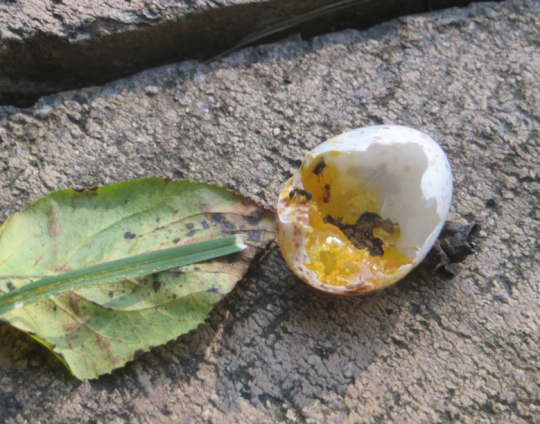
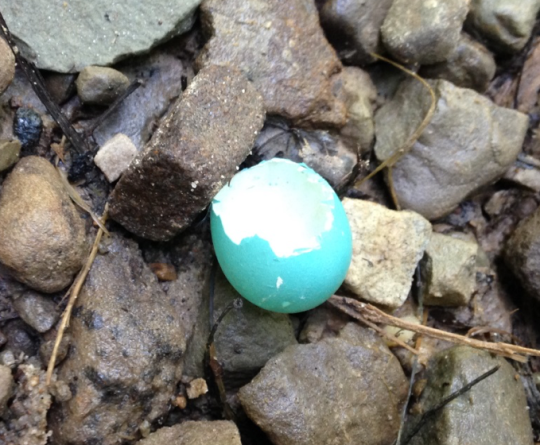
Challenges involving eggs aren’t limited to the Easter season. The pictures below are of songbird egg shells I came across in early July of 2018. Each fragment hints at a different outcome for the developing bird that once occupied the structure. My speculation about those outcomes is mainly informed by details about the places where the shells were found, critical information not captured in the photographs.

broken egg on the ground

This northern cardinal egg shell fragment rested on a brick sidewalk near a forsythia bush where a pair of the birds had been observed nesting. Blue jays frequented the area, as did eastern chipmunks. Either could have removed an egg from the nest, broken the shell, eaten much of the contents, and left drying yolk for ants to scavenge.

broken blue egg among rocks

It’s likely this wood thrush egg fragment was deliberately dropped by a parent bird as part of routine post-hatch nest-keeping duties. The blue shell rested on a gravel State Game Lands road inMercer County, a place that echoed with flute-like Wood Thrush song. The fragment’s spotless interior was evidence that this egg had almost certainly been opened by its occupant rather than a nest visitor.

Patrick McShea works in the Education and Visitor Experience department of Carnegie Museum of Natural History. Museum employees are encouraged to blog about their unique experiences and knowledge gained from working at the museum.

Filed Under: Blog Tagged With: Birds, Education, eggs, Pat McShea, Patrick McShea

August 7, 2018 by wpengine

Unscrambling the Science of the Egg

By Chase D. Mendenhall

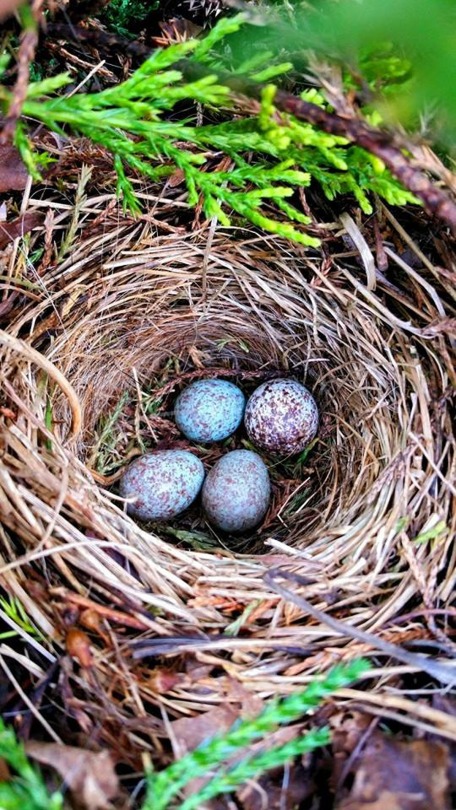
eggs in a nest

What came first, the chicken or the egg? The answer to this riddle is the egg. Eggs are universal among all vertebrates, including humans, but reptiles are responsible for the development of the eggshells typical of terrestrial birds and early mammals. Eggs are virtually self-contained life support systems that freed the first reptiles to wander away from water for reproduction, separating them from amphibians. Eggs are packed with most of the ingredients needed to grow the animal inside. All they require for the embryo to develop properly are warmth and gas exchange.

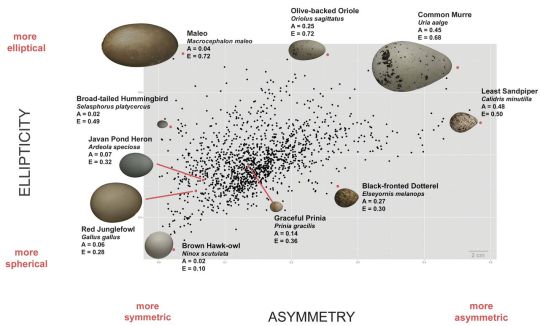
Bird eggs vary tremendously. Shape, size, coloration, and contents have often been associated with life histories of the species that lay them. For example, asymmetrical eggs with one pointed end were thought to be the result of nesting on a cliff—these eggs roll in tight circles instead of straight off the edge. Similar stories have been written about extensively to explain the jelly bean shape of the hummingbird eggs, elongated ellipses of swifts, and the spherical nature of owl eggs—but new work done in museum collections may have answered the riddle of egg shape definitively. Specifically, scientists now have evidence to suggest that selection for flight adaptations is most likely to be responsible for most of the variation.

chart of egg shapes

Measurements of nearly 50,000 eggs in museum collection from 1,400 bird species by Dr. Mary Stoddard and colleagues revealed stunning evidence that egg shape is related to flight. Dr. Stoddard’s star variables for testing her hypothesis were egg asymmetry and ellipticity. Symmetric eggs have similar shapes at each end, like the hummingbird’s jellybean shaped eggs, and asymmetric eggs are pointed at one end, like a sandpiper egg. Ellipticity is related to length and volume of the egg—for example, owls lay spherical eggs, while Orioles and Swifts lay long zeppelin-shaped eggs. The two variables of asymmetry and ellipticity interact with one another, allowing scientists to categorize egg shape across two axes that provide information about the way the egg was shaped in the shell gland after passing through the uterus.

Stoddard discovered that mother birds shape their eggs mechanically, apply pressure to the egg membranes as layers of calcium carbonate crystals form the eggshell. The shape of the egg determines the space in which the young bird completes the process of building its body for flight. Like all multi-cellular vertebrates, one cell divides into many—differentiating into trillions of cells with specialized architecture and function. According to Stoddard’s analysis of egg shape in relationship to phylogenetic history, she was able to demonstrate that egg shape explained wing shape. Spherical eggs, like those of the owl, are symmetric and score low on the ellipiticity scale and tend to belong to birds who spend little time flying. Elongated, asymmetric eggs—like those belonging to sandpipers, are associated with champion flyers who might spend many days airborne.

Chase Mendenhall is Assistant Curator of Birds, Ecology, and Conservation at Carnegie Museum of Natural History. Museum employees are encouraged to blog about their unique experiences and knowledge gained from working at the museum.

Filed Under: Blog Tagged With: Birds, egg laying, eggs, evolution

January 30, 2017 by wpengine

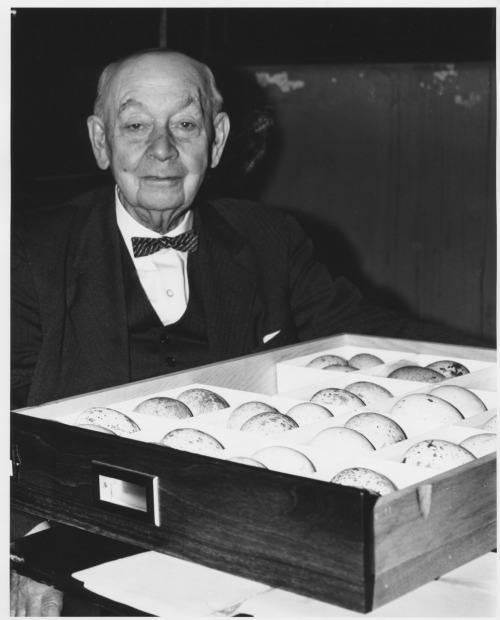
W.E. Clyde Todd

W.E. Clyde Todd, curator of Ornithology 1914-1945 at Carnegie Museum of Natural History


Filed Under: Blog Tagged With: Birds, eggs, museum history

October 8, 2016 by wpengine

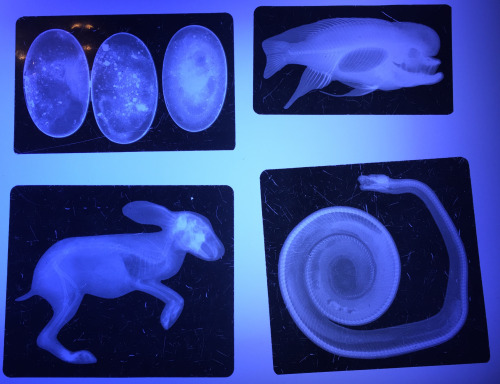
X-rays at Discovery Basecamp

X-rays of a rabbit, snake, and fish
Visitors can examine all different types of x-rays at Discovery Basecamp, our new permanent, interactive gallery that invites visitors to take part in hands-on learning.

Filed Under: Blog Tagged With: discovery, eggs, fish, nature, Pittsburgh

sidebar

About

  • Mission & Commitments
  • Directors Team
  • Museum History

Get Involved

  • Volunteer
  • Membership
  • Carnegie Discoverers
  • Donate
  • Employment
  • Events

Bring a Group

  • Groups of 10 or More
  • Birthday Parties at the Museum
  • Field Trips

Powdermill

  • Powdermill Nature Reserve
  • Powdermill Field Trips
  • Powdermill Staff
  • Research at Powdermill

More Information

  • Image Permission Requests
  • Science Stories
  • Accessibility
  • Shopping Cart
  • Contact
  • Visitor Policies
One of the Four Carnegie Museums | © Carnegie Institute | Privacy Policy | Terms of Use | Accessibility
Rad works here logo