• Skip to primary navigation
  • Skip to main content
  • Skip to primary sidebar

Carnegie Museum of Natural History

One of the Four Carnegie Museums of Pittsburgh

  • Visit
    • Buy Tickets
    • Visitor Information
    • Exhibitions
    • Events
    • Dining at the Museum
    • Celebrate at the Museum
    • Powdermill Nature Reserve
    • Event Venue Rental
  • Learn
    • Field Trips
    • Educator Information
    • Programs at the Museum
    • Bring the Museum to You
    • Guided Programs FAQ
    • Programs Online
    • Climate and Rural Systems Partnership
  • Research
    • Scientific Sections
    • Science Stories
    • Science Videos
    • Senior Science & Research Staff
    • Museum Library
    • Science Seminars
    • Scientific Publications
    • Specimen and Artifact Identification
  • About
    • Mission & Commitments
    • Directors Team
    • Museum History
  • Tickets
  • Give
  • Shop

herbarium

September 14, 2018 by wpengine

Collected on this day in 1989

by Mason Heberling

You can get see plants from all over the world without ever leaving the herbarium. Herbaria are powerful resources that enable research that would otherwise not be possible, comparing plant species collected from across the world, at different times of year.
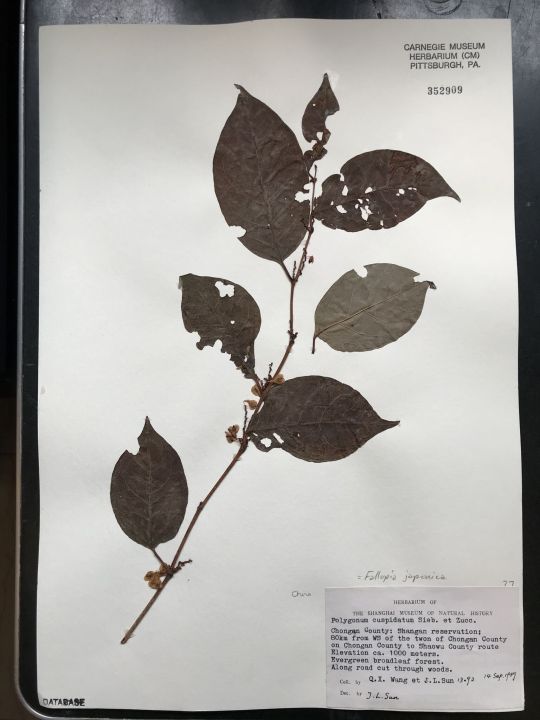
Japanese knotweed specimen

This specimen of Japanese knotweed (Fallopia japonica, formerly known as Polygonum cuspidatum) was collected in China on Sept 14, 1989 by Q.X. Wang and J.L. Sun.

Even if you’ve never been to East Asia, this species might be familiar to you.  Although native to China, Japan, and Korea, Japanese knotweed is now common across much of the temperate world, including the United States and Europe. In Pittsburgh, Japanese knotweed (and related introduced knotweed species) form dense stands along rivers, streams, and roadsides.
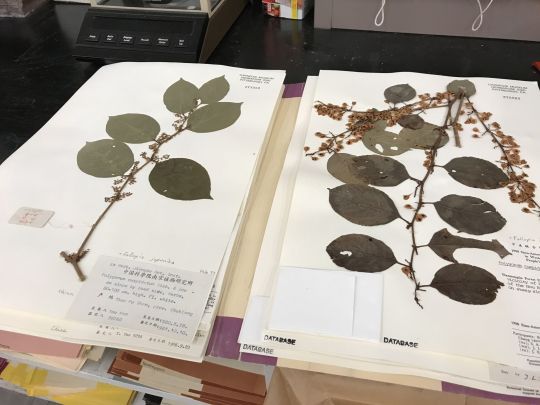
Japanese knotweed specimens

Specimens collected from both the native and introduced ranges can be compared to better understand plant invasions. For example, do invasive species look the same in their home range?

Although Collected On This Day posts tend to be biased towards specimens collected in Pennsylvania, the Carnegie Museum of Natural History herbarium includes specimens from many countries around the world. In fact, about one-third of the 530,000+ specimens are from outside the United States.

folders filled with Japanese knotweed specimens
47 of the 96 specimens of Japanese knotweed in the Carnegie Museum of Natural History’s herbarium were collected outside of the United States.

How do these species from far away regions end up at the Carnegie Museum?  Many are from expeditions from botanists affiliated with the museum – much in the same way locally collected specimens become part of the collection.  But many others are obtained through exchange with other herbaria.  Many plant collectors often collect duplicate specimens to send to several herbaria.  Most herbaria have exchange programs, where specimens (usually duplicates) are exchanged between institutions.  This practice functions to build the collection to include new species and specimens.  But it also has an important function to safeguard the future of the data.  In the case of damage (such as pest outbreaks or even fire, in the recent devastating case at the Museu Nacional in Brazil), having specimens spread across several institutions helps ensure the future of specimens.
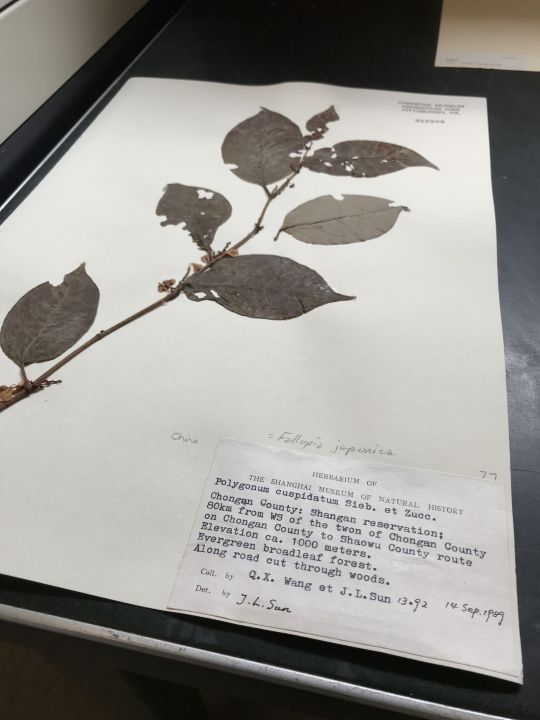
Japanese knotweed

Note the label on this specimen shows this specimen was at one time associated with the herbarium of the Shanghai Museum of Natural History.

Botanists at the Carnegie Museum of Natural History share digital specimens from the herbarium on dates they were collected. They have embarked on a three-year project to digitize nearly 190,000 plant specimens collected in the region, making images and other data publicly available online. This effort is part of the Mid-Atlantic Megalopolis Project (mamdigitization.org), a network of thirteen herbaria spanning the densely populated urban corridor from Washington, D.C. to New York City to achieve a greater understanding of our urban areas, including the unique industrial and environmental history of the greater Pittsburgh region. This project is made possible by the National Science Foundation under grant no. 1801022.
Filed Under: Blog Tagged With: Bonnie Isaac, Botany, collected on this day, herbarium, Mason Heberling

September 7, 2018 by wpengine

Collected on This Day in 2016: Japanese Stiltgrass

by Mason Heberling

Japanese Stiltgrass specimen

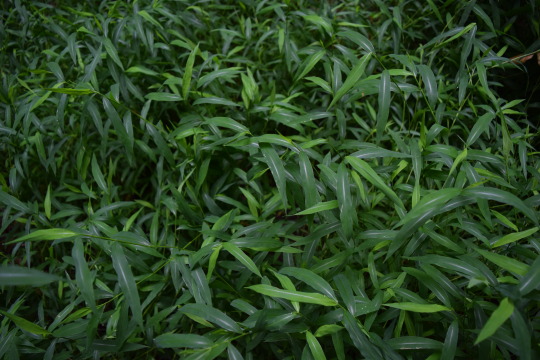
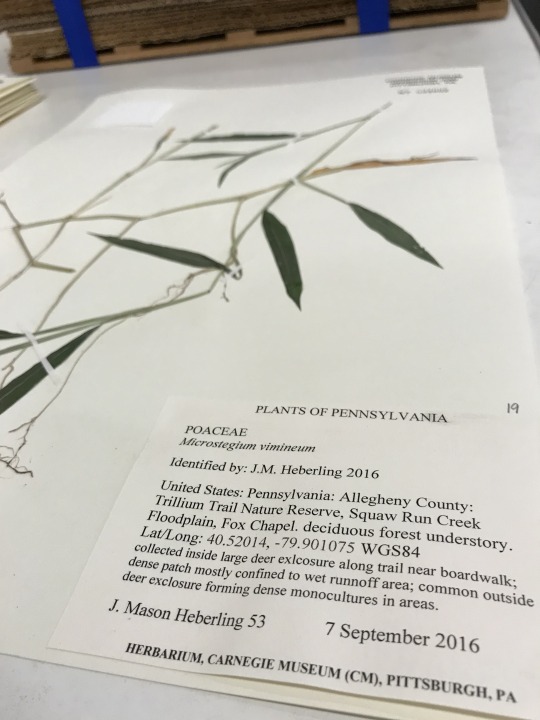
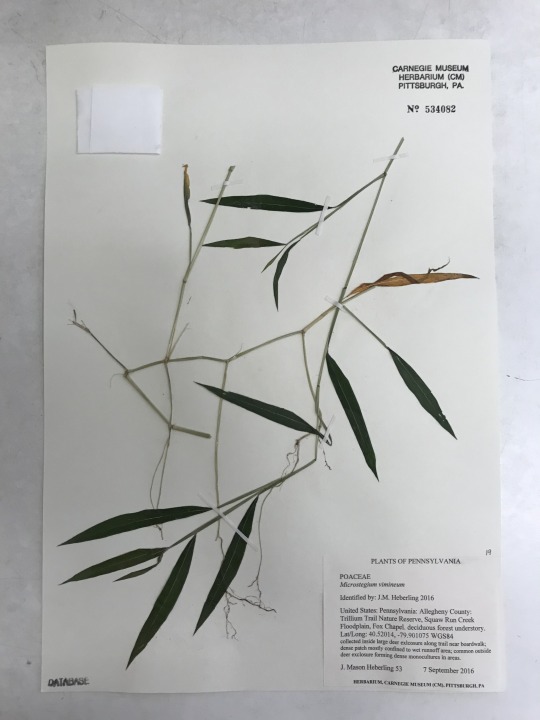
It is now a common plant in forests across Pennsylvania, but it wasn’t always.  This specimen of Japanese stiltgrass (Microstegium vimineum) was collected on September 7, 2016 by Mason Heberling (me!) at Trillium Trail, Fox Chapel, PA.  Native to East Asia, Japanese stiltgrass is an annual grass that is said to have first been introduced accidentally to Knoxville, Tennessee around 1919, used as packing material for porcelain dishes from China.  It has since become a major invasive species, spreading across forests of Eastern North America.  It is commonly found along trails, forest roads, and floodplains.  It has been shown to be facilitated by deer overabundance.  A recent study of unconventional gas well pads (such as “fracking”) in Pennsylvania by Penn State researchers found that recent hydraulic fracturing activities facilitates stiltgrass invasion (Barlow et al., 2017 Journal of Environmental Management).  Japanese stiltgrass is especially common in disturbed moist forests, where available light in the understory is higher.  Therefore, it often carpets the forest floor in disturbed forests.  High densities of deer have also been shown to facilitate stiltgrass invasions.  In fact, much of this research was done at Trillium Trail by Susan Kalisz (then at University of Pittsburgh, now at University of Tennessee Knoxville).  They used fences to exclude deer and found that stiltgrass was not present in fenced plots, but abundant when deer were allowed access. The Kalisz lab actively remains at Trillium Trail.

Japanese Stiltgrass specimen
Once  you  learn  to  recognize  this  grass,  you  are  likely  to  see  it  everywhere  in  forests  and  forest  edges  in  Western  Pennsylvania.  It  is  especially  obvious  in  the  Fall,  when  it  flowers  and  has  reached  its  peak  growth.  Note  the  faint  white  line  along  the  center  of  the  leaf  blades.

Although collected only two years ago, I was surprised to find that this specimen was the oldest Japanese stiltgrass specimen collected in Allegheny county!  There is a chance it had been collected earlier and exists in another herbarium. It was said to be uncommon (possibly absent) at Trillium Trail until 2002.

Japanese Stiltgrass
Microstegium  vimineum  carpeting  the  forest  floor  outside  deer  fences  at  Trillium  Trail.

What will our forests look like in another 10 years?  Herbarium specimens are important, verifiable sources to document our changing flora.  And ultimately, help conserve our flora.

Mason Heberling is a Postdoctoral Research Fellow in the Section of Botany at the Carnegie Museum of Natural History. Museum employees are encouraged to blog about their unique experiences working at the museum.

Filed Under: Blog Tagged With: Anthropocene, Botany, collected on this day, herbarium, Mason Heberling

July 10, 2018 by wpengine

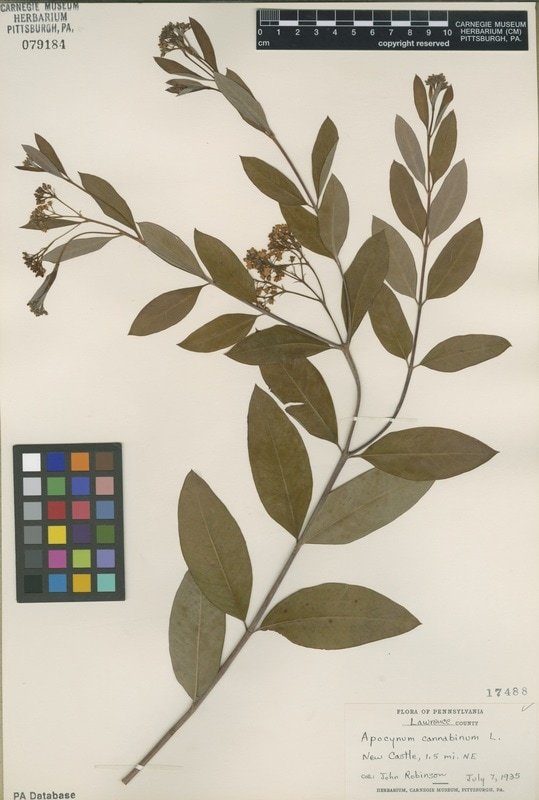
Collected on This Day: Apocynum cannabinum

Hemp dogbane (Apocynum cannabinum) specimen

Collected on July 7, 1935, this specimen was found by John Robinson near New Castle, PA.  Hemp dogbane (Apocynum cannabinum) are important food plants for moth and butterfly larvae, and like other plants in the milkweed family, this plant is poisonous.  Its milk-like, sticky, latex sap contains cardiac glycosides that causes heart problems, rapid pulse, vomiting, and possible death.  This is especially of concern to pets and livestock, although dogbane is generally avoided. Hemp dogbane has a rich ethnobotanical history by Native Americans – its bark having been used for fiber (hence the “hemp” part of name), and roots, seeds, or leaves used for medicines to treat a wide variety of ailments. Hemp dogbane can be found in sparely wooded areas, ditches, and field edges across United States.

Botanists at Carnegie Museum of Natural History share pieces of the herbarium’s historical hidden collection on the dates they were discovered or collected. Check back for more!

Mason Heberling is Associate Curator of Botany at Carnegie Museum of Natural History.

Carnegie Museum of Natural History Blog Citation Information

Blog author: Heberling, Mason
Publication date: July 6, 2017

Share this post!

  • Share on Twitter Share on Twitter
  • Share on Facebook Share on Facebook
  • Share on Pinterest Share on Pinterest
  • Share on LinkedIn Share on LinkedIn
  • Share on Reddit Share on Reddit
  • Share via Email Share via Email

Filed Under: Blog Tagged With: Botany, collected on this day, herbarium, Mason Heberling, museums, plants

January 9, 2018 by wpengine

Think the papers in the back of your file cabinet are old?

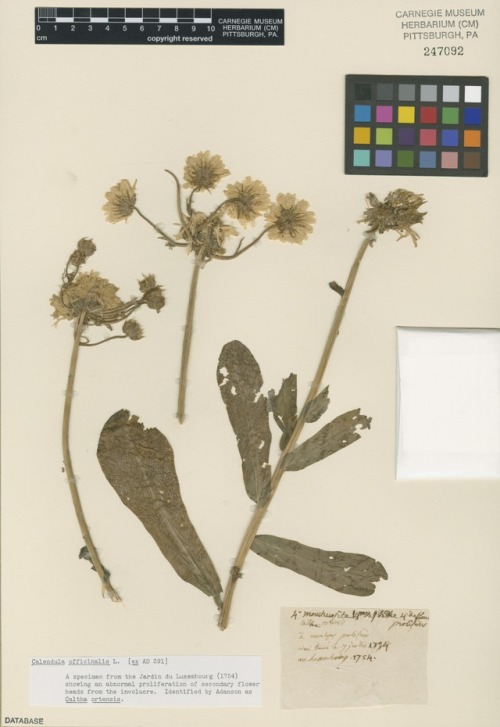
a pot marigold (Calendula officinalis) herbarium specimen

Carnegie Museum of Natural History has pressed and preserved plant specimens on paper that were collected way back in 1754!

The specimen above is one of the oldest specimens in the herbarium. It is pot marigold (Calendula officinalis) that was collected in France in 1754 by Michel Adanson, an influential naturalist.

Filed Under: Blog Tagged With: Botany, herbarium

December 28, 2017 by wpengine

Collected on Christmas Eve 1883: Mistletoe

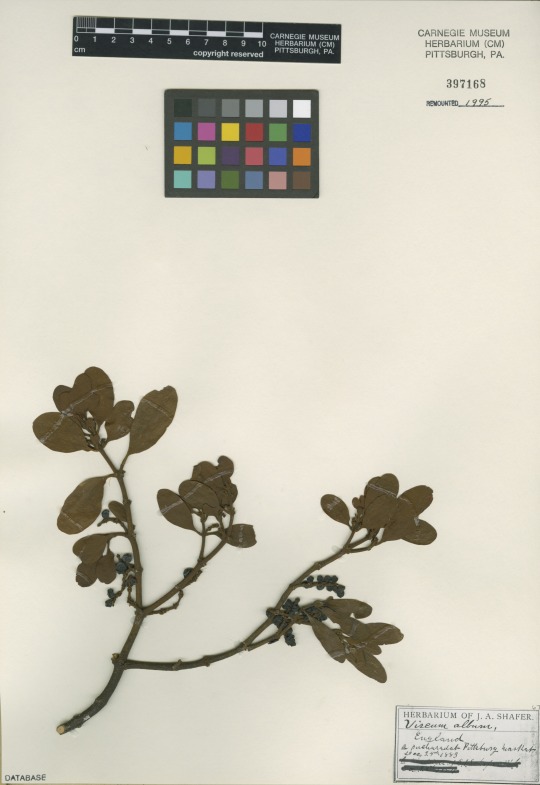
herbarium specimen of mistletoe

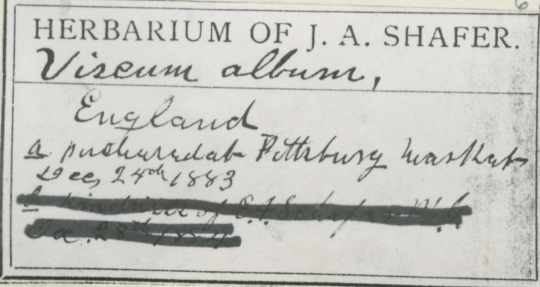
John A. Shafer bought this mistletoe at a market in Pittsburgh, Pennsylvania on Christmas Eve 1883. Sixteen years later, Shafer became the museum’s first botany curator. This mistletoe’s scientific name is Viscum album.

Mistletoes refer to many species within the genus Viscum. Usually, mistletoes refer to a species native to Europe, Viscum album. (“Album” is Latin for white.) European mistletoe has a deep cultural history, dating back to ancient Greece. It remains a well-known holiday decoration today.

Mistletoes are Hemi-Parasitic

Did you know that mistletoes are hemi-parasitic plants? They grow on the branches of trees like oaks, with special roots (called “haustorium”). These roots penetrate host trees to obtain water and nutrients. However, mistletoes don’t get all of their nutrients from their host plants. Hemi-parasitic plants like mistletoes make some of their own nutrients. They do this like other plants, through photosynthesis.

Mistletoe Germination

How do mistletoes germinate high up on the branches of trees? They have evolved to produce berries which birds like to eat. Birds then fly around, land on another branch, and poop viable mistletoe seeds. Without the help of birds, the seeds would likely just fall to the ground.

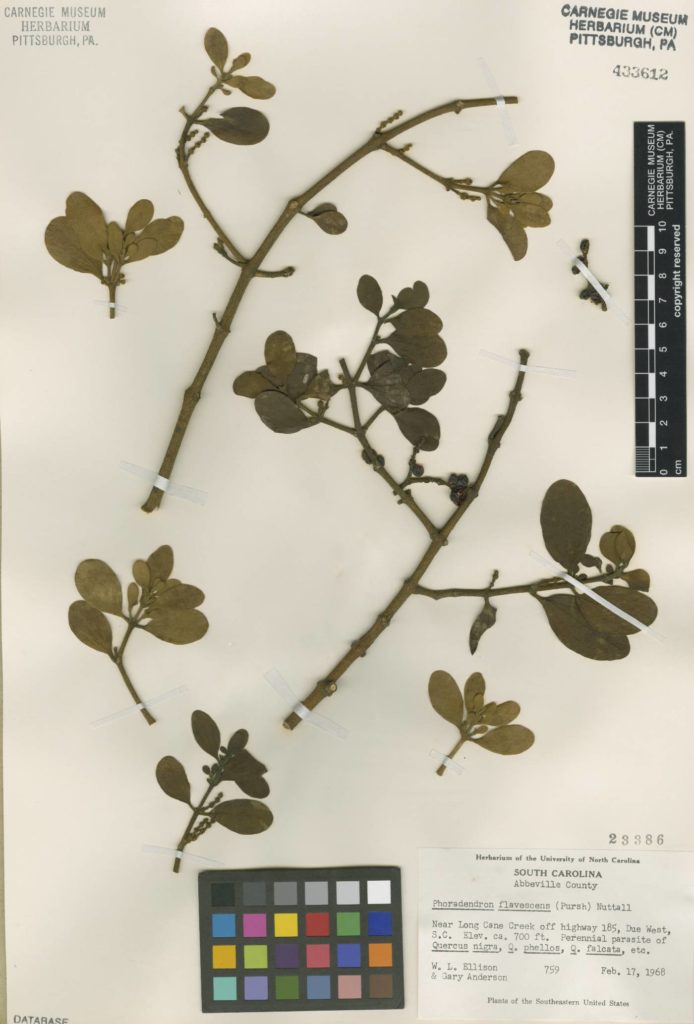
Mistletoes are native to the United States, too. American mistletoe (Phoradendron leucarpum) is native to southeastern states. People harvest and and sell this species in the United States in Christmas traditions, just like European mistletoe. The plant below is part of the museum’s herbarium and is from South Carolina in 1968. This specific American mistletoe had more than one host plant, all oak trees.

American Mistletoe
American mistletoe (Phoradendron leucarpum) used to be known as Phoradendron flavescens. You can see the old name on the Herbarium sheet from 1968.
an old label
Close up image of label that reads: “a. purchased at Pittsburg market.” It took me a while to decipher this handwriting. Note that Pittsburgh’s official spelling was “Pittsburg” until 1911. The mistletoe was for sale for the holidays. It was imported from its native range in England.

Botanists at Carnegie Museum of Natural History share pieces of the herbarium’s historical hidden collection on the dates they were discovered or collected. Check back for more!

Filed Under: Blog Tagged With: Botany, herbarium, Mason Heberling

December 22, 2017 by wpengine

Collected in December 1928

herbarium specimen of holly

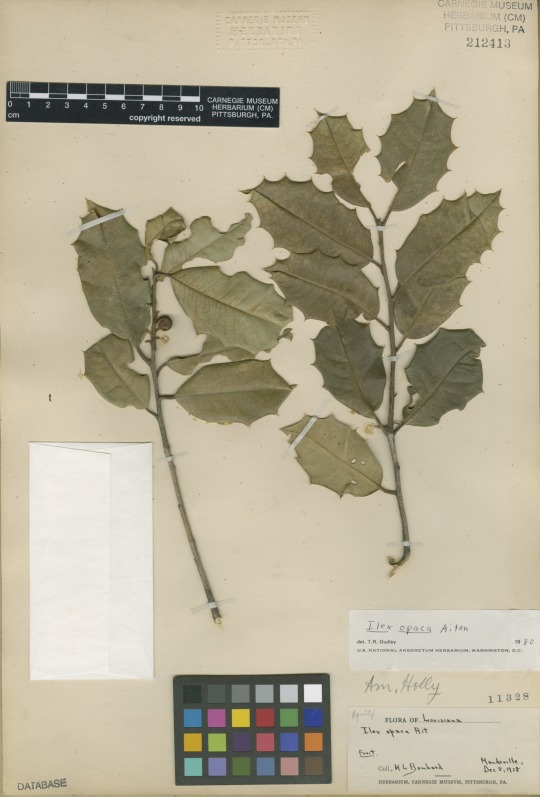
Are you decking your halls with boughs of holly? This specimen of American holly (Ilex opaca) was collected by M.L. Bomhard in Mandeville, Louisiana by on December 8, 1928. The holly revered for its holiday cheer usually refers to a related European species, Ilex aquifolium. But there are native holly species in North America that are equally (if not more) cheerful. Like most other hollies, American holly is dioecious, meaning it has male and female flowers on separate plants. Only the female plants have the characteristic bright red berries we all know and love. American holly stands out as one of the few broadleaved evergreen trees native to the Eastern United States (i.e., has green leaves during winter that are not needles). This species is near the northern edge of its range in Pennsylvania and is more common in southern states.  It is listed in PA as a species of “special concern” due to its relative rarity.


Botanists at Carnegie Museum of Natural History share pieces of the herbarium’s historical hidden collection on the dates they were discovered or collected. Check back for more!

Filed Under: Blog Tagged With: Botany, herbarium, Mason Heberling

  • « Go to Previous Page
  • Page 1
  • Page 2
  • Page 3
  • Page 4
  • Go to Next Page »

sidebar

About

  • Mission & Commitments
  • Directors Team
  • Museum History

Get Involved

  • Volunteer
  • Membership
  • Carnegie Discoverers
  • Donate
  • Employment
  • Events

Bring a Group

  • Groups of 10 or More
  • Birthday Parties at the Museum
  • Field Trips

Powdermill

  • Powdermill Nature Reserve
  • Powdermill Field Trips
  • Powdermill Staff
  • Research at Powdermill

More Information

  • Image Permission Requests
  • Science Stories
  • Accessibility
  • Shopping Cart
  • Contact
  • Visitor Policies
One of the Four Carnegie Museums | © Carnegie Institute | Privacy Policy | Terms of Use | Accessibility
Rad works here logo