• Skip to primary navigation
  • Skip to main content
  • Skip to primary sidebar

Carnegie Museum of Natural History

One of the Four Carnegie Museums of Pittsburgh

  • Visit
    • Buy Tickets
    • Visitor Information
    • Exhibitions
    • Events
    • Dining at the Museum
    • Celebrate at the Museum
    • Powdermill Nature Reserve
    • Event Venue Rental
  • Learn
    • Field Trips
    • Educator Information
    • Programs at the Museum
    • Bring the Museum to You
    • Guided Programs FAQ
    • Programs Online
    • Climate and Rural Systems Partnership
  • Research
    • Scientific Sections
    • Science Stories
    • Science Videos
    • Senior Science & Research Staff
    • Museum Library
    • Science Seminars
    • Scientific Publications
    • Specimen and Artifact Identification
  • About
    • Mission & Commitments
    • Directors Team
    • Museum History
  • Tickets
  • Give
  • Shop

herpetology

February 17, 2021 by wpengine

Introducing Matt Brandley, the Herpetology Collection’s New Science Communicator and Research Associate

Every herpetologist has an origin story – a time in their life when they realize that they want to spend their time studying the lives of amphibians and reptiles. For many, the love of herpetology started early, often after the spark of seeing their first salamander or snake in the wild. My path to herpetology, particularly a love of reptiles, developed more slowly.
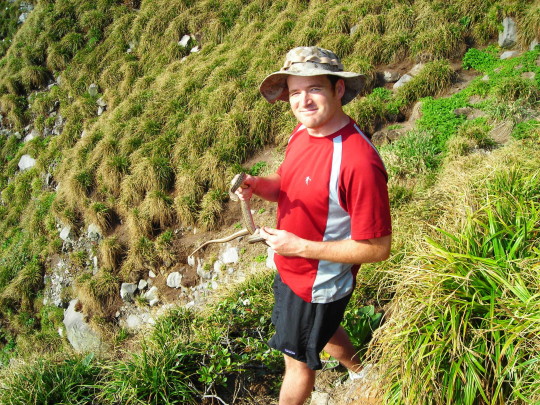
Holding a juvenile Japanese four-lined rat snake (Elaphe quadrivirgata) on the remote island of Tadanae in the Izu Island Archipelago. Although this species lives throughout Japan, the species on the small, uninhabited island grow at least 50% larger than other populations. My research with Japanese collaborators determined that this body size difference is an adaptation to eating seabird eggs and evolved within the past 10,000 years.

I had known for a long time that I wanted to study evolutionary biology. I’ve always loved both history and biology, and what better career than to study the history of life itself?  It wasn’t until a high school job at a pet shop that I became fascinated by the diversity of colors, body types, and behaviors among amphibian and reptile species. It helped that I had grown up in Oklahoma whose East-West gradient of forest to arid habitat is home to an evolutionarily diverse array of frogs, salamanders, lizards, and snakes. Perhaps even better, as a student of the University of Oklahoma, I had access to the herpetology collection at the Sam Noble Oklahoma Museum of Natural History. Being able to freely roam the aisles of the museum collection was a dream come true.
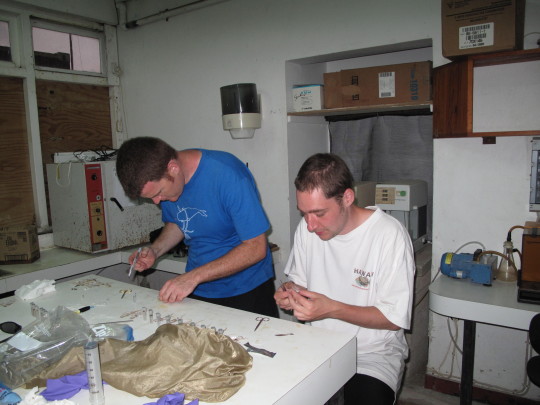
Preserving gecko specimens with Alex Dornburg (UNC Charlotte) on the island of Curaçao. Our research is studying how the introduced non-native tropical house gecko (Hemidactylus mabouia) is outcompeting and displacing the native leaf-toed gecko (Phyllodactylus martini). Before we preserve specimens and accession them into a museum collection, we take a tissue sample for DNA analysis.

As my education progressed from an undergraduate internship at the Smithsonian Museum of Natural History, to Bachelors, Master’s, and PhD degrees, so did the breadth of my research interests. Over the years, I’ve studied how different groups of skinks are related in evolutionary time and what geological processes influenced where these groups of lizards live on the planet; what ecological pressures led to the loss of limbs over 25 separate times in lizard evolutionary history; and what genetic changes underlie the evolution of live birth from egg-laying ancestors. My research has allowed me to conduct fieldwork in Australia, China, Curaçao, Mexico, and Japan, at locations ranging from deserts to remote islands. In 2015, I was honored to play a role in the training of new herpetologists by authoring four chapters on reptile fossil history, amphibian diversity and systematics, reptile diversity and systematics, and biogeography in the Herpetology textbook (4th Ed., Oxford University Press).
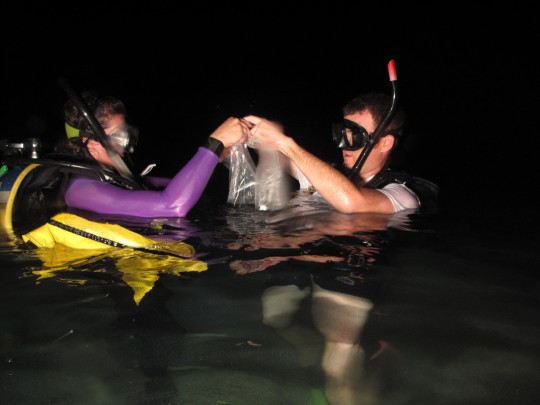
Comparing fish with Teresa Iglesias (Okinawa Institute of Science and Technology) in Okinawa for a project on the evolution of fish. As a certified scientific SCUBA diver, I consider myself an honorary marine biologist when I assist my ichthyologist friends with their research.

After working as a scientist in Australia for 10 years, I’m excited to join the skilled staff of the Section of Amphibians and Reptiles at Carnegie Museum of Natural History. The museum collection will allow me to continue research on the evolution of lizards, including changes to the lizard skeleton during the evolution of a snake-like body form, and the phylogeny and biogeography of skinks.

Through blogs and social media, I look forward to sharing updates on my research and the stories behind some of the 230,000 specimens of amphibians and reptiles in Carnegie Museum’s herpetology collection.

Matt Brandley is a Science Communicator and Research Associate in the Section of Amphibians and Reptiles at Carnegie Museum of Natural History. Museum employees are encouraged to blog about their unique experiences and knowledge gained from working at the museum.

Related Content

Ask a Scientist: What is a pitfall trap (for herpetology)?

Nerding Out Over Masting, or Why Unusual Plant Reproduction Excites Animal Ecologists

A Head Above the Rest: Unearthing the Story of Our Leatherback Sea Turtle
Filed Under: Blog Tagged With: amphibians and reptiles, herpetology, Science News

January 21, 2021 by wpengine

Nerding Out Over Masting, or Why Unusual Plant Reproduction Excites Animal Ecologists

As for many people, every pandemic month that passes marks another month since I’ve been able to travel. I realized recently that this is the longest time I’ve gone without getting on a plane since about the 5th grade (my parents divorced and lived in different states), and the longest I’ve gone without leaving the country since 2004. One reason I became an ecologist is because the work afforded me the opportunity to travel as part of my job, and that aspect is one of the main things I love about my work. For many tropical ecologists, the pandemic has marked a year of lost opportunities to travel to our field sites. Though my ongoing projects will survive this missed year of data, I miss the forest, and have spent many hours remembering all the things that made me fall in love with tropical field work in the first place.

image
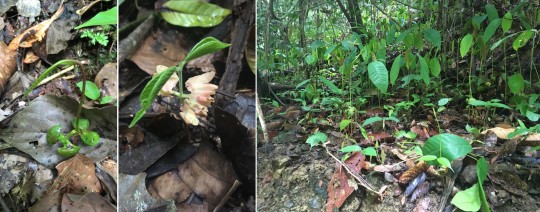
Figure 1. Seedlings at Danum Valley, Sabah, Malaysia, October 2019.

One of my favorite forest phenomena is masting. Trees in the family Dipterocarpacae dominate SE Asian rainforests. These are the world’s tallest rainforest trees, reaching more than 90 meters in height, and they reproduce by masting, which are irregular fruiting events. In northern Borneo, there is no set wet or dry season; rain falls year-round but there are sporadic dry periods that vary from year to year. Thus, there is no regular spring/flowering season like we have here in the US. Instead, the Dipterocarps reproduce in masting events, usually following strong droughts. The reason animal ecologists get excited by these masting events is because during these periods the forest seems to explode with life. The first time I went to one of my field sites (Danum Valley) was during a masting event (2010), and I had no idea how rare and special it was. I thought that it was normal to see two clouded leopards eating a mouse deer, or to see orangutans pretty much every day, or to have elephants tip over your car while you’re out surveying frogs (true story!). In the following years, I realized how incredible it was to have been there at that time. I was a little sad that my chances of seeing another masting event were low, but I got lucky again in 2019 when I spent a month at Danum during its most recent masting year.

As a herpetologist, I admit that I don’t fully appreciate all of the botanical intricacies of masting. But the most visually noticeable thing about a masting event is that it makes the forest look as though someone has planted thousands and thousands of seedlings all over the forest floor. This is incredibly striking because much of the forest doesn’t normally have a lot of undergrowth, but rather widely spaced giant trees. It would be like seeing the redwood forest with seedlings blanketing the forest floor. I have a ridiculous number of pictures of both the forest floor and individual seeds and seedlings in an enormous variety of shape and size, and will gladly bore anyone willing to look at them.

image
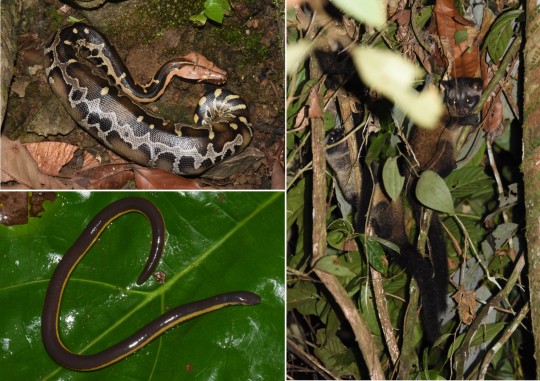
Figure 2. Borneo short python (Python breitensteini), caecilian (Ichthyophis sp.), and palm civet (Paradoxurus philippensis).

As I mentioned above, masting events also bring out heaps of animals that I don’t often otherwise see. In my first week, while setting up an introduction to electro-fishing for my students, we saw an orangutan about 30 meters away. He then came down to the forest floor, crossed the stream a little ways up from us, and walked off into the forest on the other side. Later that afternoon as I was setting up the exercise on a different stream, a lizard known as a water monitor (Varanus) was swimming downstream toward us, got spooked up onto shore by our presence, and ran right into the mouth of a concealed king cobra–!! While we couldn’t see the cobra’s full body, we clearly saw its unmistakable head scales as it was pulling the Varanus back into its hiding spot, and heard the incredible growl that cobras let out when they don’t want to be bothered. The rest of the month saw numerous species of snakes, a giant softshell turtle, my 4th ever caecilian (a limbless amphibian), mom and baby civets (a small carnivorous mammal), and in keeping with the field session’s mission, awesome frog data collected together with my students. While these animals are always present in the forest, masting events seem to bring them out in force, making all of them much easier to see.

As we start 2021, I am cautiously hoping that this year will see us all getting vaccinated, making travel safe once again. I hope to return to Borneo for more incredible encounters alongside my regular data collection, to better understand the incredible forest that hooked me into tropical field ecology in the first place.

Jennifer Sheridan is Assistant Curator in the Section of Amphibians and Reptiles at Carnegie Museum of Natural History. Museum employees are encouraged to blog about their unique experiences and knowledge gained from working at the museum.

Related Content

A Head Above the Rest: Unearthing the Story of Our Leatherback Sea Turtle
The Enduring Appeal of Snakes

Ask a Scientist: What is the creepiest specimen in the Alcohol House?

Filed Under: Blog Tagged With: amphibians and reptiles, herpetology, Jennifer Sheridan, Museum from Home, Science News

January 21, 2021 by wpengine

A Head Above the Rest: Unearthing the Story of Our Leatherback Sea Turtle
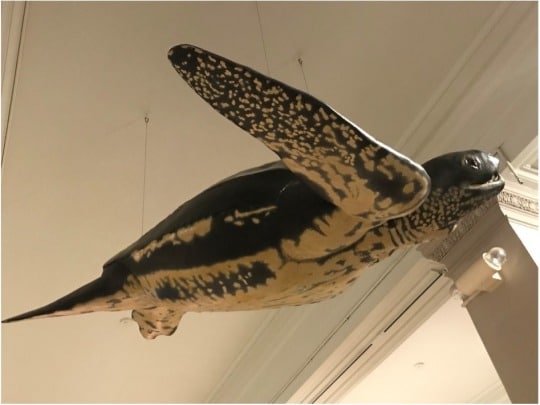
When you think of BIG sea creatures, you probably imagine great white sharks, huge blue whales, or ginormous cephalopods like the giant squid (or, for the more imaginative, the Kraken!). But would you believe me if I told you that the ocean is also home to a reptile that grows far larger than a human? Many people are familiar with the “typical” green sea turtle (Chelonia mydas) or even the hawksbill sea turtle (Eretmochelys imbricata), known for its beautifully patterned shell. However, these species are dwarfed in size compared to the leatherback sea turtle (Dermochelys coriacea). Adult leatherback sea turtles are usually 6 to 8 feet long and 550 to 1500 pounds. To put that into context, imagine 3 to 8 adult men of average height and weight huddled together or 8 to 24 Labrador retriever dogs playing about in a group (now THAT would be heavenly!). An animal that big takes up a great deal of room, which is fine in the expansive ocean but is rather problematic if such a turtle is to become a museum research specimen. That is exactly the case with CM 44460, the famous leatherback sea turtle housed in the Carnegie Museum of Natural History’s Section of Amphibians and Reptiles.

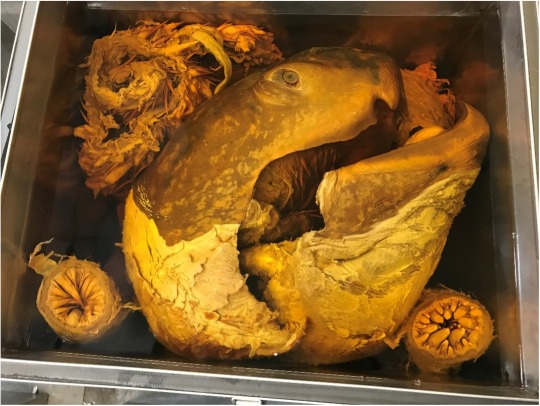
Head and esophagus of leatherback sea turtle CM 44460. The esophagus is so large it needed to be split into pieces— the two circles at the lower left and right corners of the tank and the large mass in the top left corner. Leatherback sea turtles lack teeth, and instead rely on spikey protrusions present in their mouths and esophagi to keep down their favorite prey item, jellyfish.

Cast of CM 44460 hanging above visitors in Discovery Basecamp.

When people tour the Section of Amphibians and Reptiles, we make it a point to open one of the first metal tanks our guests see, tank 156. This tank houses a single impressive specimen – the giant head and esophagus of a leatherback sea turtle. I started as the collection manager of the section just under two years ago and, until recently, the only information I had for this specimen were the scant details noted in the section’s database and on a printed sheet attached to the lid of the tank: a fisherman had found the specimen dead when it washed ashore in Maine in 1965. That was it. I knew the entire animal (not just the head) had washed ashore since a cast was made of the body and that replica is now hanging in Discovery Basecamp. I also knew ecological and herpetological information about the species in general, but nearly every specimen in a natural history collection has a story, and I knew this one had to be good… but I didn’t know what it was…

… until I began digitizing the section’s archives.

Let’s take a step away from our leatherback sea turtle specimen to understand what “digitizing the section’s archives” really means. Carnegie Museum of Natural History is over 100 years old, and the herpetology archives date back to the museum’s inception. That means we had, at the time I became involved with the digitizing work, nearly 125 years of correspondence, field notes, specimen data, and collection-related events to clean, scan, and properly organize and house both physically and electronically. (For a more in-depth dive into this archiving process, see section archivist Ren Jordan’s post here.) It took a team of about 10 people (part-time and full-time interns, work-study students, and staff members) over a year to complete this daunting task. The treasure trove of information we unearthed in those archives is priceless, and CM 44460’s story is a treasure worth sharing.

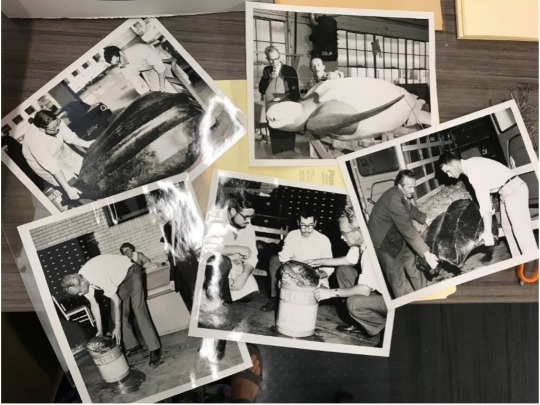
Images from archives showing how staff members prepared CM 44460 to be accessioned into the herpetology collection and displayed to the public. Clockwise from the top left: Herpetology staff members C. J. McCoy and Arthur Bianculli lift the shell onto a cart for transport; Herpetology curator Neil D. Richmond and museum preparator Otto M. Epping measure out the cast of CM 44460 created from the shell and body measurements; Preparator Otto M. Epping and Exhibits staff member Forest Hart removing the shell from a cargo van upon arrival to the Carnegie Museum; Herpetology staff members C. J. McCoy, Arthur Bianculli, and Neil D. Richmond examine the head of CM 44460 in a large potato chip can; Herpetology curator Neil D. Richmond shows the head to museum director M. Graham Netting as another staff member looks on.
black and white photo of three men pulling a turtle head out of a can

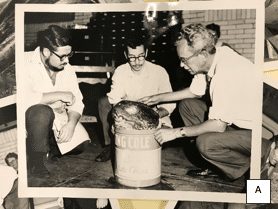
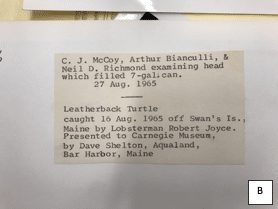
Herpetology staff members C. J. McCoy, Arthur Bianculli, and Neil D. Richmond examine the head of CM 44460 in a large potato chip can upon its arrival to the museum (A). The complete description of the image as it appears affixed to the back of the image (B).

During the digitization work, the archival material I processed included the field notes of past-curator Dr. C. J. McCoy, and among his papers was a crumbly old folder labeled “CM 44460” that required rehousing. The number lacked any context for me at the time because the section has over 180,000 catalog (or CM) numbers and, try as I might, I don’t yet have them all memorized. When I pulled out pictures from the folder, though, CM 44460’s identity instantly became apparent, for I found myself looking at the images of our famous leatherback sea turtle. One picture showed the creation of the cast and another depicted the shell being carried by two men due to its size. Another image showed Dr. McCoy crouched with two other men near a huge open tin can labeled “Potato Chips” with, shockingly, the head of dear CM 44460 peeking out of the top. A note affixed to the back of the image read “C. J. McCoy, Arthur Bianculli, & Neil D. Richmond examining head which filled 7-gal. can. 27 Aug. 1965. Leatherback Turtle caught 16 Aug. 1965 off Swan’s Is., Maine by Lobsterman Robert Joyce. Presented to Carnegie Museum by Dave Shelton, Aqualand, Bar Harbor, Maine” (Image 4B). Suddenly pieces of the story were falling into place. This specimen was transported from Maine to Pittsburgh in pieces, with the head arriving separate from the body and shell in a 7-gallon potato chip container!

A couple months later, I unearthed another folder in the archives with data from the specimen. The documents recorded the preservation process of the turtle, including measuring and weighing different organs (knowing that they would be too large to properly preserve and store), and how long it took the head to become fully and properly fixed in formalin. Through these notes, I learned that the turtle was a female measuring 7’5” from the tip of her tail to the tip of her snout, and that her ocean wandering was powered by a flipper-span of 8’4”! Based upon her carapace (the top part of a turtle shell) measuring in at 5’5”, this turtle was likely sexually reproductive and, therefore, rather old. CM 44460’s story is so much clearer now and really goes to show how each specimen in a collection has its own unique history just waiting to be investigated.

Stevie Kennedy-Gold is the collection manager for the Section of Amphibians and Reptiles at Carnegie Museum of Natural History. Museum employees are encouraged to blog about their unique experiences and knowledge gained from working at the museum.

Related Content

Ask a Scientist: What is a pitfall trap (for herpetology)?

Do Snakes Believe in the Tooth Fairy?

Lantern Slides

Filed Under: Blog Tagged With: amphibians and reptiles, herpetology, Museum from Home, Science News, Stevie Kennedy-Gold

December 1, 2020 by wpengine

Digital Developments: Why Archiving and Herpetology Go Hand-in-Hand

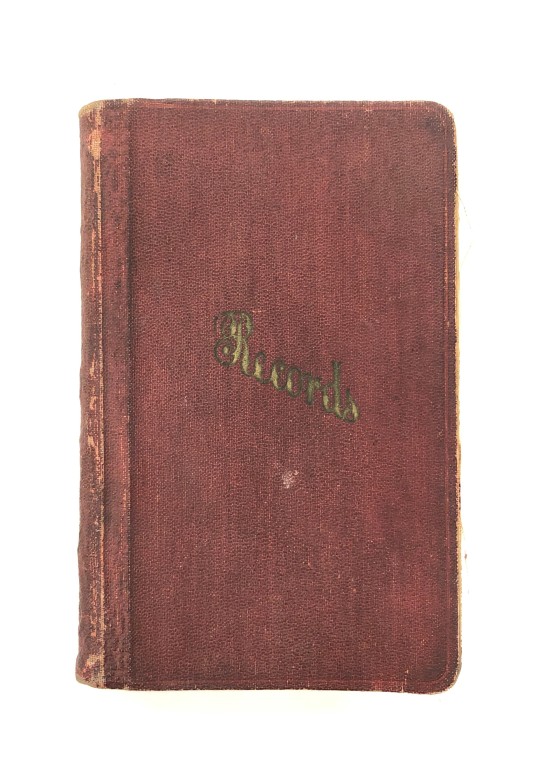
This field notebook from 1945 belonged to Paul Walker. It contains observations and specimen measurements, all of which are organized by date.

Careers in librarianship are often depicted as quiet, solitary positions that allow ample time for reading on the job. Images associated with archival librarianship (a career usually pertaining to the collection, preservation, and management of historically relevant materials) get even more visually specific than the first, for they frequently involve mahogany framed spaces filled to the brim with dusty, leather-bound, centuries-old texts. Though whimsical, these notions about texts and their caretakers cause people to overlook a critical part of archival work: digital management of texts and data.

Our society’s emphasis on the importance of technological advances and virtual storage has not only advanced the librarian’s ability to scan and virtually distribute texts and documents with ease; it has also gone so far as to set the expectation that archival texts will be digitized, or converted into a digital form. This digitization both protects data from being lost to physical damage and, through mechanisms like databases, helps interested people gain greater levels of insight into the exciting and unique collections that exist around the world.

While libraries have always housed a wide range of texts and items from a variety of professional fields, the level of priority placed on digitizing archival collections has ultimately allowed for even more crossover between people of different professional backgrounds. My job in the Section of Amphibians and Reptiles is a prime example of this. Though I have been entrusted with caring for and scanning the section’s 20th-century field notebooks, my area of expertise is not herpetological by any means. I come from a strictly literary background, with my research focusing on 19th-century magazines for children. How, then, do these professional paths intersect?

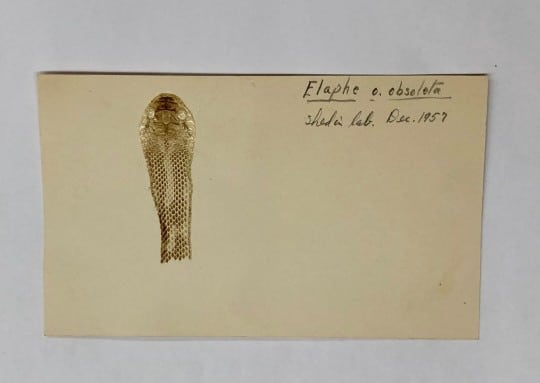
Paper is not the only archival material that needs to be scanned. The museum is home to large flatbed scanners made for digitizing delicate materials like this one, a 1957 skin sample of a Black Rat Snake.

Apart from the fact that I have handled older texts before, my background and the needs of the Section of Amphibians and Reptiles exist in harmony because of a mutual recognition of the value of accessibility. While working with archival databases through transcription-based volunteer projects and past research positions, I learned that accessibility is as much about small details as it is about sharing the museum’s materials with other institutions and, ultimately, the public. For example, if my scans are too dark or are surrounded by too much black space, the readability of the document may be affected and people with limited access to printer ink may not be able to make copies of the material. Digitization may appear to simply prevent a loss of information, but the need for accessibility causes it to take on new meaning. As a future archivist, I prioritize scan quality and the organization of digital files so that museum employees and the public alike can always find and use these important scientific materials with ease. Though we come from different fields, the Section of Amphibians and Reptiles consistently prioritizes its concern with the use of these materials in the long run as well.

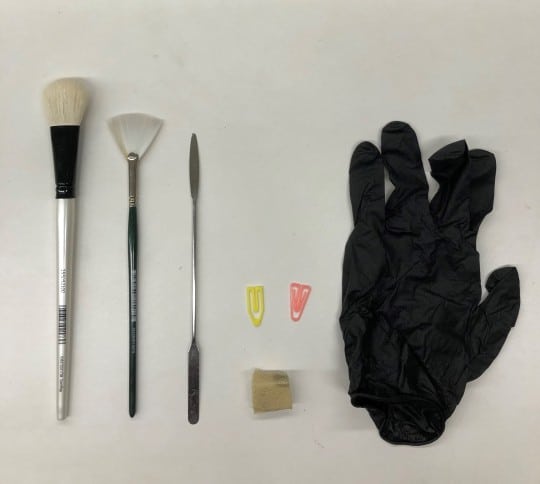
These tools are just some of the necessary pieces of equipment used to handle texts and materials during digitization. Pictured (from left to right): brushes for removing dust and dirt, a metal tool for the delicate removal of metal objects like staples and paperclips, plastic paperclips for keeping pages together without the risk of rust, a sponge for soot removal, and nitrile gloves for safely handling negatives and photos.

I am grateful that I am continuing to learn about the relevance of scientific specializations like herpetology to other fields. Likewise, I am glad that my understanding of librarianship continues to intersect with fields that I may not otherwise encounter. Perhaps, then, popular depictions of librarians and archivists can begin to recognize their preoccupation not only with reading and quieting patrons, but also with collaborating across disciplines to expand people’s access to information.

Ren Jordan is a Curatorial Assistant in the Section of Amphibians and Reptiles. Museum staff, volunteers, and interns are encouraged to blog about their unique experiences and knowledge gained from working at the museum.

Related Content

The Enduring Appeal of Snakes

Ask a Scientist: What is the creepiest specimen in the Alcohol House? 

A Holotype with a History

Filed Under: Blog Tagged With: amphibians and reptiles, herpetology, Museum from Home, Ren Jordan, Science News

October 2, 2020 by wpengine

Do Snakes Believe in the Tooth Fairy?

When a child loses a baby tooth, the Tooth Fairy will sneakily appear a short time later to snatch that tooth up and leave behind a little treat. But what happens when vipers or other snakes with large fangs lose their teeth? I doubt the Tooth Fairy would be too keen about sneaking up on a sleeping snake…and as someone who studies and admires snakes, I would not recommend it!

image
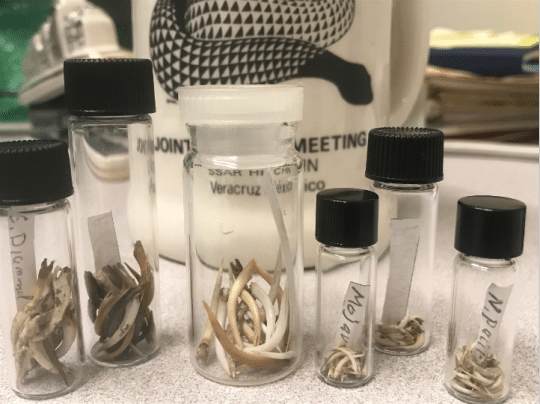
Vials containing Viperidae snake fangs. The middle vial (with clear lid) contains fangs of the Gaboon viper.

I recently learned the answer to this question when I was given seven tiny vials containing dozens of fangs. These fangs came from various species of snakes in the Viperidae family, including the Mojave green rattlesnake (Crotalus scutulatus), the Northern Pacific rattlesnake (Crotalus oreganus), and the Gaboon viper (Bitis gabonica), which has the longest fangs of any snake species. The researcher who gifted us these fangs was curious about the outcome of shed snake teeth and wanted to determine how frequently snake fangs may be swallowed and passed through the snake’s digestive tract. To answer this question, he dissected and examined dried snake feces for the possible presence of shed fangs.*

As it turns out, snakes will occasionally swallow their shed fangs! Vipers are carnivores that have to hunt down and subdue live prey in order to eat and survive. Often there is a struggle between predator and prey and, in that process, a fang may be wiggled lose. Instead of falling out of a snake’s mouth, the snake may swallow the fang along with the prey item. The fang will ultimately pass through the snake’s digestive system and emerge in its feces.

image
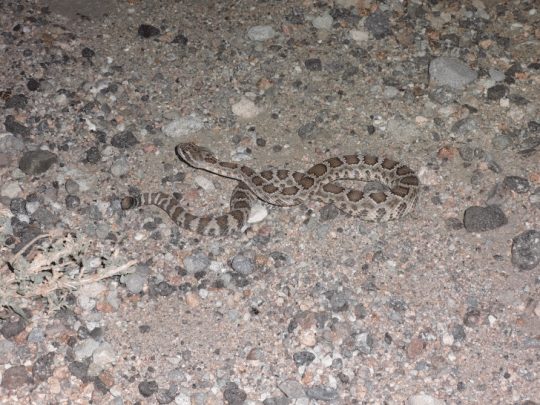
Pacific rattlesnake (Crotalus oreganus) in the Mojave Desert, California. One of the vials contained fangs from this species, but from snakes in the northern portion of the species’ range.

As the collection manager of the Section of Amphibians and Reptiles, I oversee and care for the museum’s massively beautiful and useful collection of cool and creepy herpetofaunal specimens. These specimens include full body wet specimens preserved in alcohol, the osteology collection of bones and turtle shells, and other items such as histology slides, gut contents, and even fangs. Regardless of their preservation form, all the reptile and amphibian specimens within the collection are useful for researchers and could serve to answer future scientific questions. Although the fangs within these seven seemingly unimposing vials have already answered one burning scientific question, they will be added to the collection so see what other answers they can provide!

*Researchers take careful precautions when handling feces as it can carry disease. Do not handle feces you may see in the wild.

Stevie Kennedy-Gold is the collection manager for the Section of Amphibians and Reptiles at Carnegie Museum of Natural History. Museum employees are encouraged to blog about their unique experiences and knowledge gained from working at the museum.

Related Content

Ask a Scientist: What is an Alcohol House?

The Enduring Appeal of Snakes

Poisons of the Carnegie: Timber Rattlesnake

Filed Under: Blog Tagged With: herpetology, Museum from Home, Science News, Stevie Kennedy-Gold

September 14, 2020 by wpengine

Overwintering for Amphibians and Reptiles

by Amanda Martin

With Autumn upon us, temperatures are dropping, and it is getting colder out. Especially in the northern regions, amphibians and reptiles need to prepare for brumation (essentially, hibernation for ectotherms). Ectotherms like frogs, salamanders, snakes, and turtles are highly sensitive to changes in their environment and need to stay warm by actively moving in and out of areas with heat. When temperatures increase, ectotherm metabolism increases, and when temperatures go down, so does their metabolism. But how do they survive during winter, won’t they freeze?

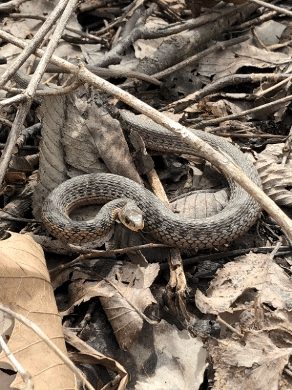
Fig. 1. Eastern garter snake. Photo by A.K. Martin.

Many snakes, like eastern garter snakes (Fig. 1) find shelters called hibernacula and curl up inside, sometimes intermixed with other snake species. These hibernacula are often small mammal burrows, dens, or tunnels below the frost line. During winter, typically between October and March, several hundred individuals will gather in the same den, tightly coiling their bodies together to stay warm enough to survive. They stop eating during this period because it is too cold to properly digest food and will stay hydrated by absorbing moisture through their scaly skin. Even though snakes are awake and sluggishly active, they expend very little energy during this time and do not lose much weight.

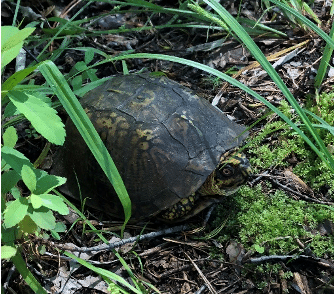
Fig. 2. Eastern box turtle. Photo by A.K. Martin.

Turtles, on the other hand, are a bit different. Aquatic turtles survive winter underwater, and the terrestrial eastern box turtle (Fig. 2) buries itself underground by digging into the soil. One extreme overwintering survivor is the painted turtle, which spends most of its time in ponds and slow-moving freshwater. When these ponds freeze, painted turtles bury themselves up to 45 cm (nearly 18 inches) in mud beneath the pond’s surface. Amazingly, these turtles can survive for months in low or no oxygen environments. During warmer months, they breathe air, but when submerged for overwintering they absorb oxygen through the thin skin of their cloaca, a phenomenon called cloacal respiration.

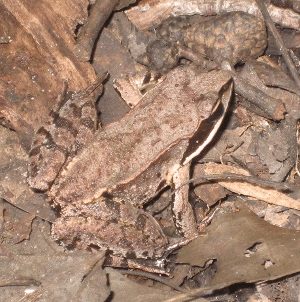
Fig. 3. Wood frog. Photo by A.K. Martin.

Another amazing overwintering feat is the freeze tolerance of wood frogs (Fig. 3) which can become frogsicles! Wood frogs are unable to bury themselves completely, like turtles, so part of their body is often exposed when trying to stay underneath the mud. This is beneficial for obtaining oxygen through their skin. However, they still need to avoid freezing and will move around to warmer areas as needed. Many frogs stay in burrows or under leaf litter to escape the frost, but wood frogs will stay at shallower depths because they have high concentrations of glucose, which produces an “antifreeze” effect. This protects their organs when over two-thirds of their body freezes!

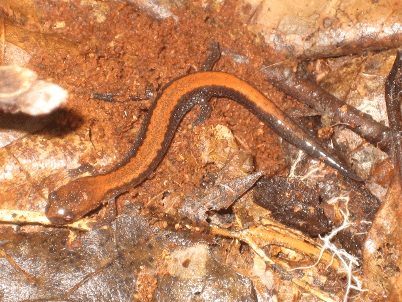
Fig. 4. Red-backed Salamander. Photo by A.K. Martin.

Other amphibians, like salamanders, do not have freeze tolerance like the wood frog. Red-backed salamanders (Fig. 4) are one of the most abundant species in the eastern United States. They are typically found underneath logs and leaf litter at shallow depths, but during winter when temperatures drop below 30°F, they travel as much as 15 inches under the ground in animal burrows. Other species, like spotted salamanders, will also look for deep burrows that are below the frost line.

In early spring when temperatures warm, amphibians and reptiles emerge from overwintering to look for basking sites, sunny spots to warm themselves. With warmer temperatures, the prey of many of these species also become more available. Garter snakes will look for slugs, earthworms, amphibians, minnows, and rodents, for example, and red-backed salamanders will eat a wide variety of invertebrates, such as spiders, worms, snails, and insects. The exact timing of emergence for amphibians and reptiles depends on a given year’s weather, resulting in variable emergence times from year to year that correspond to temperature. Not every individual makes it to the spring, but it is amazing that species that are so dependent on the temperature of their environment are capable of surviving up north!

Written by Amanda Martin, Post-doctoral Researcher in the Section of Amphibians and Reptiles at Carnegie Museum of Natural History. Edited by Jennifer Sheridan, Assistant Curator in the Section of Amphibians and Reptiles at Carnegie Museum of Natural History. Museum employees are encouraged to blog about their unique experiences and knowledge gained from working at the museum.

Related Content

An Illuminating Tale of Tracking Turtles

How to Catch 311 Amphibians in 10 Days

Pitfall Traps: Fieldwork Surprises

Carnegie Museum of Natural History Blog Citation Information

Blog author: Martin, Amanda
Publication date: September 14, 2020

Share this post!

  • Share on Twitter Share on Twitter
  • Share on Facebook Share on Facebook
  • Share on Pinterest Share on Pinterest
  • Share on LinkedIn Share on LinkedIn
  • Share on Reddit Share on Reddit
  • Share via Email Share via Email

Filed Under: Blog Tagged With: Amanda Martin, amphibians and reptiles, herpetology, Jennifer Sheridan, Science News

  • « Go to Previous Page
  • Page 1
  • Page 2
  • Page 3
  • Page 4
  • Interim pages omitted …
  • Page 6
  • Go to Next Page »

sidebar

About

  • Mission & Commitments
  • Directors Team
  • Museum History

Get Involved

  • Volunteer
  • Membership
  • Carnegie Discoverers
  • Donate
  • Employment
  • Events

Bring a Group

  • Groups of 10 or More
  • Birthday Parties at the Museum
  • Field Trips

Powdermill

  • Powdermill Nature Reserve
  • Powdermill Field Trips
  • Powdermill Staff
  • Research at Powdermill

More Information

  • Image Permission Requests
  • Science Stories
  • Accessibility
  • Shopping Cart
  • Contact
  • Visitor Policies
One of the Four Carnegie Museums | © Carnegie Institute | Privacy Policy | Terms of Use | Accessibility
Rad works here logo