• Skip to primary navigation
  • Skip to main content
  • Skip to primary sidebar

Carnegie Museum of Natural History

One of the Four Carnegie Museums of Pittsburgh

  • Visit
    • Buy Tickets
    • Visitor Information
    • Exhibitions
    • Events
    • Dining at the Museum
    • Celebrate at the Museum
    • Powdermill Nature Reserve
    • Event Venue Rental
  • Learn
    • Field Trips
    • Educator Information
    • Programs at the Museum
    • Bring the Museum to You
    • Guided Programs FAQ
    • Programs Online
    • Climate and Rural Systems Partnership
  • Research
    • Scientific Sections
    • Science Stories
    • Science Videos
    • Senior Science & Research Staff
    • Museum Library
    • Science Seminars
    • Scientific Publications
    • Specimen and Artifact Identification
  • About
    • Mission & Commitments
    • Directors Team
    • Museum History
  • Tickets
  • Give
  • Shop

James Fetzner

August 11, 2020 by wpengine

Delving into Lepidoptera Life History Studies

For a number of years now in the Section of Invertebrate Zoology (IZ), we have been rearing larvae (= caterpillars) of different species of Lepidoptera (moths & butterflies) for both fun and research. This summer, given the ongoing COVID-19 pandemic and the need for everyone to isolate, I have taken to collecting and rearing a number of different species at home that were collected at a bug sheet in my own back yard (Figure 1).
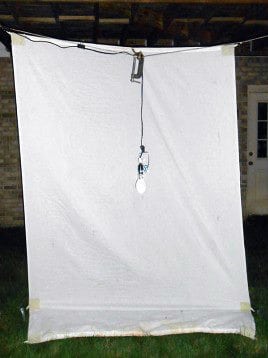
Figure 1. A set up “bug sheet” used to attract insects at night.

Female moths are collected live and held in a plastic jar we call a “live jar” (Figure 2), until they lay eggs. If eggs are laid, and they are fertile, they usually hatch in about 7-10 days. This gives you enough time to identify the female adult to species (a recent field guide to moths and butterflies is a good place to start) so you can find out information on its preferred food source(s), or host plant(s), before the little larvae hatch are start searching around for food. If the eggs do hatch, rearing the resulting little caterpillars is a fun way to break up the tedium of being cooped-up at home for so long and is a nice way to bring Nature indoors.
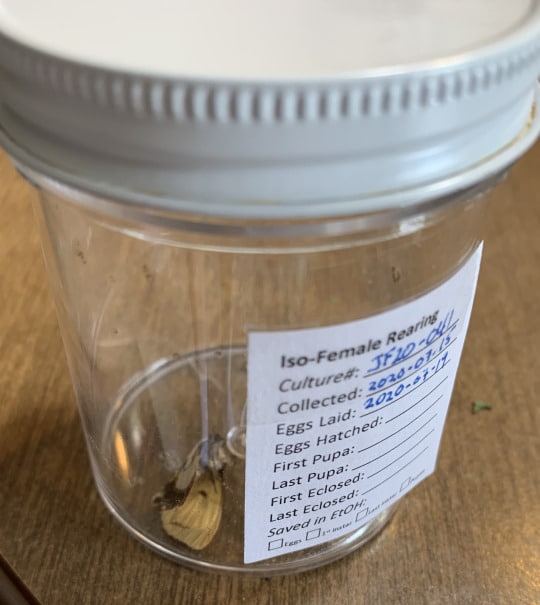
Figure 2. Plastic “live jar” used to hold female moths until they lay eggs for rearing.

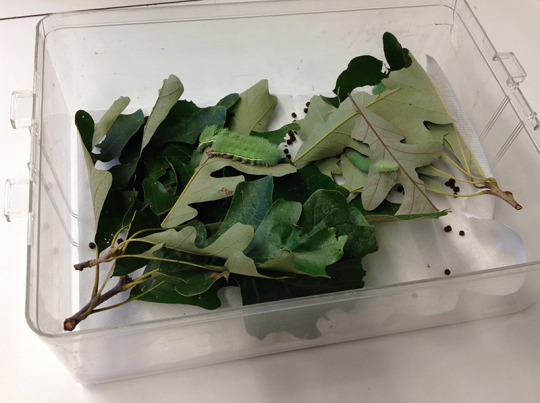
We have a little bit of experience rearing caterpillars at home. As you may know from a previous IZ blog post, my son and I reared some caterpillars that were not yet known to science, which resulted in a small publication. Right now, we have caterpillars of ten different species at various developmental stages. I check on them daily, making sure to keep their containers clean, and provide them with enough food to eat from their preferred host plant (Figure 3). It is amazing how quickly these little guys grow and change, all in the matter of a few short weeks. I try to capture images of them as they develop (see Figure 4), so they can be used on our websites, in blog posts (such as this one), or in eventual scientific publications that may result from the work.
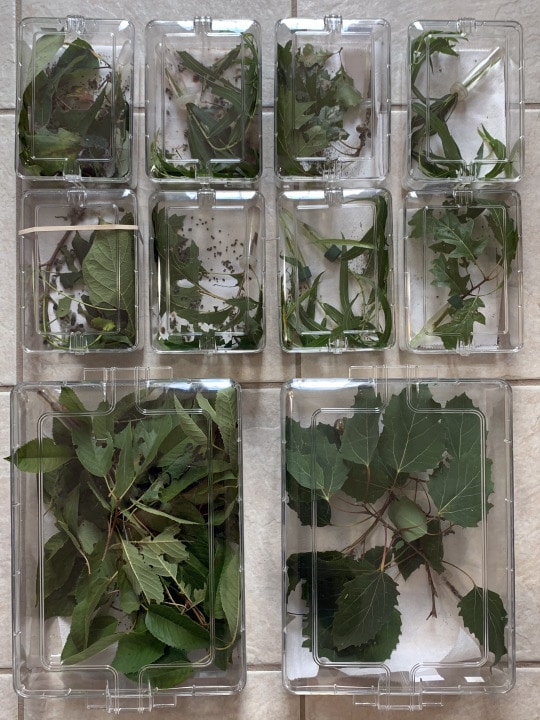
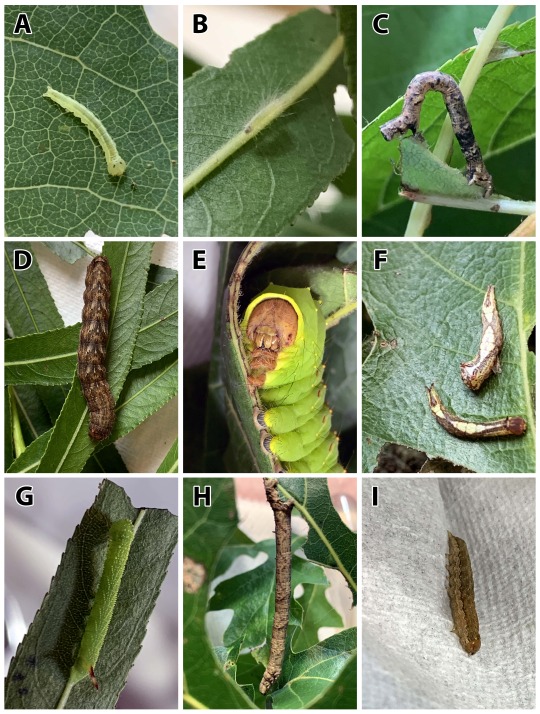
Figure 3. Clear plastic rearing chambers containing caterpillar cultures, each started from eggs laid by a single female moth (= iso-female culture). Host plants include Maple, Willow, Oak, Sassafras, Cherry and Poplar.
Figure 4. Images of various species of caterpillars currently being reared by the author at home. A.) Early instar of Gluphisia septentrionis (Notodontidae), B.) Early instar of Acronicta dactylina (Noctuidae), C.) Later instar of Metarranthis sp. (Geometridae), D.) Last instar of Lithophane disposita (Noctuidae), E.) Later instar of Antheraea polyphemus (Saturniidae), F.) Two different early instars of Heterocampa obliqua (Notodontidae), G.) Early instar of Paonias excaecata (Sphingidae), H.) Last instar of Besma quercivoraria (Geometridae), I.) Later instar of an unknown caterpillar that was found on host plant food obtained for other caterpillars. The species will be determined when the adult moth emerges from the pupa later in the summer.

Once the females have laid eggs, they usually die as a result, having completed their task in the moth’s life cycle.  The females are then pinned, and the wings are usually spread on wooden blocks until they dry, so that the specimens can be easily identified and examined by experts in the future (Figure 5).  They then receive data labels that includes information on the specific locality and date of collection, method of collection, and the collector name(s).
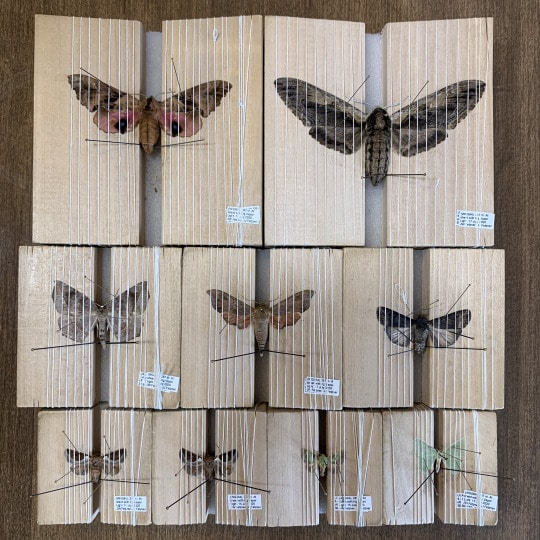
Figure 5. Moths that have been pinned with their wings spread to aid in identification. Note the data labels have been associated with each specimen (lower right of each block).

My son and I are looking forward to watching our little menagerie of caterpillars progress throughout the summer, eventually completing their life cycle and becoming adult moths. I’m glad that we are able to give you a glimpse of our progress to date and hope you have enjoyed seeing some of these diverse little spineless wonders. Hopefully, when we can all return to our normal outdoor activities, you will have a newfound appreciation for these amazing insects when you encounter them out in the wild.

James W. Fetzner Jr. is Assistant Curator of Invertebrate Zoology at Carnegie Museum of Natural History. Museum staff, volunteers, and interns are encouraged to blog about their unique experiences and knowledge gained from working at the museum.

Related Content

Ask a Scientist: What are Murder Hornets?
Bug Bonanza: Virtual Bug Display

Is This Butterfly Blue or Green?

Filed Under: Blog Tagged With: Invertebrate Zoology, James Fetzner, Museum from Home, Science News, Section of Invertebrate Zoology

October 1, 2018 by wpengine

Tiger beetle lost, tiger beetle found

by John Wible

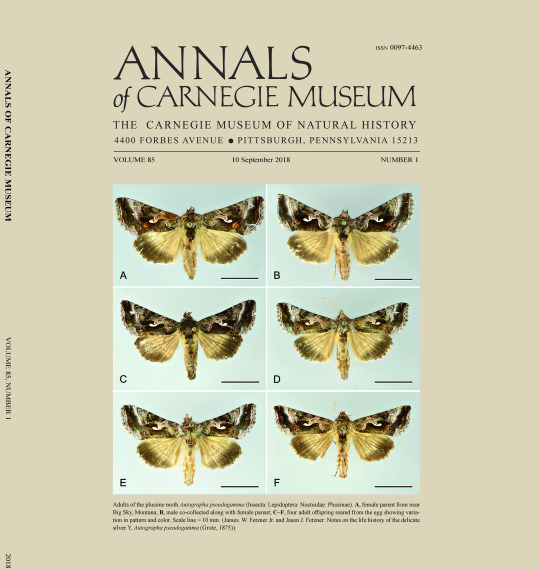
The newest issue of Annals of Carnegie Museum, our quarterly scientific journal highlighting museum research and collections, is hot off the presses. The cover is graced by photographs of a beautiful moth from Montana that was hand reared and studied by Curator James W. Fetzner Jr. and his nine-year-old son Jason. They report on this animal’s life history, previously unknown to science. Check out more about Jim and Jason’s study.

cover of Annals of the Carnegie Museum

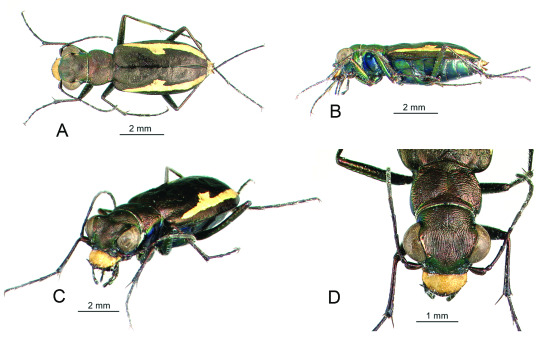
Another article by Research Associate Robert Acciavatti from the Section of Invertebrate Zoology and co-authors documents an amazing tale of scientific rediscovery regarding an extremely rare tiger beetle species from Durango, Mexico, named Cylindera nudata. The first and only known specimen of the species ended up in Germany where it was described in 1879. This beetle was one of the countless tragedies of World War II when it was lost from the Natural History Museum in Hamburg during the Allied bombing of that city. As the only known specimen, this one was designated as the holotype of the species, the specimen upon which the description and name of the species was based.

Holotypes are critically important because scientists compare other specimens to the holotype to discover if they belong to the same species or not. You can imagine that when the holotype is lost and no other specimens are known, making comparisons can only be done with whatever descriptions exist in the literature. And for this particular tiger beetle, there was only the original description in German and a line drawing that did not match the description!

Over the years, collecting expeditions to the locality of the holotype (or type locality) went searching for this beetle but came up empty or worse, being unable to reach the remote mountainous area of Mexico of the type locality. In a shipment of beetles collected from Mexico to Acciavatti, amazingly enough there was one specimen that matched the original description of Cylindera nudata. In this new article in the current Annals, that specimen is described, illustrated, and designated as the neotype of the species, which means it is the new type of the species as the old type no longer exists. Acciavatti has donated this specimen to Carnegie Museum of Natural History, and we will preserve it for future generations who will hopefully find more examples of this beautiful beetle and will need a neotype to compare to.

tiger beetle shown from four angles

John Wible, PhD, is the curator of the Section of Mammals at Carnegie Museum of Natural History and editor of Annals of Carnegie Museum. John’s research is focused on the tree of life of mammals, understanding the evolutionary relationships between living and extinct taxa, and how the mammalian fauna on Earth got to be the way it is today. He uses his expertise on the anatomy of living mammals to reconstruct the lifeways of extinct mammals. John lives with his wife and two sons in a house full of cats and rabbits in Ross Township. 

Filed Under: Blog Tagged With: Holotypes, James Fetzner, Mason Heberling

September 26, 2018 by wpengine

Kids and Caterpillars: Fostering a Child’s Interest in Nature by Rearing Lepidoptera (Moth and Butterfly) Larvae

by James W. Fetzner Jr.

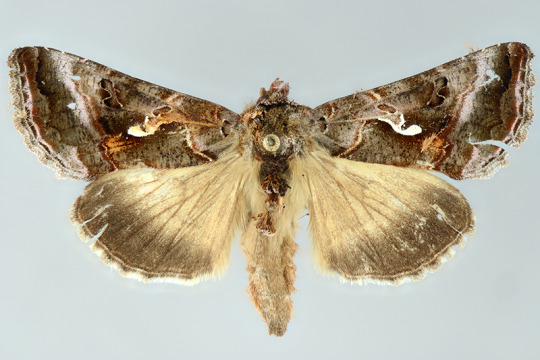
We hear a soft THUMP! as another large bug hits the sheet after being drawn in to the bright mercury vapor light on this moonless night in the mountains of Montana. Upon hearing that sound, our usual questions arise … “What was that?” or “Humm…Who are you?” My 9-year-old son and I try to determine if the new arrival to the sheet is a species that is new, or one that we have already seen this evening. In this case, we note that it appears to be a new brownish moth with slivery patches on its wings, a species that is new to us and a good choice for one of our attempted rearings. We scramble to capture it in one of our empty “live jars” before it flies away, in the hopes of eventually getting some eggs.

specimen of Female of Autographa pseudogamma (Grote, 1875) from Montana.
Female of Autographa pseudogamma (Grote, 1875) from Montana.

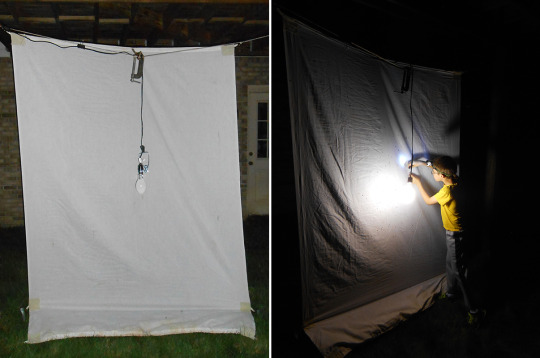
One of the easiest ways to encounter and collect insects from the wild is to erect a “bug sheet” at night and attract them en masse to your location, rather than expending a lot of effort trying to catch them individually by hand. As a scientist working in the vast insect collection at the Carnegie Museum of Natural History (CMNH), I often find myself bringing a bug sheet with me when I travel, especially when visiting family in other parts of the country. Not only does this help add specimens to our ever-expanding insect research collection, but it also serves as a fun way to experience the diversity of insects from different regions of our country. It is also an activity that kids really enjoy and engage with, and they always seem to have a great time catching interesting and colorful bugs. Even those that say they don’t like bugs seem to get caught up in the excitement when a large beetle or moth lands on the sheet.

side-by-side photos of collecting insects outside on bedsheets
Insect collecting sheet. A, the “bug sheet” setup. B, Collecting moths at the bug sheet.

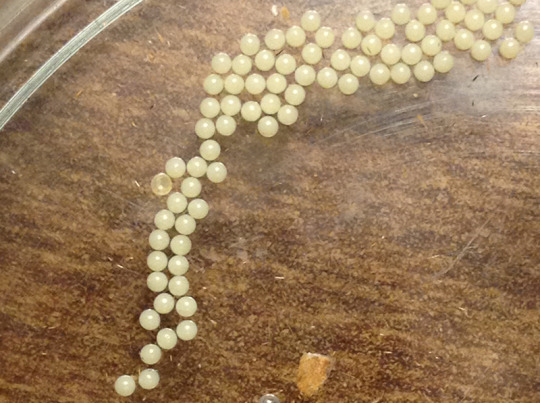
After a few hours of collecting cool bugs at the sheet the night before, my son and I wake up in the morning and check our assortment of live jars with an air of anticipation. Nothing in that one, or in that one. But wait, look at the bottom of that jar. See those little pale-yellow dots all over? Those are what we were hoping for…eggs!! Our female moth laid a bunch of eggs!  So, now the fun begins.

pale yellow eggs in the bottom of a jar
An example of pale-yellow eggs laid in the bottom of a “live jar.” Source was a female Pyrrharctia Isabella (J.E. Smith, 1797), also known as the Isabella tiger moth or banded woolly bear.

A little research in our trusty moth field guide and we determined that our bug was a species known as Autographa pseudogamma (Grote, 1875), the Delicate Silver Y moth. We also discovered that the caterpillar and host plant for this moth were unknown, (i.e., have never been described or characterized in the scientific literature). We realize that this is a great opportunity, not only to have fun rearing some caterpillars of a new species of moth that we have not encountered before, but we could also contribute to the scientific knowledge about this species by publishing a scientific paper describing the caterpillar and other aspects of its life history. A big win-win all around.

After finding out more information about this species and its close relatives, we started preparing for the eggs to hatch, which only took about seven days from the time they were laid. Once that happened, we transferred the very tiny, newly hatched caterpillars out of the live jar and into a larger plastic container with dandelion leaves from our front yard as food. They started eating and growing and my son watched them closely as they progressed through their various growth stages (instars). He had great fun watching and laughing as the 50 or so caterpillars tried to escape in all directions from the container onto our kitchen table (boy, they moved fast!) as we cleaned it out and added new food for them each day.

a typical caterpillar iso-female culture in a plastic rearing chamber with greens in it
Image showing a typical caterpillar iso-female culture in a plastic “rearing chamber” (note: the lid has been removed so the contents can be seen). The photo shows an unrelated culture of Automeris randa Druce, 1894 from Arizona.

Rearing caterpillars is a lot like raising frog tadpoles. The caterpillars can be quite active, and they are constantly changing, with some species changing colors after they molt, others become hairier, and they all increase in size every time they molt to a new instar (the developmental stage in arthropods that occurs between molts). Just watching them eat or observing some of their other odd behaviors can be quite fascinating.  The caterpillars we reared were voracious eaters, eventually going through several pounds of dandelion leaves in a single day!

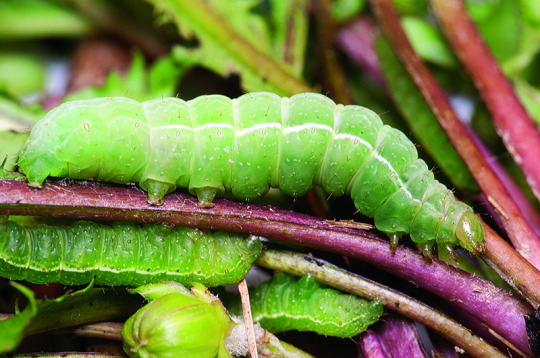
caterpillar (larva) of Autographa pseudogamma
The previously unknown last instar caterpillar (larva) of Autographa pseudogamma.

Many children show a keen interest in caterpillars when they are encountered outdoors. Caterpillars are often seen as cute and fuzzy, which often leads to children touching them and/or picking them up.  However, you should be cautious of this because some caterpillars, like the conspicuous and commonly encountered Hickory Tussock Moth (Lophocampa caryae Harris, 1841) caterpillar, can sometimes cause severe skin rashes, or even blindness if you get their hairs into your eyes. Several field guides to caterpillars are available, but they are not all-inclusive. This is because there are many moth species where the caterpillars are not known (as in our case), or where caterpillars have been found, but it is not known which adults they came from.

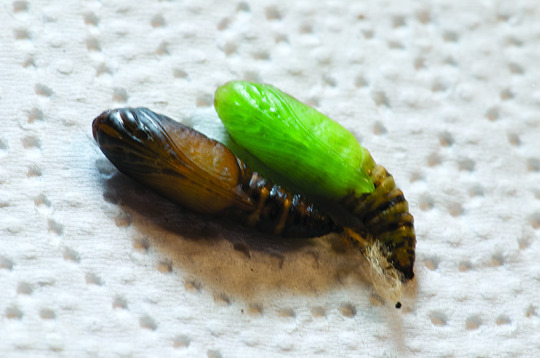
After reaching the final instar, the caterpillars move on to the next stage of their life cycle before they become adults, the pupa. During this stage, they metamorphose from a worm-like larva into a winged adult, and for A. pseudogamma, this process only took 11 days.

Pupae of Autographa pseudogamma.

We were able to witness the entire life cycle of A. pseudogamma, from an adult to an egg to a larva to a pupa and then back to an adult again, all within the span of a single month. This was a great learning experience for my son.  He was able to intimately witness first-hand the process by which insects grow and develop, which is something that few people get to see. He was also able to participate directly in the various stages of scientific discovery and, perhaps more importantly, he was able to see how a scientist would record observations and how those data are converted directly into a scientific publication. If you are interested, our study on A. pseudogamma was recently published in the Annals of Carnegie Museum. While not every caterpillar rearing will result in a published study, they are great learning experiences for young children that have an interest in nature.  Studies of caterpillars like this would also make great school science fair projects. For information on getting started, see this article on how to rear caterpillars.

The huge diversity of insects, with all their different colors, sizes, and shapes, still evokes a child-like awe in me for the natural world and this is something that I hope to pass down to my son, as well as other children that might visit the insect collection here at the natural history museum (all those budding entomologists). Remember, even something that may seem silly and inconsequential, like raising a few caterpillars at home with your child(ren), can turn into something that fosters a deeper interest in the natural world, and if you’re lucky, may even end up contributing significantly to science.

James W. Fetzner Jr., Ph.D., is assistant curator in the Section of Invertebrate Zoology at Carnegie Museum of Natural History. Museum employees are encouraged to blog about their unique experiences and knowledge gained from working at the museum.

Related Content

“Say Cheese!” – Specimen Imaging in Invertebrate Zoology

Pittsburgh’s Moths Reflect Human Impact of Industry

New Moth Species Marumba Verdeciae Named For CMNH Scientific Preparator

Carnegie Museum of Natural History Blog Citation Information

Blog author: Fetzner, James W., Jr.
Publication date: September 26, 2018

Share this post!

  • Share on Twitter Share on Twitter
  • Share on Facebook Share on Facebook
  • Share on Pinterest Share on Pinterest
  • Share on LinkedIn Share on LinkedIn
  • Share on Reddit Share on Reddit
  • Share via Email Share via Email

Share this post!

  • Share on Twitter Share on Twitter
  • Share on Facebook Share on Facebook
  • Share on Pinterest Share on Pinterest
  • Share on LinkedIn Share on LinkedIn
  • Share on Reddit Share on Reddit
  • Share via Email Share via Email

Filed Under: Blog Tagged With: Invertebrate Zoology, James Fetzner

sidebar

About

  • Mission & Commitments
  • Directors Team
  • Museum History

Get Involved

  • Volunteer
  • Membership
  • Carnegie Discoverers
  • Donate
  • Employment
  • Events

Bring a Group

  • Groups of 10 or More
  • Birthday Parties at the Museum
  • Field Trips

Powdermill

  • Powdermill Nature Reserve
  • Powdermill Field Trips
  • Powdermill Staff
  • Research at Powdermill

More Information

  • Image Permission Requests
  • Science Stories
  • Accessibility
  • Shopping Cart
  • Contact
  • Visitor Policies
One of the Four Carnegie Museums | © Carnegie Institute | Privacy Policy | Terms of Use | Accessibility
Rad works here logo