• Skip to primary navigation
  • Skip to main content
  • Skip to primary sidebar

Carnegie Museum of Natural History

One of the Four Carnegie Museums of Pittsburgh

  • Visit
    • Buy Tickets
    • Visitor Information
    • Exhibitions
    • Events
    • Dining at the Museum
    • Celebrate at the Museum
    • Powdermill Nature Reserve
    • Event Venue Rental
  • Learn
    • Field Trips
    • Educator Information
    • Programs at the Museum
    • Bring the Museum to You
    • Guided Programs FAQ
    • Programs Online
    • Climate and Rural Systems Partnership
  • Research
    • Scientific Sections
    • Science Stories
    • Science Videos
    • Senior Science & Research Staff
    • Museum Library
    • Science Seminars
    • Scientific Publications
    • Specimen and Artifact Identification
  • About
    • Mission & Commitments
    • Directors Team
    • Museum History
  • Tickets
  • Give
  • Shop

Jo Tauber

January 19, 2022 by Erin Southerland

Don’t Hang Up On Gorillas

by Jo Tauber

As you pass under the acacia tree in the Hall of African Wildlife, keeping wary of the leopard perched in the branches, you may find yourself mesmerized by the soulful eyes and powerful yet peaceful presence of George, the western lowland gorilla. George was a resident of the Pittsburgh Zoo until his death from natural causes in 1979, when he joined the museum’s collections. George is shown proudly standing in a diorama depicting his natural habitat, a patch of tropical forest in the Congo River Basin. While George’s story may be quite different from those of his wild counterparts, his presence here provides an excellent opportunity for learning more about wild gorilla populations and the threats they face.
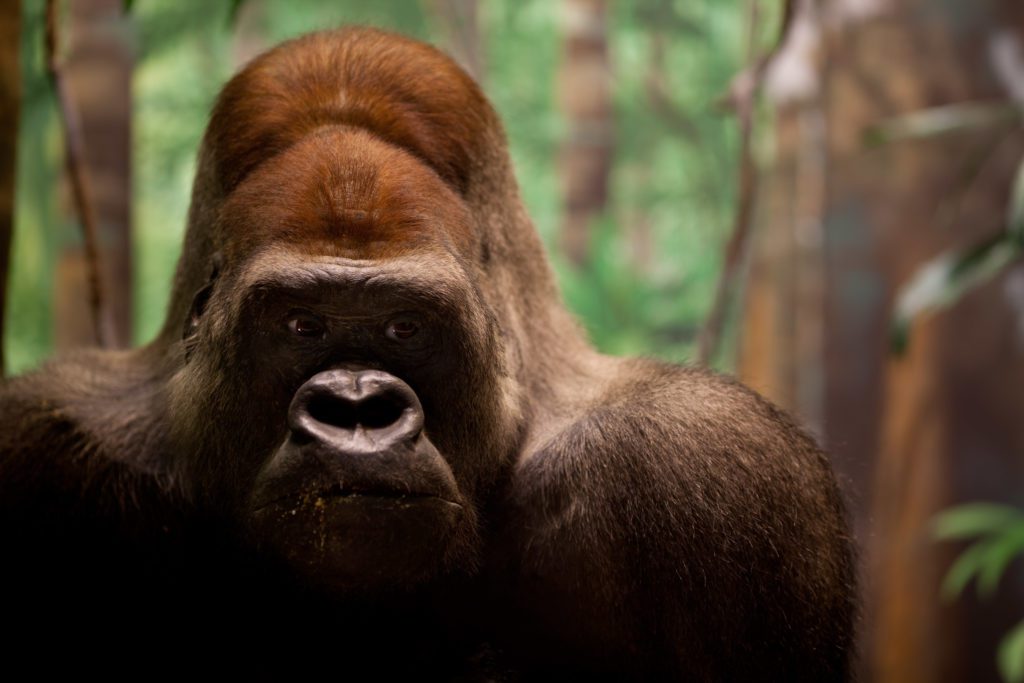
gorilla taxidermy mount
George

Did you know that the mining of a mineral known as coltan has a negative impact on gorilla populations? Or that whatever device you’re reading this blog post on, whether it’s a laptop, cell phone, tablet, or other electronic device, contains tantalum, a product of coltan? Coltan is a shorthand name for columbite-tantalite, which is refined into tantalum, an element used in heat-resistant capacitors in many electronic devices. (Delawala, 2006; Rogers, 2008). If this is new or surprising information, you are not alone–not many people realize the connection between devices like cell phones and the conservation status of these charismatic great apes.

The Congo River Basin is home to two subspecies of gorillas, western lowland gorillas (like George) and eastern lowland gorillas. Unfortunately for both species, much of this area is rich in coltan. There are many factors affecting the conservation status of gorillas, but coltan mining is having a major effect. Both subspecies are critically endangered with fewer than 100,000 western lowland gorillas, and fewer than 4,000 eastern lowland gorillas living in the wild. 

The mining of coltan alters the landscape, which not only reduces viable gorilla habitat, but also allows easier access for poachers who seek to kill or capture gorillas (Redmond, 2001). Poachers can also bring and spread infectious diseases that can affect gorillas and other humans alike (Redmond, 2001). Miners may also hunt gorillas as a food source while they work excavation sites (Redmond, 2001).

Gorillas aren’t the only primate species negatively affected by mining for coltan. Many of the people involved in the mining also suffer greatly. Mining operations are notoriously unsafe, exploit child labor, and require miners to work days over 12 hours long (Rogers, 2008). Coltan has been termed  a “conflict mineral,” meaning the mining of this resource is used to fund the actions of warlords in the ongoing civil war in the Democratic Republic of Congo (Rogers, 2008). 

Before you swear off electronics entirely, there are less drastic, but still impactful actions we can all take to benefit gorillas! We live in a world where technology is a necessity for many of us. Practicing ways to be responsible with the devices we use is the best way to minimize the unintended consequences involved in their creation. Our individual and collective actions can benefit us all, gorillas included. 

One small but important thing to do is keep your electronic gadgets as long as possible, and to recycle them when they need to be replaced. Such actions lessen the need for new coltan to be collected, meaning less mining needs to be done, and less gorilla habitat disrupted. Recycling cell phones also keeps both phones and the precious minerals they contain out of landfills. The EPA estimates that of the average 800 million phones in use annually, only 10% are recycled with the balance contributing to overly full landfills (“Recycle Your Cell Phone. It’s An Easy Call.” 2009).

If you’re wondering how to recycle a cell phone, there is some good news! Carnegie Museum of Natural History is introducing a cell-phone recycling program. When you come to visit us, you can bring unwanted cell phones and drop them in the designated collection bins. Museum staff will then ship them off to be recycled properly. Make sure you also stop by to see George, and the new exhibition We Are Nature, which tells other stories about how humans are impacting our world!

Jo Tauber is the Gallery Experience Manager in CMNH’s Lifelong Learning Department. Museum staff, volunteers, and interns are encouraged to blog about their unique experiences and knowledge gained from working at the museum.

Works Cited

Delawala, I. (2006, January 6). What Is Coltan? ABC News. Retrieved July 11, 2020, from https://abcnews.go.com/Nightline/story?id=128631&page=1

Eastern lowland gorilla. (n.d.). Retrieved July 11, 2020, from https://wwf.panda.org/knowledge_hub/endangered_species/great_apes/gorillas/eastern_lowland_gorilla/

Environmental Protection Agency. (2009). Recycle Your Cell Phone. It’s An Easy Call. [Brochure]. Retrieved March 14, 2021, from https://nepis.epa.gov/Exe/ZyPDF.cgi/P1009IF5.PDF?Dockey=P1009IF5.PDF

Redmond, I. (2001). Coltan Boom, Gorilla Bust: The Impact of Coltan Mining on Gorillas and other Wildlife in Eastern DR Congo.

Rogers, W. (2008, December 2). Coltan, Cell Phones, and Conflict: The War Economy of the DRC. Retrieved July 11, 2020, from https://www.newsecuritybeat.org/2008/12/coltan-cell-phones-and-conflict-the-war-economy-of-the-drc/Society), F., Breuer, T., Greer, D., Jeffery, K., Stokes, E., & Strindberg, S. (2016, January 29). The IUCN Red List of Threatened Species. Retrieved July 11, 2020, from https://www.iucnredlist.org/species/9406/136251508

Western lowland gorilla. (2019, October 03). Retrieved July 11, 2020, from https://nationalzoo.si.edu/animals/western-lowland-gorilla

Related Content

A Gorilla for Our Imagination

Climate Change Never Takes a Holiday: The Phenomenon of the Pizzly Bear

Paradise Found: The Real-Life Residents of Shangri-La

Carnegie Museum of Natural History Blog Citation Information

Blog author: Tauber, Jo
Publication date: January 19, 2022
Share this post!

  • Share on Twitter Share on Twitter
  • Share on Facebook Share on Facebook
  • Share on Pinterest Share on Pinterest
  • Share on LinkedIn Share on LinkedIn
  • Share on Reddit Share on Reddit
  • Share via Email Share via Email

Filed Under: Blog Tagged With: Jo Tauber, We Are Nature 2

October 13, 2020 by wpengine

Booseum: Vampires!

Vampires, creatures of folklore that feed on the lifeforce of the living, have long fascinated us. Many cultures have their own version of how vampires behave and are repelled by many different things. Modern vampires in movies, TV shows, and books have some similar main characteristics—let’s explore some interesting or common beliefs about vampires and where they may have come from.

Garlic

It’s a common belief that garlic repels vampires, but did you know that some of that belief is grounded in fact? Garlic, specifically the chemical compound allicin inside garlic, is a powerful antibiotic. Some European beliefs around vampires stated they were created by a disease of the blood, so a powerful antibiotic would “kill” a vampire.

An actual disorder of the blood, porphyria, may also be an origin for this belief: porphyria can cause those who suffer from it to look pale and even make their teeth look bigger because their gums shrink. Garlic makes these symptoms worse, so people with porphyria would often avoid it—making others around them believe they were vampires.

Mirrors

Vampires avoiding mirrors is a more recent belief— the first known reference to this is from Bram Stoker’s Dracula, which was published in 1897. But why wouldn’t a vampire show a reflection?

There are a few reasons that this belief may exist. Mirrors were traditionally backed with silver (and some still are today). Silver was commonly believed to repel evil spirits, possibly because it has antimicrobial properties; so, much like garlic, the healing properties may be what was supposed to scare off a vampire.

Another reason that suspected vampires may have avoided mirrors is because of the changes to their appearance from diseases commonly confused with vampirism, porphyria and rabies. People afflicted with these diseases may have avoided looking in a mirror for that reason, causing others to assume that “vampires” avoid mirrors.

Counting

Why does Count von Count, a vampire, teach us how to count on Sesame Street? It comes from a European belief that vampires are compelled to count spilled seeds or grains. Some Slavic coastal towns also believed that vampires would count the holes in a fishing net. It was common practice to scatter seeds outside the entrances to a home (or drape fishing nets over them). Some Chinese myths say that a vampire must count every grain if they come across a bag of rice. A vampire would stop to count, delaying them until sun-up, and we all know that vampires don’t do well in sunlight.

A common seed used was mustard seed, which was also known as eye of newt!

Count von Count from Sesame Street

Now that we’ve learned a little about fictional vampires, let’s explore some real-world vampires!

Vampire Ground Finch

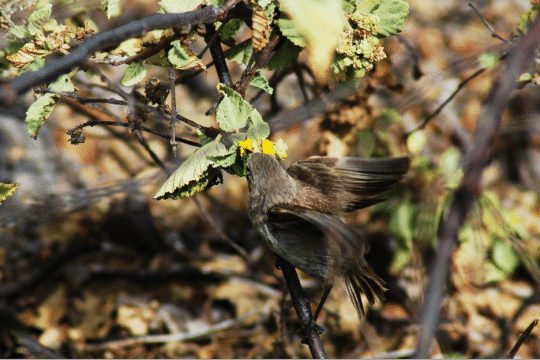
The Galapagos Islands are home to many unique and unusual species, so the vampire ground finch fits in well. This species of sharp-beaked finch lives on Darwin and Wolf Islands, and like most other finches it feeds primarily on seeds. However, seeds can sometimes be a limited resource, so vampire ground finches supplement their diet by eating small amounts of nutrient-rich blood from Nazca or blue-footed boobies.

It is believed that this behavior developed because the finches were first eating ticks from the bodies of other birds, which steadily transitioned into them eating small amounts of blood. Believe it or not, the other birds don’t seem to mind the vampire ground finches doing this, and don’t try to stop them!

vampire ground finch on a branch

Vampire Bats

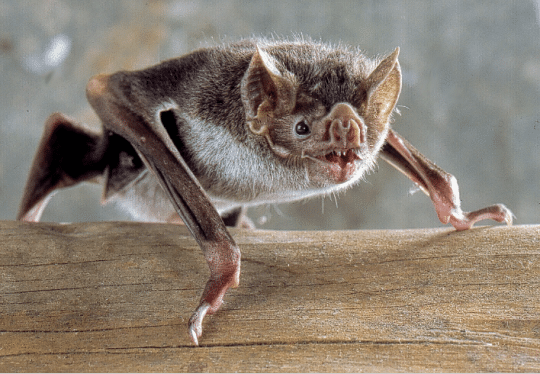
There are three species of bats that survive by exclusively feeding on the blood of other animals- the common vampire bat, the hairy-legged vampire bat, and the white-winged vampire bat. All three species are found in Central and South America.

Like other bats, they hunt at night and rely on echolocation to find their prey, which is typically sleeping livestock, like cows. Vampire bats use their sharp teeth to make a little cut and then lap up the blood. It doesn’t hurt the animal they’re feeding from, in fact most animals don’t even notice it happening and stay asleep! These bats occasionally try to feed off humans, but it is very rare.

vampire bat

Mosquitos & Ticks

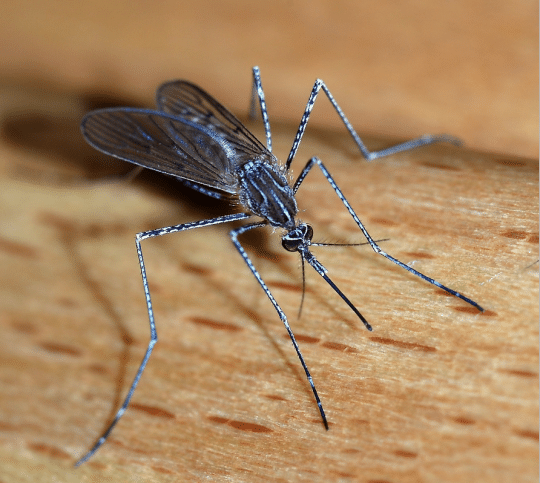
We’ve all felt the aftermath of an itchy mosquito bite! Mosquitos feed on blood from humans and other animals, but it’s only female mosquitos that eat blood. Female mosquitos need the protein from blood to produce eggs, and male mosquitos don’t so they feed on plant nectar.

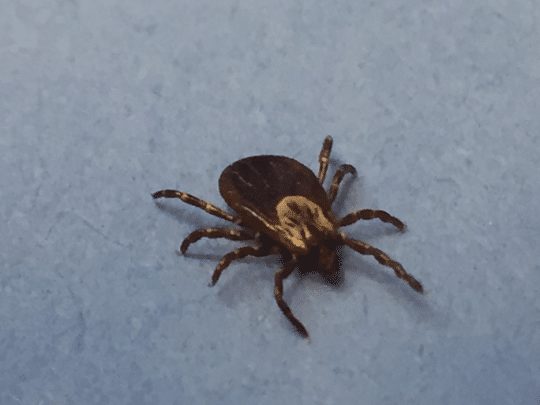
Ticks drink the blood of both warm and cold-blooded animals, latching on and feeding slowly over several days. They can fast for a long time between meals, but do need to feed on blood as they progress through the stages of their life cycle.

Neither mosquitos nor ticks (or any other blood eating insects) eat enough blood to be dangerous to humans. The biggest danger is that these insects can carry diseases, so make sure to properly care for and clean any insect bites, and see a doctor if necessary!

close up of a tick
close up of a mosquito

Jo Tauber is the Gallery Experience Coordinator for CMNH’s Life Long Learning Department, as well as the official Registrar for the Living Collection. Museum staff, volunteers, and interns are encouraged to blog about their unique experiences and knowledge gained from working at the museum.

Related Content

Booseum: Spooky Coloring Pages

Jurassic Days: Cookie Excavation

Scientist Takeover Activity: DIY Field Kit

Filed Under: Blog Tagged With: booseum, Educator Resources, Educators, halloween, Jo Tauber, Super Science Days

August 4, 2020 by wpengine

Big Cats, Big Personalities

You may have heard the phrase “big cat” before. No, it doesn’t refer to a particularly large house cat, but rather to a category of cats. “Big cat” is a term typically used to describe any member of the genus Panthera, though it can mean different things to different people.

Some consider every member of the larger subfamily Pantherinae to be big cats—for example, clouded leopards (genus Neofelis). Sometimes, the phrase “big cat” just refers to any member of the cat family (Felidae) that is large, such as the cougar (genus Puma), the cheetah (genus Acinonyx), and the Eurasian lynx (genus Lynx, species lynx).

Tigers, Lions, Jaguars, Leopards, and Snow Leopards are the extant (or currently living) members. You may be wondering how leopards and snow leopards are members of genus Panthera but clouded leopards are not. Clouded leopards are not true leopards—they branched off into their own genus roughly six million years ago; they are in the larger subfamily of Pantherinae, but not Panthera specifically.

One feature sometimes used to distinguish big cats from other cats is the ability to roar, but that ability is only found in the Panthera genus, not the additional species. Roaring itself is an important vocalization, but it isn’t a surefire way to distinguish what a “big cat” is. For example, snow leopards, in the family Panthera, cannot roar.

So, big cat can mean something different to everyone, but let’s learn a little bit more about each of the cats listed above:

Tigers

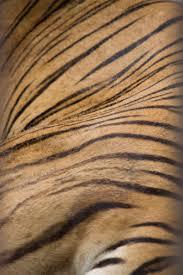
Tigers are the largest cat species on the planet! There are several subspecies and they are easily recognized by their orange color with black stripes (though Bengal tigers are occasionally white with black stripes).

close up of tiger stripes

They are solitary and territorial animals; cubs (big cat offspring are not called kittens) stay with their mother for 2 years. These cats are found throughout Asia—although they are endangered—and their population is dwindling.

Lions

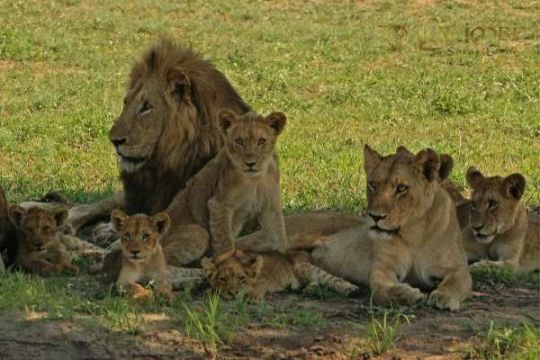
photo of a family of lions

Lions are a social species of large cats found in the grasslands and savannas of Africa. Males are recognizable by their long hair surrounding their necks, called manes. Lionesses do the hunting for the pride (social group of lions), which is comprised of several adult males, related females, and cubs. These animals are listed as vulnerable, which means they are close to becoming endangered.

Jaguars

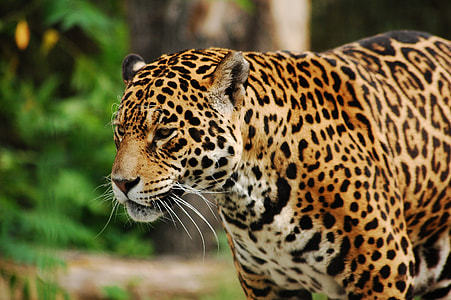
photo of a jaguar

Jaguars are the only member of the Panthera genus found in the Americas. Individual cats can be found in the Western United States, but they have had a reduced range in Central and South America since the early 20th century. They are solitary animals and ambush predators, hunting in tropical and subtropical forests and swamps. They are recognizable by their spots, which are black rosettes with spots in the middle. However, melanistic (or all black) jaguar occasionally appear; these cats are informally known as black panthers—although they are not a separate species—and the phrase “black panther” has been used to describe melanistic leopards as well. Jaguars are near-threatened, which means their numbers are decreasing and their populations are being closely monitored.

Leopards

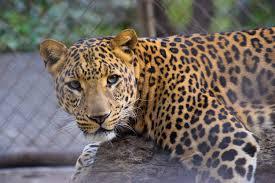
photo of a leopard

Leopards have a wide range and are found in Sub-Saharan Africa, in parts of Western and Central Asia and on the Indian subcontinent. They are recognizable by their spots; they look like jaguars with their spotted fur, but leopards are shorter with a smaller head, and their rosette-shaped spots do not have dots in the middle. Leopards are opportunistic hunters, hunting mostly on the ground at night; though in the Serengeti, they are known for attacking prey by leaping from trees. Leopards are listed as vulnerable, meaning they are potentially on their way to the endangered species list.

Snow leopards

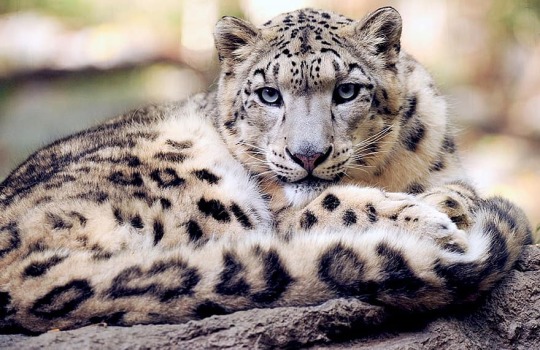
photo of a snow leopard

Snow leopards live in the mountain regions of Central and South Asia, living at elevations from 3,000 to 4,500 feet. Their fur is whitish grey, with black rosettes, distinguishing them from other leopards which are yellow or brown in color. Snow leopards have large nasal passages which helps warm the cold, dry air they breathe. Their tails are covered thickly with fur and provide fat storage; sleeping snow leopards use their warm tails like blankets to protect their faces when they sleep. They are listed as vulnerable, meaning they may appear on the endangered species list in the future.

Clouded leopards

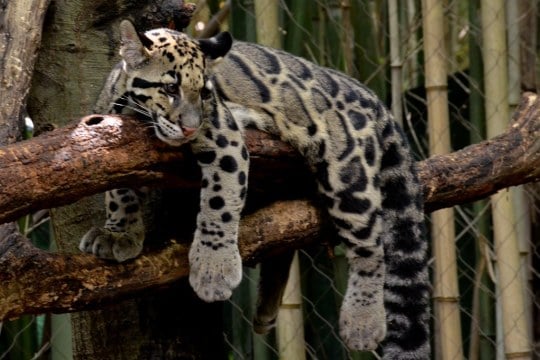
photo of a clouded leopard lounging on a branch

There are two species of clouded leopards—the mainland clouded leopard (Neofelis nebulosa) and the Sunda clouded leopard (Neofelis diardi). The mainland clouded leopard is found in the Himalayan foothills in Southeast Asia and southern China and the Sunda clouded leopard is found in Borneo and Sumatra. They are considered an evolutionary link between two cat families Pantherinae and Felinae. Their fur is dark grey with a black blotched pattern. Clouded leopards are solitary and hunt by stalking or ambushing prey. They are excellent climbers and use trees as rest sites.  Both species of clouded leopards are listed as vulnerable, meaning they can potentially end up on the endangered species list.

Cougar

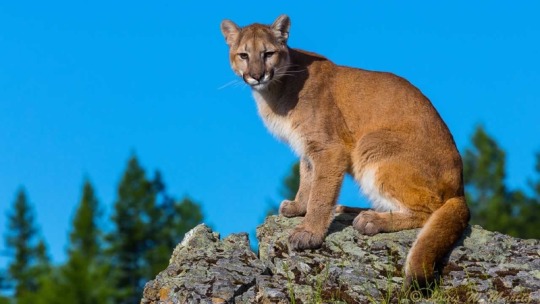
photo of a cougar sitting on a rock

The cougar (also known as a puma, mountain lion, red tiger, or catamount) is the only cat on this list that you may see in the wild around Pittsburgh; however, their populations are severely reduced in the eastern half of North America. These cats are adaptable to a wide variety of habitats, which is why they are found all throughout North and South America. This wide range is the reason people living in different regions have different names for them. They are ambush predators, preferring to hunt deer, though they will eat insects and rodents. While cougars are large, they are not always the apex (or top) predator and will occasionally give food they caught away to jaguars, grizzly bears, or even alligators! Cougars are listed as least concern, meaning their population is holding steady, though their range has shrunk.

Cheetah

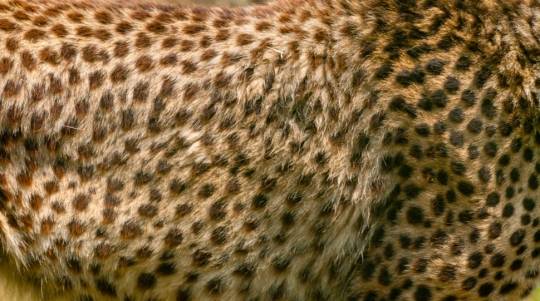
close up of a cheetah's spotted fur

Cheetahs are known for their speed; as the fastest land animal, they are capable of running up to 80 miles per hour! Cheetahs can be found in the Serengeti, Saharan mountain ranges, and in hilly areas of Iran. Cheetahs separate into three kinds of social groups—females with cubs, all-male groups, and solitary males. Females are more likely to travel further distances while males will establish and stay in smaller territories. They are active during the day and spend most of their time hunting for things like impala or springbok. Cheetahs are listed as vulnerable, with one of the main threats being a lack of genetic diversity, which makes it difficult for the species to adapt and evolve over generations, reducing the chance for individual animals to survive.

Eurasian lynx

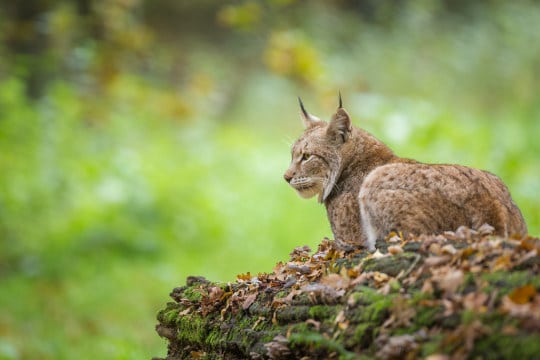
photo of a Eurasian lynx

The Eurasian lynx is found from Europe into Central Asia and Siberia, living in temperate or boreal (snow or Taiga) forests. They have short, red-brown coats, and are more colorful than most animals sharing their habitat. In the winter, their fur grows in thicker and greyer. These cats have relatively long legs and large webbed and furred paws that act like snowshoes, allowing them to walk on top of the snow. They have bobbed (or short) tails, much like one of their cousins you might see around Pittsburgh—the bobcat. They hunt small mammals and birds but will occasionally take down young moose or deer. The Eurasian lynx is listed as least concern, with a stable population.

Jo Tauber is the Gallery Experience Coordinator for CMNH’s Life Long Learning Department, as well as the official Registrar for the Living Collection. Museum staff, volunteers, and interns are encouraged to blog about their unique experiences and knowledge gained from working at the museum.

Related Content

Cats: The Archeological Site!

Meowfest: Museum Scavenger Hunt

Why Do Cat Eyes Glow in the Dark?

Filed Under: Blog Tagged With: cats, Educator Resources, Hall of African Wildlife, Hall of North American Wildlife, Jo Tauber, Museum from Home, Super Science Days, Super Science Meowfest

June 26, 2020 by wpengine

Indiana Jones and the Rosetta Stone

Have you ever watched a film about archaeology and wondered how characters like Indiana Jones or Evelyn from The Mummy (1999) can run their fingers along a carved wall or slab, translating Egyptian hieroglyphs smoothly as they go?

The ability to read ancient Egyptian hieroglyphic writing today is all thanks to the Rosetta Stone. You may have heard of the Stone before, perhaps in the context of a popular language learning software, or you may know about the Stone itself, but do you know why it was such an incredible archaeological find?

The Rosetta Stone is a black granodiorite (similar to granite) slab standing 4 feet tall, 2 ½ feet wide, and 11 inches thick. It is part of a larger stele, a stone or wooden slab erected to commemorate occasions, act as territorial markers, or for funerary purposes. The Stone bears three blocks of text written in three different languages- Egyptian hieroglyphs, Egyptian Demotic, and Ancient Greek.

Rosetta Stone

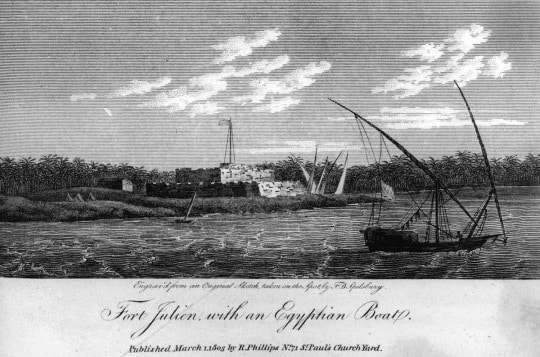
The Rosetta stone was carved during the Hellenistic period and moved at some later point. It was eventually used as construction material for a wall of Fort Julien in Rashid (or Rosetta). It was rediscovered there in 1799. While the history of its discovery is not particularly well-documented it is typically attributed to Pierre-Francis Bouchard, a French soldier on a Napoleonic campaign in Egypt. The Rosetta Stone was taken by British troops after they defeated France and transported to London. It has been on display at the British Museum since 1802.

black and white image of boat in the water

The reason the Rosetta Stone is so significant is because it was the key that unlocked our understanding of ancient Egyptian hieroglyphs, giving us a window into the ancient civilization. The text on it is pretty mundane and of no great historical significance. It is a decree (called the Decree of Memphis), outlining the achievements and good leadership of King Ptolemy, who ruled Egypt from 204-181 B.C.E. The decree was made and copied onto several stelae which were placed in temples throughout Egypt, the Rosetta Stone being just one of them. Since the discovery and eventual translation of the Rosetta Stone, several other more intact stelae inscribed with the Decree of Memphis have been found.

Ancient Greek was already well known to scholars, so the translation of that section happened fairly quickly, though unknown religious and administrative jargon delayed the process. Hubert-Pascal Ameilhon published the first translation of the Greek text in 1803. Before the discovery of the Rosetta Stone, there had been little success in translating Demotic and even less in translating hieroglyphs. Having all three languages together was an incredible resource for scholars because for the first time, they could study whether there was a direct link between the languages, and use their translation of the Ancient Greek text to translate the other languages on the stone.

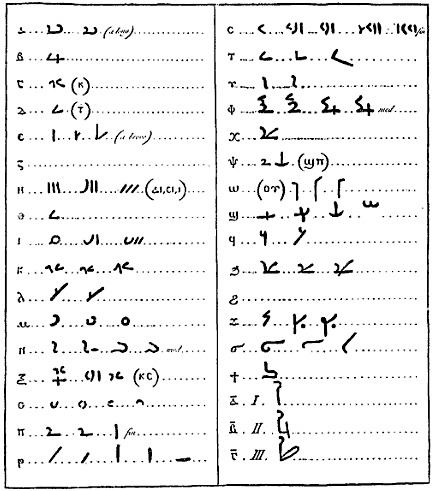
Swedish scholar Johan David Åkerblad had already been working on translating an unknown script found in Egypt. He called this script “cursive Coptic” though it did not share many similarities to Coptic, a language derived from the Greek alphabet and used in Egypt through the 17th century C.E. The language he was studying was actually Demotic, and the discovery of the Rosetta Stone aided his research. He, along with Antoine-Isaac Silvestre de Sacy, set to work translating this larger text. Having the Greek text side by side, they were able to locate where names lined up, and begin deciphering Demotic. Åkerblad proposed an alphabet of 29 letters, half of which were correct, but they failed to identify the remaining characters.

close up of the Rosetta Stone

The translation of the hieroglyphic text similarly revolved around proper names. As early as 1761, scholars believed that characters enclosed in cartouches (or ovals with a line at one end) were proper names. By sorting through the Greek text and comparing where names would most likely be Thomas Young, foreign secretary of the Royal Society of London, was able to discover phonetic characters that aligned with Greek names. This discovery was incredibly important, as Young found these phonetic characters were similar to the Demotic characters in proper names, and then further discovered about 80 other similarities between Demotic and hieroglyphic writing. This shows that Demotic is actually a mix of phonetic characters and ideograms, which is what prevented Åkerblad and Silvestre de Sacy from progressing further with their translation, they had assumed Demotic used only phonetic characters.

series of letters and symbols in various languages

In 1814, Young corresponded with Jean-François Champollion, a teacher at Grenoble who had done scholarly work on Ancient Egypt. Champollion was able to construct an alphabet of phonetic hieroglyphs, which was announced publicly on September 27th, 1822. From there, Champollion went on to develop an Ancient Egyptian grammar and hieroglyph dictionary, which was published after his death in 1832. Other scholars drew upon the work done by Åkerblad, Silvestre de Sacy, Young, and Champollion to delve deeper into the text on the Rosetta Stone and create a full translation.

Indiana Jones and the Raiders of the Lost Ark takes place more than 100 years after Champollion’s dictionary was published. We can assume that during his studies and explorations, Indy studied this dictionary, and any others that followed, giving him the ability to read Egyptian hieroglyphs at any moment. While Indiana Jones is a fictitious archaeologist and scholar, we have real scholars to thank for the fact that we can enjoy films about this character today!

Jo Tauber works in LifeLong Learning at Carnegie Museum of Natural History. Museum employees are encouraged to blog about their unique experiences and knowledge gained from working at the museum.

Filed Under: Blog Tagged With: Education, Educators, Jo Tauber, Museum from Home

sidebar

About

  • Mission & Commitments
  • Directors Team
  • Museum History

Get Involved

  • Volunteer
  • Membership
  • Carnegie Discoverers
  • Donate
  • Employment
  • Events

Bring a Group

  • Groups of 10 or More
  • Birthday Parties at the Museum
  • Field Trips

Powdermill

  • Powdermill Nature Reserve
  • Powdermill Field Trips
  • Powdermill Staff
  • Research at Powdermill

More Information

  • Image Permission Requests
  • Science Stories
  • Accessibility
  • Shopping Cart
  • Contact
  • Visitor Policies
One of the Four Carnegie Museums | © Carnegie Institute | Privacy Policy | Terms of Use | Accessibility
Rad works here logo