• Skip to primary navigation
  • Skip to main content
  • Skip to primary sidebar

Carnegie Museum of Natural History

One of the Four Carnegie Museums of Pittsburgh

  • Visit
    • Buy Tickets
    • Visitor Information
    • Exhibitions
    • Events
    • Dining at the Museum
    • Celebrate at the Museum
    • Powdermill Nature Reserve
    • Event Venue Rental
  • Learn
    • Field Trips
    • Educator Information
    • Programs at the Museum
    • Bring the Museum to You
    • Guided Programs FAQ
    • Programs Online
    • Climate and Rural Systems Partnership
  • Research
    • Scientific Sections
    • Science Stories
    • Science Videos
    • Senior Science & Research Staff
    • Museum Library
    • Science Seminars
    • Scientific Publications
    • Specimen and Artifact Identification
  • About
    • Mission & Commitments
    • Directors Team
    • Museum History
  • Tickets
  • Give
  • Shop

Blogs by Mason Heberling

Mason Heberling is the assistant curator in the Section of Botany and co-chair of collections at Carnegie Museum of Natural History. Heberling is a plant ecologist and botanist whose research explores plant functional strategies in deciduous forest understories, especially in the context
of environmental change. Much of his current research focuses on the ecology
and evolution of non-native, invasive plants in the eastern United States, the ecophysiological strategies of the herbaceous layer in deciduous forests, and the impacts of climate change on the timing of leafing out and flowering in temperate deciduous forests.

May 22, 2024 by Erin Southerland

Botanists Gone Wild! Perspectives from the Record-Breaking Finish for City Nature Challenge 2024

by Jessica Romano

Every spring people all over the world join in the City Nature Challenge, a global effort to safely document and identify nature through the free and easy-to-use iNaturalist app. For the seventh consecutive year, Carnegie Museum of Natural History staff were among the participants taking on the challenge in and around the Pittsburgh region – and in 2024, the results were record-breaking! Totals for regional participants, identifiers, observations, and number of species hit their highest in the history of the challenge, thanks to a combination of warm, dry spring weather and dedication from participants. Observations and identifications made during the challenge are shared with scientists around the world, helping to both document and better understand the diversity of species around us.

Here are the totals from the Pittsburgh Region City Nature Challenge 2024 (CNC) – which are all records for this region’s participation! 

Total participants who made observations: 643

Total participants who made identifications: 562

Total observations made: 10,050

Total species identified: 1,753

Total identifications: 16,875

Plants topped the list for observed species, with about 46% of the total, followed by insects with about 27% of the total. Other species identified but in smaller totals include fungi, birds, arachnids, mammals, reptiles, amphibians, and mollusks. 

Mayapple (Podophyllum peltatum) took the top spot overall. This native plant species sprouts early in spring with long stems and umbrella-like leaves. The rest of the top 10 species are all plants, with the exception of the Red Admiral (Vanessa Atalanta), a beautiful butterfly with red bands on the wings. The most observed bird, the American Robin (Turdus migratorius),took spot 17, and at spot 26, the White-tailed Deer (Odocoileus virginianus) was the most observed mammal. 
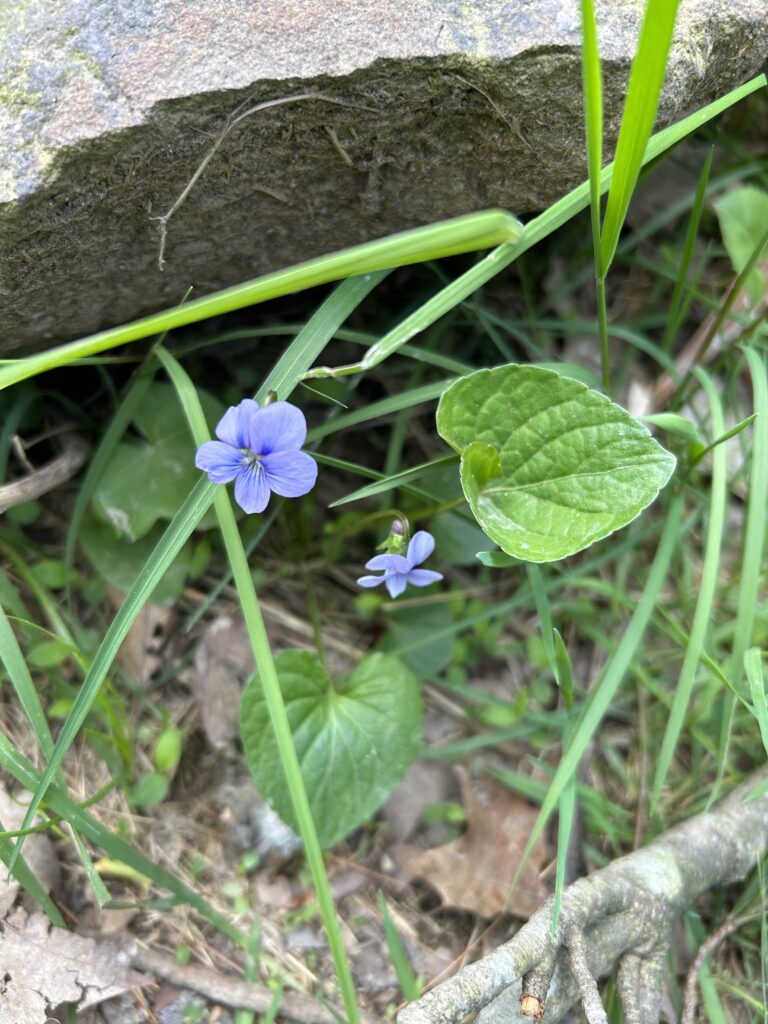
The lovely Common Blue Violet (Viola sororia) came in third place on the list of observed species.

With plants claiming nine of the top ten spots, it’s fitting to get perspective from the museum’s Section of Botany, who not only participate, but whose dedication puts them at the top of the list. Although they are literally professionals at looking for plants, the common message from the Botany staff is that anyone can do this challenge! The objective is to document nature all around us, from parks to neighborhood streets to city blocks and beyond. 

Reflections from the Section of Botany Scientists

Curatorial Assistant Alyssa Landa made a point to visit similar spots that she visited last year, as well as around her yard and street to look at things she walks past every day. “CNC is a great reminder to check out places near me,” Alyssa said. “The big thing for me this year is just the number of new-to-me species I was able to log, just by taking that little bit of extra time to pay attention to what’s around that I might not otherwise be drawn to or notice! This time of year is always really exciting to me, and CNC is a fun reminder that there’s still so much to learn. It’s also a reminder to revisit my old, well-known (plant) friends too.” And her efforts made a difference! Alyssa logged the second highest total identifications, putting her expertise to excellent use.

A steadfast champion for the City Nature Challenge, Associate Curator of Botany Mason Heberling uses the challenge to check out the woods nearby where he lives. “I get caught up in other things and forget to appreciate the hyper-local diversity, within walking distance,” Mason said. “I make it a point to visit the same woods by my house every CNC.” Despite travelling out of the area for much of the challenge, Mason logged nearly 100 local observations!

And then there’s Bonnie Isaac, the section’s Collection Manager. Although City Nature Challenge is not a competition, it’s worth noting and applauding Bonnie’s efforts – she logged the highest number of both observations and identifications in the Pittsburgh region this year! She made 607 observations, which totaled 343 different species, and identified a whopping 1,697 entries! Bonnie shared her reflections about the challenge and described why it’s so important to her.

“When I was young, I could not spend enough time outdoors. I was outside from sunup till sundown or until my folks came looking for me. My curiosity led me to want to know what everything I encountered was. One year one of my sisters gave me a Peterson field guide for Christmas. This led me to discover that there was a whole series of Peterson field guides. Thus began my collecting career. I had to have every Peterson Field Guide that came out. (I now have a complete set of Peterson Field Guides, leather bound editions.)  With these guides I could go out and try to identify everything I saw. I was in heaven. I am also a very competitive person. The City Nature Challenge takes what I love to do and makes it into a bit of a competition. I don’t live in the Pittsburgh City Nature Challenge region. I live in Lawrence County. During the pandemic the best I could do was help with identifying observations. Now that I can travel to the Pittsburgh region during the City Nature Challenge. Game on!” – Bonnie Isaac

Of Bonnie’s impressive collection of field guides, the first one she received was not plants, but animal tracks! It was written by Olaus J. Murie, a former employee of Carnegie Museum of Natural History who became a world famous biologist. Image credit: Bonnie Isaac.

For this year’s challenge, Bonnie visited Raccoon Creek State Park, Moraine State Park, Bradys Run Park, and Brush Creek Park. “The City Nature Challenge gives me a chance to get outside and see how many different things I can find,” Bonnie said. “Every year I challenge myself to find more species than I did the previous year. I also find identifying observations made by others somewhat satisfying. I get a chance to hone my identification skills and I get to see what others have found.”

Even for a botanist with decades of experience like Bonnie, each year brings surprises. “Every year there are surprises that I didn’t expect. I’ll discover that something is blooming that I didn’t think would be blooming yet, or I might find that someone found a plant growing in an area where I wouldn’t have expected it.”
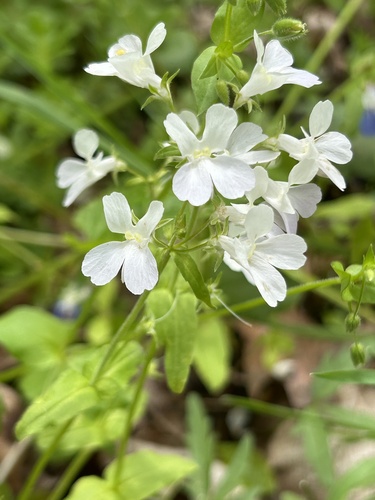
Bonnie has never seen an all-white Blue-eyed Mary (Collinsia verna). She was excited to see that iNaturalist user “bquail” found some during the challenge. Image credit: © bquail via iNaturalist, CC BY-NC

Bonnie continued, “The top observations tend to be some of the same things, many plants that are not native to the area. It’s the things with only a couple observations that I find the most interesting. It’s these unusual observations that keep me eager to see what nifty things are being found basically in our own backyards. It also keeps me energized to get out and find more and to look closer for the minute details that might separate one species from another.” 

The iNaturalist app also allows for recordings of bird song, frog calls, and other sounds. Bonnie connected with a user who identified a unique feature on one of her uploaded recordings. “One of the surprises for me was someone contacting me to let me know that one of my bird recordings had gray tree frogs singing in the background.”
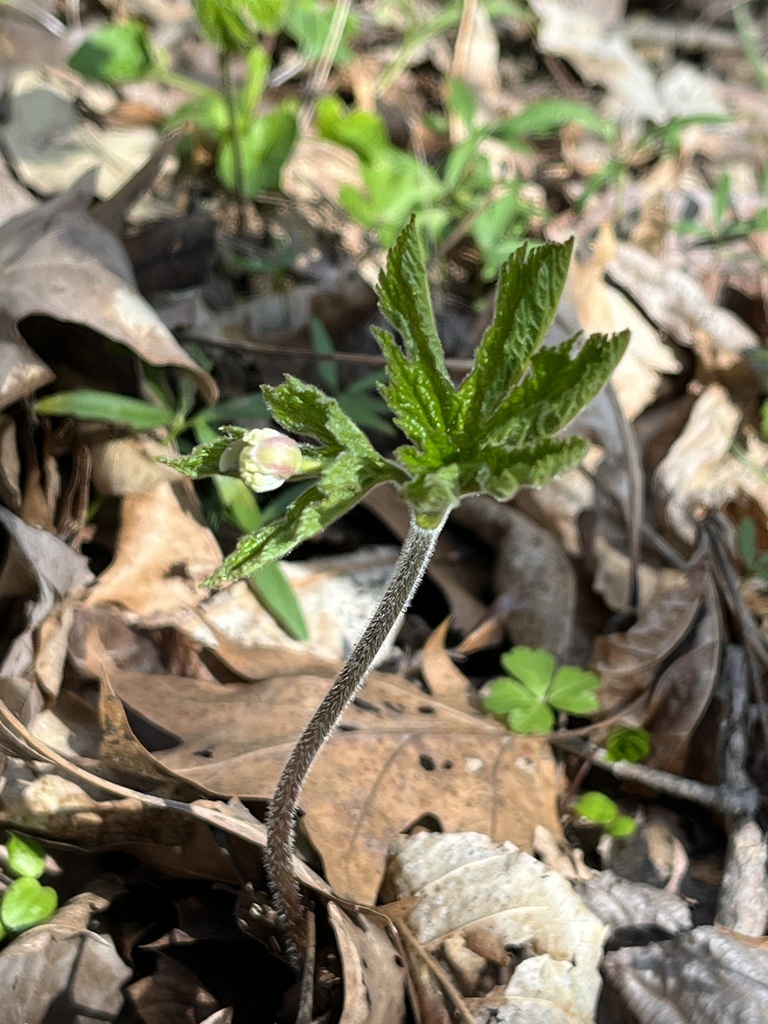
Bonnie’s favorite observation of 2024 was this Goldenseal, just coming into bloom. Image credit: Bonnie Isaac.

A Global Effort with Big Results

City Nature Challenge 2024 was not just a success in Pittsburgh – globally the number of cities participating increased to 690 this year, a big jump from 482 cities in 2023! Here are a few of the worldwide stats:

Total participants: 83,528 in 690 cities in 51 countries

Total observations made: 2.4 million

Total species identified: 65,682

The big winner across the board, with most observations, species, and participants is La Paz, Bolivia!

The City Nature Challenge returns next spring. Let’s see if we can build on the truly remarkable success of 2024!

Jessica Romano is Museum Education Writer at Carnegie Museum of Natural History.

Related Content

Snags, Logs, and the Importance of a Fallen Tree

City Nature Challenge: A 2022 Reflection

The City Nature Challenge Family Experience

Carnegie Museum of Natural History Blog Citation Information

Blog author: Romano, Jessica
Publication date: May 22, 2024
Share this post!

  • Share on Twitter Share on Twitter
  • Share on Facebook Share on Facebook
  • Share on Pinterest Share on Pinterest
  • Share on LinkedIn Share on LinkedIn
  • Share on Reddit Share on Reddit
  • Share via Email Share via Email

Filed Under: Blog Tagged With: Alyssa Landa, Bonnie Isaac, Botany, City Nature Challenge, Education, Jessica Romano, Mason Heberling

January 16, 2024 by Erin Southerland

Collected On This Day: Witch Hazel, January 1923

by Mason Heberling
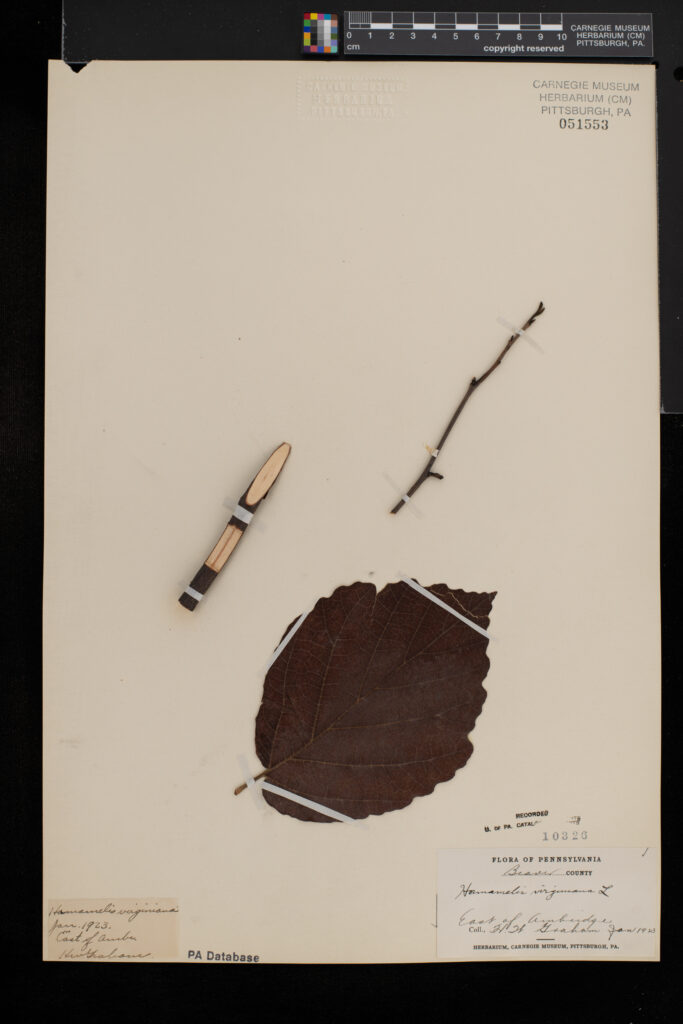
witch hazel branch, buds, and leaf on an herbarium sheet

This specimen of common witch hazel (Hamamelis virginiana) was collected in January 1923 in Beaver County, Pennsylvania “East of Ambridge” by H.W. Graham.  Herbert W. Graham (1905-2009) was an “Assistant” in Botany at the Carnegie Museum from 1925-1929 while he was a student at the University of Pittsburgh who later became an oceanographer at the Woods Hole Oceanographic Institution. During his time at the museum, he collected many specimens, often with his brother, Edward H. Graham, who was also an Assistant in Botany, later curator (1931-1937) and later, a well-known conservationist with the US Department of Agriculture.  The Graham brothers went on expeditions to the Sonoran Desert in the late 1920s, collecting specimens and information that was used to create the desert diorama that remains in the museum’s Hall of Botany today.

This specimen has a “bits and pieces” feel to it, but shows what the plant looks like in winter, with branches, buds, a leaf, and even including a nice cross section cut out of the stem. The leaf is in great shape, which makes me question whether the leaf was truly was collected in January, when the leaves are usually dry and crumbled from the wrath of winter. 

The specimen was simply collected in “January 1923” with no note on the day of year.  I feel that coming off a holiday break (what day is it?).  But more seriously, it reminds us that many specimens of the past were collected for different purposes with many of their uses today unanticipated.  For instance, collectors today would certainly record the calendar date of collection, valued just as much as information on the location it was collected, as scientists routinely use specimens to date information to understand the seasonal timing of leafing, flowering, and fruiting with changing environmental conditions over time.

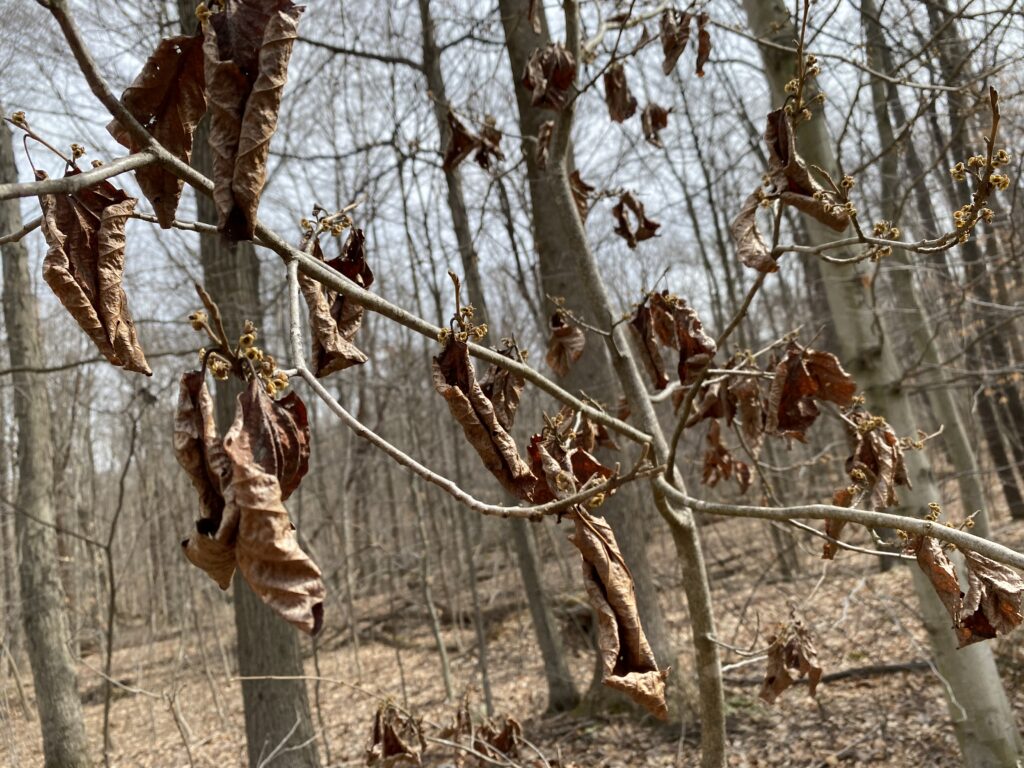
brown, dry leaves hanging from branches

The leaf is a nice touch, too.  It indicates that at least some leaves were still around in the winter of 1923, and it is quite possible they were even still connected to the stem.  Though this species is deciduous (drops its leaves seasonally), common witch hazel has been known to sometimes hang onto some dead leaves on branches through winter.  This phenomenon is known as “marcescence.”  Why this happens isn’t fully known.  Read more here.

You can find this specimen and 588 others of the species in the Carnegie Museum herbarium here.

Above: Witch hazel exhibiting marcescence, with last year’s leaves still attached in early spring (photo taken March 23 2021 at Powdermill Nature Reserve)

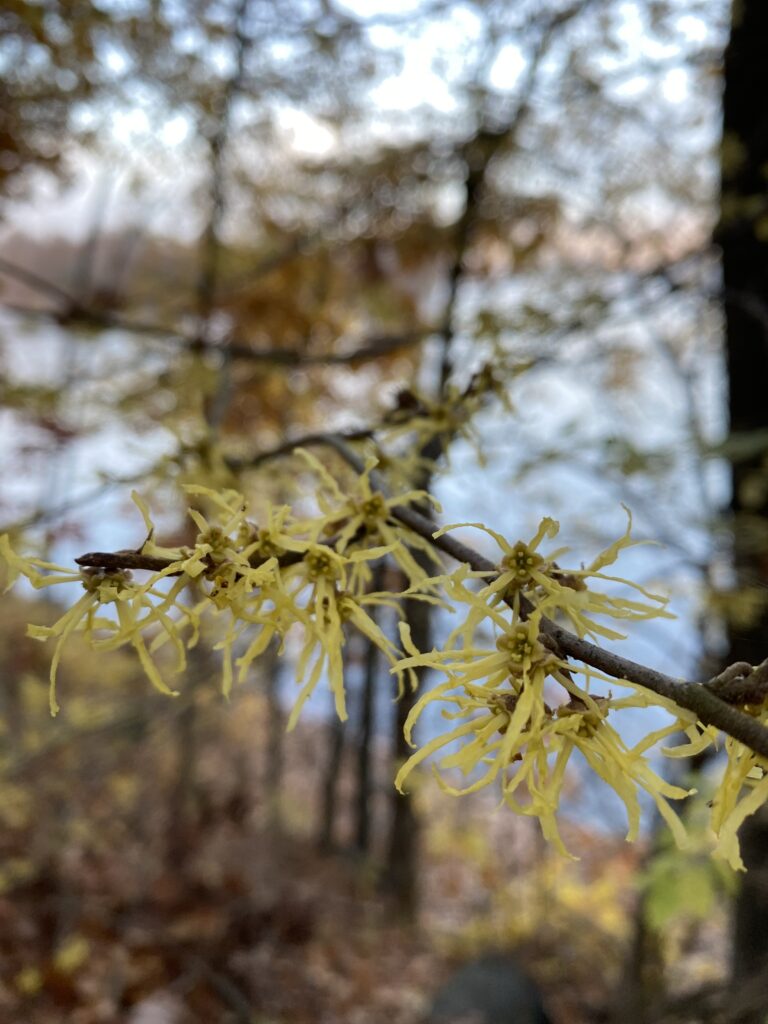
Below: Witch hazel’s magnificent autumn blooms. Unlike many woody plants in our region that bloom in spring as leaves are emerging, this species blooms in fall, as its leaves are dropping! (Photo taken October 29 2022 in New Kensington, PA.)

witch hazel blooms

Mason Heberling is Associate Curator of Botany at Carnegie Museum of Natural History.

Related Content

Witch Hazel Collected on Halloween in 1931

Collected On This Day in 1951: Bittersweet

What’s in a Name? Japanese Knotweed or Itadori

Carnegie Museum of Natural History Blog Citation Information

Blog author: Heberling, Mason
Publication date: January 16, 2024

Share this post!

  • Share on Twitter Share on Twitter
  • Share on Facebook Share on Facebook
  • Share on Pinterest Share on Pinterest
  • Share on LinkedIn Share on LinkedIn
  • Share on Reddit Share on Reddit
  • Share via Email Share via Email

Filed Under: Blog Tagged With: Botany, collected on this day, Hall of Botany, Mason Heberling, Science News

July 11, 2023 by Erin Southerland

Carnegie Museum of Natural History Awarded $225K Grant from Richard King Mellon Foundation to Lead Campaign Against Spread of Invasive Plant Species

Pittsburgh, Pennsylvania, July 11, 2023 — Thanks to a $225,000 grant from the Richard King Mellon Foundation, Carnegie Museum of Natural History (CMNH) will lead a collaborative education and outreach campaign to inspire local organizations and the public to act against the spread of invasive plant species across Pennsylvania and Central Appalachia. Partner organizations will include Audubon Society of Western Pennsylvania, Phipps Conservatory and Botanical Gardens, Pittsburgh Botanic Garden, and other organizations.

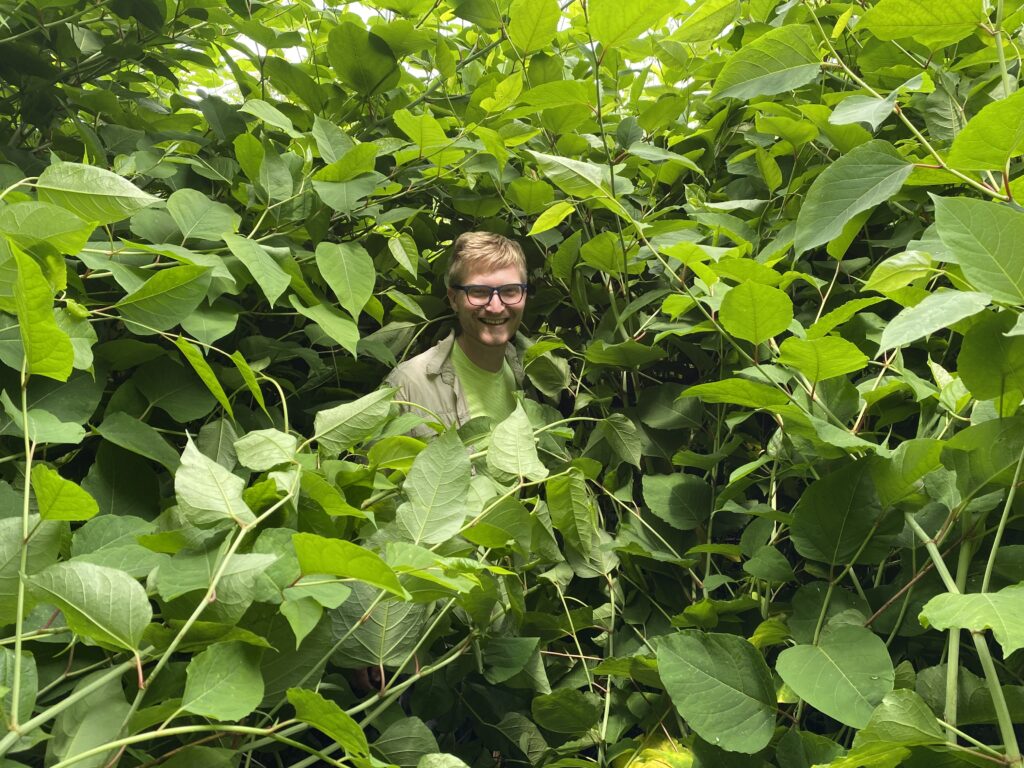
Associate Curator of Botany Mason Heberling with knotweed, an invasive plant.

CMNH cares for a collection of more than 550,000 plants specimens, the largest collection of Western Pennsylvanian plants in the world. The museum will leverage this collection and the scientific expertise of its own researchers and partner organizations to create and distribute a robust toolkit of resources designed to generate public awareness of invasive plants’ impact on local ecosystems and what people can do to slow their spread and prevent future introductions. Resources are anticipated to include museum exhibition content, digital assets, videos, maps, infographics, printed materials, and shared messaging that can be customized to the unique needs of each participating organization’s audience. The campaign will be distributed across a variety of outlets, including social media, printed handouts, and interpretive displays. 

“We’re grateful to the Richard King Mellon Foundation for this opportunity to convene the expertise of amazing colleagues in sister institutions to develop best practices for communicating about invasive species,” said Mason Heberling, CMNH’s Associate Curator of Botany. “We hope to cultivate an already growing audience and to empower the people of Western Pennsylvania to make a difference in the prevention and management of invasive species.”


The earliest record of knotweed (Reynoutria x bohemica) in the Pittsburgh region. The species now lines Pittsburgh’s three rivers, waterways, and roadsides. Collected in 1920.

The campaign will launch later in 2023 and continue through December of 2024, but the outcomes will continue well beyond that timeline. CMNH content will include a new interactive exhibit in the museum’s Hall of Botany and an exhibit at Powdermill Nature Reserve, the museum’s environmental research center located in the Laurel Highlands. CMNH will also create a free online repository for educational materials and curate a social media campaign linking the institutional partners to generate awareness and community participation across their respective networks of followers. “From weeds in your garden to invasive species in natural areas, the topic of introduced plants is not only a scientifically complex problem, but also a societally complex one,” added Heberling. “Many invasive plants were intentionally planted at first—and some continue to be planted—with environmental consequences often realized only decades later. Species invasions are one of the top drivers of biodiversity change, here in Pennsylvania and around the world.” 

About the Richard King Mellon Foundation
Founded in 1947, the Richard King Mellon Foundation is the largest foundation in Southwestern Pennsylvania, and one of the 50 largest in the world. The Foundation’s 2021 year-end net assets were $3.4 billion, and its Trustees in 2022 disbursed more than $152 million in grants and program-related investments. The Foundation focuses its funding on six primary program areas, delineated in its 2021-2030 Strategic Plan.

Filed Under: Press Release Tagged With: Botany, climate change, Mason Heberling, Science News

May 30, 2023 by Erin Southerland

Collected On This Day: White Trillium from May 28, 1993

by Mason Heberling
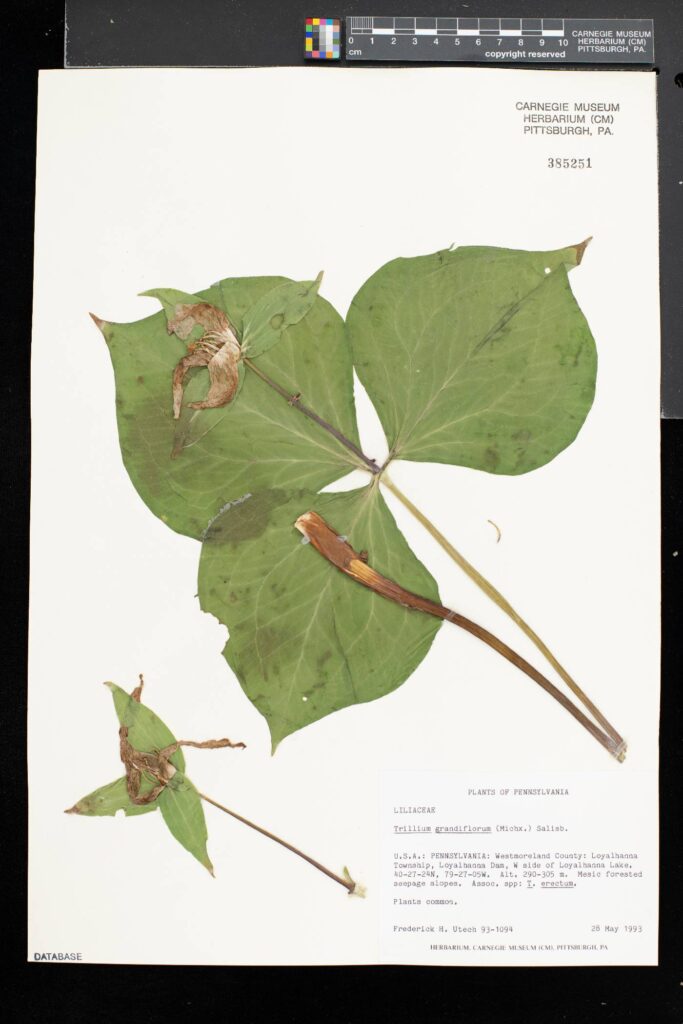
herbarium specimen of white trillium

Spring flowers fade, but some leaves hang on

This specimen of white trillium (Trillium grandiflorum) was collected by Fred Utech in Loyalhanna Township, Pennsylvania on May 28, 1993.  Fred Utech was Curator of Botany at Carnegie Museum of Natural History from 1976-1999. You can find this specimen here and search for many more trillium at midatlanticherbaria.org.

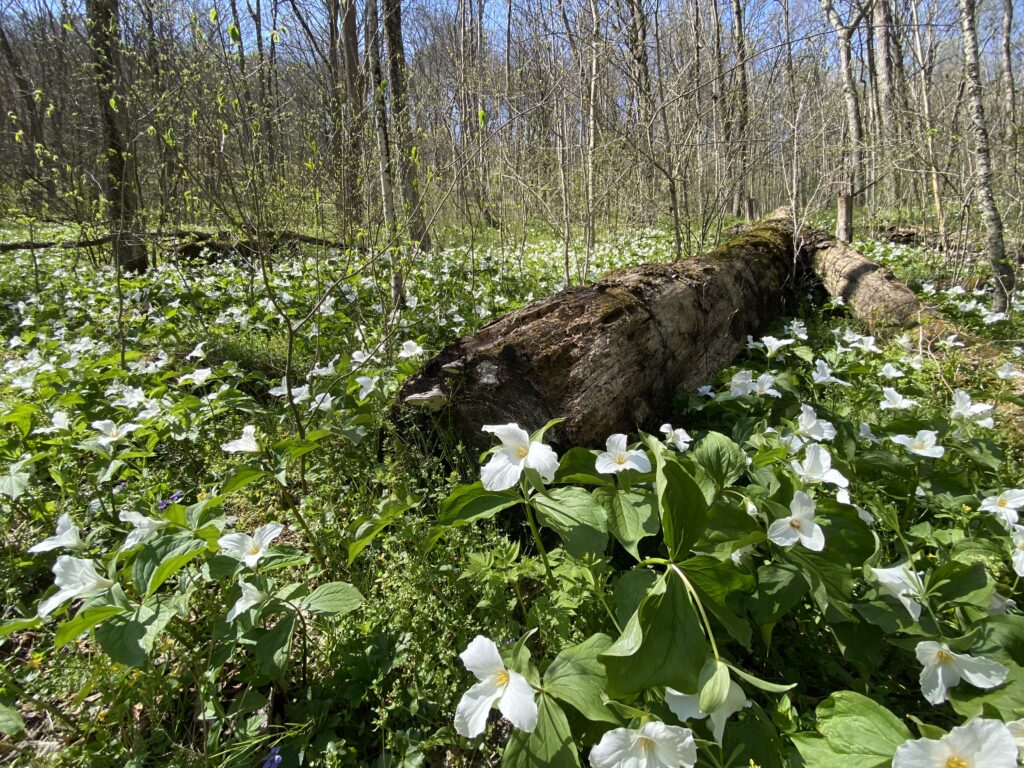
Trillium grandiflorum (white large-flowered trillium) is perhaps the most common trillium species in western Pennsylvania, along with Trillium erectum (red trillium, though petals can be white, red/purple, or occasionally yellow; the ovary is deep red, unlike white trillium).  Peak blooms of this species can be breathtaking when covering hillsides. Deer also enjoy trillium, and herbarium specimens have been used to understand their impact.

numerous white trillium flowers growing in a forest

As the heat of summer is upon us, these spring blooming species begin to fade. Or at least their flowers do.  Some trillium keep their leaves into the deep shade of summer. Though light levels are low due to the shade of overstory trees, early summer is an important time for many spring blooming species to develop their fruits.  A local study from our group found more than 20% of photosynthetic energy gains in Trillium grandiflorum after overstory trees produced leaves.

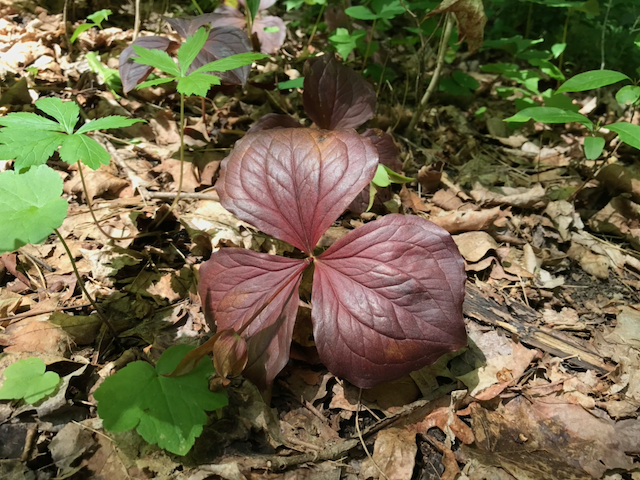
White trillium leaves do die back in mid-summer, however.  We often think of leaf coloration in the fall, but some trillium curiously have leaves that turn a deep red as they fade in mid-summer.  We are currently working up an undergraduate students-led project on this intriguing natural history phenomenon. Only about 10% of plants turn red (but highly variable), and first results suggest there doesn’t seem to be a method to the madness that explains why. More soon!  For now, enjoy the “fall” foliage of summer below.

red leaved white trillium growing in the woods

Mason Heberling is Assistant Curator of Botany at Carnegie Museum of Natural History.

Related Content

Collected On This Day in 1925: A Flower with No Leaves?

Collected On This Day in 1982: One Specimen Isn’t Always Enough!

Mayapple at Powdermill [Video]

Carnegie Museum of Natural History Blog Citation Information

Blog author: Heberling, Mason
Publication date: May 30, 2023

Share this post!

  • Share on Twitter Share on Twitter
  • Share on Facebook Share on Facebook
  • Share on Pinterest Share on Pinterest
  • Share on LinkedIn Share on LinkedIn
  • Share on Reddit Share on Reddit
  • Share via Email Share via Email

Filed Under: Blog Tagged With: Botany, collected on this day, Hall of Botany, liocf, Mason Heberling, Science News

November 1, 2022 by Erin Southerland

The Vine That Ate Pittsburgh? Not yet.

by Mason Heberling
herbarium sheet specimen of kudzu

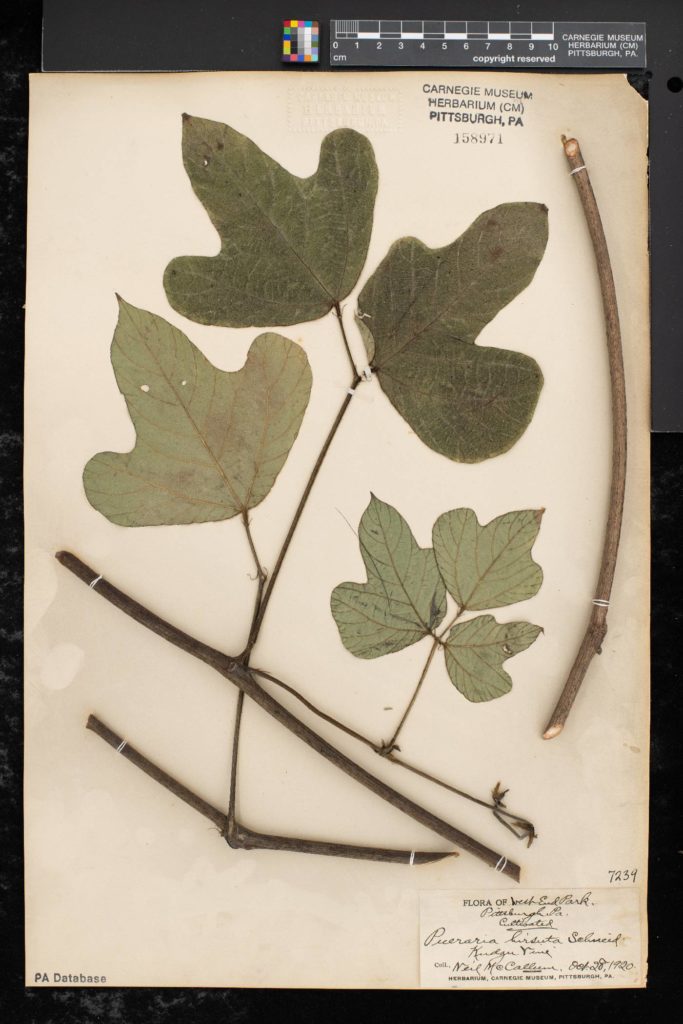
This specimen of Kudzu (Pueraria montana var. lobata) was collected on October 28, 1920 by Neil McCallum at West End Park, Pittsburgh. The plant was collected in cultivation, meaning it was intentionally planted and grown in a garden or similar managed landscape. This specimen is one of the earliest records of the species in Pittsburgh. (It was also collected two years before).

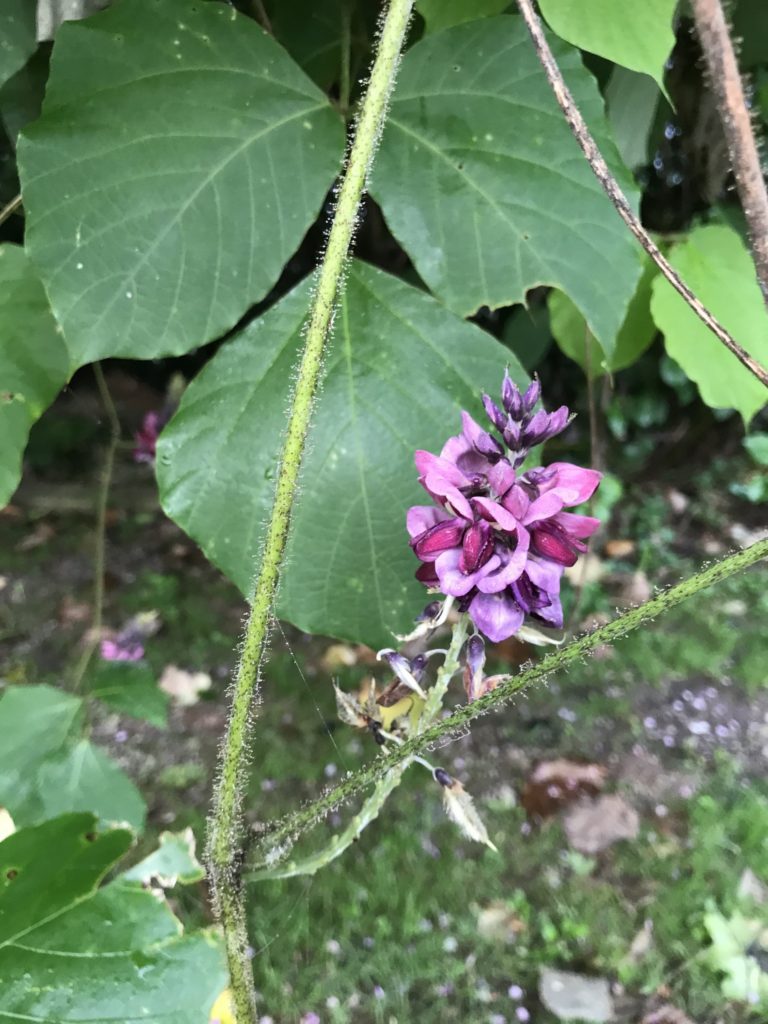
kudzu flower

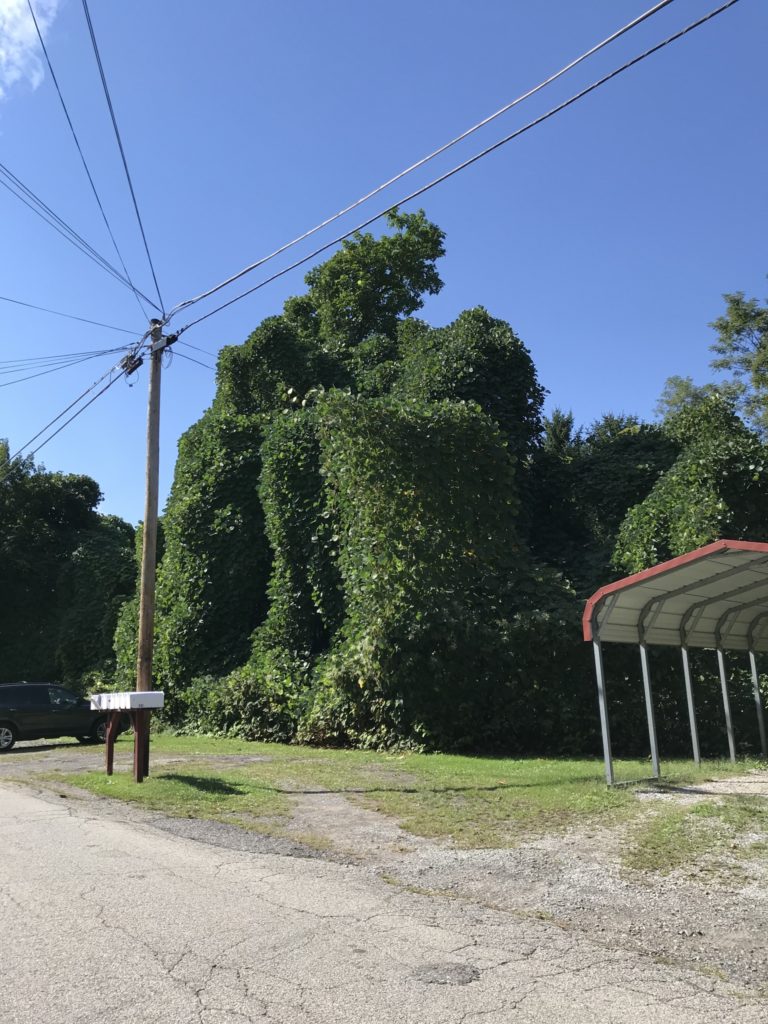
Kudzu is a vine in the bean family, Fabaceae, with beautiful purple flowers. Native to East Asia, it was introduced as an ornamental plant to the United States from Japan in 1876 at the Philadelphia Centennial Exposition. It was promoted in the 1930-40s in the southern US to prevent soil erosion. However, it is now an invasive species, with big ecological impacts. It is widely known as “the vine that ate the South.”  A quick Google search will show you striking pictures of the vine covering large areas of land, covering trees, shrubs, logs, and anything else in the path of its explosive growth. Kudzu shades out existing vegetation and can drastically alter the ecosystem.

kudzu under telephone wires


It is not common in Pennsylvania, but perhaps might become so.  Kudzu is listed by the state as a “Class A Noxious Weed” – meaning it is assessed as a high invasive risk and ecological/economical concern, but is uncommon and possible to be eradicated.  It cannot be sold or planted commercially in Pennsylvania.

It is currently most invasive in the South, but a study published in 2009 by Dr. Bethany Bradley and others suggests that the species may become more invasive in the north (including Pennsylvania) as climate change continues.


You can find this specimen online here, and search our collection at midatlanticherbaria.org.

Mason Heberling is Assistant Curator of Botany at Carnegie Museum of Natural History. 

Related Content

Collected on this Day in 1951: Bittersweet

Collected on this Day in 1930: Native…or Not?

Collected on this Day in 1995: Ragweed

Carnegie Museum of Natural History Blog Citation Information

Blog author: Heberling, Mason
Publication date: October 28, 2022

Share this post!

  • Share on Twitter Share on Twitter
  • Share on Facebook Share on Facebook
  • Share on Pinterest Share on Pinterest
  • Share on LinkedIn Share on LinkedIn
  • Share on Reddit Share on Reddit
  • Share via Email Share via Email

Filed Under: Blog Tagged With: Botany, collected on this day, liocf, Mason Heberling, Uprooted, We Are Nature 2

February 1, 2022 by Erin Southerland

STUDY CALLS FOR “EXCITING NEW ERA” OF INCREASED USE OF PLANT SPECIMENS AS TRAIT DATA SOURCES

Dr. Mason Heberling, Assistant Curator of Botany at Carnegie Museum of Natural History. 

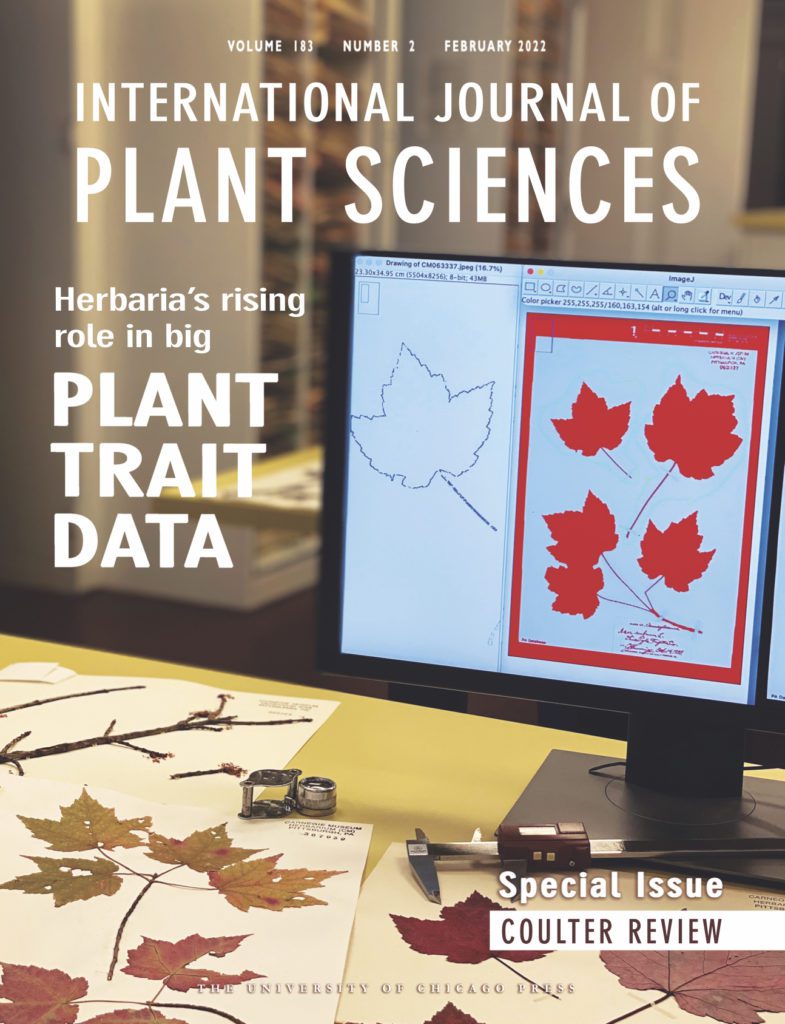
A new review by Dr. Mason Heberling, Assistant Curator of Botany at Carnegie Museum of Natural History (CMNH), cites diverse studies to synthesize past and current uses of plant specimens as trait data sources and to advocate for “an exciting new era” of potential future applications, bolstered by technology and digitization. The review, “Herbaria as big data sources of plant traits,” will be published as the most recent John M. Coulter Review and featured cover article in the February edition of the University of Chicago Press’s International Journal of Plant Sciences. The prestigious Coulter Review provides scientists in the forefront of their fields the opportunities to share insights on the latest developments of plant biology.

Cover of the February 2022 issue of International Journal of Plant Sciences.

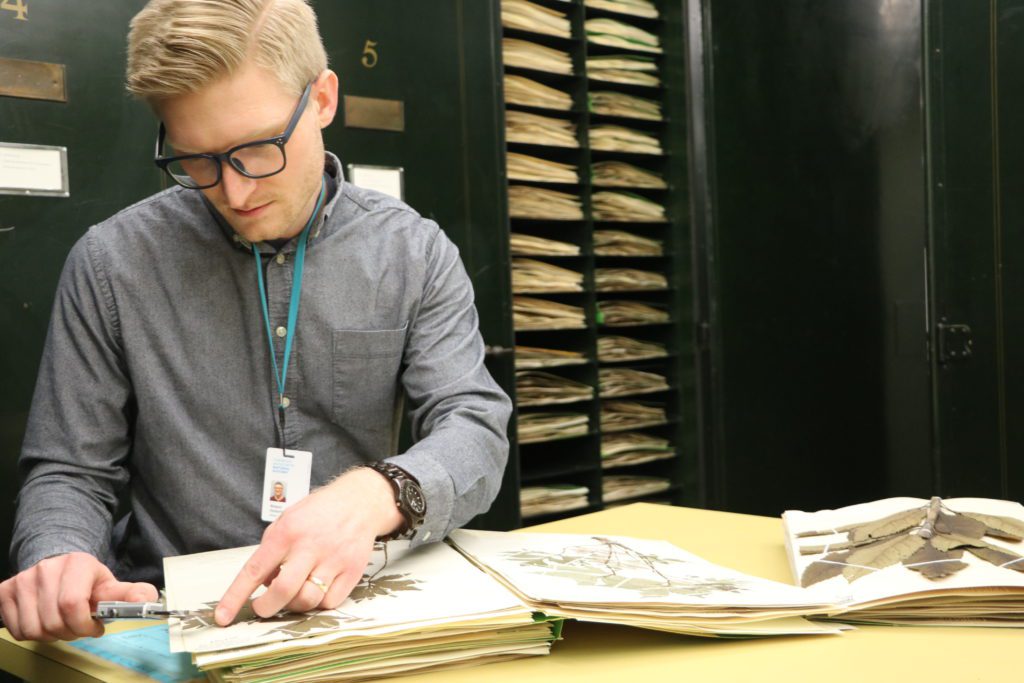
Thanks to the digitization of museum specimens, more than 3,000 active herbaria worldwide, including CMNH’s herbarium, serve as increasingly connected scientific resources documenting botanical diversity through time and space. With 396 million specimens and counting, these collections represent all formally described plant species—an ongoing effort of many thousands of botanists on every continent for over four centuries. However, these specimens are only recently being recognized for their potential as sources of extensive data on plant functional traits. 

Traditionally, herbaria and collections have been used for a handful of disciplines, including taxonomy and systematics, floristics and biogeography, species identification, scientific vouchers, and education. However, recent applications of herbaria data demonstrate a scientific relevance that diversifies beyond these original uses. They include the extraction of genetic material from century-old specimens to quantify changing plant-insect interactions. New molecular methods like next-generation sequencing make the extraction of genetic material from herbarium specimens possible in the developing field of “museomics,” or genomics exclusively studying organisms found in museum collections. Such molecular advances provide new insights into extinct species and detect genetic changes of introduced species as they spread across the landscape. Herbarium applications unanticipated—and unimagined—even a few decades ago are now mainstream. 

“As an ecologist coming into the herbarium for the first time, I was struck by the richness and enormity of information in these collections, and much of it is unrealized outside of taxonomy,” Heberling writes. “Tapping into specimens for trait data is by no means new but spread across many studies and often on smaller scales. I spent years compiling these uses of specimens as sources for trait data and staring at specimens, asking, ‘What information can we get from the many millions of decades-old specimens collected across the globe?’ This review aims to foster an exciting new era for herbaria.”

However, scientists often discount herbarium specimens as unreliable because modern utilizations may test hypotheses for which the data were not originally intended. While conceding validity to these points, Heberling argues that “preconceived assumptions about data suitability for use can stifle innovation” and suggests retroactive and proactive solutions to potential herbaria limitations, including addressing collector bias, validating herbarium-derived trait measurements, addressing microsite variation, and solutions to collecting. 

Heberling proposes new collection practices that will require a new scientific culture surrounding herbaria with significant digital, physical, and human resource infrastructural investment for transformative change. “It is an exciting time for collections,” he concludes. “Bolstered by more than a decade of digitization and emerging initiatives, the role of herbaria in modern research should only strengthen. Herbaria should be embraced as centers for functional trait research, with their uses as diverse as the specimens they house.”

The International Journal of Plant Sciences has a distinguished history of publishing research in the plant sciences since 1875. IJPS presents high quality, original, peer-reviewed research from laboratories around the world in all areas of the plant sciences. Topics covered range from genetics and genomics, developmental and cell biology, biochemistry and physiology, to morphology and anatomy, systematics, evolution, paleobotany, plant-microbe interactions, and ecology. The International Journal of Plant Sciences established the John M. Coulter Review, in 2012 in honor of John Merle Coulter (1851–1928), who joined the University of Chicago in 1896 as the first Head Professor of Botany.

Filed Under: Press Release Tagged With: Botany, Mason Heberling

  • Page 1
  • Page 2
  • Page 3
  • Interim pages omitted …
  • Page 21
  • Go to Next Page »

sidebar

About

  • Mission & Commitments
  • Directors Team
  • Museum History

Get Involved

  • Volunteer
  • Membership
  • Carnegie Discoverers
  • Donate
  • Employment
  • Events

Bring a Group

  • Groups of 10 or More
  • Birthday Parties at the Museum
  • Field Trips

Powdermill

  • Powdermill Nature Reserve
  • Powdermill Field Trips
  • Powdermill Staff
  • Research at Powdermill

More Information

  • Image Permission Requests
  • Science Stories
  • Accessibility
  • Shopping Cart
  • Contact
  • Visitor Policies
One of the Four Carnegie Museums | © Carnegie Institute | Privacy Policy | Terms of Use | Accessibility
Rad works here logo