• Skip to primary navigation
  • Skip to main content
  • Skip to primary sidebar

Carnegie Museum of Natural History

One of the Four Carnegie Museums of Pittsburgh

  • Visit
    • Buy Tickets
    • Visitor Information
    • Exhibitions
    • Events
    • Dining at the Museum
    • Celebrate at the Museum
    • Powdermill Nature Reserve
    • Event Venue Rental
  • Learn
    • Field Trips
    • Educator Information
    • Programs at the Museum
    • Bring the Museum to You
    • Guided Programs FAQ
    • Programs Online
    • Climate and Rural Systems Partnership
  • Research
    • Scientific Sections
    • Science Stories
    • Science Videos
    • Senior Science & Research Staff
    • Museum Library
    • Science Seminars
    • Scientific Publications
    • Specimen and Artifact Identification
  • About
    • Mission & Commitments
    • Directors Team
    • Museum History
  • Tickets
  • Give
  • Shop

paleontology

September 4, 2018 by wpengine

Pebble or Jaw?

by Jay Margolis

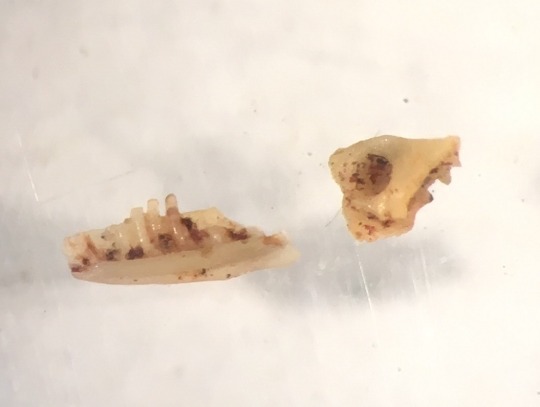
partial jawbone and bone fragment fossils

It can be difficult to find fossils when working on a microscopic scale. The partial jawbone and bone fragment above are each less than a centimeter (0.4 inches) in maximum diameter, but their small size makes them no less important to paleontologists and other researchers. Even diminutive fossils such as these can be used to help scientists determine the diet or behavior of extinct animals, as well as to piece together what kind of environment they lived in.
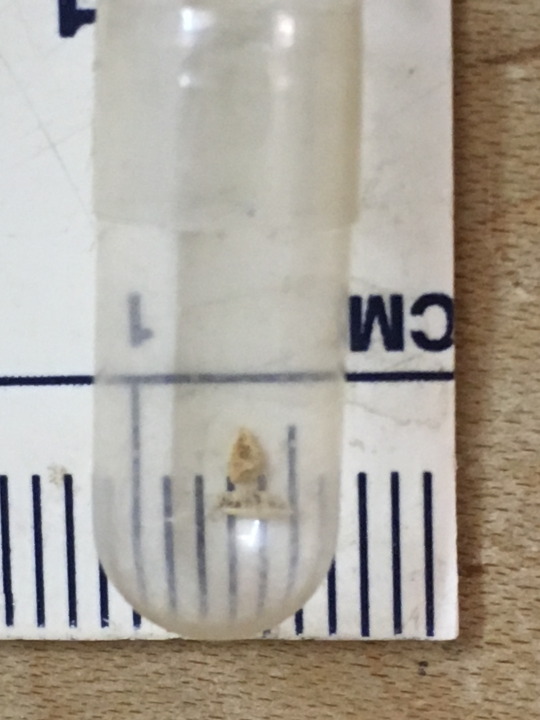
fossil measuring

Even with the help of microscopes, it can be hard to tell such fossils apart from the tiny rocks and sediment that they are often mixed in with. After spending a long amount of time practicing and studying, telling fossil apart from rock can become easier. However, for those who have not had as much practice, there are a few easy ways to help distinguish the two.

One of these ways is to look for striations, or organized and consistent lines. These lines are all oriented in the same direction and can be seen on the surface of some fossils as an indicator of past bone growth. Another way is to look for pores, circular holes that would be visible in a cross-section of a fossil bone. These holes indicate where blood vessels once carried nutrients throughout the bone.

Both of these textures can potentially be seen in a disorganized fashion on rocks and minerals. However, seeing these two textures together, and arranged in an orderly way, is among the best indicators that the rock you thought you were looking at is actually a fossil.

Jay Margolis is an intern from Chatham University working in the Section of Vertebrate Paleontology at the Carnegie Museum of Natural History. Museum employees are encouraged to blog about their unique experiences and knowledge gained from working at the museum.

Filed Under: Blog Tagged With: fossils, Jay Margolis, paleontology, Vertebrate Paleontology

August 20, 2018 by wpengine

Millions, Billions, and Trillions

By Chase D. Mendenhall

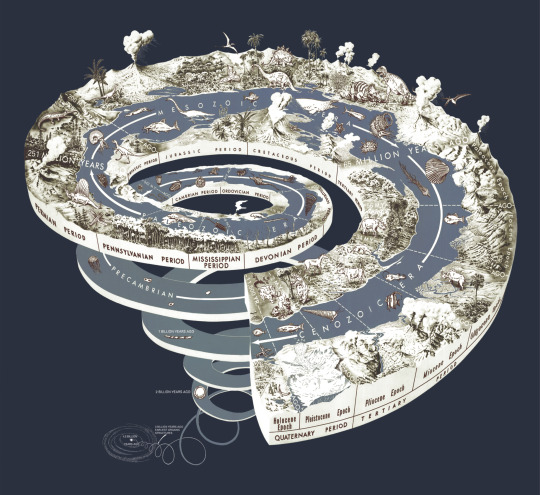
diagram of geologic time

President Trump has 53,800,000 followers on Twitter. The popular song Despacito has 5,400,000,000 views on YouTube. And, the computer giant, Apple, is worth nearly $1,000,000,000,000.

Millions, billions, and trillions are numbers we hear and see regularly nowadays, but the value of these giant numbers can get lost in all the zeros.

Comprehending these values is key to understanding natural history, but there are a couple tricks to put things into perspective.

For example, the earliest undisputed evidence of life, fossilized bits of Archean bacteria, are about 3.5-billion years old. To wrap your brain around this giant number, it is helpful to convert these large numbers into a human experience, say, an average human lifespan in the USA. Today, people can expect to live to be about 78-years old, or about 2.5 billion seconds. In other words, if you wanted to live for 3.5 billion seconds, you would be 110 years.

When biologists like me throw around numbers, like, “for 150 million years birds have been flying,” it is helpful to think of 150 million seconds as almost 5 years.

Chase Mendenhall is Assistant Curator of Birds, Ecology, and Conservation at Carnegie Museum of Natural History. Museum employees are encouraged to blog about their unique experiences and knowledge gained from working at the museum.
Filed Under: Blog Tagged With: Anthropocene, geology, paleontology

July 27, 2018 by wpengine

My Guildey Pleasure

By Andrew McAfee

As the Scientific Illustrator for the Section of Vertebrate Paleontology at Carnegie Museum of Natural History, I spend most of my time in the museum interpreting and representing the paleontologists’ work in visual form. Most of this work takes place at a desk with a computer. But as a member of the Guild of Natural Science Illustrators (GNSI), I spend one week per year away from the desk, learning new techniques in the field and sharing a few of my own.

The GNSI is an organization of scientists and science illustrators founded in 1968 by illustrators at the Smithsonian Institution in Washington, DC. The purpose of the GNSI is to advance science illustration by facilitating the exchange of ideas, knowledge, and techniques among its members.

Every year around July, the GNSI has a conference that brings members from all around the world together for a week of plenary speakers, technique expositions, lectures, and workshops. It’s a wonderful opportunity to commune with colleagues in the field of scientific illustration and acquire new perspectives and technical abilities.

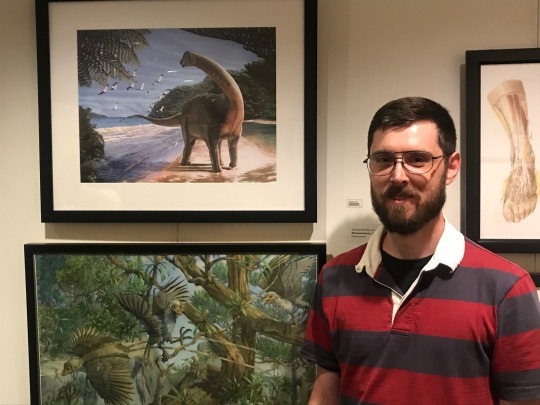
Andrew McAfee with his digital painting of Mansourasaurus 
Andrew McAfee with his digital painting of Mansourasaurus (upper left) on display in GNSI’s 50th anniversary exhibition, Visualize: Art Revealing Science, at AAAS headquarters. Photo: Reid Psaltis.

I joined the GNSI in 2013 and have not missed a conference since. This year’s event marked the 50th anniversary of the Guild’s formation and represented a homecoming, returning to Washington, DC. As a part of our anniversary celebration, the American Association for the Advancement of Science (AAAS)—known for, among other things, publishing one of the world’s foremost scientific journals, Science—hosted our annual members’ juried exhibition.

This year I was honored to have two pieces selected for exhibition in the show: my reconstructions of the recently-named dinosaurs Mansourasaurus shahinae and Tratayenia rosalesi, both completed at Carnegie Museum of Natural History under the guidance of paleontologist Matt Lamanna. I was proud to represent the museum and it was gratifying to see my work sharing walls with the stellar work of my colleagues in the AAAS gallery.

Visualize: Art Revealing Science, the 50th anniversary GNSI exhibit, will be on display at AAAS headquarters until October 15, 2018.

Andrew McAfee is Scientific Illustrator for the Section of Vertebrate Paleontology at Carnegie Museum of Natural History. Museum employees are encouraged to blog about their unique experiences and knowledge gained from working at the museum.
Filed Under: Blog Tagged With: Andrew McAfee, dinosaur, dinosaurs, dinosaurs in their time, paleontology, Vertebrate Paleontology

July 23, 2018 by wpengine

The Hidden Fossil Treasures of the Section of Invertebrate Paleontology of the Carnegie Museum of Natural History

By Albert D. Kollar

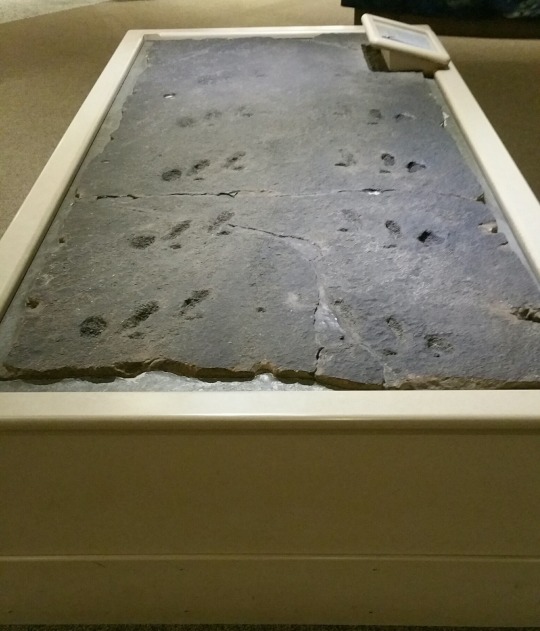
When people hear the name Invertebrate Paleontology often times they are confused what it means. Invertebrates are animals without backbones such as trilobites, lobsters, clams, snails, corals, sea urchins, and brachiopods to name a few. The term paleontology refers to fossilized animals that once lived in the geologic past. The evidence of this event is preserved in earth’s sedimentary rocks. Invertebrate fossils are found in limestones, sandstones, and shales that formed in ancient oceans, lakes and rivers during times of environmental and climate change.

Close to a million invertebrate fossil specimens are housed in the Section of Invertebrate Paleontology cabinets stored in the museum’s basement. To build a collection of 800,000 plus fossils, it takes more than a century of field collecting by section staff, exchanges with other museums from around the world, donations from our research associates and regional universities. Under special circumstances, donations are received from the general public if the fossils and the localities can be verified scientifically.

Eurypterid trackway.
Eurypterid trackway

The section’s collection strengths are based on the paleontologically, stratigraphic, and geologic interest of the section’s scientists and colleagues who work on the various invertebrate groups. The section historical strengths are in the fossil groups of trilobites, brachiopods, crustaceans’ snails, cephalopods, and the eurypterid trackway. Sometimes special fossils from the collections are placed on the museum’s exhibit floor in Benedum Hall of Geology and Dinosaurs in Their Time. For instance, one of the great regional fossils is the giant eurypterid trackway on display in Benedum Hall of Geology. The fossil track was discovered by museum scientists in 1948 in Elk County, Pennsylvania. The fossil was later named Palmichnium kosinskiorum in honor of the discoverer, James Kosinski. An in-depth geology review of the fossil site was published in the Carnegie Annals in 2016 by section staff Albert Kollar and David Brezinski.  Other Pittsburgh area fossils from the collection can be found in the Pennsylvanian Marine Diorama in Benedum Hall of Geology.

In future blogs, the section will be talking about the history of research, collection expeditions, fossils on display, the importance of volunteers in the sections and many more topics. Stay tuned.

Albert D. Kollar is the Collection Manager in the Section of Invertebrate Paleontology at Carnegie Museum of Natural History. Museum employees are encouraged to blog about their unique experiences and knowledge gained from working at the museum.
Filed Under: Blog Tagged With: Albert Kollar, fossils, invertebrate paleontology, paleontology

July 9, 2018 by wpengine

Revisiting a former expedition: Antarctica Peninsula Paleontology Project (AP3)

The following was taken from a blog series posted by Carnegie Museum of Natural History which documented a paleontology expedition in 2016.

researcher in Antarctica

“February 29–March 6, 2016

Project G-182-N (PI Matt Lamanna)

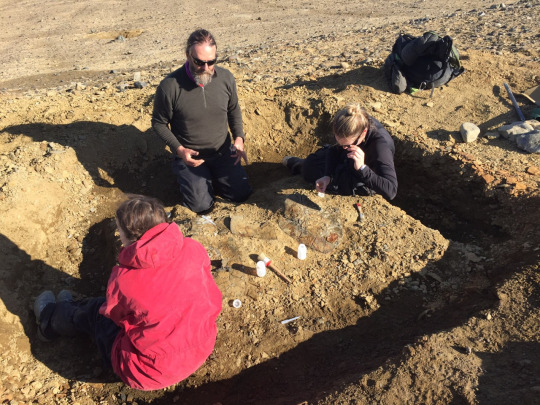
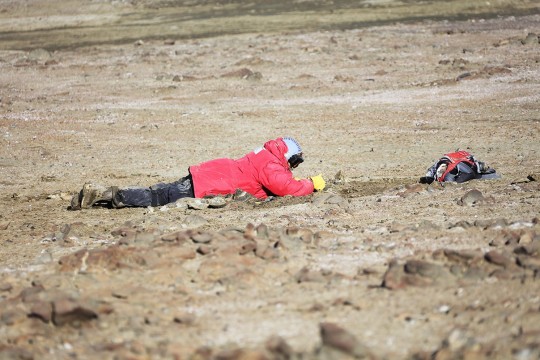
The team completed several of its research objectives and continued to make progress towards others during week three. At the Sandwich Bluff locality on Vega Island, scientists discovered four new fossil plant sites, found additional Cretaceous fish and bird material, and prepared a plesiosaur (long-necked marine reptile) shoulder girdle for extraction.

All of these specimens were recovered from the Upper Cretaceous Sandwich Bluff Member of the López de Bertodano Formation. At approximately 70 million years in age, this rock unit dates to only a few million years prior to the infamous mass extinction that ended the Mesozoic era, or Age of Dinosaurs.

researchers at work in Antarctica

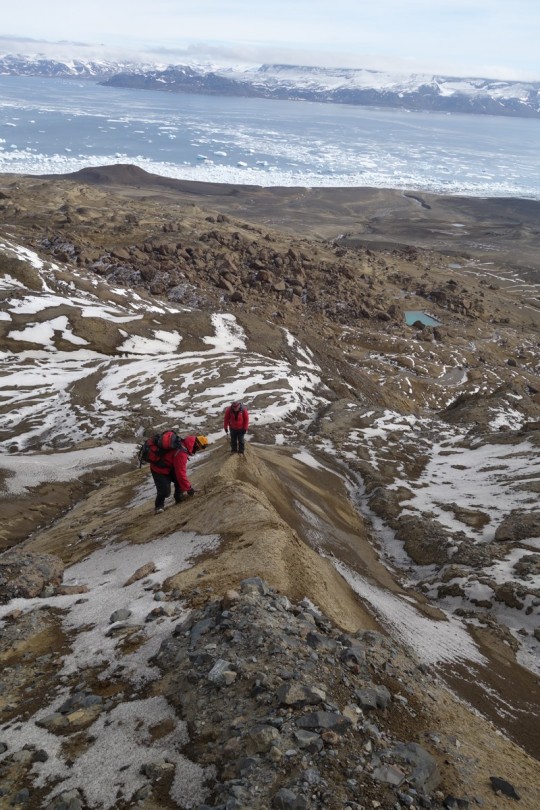
Geologists Eric Roberts and Zubair Jinnah completed their stratigraphic and sedimentological study of the sections of the Snow Hill Island and López de Bertodano formations exposed on the southwestern flank of Sandwich Bluff, an area that, due to its steepness, elevation, and snow cover, has been nicknamed ‘K2’ after that well-known Himalayan peak. They sampled the middle and upper levels of the Sandwich Bluff Member for aragonitic fossil invertebrate shells to be used in strontium isotope geochronological analyses.

Scientists also continued to conduct helicopter-supported reconnaissance visits to other areas of the James Ross Basin, identifying two previously undocumented Cretaceous exposures that were targeted for future investigation.

Inclement weather forced many members of the team to return to their ship, the RVIB Nathaniel B. Palmer, for two days during week three. They spent the time refining strategies for the remainder of the field season, updating the project’s blog and social media pages, and studying fossils that had already been collected.

researchers in Antarctica

1) G-182-N paleontologists Abby West (left) and Steve Salisbury (center) collect a plesiosaur shoulder girdle co-discovered by Salisbury with ASC Marine Technician Julia Carlton (right). Photo by Matt Lamanna.

2) G-182-N geologists Zubair Jinnah (foreground) and Eric Roberts study the stratigraphy and sedimentology of the ‘K2’ section on Vega Island. Photo by Pat O’Connor.

3.) G-182-N paleontologist Kerin Claeson searches for fossils in the ‘Fish Horizon’ near the K–Pg boundary on Seymour Island. Claeson and other G-182-N personnel have collected dozens of partial to nearly complete fish skeletons from the ‘Fish Horizon’ to date, the analysis of which promises to inform understanding of the K–Pg mass extinction in the southern high latitudes. Photo by Meng Jin.”


Matt Lamanna is a paleontologist and the principal dinosaur researcher at Carnegie Museum of Natural History in Pittsburgh. Matt and his team of researchers blogged frequently from Antarctica while on expedition at antarticdinos.org. Detailing his trip in a family-friendly, interactive documentary, Expedition Antarctica, paleontologist Matt Lamanna shares his unique experience. Members are required to preregister for the event. Sign up now.

Filed Under: Blog Tagged With: Antarctic Peninsula Paleontology Project, antarctica, fossils, Matt Lamanna, paleontology

July 9, 2018 by wpengine

Revisiting a former expedition: Antarctica Peninsula Paleontology Project (AP3)

The following blog was taken from a series posted by Carnegie Museum of Natural History which documented a paleontology expedition in February 2016. 

sunset

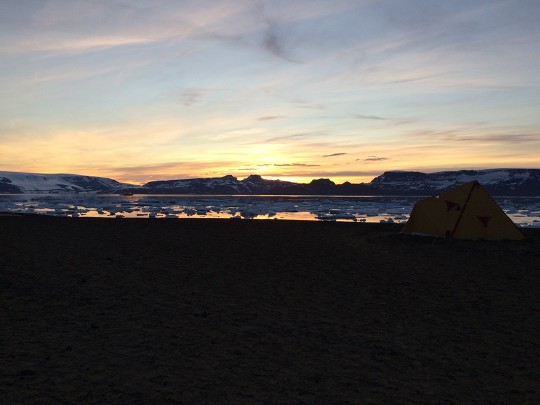
Sunset over camp on Vega Island. The eastern shore of James Ross Island and the RVIB Nathaniel B. Palmer are visible in the background. Photo by Pat O’Connor.

“February 21–28, 2016

Project G-182-N (PI Matt Lamanna)

Work at the main basecamp on the western shore of Vega Island continued in week two and resulted in the discovery of a wealth of fossils.

Senior project geologist Eric Roberts located a partial plesiosaur. The specimen, which preserves numerous vertebrae, ribs, paddle bones, and gastroliths (stomach stones), appears to be the most complete marine reptile discovered by the project to date. Many of its bones remain articulated (preserved in life position) and are beautifully preserved within sandstone concretions. With time and effort in the laboratory, much of the postcranial skeleton will likely be reassembled and will likely be significant both for scientific study and possible display.

The project made significant progress towards its geological aims as well. Roberts and fellow geologist Zubair Jinnah continued their efforts to decipher the age and depositional environments of the sediments exposed on the uppermost levels of Sandwich Bluff. They collected rock and fossil samples from the uppermost Sandwich Bluff Member and basal Sobral Formation for geochemical and palynological analyses and strontium isotopic dating. They also began to subdivide the Sobral Formation into discrete units, as Roberts and colleagues did for the Sandwich Bluff Member in a 2014 paper.

Helicopter reconnaissance efforts continued with additional trips to Seymour and eastern Vega Island. Considerable effort was expended during week two towards installing a field camp near the Cretaceous–Paleogene boundary horizon in the central area of Seymour Island. Those at the camp are having success in recovering fossils of fishes, putative turtles, and other Cretaceous vertebrates.

Lastly, filmmaker Matt Koshmrl continues to skillfully document all aspects of the project through video and still photography.

geologist Zubair Jinnah doing field work

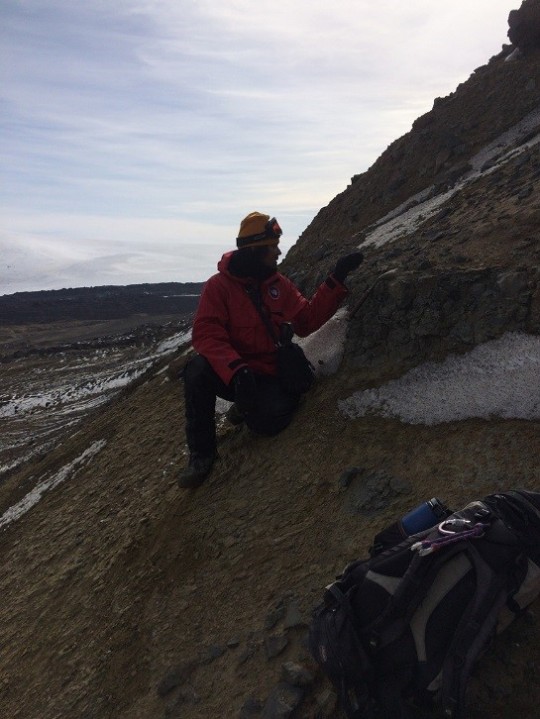
G-182-N geologist Zubair Jinnah studies an exposure of the Upper Cretaceous upper Cape Lamb Member of the Snow Hill Island Formation on Vega Island. Photo by Pat O’Connor.

Also discovered during week two

– A second plesiosaur partial skeleton. Several partial-to-complete fossil leaves and a conifer branch. Partial skeletons of Cretaceous fishes that may be the most completely-preserved fishes yet found from Cretaceous sediments on Vega Island.

– A partial dorsal rib of a very large-bodied tetrapod, possibly a sauropod (long-necked plant-eating dinosaur)

– Multiple isolated Cretaceous bird bones were also collected, as was a possible avian skull

– An abundance of exceptionally-preserved Eocene penguin bones, including a partial skull of a giant species (possibly Anthropornisnordenskjoeldi or Palaeeudyptes antarcticus). This is exciting as only a handful of cranial elements of fossil penguins have ever been described from Seymour Island.”


Matt Lamanna is a paleontologist and the principal dinosaur researcher at Carnegie Museum of Natural History in Pittsburgh. Matt and his team of researchers blogged frequently from Antarctica while on expedition at antarticdinos.org. Detailing his trip in a family-friendly, interactive documentary, Expedition Antarctica, paleontologist Matt Lamanna shares his unique experience. Members are required to preregister for the event. Sign up now.

Filed Under: Blog Tagged With: Antarctic Peninsula Paleontology Project, antarctica, Matt Lamanna, paleontology

  • « Go to Previous Page
  • Page 1
  • Page 2
  • Page 3
  • Page 4
  • Page 5
  • Page 6
  • Page 7
  • Go to Next Page »

sidebar

About

  • Mission & Commitments
  • Directors Team
  • Museum History

Get Involved

  • Volunteer
  • Membership
  • Carnegie Discoverers
  • Donate
  • Employment
  • Events

Bring a Group

  • Groups of 10 or More
  • Birthday Parties at the Museum
  • Field Trips

Powdermill

  • Powdermill Nature Reserve
  • Powdermill Field Trips
  • Powdermill Staff
  • Research at Powdermill

More Information

  • Image Permission Requests
  • Science Stories
  • Accessibility
  • Shopping Cart
  • Contact
  • Visitor Policies
One of the Four Carnegie Museums | © Carnegie Institute | Privacy Policy | Terms of Use | Accessibility
Rad works here logo