• Skip to primary navigation
  • Skip to main content
  • Skip to primary sidebar

Carnegie Museum of Natural History

One of the Four Carnegie Museums of Pittsburgh

  • Visit
    • Buy Tickets
    • Visitor Information
    • Exhibitions
    • Events
    • Dining at the Museum
    • Celebrate at the Museum
    • Powdermill Nature Reserve
    • Event Venue Rental
  • Learn
    • Field Trips
    • Educator Information
    • Programs at the Museum
    • Bring the Museum to You
    • Guided Programs FAQ
    • Programs Online
    • Climate and Rural Systems Partnership
  • Research
    • Scientific Sections
    • Science Stories
    • Science Videos
    • Senior Science & Research Staff
    • Museum Library
    • Science Seminars
    • Scientific Publications
    • Specimen and Artifact Identification
  • About
    • Mission & Commitments
    • Directors Team
    • Museum History
  • Tickets
  • Give
  • Shop

paleontology

June 27, 2017 by wpengine

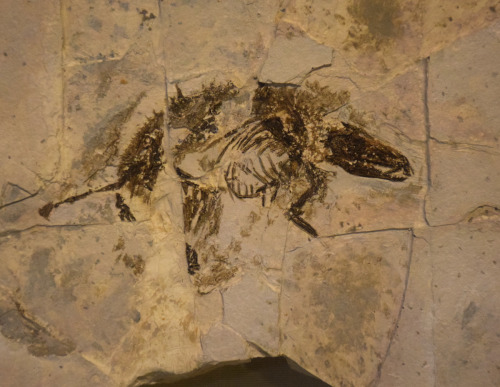
Sinodelphys szalayi

fossil of Sinodelphys szalayi

Sinodelphys szalayi is the earliest known relative of modern marsupials like kangaroos, wallabies, and opossums. Sinodelphys shows that although most modern marsupials live in Australia or South America, they actually originated in Asia during the Cretaceous Period.
Filed Under: Blog Tagged With: paleontology

January 24, 2017 by wpengine

Paleontologist Matt Lamanna

Paleontologist Matt Lamanna was live from the Big Bone Room at Carnegie Museum of Natural History in January! Matt discusses the famous Diplodocus carnegii, becoming a paleontologist, and more!

Filed Under: Blog Tagged With: Matt Lamanna, paleontology, Scientists Live

December 19, 2016 by wpengine

Paleo Field Tools

By Patrick McShea

Although work gloves, rock hammers, chisels, and protective goggles remain standard field equipment for fossil field work, electronic devices have become critical search tools. In both the Elko Hills and South Egan Wilderness, Vertebrate Paleontology Collections Manager Amy Henrici regularly referred to her iPad’s topographic map app which utilized a GPS function to provide accurate on-screen tracking of our movement across the landscape.

Other sometimes overlooked field tools are described below.

Reliable Transportation

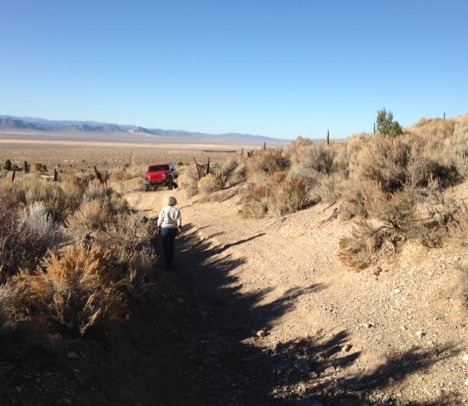
Jeep Wranlger on a rugged dirt path

A rented Jeep Wrangler proved to be an indispensable field tool. Unlike the high speed off-road travel depicted on television commercials, during a steep ascent from sage brush flats to the zone of pinyon and juniper we climbed in a low gear crawl. (Above) In places where the track crossed dry stream washes, it was sometimes necessary to scout routes into and out of the deeply eroded channels.

Fields Notes

Field notebooks

Field notes add a layer of documentation to scientific fossil collecting. Details about localities, the field crew, the vegetative cover, and even the weather might prove to be important information for a future paleontologist re-examining a particular set of fossils.

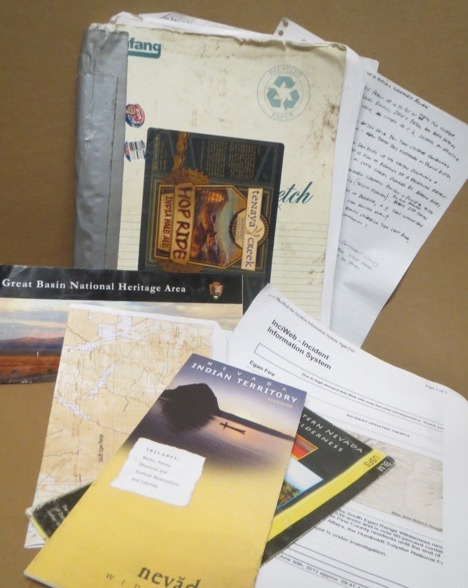
As an educator, the field work journal I kept doesn’t have direct association with particular fossils. Instead the duct tape-bound notebook, which bears the label of a Nevada-brewed IPA, serves as portable file, holding hand-written notes, related maps, brochures, and reports.

Place-related Information

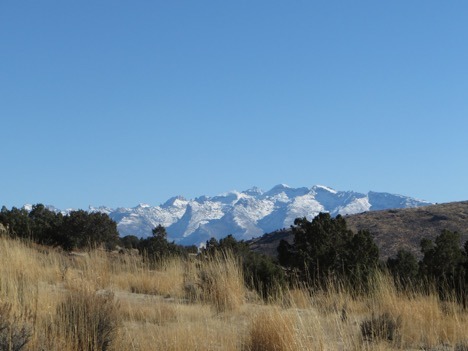
field with mountain range in the distance
Nevada’s Ruby Mountains from the hills outside Elko.


Because western scenery differs so much from that of east, a guide to the contrasts is useful tool, even for visitors focused on finding fossils. Observations by author Wallace Stegner aid in the appreciation of western landscapes.

In a dry land the brinks of hills will be clifflike, not rounded; valleys will often be canyons; hills are likely to be buttes and mesas and barerock movements; the coloration will not be the toned greens of wetter regions but the red and ochre and tan and gray and black of raw rock, the gray of sagebrush, the yellow of dry grass.

– Wallace Stegner “Why I Like the West” Marking the Sparrow’s Fall Henry Holt and Company, New York, 1998


Patrick McShea is a museum educator who is traveling through Nevada with Vertebrate Paleontology Collections Manager Amy Henrici to search for frog fossils. He frequently blogs about his experiences.

Filed Under: Blog Tagged With: Amy Henrici, Paleolab, paleontology

November 29, 2016 by wpengine

Fossil Search: Expert Assistance

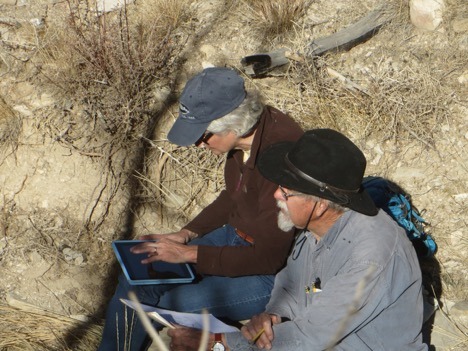
paleontologists using GPS
During a search for the contact point of two different Sheep Pass Formation rock units, Amy Henrici uses GPS-linked topographic maps in her iPad to locate the zone referenced in a stratigraphic map held by Richard Hilton.

by Patrick McShea

The frog fossil expedition workforce doubled briefly with the arrival of a two-person team affiliated with Sierra College in Rocklin, California. Earth Science professor Richard Hilton and field assistant Tina Campbell drove east from the Sacramento area, crossing the Sierra Nevada and a large portion of the Great Basin to meet us for two days of field work. They then proceeded to another fossil locality in the region to retrieve material discovered during earlier summer field work.

The Sheep Pass Formation within the South Egan Wilderness was familiar territory for both. In 2012 and 2013 they participated in larger expeditions to the area that involved not just Carnegie Museum of Natural History and Sierra College, but also the University of Nevada at Las Vegas.

Because Hilton is chairmen of Sierra College’s natural history museum,  our fireside conversations included the potential for using blog posts to broaden the audience for information about paleontological field work. Through the combination of his generosity, two-burner stove, and culinary skills, camp meals also improved.

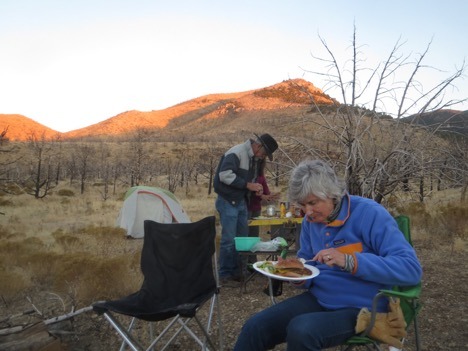
paleontologists eating at campsite
Dinner at dusk, including Caesar salad, baked beans, and hamburgers.

Patrick McShea is a museum educator who is traveling through Nevada with Vertebrate Paleontology Collections Manager Amy Henrici to search for frog fossils. He frequently blogs about his experiences.

Filed Under: Blog Tagged With: Amy Henrici, fossils, frogs, paleontology

November 28, 2016 by wpengine

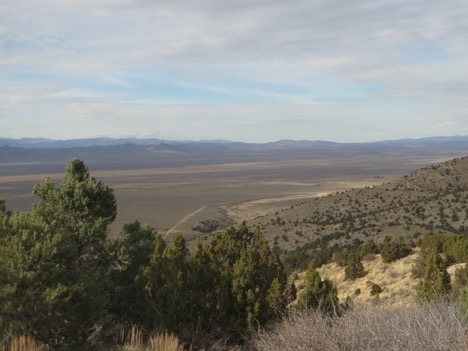
Shifting Formations

Nevada’s White River Valley from high ground in the South Egan Wilderness.

by Patrick McShea

From Elko, Nevada, the Carnegie Museum of Natural History frog fossil expedition shifted some 125 miles southeast to steep winding canyons within the South Egan Wilderness, a mountainous tract of more than 67,000 acres.

The move involved a change in the age of the rock outcrops we searched. Near Elko our efforts were confined to various associated rock layers, which geologists categorize as the Elko Formation, a thick and wide spread unit which formed some 46 – 39 million years ago during the Eocene Epoch. In the South Egan Wilderness, we explored the Sheep Pass Formation, a sequence of far older rocks which formed during the Late Cretaceous through middle Eocene Epochs some 70-46 million years ago.

Daily procedures were far different in the BLM-managed wilderness than on the outskirts of Nevada’s 15th largest city.

Instead of commuting to outcrops from a motel in Elko’s center, we hiked to rock exposures more than a mile from our simple camp site, proceeding up dry stream beds and ascending eight staircase-like water falls to reach the fossil-bearing units at elevations exceeding 6,700 feet. Evenings were cold, star-filled, and absolutely quiet but for the occasional howls and yips of coyotes.

Because a 2012 wildfire burned over 10,000 acres of sage brush, juniper, and pinyon pine, our camp area was a surreal landscape of charred trees.


Patrick McShea is a museum educator who is traveling through Nevada with Vertebrate Paleontology Collections Manager Amy Henrici to search for frog fossils. He frequently blogs about his experiences.

Filed Under: Blog Tagged With: Amy Henrici, fossils, frogs, paleontology

November 16, 2016 by wpengine

Planning for Field Work

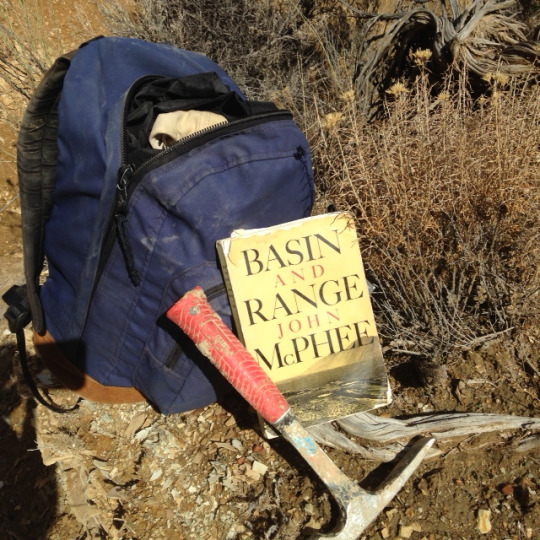
Backpack, book, and hammer sitting in the desert

by Patrick McShea

Planning for field work resembles vacation travel preparation in a fundamental way. Much consideration is given to gathering all necessary gear, and the mere assembly of these items triggers a kind of mental departure that precedes the physical one.

As a former English major, I’ve learned to manage this sometimes disorienting state by reading or re-reading destination-related articles, essays, and books.

For the Elko, Nevada sites where Amy Henrici and I hope to collect frog fossils this fall, John McPhee’s “Basin and Range” (Farrah Straus Giroux, New York, 1980) has particular relevance.

The book recounts the author’s travels along Nevada’s Interstate 80 corridor in the company of renowned Princeton University geologist. McPhee successfully translates into layperson language the region’s “geology in its four-dimension recapitulations of space and time.”

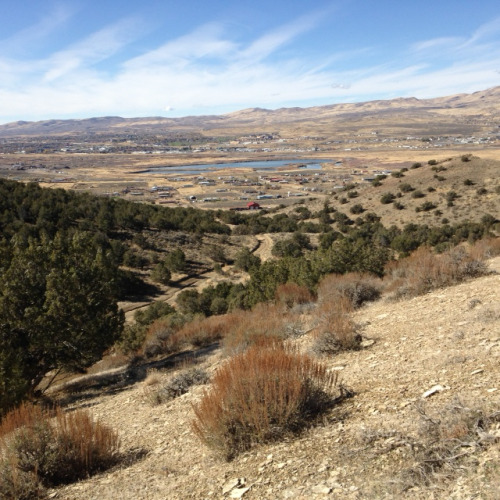
Fossils, as signs of ancient life, add critical evidence to such recapitulations. Near Elko, far up in the high desert hills south of Interstate 80, we’ll search for frog fossils to further our understanding of Earth’s past.

Desert near Elko, Nevada


Patrick McShea is a museum educator who is traveling through Nevada with Vertebrate Paleontology Collections Manager Amy Henrici to search for frog fossils. He frequently blogs about his experiences. 

Filed Under: Blog Tagged With: frogs, paleontology

  • « Go to Previous Page
  • Page 1
  • Interim pages omitted …
  • Page 3
  • Page 4
  • Page 5
  • Page 6
  • Page 7
  • Go to Next Page »

sidebar

About

  • Mission & Commitments
  • Directors Team
  • Museum History

Get Involved

  • Volunteer
  • Membership
  • Carnegie Discoverers
  • Donate
  • Employment
  • Events

Bring a Group

  • Groups of 10 or More
  • Birthday Parties at the Museum
  • Field Trips

Powdermill

  • Powdermill Nature Reserve
  • Powdermill Field Trips
  • Powdermill Staff
  • Research at Powdermill

More Information

  • Image Permission Requests
  • Science Stories
  • Accessibility
  • Shopping Cart
  • Contact
  • Visitor Policies
One of the Four Carnegie Museums | © Carnegie Institute | Privacy Policy | Terms of Use | Accessibility
Rad works here logo