• Skip to primary navigation
  • Skip to main content
  • Skip to primary sidebar

Carnegie Museum of Natural History

One of the Four Carnegie Museums of Pittsburgh

  • Visit
    • Buy Tickets
    • Visitor Information
    • Exhibitions
    • Events
    • Dining at the Museum
    • Celebrate at the Museum
    • Powdermill Nature Reserve
    • Event Venue Rental
  • Learn
    • Field Trips
    • Educator Information
    • Programs at the Museum
    • Bring the Museum to You
    • Guided Programs FAQ
    • Programs Online
    • Climate and Rural Systems Partnership
  • Research
    • Scientific Sections
    • Science Stories
    • Science Videos
    • Senior Science & Research Staff
    • Museum Library
    • Science Seminars
    • Scientific Publications
    • Specimen and Artifact Identification
  • About
    • Mission & Commitments
    • Directors Team
    • Museum History
  • Tickets
  • Give
  • Shop

parc

May 7, 2018 by wpengine

Luke DeGroote in AFO Afield

We’re thrilled to share that Avian Research Coordinator Luke DeGroote’s bird banding workshop has been featured in AFO Afield!
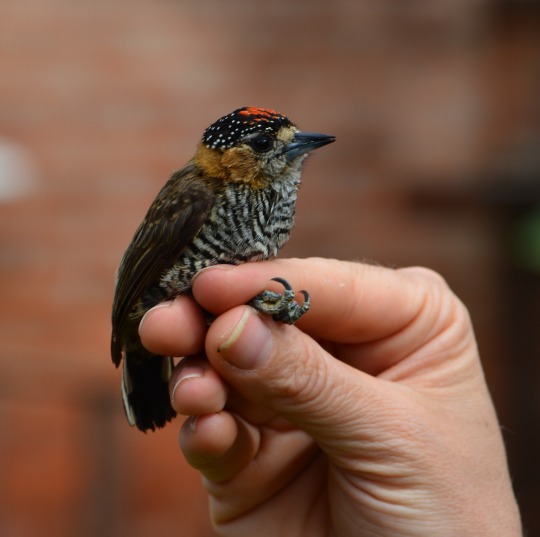
Ochre-Collared Piculet

Luke was one of five instructors teaching 15 participants advanced bird banding skills and ethics, and molt interpretation in Iguazú National Park in Argentina last year.
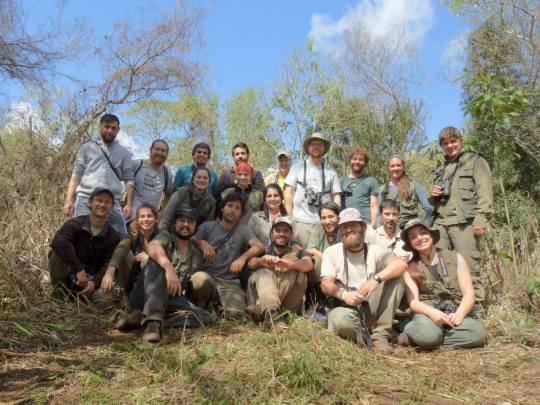
Instructors and students in Iguazú National Park

But what is bird banding and why does it matter?

It’s the practice of catching and releasing birds after marking them with a small band around the leg to identify them. The bands let researchers study all kinds of things about birds including migration patterns, social structure and behavior of different species, population changes, and diseases.
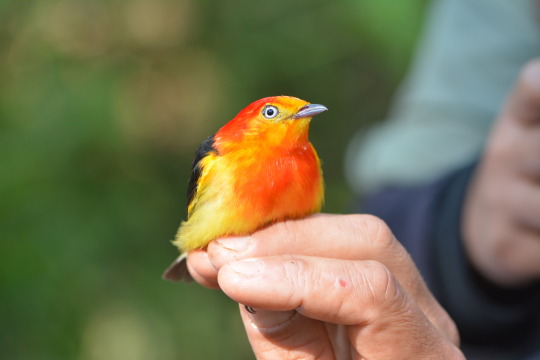
Band-Tailed Manakin

The group was thrilled to catch and band a band-tailed manakin—a small bird that looks a bit like it was tie-dyed because of the way the bright red, orange, and yellow feathers cover its head and chest.

Read more about Luke DeGroote’s participation in this collaboration between the North American Banding Council (NABC) and AFO in AFO Afield.
Filed Under: Blog Tagged With: bird banding, Luke DeGroote, parc

April 16, 2018 by wpengine

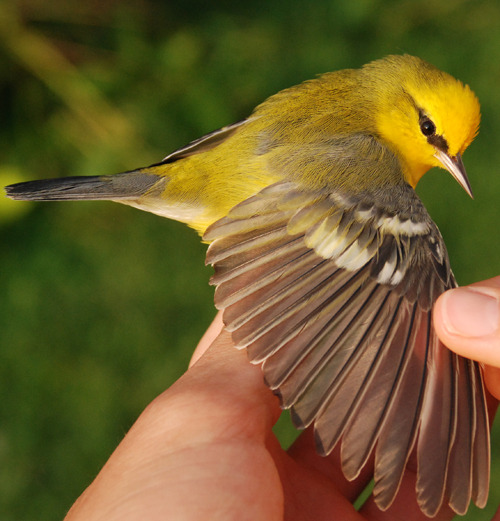
Male Blue-winged Warbler

Male Blue-winged Warbler, a brown and yellow bird

This species is relatively uncommon at Powdermill.  The lack of a molt limit in the alula feathers (A1,A2,A3) indicates this is an adult bird. Its closest relative, the Golden-winged Warbler, is much less common. The rapidly declining Golden-winged Warbler is currently being petitioned to be granted Federal protection under the Endangered Species Act.


Powdermill Nature Reserve’s avian research center is part of Carnegie Museum of Natural History’s biological research station in Rector, Pennsylvania.  The research center operates a bird banding station, conducts bioacoustical research, and performs flight tunnel analysis with the goal of reducing window collisions.


Filed Under: Blog Tagged With: bird, bird banding, parc

April 16, 2018 by wpengine

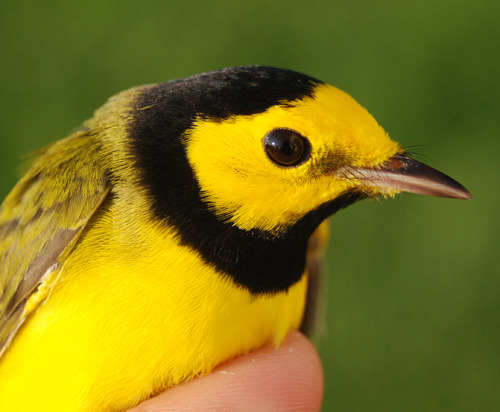
Male Hooded Warbler

Male Hooded Warbler, a bright yellow and black bird

The age of this bird is usually identifiable with a quick examination of the throat feathers.  If the black throat has extensive yellow tipping it is a hatching-year and if it lacks this tipping (or has very little) it is an after-hatching-year.


Powdermill Nature Reserve’s avian research center is part of Carnegie Museum of Natural History’s biological research station in Rector, Pennsylvania.  The research center operates a bird banding station, conducts bioacoustical research, and performs flight tunnel analysis with the goal of reducing window collisions.


Filed Under: Blog Tagged With: bird, bird banding, parc

April 14, 2018 by wpengine

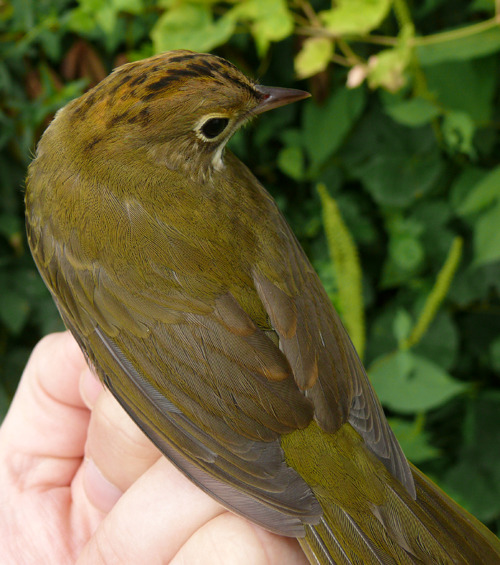
Ovenbird

ovenbird shown from the back

Although the young and adult birds have essentially the same general plumage, there are some slight differences. The rusty tipping on this bird’s tertials identify it as a hatching-year bird (adults lack the rusty tipping). By spring this tipping frequently is worn off, and age is best determined by using the presence or absence of a molt limit.  As in many birds, the shape of the tail also can be useful in ageing warblers.


Powdermill Nature Reserve’s avian research center is part of Carnegie Museum of Natural History’s biological research station in Rector, Pennsylvania.  The research center operates a bird banding station, conducts bioacoustical research, and performs flight tunnel analysis with the goal of reducing window collisions.


Filed Under: Blog Tagged With: bird, bird banding, parc

April 6, 2018 by wpengine

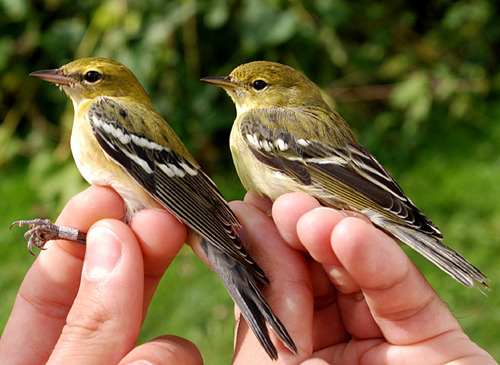
Bay-breasted and Blackpoll Warblers

Bay-breasted and Blackpoll Warblers

The first warbler benefits from spruce budworm outbreaks when the caterpillars provide abundant food. The second type of warbler has a high-pitched, almost inaudible song that drifts through boreal forests of Canada.


Powdermill Nature Reserve’s avian research center is part of Carnegie Museum of Natural History’s biological research station in Rector, Pennsylvania.  The research center operates a bird banding station, conducts bioacoustical research, and performs flight tunnel analysis with the goal of reducing window collisions.


Filed Under: Blog Tagged With: bird banding, Birds, parc

October 5, 2017 by wpengine

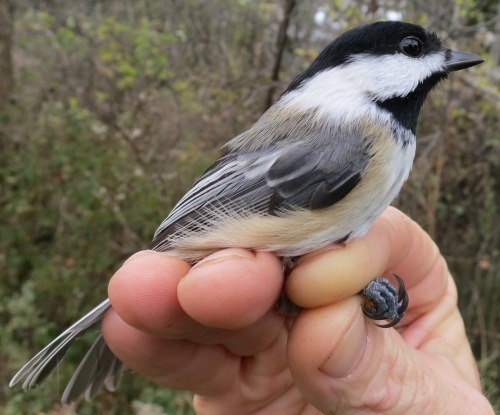
8½-year-Old Black-capped Chickadee at Powdermill

black-capped chickadee, a black, white, and tan bird

Residents of western Pennsylvania are familiar with the small and spunky black-capped chickadees that often visit their birdfeeders. These fearless birds are also frequent visitors at our banding lab at Powdermill Nature Reserve.

Last winter, this chickadee was one of the oldest of his species banded at the lab. It was first banded as a hatch-year bird at the end of August 2007, which means its age was 8½ years!

This individual has been captured 42 times in its life (so far!), at least twice every year, most often in the winter months.
It has shown up in every month of the year except June and July. In 2011, the only year that we saw this bird in May, it had a cloacal protuberance, an enlargement of the cloaca indicating breeding condition in males. So we know it is a male and that his territory is obviously not near our nets.

We are hoping to see this individual in the future. The oldest known black-capped chickadee was 11½ years old when it was banded in Minnesota in 2002.


Powdermill Nature Reserve’s avian research center is part of Carnegie Museum of Natural History’s biological research station in Rector, Pennsylvania.  The research center operates a bird banding station, conducts bioacoustical research, and performs flight tunnel analysis with the goal of reducing window collisions.

Filed Under: Blog Tagged With: bird, parc, Powdermill

  • « Go to Previous Page
  • Page 1
  • Page 2
  • Page 3
  • Page 4
  • Go to Next Page »

sidebar

About

  • Mission & Commitments
  • Directors Team
  • Museum History

Get Involved

  • Volunteer
  • Membership
  • Carnegie Discoverers
  • Donate
  • Employment
  • Events

Bring a Group

  • Groups of 10 or More
  • Birthday Parties at the Museum
  • Field Trips

Powdermill

  • Powdermill Nature Reserve
  • Powdermill Field Trips
  • Powdermill Staff
  • Research at Powdermill

More Information

  • Image Permission Requests
  • Science Stories
  • Accessibility
  • Shopping Cart
  • Contact
  • Visitor Policies
One of the Four Carnegie Museums | © Carnegie Institute | Privacy Policy | Terms of Use | Accessibility
Rad works here logo