• Skip to primary navigation
  • Skip to main content
  • Skip to primary sidebar

Carnegie Museum of Natural History

One of the Four Carnegie Museums of Pittsburgh

  • Visit
    • Buy Tickets
    • Visitor Information
    • Exhibitions
    • Events
    • Dining at the Museum
    • Celebrate at the Museum
    • Powdermill Nature Reserve
    • Event Venue Rental
  • Learn
    • Field Trips
    • Educator Information
    • Programs at the Museum
    • Bring the Museum to You
    • Guided Programs FAQ
    • Programs Online
    • Climate and Rural Systems Partnership
  • Research
    • Scientific Sections
    • Science Stories
    • Science Videos
    • Senior Science & Research Staff
    • Museum Library
    • Science Seminars
    • Scientific Publications
    • Specimen and Artifact Identification
  • About
    • Mission & Commitments
    • Directors Team
    • Museum History
  • Tickets
  • Give
  • Shop

pennsylvania

October 12, 2018 by wpengine

New England Aster – Aren’t you glad you Aster?

by Bonnie Isaac

New England Aster

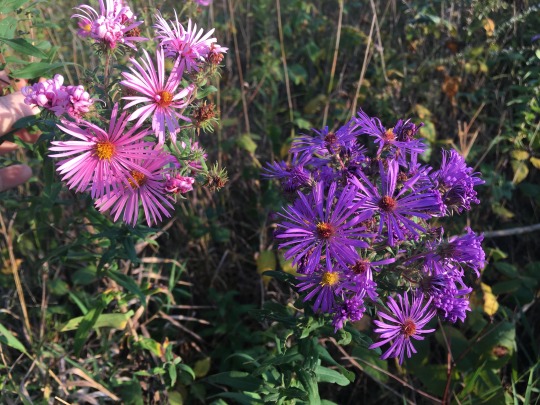
Fall is typically the time of year when we think plants are getting ready for winter. Think of trees changing colors and losing their leaves. Actually, some plants are just beginning to come into their own at this time of year.  The New England Aster is at its prime bloom now.  The purple, or sometimes pink, ray flowers are a spectacular sight along our open roadsides and fields.
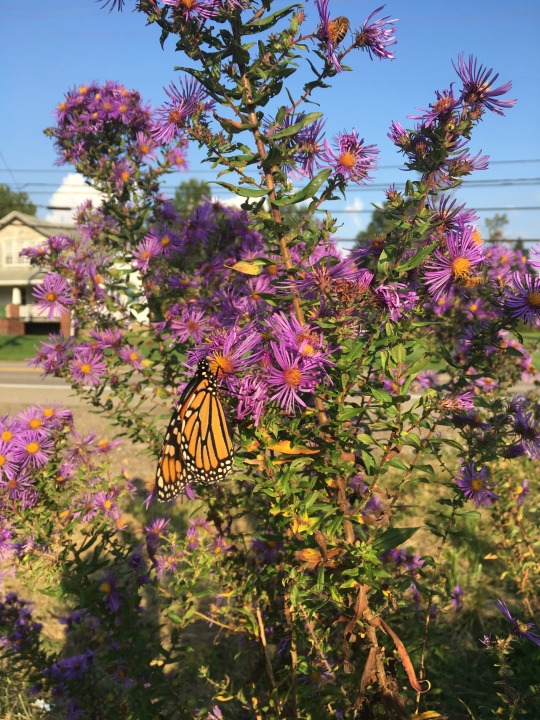
Monarch butterfly on New England Aster

New England Aster is common across Pennsylvania and is known from almost all counties in the commonwealth. This beautiful plant is a member of the Aster family which is commonly called the Composite family.  This family is called the composite family because the flower heads are made up of many small flowers (florets) close together composing what looks like one larger flower.
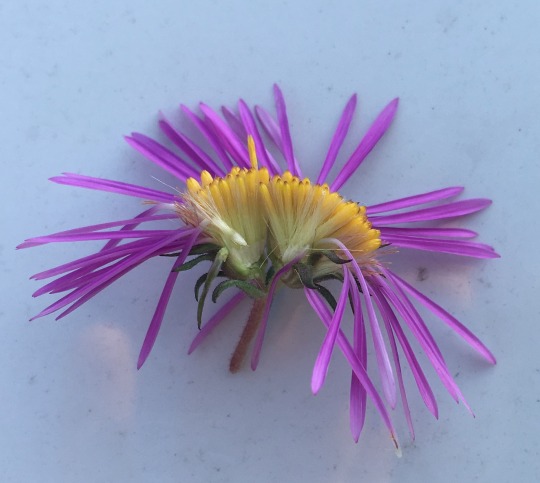
detail of New England Aster florets


Next time you look at a dandelion, daisy, or sunflower, look closely. You can see many florets. Flowers, like the New England Aster, that bloom late in the year, are very important sources of nectar for bees and butterflies.

Bonnie Isaac is the Collection Manager in the Section of Botany. Museum employees are encouraged to blog about their unique experiences and knowledge gained from working at the museum.
Filed Under: Blog Tagged With: Bonnie Isaac, Botany, flowers, pennsylvania, plants

September 21, 2018 by wpengine

Collected on this day in 1944

by Mason Heberling

illustration of a wildflower

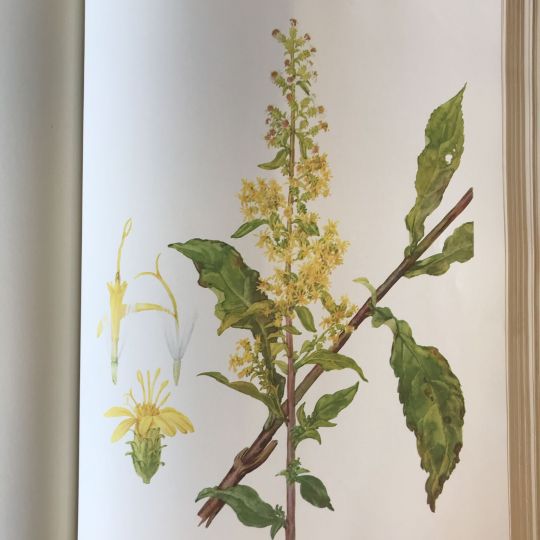
Herbarium specimens are both an art and a science.  This fact is no more apparent than in the collaborations between Andrey Avinoff and Otto Jennings, which culminated in the 1953 book Wildflowers of Western Pennsylvania and the Upper Ohio Basin.

Jennings was a longtime curator of botany, professor at University of Pittsburgh, and served many roles at the Carnegie Museum of Natural History (including director from 1945-1949).

Avinoff was a lepidopterist (studied butterflies) and artist, who was Director of the Carnegie Museum if Natural History from 1926-1945.

“Probably never again will there be two scholars, each a master in his own field, who can work together as did these two.” – Agnes L. Starrett

The book features a detailed, scientific manual describing plant species found in the region written by Jennings, along with 200 watercolor paintings of a subset of these species by Avinoff.  Jennings would travel across Western PA in search of the perfect specimen to return to the museum for Avinoff to paint while still fresh and unwithered.  Avinoff is said to have dropped everything he was doing upon Jennings’ return, and stay through the night to paint the flowers from still life.  Avinoff estimated that it took him about 1,600 hours to paint them all.

illustration of a wildflower next to a wildflower specimen

A. Avinoff, referring to his wildflower paintings: “These were my guiding principles: (1) accuracy in form and color; (2) portrayal of the individuality of the plant as to the character, position, arrangement, and venation of the leaves and the texture of their surfaces; (3) decorative arrangement, composition, and spacing; (4) strictly water color technique—only transparent pigment and no opaque colors, no whit paint anywhere, not a single stroke used in the high lights. The whit is the paper and all light parts are lighter washes of the pigment—thoroughbred aquarelle has been observed throughout.”

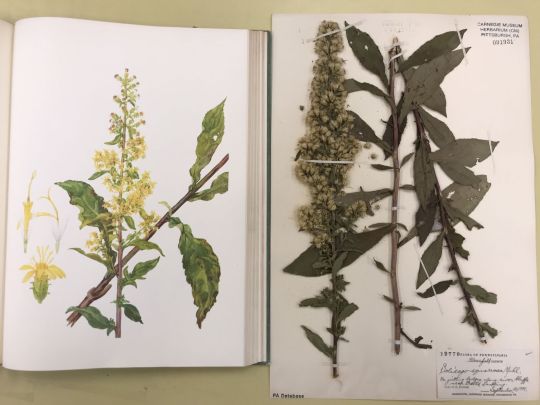
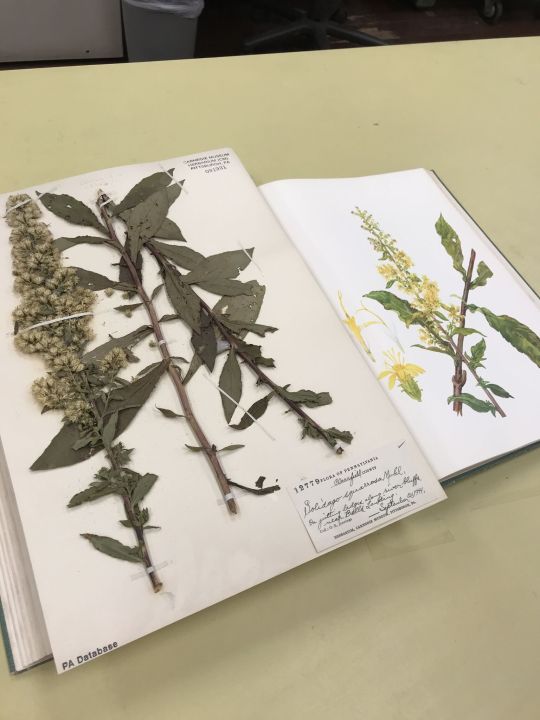
Some of these specimens were then pressed and remain in the Carnegie Museum’s herbarium today.  We know of 50 specimens that were used by Avinoff for his paintings.

illustration of a wildflower next to a wildflower specimen

This specimen of squarrose goldenrod (Solidago squarrosa) is one of those specimens.  It was collected by Otto Jennings on September 21, 1944 on a ledge along the river bluffs near Bell’s Landing, Clearfield County, Pennsylvania.

Both of scientific and cultural value, this specimen has a rich history, much more than “just” dried plants on paper.  While we know the history behind this particular one, each specimen has an important scientific and cultural story to tell.

Botanists at the Carnegie Museum of Natural History share digital specimens from the herbarium on dates they were collected. They have embarked on a three-year project to digitize nearly 190,000 plant specimens collected in the region, making images and other data publicly available online. This effort is part of the Mid-Atlantic Megalopolis Project (mamdigitization.org), a network of thirteen herbaria spanning the densely populated urban corridor from Washington, D.C. to New York City to achieve a greater understanding of our urban areas, including the unique industrial and environmental history of the greater Pittsburgh region. This project is made possible by the National Science Foundation under grant no. 1801022.  

Filed Under: Blog Tagged With: Andrey Avinoff, Botany, collected on this day, Mason Heberling, Otto Jennings, pennsylvania

September 10, 2018 by wpengine

This Land is Your Land, This Land is Mine Land

by Max Winn and Andrea Kautz

Since the passing of Act 54 in 1994, Pennsylvania requires a review of all subsidence impacts related to underground coal mining every five years. Subsidence occurs when land at the surface collapses down into a cavity created by removing a layer of coal. This can affect structures, roads, water wells/springs, streams, ponds, and wetlands. It can also induce landslides.

Powdermill scientists are currently part of the oversight team for the 2013-2018 review, and are using GIS technology to calculate and assess the impacts that mines have specifically on streams and wetlands.  Most subsidence impacts occur over “long wall” mines, where enormous panels of coal are removed. “Room and pillar” mines leave pillars of coal to support the roof of the mine, which generally prevents subsidence, but impacts may still occur.

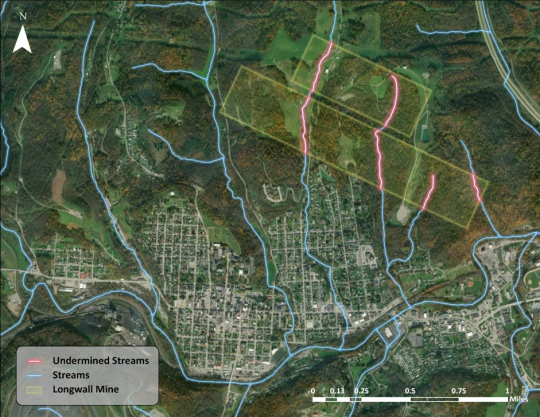
Take a look at this aerial imagery of a portion of a longwall mine, that shows just how much area the panels cover and the streams that are undermined. The larger panel is over a mile long! Using GIS, we can calculate how much of the undermined streams are impacted by either flow loss or pooling. Flow loss is experienced when the earth fractures and the water is lost below the surface.  Pooling occurs when water collects in a depression caused by subsidence and can no longer flow downstream.

map of streams and mines

When stream impacts occur in Pennsylvania, the coal companies are required to mitigate the damage to return the stream to its previous state. Because you can generally predict where subsidence impacts are going to occur before mining, pre-mining surveys are done to determine the health of the streams initially. The survey determines normal flow rates throughout the year, and also describes the community of aquatic macroinvertebrates that live in the stream. Based on what types of insects and other invertebrates are found during the survey, the stream is given a score based on how healthy it is. These data are used to compare to post-mining surveys that occur after attempts to mitigate have been completed. If the scores are comparable, the stream is considered repaired, but if not, the company is required to take further mitigative action.

Experts from the Carnegie Museum of Natural History and Powdermill Nature Reserve are working with regulatory agencies and mining companies to ensure that our natural environment is passed on to the next generation in a healthy condition.

Max Winn is a GIS Technician and Andrea Kautz is a Research Entomologist at Carnegie Museum of Natural History’s Powdermill Nature Reserve. Museum employees are encouraged to blog about their unique experiences and knowledge gained from working at the museum.
Filed Under: Blog Tagged With: coal, pennsylvania, Powdermill Nature Reserve, We Are Nature 2

September 6, 2018 by wpengine

Collected on This Day: September 6

by Mason Heberling

September 6, 1952: 66 years ago

…and recollected September 6, 2018

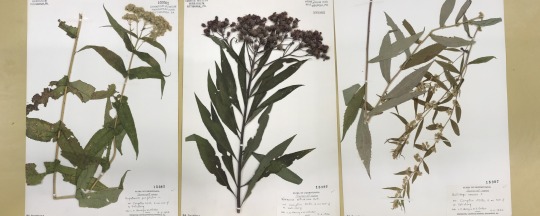
These specimens (and more) were collected on September 6, 1952 near Compton’s Mills (near Salisbury, PA, Somerset County) by Leroy Henry and Werner Buker. Henry was a long time Curator of Botany at the museum (1937-1973), and Buker was a math teacher at Perry High School, who was also a very active botanist at the museum.  Collectively, they collected nearly 50,000 specimens in the Carnegie Museum herbarium!

These specimens are part of a larger project ongoing in the Section of Botany at the Carnegie Museum.  Starting last year, we are revisiting historic sites across Western Pennsylvania, where former botanists have collected.  We are revisiting these sites in order to record and monitor biological change in the Anthropocene.  Are the same species present? (local extinction or persistence) Are new species present? (newly introduced invasive species)

We are also recollecting specimens from these historic sites to compare specimens collected decades to a century ago, to those collected today. For example, how are species affected by climate change? Are species flowering earlier? How are plant communities affected by invasive species and introduced pests? These are just a few of the many questions that can be answered.

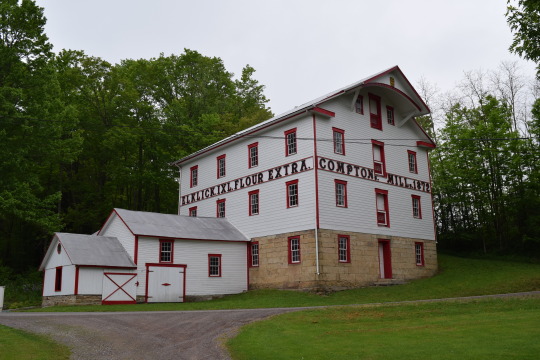
Compton's Mills

With generous permission of the current landowner, we are able to recollect specimens at Compton’s Mills. Compton’s Mills is a site of a family-run historic grist/flour mill built in 1872 on the foundation of an even earlier mill. We have done some recollections at this site last spring, including specimens of the endemic Appalachian violet (Viola appalachiensis).  Compton’s Mills is also of special importance, as specimens collected from this site were used by Leroy Henry to formally describe species new to science (known as “type” specimens).  Read about our recollection in Spring 2017.

This year we are revisiting in the late summer/early fall.

With data from Compton’s Mills, in addition to repeatedly revisiting other sites across Western Pennsylvania, we will be able to document and understand a century of past, present, and future impacts of humans on the landscape– a hallmark of the Anthropocene.  Some of our first recollections were featured in the We Are Nature exhibition.  Although this exhibition recently ended, specimens from this project will remain on display in the Hall of Botany.

wildflower specimens

The wildflower specimens pictured here are welcomed signs of late summer and fall (left to right): common boneset (Eupatorium perfoliatum), tall ironweed (Vernonia altissima), wreath goldenrod (Solidago caesia).

Mason Heberling is a Postdoctoral Research Fellow in the Section of Botany at the Carnegie Museum of Natural History. Museum employees are encouraged to blog about their unique experiences working at the museum.

Filed Under: Blog Tagged With: Botany, collected on this day, Mason Heberling, pennsylvania, plants, western pennsylvania

August 20, 2018 by wpengine

Pennsylvania Archaeology, Fluted Points, and One Snazzy Bolo Tie

By Amy L. Covell-Murthy

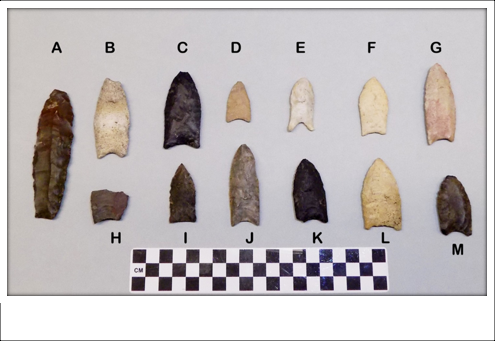
The Section of Anthropology houses a collection boasting 1.5 million artifacts. What you may not know is that most of those artifacts come from right here in Western Pennsylvania. It would be impossible to talk about Pennsylvania archaeology without mentioning Dr. Stanley W. Lantz. Dr. Lantz worked as a field and staff archaeologist at Carnegie Museum of Natural History from 1965-1990 and has continued as a research associate ever since his retirement.  Before making archaeology his life’s work, Dr. Lantz was an Army Air Force, Staff Sargent, B-17 waist-gunner and photographer, and he owned his own supermarket and building business. His 10-year archaeological survey of 23 counties of Western Pennsylvania encompassed the drainage of the Upper Ohio Valley, and allowed him to record 365 Paleo-Indian artifact finds from 210 sites. In The Pennsylvania Fluted Point Survey, Dr. Lantz and Gary Fogelman display over 1600 photographs and over 100 illustrations of fluted points of the Eastern Woodlands. Below are some of the points that Dr. Lantz donated to CMNH that he used in the book.

fluted points

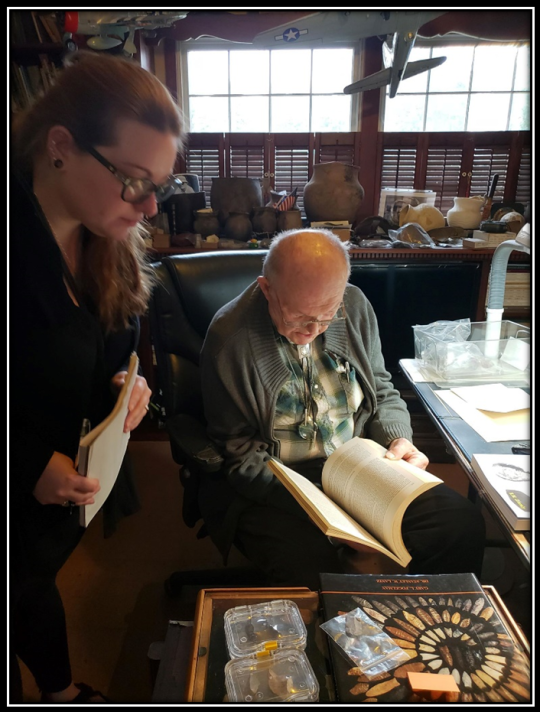
In May 2018, Dr. Lantz kindly assisted three CMNH anthropology interns with a poster that they presented at the 89thAnnual Meeting of the Society for Pennsylvania Archaeology, regarding the process of locating Clovis points in a site-specific museum collection. Clovis points, dating to the Early Paleoindian Period, 10,000-16,000 BP, are the earliest fluted styles found in North America. Rebecca Stewart, Brittany Creely, and Liana Thies were awarded second place. Liana is pictured in this photo with Dr. Lantz who is sporting his signature bolo tie.

Dr. Lantz and Liana

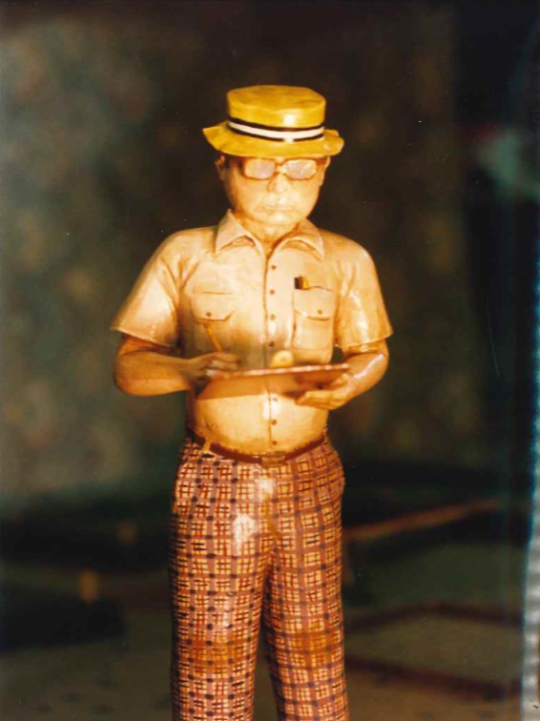
Dr. Lantz can be found on exhibit outside of the Anthropology Halls on the third floor. Look for his likeness in the Iroqouis longhouse diorama. He is missing his tie, but keep an eye out for his plaid pants! Fun Fact: Someone stole Dr. Lantz’s plaid polyester pants and buried them in a secret location so that he wouldn’t be able to wear them anymore.

Dr. Lantz likeness

Amy L. Covell-Murthy is the Archaeology Collection Manager at Carnegie Museum of Natural History. Museum employees are encouraged to blog about their unique experiences and knowledge gained from working at the museum.
Filed Under: Blog Tagged With: anthropology, archaeology, pennsylvania

July 17, 2018 by wpengine

Cactuses, and the Spine of Appalachia

By John Wenzel

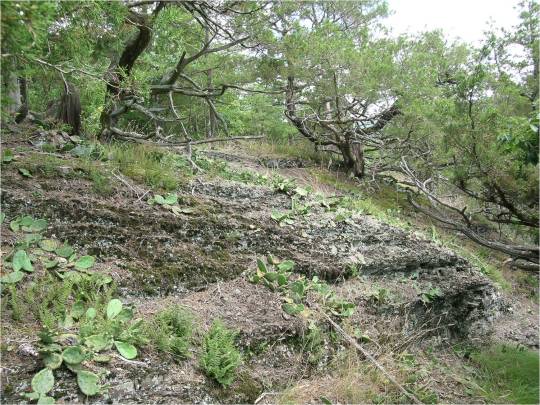
No one thinks of deserts in Pennsylvania, but we have one habitat that includes many plants typical of the western deserts. The “shale barrens” have formed over millions of years as the eroding crests of the Appalachian ridges open up areas where rock slides or exposed shale deposits create an area of very little soil that gets hot in the sun and that holds no water.

shale barren

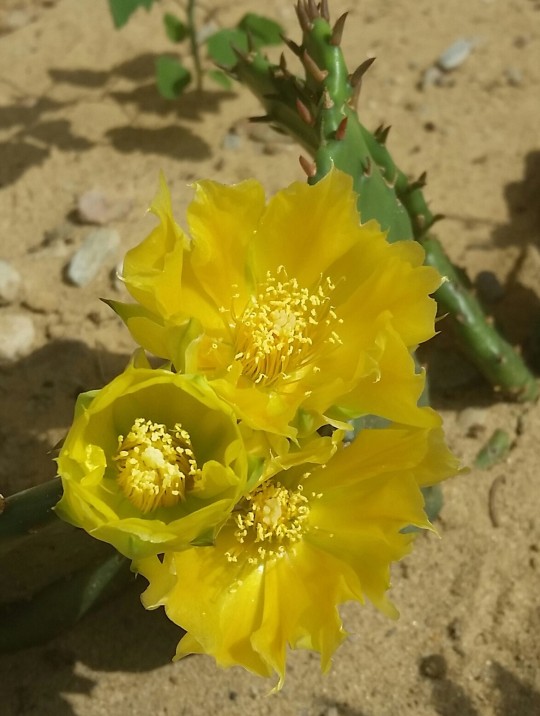
Plants such as the red cedar, barrens stonecrop, hen-and-chicks, or even prickly pear cactus thrive in these microdeserts, mostly on south-facing hillsides. These resemble more closely communities in west Texas than the eastern deciduous forest around them. Yet, unlike the West, there may be ferns alongside the cactuses, taking advantage of the rain.

prickly pear cactus

How do cactuses survive our winter?  Because they can tolerate being dried out, they dump their water when it gets cold and collapse like deflated balloons. With little water in them, they do not develop ice crystals internally, and so do not freeze! At Powdermill Nature Reserve, we maintain a small dry garden to show these unusual species to visitors.

John Wenzel is the Director at Powdermill Nature Reserve, Carnegie Museum of Natural History’s environmental research center. Museum employees are encouraged to blog about their unique experiences and knowledge gained from working at the museum.
Filed Under: Blog Tagged With: cactus, John Wenzel, pennsylvania, Powdermill Nature Reserve

  • « Go to Previous Page
  • Page 1
  • Page 2
  • Page 3
  • Page 4
  • Go to Next Page »

sidebar

About

  • Mission & Commitments
  • Directors Team
  • Museum History

Get Involved

  • Volunteer
  • Membership
  • Carnegie Discoverers
  • Donate
  • Employment
  • Events

Bring a Group

  • Groups of 10 or More
  • Birthday Parties at the Museum
  • Field Trips

Powdermill

  • Powdermill Nature Reserve
  • Powdermill Field Trips
  • Powdermill Staff
  • Research at Powdermill

More Information

  • Image Permission Requests
  • Science Stories
  • Accessibility
  • Shopping Cart
  • Contact
  • Visitor Policies
One of the Four Carnegie Museums | © Carnegie Institute | Privacy Policy | Terms of Use | Accessibility
Rad works here logo