• Skip to primary navigation
  • Skip to main content
  • Skip to primary sidebar

Carnegie Museum of Natural History

One of the Four Carnegie Museums of Pittsburgh

  • Visit
    • Buy Tickets
    • Visitor Information
    • Exhibitions
    • Events
    • Dining at the Museum
    • Celebrate at the Museum
    • Powdermill Nature Reserve
    • Event Venue Rental
  • Learn
    • Field Trips
    • Educator Information
    • Programs at the Museum
    • Bring the Museum to You
    • Guided Programs FAQ
    • Programs Online
    • Climate and Rural Systems Partnership
  • Research
    • Scientific Sections
    • Science Stories
    • Science Videos
    • Senior Science & Research Staff
    • Museum Library
    • Science Seminars
    • Scientific Publications
    • Specimen and Artifact Identification
  • About
    • Mission & Commitments
    • Directors Team
    • Museum History
  • Tickets
  • Give
  • Shop

Blogs about Pittsburgh

Carnegie Museum of Natural History is in Pittsburgh, Pennsylvania. Many of the museum's collection specimens are from the local area, including our Botany, Invertebrate Paleontology, and Herpetology specimens. Our collections and our community often influence our work, whether that includes researching climate change, air pollution improvements from the closing of steel mills in the city, or invasive species.

April 1, 2019 by wpengine

Bayet’s Bounty: The Invertebrates That Time Forgot

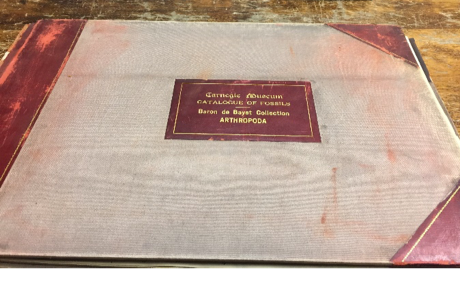
book about the baron de bayet collection
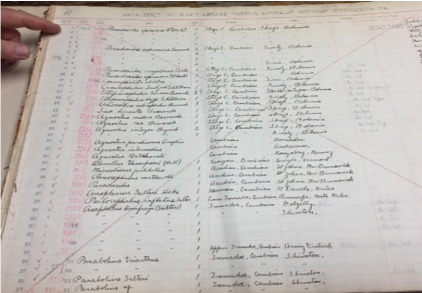
interior of book about baron de bayet collection

Albert Kollar, Collections Manager for the Carnegie Museum of Natural History Section of Invertebrate Paleontology, is on a mission to re-examine the Bayet Collection, a collection of 130,000 invertebrate and vertebrate fossils brought to the Carnegie more than 100 years ago.  Albert is re-examining the invertebrate portion of the Bayet (pronounced “Bye-aye”), which as it turns out, is 99.9% of the collection.

The story starts with a last-minute trip that began on July 8, 1903 by Carnegie Director William Holland, who had received word of a world-class fossil collection that had been put up for sale in Europe by the Baron de Bayet, secretary to the cabinet of Leopold II of Belgium.  Holland immediately booked passage to Europe on the steamer “New York” to complete the deal.  At stake were 130,000 invertebrates, combined with a small number of vertebrate fossils (several on display in the Dinosaurs in Their Time exhibition), sought by museums throughout Europe, Great Britain and the United States.  This collection became the largest addition to the department of paleontology at the Carnegie Institute, since the discovery of the dinosaur Diplodocus carnegii, at Sheep Creek, Wyoming in 1899.

Mr. Carnegie personally wrote a check for $25,000 for the project, a sum so large it exceeded the entire 1903 budget for all art and natural history acquisitions combined. Eventually, Mr. Holland negotiated a price of just under $21,000 with the Baron de Bayet for the entire collection. Another $2,300 was spent to pack, insure and transport everything back to Pittsburgh.  Twenty men and women worked for three weeks to meticulously wrap each fossil in cotton, batting, or straw and by September 1903, two hundred and fifty-nine crates arrived safely in Pittsburgh.  Storage of the crates was an issue, since the Carnegie Museum building would not be completed until 1907; so Mr. Holland rented space in a warehouse on 3rd Street in Pittsburgh for storage of 210 of the 259 crates.

This decision, however, almost destroyed the collection when a fire broke out on the upper floors of the 3rd Street warehouse.  On December 30, 1903, Mr. Holland wrote, “Yesterday brought with it a fire in which it appeared as if the Bayet collection, the acquisition of which we had so prided ourselves, was destined to go up in smoke.”  Fortunately, the Pittsburgh Fire Department contained the fire to the upper floors and the Bayet collection, stored on the lower floor, and meticulously wrapped and crated, survived with minimal damage. The crates returned to the Carnegie Institute to dry out.

In early 1904, William Holland hired Dr. Percy Raymond, a graduate of Yale University, to be the first curator of Invertebrate Paleontology.  His primary directive was to catalog and organize the Invertebrate portion of the Bayet collection. Today, over 100 years later, Albert Kollar with the help of Pitt Geology student E. Kevin Love, is undertaking a multi-year project to translate Percy Raymond’s beautifully hand-written catalogs and to migrate all 130,000 specimens into a new database.

Pictured below is (BH1) the very first Bayet specimen cataloged by Percy Raymond.  BH1 is an exquisite 510-million-year-old, CM 1828 Paradoxides spinosus, a 17.17 cm or 7” long trilobite from Skreje, Bohemia – or the Czech Republic of today.
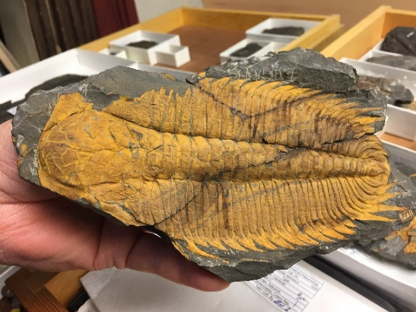
trilobite fossil

Albert’s goal in revisiting the Bayet collection is to better understand the great history of the how, why and where of fossils collected in the late 19th century, especially in Europe the birthplace of paleontology and geology.  “This project will give us insight into why certain Bayet fossils were recovered from classic European fossil localities, many of which are designated stratotype (significant geologic time reference) regions.  These fossils and localities have been used to document the validity of evolution, extinction, and the Geologic Time Scale over the last 100 years.  With an improved database, we hope to better appreciate the scientific value of the entire collection and create new statistical measures for future research and education.”

When asked if he expected any surprises as we go forward, Albert smiled, “Not until all the data has been analyzed will we have an opportunity to review the collection’s full scientific worth.”

Check back in a few months, Bayet’s invertebrates may have a few secrets yet to share.

Many thanks to Carnegie Museum Library Manager, Xianghua Sun for help researching this post.

Joann Wilson is an Interpreter in the Education department at Carnegie Museum of Natural History. Museum employees are encouraged to blog about their unique experiences and knowledge gained from working at the museum.

Filed Under: Blog Tagged With: Albert Kollar, Andrew Carnegie, fossils, geology, invertebrate paleontology, paleontology, Pittsburgh, SWK2, Trilobite, William Holland

March 29, 2019 by wpengine

Adventures with Taiji Nelson

“If you stop and look with some intention, you can find some really amazing things…”

Taiji Nelson

Frick Park has an extensive network of trails and is home to more wildlife than you might imagine.  Taiji Nelson is there to help you explore it all.

“When nature shows up for you as an educator, it’s so great…”

Taiji works for the Pittsburgh Parks Conservancy at the Frick Environmental Center as a Naturalist Educator.  What does that mean?  It means that he works with middle school and high school students to look at ecosystems in the parks and restore park health.  He shows students how parks can connect communities and introduce people to nature.

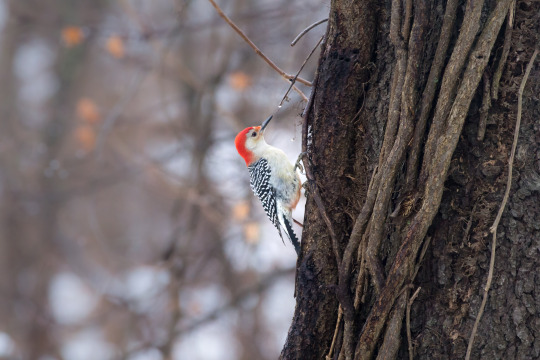
A red-belied woodpecker sips from a water droplet.

“Finding a salamander, finding a snake, finding an owl…you don’t expect to be able to see that kind of stuff in the middle of a city, in the middle of Pittsburgh, but it’s out here.”

“An interest in nature can be a really strong force to connect people.”

Taiji loves parks because he thinks they are places where groups of people can come together and be excited about being outside.

“There’s a ton of value in bringing people with different perspectives together.  Being a queer person of color, I understand the value of meeting people who think differently than you and being able to find common ground.”

“I’m the hype man for nature.”

Nature is always there for adventurers who want to see new and exciting things.  Taiji is there to guide those adventurers along.

A World of Wonder

In the parks, Taiji has seen all sorts of interesting sights. There are always birds flying from tree to tree, there are great horned owls that come out when it gets dark, and even a beaver that’s been known to frequent a stream in the park’s ravine.

Explore nature together.  Visit Nature 360 for activities and information.

Blog post by Melissa Cagan. 

Filed Under: Blog Tagged With: Education, Melissa Cagan, Nature 360, Pittsburgh, Taiji Nelson

January 17, 2019 by wpengine

Dial M for a Murder (of crows)

By Melissa Cagan

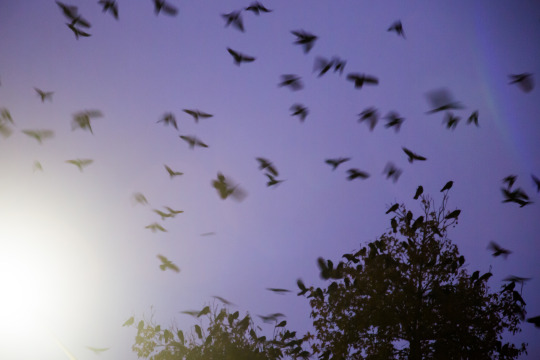
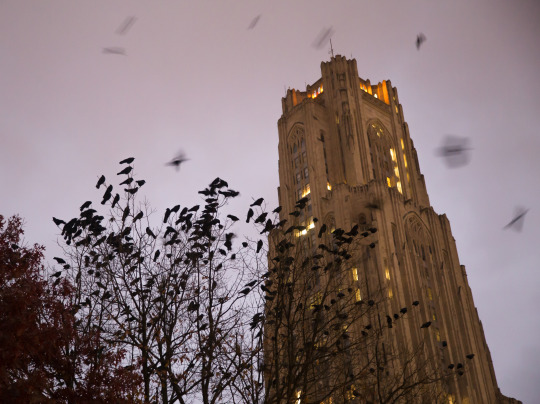
crows with cathedral of learning

In the city of Pittsburgh, there are many different places you might find a rowdy roost of crows.  Crows gather to spend the night in areas with big trees and some source of light. Most people wouldn’t want to sleep with the lights on, but for crows, lights let them keep an eye out for possible predators like the fearsome great horned owl.

Fun Fact:  They’re not really that vicious, but a group of crows is often referred to as a “murder.”  Spooky, right?  One reason for the term “murder” could be that, as scavengers, crows are often associated with cemeteries or battlefields.

Duck, duck… crow?

Throughout winter, roosts of crows will shift around the city of Pittsburgh.  This means that you could spot a group of crows in one place and then three months later observe the same exact “murder” in another area of the city!

Where can I find crows?

Here are some of the places in Pittsburgh where you might have seen a crow (or a thousand!) in past years:

• Flagstaff Hill

• Homewood Cemetery (in October)

• Allegheny Cemetery (in October)

• By Bigelow Boulevard in the Hill District

• Next to the Cathedral of Learning

In fact, the University of Pittsburgh has started blasting predatory bird calls from the Cathedral to try and scare the crows away. Do you think this is working?  If you’re riding through Oakland keep both your eyes and ears open!

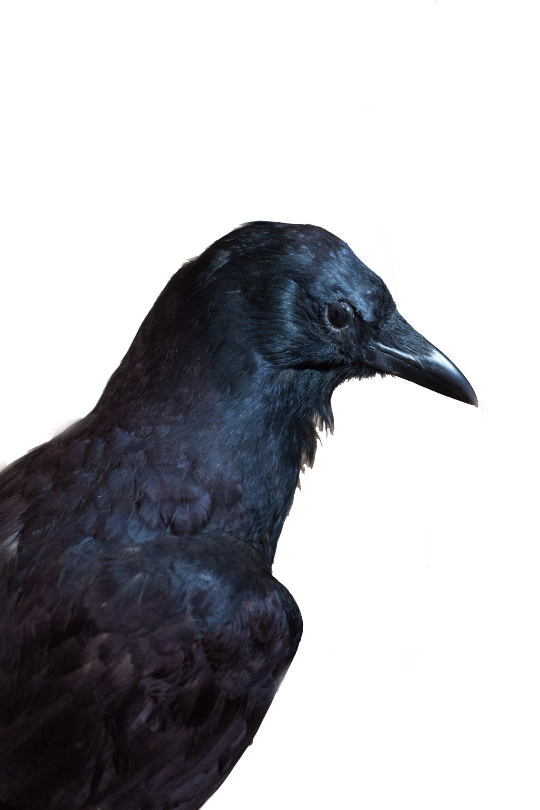
crow

I Spy with My Little Eye…

Next time the sun starts to set, go outside and see what sorts of things you notice.  Do you observe anything unusual happening with the birds in your area? You can even take along a camera or notepad to write down your observations.  Make a note of anything fun or interesting that stands out to you!

Explore nature together. Visit Nature 360  for activities and information.

Filed Under: Blog Tagged With: bird hall, Birds, Melissa Cagan, Nature 360, Pittsburgh

January 10, 2019 by wpengine

The Crows are Back in Town

By Melissa Cagan and Rachael Carlberg

a murder of crows in the sky

If you looked out your window at sunset in the recent months, you would probably notice a strange phenomenon – hundreds, even thousands, of crows flying from all directions towards the same place.

Where are the crows going?

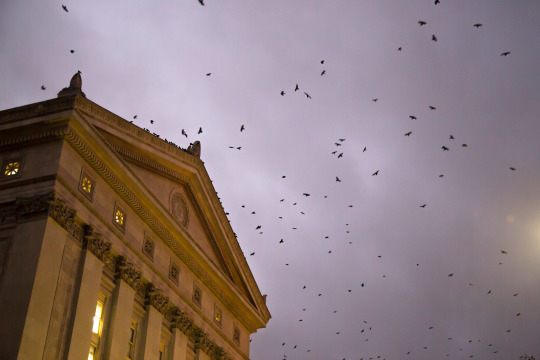
Well, when the weather starts getting cold, crows will fly into Pittsburgh from surrounding areas to join in one communal roost, a large group of birds that flock together to sleep through cold nights. You may wonder why these crows have chosen a city as their roost site, but there are actually many advantages to choosing an urban roost.  For one thing, cities are usually warmer than rural areas, are well-lit by night lights, and contain fewer predators.  In addition, Pittsburgh has an abundance of large trees that make safe spots for a big crow slumber party!

crows in the sky about a museum

Heads up…

Now – imagine that a hundred (or even a thousand!) birds moved into your neighbor’s place… what sorts of strange things might you start to notice?  Crows are not known for being quiet, so don’t be surprised if it gets super noisy when you’re trying to sleep.  Also, as you might imagine, a roost of crows poses some… sanitary issues as well.  If you live in the city near a roost look out for some lovely crow presents on your streets, sidewalks, or car.

Birds can be trash collectors?

Corvids, the family of birds that crows are a part of, are really smart birds.

In fact, a theme park in France has made use of corvids’ talents by hiring six rooks (a cousin of the crow) to act as garbage collectors throughout the park!

Related Content

Ask a Scientist: Ravens and crows, what’s the difference?

Stuffed Animal Safari: Binocular Activity

Jurassic Days: An Adventure Under the Sea

Filed Under: Blog Tagged With: bird hall, Hall of Birds, Nature 360, Pittsburgh

November 9, 2018 by wpengine

Keeping Birds Safe with GIS and Citizen Science

By Jon Rice and James Whitacre

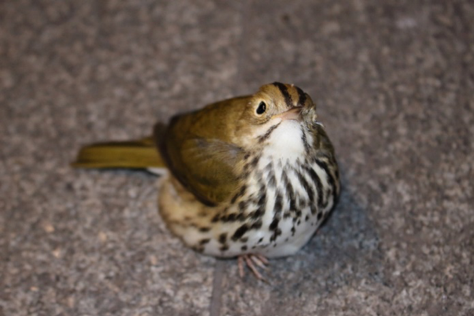
Almost 600 million birds die every year in North America after colliding with buildings. BirdSafe Pittsburgh, which has been a museum program for over four years, has collected over 1,500 birds that collided with windows. These birds have been collected in Downtown and surrounding areas, and through our efforts, we have learned what increases the likelihood of birds colliding with windows.

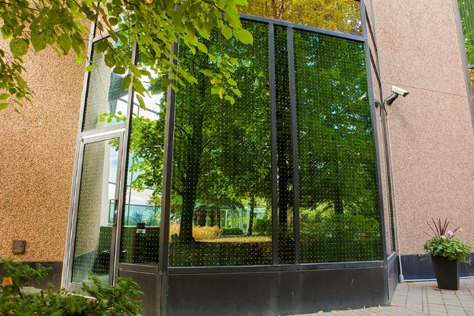
windows modified with a pattern birds can see

Locating and Researching Bird Strikes

Using the power of Geographic Information Systems (GIS), we have been tracking and collecting where birds have collided with windows. This will help us to find collision hotspots and assess the types of buildings that cause the most problems for birds. Our efforts so far have concentrated on downtown Pittsburgh with a crew of dedicated volunteers.

However, we are now inviting you – the public – to help us find bird strikes in your neighborhood. We have developed a form on our website for you to add bird strikes to our database. If you find a bird dead or stunned, you can help us add to our database of bird strikes using the form. It will guide you through how to add pictures of the bird, add the location to the map, and fill out the required data. Any bird added will help us expand our research.

We already know that skyscrapers, low-rise buildings, and residential houses alike threaten birds, albeit unequally. According to a study published in 2014, low-rises account for the majority of building related mortalities at 56%, with residential houses accounting for nearly all the rest at 44%, and high-rises only accounting for less than 1%. But, how do the buildings in downtown Pittsburgh and the surrounding neighborhoods fit into this picture?

By analyzing the precise locations of bird strikes in Pittsburgh using GIS, we hope to assess the types of buildings impacting bird deaths. By collecting fine scale data where birds strike windows, we could identify specific problem windows that birds strike more often than others. This would allow us to focus mitigation efforts to specific areas of concern rather than along an entire building façade. For instance, treating 10 windows on a building side instead of all 100 windows would result in considerable cost-savings while maintaining the same effect on decreasing bird strikes.

How You Can Help Save Birds

bird sitting on the sidewalk

Birds hit windows because of the reflections caused by sunlight hitting the glass and looking like open sky, trees or habitat. By breaking up the reflections with anything following a “2-inch-by-4-inch rule,” birds are less likely to strike the window. The 2-by-4 rule refers to the space between horizontal elements at no more than 2 inches apart, and the space between vertical elements at no more than 4 inches apart. These simple and cost-effective measures will reduce window collisions while maintaining the aesthetic qualities.

By helping us collect bird strike data and modifying the windows of your home or business, we can decrease the number of bird-window collisions and maintain stronger bird populations.

More information about BirdSafe Pittsburgh can be found at birdsafepgh.org.

Jon Rice is Citizen Science Assistant and James Whitacre is a GIS Research Scientist at Carnegie Museum of Natural History’s Powdermill Nature Reserve. Museum employees are encouraged to blog about their unique experiences and knowledge gained from working at the museum.
Filed Under: Blog Tagged With: Birds, birdsafe pittsburgh, James Whitacre, Jon Rice, Pittsburgh, Powdermill Nature Reserve

September 18, 2018 by wpengine

Hidden Treasure of Pittsburgh Found

by Bonnie Isaac

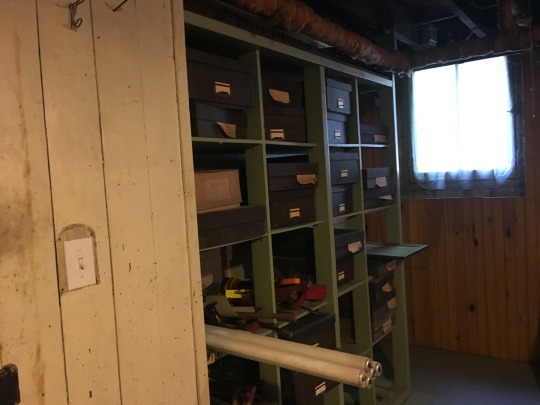
Recently I received a call from a woman who had bought an estate and discovered a hidden treasure in the basement. The basement contained 28 boxes of herbarium specimens. These boxes contained the private herbarium of Charles Boardman. Boardman was a research associate of Botany here at the museum from 1951 until his death on January 5, 1983. He had built his own herbarium space in his basement. These specimens are already mounted and in remarkably good shape for having been stored in a basement unattended for over 30 years.

Herbarium space built in the basement of Charles Boardman’s house with boxes of specimens.

Amazingly enough, there was also a letter with the collection with some details about his life. Charles Boardman was born in Buffalo, New York in 1903. Mr. Boardman attended the Massachusetts Institute of Technology and became a professional engineer. Charles was especially interested in mosses which led to his affiliation with Carnegie’s own Otto Jennings. Boardman accompanied Jennings on many field trips and collected specimens for the Manual of Mosses of Western Pennsylvania written and illustrated by Jennings. Boardman’s moss collection was donated to Duke University at his request shortly after his death. His vascular plant collection remained hidden in his basement until just a few weeks ago.

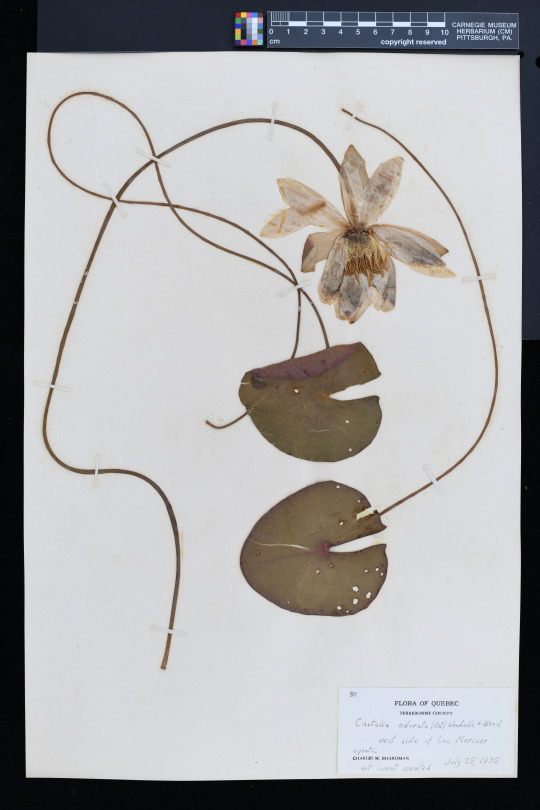
Water lily specimen
Water lily specimen found in Boardman’s personal herbarium.

Most of the specimens are from the 1930’s and 1940’s collected from Pennsylvania and beyond. In the coming weeks and months, we will process this amazing gift to see how many specimens are in this hidden treasure and put them into the main herbarium here at the museum for researchers to use in the future. You never know where a historic treasure may be lurking.

Bonnie Isaac is the Collection Manager in the Section of Botany. Museum employees are encouraged to blog about their unique experiences and knowledge gained from working at the museum.
Filed Under: Blog Tagged With: Bonnie Isaac, Botany, Charles Boardman, herbarium, Mason Heberling, Pittsburgh, plants

  • « Go to Previous Page
  • Page 1
  • Page 2
  • Page 3
  • Page 4
  • Interim pages omitted …
  • Page 18
  • Go to Next Page »

sidebar

About

  • Mission & Commitments
  • Directors Team
  • Museum History

Get Involved

  • Volunteer
  • Membership
  • Carnegie Discoverers
  • Donate
  • Employment
  • Events

Bring a Group

  • Groups of 10 or More
  • Birthday Parties at the Museum
  • Field Trips

Powdermill

  • Powdermill Nature Reserve
  • Powdermill Field Trips
  • Powdermill Staff
  • Research at Powdermill

More Information

  • Image Permission Requests
  • Science Stories
  • Accessibility
  • Shopping Cart
  • Contact
  • Visitor Policies
One of the Four Carnegie Museums | © Carnegie Institute | Privacy Policy | Terms of Use | Accessibility
Rad works here logo