• Skip to primary navigation
  • Skip to main content
  • Skip to primary sidebar

Carnegie Museum of Natural History

One of the Four Carnegie Museums of Pittsburgh

  • Visit
    • Buy Tickets
    • Visitor Information
    • Exhibitions
    • Events
    • Dining at the Museum
    • Celebrate at the Museum
    • Powdermill Nature Reserve
    • Event Venue Rental
  • Learn
    • Field Trips
    • Educator Information
    • Programs at the Museum
    • Bring the Museum to You
    • Guided Programs FAQ
    • Programs Online
    • Climate and Rural Systems Partnership
  • Research
    • Scientific Sections
    • Science Stories
    • Science Videos
    • Senior Science & Research Staff
    • Museum Library
    • Science Seminars
    • Scientific Publications
    • Specimen and Artifact Identification
  • About
    • Mission & Commitments
    • Directors Team
    • Museum History
  • Tickets
  • Give
  • Shop

plants

September 24, 2021 by wpengine

What Do Botanists Do On Saturday?

by Sarah C. Williams

Here in the section of Botany we’ve adapted in some strange ways, just like plants do, to the changes of the past year and a half. Let’s learn about the off days of some of our Super Scientists in the Section of Botany!

Mason Heberling, Assistant Curator of Botany

Collecting specimens has become a focus as more time was able to be spent in the field when we weren’t allowed to be at the museum. As our new Botany Hall entrance video shows, Assistant Curator of Botany, Mason Heberling and Collections Manager Bonnie Isaac collect plant specimens on a pretty regular basis. They also snag iNaturalist observations for these plants, taking photos that show what the plant and habitat looked before being picked and pressed.

Mason studies forest understory plants, in particular, introduced species and wildflowers in our changing environment. Mason has a bunch of fun projects going on this summer, ranging from coordinating seed collections of an uncommon native grass to send to Germany for a large greenhouse study to working with a team of students to study the effects of climate change and introduced shrubs on our forest wildflowers.

In addition to work in the field, the herbarium has been a busy place this summer too! Mason has been working with Alyssa McCormick, an undergraduate research intern from Chatham University, to examine stomata (the pores on leaves for air exchange for plants to “breathe”) and leaf nutrients in everyone’s favorite plant – poison ivy!  Poison ivy has been previously shown to grow bigger and cause nastier skin rashes with increasing carbon dioxide in our air due to fossil fuel emissions. Alyssa is using specimens collected as long ago as the 1800s to examine long term changes in poison ivy.
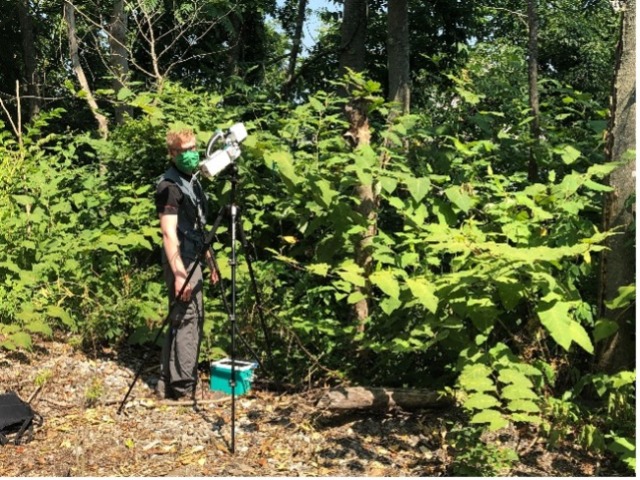
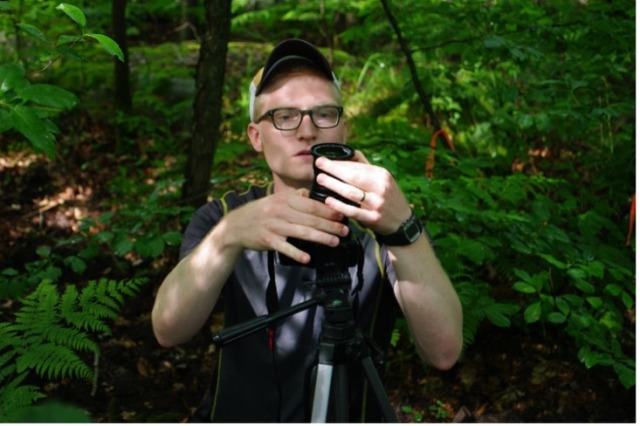
Man outside in a forested area
Man setting up equipment in a forested area

Mason, where can we find you on a Saturday?

“This summer has been a lot of going to various places around western PA like Presque Isle or Idlewild to get out and enjoy the fresh air with my family. I can also be found most Saturdays around the house doing chores!”

Bonnie Isaac, Collection Manager

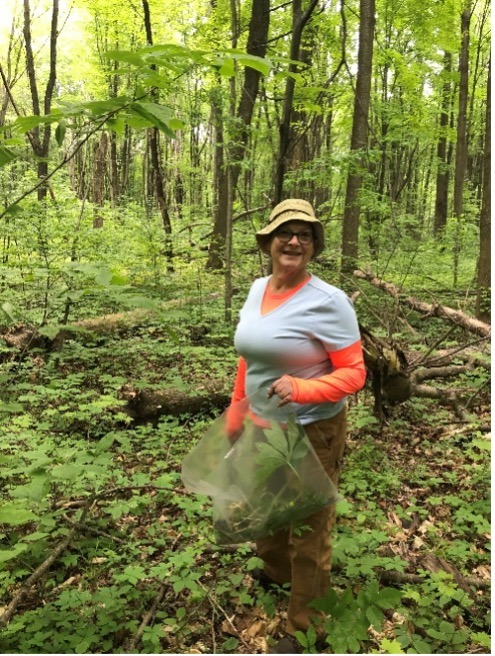
Bonnie, one of CMNH’s TikTok celebrities, and All-Star in the Mid-Atlantic plant world, has spent a lot of the past year doing fieldwork. Her PA Wild Resource Grant involved looking at most of the populations for 10 Pennsylvania rare species. She and husband Joe Isaac spent many days on the road and a few in the bog! You can see some of her videos about these unique Pennsylvania finds on Carnegie Museum of Natural History’s Tiktok account: @carnegiemnh.

She diligently keeps track of various data points from latitude and longitude and elevation, to flower color, size, and associated species within a habitat. In addition to trying to make sure the plant names in our database are correct, she has also been busy georeferencing some of our specimens so that we can see on a map where each one was collected.
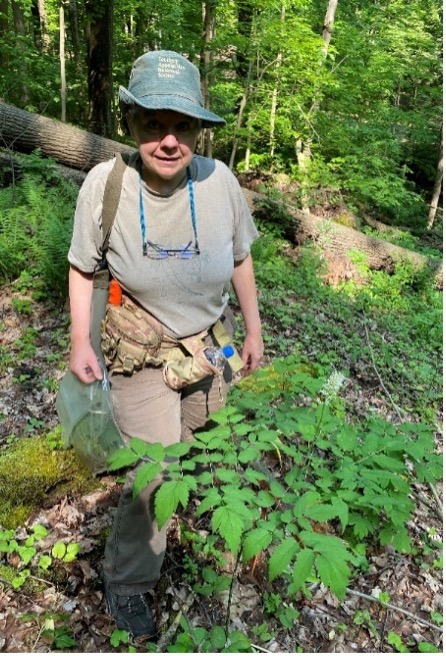

Woman walking in the woods
Two people in kayaks on the water

Bonnie, where can we find you on a Saturday?

“On most Saturdays I am either home taking care of my many chickens or getting some exercise in one of my kayaks with my spousal unit, Joe. I sometime even take a fishing pole for a ride or see how many different kinds of plants I can find on a hike. As long as I can get outside with Joe, I’m happy.”

Cynthia Pagesh, Herbarium Assistant

Specimens make their way home to the museum, where we assure they’re bone dry, flat as a pancake, and have been frozen twice to get rid of any pests. They then find their way into the nimble hands of Cynthia Pagesh, our resident plant mounter. Cynthia has luckily been able to do some mounting both onsite and at home over this past year, really honing her craft. She uses Elmer’s glue, dental and sculpture tools, linen tape, and a paintbrush akin to a magic wand: transforming roots, stems, flowers, and fruits into scientific and artistic renderings on an 11.5×16.5” archival herbarium sheet.

Mounting can be very detailed and challenging: wrangling a dry and brittle rare plant you want to salvage every detail from, or an oversized leaf ‘how-will-this-all-fit?’ ordeal, or finessing a delicate petal that glue is especially heavy on. Bulky bits, crumbly bits, spiky no nos: Cyn handles them all. Her work is just as much an art as it is a science. When she’s not making masterpieces, she’s probably doing something with plants.
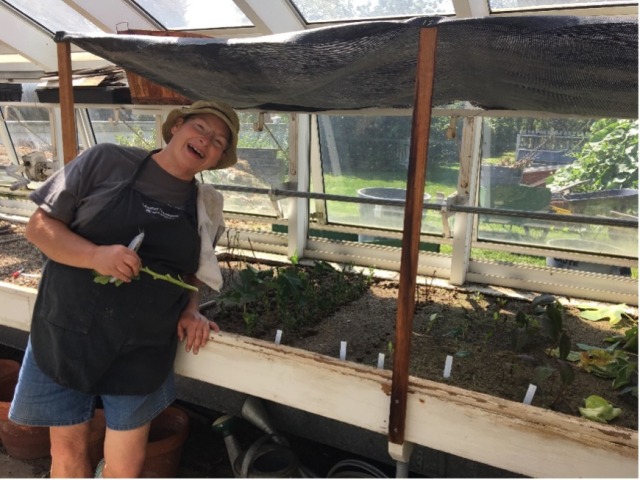
Person in a greenhouse
Person in the woods

Cyn, where can we find you on a Saturday?

“You can find me on Saturdays helping prune young trees in my community, collecting wildflower seeds or in my kitchen making preserves or homemade pasta noodles.  I volunteer in vegetable, herb and flower gardens.  I have a pollinator garden at home and raise Monarch caterpillars.  I tag and release them to migrate south.

There are lots of Community Science projects for people of all ages: ask someone to help you find one related to a subject you have an interest in.  I have an interest in pollinators including bees.  I participate in a Community Science Project every Summer that counts types of bees on certain plants when they bloom.”

Iliana DiNicola

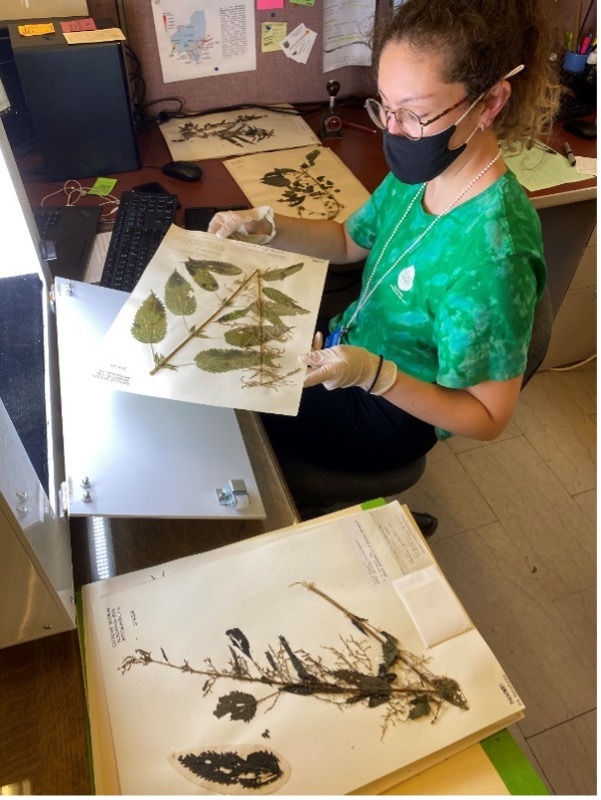
After another stint in the freezer for bugs-be-gone, it’s everyone’s favorite day: Picture Day! Each plant: sturdy and mounted, all data logged and super official, makes their way to the imaging station to spend some time under the bright lights. Since 2018, students, interns, and volunteers have lovingly held these plants’ hands as they get their close ups. We take high definition photos using a specially made lightbox and special software.

While this is part of a limited project, called the Mid-Atlantic Megalopolis, we are still hard at work going into our last year of the time we were given. This past schoolyear and summer, former Pitt student, Iliana DiNicola was taking pictures for us on the regular while also interning with the Pittsburgh Parks Conservancy. She just graduated and I’m excited to hear what she does on her Saturdays in the future.
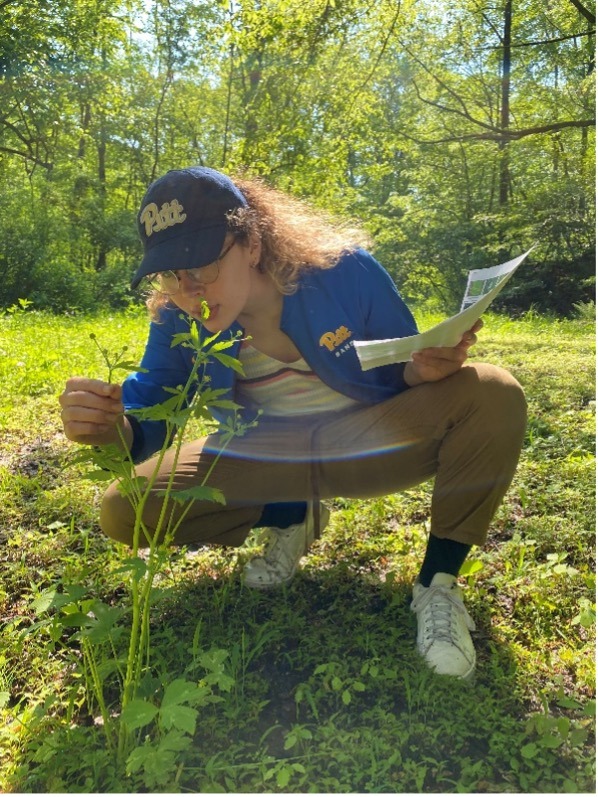
Woman looking at a plant outdoors
Woman working with herbarium sheets

Iliana, where can we find you on a Saturday?

“I just graduated from the University of Pittsburgh with a degree in Environmental Studies, and I am now on the lookout for any jobs related to the environment back in my hometown of Phoenix, Arizona. I am interested in working with anything from sustainability, to policy or political work, or maybe even something more related to ecology and outdoor work.

On a Saturday, I am definitely helping clean my house since I am a semi-clean freak, I love to go hiking if the weather isn’t too hot, enjoy drawing and working on any art projects, or work on my future hydroponics garden.

As somebody who interned for Pittsburgh Parks Conservancy, I highly recommend participating in any camps or activities the conservancy has to offer. It was super fun learning more about Pittsburgh’s history and ecology and getting to teach kids about these topics, alongside participating in fun outdoor activities.”

Sarah Williams, Curatorial Assistant

Next up, Sarah Williams, the Curatorial Assistant in the Section of Botany, is overseeing the digitization project, morphing the photos from raw camera files into smaller files for sharing and detailed files for archival storing using Adobe Lightroom. She takes the images from the newly photographed specimens and makes sure they get uploaded onto the Mid-Atlantic Herbaria Consortium’s website to be shared far and wide across the world.

There is also a lot she does in sorting, filing, and taking care of the specimens as well. She does a bunch of scheduling, hiring, and training of work study students, interns, and volunteers. We consider her a jack of all trades.
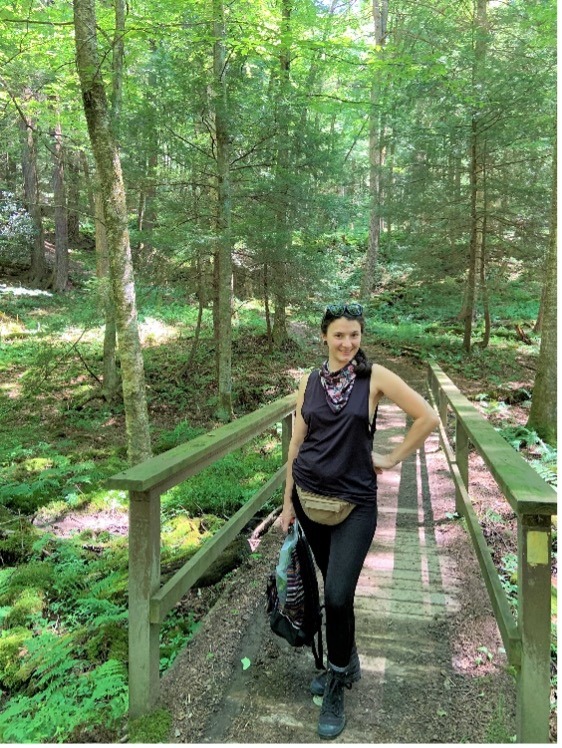
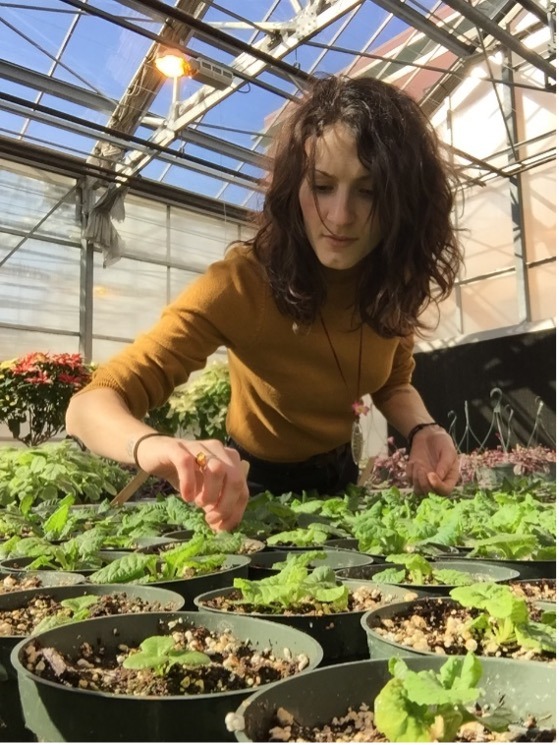
Woman in the woods
Woman in a greenhouse

Sarah, where can we find you on a Saturday?

“Most weekends I work with a local catering company called Black Radish Kitchen. I usually end up serving delicious vegetable and farm focused meals at least one day a week, commonly Saturdays because they’re prime for celebrations. The re-start up since the pandemic has been cautious, and I’m excited to be amongst people and help them to make mouthwatering memories again. I’ve worked in the restaurant industry for over a decade and the skills I’ve learned doing it as well as the friends I’ve made are matchless. It has a big piece of my heart.

I also moved into a new house this year about five minutes from my mom, so if I’m not running to say hi to her and ‘borrow’ some groceries, I’m doing laundry, dusting and yardwork… but only after I sleep in, eat some delicious breakfast with my partner, and hang out with our two cats, Santi and Gil.”

We hope you enjoyed getting to know us here in the Section of Botany, look forward to updates and more introductions in the future as we continue to host volunteers, federal work-study students, and interns on their journeys to learn even more about the plant kingdom.

Sarah Williams is Curatorial Assistant in the Section of Botany at Carnegie Museum of Natural History. Museum employees are encouraged to blog about their unique experiences and knowledge gained from working at the museum.

Related Content

How Do You Preserve a Giant Pumpkin?

Fall Blooms Rival Those of Spring

A Deeper Look at Dioramas

Carnegie Museum of Natural History Blog Citation Information

Blog author: Williams, Sarah C.
Publication date: September 24, 2021
Share this post!

  • Share on Twitter Share on Twitter
  • Share on Facebook Share on Facebook
  • Share on Pinterest Share on Pinterest
  • Share on LinkedIn Share on LinkedIn
  • Share on Reddit Share on Reddit
  • Share via Email Share via Email

Share this post!

  • Share on Twitter Share on Twitter
  • Share on Facebook Share on Facebook
  • Share on Pinterest Share on Pinterest
  • Share on LinkedIn Share on LinkedIn
  • Share on Reddit Share on Reddit
  • Share via Email Share via Email

Filed Under: Blog Tagged With: Botany, plants, Sarah Williams, Science News, ssstakeover

June 4, 2021 by wpengine

Collected on this Day in 1982: One specimen isn’t always enough!

Archiving biological variation.

by Mason Heberling

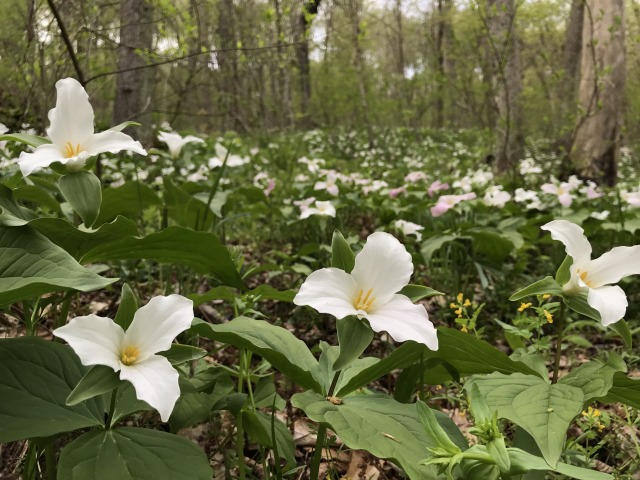
Flowering trillium in the woods

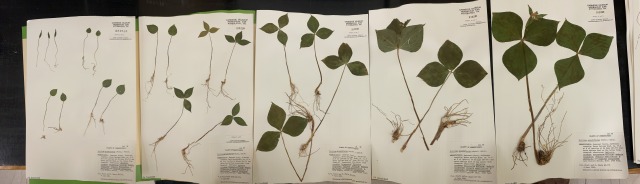
Five herbarium sheets with specimens of trillium on them arranged with the smallest leaves on the left and largest on the right.

This specimen is not a specimen but a set of five specimens! Same species (large flowered trillium, Trillium grandiflorum). Same site (in Somerset county, PA). All collected on same date (June 4, 1982) by Frederick H. Utech and Masashi Ohara.

We know that one specimen of every species is not enough. Having many specimens of many species, across many sites, and through time are necessary to document what organisms lived where, when, how far species ranges extend, and how these change through time. We study these specimens to understand biodiversity and biodiversity change across many scales.

But why collect that many vouchers of the same species, from the same site, on same date? One reason might be to send “duplicate” vouchers to other herbaria, both to help other collections expand their holdings, to get expert opinions on identification, and/or to protect against (unlikely but very possible) damage that may happen in one herbarium (like fire, flood, insect damage – oh my!).

But that isn’t what happened here. All specimens are stored together at Carnegie Museum of Natural History.

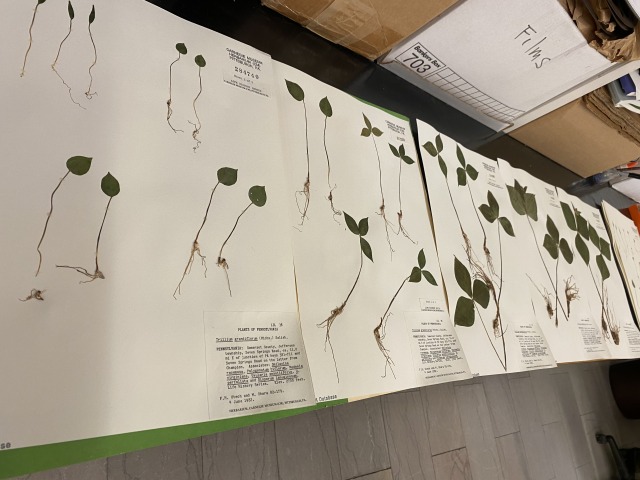
Voucher series of trillium herbarium specimen sheets.

So why? Well, it is simple, but quite genius, really. Utech and Ohara collected a “life history” voucher series. That is, these specimens each show different stages of the species’ development from small cotyledon-bearing seedlings just germinating above ground, to one leaved plants, to small to large three leaved juvenile trilliums that have not yet flowered, to large adult plants with flowers.

Utech and Ohara, along with Shoichi Kawano, pioneered this method of collecting and advocated for its importance in a 1984 essay in the Journal of Phytogeography and Taxonomy. Historically, plant specimens are collected with a major specific purpose in mind – to document the plant was there at a given time. To do that, botanists of course collect specimens that are best for identification, such that others can verify the species. For most species, that means plants tend to be collected when they are adults and reproductive (with flowers and/or fruits). Specimens without reproductive organs (called “vegetative” specimens) are generally viewed as less useful for this purpose and often avoided.

But Utech and others found that this standard approach, though useful for some research, did not cut it for their work. As organismal biologists studying the life history, ecology, and life cycle of species, they found many species were not well represented in herbarium collections.

Many species, like trillium, have distinct life stages from seedling to juvenile to adult. Many species form overwintering leaves or juvenile leaves that differ dramatically, even unrecognizably, from “typical” adult specimens.

So there’s good reasons to collect across life history and across individuals within a population. Biological collections are all about archiving biodiversity in its many forms, whether across deep time with fossils, across species, within species, or even within populations at a specific site.

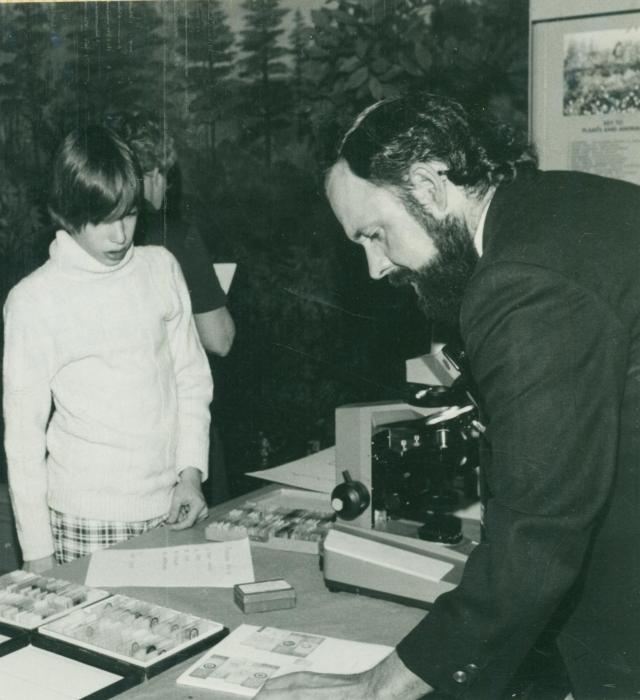
Man at a table of plant specimens talking to a child about them.
Dr. Frederick H. Utech, past curator at Carnegie Museum, at a member’s night in 1979.

Dr. Utech (1943-2021) was a curator at the museum from 1976 until 1999. He was then a research botanist at the nearby Hunt Institute for Botanical Documentation until his retirement in 2011, notably contributing to three volumes of the Flora of North America project. More than 23 thousand specimens in the Carnegie Museum herbarium were collected by him. Dr. Utech passed away earlier this year but his legacy lives on. You can find his obituary here.

Inspired by the method of life history series and the need for new perspectives in the way we collect, CMNH Botany staff are working to promote and expand these ideas. We are presenting some of these ideas at the Society of Herbarium Curators annual meeting later this summer.

Find many more specimens (24,662 to be exact!) collected by Dr. Utech (including other life history series vouchers) here.

Check back for more! Botanists at the Carnegie Museum of Natural History share digital specimens from the herbarium on dates they were collected. They are in the midst of a three-year project to digitize nearly 190,000 plant specimens collected in the region, making images and other data publicly available online. This effort is part of the Mid-Atlantic Megalopolis Project (mamdigitization.org), a network of thirteen herbaria spanning the densely populated urban corridor from Washington, D.C. to New York City to achieve a greater understanding of our urban areas, including the unique industrial and environmental history of the greater Pittsburgh region. This project is made possible by the National Science Foundation under grant no. 1801022.

Mason Heberling is Assistant Curator of Botany at Carnegie Museum of Natural History. Museum employees are encouraged to blog about their unique experiences and knowledge gained from working at the museum.

Related Content

Collected On This Day: September 6

Ask a Scientist: How do you find rare plants?

Do Plants Have Lips? No, But One Genus Sure Looks Like it Does!

Carnegie Museum of Natural History Blog Citation Information

Blog author: Heberling, Mason
Publication date: June 4, 2021

Share this post!

  • Share on Twitter Share on Twitter
  • Share on Facebook Share on Facebook
  • Share on Pinterest Share on Pinterest
  • Share on LinkedIn Share on LinkedIn
  • Share on Reddit Share on Reddit
  • Share via Email Share via Email

Share this post!

  • Share on Twitter Share on Twitter
  • Share on Facebook Share on Facebook
  • Share on Pinterest Share on Pinterest
  • Share on LinkedIn Share on LinkedIn
  • Share on Reddit Share on Reddit
  • Share via Email Share via Email

Filed Under: Blog Tagged With: Botany, collected on this day, Mason Heberling, plants, Science News, We Are Nature 2

September 20, 2019 by wpengine

September 20, 1952: 67 Years Ago

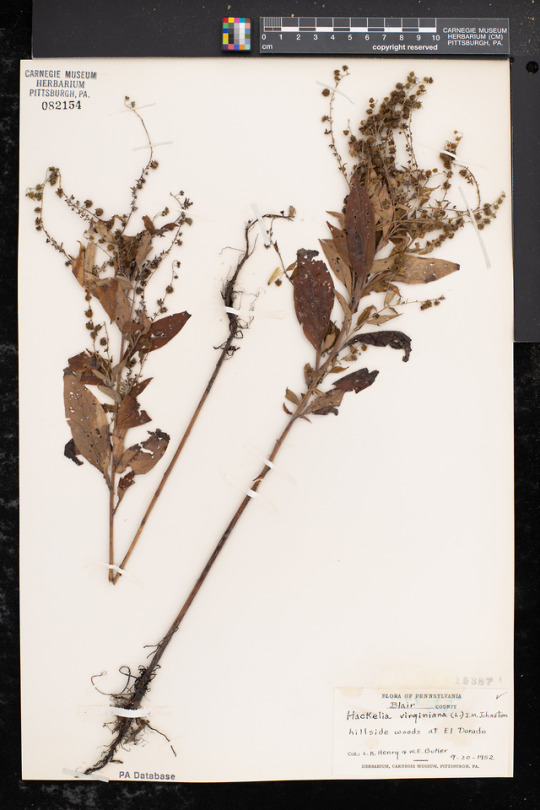
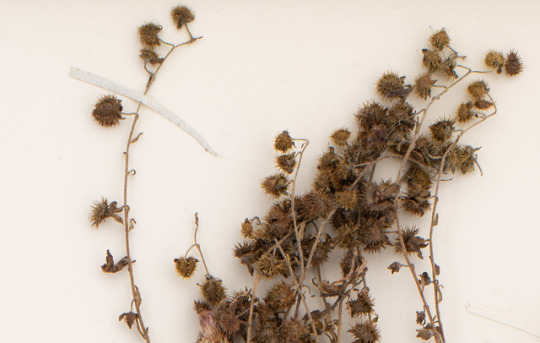
Virginia stickseed specimen

It’s fall seed dispersal time!

This specimen of Virginia stickseed (Hackelia virginiana), also interestingly called beggar’s lice, was collected on September 20, 1952 by Leroy Henry (Carnegie Museum Curator of Botany at the time) in the woods of Blair county, Pennsylvania.

The common name for this plant is quite appropriate.  The small seeds have many burs on them, making them very sticky.  And stick to your clothes with barely a touch, making them easily dispersed (unknowingly) by animals.

If you have a dog, you’ve likely pulled these out their fur in the fall!  My dog was covered in them the other day, which was both amazing and annoying at the same time.

Stickseed is in the borage family, Boraginaceae.  It has very small white flowers that resemble forget-me-not, also in the same plant family.  However, it is the fruit/seeds that are most memorable.

Find high resolution image of this Virginia stickseed specimen (and more) online here:
midatlanticherbaria.org/portal/collections/individual/index.php?occid=12253345&clid=0 


detail of Virginia stickseed specimen

Check back for more! Botanists at the Carnegie Museum of Natural History share digital specimens from the herbarium on dates they were collected. They are in the midst of a three-year project to digitize nearly 190,000 plant specimens collected in the region, making images and other data publicly available online. This effort is part of the Mid-Atlantic Megalopolis Project (mamdigitization.org), a network of thirteen herbaria spanning the densely populated urban corridor from Washington, D.C. to New York City to achieve a greater understanding of our urban areas, including the unique industrial and environmental history of the greater Pittsburgh region. This project is made possible by the National Science Foundation under grant no. 1801022.

Mason Heberling is Assistant Curator of Botany at the Carnegie Museum of Natural History. Museum employees are encouraged to blog about their unique experiences and knowledge gained from working at the museum.

Filed Under: Blog Tagged With: Anthropocene, Botany, collected on this day, Mason Heberling, plants

September 9, 2019 by wpengine

Don’t Overlook the Lichens

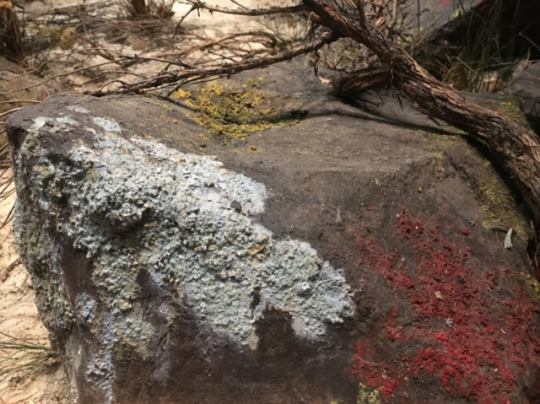
various lichen on rock

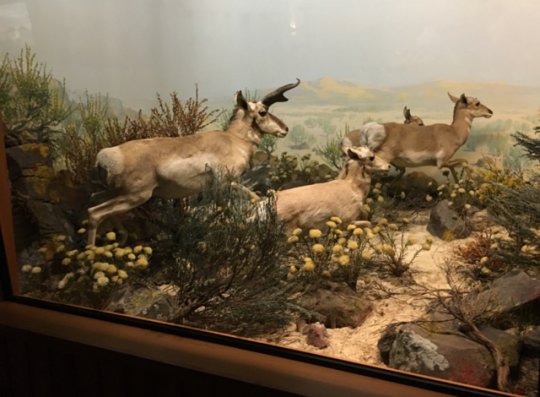
Lichens are scenery elements in many museum dioramas. Within the Pronghorn Antelope diorama in the Hall of North American Wildlife, for example, these frequently overlooked organisms coat a foreground boulder with irregular patches of gray, red, and gold.

pronghorn antelope diorama

If you approach this artfully recreated western scene with a little background information about lichens, you might find the colorful cluster of immobile organisms in the bottom right corner just as interesting as the four galloping centerpieces.

Lichens are found on every continent and estimates of their global diversity range from 13,000 to more than 17,000 species. Every lichen is a partnership of two different organisms, a fungus whose tissue provides the physical structure to support a second organism capable of photosynthesis. For most lichens the partner with the solar energy power is some form of green algae.  The fungus/algae partnership is a living arrangement in which separate identities fade while combined abilities allow for survival in locations where neither organism could live alone.

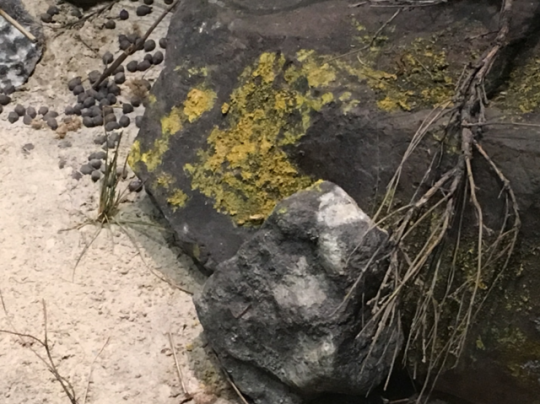
Crustose or curst-like lichen and pronghorn antelope scat.

Three distinctive growth forms provide a means for categorizing lichen. The colorful trio sharing the pronghorn antelope diorama are termed “crustose” or crust-like lichens. Lichens with a leaf-like appearance and structure are termed “foliose,” and those with shrubby upright or dangling strands are termed “fruticose.”

Because lichens absorb so much of their nourishment from the air and rainfall, they serve as living air quality indicators. By monitoring a region’s changing balance of pollution sensitive species and pollution tolerant species, a researcher can visually chart the build-up or decrease of pollutants such as sulfur dioxide and nitrogen dioxide.

For more detailed information about lichen ecology, including information about local research efforts, please visit the site maintained by Point Park University Professor Matthew Opdyke.

Patrick McShea works in the Education and Visitor Experience department of Carnegie Museum of Natural History. Museum employees are encouraged to blog about their unique experiences and knowledge gained from working at the museum.

Filed Under: Blog Tagged With: Botany, Hall of North American Wildlife, Pat McShea, Patrick McShea, plants

August 22, 2019 by wpengine

A couple of creepers: plant doppelgängers

Did you know that many plant species have doppelgängers?

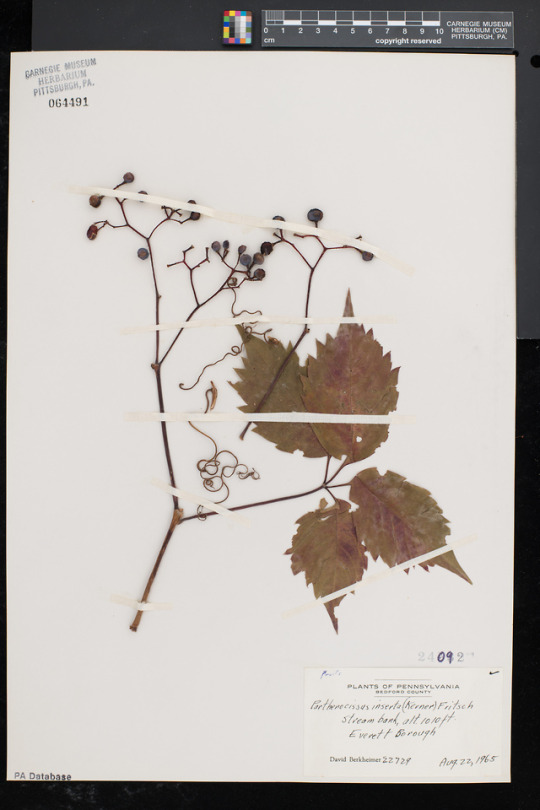
thicket creeper specimen
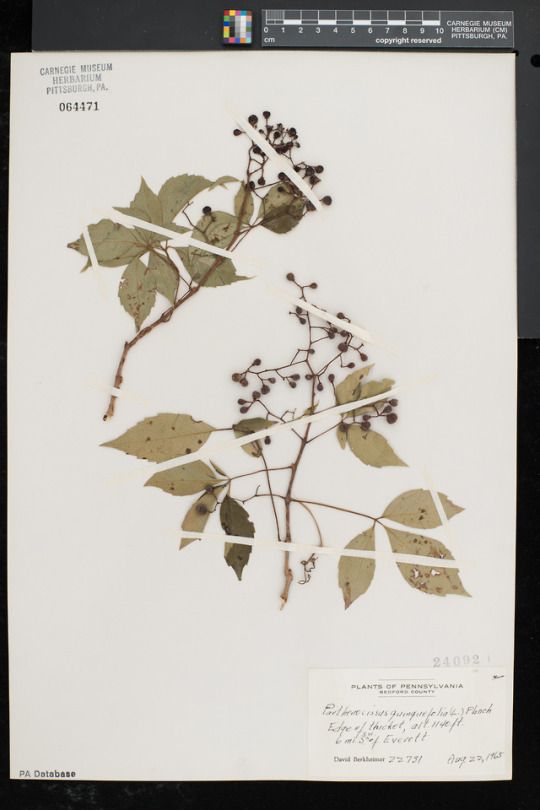
Virginia creeper specimen

Check out these two species, both collected at the same site on August 22, 1965 by David Berkheimer in Everett Borough (Bedford county), Pennsylvania.

With its distinctive hand-like leaves, Virginia creeper (Parthenocissus quinquefolia) is fairly well known, or at least familiar by look to many.  It is a woody vine in the grape plant family (Vitaceae), common to forests, forest edges, and urban areas across eastern North America.  It is one of those ubiquitous but overlooked plants. The species is just about everywhere, climbing high up trees. But upon closer look, there are two similar looking species in Pennsylvania. Although less commonly recognized (though not all that uncommon to find!), thicket creeper (Parthenocissus inserta) looks very similar.  (Note: there is some confusion, with some botanists calling this species P. vitacea, but either way, there are definitely two species here).

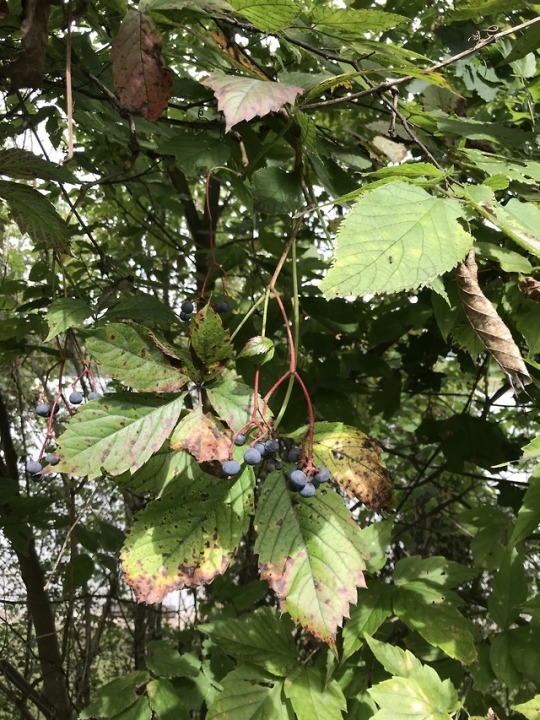
Virginia creeper
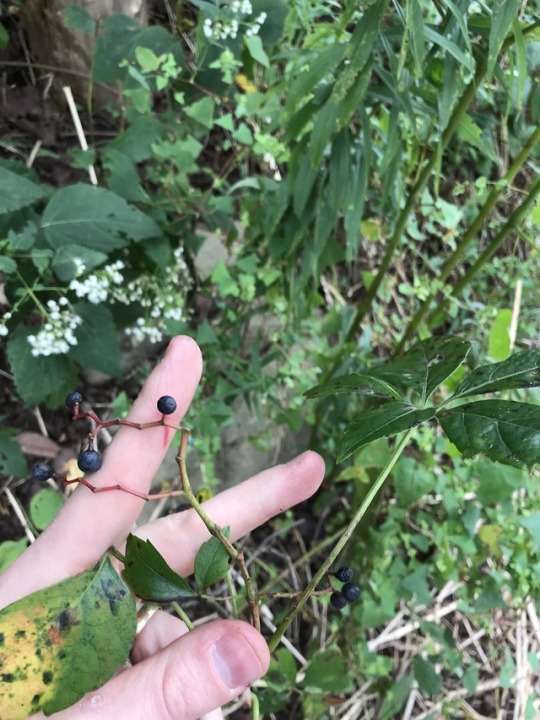
thicket creeper

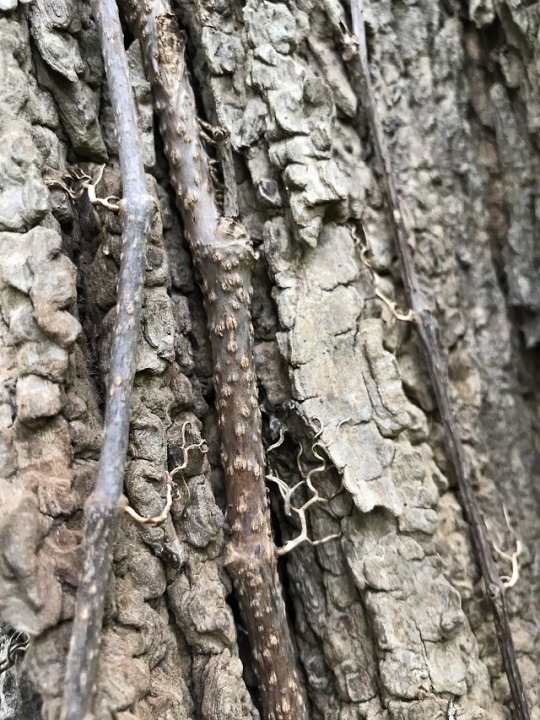
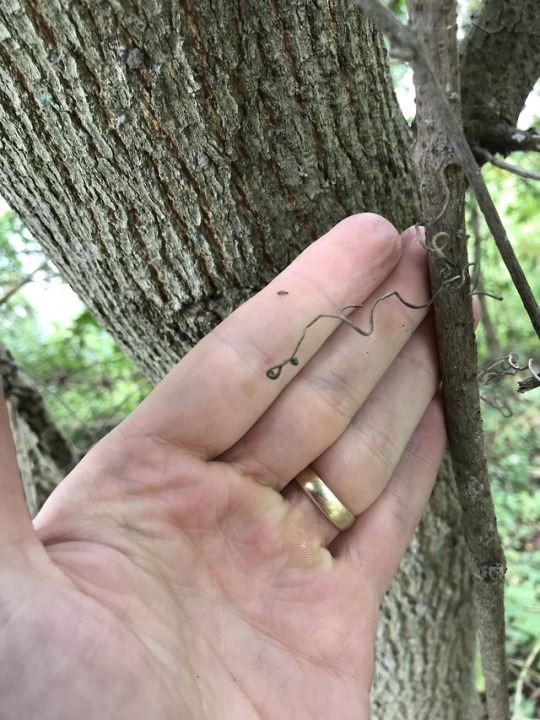
So what’s the difference? There are two easy ways to tell the difference.  First, the species have differences in their tendrils (the structures that wrap around branches, attaching the vine to the tree it is climbing).  Virginia creeper has clear adhesive, swollen disks where the tendrils attach to the tree.  In contrast, thicket creeper does not have these. (But to confuse you, they rarely do).  Second, the flowering/fruiting structures are different. Thicket creeper has branching inflorescences (stem structure with flowers/fruits), often in two main axes, with noticeably larger berries than Virginia creeper. Virginia creeper has an inflorescence that branches, often in zig-zag, random looking pattern, but most importantly – with a clear central axis.

Virginia creeper with adhesive disks
thicket creeper no adhesive disks

A couple years ago, I was confident I could pick Virginia creeper out of a line up.  But I must admit, I didn’t even know until last year there was another species that looked like Virginia creeper. It was a mind-blowing moment, and pretty much dropped everything to go exploring for the two species. I’m always curious every time I see these vines to figure out which species it is.  It turns out, thicket creeper is more common than I thought around Pittsburgh, especially along the rivers.

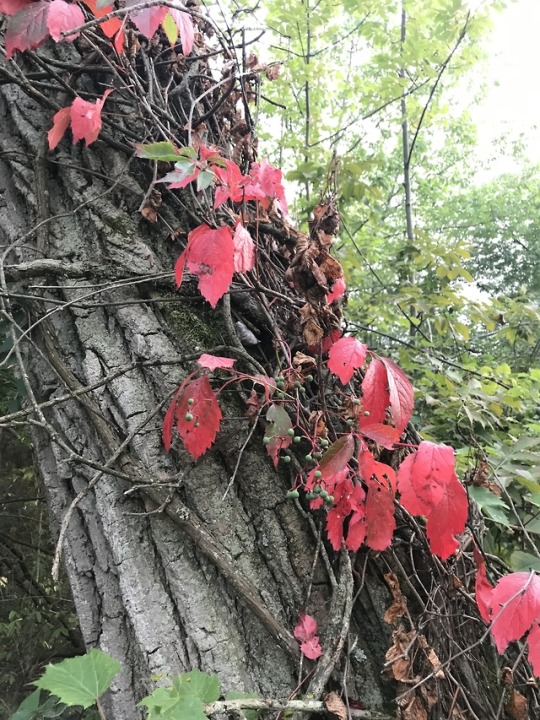
And keep an eye out for these species this fall, when they have developed fruits to easily tell them apart.  And on top of that, they have some of the most bright red, beautiful foliage of any plant in our area!

thicket creeper in autumn
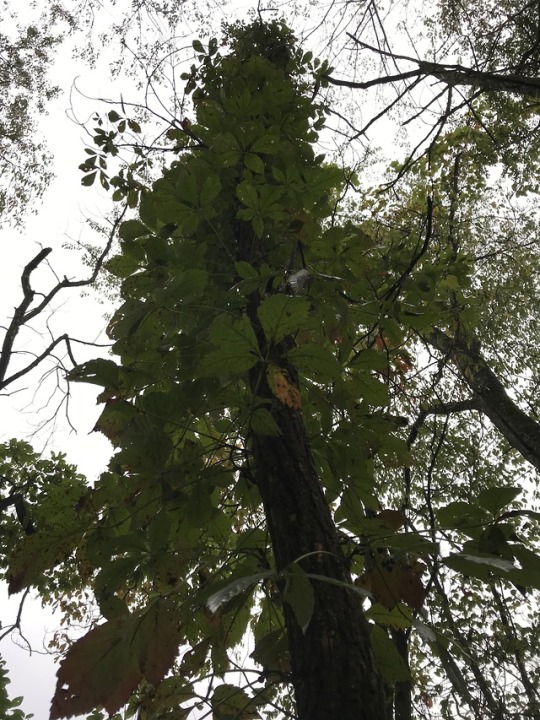
Virginia creeper climbing up

Check out these specimens (and more!) here.

Check back for more! Botanists at the Carnegie Museum of Natural History share digital specimens from the herbarium on dates they were collected. They are in the midst of a three-year project to digitize nearly 190,000 plant specimens collected in the region, making images and other data publicly available online. This effort is part of the Mid-Atlantic Megalopolis Project (mamdigitization.org), a network of thirteen herbaria spanning the densely populated urban corridor from Washington, D.C. to New York City to achieve a greater understanding of our urban areas, including the unique industrial and environmental history of the greater Pittsburgh region. This project is made possible by the National Science Foundation under grant no. 1801022.

Mason Heberling is Assistant Curator of Botany at the Carnegie Museum of Natural History. Museum employees are encouraged to blog about their unique experiences and knowledge gained from working at the museum.

Filed Under: Blog Tagged With: Botany, Mason Heberling, plants

August 20, 2019 by wpengine

A day late, but thanks for your Impatiens!

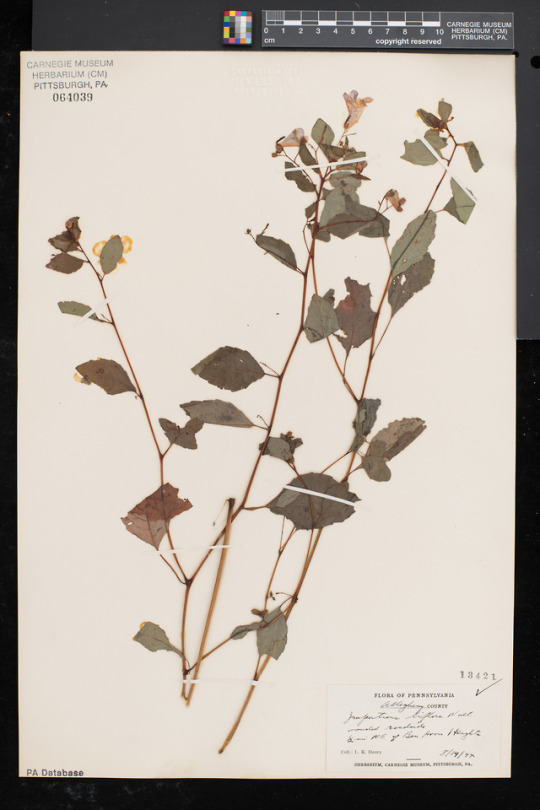
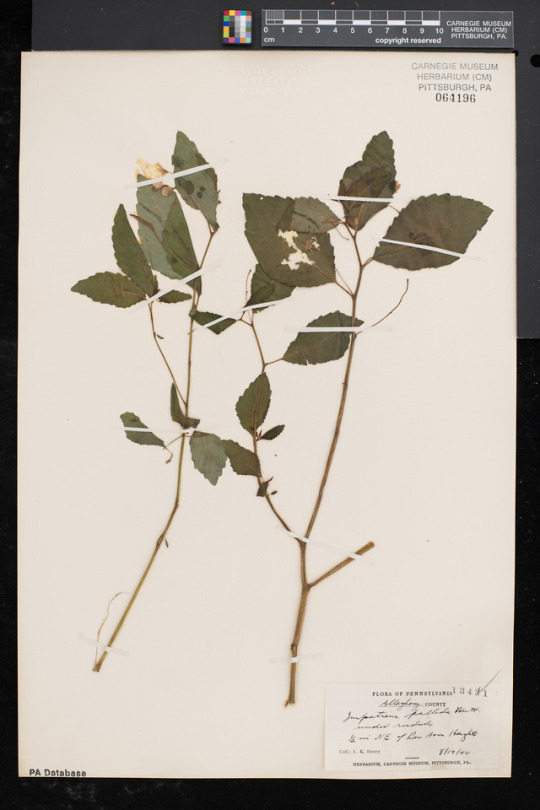
impatiens specimen
impatiens specimen

Two specimens of jewelweed, Impatiens, collected on this day (well, yesterday) by Carnegie Museum curator Leroy Henry in 1944 in Ben Avon Heights, near Pittsburgh.

There are two species of jewelweed commonly found in Pennsylvania and in relatively wet, partly shady habitats across eastern North America. They can form dense stands along wet roadside ditches at edge of woods and in floodplain forests. Henry collected both species in the same location, as they commonly grow together.

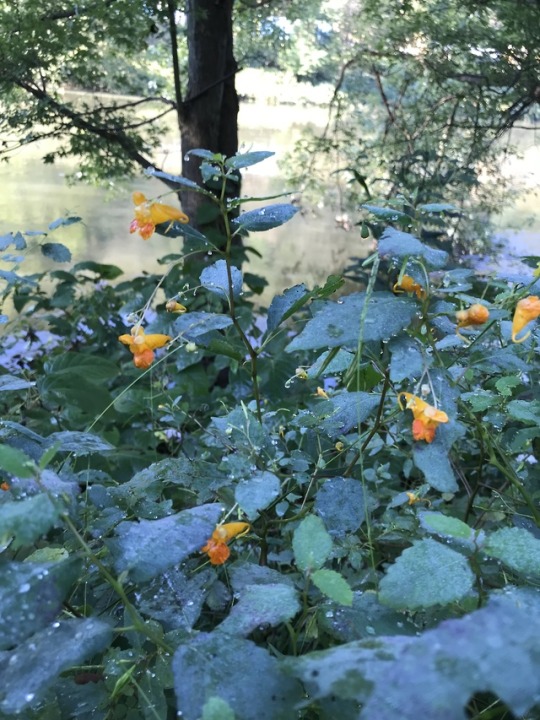
orange jewelweed

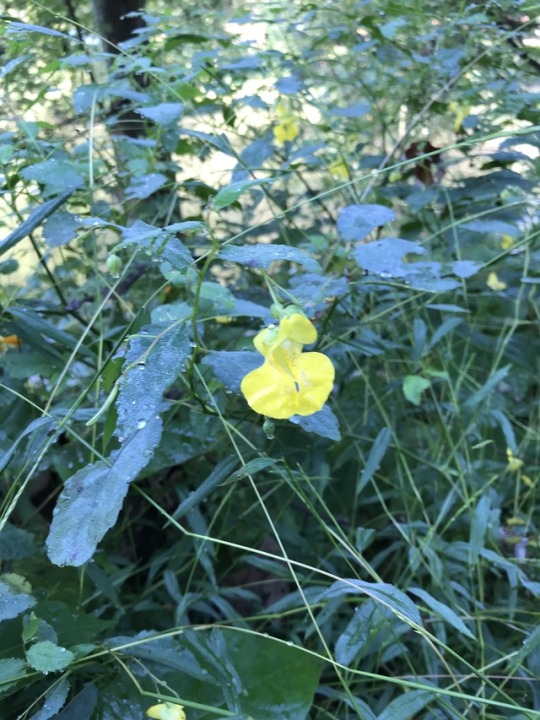
What’s the difference between these two specimens?  Though less obvious in specimen form, the most noticeable difference is flower color. Common jewelweed (Impatiens capensis), also called spotted or orange jewelweed, has orange flowers. In contrast, the flowers of yellow jewelweed (Impatiens pallida), also called pale jewelweed, are…well, yellow.  Flowers of both species have distinctive nectar spurs that jut out of the back of the flower. It is entertaining to watch bumblebees go from flower to flower in a stand of jewelweed.

yellow jewelweed

Jewelweeds are herbaceous, annual plants with juicy stems that can range in size, from short to very tall.  A widespread story is that jewelweed can treat skin irritations, and in particular, helps prevent poison ivy rash by rubbing jewelweed on skin after contact with poison ivy.  I don’t know of this being supported with data.

Jewelweed is also often called “touch-me-not” because the developed seed pods eject seeds out when touched. It can be a fun activity for kids (and adults).

Jewelweed flowers open mid-summer and the plants continue to flower until killed by autumn frost.

Jewelweed produces two types of flowers – the obvious ones with nectar spurs that are visited by bees and also, tiny inconspicuous flowers that do not open.  These small flowers are self-pollinating (cleistogamous).

Deer often eat jewelweed. A recent study found that some populations of the species that have historically received a lot of deer browsing have evolved greater tolerance to herbivory.

I’m always amazed how sensitive jewelweed leaves are to the sun. When exposed to direct sun, their leaves get very droopy. But they seem to quickly bounce back.

Impatiens commonly planted in gardens are related (in the same genus) but are not the same species.

Check out these specimens (and more!) here.

Check back for more! Botanists at the Carnegie Museum of Natural History share digital specimens from the herbarium on dates they were collected. They have embarked on a three-year project to digitize nearly 190,000 plant specimens collected in the region, making images and other data publicly available online. This effort is part of the Mid-Atlantic Megalopolis Project (mamdigitization.org), a network of thirteen herbaria spanning the densely populated urban corridor from Washington, D.C. to New York City to achieve a greater understanding of our urban areas, including the unique industrial and environmental history of the greater Pittsburgh region. This project is made possible by the National Science Foundation under grant no. 1801022.

Mason Heberling is Assistant Curator of Botany at the Carnegie Museum of Natural History. Museum employees are encouraged to blog about their unique experiences and knowledge gained from working at the museum.

Filed Under: Blog Tagged With: Botany, collected on this day, flowers, Leroy Henry, Mason Heberling, plants

  • Page 1
  • Page 2
  • Page 3
  • Interim pages omitted …
  • Page 7
  • Go to Next Page »

sidebar

About

  • Mission & Commitments
  • Directors Team
  • Museum History

Get Involved

  • Volunteer
  • Membership
  • Carnegie Discoverers
  • Donate
  • Employment
  • Events

Bring a Group

  • Groups of 10 or More
  • Birthday Parties at the Museum
  • Field Trips

Powdermill

  • Powdermill Nature Reserve
  • Powdermill Field Trips
  • Powdermill Staff
  • Research at Powdermill

More Information

  • Image Permission Requests
  • Science Stories
  • Accessibility
  • Shopping Cart
  • Contact
  • Visitor Policies
One of the Four Carnegie Museums | © Carnegie Institute | Privacy Policy | Terms of Use | Accessibility
Rad works here logo