• Skip to primary navigation
  • Skip to main content
  • Skip to primary sidebar

Carnegie Museum of Natural History

One of the Four Carnegie Museums of Pittsburgh

  • Visit
    • Buy Tickets
    • Visitor Information
    • Exhibitions
    • Events
    • Dining at the Museum
    • Celebrate at the Museum
    • Powdermill Nature Reserve
    • Event Venue Rental
  • Learn
    • Field Trips
    • Educator Information
    • Programs at the Museum
    • Bring the Museum to You
    • Guided Programs FAQ
    • Programs Online
    • Climate and Rural Systems Partnership
  • Research
    • Scientific Sections
    • Science Stories
    • Science Videos
    • Senior Science & Research Staff
    • Museum Library
    • Science Seminars
    • Scientific Publications
    • Specimen and Artifact Identification
  • About
    • Mission & Commitments
    • Directors Team
    • Museum History
  • Tickets
  • Give
  • Shop

Blogs from our Scientific Researchers

Carnegie Museum of Natural History is home to active research and vast scientific collections. Our scientific researchers regularly contribute to the blog at the museum.

October 10, 2018 by wpengine

Fred the Crystal Skull

by Debra Wilson
Fred the Crystal Skull

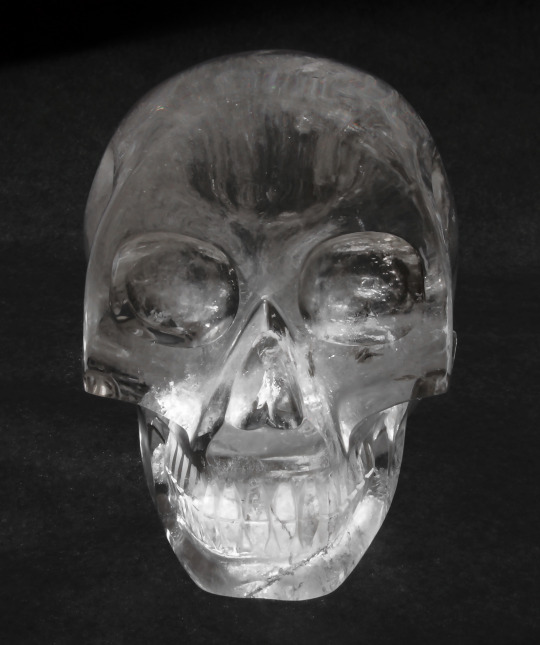
Just about every year since the Carnegie Museum of Natural History acquired it, Fred the Crystal Skull has made an appearance in Hillman Hall of Minerals and Gems right around Halloween. So how did we acquire a crystal skull and how did it get the name Fred you ask? Just to set the record straight right off the bat, Fred is not one of the dozen or so mysterious skulls that some think were carved by an ancient Mesoamerican civilization thousands of years ago. Our skull was carved and polished from a single quartz crystal with modern tools in Brazil and was donated to the museum in 2004 by South American Gems, Ltd located in Guarapari, Espirito Santo, Brazil.Germany, China and Brazil currently produce thousands of carved crystal skulls every year in numerous sizes. Fred measures 7.8 inches high by 5 inches wide, which is slightly smaller than the average human skull (8 to 9 inches high and 6 to 7 inches wide) so he was named after a man of small stature, namely the step father of the former Head of the Section of Minerals Marc Wilson. Marc was Section Head from August 1992 to August 2017.
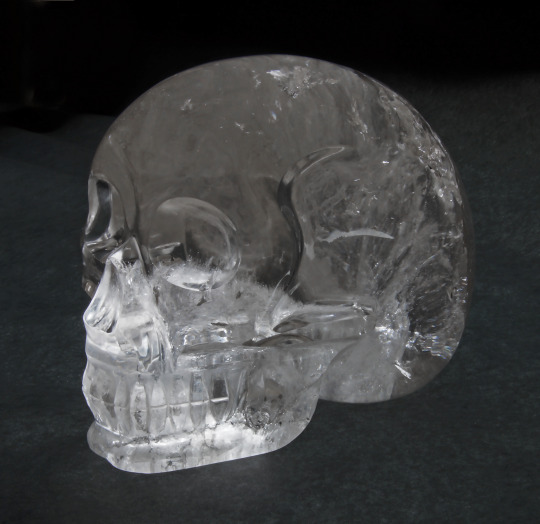
Fred the Crystal Skull side view

As you can see in the photograph of Fred, he has some internal flaws and fractures which is very common in the mineral quartz. Chemical impurities, physical flaws and twinning in natural quartz are issues that caused industry to develop a commercial process of manufacturing pure, electronics-grade quartz that can be used in circuits for consumer products such as televisions, radios, computers, cell phones and electronic games, just to name a few, and for crystal-controlled clocks and watches. As it so happens, the Section of Minerals also has a few lab-grown quartz crystals in the collection, including a large crystal nicknamed The Football that is nearly a foot across.
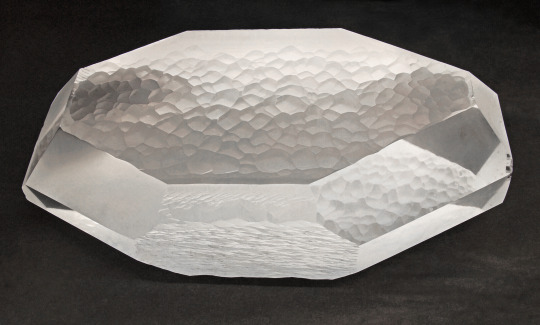
the football crystal

You will notice it is so clear that you can see the growth patterns of the bottom surface through the crystal. The Football was part of a donation of 57 lab created specimens given to the Section of Minerals in 2017 by Lynn Boatner just before he retired from Oak Ridge National Laboratory in Tennessee.

Debra Wilson is the Collection Manager for the Section of Minerals at Carnegie Museum of Natural History. Museum employees are encouraged to blog about their unique experiences and knowledge gained from working at the museum.

Related Content

Born to the Purple

How Do You Preserve A Giant Pumpkin?

Early Bats: Ancient Origins of a Halloween Icon

Filed Under: Blog Tagged With: Debra Wilson, gems and minerals, halloween, Hillman Hall of Minerals and Gems, minerals and gems, quartz, Science News

March 15, 2017 by wpengine

Squirrels at CMNH

by John Wible
squirrel on a fence post

Like many people in western Pennsylvania, I share my yard with gray squirrels (Sciurus caroliensis). Other than the mammalian pets in our houses, gray squirrels are the mammals we are most likely to see on a daily basis. They amuse us with their acrobatic antics at our bird feeders, their chattering vocalizations, and their skirmishes with their squirrel neighbors.

Gray squirrels are rodents with large, ever-growing incisors that help them open nuts and seeds. They belong to the squirrel family (Sciuridae), which also includes chipmunks, woodchucks, and flying squirrels. In fact, there are more than 200 species of squirrels that inhabit all continents except Antarctica, although humans brought them along to Australia.

brown squirrel specimen in the Section of Mammals
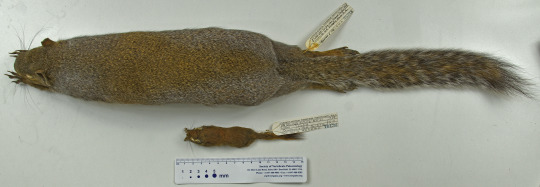
Gray squirrel and African pygmy squirrel specimens.

A typical adult gray squirrel in western Pennsylvania is about two feet from head to tail tip. That is not a baby gray squirrel below it in the picture above. That is an adult of the world’s smallest squirrel, the African pygmy squirrel (Myosciurus pumilio)! It measures about 5 inches and weighs 16 grams, less than half an ounce. They are found in lowland tropical forests in west central Africa (Cameroon, Gabon, Congo, and Equatorial Guinea). They are omnivores, foraging constantly, eating bark, fruits, and insects. Their conservation status is generally okay, but deforestation is a threat.

The African pygmy squirrel is the only squirrel that travels frequently both upside down and right side up along branches. What a treat it would be to see how one of these would get to my bird feeder!

John Wible, PhD, is the curator of the Section of Mammals at Carnegie Museum of Natural History. Museum employees are encouraged to blog about their unique experiences and knowledge gained from working at the museum.

Related Content

Ask a Scientist: What is the “Crazy Beast?”

How-to Draw a Squirrel

Armadillos: Identical Quadruplets Every Time

Carnegie Museum of Natural History Blog Citation Information

Blog author: Wible, John
Publication date: March 15, 2017

Share this post!

  • Share on Twitter Share on Twitter
  • Share on Facebook Share on Facebook
  • Share on Pinterest Share on Pinterest
  • Share on LinkedIn Share on LinkedIn
  • Share on Reddit Share on Reddit
  • Share via Email Share via Email

Filed Under: Blog Tagged With: John Wible, mammals, Science News

  • « Go to Previous Page
  • Page 1
  • Interim pages omitted …
  • Page 41
  • Page 42
  • Page 43

sidebar

About

  • Mission & Commitments
  • Directors Team
  • Museum History

Get Involved

  • Volunteer
  • Membership
  • Carnegie Discoverers
  • Donate
  • Employment
  • Events

Bring a Group

  • Groups of 10 or More
  • Birthday Parties at the Museum
  • Field Trips

Powdermill

  • Powdermill Nature Reserve
  • Powdermill Field Trips
  • Powdermill Staff
  • Research at Powdermill

More Information

  • Image Permission Requests
  • Science Stories
  • Accessibility
  • Shopping Cart
  • Contact
  • Visitor Policies
One of the Four Carnegie Museums | © Carnegie Institute | Privacy Policy | Terms of Use | Accessibility
Rad works here logo