• Skip to primary navigation
  • Skip to main content
  • Skip to primary sidebar

Carnegie Museum of Natural History

One of the Four Carnegie Museums of Pittsburgh

  • Visit
    • Buy Tickets
    • Visitor Information
    • Exhibitions
    • Events
    • Dining at the Museum
    • Celebrate at the Museum
    • Powdermill Nature Reserve
    • Event Venue Rental
    • Gift Cards
  • Learn
    • Field Trips
    • Educator Information
    • Programs at the Museum
    • Bring the Museum to You
    • Guided Programs FAQ
    • Programs Online
    • Climate and Rural Systems Partnership
  • Research
    • Scientific Sections
    • Science Stories
    • Science Videos
    • Senior Science & Research Staff
    • Museum Library
    • Science Seminars
    • Scientific Publications
    • Specimen and Artifact Identification
  • About
    • Mission & Commitments
    • Directors Team
    • Museum History
  • Tickets
  • Give
  • Shop

Blogs from our Scientific Researchers

Carnegie Museum of Natural History is home to active research and vast scientific collections. Our scientific researchers regularly contribute to the blog at the museum.

February 10, 2020 by wpengine

A Journey to France to Uncover the Mysteries of the Carnegie’s Grand Staircase

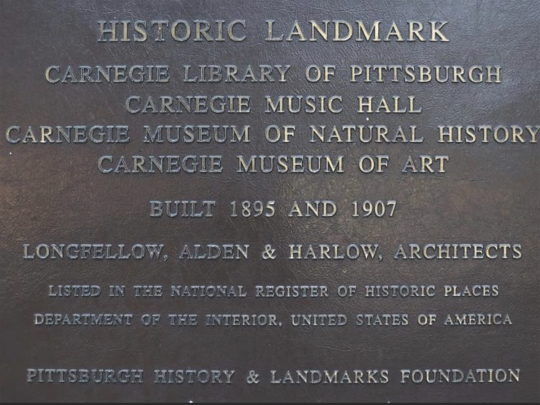
The Carnegie Institute has been in existence for 125 years and is one of the greatest architectural buildings ever designed in Pittsburgh. In 1985, Carnegie Institute President Robert Wilburn invited Dr. Cynthia R. Field, the Smithsonian’s Architecture Historian, to assess the artistic value of the museum. He asked, “what do you think is the most valuable specimen or painting in the museum?” She said, “The Building Itself is the Greatest Object of the entire Museum Collection” (Fig. 1).

image

Fig. 1: Carnegie plaque

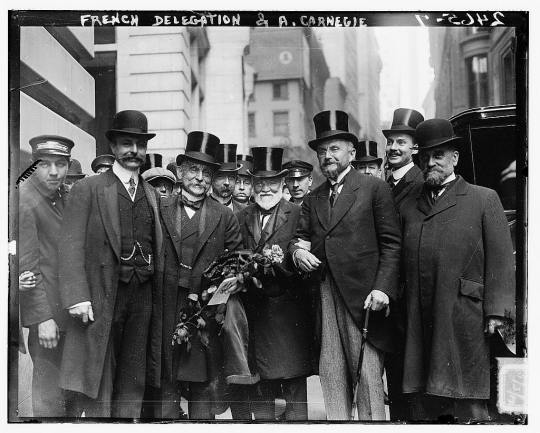
The internationally-famous architect, I.M. Pei, who designed the Louvre’s glass pyramid that sits in the Louvre’s central courtyard in Paris, France, opined, “Architecture is the very mirror of life. You only have to cast your eyes on buildings to feel the presence of the past, the spirit of a place; they are the reflection of society.” In 2018, Architecture Digest ranked the Carnegie’s Grand Staircase the 8th best museum staircase in the world. The Grand Staircase was built by the Pittsburgh architectural firm of Alden and Harlow at the apex of America’s Gilded-Age building boom. During my research, I discovered that the architects employed multicolored classic marbles and fossil limestones in the interior design from Algeria, Croatia, Greece, France, Ireland, Italy, and the United States. The commission to build the Grand Staircase in 1907 incorporated two classical French fossil limestones in the columns and pillars, floor tiles, steps, walls, balconies, and water fountains. This monumental Beaux-Arts style staircase is modeled after the L‘Opéra Garnier ‛a Paris, Grand Staircase in France, c. 1875, and was visited by a French Delegation with Andrew Carnegie (Fig. 2). The architecture described as Beaux-Arts was taught at the École des Beaux-Arts in Paris, from the mid-19th century until 1900. It drew upon the principles of French neoclassicism and used modern building materials, i.e., iron and glass. And as such, it became a preferred architectural style in the United States from 1895 until 1910 in cities such as, Boston, Chicago, New York City, Pittsburgh, and Washington D.C.

image

Fig. 2: French delegation and Andrew Carnegie

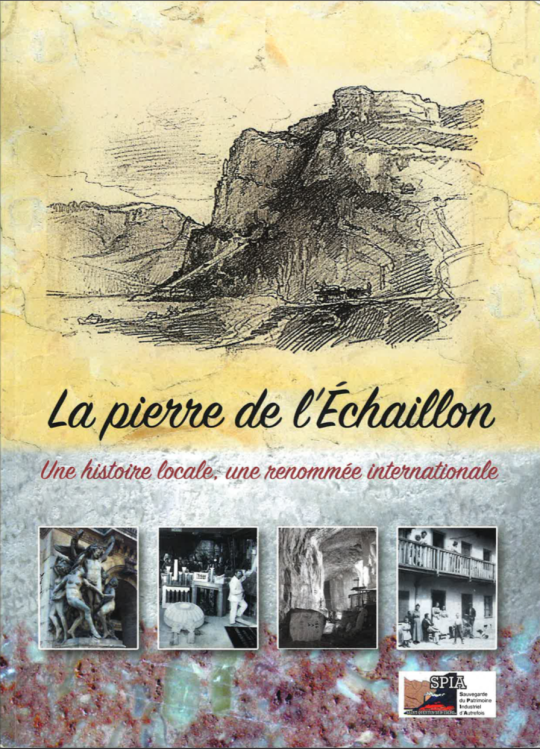
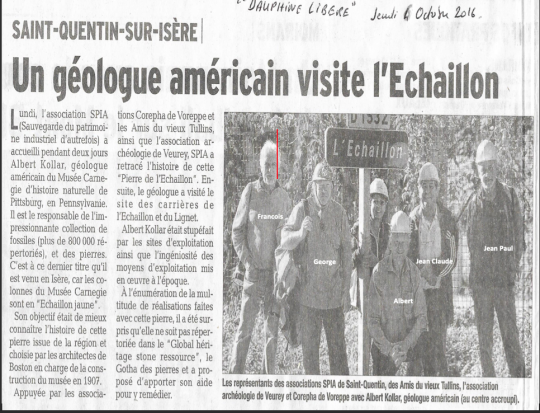
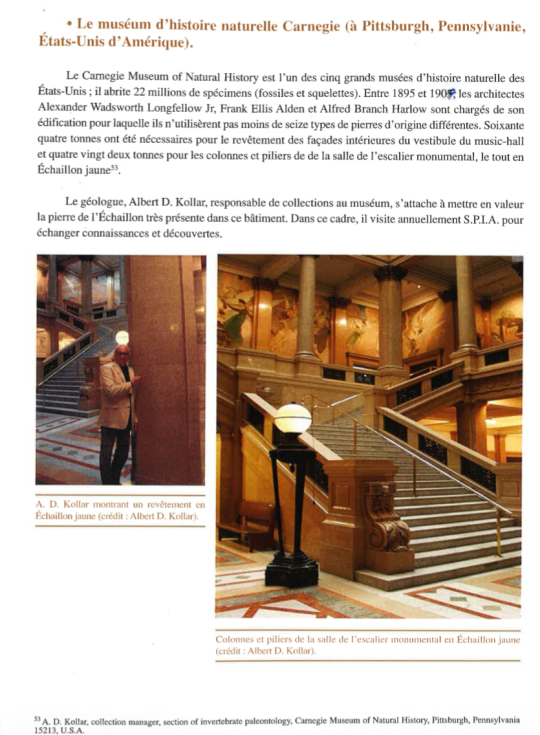
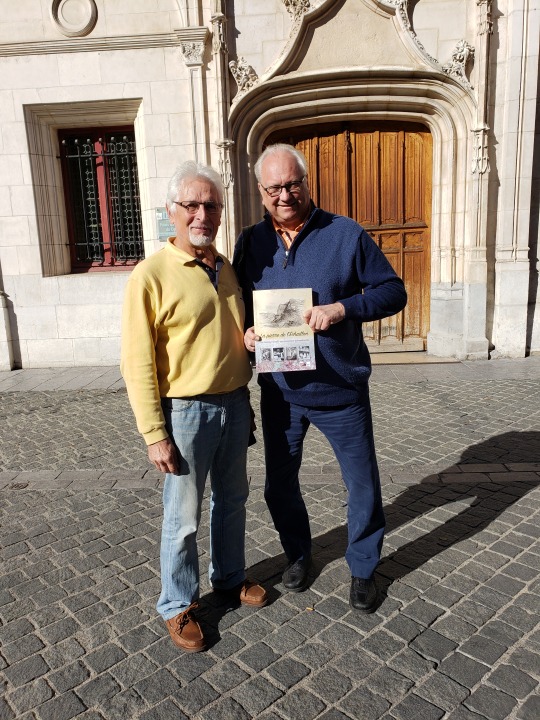
In 2019, The Carnegie’s Grand Staircase and Music Hall Foyer were recognized in the book La pierre de l’Échaillon Une histoire locale, une renommée international for the use of Échaillon jaune (yellow) ornamental stone in the museum’s columns, pillars, and walls (Fig. 3). This book was published by S.P.I.A. (Sauvegarde du Partrimoine Industriel d’Autrefois, a historical society founded by Jean Paul Rey, president) (Fig. 4).  In the book, they describe how a small French village of l’Échaillon, pronounced Esh-ee-own, received recognition for its white marble (a limestone) used by famous French architects in 64 classic buildings and sculptures from 1875 to the early 20th century (Fig. 5).  I first met Jean Paul in October of 2016, when I was invited to give a presentation at an S.P.I.A. meeting on my research on the Carnegie’s l’Échaillon.  The meeting was held in an old schoolhouse in the village of Saint-Quentin-sur-Isère, Département de Isère, in southeast France.

image

Fig. 3: The Grand Staircase

image

Fig. 4: Jean Paul Rey and Albert D. Kollar

image

Fig. 5: Book cover

The French Limestones in the Carnegie’s Architecture

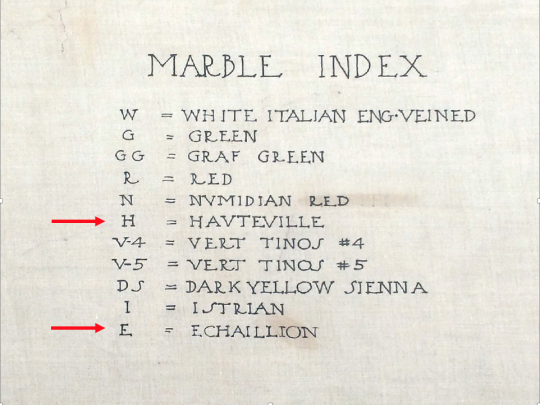
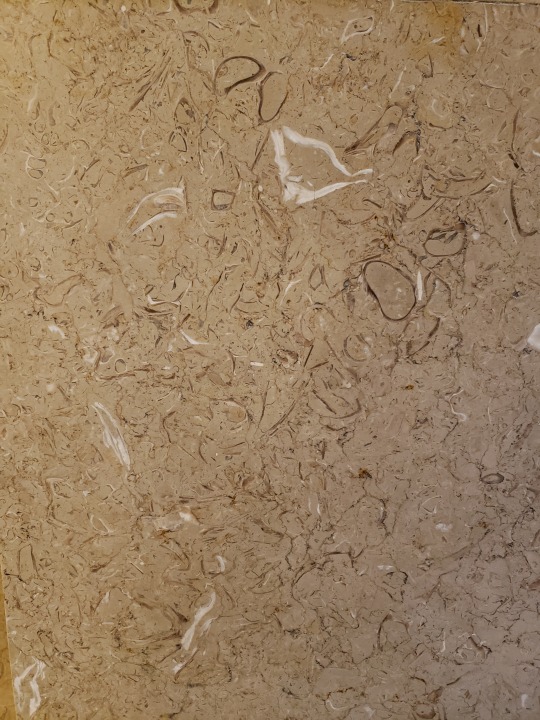
The Carnegie building stones research project progressed significantly, once we obtained the digital images of the architect’s blueprints from the Carnegie Museum of Art’s Architecture Department. With the assistance of my co-authors, Rich Fedosick and Kay Hughes of the Section of Invertebrate Paleontology, we examined the blueprints to understand the architects Marble Index terminology (Fig. 6). Eventually, we were able to interpret and recognize the location of the two French limestones based on the Marble Index letters, E for Échaillon and H for Hauteville. From a nonscientific perspective, the architects considered the Carnegie’s interior stones to be marbles. However, the geological definition of a marble is when a rock defined as a limestone or dolomite is subjected to high heat and pressure from geologic forces forms a metamorphic rock.  The six stones listed in the Marble Index as marbles, are limestones, a sedimentary rock enriched with fossil seashells. The characteristic rudist fossils and yellow color that distinguish the Échaillon stone are found in the 18 pillars and the 22 columns that rise 3.8 meters or 12.5 feet about the Grand Staircase, and in the walls of the Music Hall Foyer (Fig. 7).

image

Fig. 6: Marble index E and H letters

image

Fig. 7: Échaillon fossils

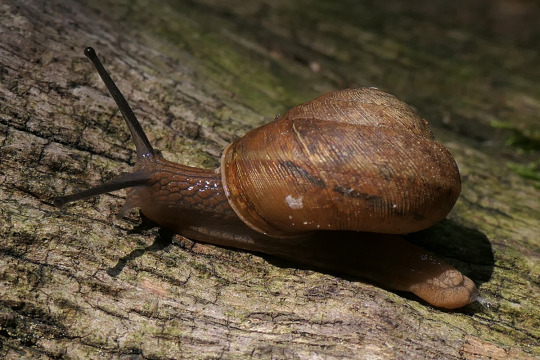
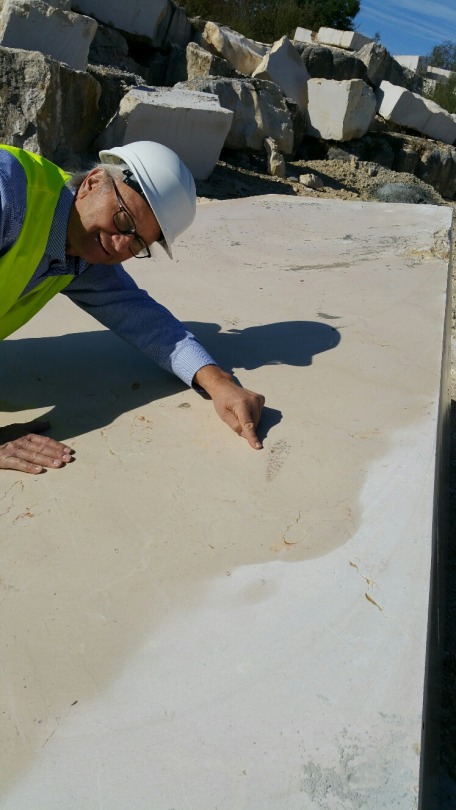
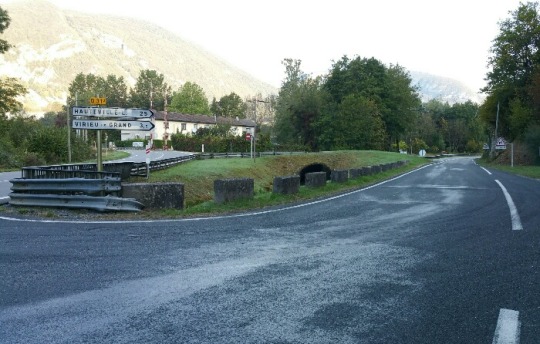
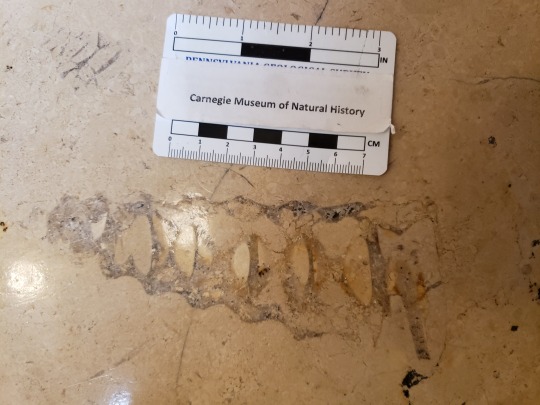
The other French limestone used in the Carnegie is Hauteville. This limestone was quarried from the Plateau d’Hauteville in the Ain Department, in eastern France. I visited this quarry in 2016 to investigate the geology of the quarry operation, to uncover evidence of the common fossil snail Nerinea in the quarry rock (Fig. 8), and to learn more about the cultural history of the region (Fig. 9).  The Hauteville limestone was used in the Grand Staircase walls, balcony features, water fountains, vestibule steps, and as floor tiles. Other locations include, the Hall of Sculpture and Hall of Architecture floors, the walls along the grand hallway, the Music Hall vestibule floor, the Founder’s Room vestibule floor, the floor and steps in the Smoking Room (now offices), the Forbes Avenue vestibule entrances to the music hall, carriage drive, and museum and fine arts. Moreover, the Hauteville floor tiles are distributed throughout the Carnegie Library of Pittsburgh main entrance corridors. The Hauteville stone is beige in color and contains many visible fossils, none more distinctive than the robust Nerinea, a 12.7 cm/5-inch-long snail that serves as the index fossil for the limestone identification (Fig. 10).

image

Fig. 8: Hauteville Quarry fossil snail

image

Fig. 9: Hauteville directional signs

image

Fig. 10: Nerinea snail in Carnegie floor

Introduction to the l’Échaillon Carrières

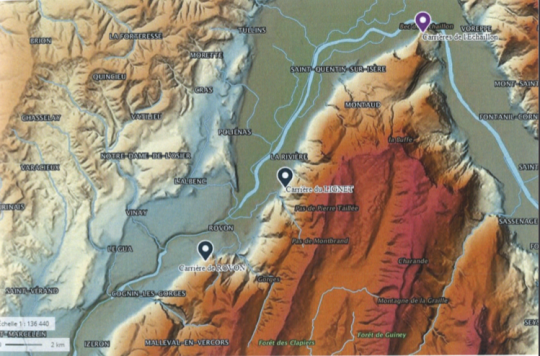
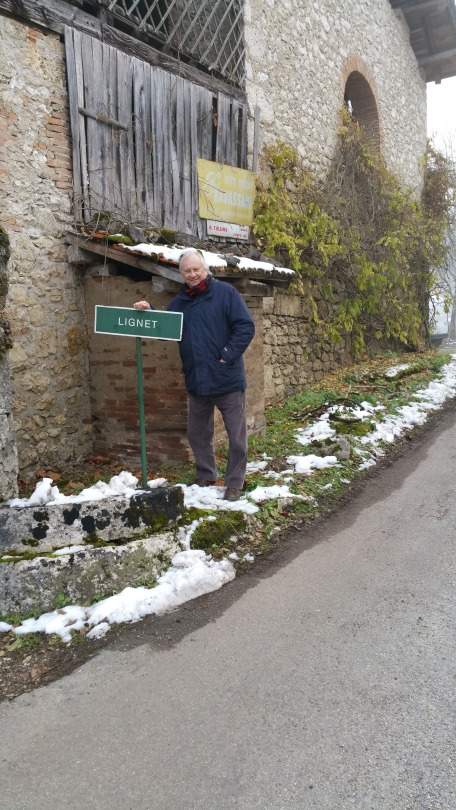
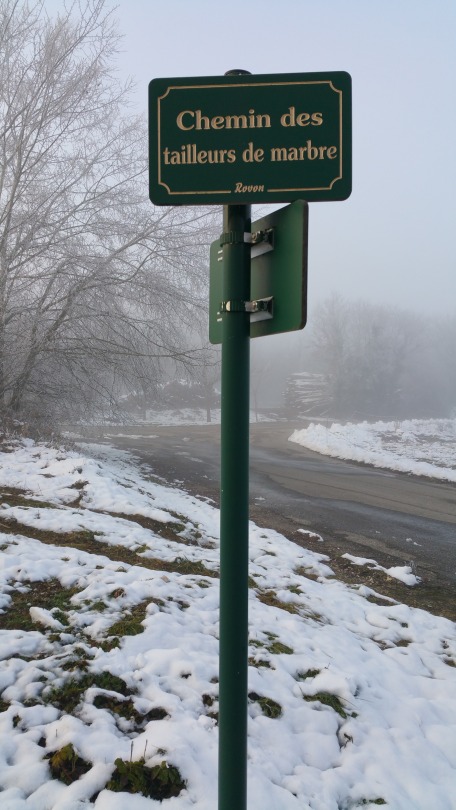
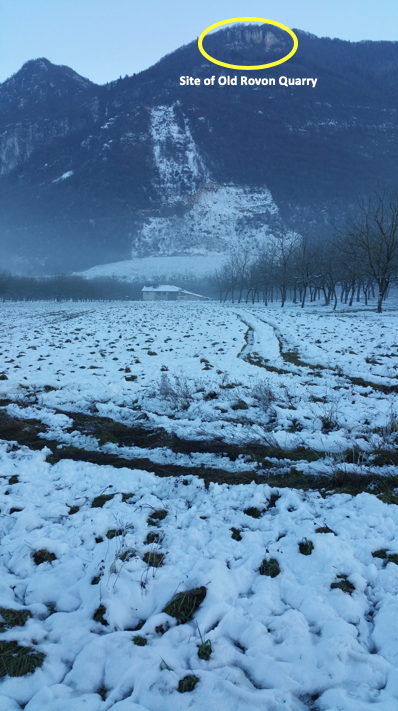
There are three carrières or quarries in the Vercors cliffs located in the Isère River Valley that were excavated for White Echaillon or “Echaillon blanc,” Yellow Echaillon or “Echaillon jaune,” and Pink Echaillon or “Echaillon rose” during the 19th and early 20th century (Fig. 11).  These unique color combinations became popular for various interior and exterior architecture features in 194 buildings in western Europe, North Africa, and the United States. In 2016, Jean Paul Rey and members of S.P.I.A. led me on a field trip to the abandoned classic l’Échaillon white quarries (Fig. 12). We explored what is thought to be a 2,000-year-old Roman quarry and walked through a maze of underground caverns and narrow tunnels that contained abandoned mining equipment.  The other two Echaillon carrières are located several kilometers south in the small villages of Lignet, where the Pink Echaillon was quarried (Fig. 13) and Rovon, where the Yellow Echaillon was excavated (Fig. 14).

image

Fig. 11: Echaillon quarries locations, S.P.I.A.

image

Fig. 12: Visit to Echaillon

image

Fig. 13: Lignet Quarry Marker

image

Fig. 14: Rovon quarry

Cularo, Grenoble, and the white l’Echaillon stone

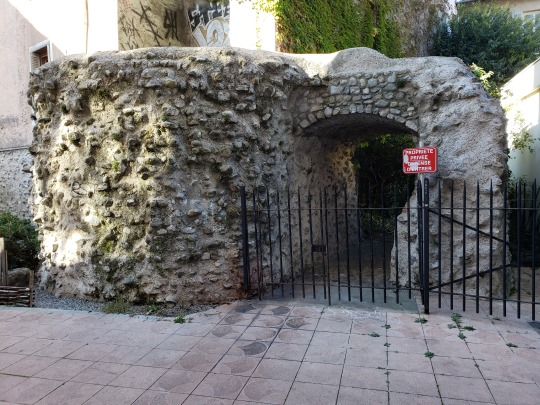
A fortuitous discovery was made by S.P.I.A. for their book while searching for evidence of the white l’Echaillon in the Gallo-Romans era 4th century Cularo or Grenoble, France today. In the Saint Laurent crypt that is preserved many meters below the modern-day street level tramway, a white capitol on top of a white limestone column was identified as l’Echaillon. This white capitol stone is presumably from the Roman quarry adjacent to the white l’Echaillon underground caverns. When Emperor Gratian ruled the Roman Empire from 367 to 383 A.D., he renamed Cularo after himself. Cularo thus became Gratianopolis, which through a later phonetic shift became Graignovol and then Grenoble. Although hard to find among the narrow streets and passageways of Grenoble, is a section of a Roman wall that once encircled Cularo, a portion of which is protected by a fence. This historic wall can be seen at Passage Sainte-Claire on the corner of Rue Lafayette, in the central city of Grenoble (Fig. 15). I suspect some of the white cobbles embedded in the wall may have their origin from the white l’Echaillon Roman quarry. Undoubtedly, more research will be necessary to make an affirmative conclusion.

image

Fig. 15: Roman wall

“Geology of the l’Échaillon Carrières”

The drawing of a new geologic map on the l’Echaillon carrières by Professor Thierry Dumont of the Université Grenoble-Alpes, confirms stratigraphically, the ages of the three limestone quarries. Among the three, the white Echaillon limestone is late Jurassic in age, whereas the pink Lignet and yellow Rovon limestones are early Cretaceous in age. The formal geologic name for the rose and yellow limestones is the Urgonian Formation. Fossils are abundant in the three limestones. Dr. Claudie Durand of Le musèum d’Histoire naturelle de Grenoble (Fig. 16) curated a diverse collection of 163 species of invertebrate fossils from l’Echaillon first published in 1919. Geologically, the three limestones were deposited in the tropical Tethys Seaway a circum-equatorial ocean of the Mesozoic Era. The strata form the Vercors carbonate platform, a buildup of late Mesozoic rudist (bivalve mollusk) reefs spanning 25 million years of evolution from (late Jurassic 140 million years ago to early Cretaceous 165 million years ago) (Fig. 17).  

image

Fig. 16: Dr. Claudie Durand

image

Fig. 17: Rudist (bivalve) reef fossils

The Rovon carrière provenance and fossils

The primary goal of this research is to define the geology and authenticate the specific provenance of all marbles, fossil limestones, sandstones, and the singular igneous granite rock used in the Carnegie building. The search for the provenance of the Carnegie’s yellow Echaillon was initiated in December of 2017 by Jean Paul Rey, when we were introduced to the Forman of the modern-day Rovon quarry. After a long discussion about our objectives, he granted permission to visit the old quarry. As darkness fell, we met with a local farmer who directed us to the quarry location in the Vercors cliffs that rise some 538 meters above his snow-covered field (Fig. 18).  

image

Fig. 18: Verors cliffs and old Rovon quarry

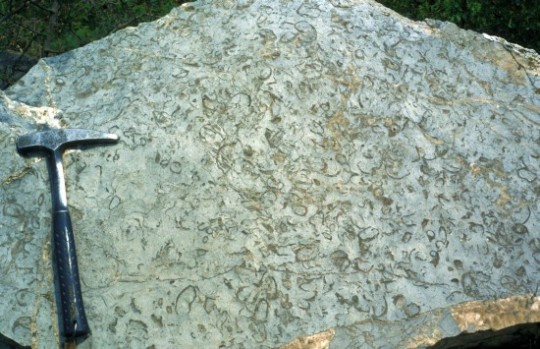
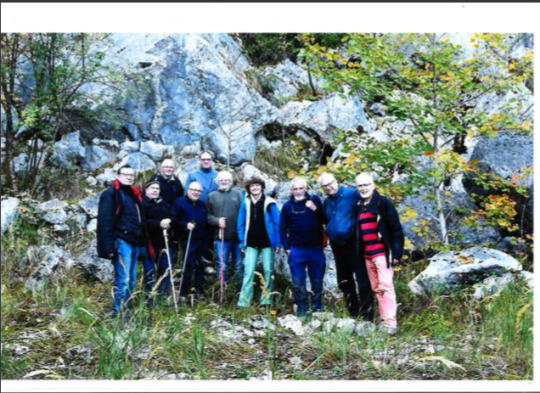
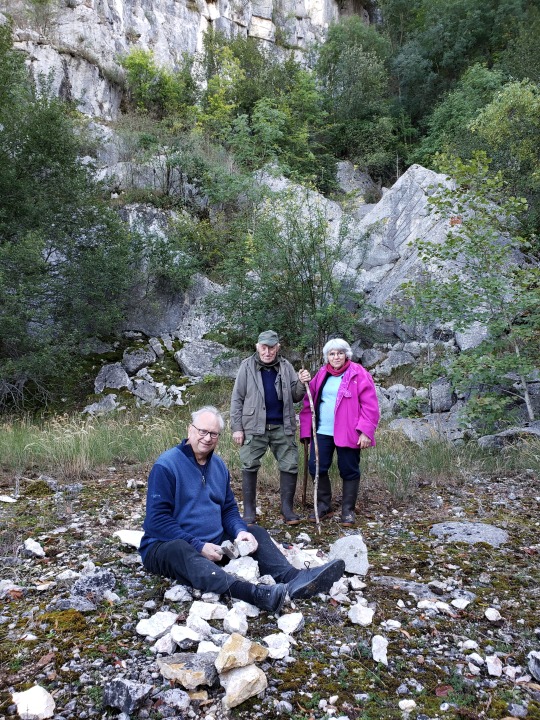
In October of 2018, the S.P.I.A. team pre-arranged to have several 4-wheel trucks transport ten people including Professor Fabienne Giraud-Guillot of the Université Grenoble-Alpes to the Rovon quarry. We ascended the long steep road that ended some 500 m from the main quarry. Surprisingly, the quarry was filled with massive limestone boulders that were cut by mechanical wire saws from the cliff rock (Fig. 19). Such large boulders make it virtually impossible to break with small hammers. For actual fossil collecting purposes, it is better to search for smaller size rocks to break apart (Fig. 20). This past October, transport to the Rovon quarry riding in a 55-year-old Russian built farm tractor was a treat (Fig. 21). And the fossil collecting was a success with 21 complete specimens collected for the museum of the diagnostic Caprina rudist bivalve clam (Fig. 22). The shape of these fossils closely resembles the fossils preserved in the Echaillon limestone in the Grand Staircase and Music Hall Foyer. Additional geologic data is being reviewed by colleagues from the Geology Department at the University of Zagreb in Croatia and the University of Ireland at Galway.  

image

Fig. 19: S.P.I.A. team

image

Fig. 20: Collecting fossils

image

Fig. 21: Russian tractor

image

Fig. 22: Caprina rudist clam

“Carnegie’s Grand Staircase in the 21st Century”

A study published this month by the BMJ, formerly The British Medical Journal, suggested that “when people of all ages participate in the arts and visit museums once a month or even every few months, they are likely to be more engaged in the world and may actually live longer.” Years ago, the Oscar winner actor Russell Crowe was in Pittsburgh, and he was asked what he did on his days off. In reply, he said, “I ride my bicycle to look at buildings and the architecture of the city.” I. M. Pei states, “Architecture brings people together.” I agree.

Maybe it’s time to reconsider how the Carnegie’s Grand Staircase is promoted to the public at large. For instance, the current arrangement of the free-standing dioramas situated on the first floor, awkwardly impede the flow of patrons walking among the pillars, columns, and the taking of photographs of the Grand Staircase.  Moreover, the placement of these dioramas detracts from the visual enjoyment of the famous John White Alexander multicolor murals. An artistic feature of the murals is their connection to the stone colors to enhance the first and second floors architectural features. The best vantage points to see this fabulous spectrum of color is from the third-floor balcony looking down to the first and second floors.

The Carnegie Museum of Art (Museum of Fine Arts) will be celebrating its 125th Anniversary in the fall of 2020. The Grand Staircase was designed as the showcase entrance to the Museum of Fine Arts for Pittsburghers of the early 20th Century. One hundred and twenty-five years later, perhaps, this world-class space can once again establish a new generation of museum patrons and become the destination as a place to be for its cultural and intellectual heritage.  And don’t forget, this staircase can be an Instagram-worthy site for a family portrait to encourage our younger audiences to visit too.

Albert D. Kollar is the Collection Manager in the Section of Invertebrate Paleontology at Carnegie Museum of Natural History. Museum employees are encouraged to blog about their unique experiences and knowledge gained from working at the museum.
Filed Under: Blog Tagged With: Albert Kollar, Invertebrate Zoology, Science News

October 10, 2018 by wpengine

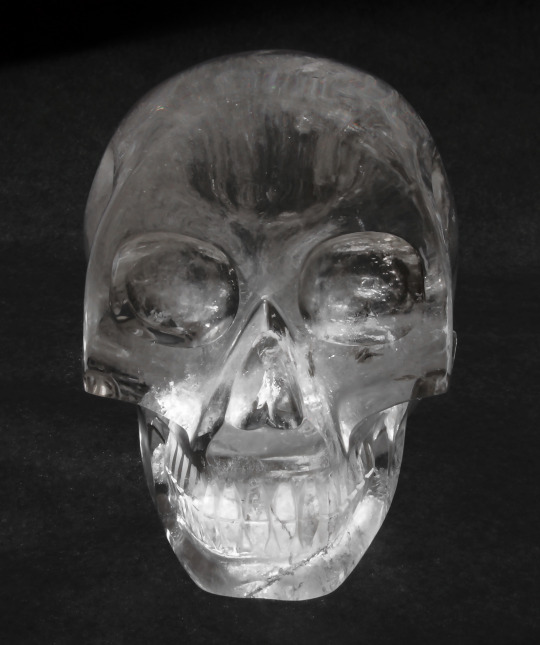
Fred the Crystal Skull

by Debra Wilson
Fred the Crystal Skull

Just about every year since the Carnegie Museum of Natural History acquired it, Fred the Crystal Skull has made an appearance in Hillman Hall of Minerals and Gems right around Halloween. So how did we acquire a crystal skull and how did it get the name Fred you ask? Just to set the record straight right off the bat, Fred is not one of the dozen or so mysterious skulls that some think were carved by an ancient Mesoamerican civilization thousands of years ago. Our skull was carved and polished from a single quartz crystal with modern tools in Brazil and was donated to the museum in 2004 by South American Gems, Ltd located in Guarapari, Espirito Santo, Brazil.Germany, China and Brazil currently produce thousands of carved crystal skulls every year in numerous sizes. Fred measures 7.8 inches high by 5 inches wide, which is slightly smaller than the average human skull (8 to 9 inches high and 6 to 7 inches wide) so he was named after a man of small stature, namely the step father of the former Head of the Section of Minerals Marc Wilson. Marc was Section Head from August 1992 to August 2017.

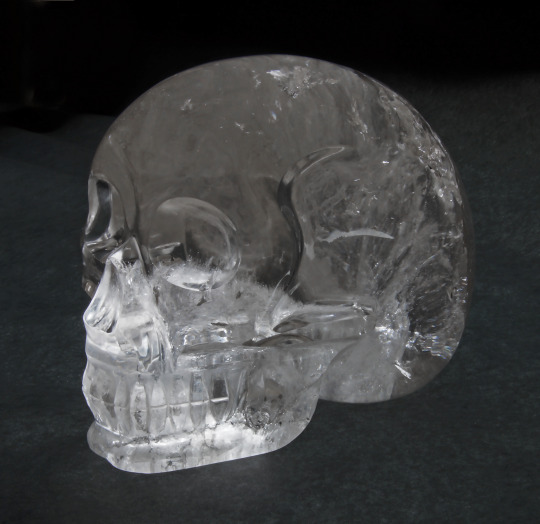
Fred the Crystal Skull side view

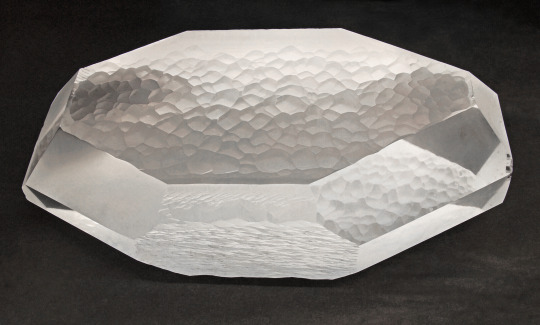
As you can see in the photograph of Fred, he has some internal flaws and fractures which is very common in the mineral quartz. Chemical impurities, physical flaws and twinning in natural quartz are issues that caused industry to develop a commercial process of manufacturing pure, electronics-grade quartz that can be used in circuits for consumer products such as televisions, radios, computers, cell phones and electronic games, just to name a few, and for crystal-controlled clocks and watches. As it so happens, the Section of Minerals also has a few lab-grown quartz crystals in the collection, including a large crystal nicknamed The Football that is nearly a foot across.

the football crystal

You will notice it is so clear that you can see the growth patterns of the bottom surface through the crystal. The Football was part of a donation of 57 lab created specimens given to the Section of Minerals in 2017 by Lynn Boatner just before he retired from Oak Ridge National Laboratory in Tennessee.

Debra Wilson is the Collection Manager for the Section of Minerals at Carnegie Museum of Natural History. Museum employees are encouraged to blog about their unique experiences and knowledge gained from working at the museum.
Related Content

Born to the Purple

How Do You Preserve A Giant Pumpkin?

Early Bats: Ancient Origins of a Halloween Icon

Filed Under: Blog Tagged With: Debra Wilson, gems and minerals, halloween, Hillman Hall of Minerals and Gems, minerals and gems, quartz, Science News

March 15, 2017 by wpengine

Squirrels at CMNH

by John Wible
squirrel on a fence post

Like many people in western Pennsylvania, I share my yard with gray squirrels (Sciurus caroliensis). Other than the mammalian pets in our houses, gray squirrels are the mammals we are most likely to see on a daily basis. They amuse us with their acrobatic antics at our bird feeders, their chattering vocalizations, and their skirmishes with their squirrel neighbors.

Gray squirrels are rodents with large, ever-growing incisors that help them open nuts and seeds. They belong to the squirrel family (Sciuridae), which also includes chipmunks, woodchucks, and flying squirrels. In fact, there are more than 200 species of squirrels that inhabit all continents except Antarctica, although humans brought them along to Australia.

brown squirrel specimen in the Section of Mammals
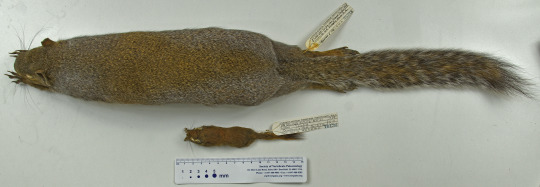
Gray squirrel and African pygmy squirrel specimens.

A typical adult gray squirrel in western Pennsylvania is about two feet from head to tail tip. That is not a baby gray squirrel below it in the picture above. That is an adult of the world’s smallest squirrel, the African pygmy squirrel (Myosciurus pumilio)! It measures about 5 inches and weighs 16 grams, less than half an ounce. They are found in lowland tropical forests in west central Africa (Cameroon, Gabon, Congo, and Equatorial Guinea). They are omnivores, foraging constantly, eating bark, fruits, and insects. Their conservation status is generally okay, but deforestation is a threat.

The African pygmy squirrel is the only squirrel that travels frequently both upside down and right side up along branches. What a treat it would be to see how one of these would get to my bird feeder!

John Wible, PhD, is the curator of the Section of Mammals at Carnegie Museum of Natural History. Museum employees are encouraged to blog about their unique experiences and knowledge gained from working at the museum.
Related Content

Ask a Scientist: What is the “Crazy Beast?”

How-to Draw a Squirrel

Armadillos: Identical Quadruplets Every Time

Carnegie Museum of Natural History Blog Citation Information

Blog author: Wible, John
Publication date: March 15, 2017

Share this post!

  • Share on Twitter Share on Twitter
  • Share on Facebook Share on Facebook
  • Share on Pinterest Share on Pinterest
  • Share on LinkedIn Share on LinkedIn
  • Share on Reddit Share on Reddit
  • Share via Email Share via Email

Filed Under: Blog Tagged With: John Wible, mammals, Science News

  • « Go to Previous Page
  • Page 1
  • Interim pages omitted …
  • Page 41
  • Page 42
  • Page 43

sidebar

About

  • Mission & Commitments
  • Directors Team
  • Museum History

Get Involved

  • Volunteer
  • Membership
  • Carnegie Discoverers
  • Donate
  • Employment
  • Events

Bring a Group

  • Groups of 10 or More
  • Birthday Parties at the Museum
  • Field Trips

Powdermill

  • Powdermill Nature Reserve
  • Powdermill Field Trips
  • Powdermill Staff
  • Research at Powdermill

More Information

  • Image Permission Requests
  • Science Stories
  • Accessibility
  • Shopping Cart
  • Contact
  • Visitor Policies
One of the Four Carnegie Museums | © Carnegie Institute | Privacy Policy | Terms of Use | Accessibility
Rad works here logo