• Skip to primary navigation
  • Skip to main content
  • Skip to primary sidebar

Carnegie Museum of Natural History

One of the Four Carnegie Museums of Pittsburgh

  • Visit
    • Buy Tickets
    • Visitor Information
    • Exhibitions
    • Events
    • Dining at the Museum
    • Celebrate at the Museum
    • Powdermill Nature Reserve
    • Event Venue Rental
  • Learn
    • Field Trips
    • Educator Information
    • Programs at the Museum
    • Bring the Museum to You
    • Guided Programs FAQ
    • Programs Online
    • Climate and Rural Systems Partnership
  • Research
    • Scientific Sections
    • Science Stories
    • Science Videos
    • Senior Science & Research Staff
    • Museum Library
    • Science Seminars
    • Scientific Publications
    • Specimen and Artifact Identification
  • About
    • Mission & Commitments
    • Directors Team
    • Museum History
  • Tickets
  • Give
  • Shop

Section of Minerals

June 4, 2019 by wpengine

Roll Out the Beryl

four beryl gemstones

Beryl has many different varieties that you may be familiar with, the most recognized being: Emerald (green), Heliodor (yellow), Morganite (pink), and Aquamarine (blue or blue-green). One that you may not be familiar with is Red Beryl, a very rare variety of the species. The red is due to the trace element manganese. Red Beryl occurs in only a few places in the world and of those localities, only one of them produces crystals of the size and quality suitable for cutting gemstones, namely the Ruby Violet claims in the Wah Wah Mountains in Beaver County, Utah. For over a dozen years the Section of Minerals & Earth Sciences staff have been on the lookout for a faceted Red Beryl to put on display in the Beryl as a Gemstone exhibit in Wertz Gallery: Gems and Jewelry. But, alas, most of the Red Beryl gemstones on the market are very small because nearly all the gem rough that is produced is less than a carat in size. Faceting rough of that size usually yields gemstones of only ¼ to ½ carat, which would be too small to use in the exhibit. Occasionally we have come across gemstones of around one carat, but they were not of high enough quality for the exhibit due to poor color, poor cut, or numerous inclusions. But, as luck would have it, in March of this year I was able to acquire from Pala International a worthy, cushion cut Red Beryl gemstone with the amazing size of 2.45 carats! Together with the crystal from the same locality (acquired two years ago from Collector’s Edge) we now have a stunning rough & cut pair to represent the variety Red Beryl in the Beryl as a Gemstone exhibit.
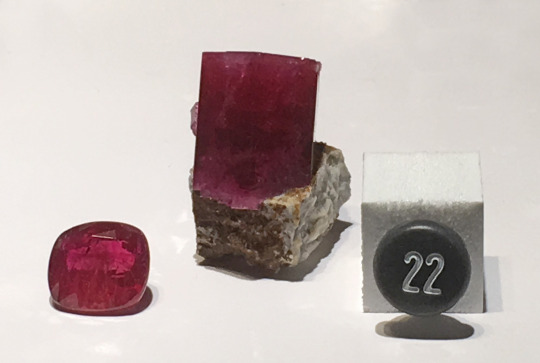
Cut gemstone & crystal of Red Beryl from Utah

Another lesser known variety of Beryl is Goshenite, which is colorless. When Wertz Gallery opened in September of 2007 the Beryl as a Gemstone exhibit had a nice crystal of Goshenite on display from Pakistan but lacked a cut gemstone from Pakistan to go with it. In May, I acquired a beautiful 5.06 carat emerald cut Goshenite from Dudley Blauwet Gems to complement the crystal. Now every crystal on display in that exhibit has an accompanying gemstone.
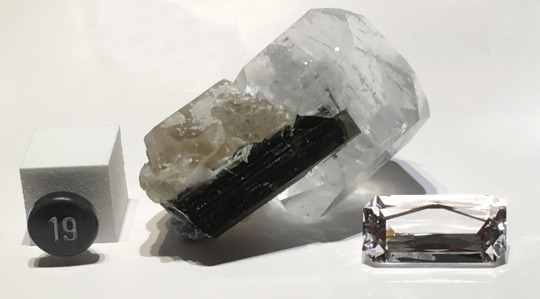
Crystal & cut gemstone of Goshenite from Pakistan

Both of these new gemstones were placed on exhibit in Wertz Gallery on June 4, 2019, so stop by and see them in the Beryl as a Gemstone case!

Debra Wilson is the Collection Manager for the Section of Minerals at Carnegie Museum of Natural History. Museum employees are encouraged to blog about their unique experiences and knowledge gained from working at the museum.
Filed Under: Blog Tagged With: Deb Wilson, Debra Wilson, gems and minerals, Hillman Hall, Hillman Hall of Minerals and Gems, minerals, Section of Minerals, Wertz Gallery

March 26, 2019 by wpengine

New Mineral Acquisitions

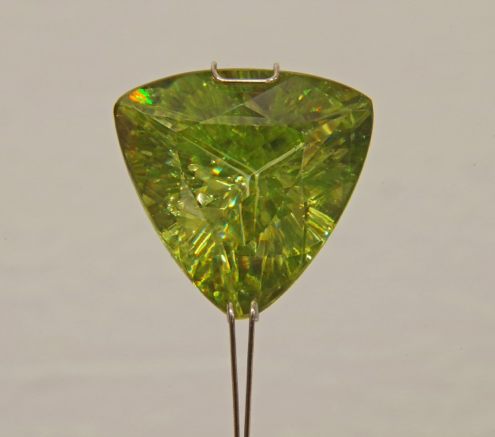
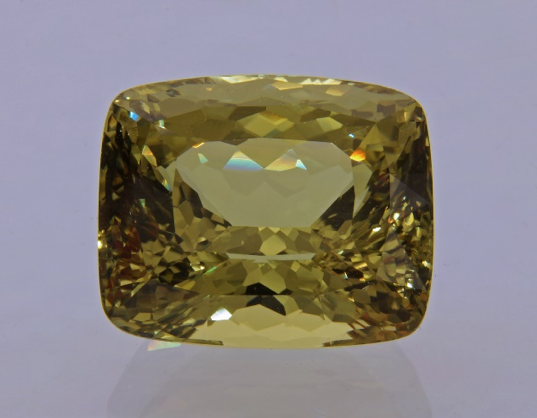
I had a successful trip to Tucson, Arizona in January/February of this year. This is an annual event where the Section of Minerals participates in the Tucson Gem & Mineral Show by not only exhibiting a mineral display, the Carnegie Mineralogical Award is also presented during the show, and many of the minerals acquired for the collection are found amongst the dozens of venues around the city where vendors are selling their specimens. Numerous motels turned into shopping centers starting as early as January 28th, where each room is a separate store for an individual vendor. Tent shows were set up along streets and in parking lots. The Tucson Convention Center housed two major shows: The American Gem Trade Association Show (AGTA), which was held February 5th through 10th, and the Tucson Gem & Mineral Show, which was held February 14th through 17th.  In total, I brought back 10 specimens acquired for the collection, five of which were acquired specifically for exhibit in Hillman Hall of Minerals and Gems or Wertz Gallery: Gems and Jewelry. Two gemstones were put on display in the “What is a Gemstone?” exhibit in Wertz Gallery on March 12th: a 44.27 carat, cushion cut spodumene from Afghanistan, and a 7.08 carat, trillion cut titanite (also known as sphene) from Zimbabwe.

CM33874: 7.08 carat Titanite, Zimbabwe

CM33876: 44.27 carat spodumene, Afghanistan

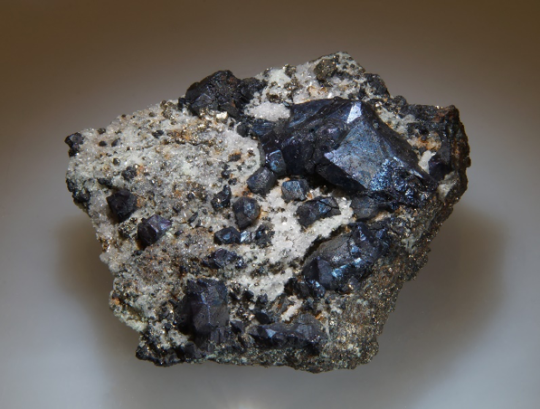
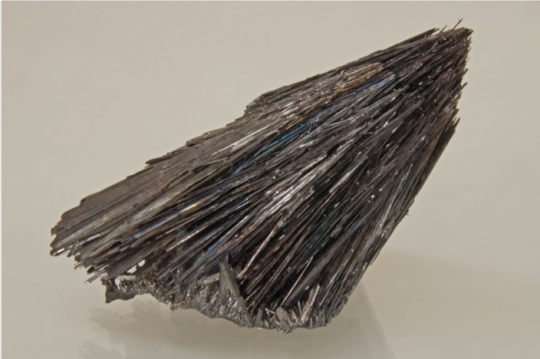
A special exhibit to highlight the museums acquisitions will be put in Hillman Hall on March 26th that will feature a world class Kermesite specimen from China. This specimen measures 20 cm and is probably the finest example of its species in the world. The largest kermesite in our collection prior to this acquisition is only 3cm.

CM33868: Kermesite, Caiwa mine, Shaanxi, China

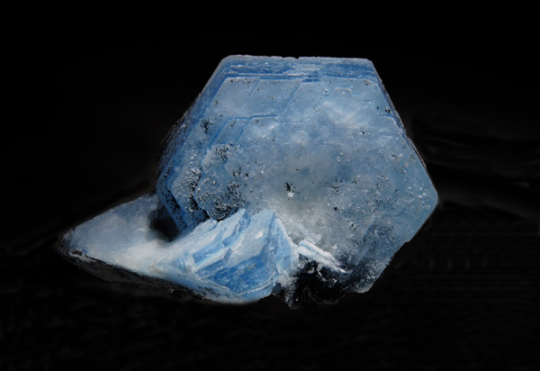
Two other specimens will be going on display soon in the Systematic Collection area of Hillman Hall: a blue tabular beryl from Afghanistan in the Silicates 2 case, and a bornite from Montana in the Sulfides 2 case. The beryl is a recent discovery in Afghanistan that is different than any other type of beryl, while the bornite was collected sometime in the 1950s in Butte, Montana which is known as the best locality in the United States for this species. Watch for announcements of when these two special pieces go on exhibit!

CM33875: Blue Alkali Beryl, Deo Darrah mine, Badakhshan, Afghanistan, 4.4 cm across

CM33877: Bornite, Butte, Montana, 6.6 cm across

Debra Wilson is the Collection Manager for the Section of Minerals at Carnegie Museum of Natural History. Museum employees are encouraged to blog about their unique experiences and knowledge gained from working at the museum.
Filed Under: Blog Tagged With: Deb Wilson, Debra Wilson, gems and minerals, Hillman Hall, Hillman Hall of Minerals and Gems, minerals and gems, Section of Minerals, Wertz Gallery

December 13, 2018 by wpengine

A Perfect Mineral for the Christmas Season

by Debra Wilson

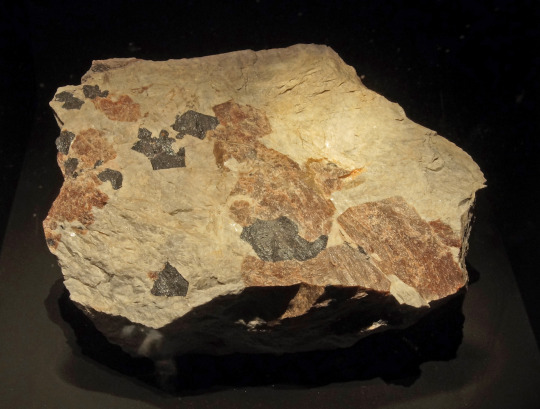
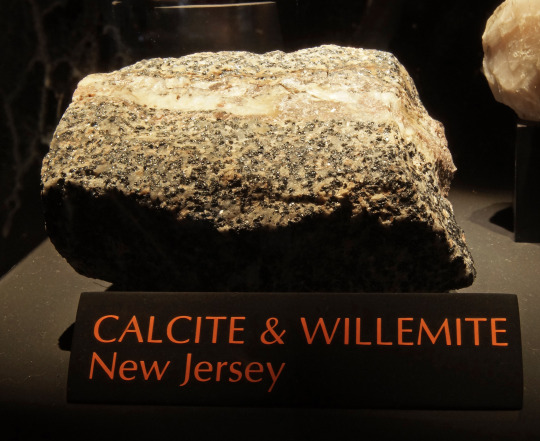
How can you decorate a mineral for Christmas? If it’s the right mineral, all you need to do is shine a SWUV (short wave ultraviolet) light on it. Such is the case with a mineral that is known as “Christmas Ore.” Under normal light it looks like kind of a drab rock as the one in this photo does.

Christmas ore

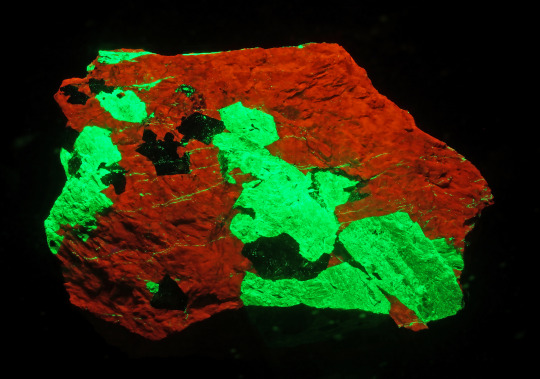
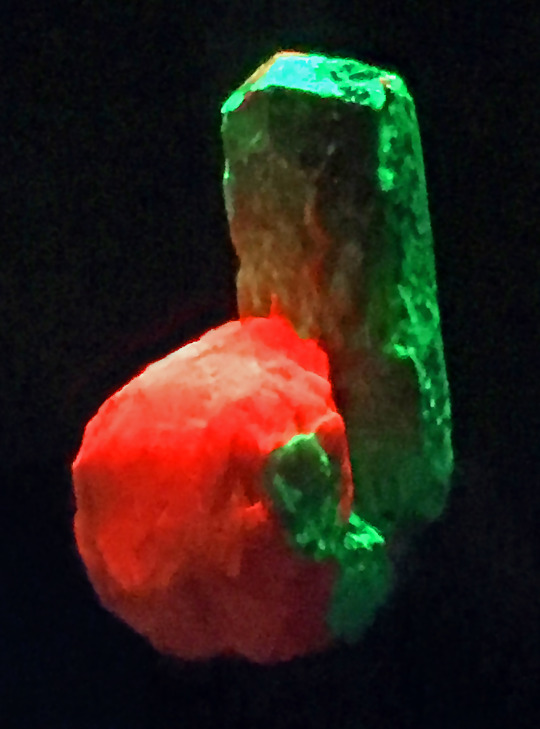
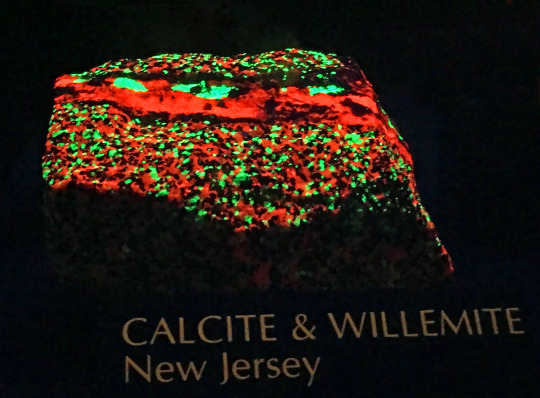
This specimen of calcite (tan color), willemite (brown color) and franklinite (black color) is on display in Hillman Hall of Minerals and Gems in the Fluorescence & Phosphorescence exhibit and was donated by the Sterling Hill Mining Museum for this exhibit. It originated from the Sterling Hill mine in Ogdensburg, in the Franklin Mining District of New Jersey. When you shine the SWUV light on it you will see why it is called “Christmas Ore” because it glows with the colors of Christmas. The calcite glows a bright red and the willemite glows a bright green, as you can see in this photo.

christmas ore

This glowing is known as fluorescence and the Franklin Mining District is known as the fluorescent capital of the world. The Franklin and Sterling Hill ore bodies are the source of at least 350 mineral species.At present, over 80 fluorescent mineral species are known from the area. Willemite and calcite are the most common fluorescents in these ore bodies and are known as “Christmas Ore” when they occur together in the same specimen.

So, what causes the fluorescence? Fluorescence usually occurs when specific impurities known as “activators” are present within the mineral. These activators are typically cat ions of metals such as: tungsten, molybdenum, lead, boron, titanium, manganese, uranium and chromium. Rare earth elements such as europium, terbium, dysprosium, and yttrium are also known to contribute to the fluorescence phenomenon. Fluorescence can also be caused by crystal structural defects or organic impurities. Calcite (CaCO3) and willemite (Zn2SiO4) are examples of minerals that in their pure state do not fluoresce but add a little divalent manganese (Mn2+) and they will fluoresce red and green, respectively.

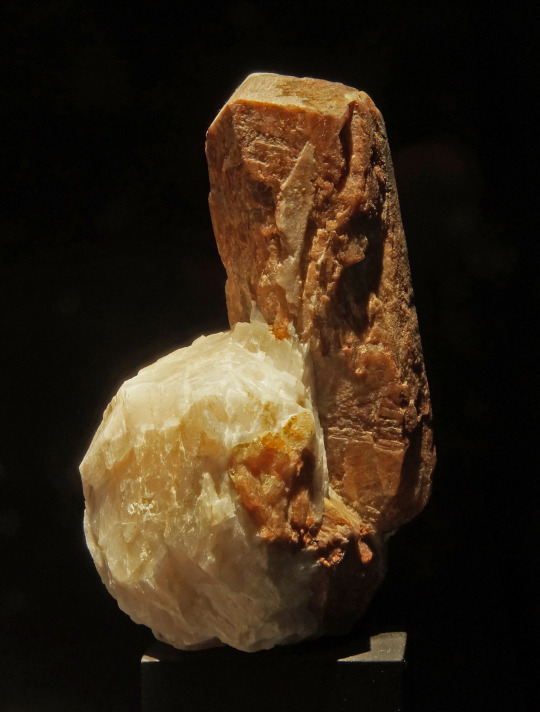
There are two other specimens of calcite and willemite, also from the Franklin District, in the Fluorescence & Phosphorescence exhibit, shown here under normal light and under SWUV light.

Christmas ore
christmas ore
christmas ore
Christmas ore

Come to Hillman Hall of Minerals and Gems to hear a more detailed explanation of the phenomenon of fluorescence and see all 21 specimens in the exhibit from world-wide localities that glow under the ultraviolet lights.

Debra Wilson is the Collection Manager for the Section of Minerals at Carnegie Museum of Natural History. Museum employees are encouraged to blog about their unique experiences and knowledge gained from working at the museum.
Related Content

Born to the Purple

Thanksgiving and Nutritional Mineralogy

Ask a Scientist: Why do some minerals glow?

Carnegie Museum of Natural History Blog Citation Information

Blog author: Wilson, Debra
Publication date: December 13, 2018

Share this post!

  • Share on Twitter Share on Twitter
  • Share on Facebook Share on Facebook
  • Share on Pinterest Share on Pinterest
  • Share on LinkedIn Share on LinkedIn
  • Share on Reddit Share on Reddit
  • Share via Email Share via Email

Filed Under: Blog Tagged With: Deb Wilson, gems and minerals, Hillman Hall, Hillman Hall of Minerals and Gems, minerals, minerals and gems, Section of Minerals

  • « Go to Previous Page
  • Page 1
  • Page 2

sidebar

About

  • Mission & Commitments
  • Directors Team
  • Museum History

Get Involved

  • Volunteer
  • Membership
  • Carnegie Discoverers
  • Donate
  • Employment
  • Events

Bring a Group

  • Groups of 10 or More
  • Birthday Parties at the Museum
  • Field Trips

Powdermill

  • Powdermill Nature Reserve
  • Powdermill Field Trips
  • Powdermill Staff
  • Research at Powdermill

More Information

  • Image Permission Requests
  • Science Stories
  • Accessibility
  • Shopping Cart
  • Contact
  • Visitor Policies
One of the Four Carnegie Museums | © Carnegie Institute | Privacy Policy | Terms of Use | Accessibility
Rad works here logo