• Skip to primary navigation
  • Skip to main content
  • Skip to primary sidebar

Carnegie Museum of Natural History

One of the Four Carnegie Museums of Pittsburgh

  • Visit
    • Buy Tickets
    • Visitor Information
    • Exhibitions
    • Events
    • Dining at the Museum
    • Celebrate at the Museum
    • Powdermill Nature Reserve
    • Event Venue Rental
  • Learn
    • Field Trips
    • Educator Information
    • Programs at the Museum
    • Bring the Museum to You
    • Guided Programs FAQ
    • Programs Online
    • Climate and Rural Systems Partnership
  • Research
    • Scientific Sections
    • Science Stories
    • Science Videos
    • Senior Science & Research Staff
    • Museum Library
    • Science Seminars
    • Scientific Publications
    • Specimen and Artifact Identification
  • About
    • Mission & Commitments
    • Directors Team
    • Museum History
  • Tickets
  • Give
  • Shop

snails

February 9, 2021 by wpengine

For Some Snails, Reproduction is a Jab Well Done

Some land snails possess darts in their reproductive systems. During courtship, one or both partners jab the other partner with the dart, which some observers have likened to Cupid’s arrow. If the dart misses or otherwise fails to stab the partner, then courtship and mating stop, unfinished. And we’re not talking about tiny darts; in one species the dart is a fifth the length of the creature’s body!
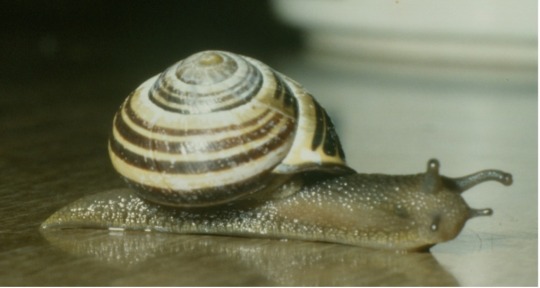
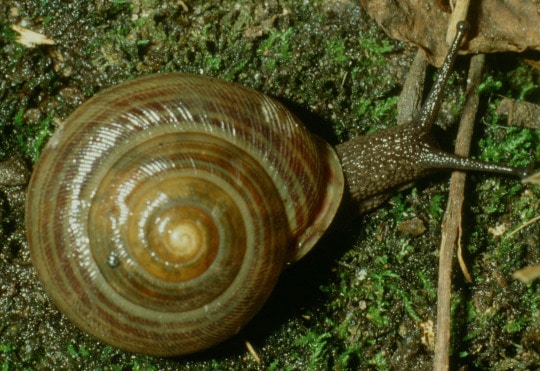
Dart-bearing (not shown) hermaphroditic snail, Cepaea nemoralis (family Helicidae). Shell ca 2 cm diam. 

In those species studied, the dart appears to deliver hormones into the partner to increase the chance of paternity. Most land snails are hermaphrodites (both male and female within one individual). During mating, sperm enters the partner’s copulation pouch, which is not a safe haven because digestive processes begin! The hormones help the sperm escape that pouch so they can find their way to the fertilization chamber.

Note that in these land snails, the dart is used during courtship before copulation. These land snails are not using the dart to transfer sperm, a behavior known as traumatic insemination in some other creatures such as saccoglossans (relatives of sea slugs), some flatworms, and bed bugs.

Dart-bearing snails that you might know include the escargot snails (family Helicidae), the large native snails in southwestern USA (Xanthonychidae), and some of the large native slugs of eastern North America (Philomycidae). Note that the Polygyridae, the larger land snails in eastern North America, lack a dart.
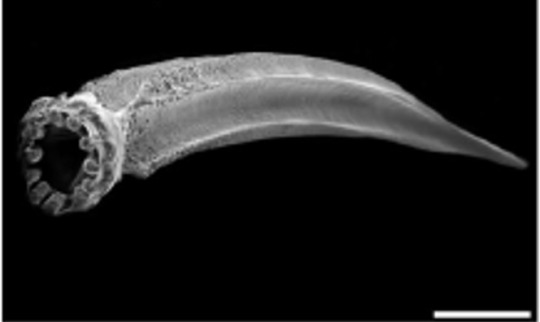
Love dart of Cepaea hortensis. Scale bar is 0.5 mm. Image from Wikimedia Commons, from Koene & Schulenburg (2005).

The dart is formed in a structure called a dart sac, and after the dart is used, a new one grows after about a week. While many species have a single dart sac, some snail groups possess two, four, or even more dart sacs, so presumably they can mate again without waiting for the single dart to re-grow.

A mystery: most groups of land snails lack darts in the reproductive system, although multiple, relatively un-related groups of snails possess darts. Two explanations exist for this diversity of having or lacking darts: (1) the ancestor of all land snails possessed a dart, and then evolutionarily the dart was lost in most groups, or (2) the ancestor lacked a dart, and then a dart was acquired independently in multiple lineages.

Some snail biologists favor the ancestral dart idea, although others (e.g., Tompa 1980) favor the independent origin idea. I like the independent origin idea because of dramatic differences among darts: in some groups, the dart is made of calcium carbonate, in others it is chitin, and in still others it is cartilaginous. I hold that in evolution, it is sometimes easier to start over from scratch than to change fundamental building materials. Nevertheless, most snail biologists agree that the ancestor to the superfamily Helicoidea, which contains the familiar escargot snails, had at least one dart (e.g., Schileyko 1989), but whether it was one dart that proliferated into multi-dart forms or vice versa remains unresolved.

One way to solve this mystery could be to examine molecular processes used in forming and deploying the dart. If all dart-possessing land snails use similar biochemical pathways to form and deploy their darts, those similarities would be consistent with the ancestral dart idea. On the other hand, if love darts of different groups rely on different biochemistry to form and deploy, that would suggest multiple independent origins of darts, with their apparently similar shapes and functions being due to convergent evolution.

Meanwhile, snails continue reproducing, and for those that use a dart, I say, “A jab well done!”

References

Koene, J.M. & Schulenburg, H. 2005. Shooting darts: co-evolution and counter-adaptation in hermaphroditic snails. BMC Evolutionary Biology 5(25): 13 pp. https://doi.org/10.1186/1471-2148-5-25

Schileyko, A.A. 1989. Taxonomic status, phylogenetic relations and system of the Helicoidea sensu lato (Pulmonata). Archiv für Molluskenjunde 120: 187-236.

Tompa, A.S. 1980. The ultrastructure and mineralogy of the dart from Philomycus carolinianus (Pulmonata: Gastropoda) with a brief survey of the occurrence of darts in land snails. Veliger 23: 35-42.

Tim Pearce is the head of the mollusks section at Carnegie Museum of Natural History. Museum employees are encouraged to blog about their unique experiences and knowledge gained from working at the museum.

Related Content

Ask a Scientist: Are slugs just snails with their shells taken off?

Nerding Out Over Masting, or Why Unusual Plant Reproduction Excites Animal Ecologists

The Story of a Beetle, a Dolphin, and Some Remarkable Genitalia
Filed Under: Blog Tagged With: mollusks, Science News, snails, Tim Pearce

June 1, 2020 by wpengine

What’s So Good About Being a Slug?

When lifestyles or forms evolve multiple times, we often think they must have some benefit. For example, flying creatures evolved at least 4 separate times: birds, bats, insects, and pterosaurs. These 4 separate origins of flight support the idea that there must be an advantage to flying. (You can probably think of some advantages.)

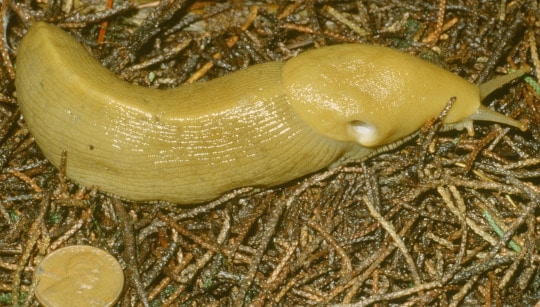
Slugs evolved from snails more than a dozen separate times. By that logic, there must be an advantage to being a slug, but compared to flight, it’s harder to think what the advantage might be. Slugs evolved from snails by reducing the size of the shell and internalizing it (yes, most slugs have an internal shell), and there are likely to be consequences of reducing the shell.

A snail with an external shell large enough for the body to pull back into. Webbhelix multilineata from Ann Arbor, Michigan.

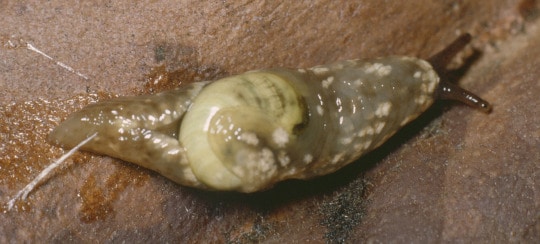
Furthermore, in the lineages leading from snails to slugs, an intermediate stage occurs called a semi-slug (not a slug the size of a semi-truck). In contrast to snails that have an external shell large enough to accommodate the body, or slugs in which the shell is completely internal or absent, semi-slugs have an external shell, but the shell is too small to accommodate the animal’s entire body. Many semi-slugs live on our planet today (for example, Vitrinizonites latissimus lives in the Great Smokey Mountains). Curiously, semi-slugs evolved from snails at least 22 times.

A semi-slug whose external shell is too small for the body to fit into. Family Urocyclidae from Mount Kenya

Let’s consider some possible advantages and disadvantages of these body forms: protection from predators, protection from desiccation (drying out), need for calcium, and fitting into tiny hidey holes. As shown in the table, shells protect snails from predators and from drying out, but the snails still need lots of calcium to build shells, and the rigid shell prevents them from squeezing into tiny hidey holes. Snail score: 2 advantages, 2 disadvantages. Slugs, on the other hand, are not protected from predators or drying out, but have less need for calcium and can fit into tiny hidey holes. Slug score: 2 advantages, 2 disadvantages. However, semi-slugs seem to have all disadvantages: no protection from predators or drying out, a need for calcium, and can’t fit into tiny hidey holes. Semi-slug score: 0 advantages, 4 disadvantages.

Predator protection Desiccation protection Need less calcium Fit in tiny hidey holes
Snail + + – –
Semi-slug – – – –
Slug – – + +

In evolution, every form in a lineage must have at least a limited track record of survival, so how did slugs evolve from snails if they had to go through a life form having so many disadvantages, and how could that evolution have happened so many different times?

A slug with an internal shell (not visible). Ariolimax cf californicus from the Santa Cruz Mountains, California.

Although we don’t know the answer for sure, my studies suggest some possible answers. I examined locations where slugs and semi-slugs evolved from snails. I discovered that many of those events seem to have happened on oceanic islands (40%) and within 35° of the Equator (80%). Islands often have fewer predators and tropical and subtropical islands often have regular moisture inputs (daily rain or fog), so on islands there might be less need of shells or hidey holes for protection from predators or desiccation. I’m not sure what to predict about calcium because many islands are volcanic, with calcium-poor soils, but calcium carbonate would be available from empty seashells washed up on the shore. If calcium were difficult to find, that might favor forms needing less calcium. Evolutionary biologists use the term “relaxed selection” to refer to a situation in which changes to an organism’s environment cause less need to maintain certain forms or behaviors.

It seems likely to me that relaxed selection on tropical islands allowed the evolutionary transition from snails to semi-slugs to slugs by reducing the disadvantages of having, or not having, a shell.

Where better to be sluggish than on a tropical island?

Timothy A. Pearce, PhD, is the head of the mollusks section at Carnegie Museum of Natural History. Museum employees are encouraged to blog about their unique experiences and knowledge gained from working at the museum.

Filed Under: Blog Tagged With: Museum from Home, Science News, Section of Mollusks, slugs, snails, Tim Pearce

October 29, 2019 by wpengine

Tornadoes, Snails, and Sample Sizes

woman collecting snail species specimens
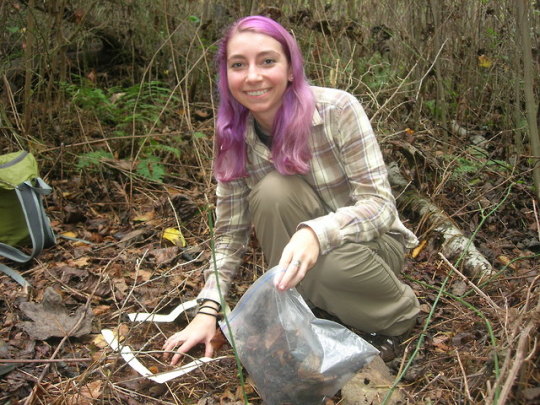
Abbey collecting snails after braving unkind vegetation. Photo by Tim Pearce.

In 2012, a tornado felled trees in four places at Carnegie Museum’s field station, Powdermill Nature Reserve in southwestern Pennsylvania, about 1-hour drive East of Pittsburgh. Each blowdown was 3-6 ha (8-15 acres), within 3 km (2 miles) of each other. These blowdowns provide natural replicates to examine land snail response to habitat change. Given that some snail species are known to occur in forests and others in meadows, we might expect the snail species composition to shift when the wind turns part of a forest into a meadow.

Samples taken in 2016 showed differences in snail species community composition between the blowdown areas and the adjacent, intact forest. However, other statistical tests did not show differences that were significant, but they were nearly significant.

A good scientist should readily accept “no difference” when statistical results show that the differences are not significant. However, when the differences are tantalizingly close to significant, one might wonder whether “no difference” is real, or if a larger sample size might have demonstrated a significant difference.

So, we sampled again this year and took more samples. We are still processing the samples, so results are not in yet, but with the larger sample size, we will accept “no difference” if that is what the statistics tell us.

In the photo, Abbey is collecting leaf litter (containing snails) at the Laurel Run blowdown. The sample she collected contained 23 snails, of five species: Glyphyalinia indentata, Punctum minutissimum, Striatura ferrea, Striatura milium, and Zonitoides arboreus.

Timothy A. Pearce, PhD, is the Head of the Section of Mollusks and Abbey Hines is a Gallery Experience Presenter at Carnegie Museum of Natural History. Museum employees are encouraged to blog about their unique experiences and knowledge gained from working at the museum.

Filed Under: Blog Tagged With: land snails, mollusks, Powdermill Nature Reserve, snails, Tim Pearce

January 28, 2019 by wpengine

Snail Extinction – Bad Situation Getting Worse

By Timothy Pearce

Move Aside Rosy Wolf Snail, the New Guinea Flatworm Wreaks Greater Devastation

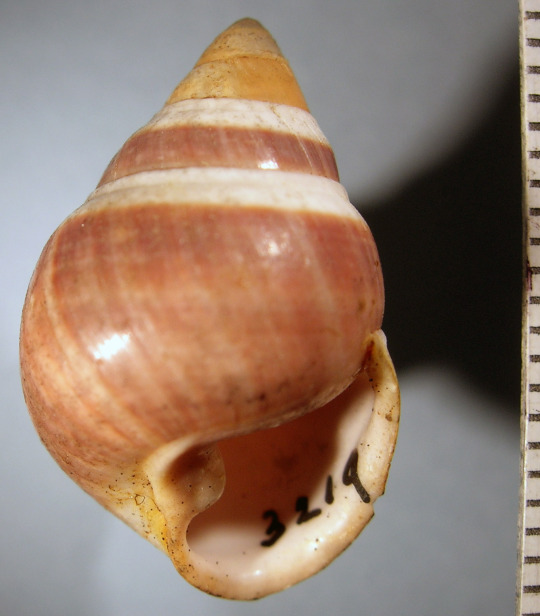
Another species of land snail went extinct on January 1, 2019. George, the last member of his species, Achatinella apexfulva, died in a captive breeding facility at the University of Hawaii. The loss of this snail, and this species, is sad from many perspectives, I’ll mention two: first, George’s species is the first land snail ever described from Hawaii; second, this loss contributes to the largely overlooked extinction crisis of land snails around the world.

Achatinella apexfulva shell
Achatinella apexfulva from the Carnegie Museum of Natural History collection.

George was named after Lonesome George, the last Galapagos tortoise of the subspecies Geochelone nigra abingdoni, who died in 2012. Like most land snails, George the snail was hermaphroditic (having both male and female parts), so either male, female, or androgynous names would have been appropriate.

News outlets including New York Times, National Geographic, and National Public Radio, as well as various blogs (e.g., https://www.shellmuseum.org/curators-corner) have well-covered the story of George’s passing, so look there for more details that I won’t repeat. Those outlets mentioned threats leading to the demise of tree snails, including the introduced rosy wolf snail, a snail-eating snail credited with causing snail extinctions on some Pacific Islands. However, none of those news outlets mentioned the New Guinea flatworm, which is already showing itself to be a much greater threat to snail-kind than the rosy wolf snail.

New Guinea flatworm
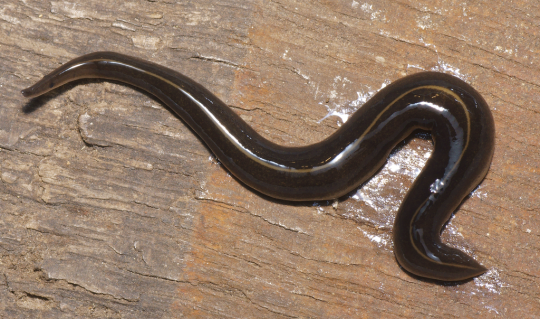
The New Guinea flatworm (Platydemus manokwari) eats land snails so efficiently that it is causing snail extinctions. Photo from Wikimedia Commons.

The New Guinea flatworm (Platydemus manokwari), which eats mostly snails, has been categorized as one of the 100 worst invasive species. Originally found in New Guinea, human activity has introduced it to many tropical and temperate regions of the world where it has had significant negative impacts on the rare endemic land snail fauna of some Pacific islands. Evidence indicates that predation by the New Guinea flatworm is the greatest cause of the extinction or drastically reduced numbers of several native snails. Up to 65 mm (2.5 inches) long, it can follow snail mucus trails to catch prey, sometimes even into trees, so its presence in Hawaii seriously threatens the remaining Hawaiian tree snails.

In 2015, the New Guinea flatworm was found in Florida, from which it poses a threat to land snails on the mainland of the USA. A colleague told me that in some of the Everglade hammocks where the flatworm has reached, all you can find now are dead, empty shells of the colorful tree snails that were gobbled by the flatworm. The flatworm does not survive in colder climates, so for the time being, the northern United States might be spared from this scourge. The flatworm survives best at 18 to 28 C (64-82F) and nearly ¼ of them survived in an experiment down to 10°C (50F) for 2 weeks.

Timothy A. Pearce is Curator of Collections, Section of Mollusks at Carnegie Museum of Natural History. Museum employees are encouraged to blog about their unique experiences and knowledge gained from working at the museum.

Filed Under: Blog Tagged With: land snails, mollusks, Section of Mollusks, snails, Tim Pearce

October 31, 2018 by wpengine

The Tell-Snail Heart

by Timothy A. Pearce

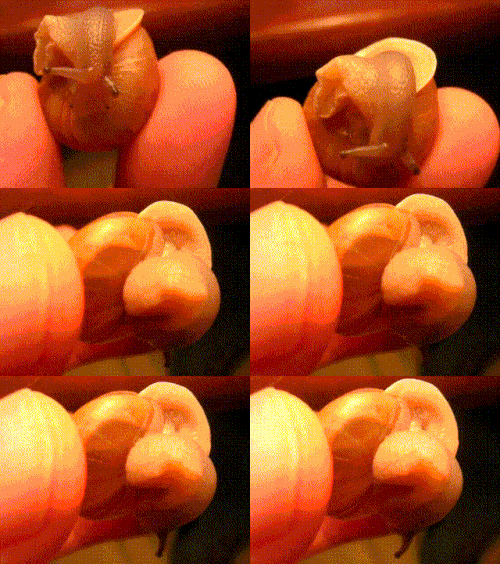
gif of a snail's heart beating

Edgar Allen Poe is well-known as an American writer of poems and short stories, including some spooky works that are often repeated around Halloween. Many people are surprised to learn that Poe once edited a book on shells, “The Conchologist’s First Book”, published in 1839. Poe’s shell book is a condensed version of a book by Thomas Wyatt. Poe wrote the preface and introduction initially; then he made more substantial changes.

Poe’s short story, “The Tell-Tale Heart,” is about someone who kills a man, then hides the body under the floorboards. The murderer, while talking with the police, is initially calm, but goes mad from the perceived sound of a heartbeat, and thinking the sound is the dead man’s beating heart, confesses to the crime.

In honor of Halloween and in recognition of Poe’s contributions to the study of mollusks, I made this gif movie of a snail’s heart beating, visible through the shell. The snail is Neohelix dentifera (the big-tooth whitelip snail), a land snail commonly found in Pennsylvania and elsewhere in northeastern North America. First you see the face with the four tentacles (the upper two tentacles have eyes on the tips; the lower tentacles are for smelling and tasting). Then as I turn the snail you get a quick peek at the breathing pore above the head, then you can look through the translucent shell to see the heart beat 3 times. It is the Tell-Snail Heart!

Timothy A. Pearce is Curator of Collections, Section of Mollusks at Carnegie Museum of Natural History. Museum employees are encouraged to blog about their unique experiences and knowledge gained from working at the museum.

Related Content

Vampire Squid: Cutest Dracula

Happy Highsmith Halloween! A Review of Two Scary Snail Short Stories by Patricia Highsmith

Shark-ish Beasts vs. Cephalopods: Which is Predator, Which is Prey, and is One an Artist?

Carnegie Museum of Natural History Blog Citation Information

Blog author: Pearce, Timothy A.
Publication date: October 31, 2018

Share this post!

  • Share on Twitter Share on Twitter
  • Share on Facebook Share on Facebook
  • Share on Pinterest Share on Pinterest
  • Share on LinkedIn Share on LinkedIn
  • Share on Reddit Share on Reddit
  • Share via Email Share via Email

Filed Under: Blog Tagged With: halloween, mollusks, snails, Tim Pearce

October 22, 2018 by wpengine

Are slugs and snails the same thing?

Are slugs and snails the same thing? Head of Mollusks Dr. Timothy Pearce takes us behind the scenes in the mollusks collection to see the differences between snails and slugs. Plus, find out all about semislugs – a very special type of mollusk.

Ask a Scientist is a video series where we ask our research staff questions about the millions of amazing objects and specimens stored in our museum collection. Tune in on YouTube, and submit your own questions via Twitter @CarnegieMNH!


Filed Under: Blog Tagged With: Ask a Scientist, mollusks, slugs, snails

  • Page 1
  • Page 2
  • Page 3
  • Go to Next Page »

sidebar

About

  • Mission & Commitments
  • Directors Team
  • Museum History

Get Involved

  • Volunteer
  • Membership
  • Carnegie Discoverers
  • Donate
  • Employment
  • Events

Bring a Group

  • Groups of 10 or More
  • Birthday Parties at the Museum
  • Field Trips

Powdermill

  • Powdermill Nature Reserve
  • Powdermill Field Trips
  • Powdermill Staff
  • Research at Powdermill

More Information

  • Image Permission Requests
  • Science Stories
  • Accessibility
  • Shopping Cart
  • Contact
  • Visitor Policies
One of the Four Carnegie Museums | © Carnegie Institute | Privacy Policy | Terms of Use | Accessibility
Rad works here logo