• Skip to primary navigation
  • Skip to main content
  • Skip to primary sidebar

Carnegie Museum of Natural History

One of the Four Carnegie Museums of Pittsburgh

  • Visit
    • Buy Tickets
    • Visitor Information
    • Exhibitions
    • Events
    • Dining at the Museum
    • Celebrate at the Museum
    • Powdermill Nature Reserve
    • Event Venue Rental
    • Gift Cards
  • Learn
    • Field Trips
    • Educator Information
    • Programs at the Museum
    • Bring the Museum to You
    • Guided Programs FAQ
    • Programs Online
    • Climate and Rural Systems Partnership
  • Research
    • Scientific Sections
    • Science Stories
    • Science Videos
    • Senior Science & Research Staff
    • Museum Library
    • Science Seminars
    • Scientific Publications
    • Specimen and Artifact Identification
  • About
    • Mission & Commitments
    • Directors Team
    • Museum History
  • Tickets
  • Give
  • Shop

Super Science Meowfest

August 4, 2020 by wpengine

Big Cats, Big Personalities

You may have heard the phrase “big cat” before. No, it doesn’t refer to a particularly large house cat, but rather to a category of cats. “Big cat” is a term typically used to describe any member of the genus Panthera, though it can mean different things to different people.

Some consider every member of the larger subfamily Pantherinae to be big cats—for example, clouded leopards (genus Neofelis). Sometimes, the phrase “big cat” just refers to any member of the cat family (Felidae) that is large, such as the cougar (genus Puma), the cheetah (genus Acinonyx), and the Eurasian lynx (genus Lynx, species lynx).

Tigers, Lions, Jaguars, Leopards, and Snow Leopards are the extant (or currently living) members. You may be wondering how leopards and snow leopards are members of genus Panthera but clouded leopards are not. Clouded leopards are not true leopards—they branched off into their own genus roughly six million years ago; they are in the larger subfamily of Pantherinae, but not Panthera specifically.

One feature sometimes used to distinguish big cats from other cats is the ability to roar, but that ability is only found in the Panthera genus, not the additional species. Roaring itself is an important vocalization, but it isn’t a surefire way to distinguish what a “big cat” is. For example, snow leopards, in the family Panthera, cannot roar.

So, big cat can mean something different to everyone, but let’s learn a little bit more about each of the cats listed above:

Tigers

Tigers are the largest cat species on the planet! There are several subspecies and they are easily recognized by their orange color with black stripes (though Bengal tigers are occasionally white with black stripes).
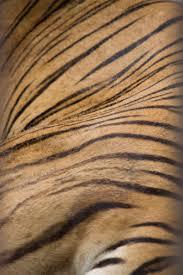
close up of tiger stripes

They are solitary and territorial animals; cubs (big cat offspring are not called kittens) stay with their mother for 2 years. These cats are found throughout Asia—although they are endangered—and their population is dwindling.

Lions

photo of a family of lions

Lions are a social species of large cats found in the grasslands and savannas of Africa. Males are recognizable by their long hair surrounding their necks, called manes. Lionesses do the hunting for the pride (social group of lions), which is comprised of several adult males, related females, and cubs. These animals are listed as vulnerable, which means they are close to becoming endangered.

Jaguars
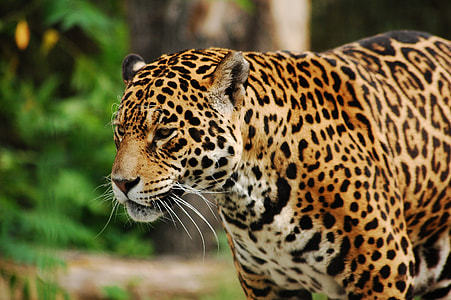
photo of a jaguar

Jaguars are the only member of the Panthera genus found in the Americas. Individual cats can be found in the Western United States, but they have had a reduced range in Central and South America since the early 20th century. They are solitary animals and ambush predators, hunting in tropical and subtropical forests and swamps. They are recognizable by their spots, which are black rosettes with spots in the middle. However, melanistic (or all black) jaguar occasionally appear; these cats are informally known as black panthers—although they are not a separate species—and the phrase “black panther” has been used to describe melanistic leopards as well. Jaguars are near-threatened, which means their numbers are decreasing and their populations are being closely monitored.

Leopards
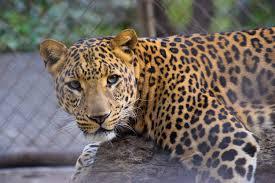
photo of a leopard

Leopards have a wide range and are found in Sub-Saharan Africa, in parts of Western and Central Asia and on the Indian subcontinent. They are recognizable by their spots; they look like jaguars with their spotted fur, but leopards are shorter with a smaller head, and their rosette-shaped spots do not have dots in the middle. Leopards are opportunistic hunters, hunting mostly on the ground at night; though in the Serengeti, they are known for attacking prey by leaping from trees. Leopards are listed as vulnerable, meaning they are potentially on their way to the endangered species list.

Snow leopards
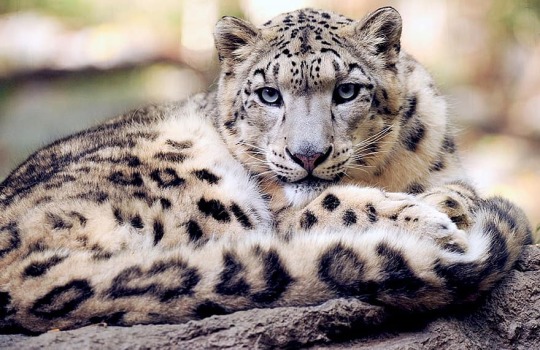
photo of a snow leopard

Snow leopards live in the mountain regions of Central and South Asia, living at elevations from 3,000 to 4,500 feet. Their fur is whitish grey, with black rosettes, distinguishing them from other leopards which are yellow or brown in color. Snow leopards have large nasal passages which helps warm the cold, dry air they breathe. Their tails are covered thickly with fur and provide fat storage; sleeping snow leopards use their warm tails like blankets to protect their faces when they sleep. They are listed as vulnerable, meaning they may appear on the endangered species list in the future.

Clouded leopards
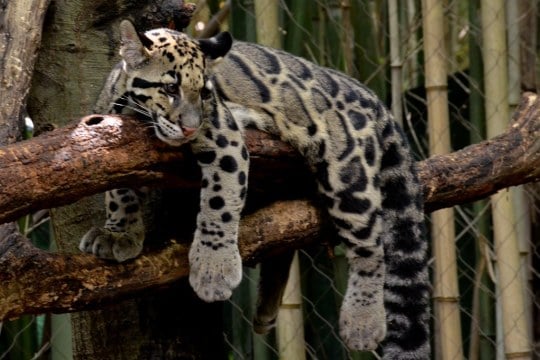
photo of a clouded leopard lounging on a branch

There are two species of clouded leopards—the mainland clouded leopard (Neofelis nebulosa) and the Sunda clouded leopard (Neofelis diardi). The mainland clouded leopard is found in the Himalayan foothills in Southeast Asia and southern China and the Sunda clouded leopard is found in Borneo and Sumatra. They are considered an evolutionary link between two cat families Pantherinae and Felinae. Their fur is dark grey with a black blotched pattern. Clouded leopards are solitary and hunt by stalking or ambushing prey. They are excellent climbers and use trees as rest sites.  Both species of clouded leopards are listed as vulnerable, meaning they can potentially end up on the endangered species list.

Cougar
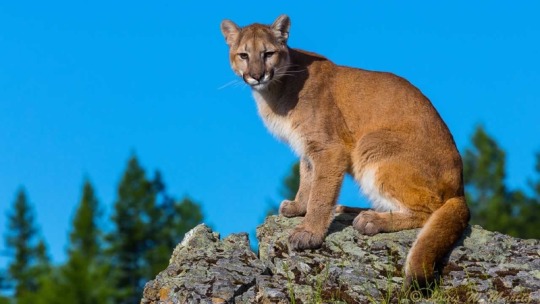
photo of a cougar sitting on a rock

The cougar (also known as a puma, mountain lion, red tiger, or catamount) is the only cat on this list that you may see in the wild around Pittsburgh; however, their populations are severely reduced in the eastern half of North America. These cats are adaptable to a wide variety of habitats, which is why they are found all throughout North and South America. This wide range is the reason people living in different regions have different names for them. They are ambush predators, preferring to hunt deer, though they will eat insects and rodents. While cougars are large, they are not always the apex (or top) predator and will occasionally give food they caught away to jaguars, grizzly bears, or even alligators! Cougars are listed as least concern, meaning their population is holding steady, though their range has shrunk.

Cheetah
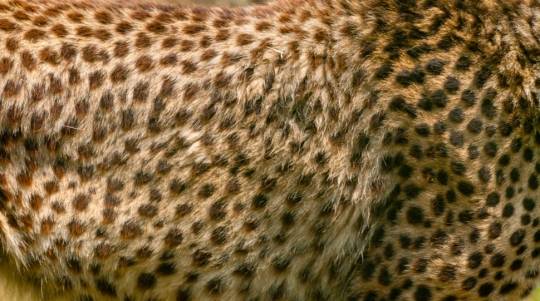
close up of a cheetah's spotted fur

Cheetahs are known for their speed; as the fastest land animal, they are capable of running up to 80 miles per hour! Cheetahs can be found in the Serengeti, Saharan mountain ranges, and in hilly areas of Iran. Cheetahs separate into three kinds of social groups—females with cubs, all-male groups, and solitary males. Females are more likely to travel further distances while males will establish and stay in smaller territories. They are active during the day and spend most of their time hunting for things like impala or springbok. Cheetahs are listed as vulnerable, with one of the main threats being a lack of genetic diversity, which makes it difficult for the species to adapt and evolve over generations, reducing the chance for individual animals to survive.

Eurasian lynx
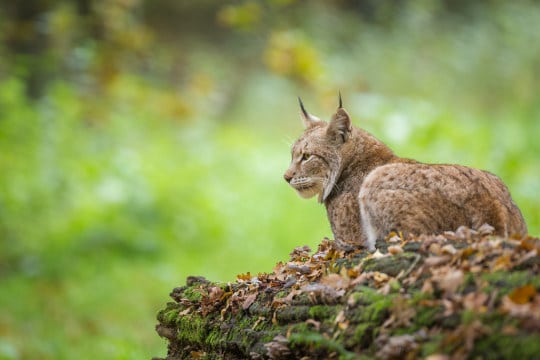
photo of a Eurasian lynx

The Eurasian lynx is found from Europe into Central Asia and Siberia, living in temperate or boreal (snow or Taiga) forests. They have short, red-brown coats, and are more colorful than most animals sharing their habitat. In the winter, their fur grows in thicker and greyer. These cats have relatively long legs and large webbed and furred paws that act like snowshoes, allowing them to walk on top of the snow. They have bobbed (or short) tails, much like one of their cousins you might see around Pittsburgh—the bobcat. They hunt small mammals and birds but will occasionally take down young moose or deer. The Eurasian lynx is listed as least concern, with a stable population.

Jo Tauber is the Gallery Experience Coordinator for CMNH’s Life Long Learning Department, as well as the official Registrar for the Living Collection. Museum staff, volunteers, and interns are encouraged to blog about their unique experiences and knowledge gained from working at the museum.
Related Content

Cats: The Archeological Site!

Meowfest: Museum Scavenger Hunt

Why Do Cat Eyes Glow in the Dark?

Filed Under: Blog Tagged With: cats, Educator Resources, Hall of African Wildlife, Hall of North American Wildlife, Jo Tauber, Museum from Home, Super Science Days, Super Science Meowfest

August 4, 2020 by Kathleen

Meowfest: DIY Cat Toy

Filed Under: Blog Tagged With: activities, Crafts, Super Science Days, Super Science Meowfest

August 3, 2020 by wpengine

Cats: The Archeological Site!

There’s an internet meme making the rounds that says if dogs are “man’s best friend” then cats are basically weird roommates. However, if you happened to live in ancient Egypt, you’d consider cats to be tad more special—a veritable link to the divine, in fact. Cats were of great importance in matters both earthbound and spiritual in Egypt, beginning even before the First Dynasty over 5,000 years ago. Aloof but lovable, cats played the role of pet, hunter, and deity in ancient Egypt and to this day they haven’t forgotten. Believe me, cats know.

Let’s start with the practical role that cats played in Egypt. Has yours ever left you a present of a dead mouse or bird? Odds are that it has—whether you liked it or not. Ancient Egyptians valued cats for this very skill. Cats hunted the rodents that threatened to devour Egyptian grain and spread deadly diseases. Cats also hunted animals dangerous to humans like snakes and scorpions. Tomb paintings also depict cats helping their royal owners hunt elusive marsh birds for sport. Egyptians loved cats for their companionship as well—not just as hard-working professionals—and played a major role in domesticating them. Ancient Egyptian art captures cats wearing collars and lurking under chairs not so differently from the cats that keep us company today.

When cats stretched themselves out in the sun for a catnap, ancient Egyptians associated them with the sun god Ra and his daughter Bastet. Bastet was the goddess of the home, fertility, joy, and the protection of children; and she is often depicted in statuary as a woman with the head of an alert, attentive cat. Even earlier depictions of Bastet, however, show a fierce and wild lioness. Some scholars believe this shift in imagery is connected to the domestication of cats—from the Near Eastern wildcat (Felis silvestris lybica) to the modern-day housecat (Felis catus). These traits of the goddess Bastet—vigilance, protectiveness, companionship—were reflected in the characteristics of Felis catus. Ra, in his cat form, also shared these characteristics. When accompanying a deceased Egyptian to the afterlife, Ra was prepared to defend them from Apep, the serpent god of chaos and disorder.

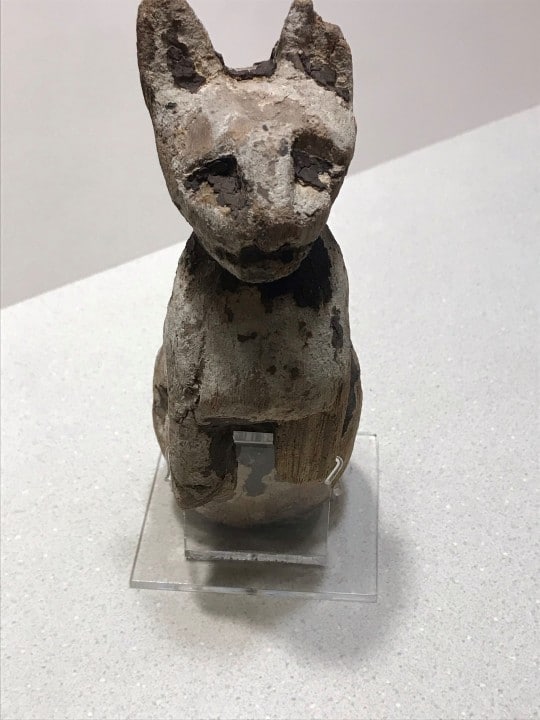
cat statuette

By the Ptolemaic period of Egyptian history (305-30 BCE), Bastet was hugely popular. Her temples drew thousands of pilgrims every year. These pilgrims would buy statuettes of the goddess or actual cat mummies to leave at the temple. This was a way for the pilgrims to commemorate their visit and to venerate Bastet. When the number of these statues and cat mummies grew too large, the priests of the temple would dig special trenches and bury them to make room for more. About two thousand years later in the nineteenth century, archeologists would begin to unearth these trenches and discover more cat mummies and Bastet statuary than they knew what to do with. Unfortunately, some English excavators even sent the cat mummies they discovered back to Britain…to be ground into fertilizer!

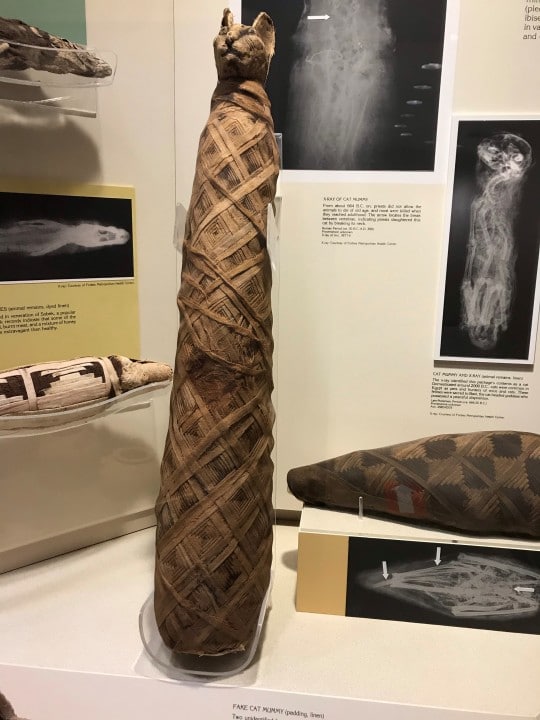
cat mummy in museum display

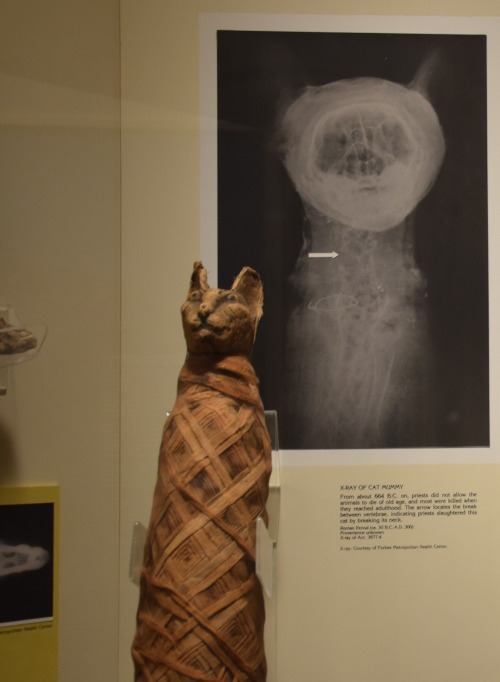
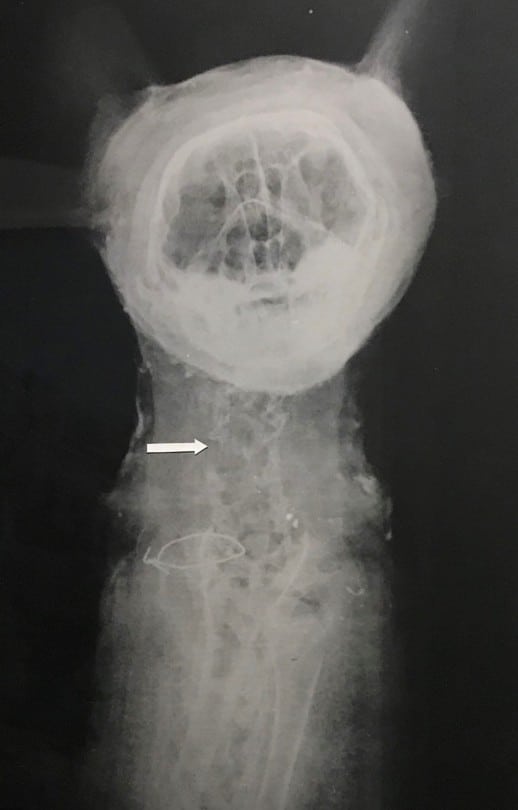
Millions of cats were mummified in ancient Egypt either to be buried alongside their owner or to be sold to pilgrims devoted to Bastet. Cat mummification in the name of Bastet became an industry because many temples—depending on the whim of pharaonic decree—had to sustain themselves financially on their own. Sometimes a temple might sell a pilgrim a “fake” cat mummy! And it’s one of these curiosities that the Carnegie Museum of Natural History has on display in Walton Hall of Ancient Egypt. While it looks like a standard-issue cat mummy (Roman period, c. 30 BCE), an x-ray led to the discovery that the remains belong to another undetermined animal.

x-ray of cat mummy

Cats played a central role in the daily life and religious practices of ancient Egyptians. They kept their humans safe from snakes and scorpions and Egypt’s grain supply safe from rats and mice. Cats even came to represent in animal form some of Egypt’s most important gods. So, the next time your cat ignores you and wanders off, know that one of its ancestors quite possibly did the same thing to a pharaoh.

Nicholas Sauer is a Gallery Experiences Presenter and Natural History Interpreter at the Carnegie Museum of Natural History. Museum staff, volunteers, and interns are encouraged to blog about their unique experiences and knowledge gained from working at the museum.
Works Cited

“Bastet.” The Louvre Museum. 2009. <https://www.louvre.fr/en/oeuvre-notices/bastet>.

Castellano, Nuria. “The Sacred and Secret Rituals in the Egyptian Book of the Dead.” National Geographic, 8 February 2018. <https://www.nationalgeographic.com/history/magazine/2016/01-02/egypt-book-of-the-dead/>.

Grimm, David. “Ancient Egyptians May Have Given Cats the Personality to Conquer the World.” Science Magazine, 19 June 2017. <https://www.sciencemag.org/news/2017/06/ancient-egyptians-may-have-given-cats-personality-conquer-world>.

Little, Becky. “Kitten Mummies.” History.com, 18 November 2018. <https://www.history.com/news/ancient-egypt-cat-mummy-discovery-scarab>.

Macdonald, James. “Why Ancient Egyptians Loved Cats So Much.” JSTOR Daily, 27 November 2018. <https://daily.jstor.org/why-ancient-egyptians-loved-cats-so-much/>.

“Paintings from the Tomb-chapel of Nebamun.” Khan Academy. 2020. <https://www.khanacademy.org/humanities/ancient-art-civilizations/egypt-art/new-kingdom/a/paintings-from-the-tomb-chapel-of-nebamun>.

Related Content

Meowfest: Museum Scavenger Hunt

Meowfest: Why do Cat Eyes Glow in the Dark?

Stuffed Animal Safari: Jaguars

Filed Under: Blog Tagged With: cats, Museum from Home, Super Science Days, Super Science Meowfest, Walton Hall of Ancient Egypt

August 3, 2020 by Kathleen

Meowfest: Why Do Cat Eyes Glow in the Dark?

Have you ever walked around a dark corner only to be surprised by glowing eyes staring back at you? The glowing eyes of a cat at night can sometimes be shocking and even a little scary if unexpected. Ancient Egyptians believed cats captured the glow of the setting sun in their eyes and kept it safe until morning. Ancient Greeks believed there was a light source inside the eyes that was like a gleaming fire. We now know that cat’s eyes appear to glow because they, along with the eyes of many other nocturnal animals, reflect light.

All eyes reflect light, but some eyes have a special reflective structure called a tapetum lucidum that create the appearance of glowing at night. The tapetum lucidum (Latin for “shining layer”) is essentially a tiny mirror in the back of many types of nocturnal animals’ eyeballs. It basically helps these animals see super-well at night. It is also what causes the glowing eye phenomenon known as “eyeshine.”

How Does It Work?

When light enters a cat’s eye, it can take a few routes. Some of the light directly hits the retina, a layer at the back of the eyeball containing cells that are sensitive to light. These photoreceptor cells trigger nerve impulses that pass via the optic nerve to the brain, where a visual image is formed.

Some of the light passes through or around the retina and hits the tapetum lucidum. The tapetum lucidum reflects visible light back through the retina, increasing the light available to the photoreceptors. This allows cats to see better in the dark than humans.

In the last route, some of the light that bounces off the tapetum lucidum, misses the retina, and bounces back out of the cat’s eyes. This reflected light, or eyeshine, is what we see when a cat’s eyes appear to be glowing.

Do Humans Have a Tapetum Lucidum?

Though our eyes have much in common with cats’ eyes, humans do not have this tapetum lucidum layer. If you shine a flashlight in a person’s eyes at night, you don’t see any sort of reflection.

The flash on a camera is bright enough, however, to cause a reflection off of the retina itself. This is the infamous “red-eye” in photographs. What you see is the red color from the blood vessels nourishing the eye.

Activity

In this two-part activity, you will be able to see how the tapetum lucidum works and then simulate how this reflective layer helps cats see well at night.

Materials Needed

  • Flashlight
  • Mirror (or a shiny/reflective surface)
  • Thick paper or cardboard
  • Pencil (or an object you can poke a hole with) REMEMBER TO ASK A GROWN-UP FOR HELP!

Directions

  1. Make about a hole in your paper or cardboard using a pencil or pen. It does not have to be perfect! If using a thinner paper, try folding it a few times before making the hole (the harder it is to see light through, the better!).
  2. Hold the cardboard about 6 inches away from a blank wall and shine the flashlight through the hole toward the wall.
  3. Without looking directly into the light, glance at the side of the cardboard facing the wall. Take note of what you see.
  4. Repeat steps 2 and 3 while using your mirror instead of a wall. Again, avoid looking directly into the light or its reflection in the mirror! Note the difference in light on the side of the cardboard facing the mirror.

Imagine that the cardboard is a retina and the mirror is a reflective layer like the tapetum lucidum. What happened to the “retina” when the mirror was used instead of the wall?

This experiment shows how the amount of light from a singular light source is doubled when a reflective layer is present. Thus, it shows us how having a reflective layer—like a tapetum lucidum—increases the amount of light information available.

Materials Needed

  • Flashlight
  • Clear Glass container (jar or cup work well!)
  • Water

Directions

1. Place your glass container about 6 inches away from a wall.

2. Shine your flashlight through the glass toward the wall and observe how the light appears on the wall.

3. Fill the container with water and place in the same spot as before.

4. Shine your flashlight through the glass toward the wall and observe how the light now appears on the wall.

Imagine that the wall is the retina and the water is a reflective layer like the tapetum lucidum. How does the reflective layer change the presence of light on the retina?

While this experiment is technically showing how light refraction works in water, it can also show us how having a reflective layer—like a tapetum lucidum—increases the amount of light available to cats’ eyes. Also, that the extra reflective light is not as clear as the original light input.

Filed Under: Blog Tagged With: activities, Crafts, Super Science Days, Super Science Meowfest

August 3, 2020 by Kathleen

Meowfest: Museum Scavenger Hunt

cat

If you visit the museum in the near future, prowl around for these favorite feline finds!

[gravityform id=”63″ title=”false” description=”false”]

cat mummy

Filed Under: Blog Tagged With: Super Science Days, Super Science Meowfest

  • « Go to Previous Page
  • Page 1
  • Page 2

sidebar

About

  • Mission & Commitments
  • Directors Team
  • Museum History

Get Involved

  • Volunteer
  • Membership
  • Carnegie Discoverers
  • Donate
  • Employment
  • Events

Bring a Group

  • Groups of 10 or More
  • Birthday Parties at the Museum
  • Field Trips

Powdermill

  • Powdermill Nature Reserve
  • Powdermill Field Trips
  • Powdermill Staff
  • Research at Powdermill

More Information

  • Image Permission Requests
  • Science Stories
  • Accessibility
  • Shopping Cart
  • Contact
  • Visitor Policies
Stay in the loop! Sign up for our newsletter(s).
One of the Four Carnegie Museums | © Carnegie Institute | Privacy Policy | Terms of Use | Accessibility
Rad works here logo