• Skip to primary navigation
  • Skip to main content
  • Skip to primary sidebar

Carnegie Museum of Natural History

One of the Four Carnegie Museums of Pittsburgh

  • Visit
    • Buy Tickets
    • Visitor Information
    • Exhibitions
    • Events
    • Dining at the Museum
    • Celebrate at the Museum
    • Powdermill Nature Reserve
    • Event Venue Rental
    • Gift Cards
  • Learn
    • Field Trips
    • Educator Information
    • Programs at the Museum
    • Bring the Museum to You
    • Guided Programs FAQ
    • Programs Online
    • Climate and Rural Systems Partnership
  • Research
    • Scientific Sections
    • Science Stories
    • Science Videos
    • Senior Science & Research Staff
    • Museum Library
    • Science Seminars
    • Scientific Publications
    • Specimen and Artifact Identification
  • About
    • Mission & Commitments
    • Directors Team
    • Museum History
  • Tickets
  • Give
  • Shop

Vertebrate Paleontology

December 10, 2017 by wpengine

Vertebrate Fossils from Bears Ears National Monument, Utah

dessert with giat red rocks rising the back
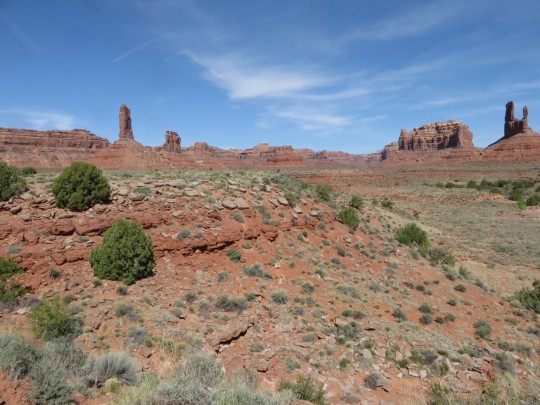
Valley of the Gods area of Bears Ears National Monument.

By Amy Henrici, Collection Manager of Vertebrate Paleontology

You may have noticed that Bears Ears National Monument, southeastern Utah, has been in the National news lately. This vast area of spectacular red rock canyons with Native American ruins was designated in 2016 but is proposed to be reduced by 85%. What hasn’t received much media attention are the Late Paleozoic (~315-280 million years ago) vertebrate fossils collected from this region.

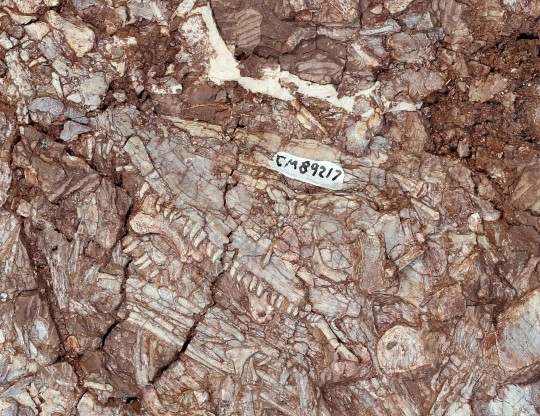
Fossils from Bears Ears N.M. include a variety of freshwater sharks and fishes and amphibians and reptiles, creatures which once inhabited a coastal plain adjacent to an inland seaway. Through the Late Paleozoic the seaway filled with sediment shed from the Ancestral Rocky Mountains to the northeast, and, as the climate became more arid, dunes encroached the coastal plain. The fauna of this changing environment records a primitive stage of the terrestrial ecosystem in which carnivores greatly outnumber herbivores, a stark contrast to modern ratios in which herbivores greatly outnumber carnivores. The most common animals represented in this fossil record are the heavy-bodied, semi-aquatic, carnivore Eryops and the semi-aquatic carnivorous mammal-like reptile, Ophiacodon.
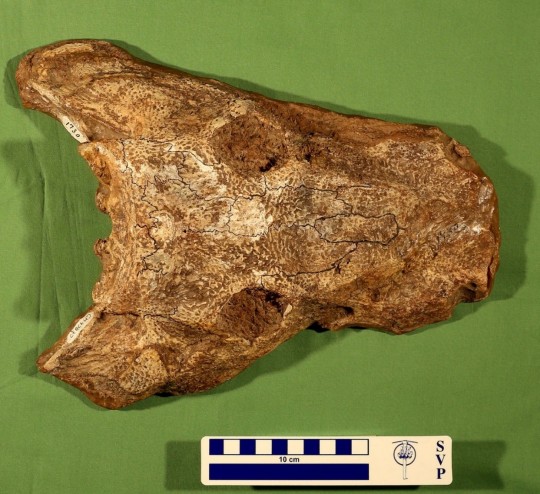
brown skull fossil on a green background
Skull of Eryops grandis, CM 47817.


ground with fossils protruding
Skull of Ophiacodon navajovicus as preserved in bone bed.

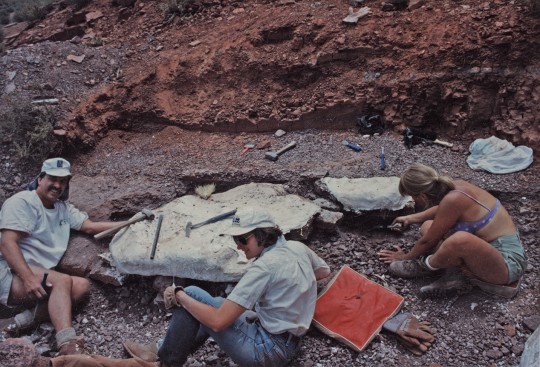
The Section of Vertebrate Paleontology has the best collection of vertebrate fossils from Bears Ears National Monument. Curator Emeritus Dave Berman collected fossils here as a student of Peter Vaughn at the University of California (UCLA). The UCLA Late Paleozoic collection was donated to CMNH in 1988. Berman renewed collecting in the Bears Ears region in 1990, resulting in the discovery of a significant bone bed. CMNH crews in collaboration with researchers from the Illinois State Geologic Survey, University of California at San Bernardino, University of Chicago, and University of Southern California have worked this site since, and a potential new bone bed was discovered last summer.

Funding for field work has been provided by the Bureau of Land Management, Carnegie Museum of Natural History, and the National Geographic Society.
three researchers gathered around a bed of fossils
1991 excavation of the bone bed discovered in 1990.


Filed Under: Blog Tagged With: Amy Henrici, Vertebrate Paleontology

December 10, 2017 by wpengine

Ask a Scientist: What is “The Chicken from Hell?”

Paleontologist Dr. Matt Lamanna shows off fossils and discusses the amazing features of Anzu wyliei, a fierce and feathered prehistoric dinosaur. Dr. Lamanna worked on the team that discovered Anzu wyliei in 2014.


Ask a Scientist is a new short video series where we ask our research staff questions about the millions of amazing objects and specimens stored in our collection. Tune in on YouTube, and submit your own questions via Twitter @CarnegieMNH.

Filed Under: Blog Tagged With: Matt Lamanna, Vertebrate Paleontology

November 17, 2017 by wpengine

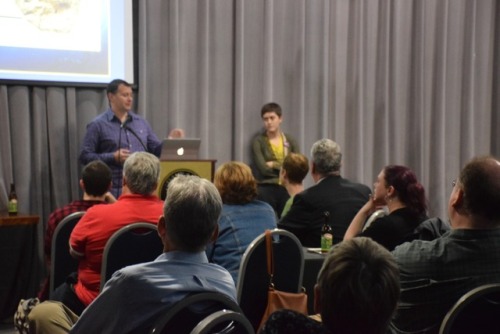
We had a great turn out for our museum Pub Talk

Abby West speaking at a podium

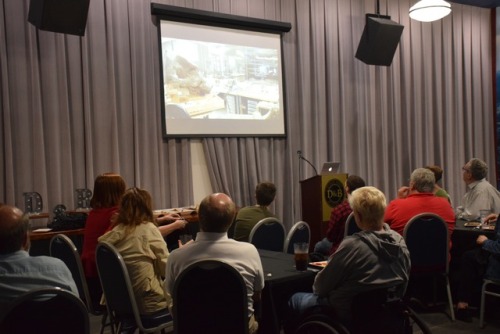
crowd enjoying the pub talk

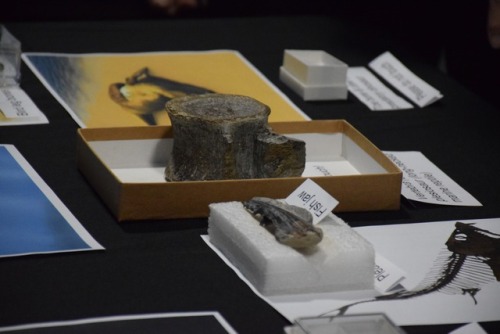
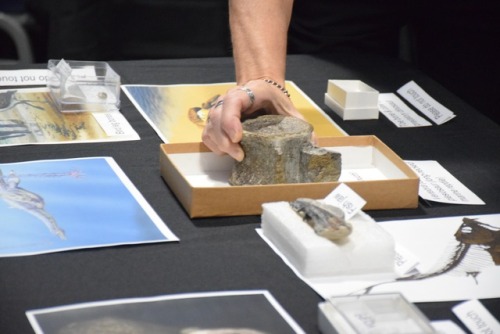
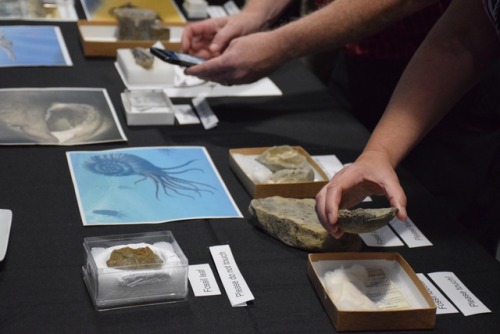
objects from the Antartica expedition

artifacts on a table

artifacts from Antartica

Matt speaking at a podium

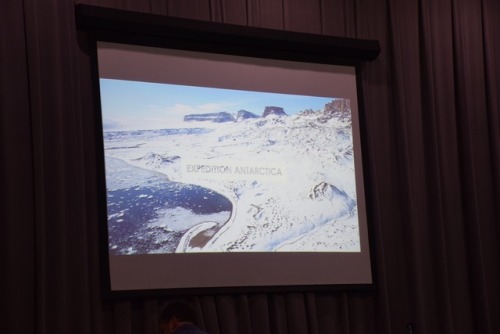
Expedition Antartica Slides

vegetable and cheese trays

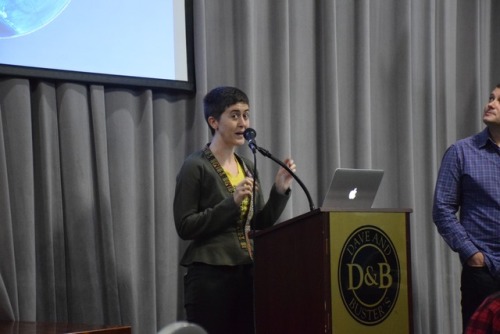
We had a great turn out for our museum Pub Talk at Dave and Busters in October hosted! Paleontologists Dr. Matt Lamanna and Dr. Abby West entertained a crowd of about 60 with a talk about their recent expedition to Antarctica as part of the AP3 Project. Their presentation touched on dinosaurs, evolution, how to find fossils, and even very friendly penguins. Matt and Abby also answered questions and brought fossils so that those in attendance could examine and even touch real fossils found in Antarctica. Guests enjoyed some complimentary appetizers and watched the new documentary “Expedition Antarctica,” which will be coming soon to the Earth Theater! Thanks to Matt and Abby and all who came out for a great night of science and fun. For more events like this, follow our museum Meetup page!

Pub Talks is a public relations initiative that brings our science out of the museum and into the public. Different scientists are featured throughout the year at various pubs around the beautiful city of Pittsburgh.

Filed Under: Blog Tagged With: antarctica, Matt Lamanna, Vertebrate Paleontology

October 5, 2017 by wpengine

Tyrannosaurus rex

Tyrannosaurus rex was one of the largest predators to ever walk the Earth. Growing up to 46 feet in length and standing 13 feet high at the hips, this meat-eater could weigh up to seven tons.

T. rex was more than just enormous, it was ferocious. It had massive hind legs with three-toed feet, small, strong arms the size of a man’s, and a huge, heavy tail that was used as a counterbalance.

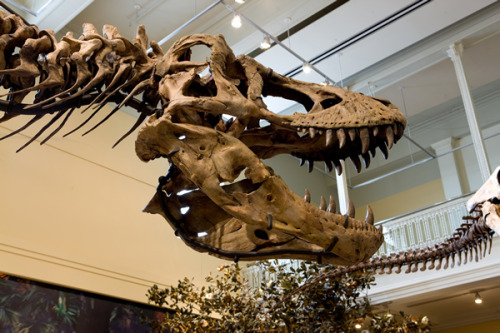
head of a T.rex skeleton
Credit: Joshua Franzos for Carnegie Museum of Natural History

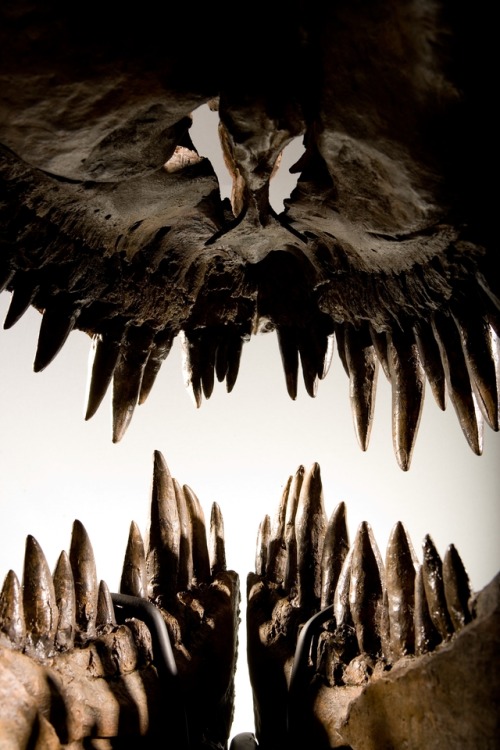
Its skull grew to five feet long and housed strong jaws that created a bone-crushing bite. It had nearly 60 serrated, razor-sharp teeth that grew up to six inches in length. With a name that means “tyrant lizard king,” this dinosaur feasted on the large herbivores of its time.

view of T.rex teeth from inside the dinosaur's mouth
Credit: Joshua Franzos for Carnegie Museum of Natural History

T. rex roamed the western United States and southwestern Canada during the late Cretaceous Period, about 66 to 68 million years ago. The specimen on display at Carnegie Museum of Natural History was discovered in 1902 by Barnum Brown and sent to the American Museum of Natural History. It was bought by the Carnegie Museum in 1941.

This specimen is extremely important because it is the holotype of the species. A holotype is a specimen upon which a given species is based. So, in other words, Carnegie Museum of Natural History’s T. rex is the ‘gold standard’ to which all potential fossils of this notorious meat-eater must forever be compared. Although a few specimens that are now known to belong to T. rex were found prior to the discovery of the holotype, the holotype was, by definition, the first fossil of the species to be recognized by science. Therefore, it can be considered the world’s first specimen of the world’s most famous dinosaur.

Filed Under: Blog Tagged With: dinosaur, dinosaurs, dinosaurs in their time, Matt Lamanna, t-rex, Tyrannosaurus Rex, Vertebrate Paleontology

October 5, 2017 by wpengine

Protoceratops andrewsi

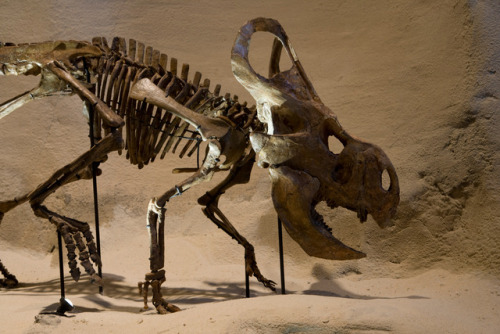
dinosaur fossil of Protoceratops andrewsi in a museum display
Photo Credit: Image by Josh Franzos for Carnegie Museum of Natural History

Protoceratops andrewsi is a fairly small and primitive ceratopsian, or horned dinosaur. Although it lacked the horns of later species, Protoceratops had a distinct bump above its nostrils and thickened bone over its eye sockets. Like its larger and geologically younger relative Triceratops, this herbivore also had a bony neck frill that may have been used for species identification and display. With a name that means “Andrews’ early horned face,” this dinosaur reached two and one-half feet tall at the hips and grew up to six feet long. It weighed around 200 pounds and had a horn-covered beak that it used to crop plants and to defend itself.

Protoceratops was first discovered in Mongolia, and a great many specimens have since been found in that nation and in northern China. They range in size from hatchlings to full-grown adults, including one that is preserved locked in combat with an individual of Velociraptor, the predatory ‘raptor’ made famous by the Jurassic Park films.

Protoceratops thrived in Central Asia during the late Cretaceous Period, roughly 80-75 million years ago. Roughly 20 million years beforehand, a ceratopsian species that closely resembled Protoceratops is thought to have migrated from Asia to North America via a land bridge that spanned the region between what are now Siberia and Alaska. The descendants of this dinosaur eventually evolved into the huge horned ceratopsians such as Triceratops.

The Protoceratops on display at Carnegie Museum was collected by the American Museum of Natural History during an expedition to Mongolia in 1925 and obtained via an exchange in 1945.

Filed Under: Blog Tagged With: dinosaur, dinosaurs in their time, Vertebrate Paleontology

October 5, 2017 by wpengine

Who is Dr. Matt Lamanna?

Matt Lamanna on expedition in Antarctica

Did you know that Section of Vertebrate Paleontology curator Matt Lamanna has discovered dinosaur fossils on all seven
continents, including Antarctica?

Dr. Lamanna leads the Antarctic Peninsula Paleontology Project, an international team of scientists investigating the end
of the Mesozoic Era (”Age of Dinosaurs”) in Antarctica, and also leads or co-leads research projects studying dinosaurs in Patagonia (Argentina), the Sahara (Egypt), and the Australian Outback.

Lamanna has named or co-named 15 new species of dinosaurs and fossil birds, including Anzu wyliei and three of the largest land animals known to science—the titanosaurian sauropods Dreadnoughtus schrani, Notocolossus gonzalezparejasi, and Paralititan stromeri. Each of these massive sauropods is estimated to have weighed more
than 40 tons, roughly equivalent to eight adult elephants.

Lamanna has co-authored two papers in the preeminent journal Science and appeared on television programs for PBS (NOVA), the Discovery Channel, the History Channel, A&E, the Science Channel, and more. Recently, he assisted the US Department of Homeland Security in their investigation of a dinosaur fossil that had been illegally smuggled out of China.

Filed Under: Blog Tagged With: Antarctic Peninsula Paleontology Project, dinosaurs, Matt Lamanna, Vertebrate Paleontology

  • « Go to Previous Page
  • Page 1
  • Interim pages omitted …
  • Page 7
  • Page 8
  • Page 9
  • Page 10
  • Go to Next Page »

sidebar

About

  • Mission & Commitments
  • Directors Team
  • Museum History

Get Involved

  • Volunteer
  • Membership
  • Carnegie Discoverers
  • Donate
  • Employment
  • Events

Bring a Group

  • Groups of 10 or More
  • Birthday Parties at the Museum
  • Field Trips

Powdermill

  • Powdermill Nature Reserve
  • Powdermill Field Trips
  • Powdermill Staff
  • Research at Powdermill

More Information

  • Image Permission Requests
  • Science Stories
  • Accessibility
  • Shopping Cart
  • Contact
  • Visitor Policies
One of the Four Carnegie Museums | © Carnegie Institute | Privacy Policy | Terms of Use | Accessibility
Rad works here logo