• Skip to primary navigation
  • Skip to main content
  • Skip to primary sidebar

Carnegie Museum of Natural History

One of the Four Carnegie Museums of Pittsburgh

  • Visit
    • Buy Tickets
    • Visitor Information
    • Exhibitions
    • Events
    • Dining at the Museum
    • Celebrate at the Museum
    • Powdermill Nature Reserve
    • Event Venue Rental
    • Gift Cards
  • Learn
    • Field Trips
    • Educator Information
    • Programs at the Museum
    • Bring the Museum to You
    • Guided Programs FAQ
    • Programs Online
    • Climate and Rural Systems Partnership
  • Research
    • Scientific Sections
    • Science Stories
    • Science Videos
    • Senior Science & Research Staff
    • Museum Library
    • Science Seminars
    • Scientific Publications
    • Specimen and Artifact Identification
  • About
    • Mission & Commitments
    • Directors Team
    • Museum History
  • Tickets
  • Give
  • Shop

Vertebrate Paleontology

January 7, 2019 by wpengine

Dinohyus: “Terrible Pig” in More Ways Than One

by Joe Sawchak

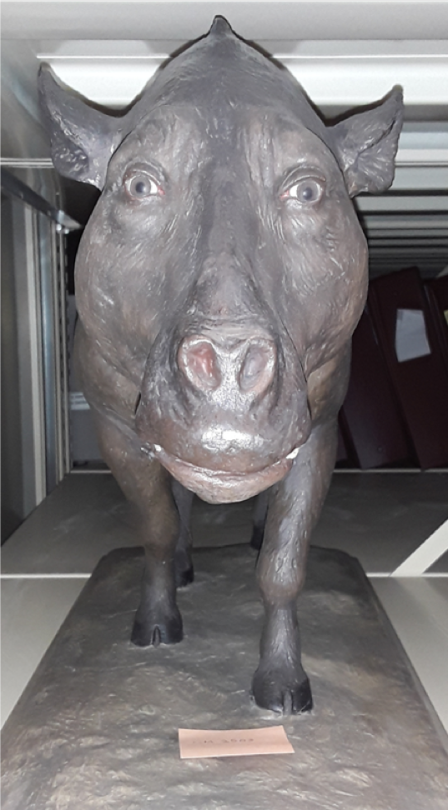
In the depths of Carnegie Museum of Natural History’s basement, in the Vertebrate Paleontology (VP) collection area known as the Big Bone Room, there is a small model of a prehistoric pig-like mammal known as Dinohyus. The name Dinohyus translates to “terrible pig,” and in life, this buffalo-sized beast must indeed have been a terrifying sight. Even so, to several members of the VP staff, including myself, the model—lovingly known as The Hyus—is perhaps even more horrifying than the actual creature itself. See for yourself:
scale model of Dinohyus
The Hyus: the rarely-seen scale model of Dinohyus in the Big Bone Room at Carnegie Museum of Natural History. Does anything about it seem odd to you?

Notice anything weird?

Like, maybe, the eyes?!

If so, then you’re not alone. To those other VP staff and I—plus most of the few other people to whom we’ve shown this model—the eyes seem so ‘emotive’ or ‘human’ that it’s disturbing. It almost seems as though they’re staring right into your soul…
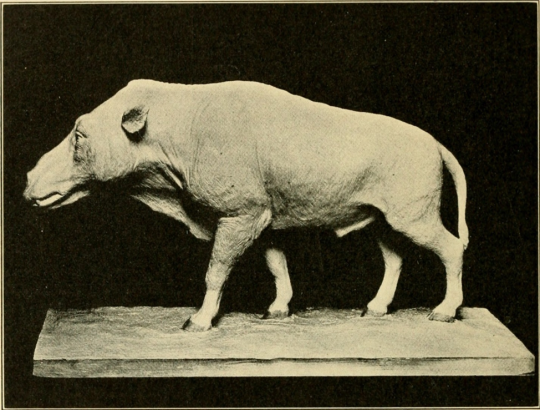
side view of dinohyus model
A side view of The Hyus taken in 1910, shortly after the model was made.

So, how did such a bizarre model come to be in our museum’s collection? Well, none of us really knew, so I did some digging into our archives. As it turns out, the model was sculpted by one Theodore Augustus Mills, born April 24, 1839 in Charleston, South Carolina. Beginning in 1860, Mills studied at the Munich Royal Academy of Fine Arts for five years. Afterward, he was employed by the Smithsonian and a few other institutions. Then, in 1898, he began work at Carnegie Institute, the parent organization of what is now known as Carnegie Museum of Natural History. Soon thereafter, he was permanently hired in the Section of Vertebrate Paleontology to make models of prehistoric animals. His Dinohyus model was completed in 1909 and catalogued as specimen CM (Carnegie Museum) 2503. A mold was made of the sculpture, and as such, the museum actually possesses multiple copies of the model. Mills worked at the Carnegie until his death from pneumonia on December 11, 1916.

An interesting side note regarding Theodore Mills is that, early in his career, he assisted his father Clark Mills in making a cast of US President Abraham Lincoln’s face. This cast was made only 60 days prior to Lincoln’s assassination in 1865.
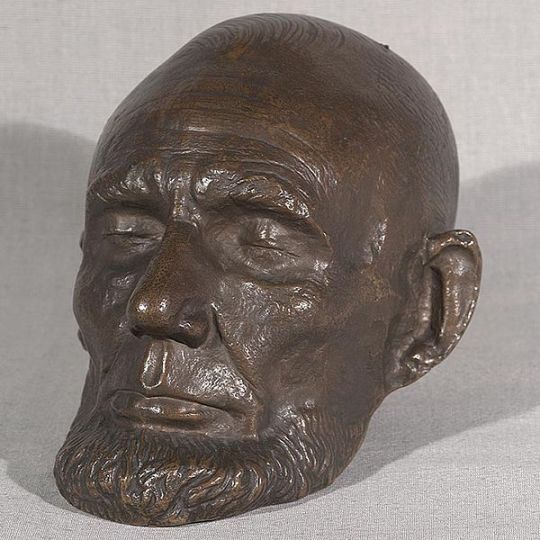
Life mask of President Abraham Lincoln
Life mask of President Abraham Lincoln, made by Clark and Theodore Mills in early 1865, shortly before Lincoln’s assassination. Theodore Mills also sculpted The Hyus.

But back to the question at hand: why does Carnegie Museum of Natural History house The Hyus? The answer is that the museum is also home to what is probably the most complete, best-preserved fossil skeleton of its namesake species that has ever been discovered. In 1905, Carnegie Museum field collector T. F. Olcott unearthed this skeleton (now catalogued as specimen CM 1594) from the Agate Springs Fossil Quarry in the northwestern corner of Nebraska. Later that year, another Carnegie paleontologist, O. A. Peterson, designated that fossil as the type, or name-bearing, specimen of a new species that he called Dinohyus hollandi. As explained above, Dinohyus translates to “terrible pig,” whereas hollandi refers to William Jacob Holland, the Director of Carnegie Institute at the time. Dinohyus is an entelodont, an extinct group of pig-like (but not closely related to modern pigs) mammals that probably ate both meat and plants. Standing about six feet tall at the shoulder, it was among the largest of its kind. Dinohyus inhabited North America between roughly 29 and 19 million years ago during the late Oligocene and early Miocene epochs.

Shortly after its discovery, the type specimen of Dinohyus hollandi was mounted and put on display here at the Carnegie Museum. We presume that Theodore Mills made his model to accompany this display, intending to give museum visitors a glimpse of what this frightening brute may have looked like in the flesh.

Decades later, beginning in the 1990s, many paleontologists have argued that the entelodont species Dinohyus hollandi and Daeodon shoshonensis are actually the same kind of animal. If so, Daeodon would be the correct name because it was coined first.

Today, though the model is relegated to storage in the Big Bone Room (due, perhaps, to its unsettling appearance?), CM 1594 is still on display in Carnegie Museum of Natural History’s exhibition Age of Mammals: The Cenozoic Era. Furthermore, the source of this remarkable specimen, Agate Springs Fossil Quarry, is now the centerpiece of Agate Fossil Beds National Monument.

And though Dinohyus itself is now widely known as Daeodon, Mills’ model will always be The Hyus to us.
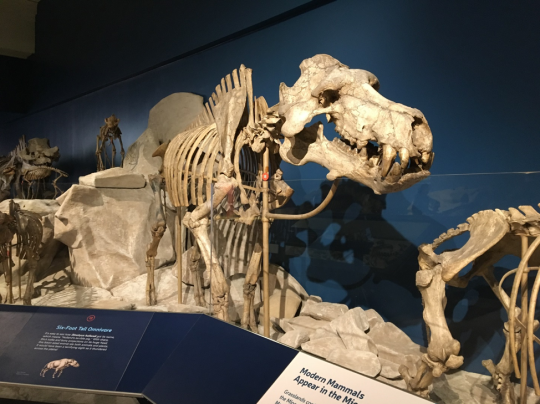
CM 1594, the type specimen of Dinohyus hollandi (now widely regarded as Daeodon shoshonensis) on display in Carnegie Museum of Natural History’s Age of Mammals exhibition.

Joe Sawchak is a collection assistant for the Section of Vertebrate Paleontology at Carnegie Museum of Natural History. Museum employees are encouraged to blog about their unique experiences and knowledge gained from working at the museum.

Related Content

Dinohyus Fossils on TikTok

A Very Hyus Halloween (Video)

Meet The Hyus of “Daeodon at the Door” Meme Fame (Video)

Carnegie Museum of Natural History Blog Citation Information

Blog author: Sawchak, Joe
Publication date: January 7, 2019
Share this post!

  • Share on Twitter Share on Twitter
  • Share on Facebook Share on Facebook
  • Share on Pinterest Share on Pinterest
  • Share on LinkedIn Share on LinkedIn
  • Share on Reddit Share on Reddit
  • Share via Email Share via Email

Filed Under: Blog Tagged With: Age of Mammals, dinohyus, Joe Sawchak, Vertebrate Paleontology

December 27, 2018 by wpengine

Eorubeta: A Mysterious Ancient Frog Revealed

By Amy Henrici

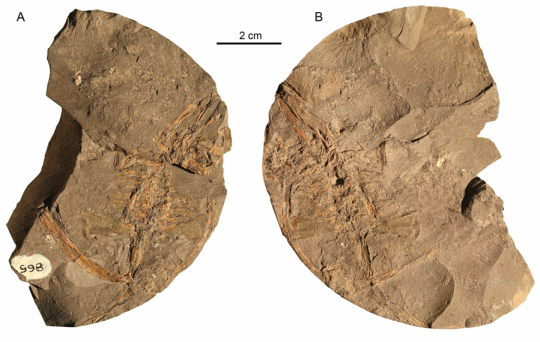
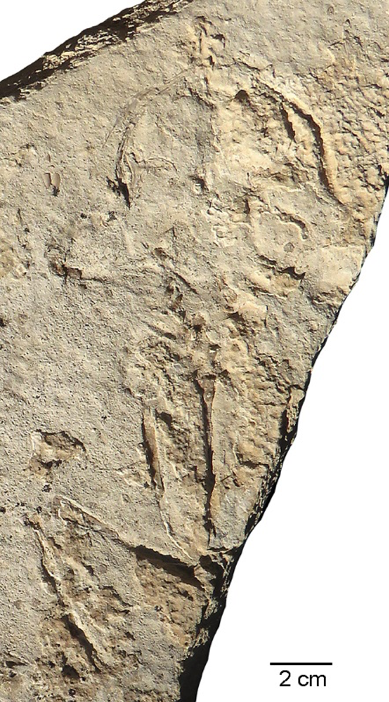
I recently completed a project on fossil frogs from east central Nevada that my collaborators and I identified as the enigmatic Eorubeta nevadensis Hecht, a species that was originally based on a single, poorly preserved specimen that had been discovered in a well core.

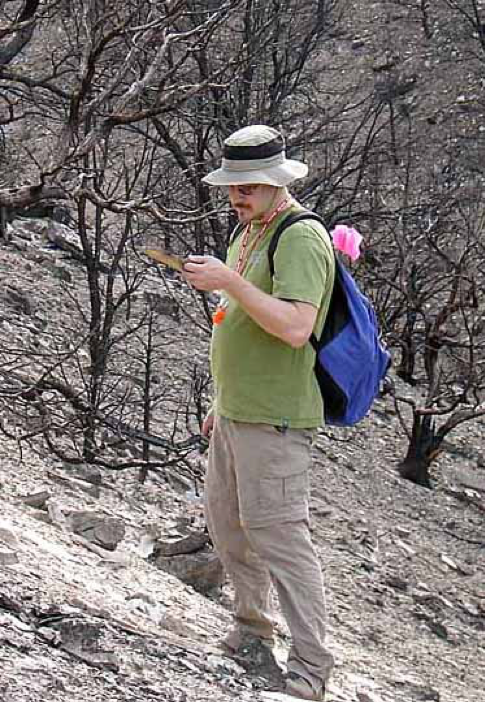
The new collection of Eorubeta came from the Sheep Pass Canyon area about 12.5 miles northeast of the well core site. Peter Druschke discovered fossil frogs here in 2005 while working on his PhD dissertation on a rock unit known as the Sheep Pass Formation. Peter and fellow University of Nevada Las Vegas graduate students Josh Bonde and Aubrey Shirk and colleagues Dick Hilton and Tina Campbell (of Sierra College in Rocklin, California) collected additional fossil frogs in subsequent years. I was very fortunate to be invited to join the team, and we collected over 60 specimens for Carnegie Museum of Natural History in 2012, 2013, and 2016.

ancient frog fossils
Part (A) and counterpart (B) of the first-known specimen of the fossil frog Eorubeta nevadensis. This specimen resides in the Vertebrate Paleontology collection of the American Museum of Natural History in New York.

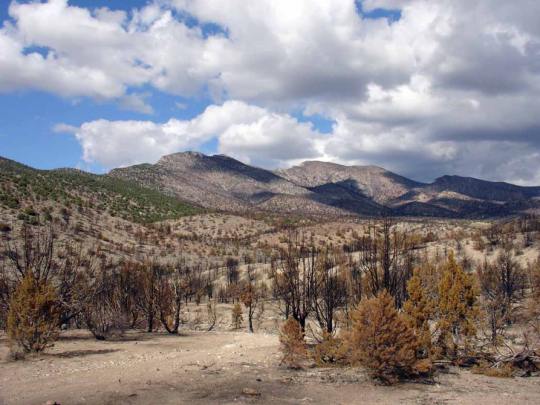
The field site lies in the South Egan Range Wilderness Area of east central Nevada. Being a wilderness area, we could only drive on existing roads, and had to hike nearly a mile to the fossil-producing slopes. The climate in Nevada is challenging to work and camp in, with temperatures reaching over 100 degrees Fahrenheit during the July 2013 field season and nighttime temperatures dipping into the high 20s during the November 2016 season.

White Pine County, Nevada.
Road into the South Egan Range Wilderness area, White Pine County, Nevada. The area burned three months prior to the 2012 field season. The fire cleared vegetation from the fossil-producing slopes, making it easier to find fossils, though burnt tree branches left us streaked with charcoal.

When Eorubeta was originally named, the rock unit from which this frog came (Member B of the Sheep Pass Formation) was thought to date to a time interval known as the Early Eocene (56–47.8 million years ago). More recently, however, Peter has determined that this unit was probably latest Cretaceous–Paleocene (72.1–56 million years ago) in age instead. It is thus possible that Eorubeta spanned the Cretaceous–Paleogene boundary (66 million years ago) and survived the infamous asteroid impact that caused the extinction of non-avian dinosaurs and many other animal and plant species.

ancient frog fossil
ancient frog fossil
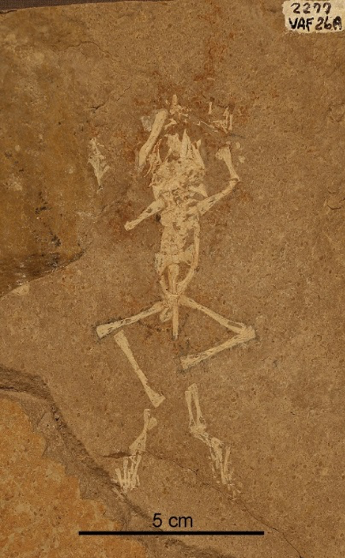
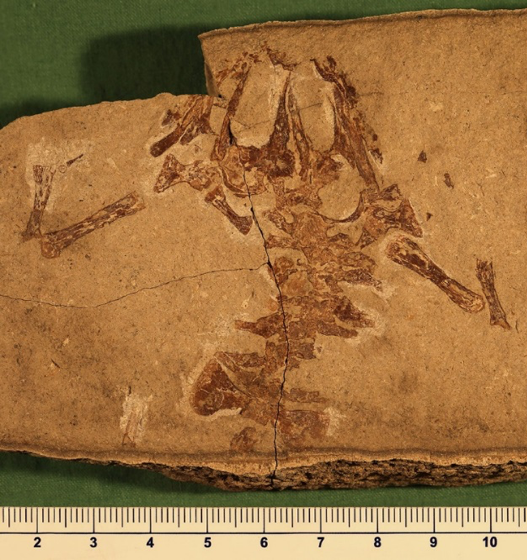
Two of the recently-collected specimens of Eorubeta nevadensis.

Peter determined that the beds in which the fossil frogs were preserved were part of a very high-elevation lake system (1.4–2.2 miles in elevation), similar in this way to today’s Lake Titicaca located in the Andes Mountains on the border of Bolivia and Peru. To date, Eorubeta is the only fossil frog known to have inhabited such a high-elevation environment. Most fossil frogs from this time come from prehistoric river and lake systems situated on coastal plains. The discovery of Eorubeta suggests that ancient frogs probably inhabited a greater variety of environments than the current fossil frog record indicates.

The first specimen discovered by Peter in 2005 indicates that Eorubeta may have reached a considerable size, though the fossil’s extremely weathered condition makes its identification uncertain. An analysis of the relationships of Eorubeta to other frogs reveals that it is more archaic than spadefoot toads, Neobatrachia (a group known as modern frogs), and their relatives.

ancient frog specimen
The largest known specimen of Eorubeta.
Peter Druschke, the team geologist who discovered the specimen.

To learn more about Eorubeta, please follow this link to our paper recently published online in the Journal of Vertebrate Paleontology: https://www.tandfonline.com/doi/full/10.1080/02724634.2018.1510413.

Amy Henrici is the collection manager for the Section of Vertebrate Paleontology at Carnegie Museum of Natural History. Museum employees are encouraged to blog about their unique experiences and knowledge gained from working at the museum.

Filed Under: Blog Tagged With: amphibians and reptiles, Amy Henrici, Ancient Frog, paleontology, Vertebrate Paleontology

October 15, 2018 by wpengine

Meet The Newest Addition To The Fossil Vertebrate Collection

by Amy Henrici

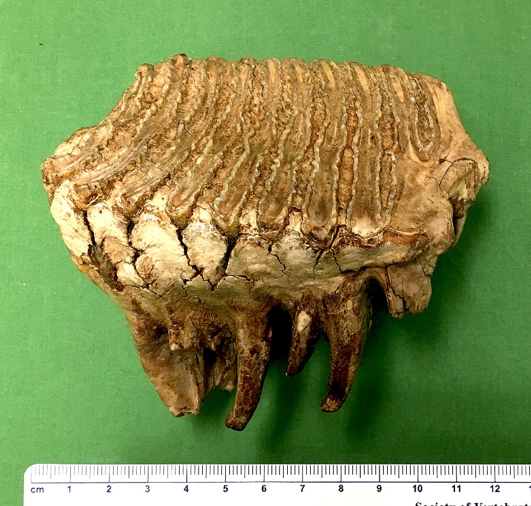
mammoth tooth from the side
The new mammoth tooth as viewed from the side. The crown, or exposed part, of the tooth is at the top, and the root is at the bottom.

The Section of Vertebrate Paleontology at Carnegie Museum of Natural History acquires fossils in a variety of ways, most commonly through field work by Section staff, exchanges with other museums, donations, or (very rarely) purchases. The most recent addition to the collection came by way of a donation.

Gary Kirsch discovered the tooth shown above in a sand-gravel bar of a central Ohio stream in 1988 while collecting sediment samples. He had set his sampling equipment on the sand-gravel bar and was moving between the bar and the stream collecting samples. During one of his many forays, Gary noticed an edge of the tooth sticking out of the bar and pulled it out. It was covered in mud, which he quickly cleaned off in the stream to reveal the beautifully preserved tooth, which he identified as that of a mammoth.

Gary recently emailed photographs of the tooth to Assistant Curator of Vertebrate Paleontology Matt Lamanna because he wanted to donate it to the museum. Acceptance of his generous offer required some research: mammoth and Asian elephant teeth are very similar, and because none of the Section staff are experts in fossils of Pleistocene (Ice Age) mammals, we reached out to Pleistocene expert Blaine Schubert at East Tennessee State University, who often uses our collection, to verify Gary’s identification. Blaine was certain that it was a mammoth tooth because an Asian elephant tooth could only have come from a zoo or circus animal, which was highly unlikely. Blaine was curious about how teeth of the two species are distinguished, so he forwarded the photographs to an elephant expert at his university, Chris Widga.

mammoth tooth from the top
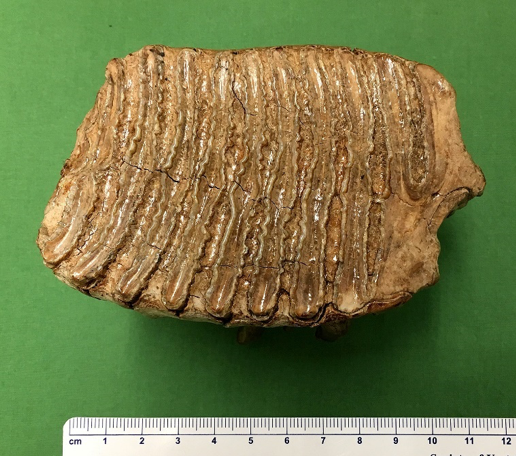
The grinding (i.e., lower, occlusal) surface of the tooth, showing the fairly crenulated tooth enamel.

Chris determined that the tooth is the first (forward-most) molar from the left upper jaw, and because it has fairly crenulated enamel, that it is from a woolly mammoth (Mammuthus primigenius). Through comparison with tooth eruption and wear schedules (sequences) of modern elephants, Chris concluded that the animal was in its late teens to early 20s when it died. In the wild, modern elephants generally live to about their mid-50s, so this single specimen offers a window into mammoth mid-life.

The Section is grateful to Gary for his thoughtful donation. The specimen will be put on temporary display soon in the PaleoLab window on the first floor of the museum for public viewing.

Amy Henrici is the collection manager for the Section of Vertebrate Paleontology at Carnegie Museum of Natural History. Museum employees are encouraged to blog about their unique experiences and knowledge gained from working at the museum.

Filed Under: Blog Tagged With: Amy Henrici, fossils, ice age mammals, paleontology, Vertebrate Paleontology

October 1, 2018 by Kathleen

Scientists Live: Matt Lamanna

Lamanna, MattAssistant Curator and Head of Vertebrate Paleontology Dr. Matt Lamanna will broadcast on Facebook Live to share details of his upcoming research trip to Croatia. Discovered in the 1990s, the site of Kolone/Porto Colonne on the coast of Istria, Croatia preserves ~130-million-year-old dinosaur bones in shallow water on the bed of the Adriatic Sea. During the time these dinosaurs were alive, this area of Croatia was part of a large island or long peninsula in the middle of an ancient ocean. Despite its probable significance, the site has never been systematically explored by paleontologists. Lamanna and a team of Croatian, Italian, and US paleontologists, geologists, and scientific divers will conduct a five-day underwater reconnaissance of Kolone/Porto Colonne from October 8–13, to discover additional fossils, map the site in detail, and form a comprehensive plan for future research.
The broadcast will begin at 10:30 a.m. and will include a question and answer segment.

Tune in at facebook.com/carnegiemnh. A recording will be posted later for those unable to watch live.


Tagged With: dinosaurs, Matt Lamanna, Scientists Live, Vertebrate Paleontology

September 27, 2018 by wpengine

Badwater 20: Not So Bad After All

by Lauren Raysich

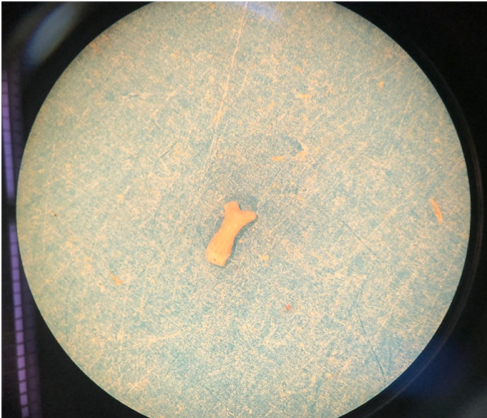
small fossil

Although many people are familiar with fossilized bones of dinosaurs and other large extinct creatures, some fossils can be so small that a microscope is needed to see them. In Carnegie Museum of Natural History’s PaleoLab, volunteers like me use microscope stations to search for tiny fossils in different sediments collected from sites all over the world. Sediment from the Badwater 20 locality in Wyoming interests me more than any other. Sediment from this site dates to a time known as the Eocene Epoch. The middle of three epochs in the Paleogene Period, the Eocene lasted from 56 to 33.9 million years ago. Many fossils found from the Eocene belong to some of the oldest known members of modern mammal groups. Studying these fossils helps scientists trace the evolutionary histories of mammals we know today.

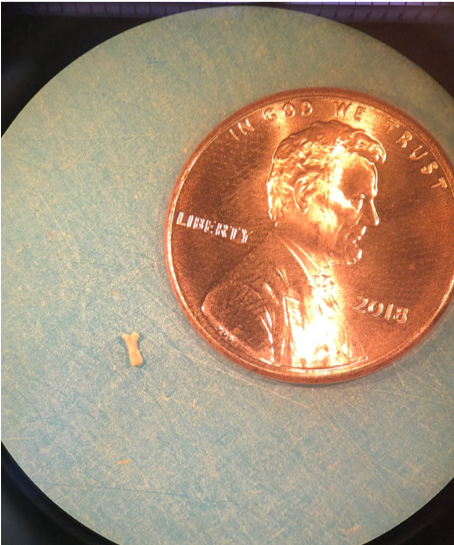
After searching through the Badwater 20 sediment for nearly two weeks, I had found only fragments of bones and teeth. Then, surprisingly, I came across a small, complete bone. It is not common to find complete fossil bones that are this tiny because they can be broken easily, whether by erosion or by being crushed by scavenging animals or water currents. Fossils are not immune to human-induced hazards either. After I found the bone, I was so excited that I accidentally dropped it on the floor of the lab and had to use a magnifying glass to relocate it! (Thankfully, it didn’t break.)

small fossil next to a penny for scale

This bone interested me more than any other because it was the first bone I’d found from the Badwater 20 site that wasn’t fractured in some way. Since the bone is so small, I figured it had to have come from a tiny mammal. Through research and the help of other museum volunteers and staff, I have concluded that this bone is a phalanx (finger or toe bone) of an Eocene rodent. The mouse-like animal to which it belonged most likely lived in a tree, a burrow, or the undergrowth more than 37 million years ago! Although, to some people, this little bone may not be as exciting as those of, say, Tyrannosaurus rex, it thus has an important story to tell in the history of life on our planet.

Lauren Raysich is an undergraduate student at the University of Pittsburgh who volunteers in the Section of Vertebrate Paleontology at Carnegie Museum of Natural History. Museum employees are encouraged to blog about their unique experiences working at the museum.

Filed Under: Blog Tagged With: fossils, Lauren Raysich, mammals, Mason Heberling, Paleolab, paleontology, Vertebrate Paleontology

September 11, 2018 by wpengine

Ask A Scientist – What Kind of Dinosaur is a Megaraptorid?

Are megaraptors really raptors? Assistant Curator and Head of Vertebrate Paleontology Dr. Matt Lamanna discusses what paleontologists know about the dinosaur family Megaraptoridae in our latest Ask a Scientist! See a life-sized replica of a megaraptorid thumb claw from Patagonia up close and find out how a claw like that led researchers to give megaraptorids their name.
 Ask a Scientist is a video series where we ask our research staff questions about the millions of amazing objects and specimens stored in our museum collection. Tune in on YouTube, and submit your own questions via Twitter @CarnegieMNH!

Filed Under: Blog Tagged With: Ask a Scientist, dinosaur, dinosaurs, Matt Lamanna, paleontology, Vertebrate Paleontology

  • « Go to Previous Page
  • Page 1
  • Interim pages omitted …
  • Page 5
  • Page 6
  • Page 7
  • Page 8
  • Page 9
  • Page 10
  • Go to Next Page »

sidebar

About

  • Mission & Commitments
  • Directors Team
  • Museum History

Get Involved

  • Volunteer
  • Membership
  • Carnegie Discoverers
  • Donate
  • Employment
  • Events

Bring a Group

  • Groups of 10 or More
  • Birthday Parties at the Museum
  • Field Trips

Powdermill

  • Powdermill Nature Reserve
  • Powdermill Field Trips
  • Powdermill Staff
  • Research at Powdermill

More Information

  • Image Permission Requests
  • Science Stories
  • Accessibility
  • Shopping Cart
  • Contact
  • Visitor Policies
One of the Four Carnegie Museums | © Carnegie Institute | Privacy Policy | Terms of Use | Accessibility
Rad works here logo